Volume 2 · p. 377
Conclusion of Chapter V on inspection in relatives
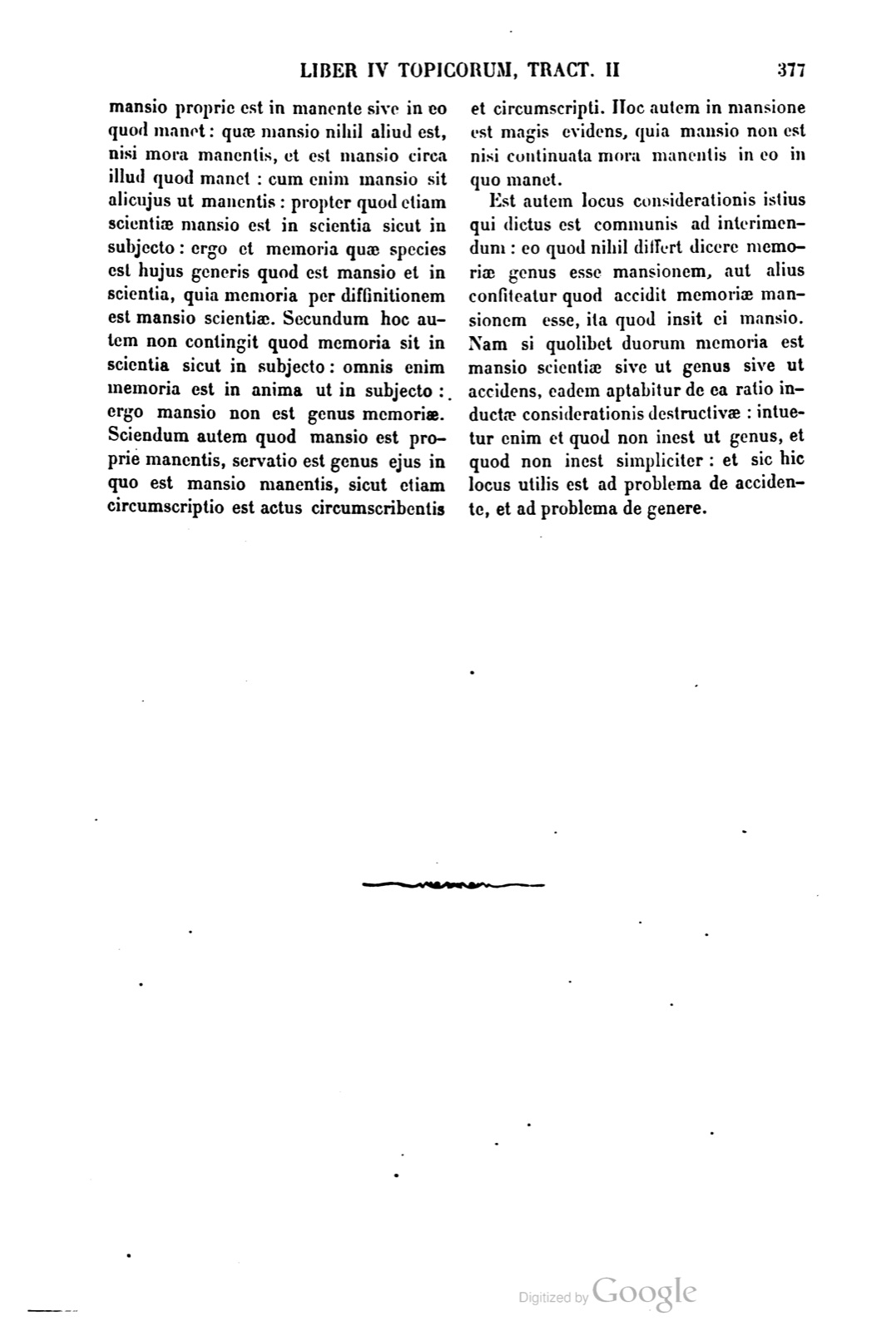
mansio proprie est in manente sive in eo quod manet: quae mansio nihil aliud est, nisi mora manentis, et est mansio circa illud quod manet: cum enim mansio sit alicujus ut manentis: propter quod etiam scientiae mansio est in scientia sicut in subjecto: ergo et memoria quae species est hujus generis quod est mansio et in scientia, quia memoria per diffinitionem est mansio scientiae. Secundum hoc autem non contingit quod memoria sit in scientia sicut in subjecto: omnis enim memoria est in anima ut in subjecto: ergo mansio non est genus memoriae. Sciendum autem quod mansio est proprie manentis, servatio est genus ejus in quo est mansio manentis, sicut etiam circumscriptio est actus circumscribentis et circumscripti. Hoc autem in mansione est magis evidens, quia mansio non est nisi continuata mora manentis in eo in quo manet.
Est autem locus considerationis istius qui dictus est communis ad interimendum: eo quod nihil differt dicere memoriae genus esse mansionem, aut alius confiteatur quod accidit memoriae mansionem esse, ita quod insit ei mansio. Nam si quolibet duorum memoria est mansio scientiae sive ut genus sive ut accidens, eadem aptabitur de ea ratio inductae considerationis destructivae: intuetur enim et quod non inest ut genus, et quod non inest simpliciter: et sic hic locus utilis est ad problema de accidente, et ad problema de genere.
abiding is properly in the one abiding, or in that which abides; and this abiding is nothing other than the delay of the one abiding, and abiding is about that in which it abides. For since abiding belongs to something as abiding, therefore the abiding of science is also in science as in a subject. Therefore memory too, which is a species of this genus which is abiding, would be in science, because memory by definition is the abiding of science. But according to this it does not happen that memory is in science as in a subject; for every memory is in the soul as in a subject. Therefore abiding is not the genus of memory. But one must know that abiding belongs properly to the one abiding; preservation is the genus of that in which there is the abiding of the one abiding, just as circumscription is the act of the one circumscribing and of the thing circumscribed. But this is more evident in abiding, because abiding is nothing except the continued delay of the one abiding in that in which it abides.
But the locus of this consideration which has been stated is common for destroying, because it makes no difference to say that the genus of memory is abiding, or for another to confess that it happens to memory to be abiding, so that abiding inheres in it. For if, by either of the two, memory is the abiding of science, either as genus or as accident, the same account of the destructive consideration introduced will be adapted to it. For it looks both to the fact that it does not inhere as genus and to the fact that it does not inhere simply; and thus this locus is useful both for the problem concerning accident and for the problem concerning genus.
If a page does not appear, its photograph has not been uploaded yet.