Volume 2 · pp. 372–373
Chapters III-IV. On inspection in opposites according to privation and habit; on inspection in affirmation and negation
A marker with ≈ is an approximate page boundary, placed by measure of the text; the page photographs remain the authority. In the paired views, clicking a page marker brings that page into view.
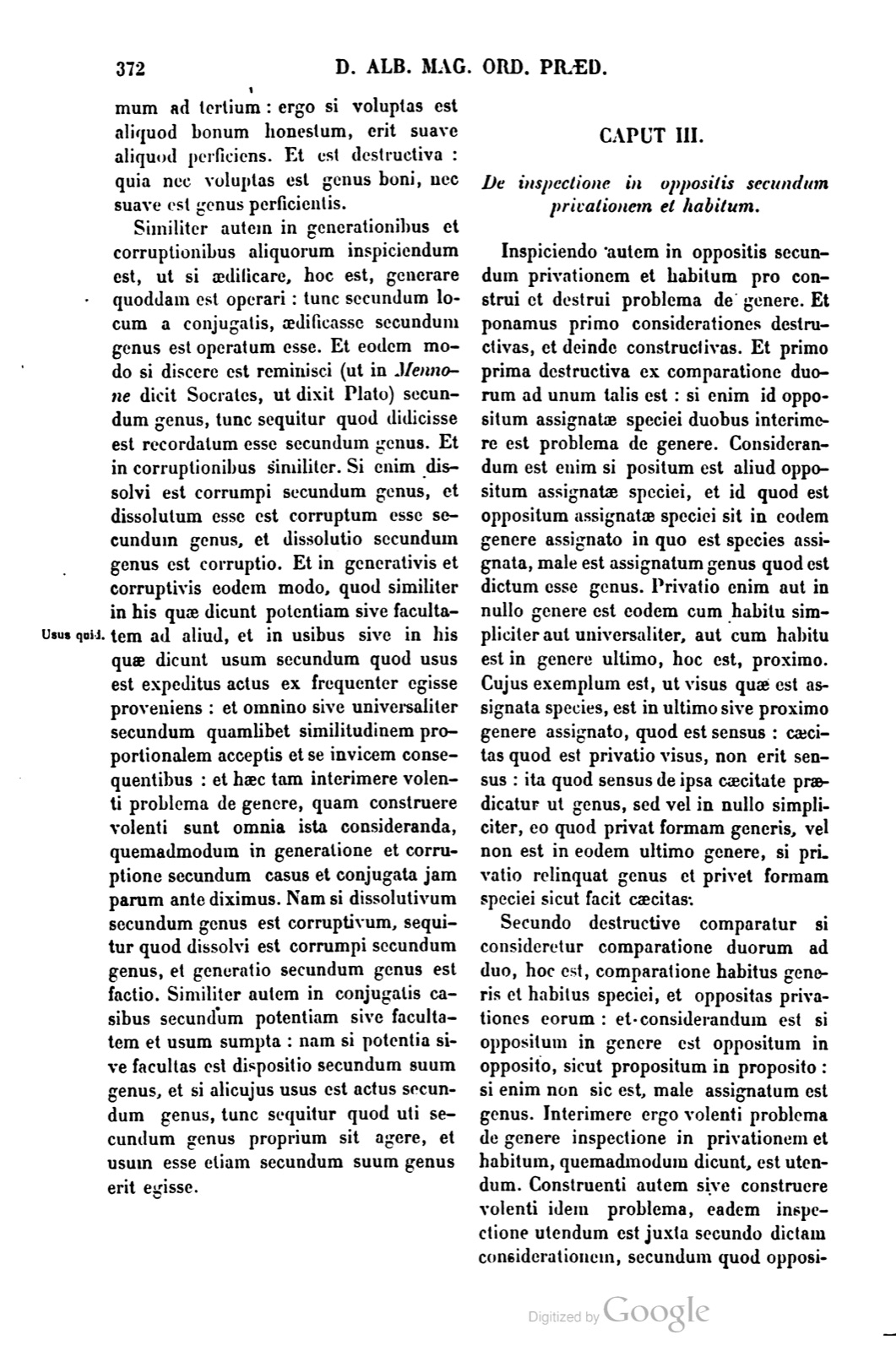
CAPUT III.
De inspectione in oppositis secundum privationem et habitum.
Inspiciendo autem in oppositis secundum privationem et habitum pro construi et destrui problema de genere. Et ponamus primo considerationes destructivas, et deinde constructivas. Et primo prima destructiva ex comparatione duorum ad unum talis est: si enim id oppositum assignatae speciei duobus interimere est problema de genere. Considerandum est enim si positum est aliud oppositum assignatae speciei, et id quod est oppositum assignatae speciei sit in eodem genere assignato in quo est species assignata, male est assignatum genus quod est dictum esse genus. Privatio enim aut in nullo genere est eodem cum habitu simpliciter aut universaliter, aut cum habitu est in genere ultimo, hoc est, proximo. Cujus exemplum est, ut visus quae est assignata species, est in ultimo sive proximo genere assignato, quod est sensus: caecitas quod est privatio visus, non erit sensus: ita quod sensus de ipsa caecitate praedicatur ut genus, sed vel in nullo simpliciter, eo quod privat formam generis, vel non est in eodem ultimo genere, si privatio relinquat genus et privet formam speciei sicut facit caecitas.
Secundo destructive comparatur si consideretur comparatione duorum ad duo, hoc est, comparatione habitus generis et habitus speciei, et oppositas privationes eorum: et considerandum est si oppositum in genere est oppositum in opposito, sicut propositum in proposito: si enim non sic est, male assignatum est genus. Interimere ergo volenti problema de genere inspectione in privationem et habitum, quemadmodum dicunt, est utendum. Construenti autem sive construere volenti idem problema, eadem inspectione utendum est juxta secundo dictam considerationem, secundum quod oppositum ut privatio speciei assignatae est in opposito sicut in genere, propositum in proposito est sicut in genere: tunc genus est bene assignatum.
[Marginal label, printed page 373: Removet dubium.]
Nec obstat quod ante dictum est, quod privatio aut in nullo genere est, aut non est in proximo sive in ultimo: quia ibi dicitur genus generalis forma in natura, quam quoniam est genus, et illam non ponit privatio: hic autem dicitur genus commune a quo non convertitur consequentia sive sit affirmatio et negatio, sive habitus sive privatio: ut si caecitas est insensibilitas quaedam, ita quod sit in ea sicut in genere, sequitur quod visus secundum suum genus est sensus, etc.
CHAPTER III.
On inspection in opposites according to privation and habit.
But by inspecting opposites according to privation and habit for constructing and destroying the problem concerning genus, let us first posit destructive considerations and then constructive ones. And first, the first destructive consideration from comparison of two to one is such: for if the opposite of the assigned species is to destroy the problem concerning genus in two ways. For one must consider whether another opposite of the assigned species has been posited, and whether that which is opposite to the assigned species is in the same assigned genus in which the assigned species is; then the genus that was said to be genus has been badly assigned. For privation either is simply or universally in no same genus with habit, or with habit it is in the ultimate genus, that is, the proximate genus. An example is that sight, which is the assigned species, is in the ultimate or proximate assigned genus, which is sense; blindness, which is the privation of sight, will not be sense in such a way that sense is predicated of blindness itself as genus, but either is in no genus simply, because it deprives the form of the genus, or it is not in the same ultimate genus, if privation leaves the genus and deprives the form of the species, as blindness does.
Secondly, it is compared destructively if it is considered by comparison of two to two, that is, by comparison of the habit of the genus and the habit of the species and their opposite privations; and one must consider whether the opposite in the genus is opposite in the opposite, just as the proposed is in the proposed. For if it is not so, the genus has been badly assigned. Therefore one wishing to destroy the problem concerning genus must use inspection into privation and habit, as they say. But one constructing, or wishing to construct the same problem, must use the same inspection next to the consideration stated second, according as the opposite, as privation of the assigned species, is in the opposite as in genus, and the proposed is in the proposed as in genus; then the genus has been well assigned.
[Marginal label, printed page 373: He removes a doubt.]
Nor is it an obstacle that it was said before that privation either is in no genus, or is not in the proximate or ultimate genus, because there genus there means the general form in nature, insofar as it is genus, and privation does not posit that form. But here genus means a common thing from which consequence is not converted, whether it is affirmation and negation, or habit or privation. Thus if blindness is a certain insensibility, so that it is in it as in a genus, it follows that sight according to its genus is sense, and so forth.
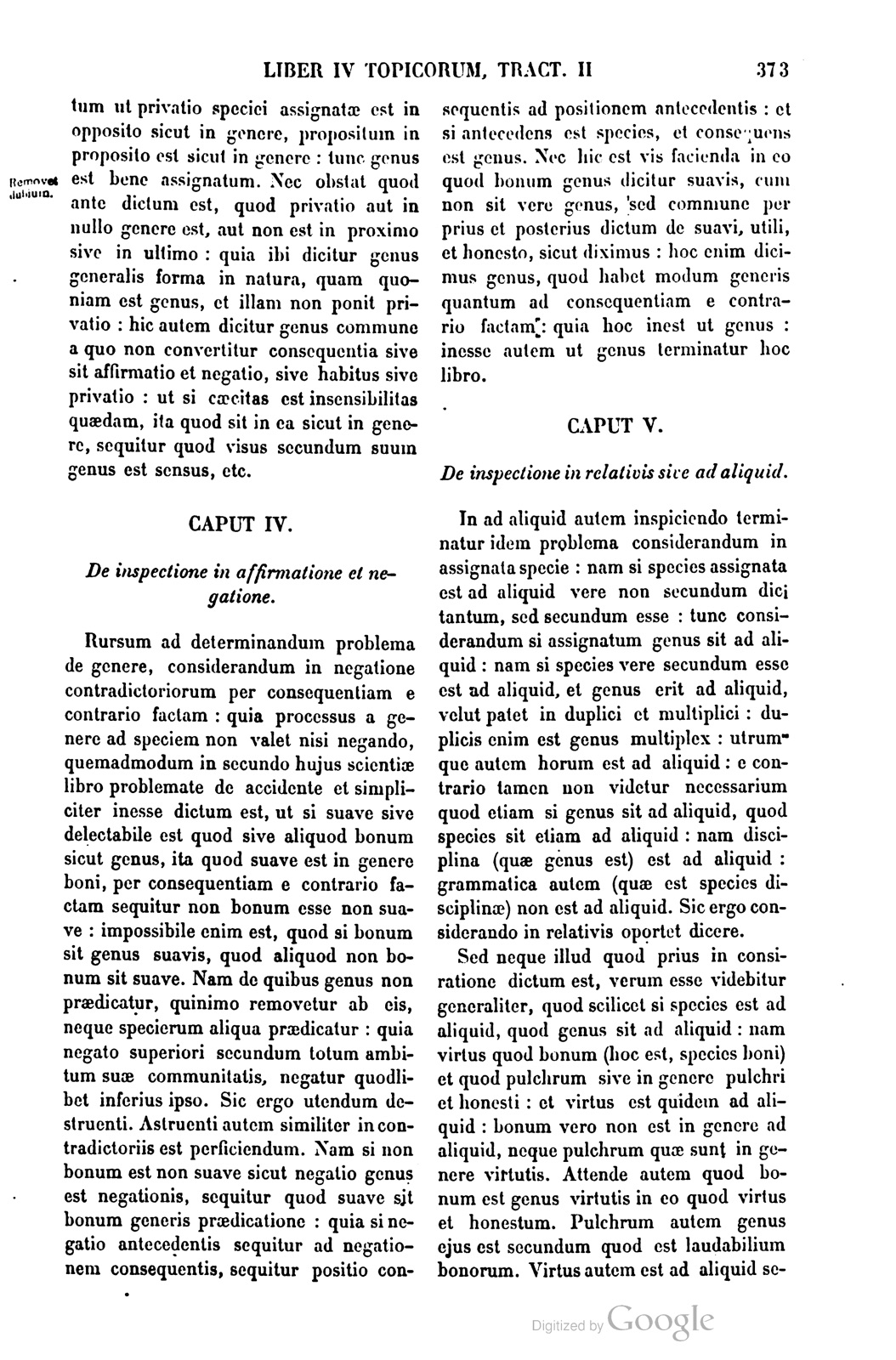
CAPUT IV.
De inspectione in affirmatione et negatione.
Rursum ad determinandum problema de genere, considerandum in negatione contradictoriorum per consequentiam e contrario factam: quia processus a genere ad speciem non valet nisi negando, quemadmodum in secundo hujus scientiae libro problemate de accidente et simpliciter inesse dictum est, ut si suave sive delectabile est quod sive aliquod bonum sicut genus, ita quod suave est in genere boni, per consequentiam e contrario factam sequitur non bonum esse non suave: impossibile enim est, quod si bonum sit genus suavis, quod aliquod non bonum sit suave. Nam de quibus genus non praedicatur, quinimo removetur ab eis, neque specierum aliqua praedicatur: quia negato superiori secundum totum ambitum suae communitatis, negatur quodlibet inferius ipso. Sic ergo utendum destruenti. Astruenti autem similiter in contradictoriis est perficiendum. Nam si non bonum est non suave sicut negatio genus est negationis, sequitur quod suave sit bonum generis praedicatione: quia si negatio antecedentis sequitur ad negationem consequentis, sequitur positio consequentis ad positionem antecedentis: et si antecedens est species, et consequens est genus. Nec hic est vis facienda in eo quod bonum genus dicitur suavis, cum non sit vere genus, sed commune per prius et posterius dictum de suavi, utili, et honesto, sicut diximus: hoc enim dicimus genus, quod habet modum generis quantum ad consequentiam e contrario factam: quia hoc inest ut genus: inesse autem ut genus terminatur hoc libro.
CHAPTER IV.
On inspection in affirmation and negation.
Again, for determining the problem concerning genus, one must consider in the negation of contradictories through consequence made from the contrary, because the process from genus to species has force only by denying, as was said in the second book of this science in the problem concerning accident and inhering simply. For example, if sweet or delightful is what is, or is some, good as genus, so that sweet is in the genus of good, through consequence made from the contrary it follows that the not-good is not-sweet. For it is impossible, if good is the genus of sweet, that something not good be sweet. For of the things of which genus is not predicated, indeed is removed from them, no species is predicated either, because when the superior is denied according to the whole range of its commonness, every inferior under it is denied. Therefore one destroying must use it in this way. But for one constructing, it must similarly be completed in contradictories. For if the not-good is the not-sweet, as negation is the genus of negation, it follows that sweet is good by the predication of genus, because if the negation of the antecedent follows upon the negation of the consequent, the position of the consequent follows upon the position of the antecedent; and this holds if the antecedent is species and the consequent is genus. Nor must force be made here in the fact that good is called the genus of sweet, since it is not truly genus, but a common thing said by prior and posterior of sweet, useful, and honorable, as we have said. For we call this genus, namely what has the mode of genus with respect to the consequence made from the contrary, because this inheres as genus; but inhering as genus is terminated in this book.
If a page does not appear, its photograph has not been uploaded yet.