Volume 2 · pp. 365–367
Continuation of Chapter IV and Chapter V. On considerations accepted from things consequent upon genus, etc.
A marker with ≈ is an approximate page boundary, placed by measure of the text; the page photographs remain the authority. In the paired views, clicking a page marker brings that page into view.
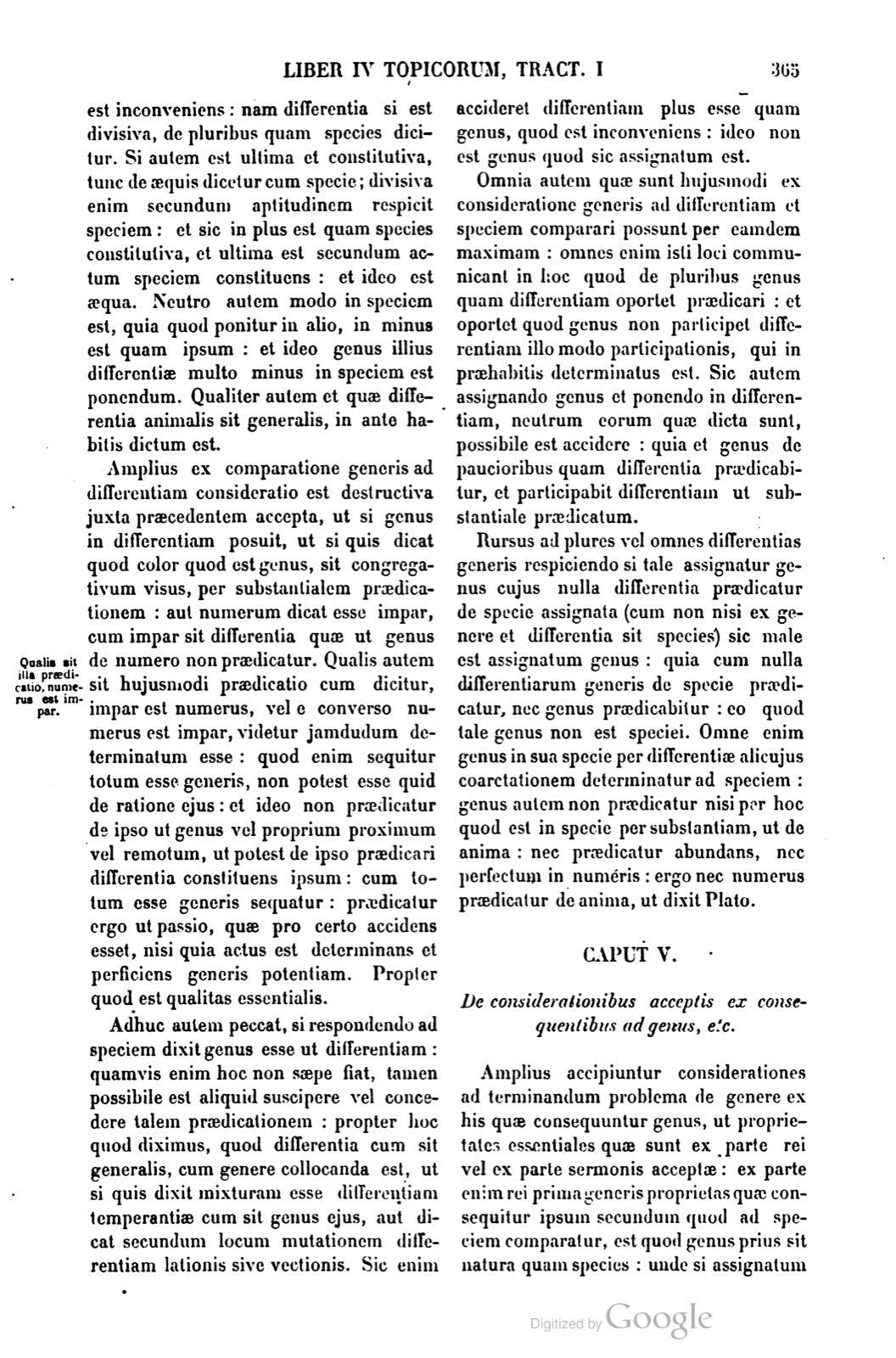
est inconveniens: nam differentia si est divisiva, de pluribus quam species dicitur. Si autem est ultima et constitutiva, tunc de aequis dicetur cum specie; divisiva enim secundum aptitudinem respicit speciem: et sic in plus est quam species constitutiva, et ultima est secundum actum speciem constituens: et ideo est aequa. Neutro autem modo in speciem est, quia quod ponitur in alio, in minus est quam ipsum: et ideo genus illius differentiae multo minus in speciem est ponendum. Qualiter autem et quae differentia animalis sit generalis, in ante habitis dictum est.
Amplius ex comparatione generis ad differentiam consideratio est destructiva juxta praecedentem accepta, ut si genus in differentiam posuit, ut si quis dicat quod color quod est genus, sit congregativum visus, per substantialem praedicationem: aut numerum dicat esse impar, cum impar sit differentia quae ut genus de numero non praedicatur.
[Marginal label, printed page 365: Qualis sit illa praedicatio, numerus est impar.]
Qualis autem sit hujusmodi praedicatio cum dicitur, impar est numerus, vel e converso numerus est impar, videtur jamdudum determinatum esse: quod enim sequitur totum esse generis, non potest esse quid de ratione ejus: et ideo non praedicatur de ipso ut genus vel proprium proximum vel remotum, ut potest de ipso praedicari differentia constituens ipsum: cum totum esse generis sequatur: praedicatur ergo ut passio, quae pro certo accidens esset, nisi quia actus est determinans et perficiens generis potentiam. Propter quod est qualitas essentialis.
Adhuc autem peccat, si respondendo ad speciem dixit genus esse ut differentiam: quamvis enim hoc non saepe fiat, tamen possibile est aliquid suscipere vel concedere talem praedicationem: propter hoc quod diximus, quod differentia cum sit generalis, cum genere collocanda est, ut si quis dixit mixturam esse differentiam temperantiae cum sit genus ejus, aut dicat secundum locum mutationem differentiam lationis sive vectionis. Sic enim accideret differentiam plus esse quam genus, quod est inconveniens: ideo non est genus quod sic assignatum est.
Omnia autem quae sunt hujusmodi ex consideratione generis ad differentiam et speciem comparari possunt per eamdem maximam: omnes enim isti loci communicant in hoc quod de pluribus genus quam differentiam oportet praedicari: et oportet quod genus non participet differentiam illo modo participationis, qui in praehabitis determinatus est. Sic autem assignando genus et ponendo in differentiam, neutrum eorum quae dicta sunt, possibile est accidere: quia et genus de paucioribus quam differentia praedicabitur, et participabit differentiam ut substantiale praedicatum.
Rursus ad plures vel omnes differentias generis respiciendo si tale assignatur genus cujus nulla differentia praedicatur de specie assignata, cum non nisi ex genere et differentia sit species, sic male est assignatum genus: quia cum nulla differentiarum generis de specie praedicatur, nec genus praedicabitur: eo quod tale genus non est speciei. Omne enim genus in sua specie per differentiae alicujus coarctationem determinatur ad speciem: genus autem non praedicatur nisi per hoc quod est in specie per substantiam, ut de anima: nec praedicatur abundans, nec perfectum in numeris: ergo nec numerus praedicatur de anima, ut dixit Plato.
CAPUT V.
De considerationibus acceptis ex consequentibus ad genus, etc.
Amplius accipiuntur considerationes ad terminandum problema de genere ex his quae consequuntur genus, ut proprietates essentiales quae sunt ex parte rei vel ex parte sermonis acceptae: ex parte enim rei prima generis proprietas quae consequitur ipsum secundum quod ad speciem comparatur, est quod genus prius sit natura quam species: unde si assignatum pro specie sit prius natura quam assignatum pro genere, et si species assignata interempta simul interimit genus: tunc patet quod species est prior natura quam genus: cum videatur e contrario debere fieri, quod scilicet genus interemptum simul interimat speciem, et non e contrario. Et constat quod non est genus quod est assignatum pro genere.
is unfitting; for if difference is divisive, it is said of more things than species. But if it is ultimate and constitutive, then it will be said of things equal with the species; for the divisive difference regards species according to aptitude, and thus it is more extensive than constitutive species, while the ultimate difference is constituting species according to act, and therefore is equal. But in neither way is it in species, because what is posited in another is less than that other; and therefore the genus of that difference is much less to be posited in species. But how and what difference of animal is general has been said in the preceding matters.
Moreover, from the comparison of genus to difference there is a destructive consideration accepted next to the preceding one, as when one has placed genus in difference; for instance, if someone says that color, which is a genus, is congregative of sight by substantial predication, or says that number is odd, although odd is a difference which is not predicated as genus of number.
[Marginal label, printed page 365: What sort that predication is: number is odd.]
But what sort of predication this is when it is said, "odd is number," or conversely, "number is odd," seems already to have been determined before. For what follows the whole being of a genus cannot be something of its account; and therefore it is not predicated of it as genus or as proximate or remote property, as the difference constituting it can be predicated of it, since the whole being of the genus follows. Therefore it is predicated as a passion, which would certainly be an accident, except that it is the act determining and perfecting the potency of the genus. Therefore it is an essential quality.
Furthermore he sins if, in responding to the species, he has said that genus is as difference. For although this does not often happen, nevertheless it is possible for someone to receive or concede such a predication, because of what we said, that since difference is general, it must be placed together with the genus; as if someone said that mixture is the difference of temperance, although it is its genus, or said that change according to place is the difference of locomotion or conveyance. For thus it would happen that difference is more extensive than genus, which is unfitting; therefore what is assigned in that way is not genus.
But all things of this kind, from the consideration of genus compared to difference and species, can be compared through the same maxim: for all these loci share in this, that genus must be predicated of more things than difference, and that genus must not participate difference in that mode of participation which has been determined in the preceding matters. But by assigning genus in this way and placing it in difference, neither of the things that have been said can happen, because both genus will be predicated of fewer things than difference and it will participate difference as a substantial predicate.
Again, by looking to several or all differences of the genus, if such a genus is assigned of which no difference is predicated of the assigned species, since species is only from genus and difference, the genus has thus been badly assigned; because, when none of the differences of the genus is predicated of the species, neither will the genus be predicated, since such a genus does not belong to the species. For every genus in its species is determined to species through the narrowing of some difference; but genus is predicated only through the fact that it is in species through substance, as concerning soul. But neither abundant nor perfect is predicated in numbers; therefore neither is number predicated of soul, as Plato said.
CHAPTER V.
On considerations accepted from things consequent upon genus, etc.
Moreover, considerations for terminating the problem concerning genus are accepted from those things which follow genus, as essential properties accepted either on the part of the thing or on the part of speech. For on the part of the thing the first property of genus, which follows it insofar as it is compared to species, is that genus is prior in nature to species. Hence if what is assigned as species is prior in nature to what is assigned as genus, and if the assigned species, when destroyed, simultaneously destroys the genus, then it is clear that species is prior in nature to genus, although the contrary seems ought to occur, namely that the destroyed genus simultaneously destroys the species, and not conversely. And it is certain that what has been assigned as genus is not genus.
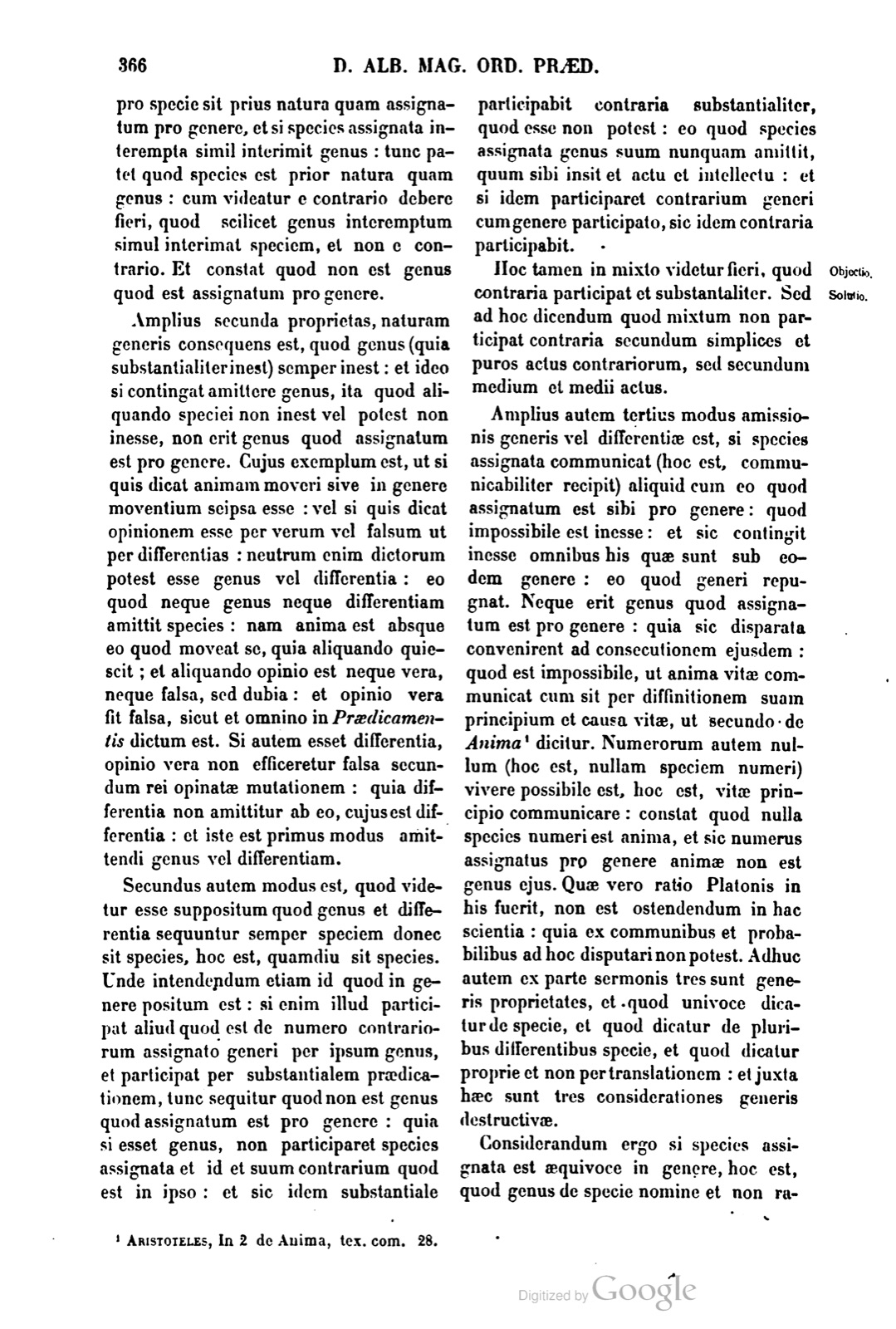
Amplius secunda proprietas, naturam generis consequens est, quod genus quia substantialiter inest semper inest: et ideo si contingat amittere genus, ita quod aliquando speciei non inest vel potest non inesse, non erit genus quod assignatum est pro genere. Cujus exemplum est, ut si quis dicat animam moveri sive in genere moventium seipsa esse: vel si quis dicat opinionem esse per verum vel falsum ut per differentias: neutrum enim dictorum potest esse genus vel differentia: eo quod neque genus neque differentiam amittit species: nam anima est absque eo quod moveat se, quia aliquando quiescit; et aliquando opinio est neque vera, neque falsa, sed dubia: et opinio vera fit falsa, sicut et omnino in Praedicamentis dictum est. Si autem esset differentia, opinio vera non efficeretur falsa secundum rei opinatae mutationem: quia differentia non amittitur ab eo, cujus est differentia: et iste est primus modus amittendi genus vel differentiam.
Secundus autem modus est, quod videtur esse suppositum quod genus et differentia sequuntur semper speciem donec sit species, hoc est, quamdiu sit species. Unde intendendum etiam id quod in genere positum est: si enim illud participat aliud quod est de numero contrariorum assignato generi per ipsum genus, et participat per substantialem praedicationem, tunc sequitur quod non est genus quod assignatum est pro genere: quia si esset genus, non participaret species assignata et id et suum contrarium quod est in ipso: et sic idem substantiale participabit contraria substantialiter, quod esse non potest: eo quod species assignata genus suum nunquam amittit, quum sibi insit et actu et intellectu: et si idem participaret contrarium generi cum genere participato, sic idem contraria participabit.
[Marginal label, printed page 366: Objectio.]
Hoc tamen in mixto videtur fieri, quod contraria participat et substantialiter.
[Marginal label, printed page 366: Solutio.]
Sed ad hoc dicendum quod mixtum non participat contraria secundum simplices et puros actus contrariorum, sed secundum medium et medii actus.
Amplius autem tertius modus amissionis generis vel differentiae est, si species assignata communicat, hoc est, communicabiliter recipit, aliquid cum eo quod assignatum est sibi pro genere: quod impossibile est inesse: et sic contingit inesse omnibus his quae sunt sub eodem genere: eo quod generi repugnat. Neque erit genus quod assignatum est pro genere: quia sic disparata convenirent ad consecutionem ejusdem: quod est impossibile, ut anima vitae communicat cum sit per diffinitionem suam principium et causa vitae, ut secundo de Anima 1 dicitur. Numerorum autem nullum, hoc est, nullam speciem numeri, vivere possibile est, hoc est, vitae principio communicare: constat quod nulla species numeri est anima, et sic numerus assignatus pro genere animae non est genus ejus. Quae vero ratio Platonis in his fuerit, non est ostendendum in hac scientia: quia ex communibus et probabilibus ad hoc disputari non potest. Adhuc autem ex parte sermonis tres sunt generis proprietates, et quod univoce dicatur de specie, et quod dicatur de pluribus differentibus specie, et quod dicatur proprie et non per translationem: et juxta haec sunt tres considerationes generis destructivae.
Moreover, a second property consequent upon the nature of genus is that genus, because it inheres substantially, always inheres. And therefore if it can happen that the genus is lost, so that at some time it does not inhere in the species or can fail to inhere, it will not be the genus that has been assigned as genus. An example of this is if someone says that soul is moved, or is in the genus of things moving themselves, or if someone says that opinion is through true or false as through differences. For neither of the things said can be a genus or a difference, because species loses neither genus nor difference. For soul exists without moving itself, because it sometimes rests; and sometimes opinion is neither true nor false, but doubtful; and a true opinion becomes false, as also has been said generally in the Categories. But if it were a difference, true opinion would not become false according to the change of the thing opined, because difference is not lost by that of which it is the difference. And this is the first mode of losing genus or difference.
But the second mode is that it seems to be presupposed that genus and difference always follow species as long as it is species, that is, for as long as it is species. Hence one must also attend to that which has been placed in the genus: for if it participates something else which is from the number of things contrary to the assigned genus through that very genus, and participates it through substantial predication, then it follows that it is not the genus assigned as genus. For if it were genus, the assigned species would not participate both that and its contrary which is in it; and thus the same substantial thing would participate contraries substantially, which cannot be, because the assigned species never loses its genus, since it inheres in it both in act and in understanding. And if the same thing participated the contrary to the genus together with the participated genus, thus the same thing would participate contraries.
[Marginal label, printed page 366: Objection.]
Nevertheless, this seems to happen in a mixed thing, which participates contraries and does so substantially.
[Marginal label, printed page 366: Solution.]
But to this one must say that the mixed thing does not participate contraries according to the simple and pure acts of the contraries, but according to the middle and the acts of the middle.
Moreover, the third mode of loss of genus or difference is if the assigned species communicates, that is, communicably receives, something with that which has been assigned to it as genus, which it is impossible to inhere; and thus it can happen to inhere in all those things which are under the same genus, because it is repugnant to the genus. Nor will what has been assigned as genus be genus, because in this way disparate things would agree in the attainment of the same thing, which is impossible. For example, soul communicates life, since through its definition it is the principle and cause of life, as is said in the second book On the Soul 1. But no number, that is, no species of number, can live, that is, communicate in the principle of life. It is certain that no species of number is soul; and thus number assigned as the genus of soul is not its genus. But what Plato's reason was in these matters is not to be shown in this science, because one cannot dispute to this from common and probable things. Furthermore, on the part of speech there are three properties of genus: that it is said univocally of the species, that it is said of several things differing in species, and that it is said properly and not by metaphor. And next to these there are three destructive considerations of genus.
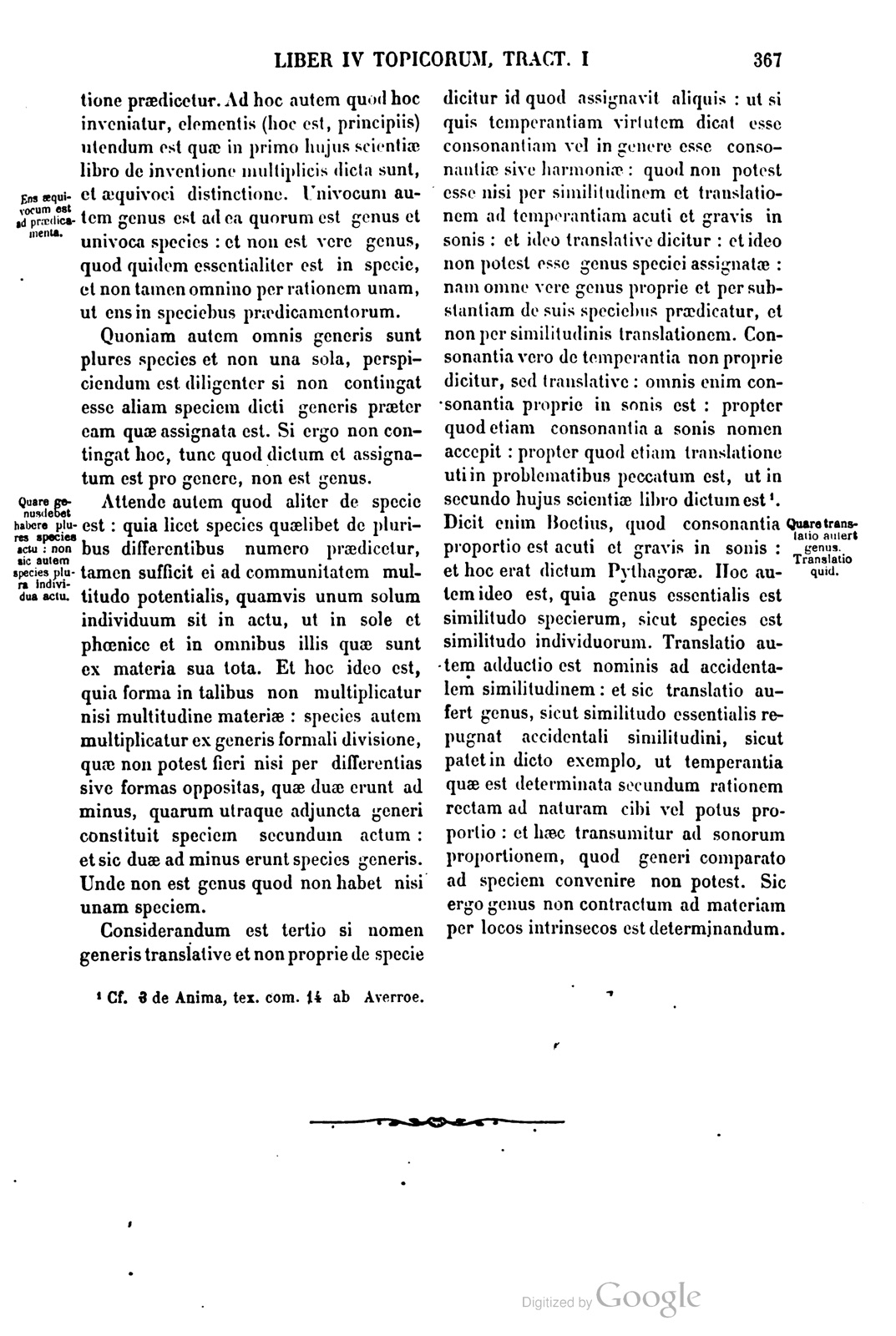
Considerandum ergo si species assignata est aequivoce in genere, hoc est, quod genus de specie nomine et non ratione praedicetur. Ad hoc autem quod hoc inveniatur, elementis, hoc est, principiis, utendum est quae in primo hujus scientiae libro de inventione multiplicis dicta sunt, et aequivoci distinctione.
[Marginal label, printed page 367: Ens aequivocum est ad praedicamenta.]
Univocum autem genus est ad ea quorum est genus et univoca species: et non est vere genus, quod quidem essentialiter est in specie, et non tamen omnino per rationem unam, ut ens in speciebus praedicamentorum.
Quoniam autem omnis generis sunt plures species et non una sola, perspiciendum est diligenter si non contingat esse aliam speciem dicti generis praeter eam quae assignata est. Si ergo non contingat hoc, tunc quod dictum et assignatum est pro genere, non est genus.
[Marginal label, printed page 367: Quare genus debet habere plures species actu, non sic autem species plura individua actu.]
Attende autem quod aliter de specie est: quia licet species quaelibet de pluribus differentibus numero praedicetur, tamen sufficit ei ad communitatem multitudo potentialis, quamvis unum solum individuum sit in actu, ut in sole et phaenice et in omnibus illis quae sunt ex materia sua tota. Et hoc ideo est, quia forma in talibus non multiplicatur nisi multitudine materiae: species autem multiplicatur ex generis formali divisione, quae non potest fieri nisi per differentias sive formas oppositas, quae duae erunt ad minus, quarum utraque adjuncta generi constituit speciem secundum actum: et sic duae ad minus erunt species generis. Unde non est genus quod non habet nisi unam speciem.
Considerandum est tertio si nomen generis translative et non proprie de specie dicitur id quod assignavit aliquis: ut si quis temperantiam virtutem dicat esse consonantiam vel in genere esse consonantiae sive harmoniae: quod non potest esse nisi per similitudinem et translationem ad temperantiam acuti et gravis in sonis: et ideo translative dicitur: et ideo non potest esse genus speciei assignatae: nam omne vere genus proprie et per substantiam de suis speciebus praedicatur, et non per similitudinis translationem. Consonantia vero de temperantia non proprie dicitur, sed translative: omnis enim consonantia proprie in sonis est: propter quod etiam consonantia a sonis nomen accepit: propter quod etiam translatione uti in problematibus peccatum est, ut in secundo hujus scientiae libro dictum est 2.
[Marginal label, printed page 367: Quare translatio aufert genus.]
[Marginal label, printed page 367: Translatio quid.]
Dicit enim Boetius, quod consonantia proportio est acuti et gravis in sonis: et hoc erat dictum Pythagorae. Hoc autem ideo est, quia genus essentialis est similitudo specierum, sicut species est similitudo individuorum. Translatio autem adductio est nominis ad accidentalem similitudinem: et sic translatio aufert genus, sicut similitudo essentialis repugnat accidentali similitudini, sicut patet in dicto exemplo, ut temperantia quae est determinata secundum rationem rectam ad naturam cibi vel potus proportio: et haec transumitur ad sonorum proportionem, quod generi comparato ad speciem convenire non potest. Sic ergo genus non contractum ad materiam per locos intrinsecos est determinandum.
Therefore one must consider whether the assigned species is equivocally in the genus, that is, whether the genus is predicated of the species in name and not in account. But in order that this may be found, one must use the elements, that is, the principles, which were discussed in the first book of this science concerning the discovery of multiplicity and concerning the distinction of the equivocal.
[Marginal label, printed page 367: Being is equivocal with respect to the predicaments.]
But genus is univocal with respect to those things of which it is the genus, and species is univocal; and that is not truly genus which is indeed essentially in the species and yet not altogether through one account, as being is in the species of the predicaments.
But because every genus has several species and not only one, one must diligently inspect whether there can be another species of the genus named besides the one that has been assigned. If this cannot happen, then what has been said and assigned as genus is not genus.
[Marginal label, printed page 367: Why genus must have several species in act, but species need not in this way have several individuals in act.]
But attend that it is otherwise with species: because although any species is predicated of several things differing in number, nevertheless a potential multitude suffices it for commonness, even if only one individual is in act, as in the sun and the phoenix and in all those things which are from their whole matter. And this is because form in such things is not multiplied except by multitude of matter. But species is multiplied from the formal division of genus, which cannot occur except through differences or opposed forms, of which there will be at least two, each of which, joined to the genus, constitutes a species according to act; and thus there will be at least two species of the genus. Hence that which has only one species is not genus.
Thirdly, one must consider whether someone says of the species the name of the genus metaphorically and not properly, namely what he has assigned; as if someone says that temperance as a virtue is consonance, or is in the genus of consonance or harmony. This cannot be except through likeness and metaphor to the tempering of acute and grave in sounds; and therefore it is said metaphorically, and therefore it cannot be the genus of the assigned species. For every true genus is predicated properly and through substance of its species, and not through a metaphor of likeness. But consonance is not said properly of temperance, but metaphorically; for every consonance is properly in sounds. For this reason also consonance has received its name from sounds; for this reason also to use metaphor in problems is a sin, as was said in the second book of this science 2.
[Marginal label, printed page 367: Why metaphor removes genus.]
[Marginal label, printed page 367: What metaphor is.]
For Boethius says that consonance is a proportion of acute and grave in sounds; and this was the saying of Pythagoras. But this is because genus is the essential likeness of species, just as species is the likeness of individuals. But metaphor is the bringing over of a name to an accidental likeness; and thus metaphor removes genus, just as essential likeness is repugnant to accidental likeness, as is clear in the example given: temperance, which is a proportion determined according to right reason toward the nature of food or drink, is transferred to the proportion of sounds, which cannot belong to genus compared to species. Therefore genus not contracted to matter must be determined through intrinsic loci.
If a page does not appear, its photograph has not been uploaded yet.