Volume 2 · pp. 363–364
Chapter IV. On considerations taken from the comparison of genus to difference and species, etc.
A marker with ≈ is an approximate page boundary, placed by measure of the text; the page photographs remain the authority. In the paired views, clicking a page marker brings that page into view.
CAPUT IV.
De considerationibus sumptis ex comparatione generis ad differentiam et speciem, etc.
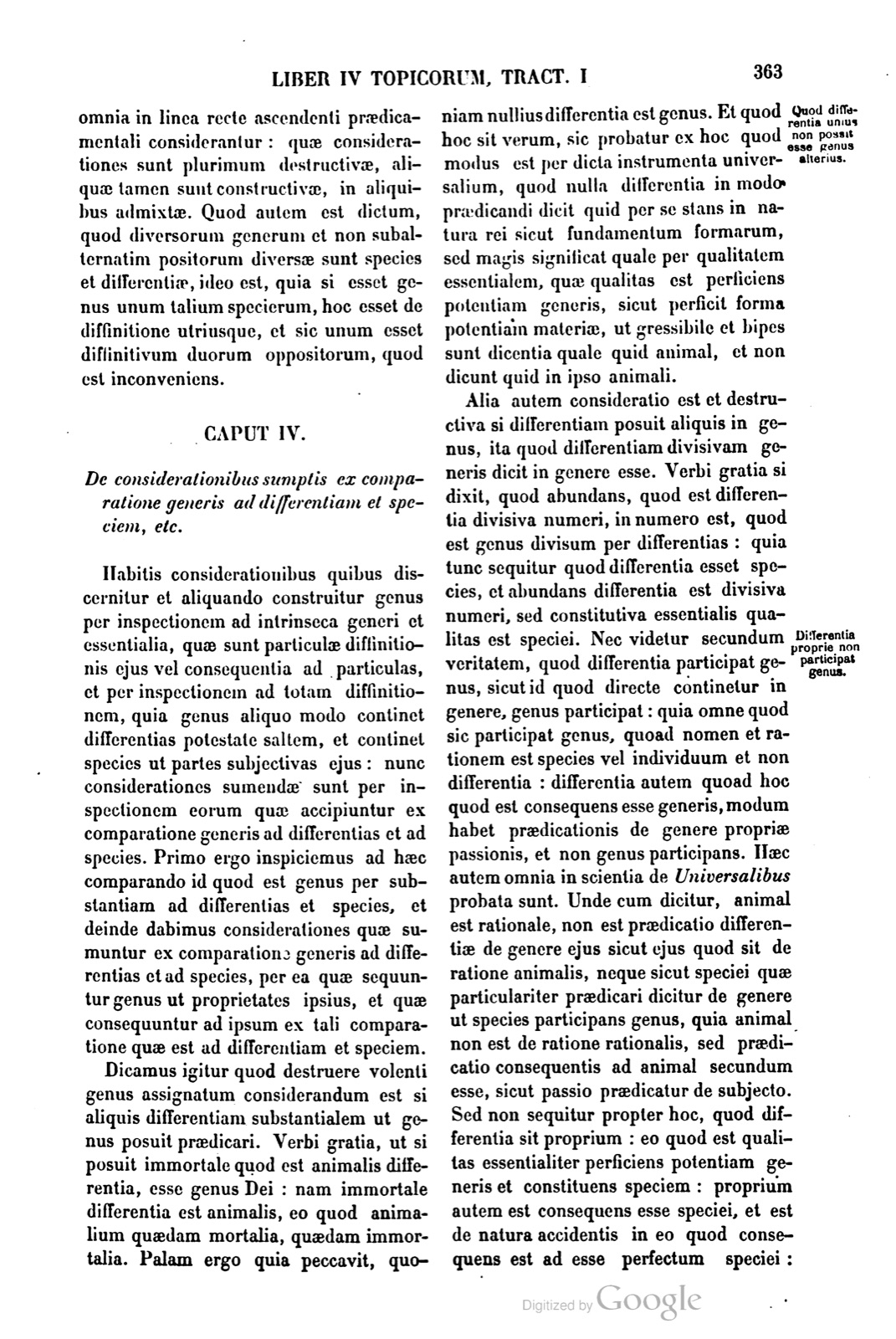
Habitis considerationibus quibus discernitur et aliquando construitur genus per inspectionem ad intrinseca generi et essentialia, quae sunt particulae diffinitionis ejus vel consequentia ad particulas, et per inspectionem ad totam diffinitionem, quia genus aliquo modo continet differentias potestate saltem, et continet species ut partes subjectivas ejus: nunc considerationes sumendae sunt per inspectionem eorum quae accipiuntur ex comparatione generis ad differentias et ad species. Primo ergo inspiciemus ad haec comparando id quod est genus per substantiam ad differentias et species, et deinde dabimus considerationes quae sumuntur ex comparatione generis ad differentias et ad species, per ea quae sequuntur genus ut proprietates ipsius, et quae consequuntur ad ipsum ex tali comparatione quae est ad differentiam et speciem.
Dicamus igitur quod destruere volenti genus assignatum considerandum est si aliquis differentiam substantialem ut genus posuit praedicari. Verbi gratia, ut si posuit immortale quod est animalis differentia, esse genus Dei: nam immortale differentia est animalis, eo quod animalium quaedam mortalia, quaedam immortalia. Palam ergo quia peccavit, quoniam nullius differentia est genus.
Et quod hoc sit verum, sic probatur ex hoc quod modus est per dicta instrumenta universalium, quod nulla differentia in modo praedicandi dicit quid per se stans in natura rei sicut fundamentum formarum, sed magis significat quale per qualitatem essentialem, quae qualitas est perficiens potentiam generis, sicut perficit forma potentiam materiae, ut gressibile et bipes sunt dicentia quale quid animal, et non dicunt quid in ipso animali.
Alia autem consideratio est et destructiva si differentiam posuit aliquis in genus, ita quod differentiam divisivam generis dicit in genere esse. Verbi gratia si dixit, quod abundans, quod est differentia divisiva numeri, in numero est, quod est genus divisum per differentias: quia tunc sequitur quod differentia esset species, et abundans differentia est divisiva numeri, sed constitutiva essentialis qualitas est speciei.
Nec videtur secundum veritatem, quod differentia participat genus, sicut id quod directe continetur in genere, genus participat: quia omne quod sic participat genus, quoad nomen et rationem est species vel individuum et non differentia: differentia autem quoad hoc quod est consequens esse generis, modum habet praedicationis de genere propriae passionis, et non genus participans. Haec autem omnia in scientia de Universalibus probata sunt. Unde cum dicitur, animal est rationale, non est praedicatio differentiae de genere ejus sicut ejus quod sit de ratione animalis, neque sicut speciei quae particulariter praedicari dicitur de genere ut species participans genus, quia animal non est de ratione rationalis, sed praedicatio consequentis ad animal secundum esse, sicut passio praedicatur de subjecto. Sed non sequitur propter hoc, quod differentia sit proprium: eo quod est qualitas essentialiter perficiens potentiam generis et constituens speciem: proprium autem est consequens esse speciei, et est de natura accidentis in eo quod consequens est ad esse perfectum speciei: unde cum omnino quod participat genus, species sit vel individuum, ideo palam est quod differentia non participat genus. Propter quod nec abundans est species numeri, sed differentia: quoniam non participat genus quod est numerus.
CHAPTER IV.
On considerations taken from the comparison of genus to difference and species, etc.
After the considerations by which genus is discerned and sometimes constructed through inspection of things intrinsic and essential to genus, which are particles of its definition or things consequent upon the particles, and through inspection of the whole definition, because genus in some way contains differences, at least in power, and contains species as its subjective parts: now considerations must be taken through inspection of those things which are accepted from the comparison of genus to differences and to species. Therefore first we shall inspect these matters by comparing that which is genus through substance to differences and species; and then we shall give the considerations that are taken from the comparison of genus to differences and species through those things which follow genus as its properties, and which follow upon it from such a comparison as is made to difference and species.
Therefore let us say that, for one wishing to destroy an assigned genus, one must consider whether someone has posited a substantial difference to be predicated as genus. For example, if he posited immortal, which is a difference of animal, to be the genus of God: for immortal is a difference of animal, because some animals are mortal and some immortal. Therefore it is plain that he has sinned, because the difference of nothing is a genus.
And that this is true is proved in this way from the fact that the mode, through the instruments of universals that have been discussed, is that no difference, in its mode of predicating, says what a thing is standing per se in the nature of the thing as the foundation of forms, but rather signifies what sort of thing through an essential quality. That quality perfects the potency of genus, just as form perfects the potency of matter; thus able-to-walk and two-footed say what sort of animal something is, and do not say what it is in the animal itself.
But another consideration is also destructive if someone has placed a difference in a genus, in such a way that he says that the divisive difference of the genus is in the genus. For example, if he said that abundant, which is the divisive difference of number, is in number, which is the genus divided by differences: because then it follows that the difference would be a species, and abundant is a divisive difference of number, but the constitutive essential quality belongs to the species.
Nor does it seem according to truth that difference participates genus in the way in which what is directly contained in a genus participates the genus, because everything that thus participates genus is, with respect to name and account, a species or individual and not a difference. But difference, with respect to this, that it is consequent upon the being of the genus, has the mode of predication of a proper passion concerning the genus, and not of a genus-participant. All these things have been proved in the science concerning Universals. Hence when it is said, "animal is rational," it is not a predication of the difference concerning its genus as of something that belongs to the account of animal, nor as of a species which is said to be predicated particularly of the genus as a species participating genus, because animal is not of the account of rational; rather it is a predication of something consequent upon animal according to being, just as a passion is predicated of a subject. But it does not follow on account of this that difference is a property, because it is a quality essentially perfecting the potency of the genus and constituting the species. But property is consequent upon the being of the species, and is of the nature of accident insofar as it is consequent upon the perfect being of the species. Hence since absolutely everything that participates genus is a species or an individual, therefore it is plain that difference does not participate genus. Therefore abundant is not a species of number, but a difference, because it does not participate the genus which is number.
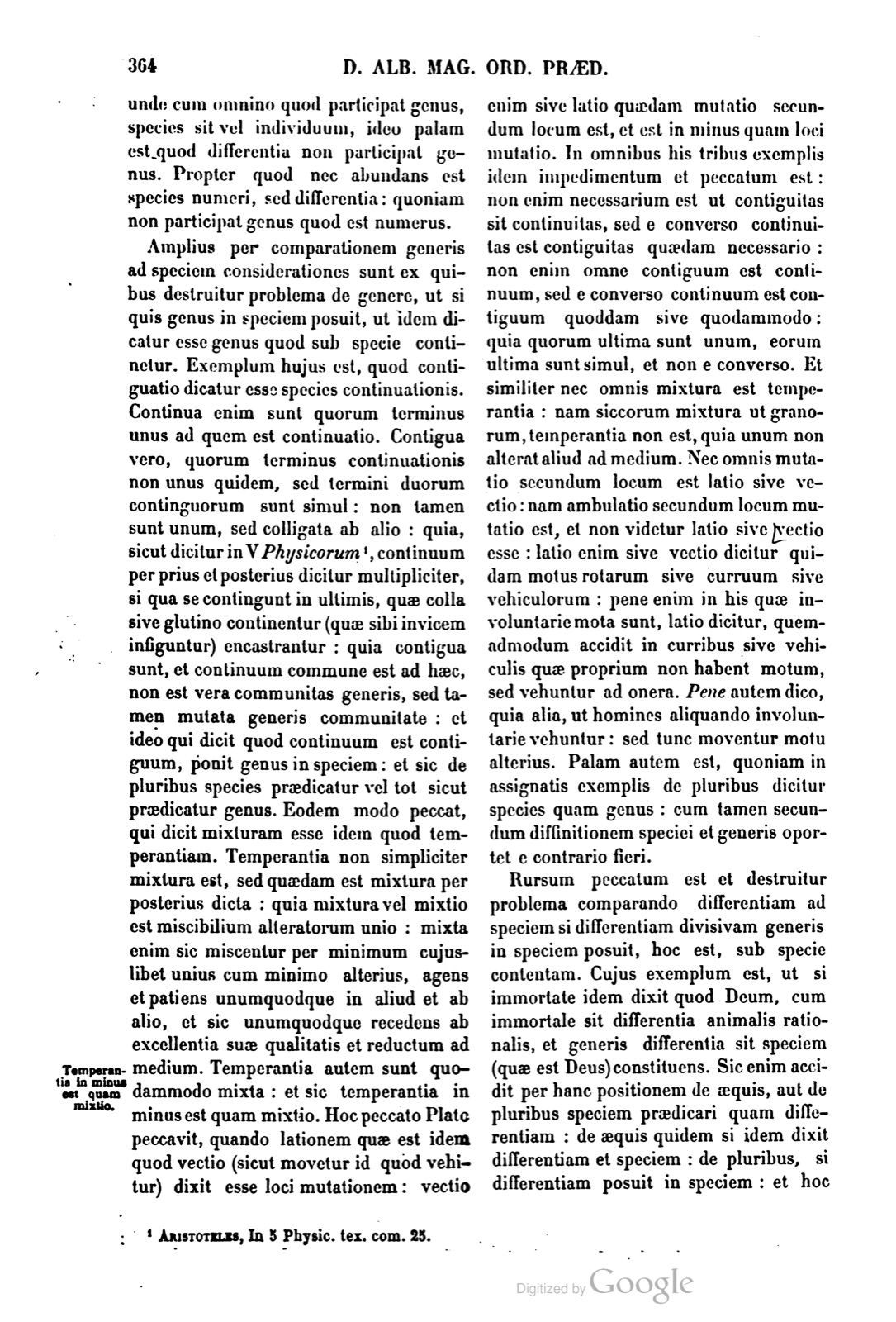
Amplius per comparationem generis ad speciem considerationes sunt ex quibus destruitur problema de genere, ut si quis genus in speciem posuit, ut idem dicatur esse genus quod sub specie continetur. Exemplum hujus est, quod contiguatio dicatur esse species continuationis. Continua enim sunt quorum terminus unus ad quem est continuatio. Contigua vero, quorum terminus continuationis non unus quidem, sed termini duorum continguorum sunt simul: non tamen sunt unum, sed colligata ab alio: quia, sicut dicitur in V Physicorum 1, continuum per prius et posterius dicitur multipliciter, si qua se contingunt in ultimis, quae colla sive glutino continentur, quae sibi invicem infiguntur, encastrantur: quia contigua sunt, et continuum commune est ad haec, non est vera communitas generis, sed tamen mutata generis communitate: et ideo qui dicit quod continuum est contiguum, ponit genus in speciem: et sic de pluribus species praedicatur vel tot sicut praedicatur genus.
Eodem modo peccat, qui dicit mixturam esse idem quod temperantiam. Temperantia non simpliciter mixtura est, sed quaedam est mixtura per posterius dicta: quia mixtura vel mixtio est miscibilium alteratorum unio: mixta enim sic miscentur per minimum cujuslibet unius cum minimo alterius, agens et patiens unumquodque in aliud et ab alio, et sic unumquodque recedens ab excellentia suae qualitatis et reductum ad medium. Temperantia autem sunt quodammodo mixta: et sic temperantia in minus est quam mixtio.
Hoc peccato Plato peccavit, quando lationem quae est idem quod vectio, sicut movetur id quod vehitur, dixit esse loci mutationem: vectio enim sive latio quaedam mutatio secundum locum est, et est in minus quam loci mutatio. In omnibus his tribus exemplis idem impedimentum et peccatum est: non enim necessarium est ut contiguitas sit continuitas, sed e converso continuitas est contiguitas quaedam necessario: non enim omne contiguum est continuum, sed e converso continuum est contiguum quoddam sive quodammodo: quia quorum ultima sunt unum, eorum ultima sunt simul, et non e converso. Et similiter nec omnis mixtura est temperantia: nam siccorum mixtura ut granorum, temperantia non est, quia unum non alterat aliud ad medium. Nec omnis mutatio secundum locum est latio sive vectio: nam ambulatio secundum locum mutatio est, et non videtur latio sive vectio esse: latio enim sive vectio dicitur quidam motus rotarum sive curruum sive vehiculorum: pene enim in his quae involuntarie mota sunt, latio dicitur, quemadmodum accidit in curribus sive vehiculis quae proprium non habent motum, sed vehuntur ad onera. Pene autem dico, quia alia, ut homines aliquando involuntarie vehuntur: sed tunc moventur motu alterius. Palam autem est, quoniam in assignatis exemplis de pluribus dicitur species quam genus: cum tamen secundum diffinitionem speciei et generis oportet e contrario fieri.
Rursum peccatum est et destruitur problema comparando differentiam ad speciem si differentiam divisivam generis in speciem posuit, hoc est, sub specie contentam. Cujus exemplum est, ut si immortale idem dixit quod Deum, cum immortale sit differentia animalis rationalis, et generis differentia sit speciem, quae est Deus, constituens. Sic enim accidit per hanc positionem de aequis, aut de pluribus speciem praedicari quam differentiam: de aequis quidem si idem dixit differentiam et speciem: de pluribus, si differentiam posuit in speciem: et hoc
Moreover, through the comparison of genus to species there are considerations by which the problem concerning genus is destroyed, as if someone has placed genus in species, so that the same thing is said to be genus which is contained under the species. An example of this is that contiguation is said to be a species of continuation. For continuous things are those whose terminus to which continuation is directed is one. But contiguous things are those whose terminus of continuation is not indeed one, but the termini of two contiguous things are together; nevertheless they are not one, but are bound by another. For, as is said in book V of the Physics 1, continuous is said in many ways according to prior and posterior, if things touch one another at their extremities, which are contained by collar or by glue, which are fixed into one another, and are encaustred. Because they are contiguous, and continuous is common to these, there is not a true commonness of genus, but nevertheless a commonness changed from the commonness of genus. Therefore the one who says that continuous is contiguous places genus in species; and thus species is predicated of more things, or of as many things, as genus is predicated.
In the same way the one who says that mixture is the same as temperance sins. Temperance is not mixture simply, but is a certain mixture said posteriorly, because mixture or mixing is the union of mixable things that have been altered. For mixed things are mixed in this way through the least of each one with the least of the other, each acting and suffering into the other and from the other, and thus each receding from the excellence of its quality and being reduced to the mean. But temperate things are in some way mixed; and thus temperance is less than mixing.
With this sin Plato sinned when he said that locomotion, which is the same as conveyance, as that which is carried is moved, is change of place. For conveyance or locomotion is a certain change according to place, and is less than change of place. In all these three examples there is the same impediment and sin: for it is not necessary that contiguity be continuity, but conversely continuity is necessarily a certain contiguity. For not every contiguous thing is continuous, but conversely the continuous is some contiguous thing or in some way contiguous, because things whose extremities are one have their extremities together, and not conversely. And similarly not every mixture is temperance; for the mixture of dry things, such as grains, is not temperance, because one does not alter another to the mean. Nor is every change according to place locomotion or conveyance; for walking is change according to place and does not seem to be locomotion or conveyance. For locomotion or conveyance is said to be a certain motion of wheels or carts or vehicles; for nearly in the case of those things that are moved involuntarily, it is called conveyance, as happens in carts or vehicles which do not have their own motion but are carried for loads. But I say "nearly," because others, such as human beings, are sometimes carried involuntarily; but then they are moved by the motion of another. It is plain, however, that in the assigned examples the species is said of more things than the genus, although according to the definition of species and genus the contrary ought to happen.
Again, there is a sin and the problem is destroyed by comparing difference to species if he has placed the divisive difference of genus in species, that is, contained under the species. An example of this is if he said that immortal is the same as God, since immortal is a difference of rational animal, and the difference of the genus is constituting the species, which is God. For thus by this position it happens that the species is predicated of things equal to, or of more things than, the difference: of equal things indeed if he said that the difference and the species are the same; of more things if he placed the difference in the species; and this
Notes
- Aristotle, on book 5 of the Physics, text comment 25. (ARISTOTELES, In 5 Physic. tex. com. 25.) ↩
If a page does not appear, its photograph has not been uploaded yet.