Volume 2 · pp. 356–360
Chapter II. On genus insofar as it is assigned as the genus of some species
A marker with ≈ is an approximate page boundary, placed by measure of the text; the page photographs remain the authority. In the paired views, clicking a page marker brings that page into view.
CAPUT II.
De genere prout assignatur genus alicujus speciei.
Ponemus igitur primo considerationes proprias sumptas penes particulas in diffinitione generis logice positas. Deinde ponemus particulas penes ea sumptas quae consequuntur ad particulas positas in diffinitione generis logici non contracti ad materiam generis: et ipsum consideremus prout assignatur genus alicujus, et non prout genus simpliciter vel omni: et hoc est comparare genus ad propinquum etiam, vel remotum, et non ad remotum.
Si ergo ponatur genus vel pro genere alicujus existentium quod significet ens existens. Existens autem proprie est compositum, quia omne genus et species composita sunt. Primum quidem igitur inspiciendum est ad omnia quae sunt illi quod pro genere positum est cognata, hoc est, ejusdem coordinationis in linea praedicabili ejus quod dicitur esse genus: omnia enim quae sunt in ipso, sunt suae coordinationis ut originata secundum essentiam ab ipso: et ideo de omnibus illis praedicatur. Unde inspiciendum est si de aliquo illorum non praedicatur quemadmodum de accidente in secundo hujus scientiae libro dictum est: quia si de aliquo eorum cognatorum non praedicatur, non erit genus quod assignatum est pro genere, et problema propositum interimendum est. Cujus exemplum est, ut si voluptatis ponatur genus esse bonum, sicut ponit Epicurus, considerandum si aliqua voluptas est non bonum, sicut voluptas aegritudinalis, ut in X Ethicorum praedicatum est: et si hoc concedatur et inveniatur, manifestum quoniam bonum non est genus voluptatis: et sumitur penes hoc, quod in diffinitione generis ponitur praedicari de omnibus speciebus et individuis: dico autem de eadem specie: quia generalissima genera sunt species entis, ut dicit Aristoteles in prima philosophia 1, et alia species genus est generis, et alia qualitatis genus, et sic de aliis.
Deinde alia consideratio sumitur penes hoc quod in diffinitione generis est praedicari in quid: unde considerandum est demum id quod sumitur penes hoc quod assignatum est pro genere, de omnibus cognatis in quid est praedicatur, vel non, sed in quale: velut album si dicatur esse genus nivis, aut velut de anima praedicatur mobile vel movens ut genus, ut dicit Plato animam esse quod est mobile vel motivum sui, sicut in genere dicimus animam esse quod per se mobile est, hoc est, a se, sive quod movet seipsum: quamvis enim Plato dicat animam esse numerum, ut genus animae, tamen quia mobile a se ponit differentiam, et differentia generalis cum genere collocanda est, mobile a se etiam posuit genus animae: et cum nec album de nive, nec mobile a se in quid praedicetur de nive et anima, patet quia neutrum est genus ejus cujus positum est esse genus: neque enim nix secundum quid album est, vel albi suscipit praedicationem: nec anima secundum quid est quod movetur: et propter hoc non est album genus nivis, ut dixit Empedocles, nec anima est quid quod movetur, ut dixit Plato: accidit enim moveri animae, et non praedicatur de ea in quid: quemadmodum accidit animali frequenter moveri ut ambulare vel ambulans esse.
Amplius hoc quidem probatur, quod mobile esse non est genus animae: quia mobile esse a se non significat quid-est in ipso de quo praedicatur, sed significat aliud vel faciens vel patiens: movere enim significat quid faciens in genere actionis, a se moveri significat quid patiens in genere passionis. Similiter autem et album: non enim et album significat quid est nix, sed indicat quale sit illud quid, sive aliquid de quo praedicatur. Propter quod neutrum horum in eo quod quid est praedicatur de eo de quo praedicatur.
CHAPTER II.
On genus insofar as it is assigned as the genus of some species.
Therefore first we shall set down the proper considerations taken according to the particles logically placed in the definition of genus. Then we shall set down particles taken according to those things which follow upon the particles placed in the definition of logical genus not contracted to the matter of genus. And let us consider genus itself insofar as it is assigned as the genus of something, and not insofar as it is genus simply or of every thing; and this is to compare genus to what is proximate also, or remote, and not to the remote.
Therefore if a genus, or something as a genus of one of existing things, is posited which signifies an existing being. But what exists is properly a composite, because every genus and species are composite. First, then, one must inspect all things that are cognate to that which has been posited as genus, that is, of the same coordination in the predicable line of that which is said to be genus. For all things that are in it are of its coordination as originated according to essence from it, and therefore it is predicated of all of them. Hence one must inspect whether it is not predicated of some one of them in the way said about accident in the second book of this science; for if it is not predicated of some one of those cognates, it will not be the genus that was assigned as genus, and the proposed problem must be destroyed. An example of this is: if the genus of pleasure is posited to be good, as Epicurus posits, one must consider whether some pleasure is not good, such as diseased pleasure, as has been predicated in book X of the Ethics. And if this is granted and found, it is manifest that good is not the genus of pleasure. And this is taken according to the fact that, in the definition of genus, being predicated of all species and individuals is posited. But I say "of the same species," because the most general genera are species of being, as Aristotle says in the First Philosophy 1, and one species is the genus of genus, and another is the genus of quality, and so concerning the others.
Next another consideration is taken according to the fact that in the definition of genus there is being predicated in what a thing is. Hence finally one must consider whether that which is taken according to the fact that it has been assigned as genus is predicated of all cognates in what they are, or not, but rather in what sort of thing they are. For example, if white is said to be the genus of snow, or if mobile or moving is predicated of soul as genus, as Plato says that soul is what is mobile or self-moving, just as in the genus we say that soul is what is movable per se, that is, by itself, or what moves itself. For although Plato says that soul is number as the genus of soul, nevertheless, because mobile-by-itself posits a difference, and a general difference must be placed together with the genus, he also posited mobile-by-itself as the genus of soul. And since neither white is predicated of snow in what it is, nor mobile-by-itself of snow and soul in what they are, it is clear that neither is the genus of that of which it has been posited to be the genus. For snow is not white according to what it is, nor does it receive the predication of white; nor is soul, according to what it is, that which is moved. And for this reason white is not the genus of snow, as Empedocles said, nor is soul something that is moved, as Plato said. For being moved happens to soul and is not predicated of it in what it is, just as it often happens to an animal to be moved, as to walk or to be walking.
Moreover, this indeed is proved, that being mobile is not the genus of soul, because being mobile by itself does not signify what is in the very thing of which it is predicated, but signifies something else, either acting or suffering. For to move signifies something acting in the genus of action; to be moved by itself signifies something suffering in the genus of passion. And similarly also white: for white does not signify what snow is, but indicates what sort that what, or something of which it is predicated, is. Therefore neither of these is predicated in what a thing is of that of which it is predicated.
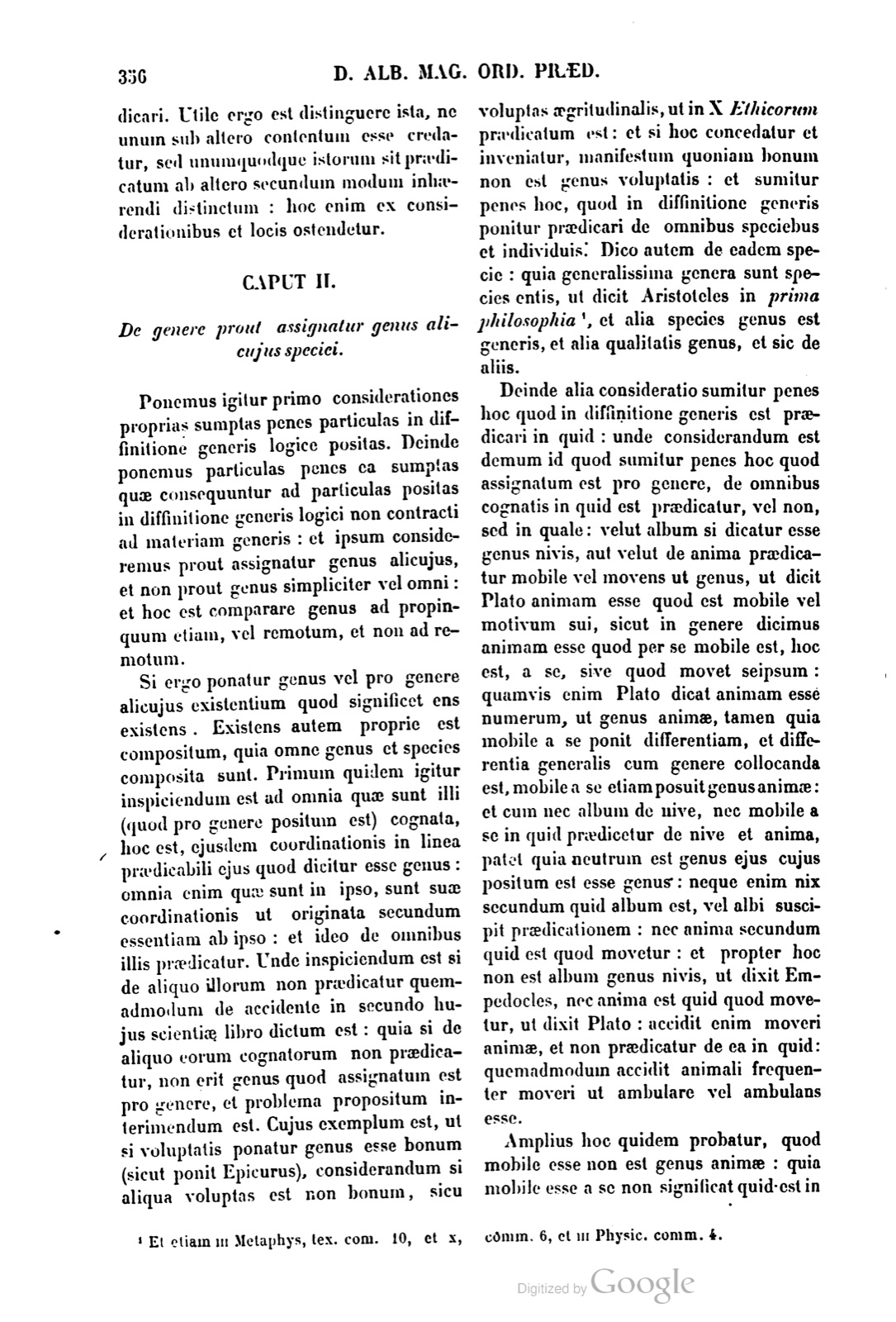
Alia etiam est ratio ad idem, quod maxime in diffinitione accidentis est inspiciendum, si diffinitio accidentis et ea quae sunt in diffinitione, aptantur convenienter ad id quod dictum est esse genus, ut patet in his quae dicta sunt album et mobile: contingit enim ut accidens idem movere seipsum, et aliquando non movere. Similiter contingit aliud album aliquando esse album, et aliquando non contingit: et sic non erit album genus, sed inest ut accidens, cujus diffinitio est, quod contingit eidem inesse et non inesse. Propter quod neutrum horum est ut genus, sed ut accidens est utrique illorum de quibus praedicatur, eo quod, sicut diximus, utrique illorum contingit inesse et non inesse.
Amplius si attendatur consequentia ad particulas positas in ratione generis: tunc prima est quae est praedicari de pluribus, secundum regulam quae data est in Praedicamentis, quae dixit quod quando alterum de altero praedicatur ut de subjecto, quaecumque de praedicato dicuntur et omnia de subjecto dici necesse est: et ex ista sequitur, quod omnia de quibus dicitur genus, sint ejusdem coordinationis cum genere secundum rectam lineam. Si ergo non in eadem divisione vel coordinatione fuerit genus cum his quorum dicitur esse genus, et species similiter de qua praedicatur genus, sed hoc quidem ut genus sit substantia, hoc est, in genere substantiae: aliud autem de quo praedicatur genus, hoc est, species, sit qualitas, hoc est, in genere qualitatis: tunc non erit genus quod pro genere assignatum est. Verbi gratia, ut nix quidem et cygnus, qui albi sunt species secundum Empedoclem, quidem substantia: album autem, quod genus eorum dictum est, non est substantia, sed quale. Propter quod non est album genus nivis, nec genus cygni: quia non sunt ejusdem coordinationis vel divisionis.
Rursum juxta idem consequens accipitur, quod disciplina ad aliquid est, hoc est, ad disciplinatum vel disciplinabile: bonum autem vel pulchrum dicunt quale: propter quod nec bonum nec pulchrum sunt genus disciplinae: quia non sunt ejusdem coordinationis et divisionis. Nam eorum quae sunt ad aliquid secundum speciem, genera oportet esse ad aliquid, ut patet in duplici quod est species de numero eorum quae sunt ad aliquid, et multiplex quod est genus ejusdem, et etiam ad aliquid. Universaliter in talibus quidem dicendum est et pro maxima, quod sub eadem divisione et coordinatione praedicabilium oportet genus esse speciei, sive insertum cum specie secundum rectam lineam: nam si species est substantia, et est genus de ista specie praedicatum substantia: et si species est quale quid, et genus erit quale quid. Cujus exemplum est si genus est quale quid et species non, ut si album est quale quid, et color quid erit. Similiter autem et in aliis.
There is also another reason for the same point, one which must chiefly be inspected in the definition of accident: whether the definition of accident and the things that are in the definition are suitably adapted to that which has been said to be genus, as is clear in these things that have been said, white and mobile. For it can happen that the same accident moves itself and at some time does not move; similarly, it can happen that something white is at some time white and at some time is not. And thus white will not be genus, but inheres as accident, whose definition is that it can inhere and not inhere in the same thing. Therefore neither of these is as genus, but each is as accident to those things of which it is predicated, because, as we have said, each of those can inhere and not inhere.
Moreover, if the consequence to the particles placed in the account of genus is attended to, then the first is the one which is being predicated of several things, according to the rule given in the Categories, which said that when one thing is predicated of another as of a subject, whatever things are said of the predicate must all be said of the subject. And from that it follows that all things of which genus is said are of the same coordination with the genus according to a straight line. Therefore if the genus is not in the same division or coordination with those things of which it is said to be the genus, and similarly the species of which the genus is predicated, but this as genus is substance, that is, in the genus of substance, while the other of which the genus is predicated, that is, the species, is quality, that is, in the genus of quality, then it will not be the genus that has been assigned as genus. For example, snow and swan, which according to Empedocles are species of white, are substance; but white, which is said to be their genus, is not substance but a quale. Therefore white is not the genus of snow, nor the genus of swan, because they are not of the same coordination or division.
Again, next to the same consequent it is taken that discipline is relative, that is, relative to the disciplined or disciplinable thing; but they say that good or beautiful is a quale. Therefore neither good nor beautiful is the genus of discipline, because they are not of the same coordination and division. For of those things that are relative according to species, the genera must be relative, as is clear in double, which is a species from the number of relatives, and multiple, which is the genus of the same, and is also relative. Universally in such matters one must indeed say, and as a maxim, that the genus must be under the same division and coordination of predicables as the species, or inserted with the species according to a straight line. For if the species is substance, the genus predicated of that species is also substance; and if the species is some quale, the genus also will be some quale. An example of this is if the genus is some quale and the species is not, as if white is some quale, then color will be a quid. And similarly also in the others.
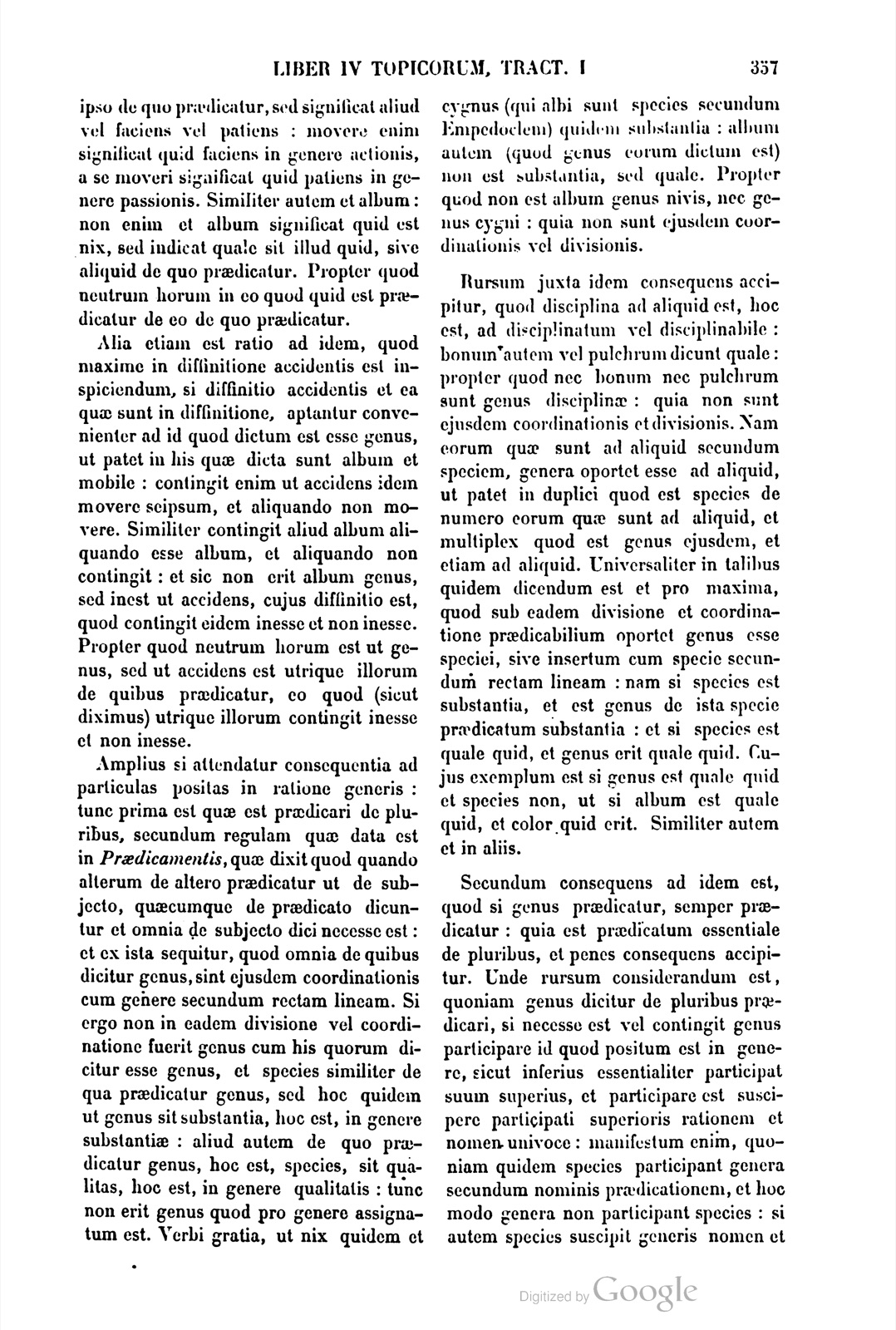
Secundum consequens ad idem est, quod si genus praedicatur, semper praedicatur: quia est praedicatum essentiale de pluribus, et penes consequens accipitur. Unde rursum considerandum est, quoniam genus dicitur de pluribus praedicari, si necesse est vel contingit genus participare id quod positum est in genere, sicut inferius essentialiter participat suum superius, et participare est suscipere participati superioris rationem et nomen univoce: manifestum enim, quoniam quidem species participant genera secundum nominis praedicationem, et hoc modo genera non participant species: si autem species suscipit generis nomen et rationem, genus non suscipit nomen et rationem speciei.
Unde considerandum si contingit assignatum genus vel assignatum pro genere, participare speciem secundum nomen et rationem: quia tunc non erit genus quod pro genere assignatum est: ut verbi gratia, si quis assignet aliquid pro genere entis vel unius: tunc enim cum ens et unum de omnibus dicantur, dicuntur etiam de isto quod pro genere eorum est assignatum: et sic accidit quod id quod assignatum est pro genere entis vel unius, quae dicuntur esse species suae, participabit rationem eorum, quod est inconveniens. Et hujus causa est, quia de omnibus quae sunt, unum et ens praedicantur, et etiam de isto quod assignatum est ut genus eorum. Propter quod ratio eorum etiam, scilicet entis et unius, participatione praedicatur de ipsis. Rationem autem dico expositionem quae est majoris declarationis quam nomen, quia aliam ens et unum non habent rationem.
Amplius ad idem quod est praedicare de pluribus, consequens est, quod genus de omnibus his praedicatur species, et de pluribus. Unde si de aliquo vel aliquibus una vera est species secundum praedicationem, de quibus non est verum genus praedicatum de eisdem, non erit genus quod assignatum est pro genere. Verbi gratia, si ens aut scibile dicatur esse genus opinabilis: nam de non ente praedicatur opinabile: multa enim non entia sunt opinabilia, ut quod sol sit monopodalis, vel quod fauni vel satyri sint: cum autem ens vel scibile non praedicentur de non ente: et ratio est, quia ens non est non ens: et quod scitur vel scibile est, hoc est unum propter quod ens et scibile non est genus ad opinabile: quia de pluribus praedicaretur species quam genus: quia de quibus praedicatur species, et genus de eisdem praedicari necesse est: nunc autem opinabile praedicatur de quibus non praedicatur ens vel scibile.
Adhuc autem de pluribus praedicari quarto loco consequitur, quod omnia de quibus praedicatur ipsum genus, participabunt illud genus.
Diffinitio autem ejus quod est participare, est suscipere participati rationem. Participatum autem dicimus, cujus secundum partem suae potestatis, et secundum partem suae communitatis inferens suscipit praedicationem, ut homo suscipit rationem animalis et praedicationem. Unde si nullum eorum quae sunt species positae sub eodem genere, contingit participare, id quod positum pro genere, non erit genus quod pro genere est assignatum. Nam impossibile est participare genus, quod nullam specierum participat, nisi sit aliqua primarum specierum primae divisionis generis sui primi, in qua immediate primum genus est divisum: hoc enim participat primum genus tantum, et nullam participat specierum: aliae autem omnes subalternae species quae sunt in genere primo, participant genus secundum aliquam specierum: quia quidquid est in genere, est in aliqua specierum illius generis praeter species primas.
The second consequent toward the same point is that, if genus is predicated, it is always predicated, because it is an essential predicate of several things; and it is taken according to the consequent. Hence again one must consider, since genus is said to be predicated of several things, whether it is necessary or possible for genus to participate that which has been placed in the genus, just as an inferior essentially participates its superior, and to participate is to receive univocally the account and name of the participated superior. For it is manifest that species participate genera according to the predication of the name, and in this way genera do not participate species; but if a species receives the name and account of the genus, the genus does not receive the name and account of the species.
Hence one must consider whether the assigned genus, or that assigned as genus, can participate the species according to name and account, because then it will not be the genus that was assigned as genus. For example, if someone assigns something as the genus of being or of one: then, since being and one are said of all things, they are also said of that which is assigned as their genus; and thus it happens that what has been assigned as the genus of being or of one, which are said to be its species, will participate their account, which is unfitting. And the cause of this is that one and being are predicated of all things, and also of that which is assigned as their genus. Therefore their account also, namely the account of being and one, is predicated of those things by participation. But I call an account an exposition that is of greater declaration than a name, because being and one have no other account.
Moreover, to the same thing, namely being predicated of several things, it is consequent that the genus is predicated of all those things of which the species is predicated, and of more. Hence if one true species according to predication is predicated of someone or some things of which the genus is not truly predicated of the same, it will not be the genus that has been assigned as genus. For example, if being or knowable is said to be the genus of the opinable: for the opinable is predicated of non-being. For many non-beings are opinable, as that the sun is one-footed, or that fauns or satyrs exist; but being or knowable are not predicated of non-being. And the reason is that being is not non-being, and that which is known or knowable is, that is, is one. Therefore being and knowable are not the genus for the opinable, because the species would be predicated of more things than the genus; for of the things of which the species is predicated, the genus also must be predicated of the same. But now opinable is predicated of things of which being or knowable is not predicated.
Furthermore, in the fourth place it follows upon being predicated of several things that all things of which the genus itself is predicated will participate that genus.
But the definition of what it is to participate is to receive the account of the participated thing. But we call participated that whose predication the inferior receives according to part of its power and according to part of its commonness, as a human being receives the account and predication of animal. Hence if none of the things that are species placed under the same genus can participate what has been placed as genus, it will not be the genus that has been assigned as genus. For it is impossible to participate a genus which participates none of the species, unless it is one of the first species of the first division of its first genus, in which the first genus has been immediately divided. For this participates only the first genus and participates none of the species; but all other subaltern species that are in the first genus participate the genus according to some one of the species, because whatever is in a genus is in some species of that genus except the first species.
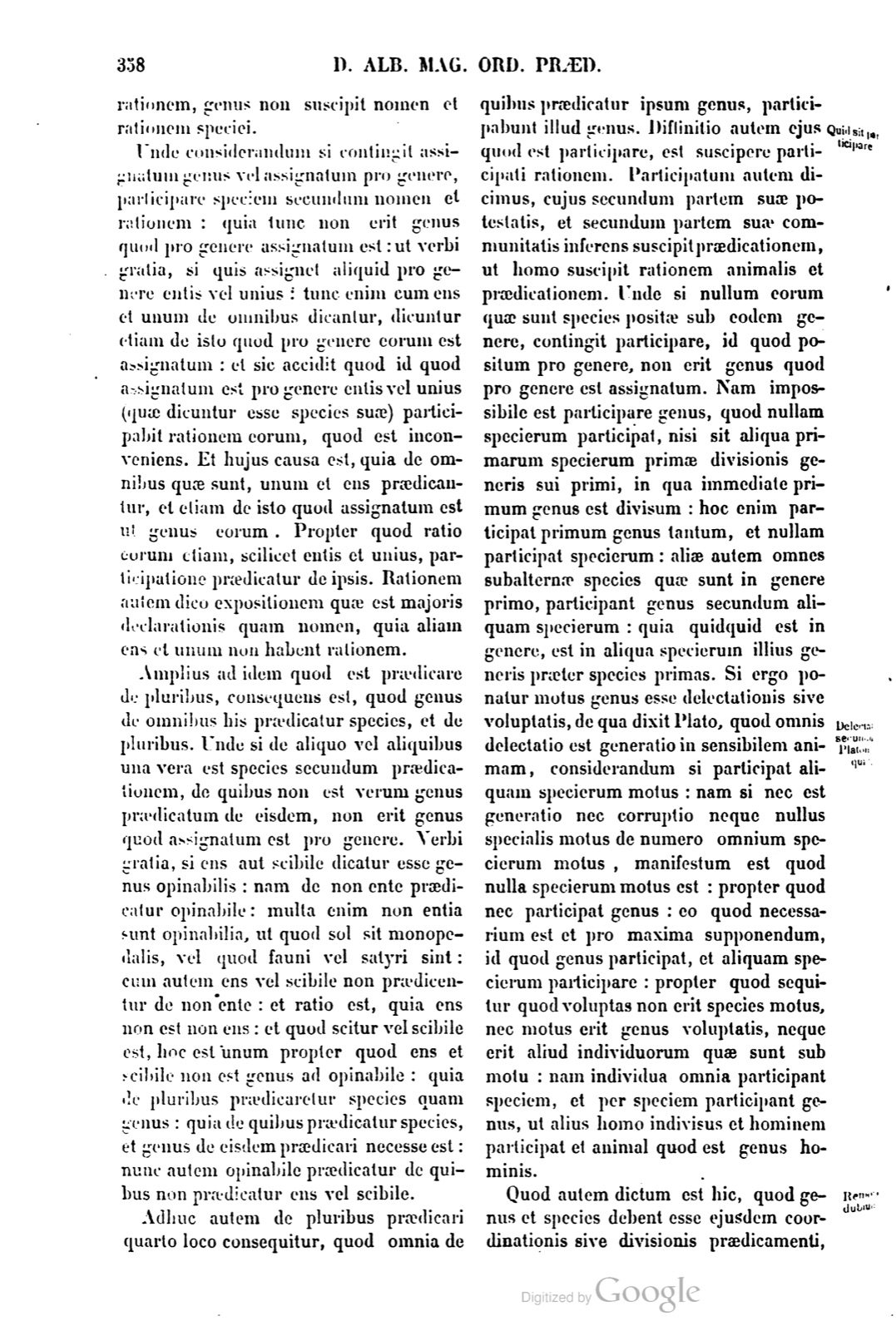
Si ergo ponatur motus genus esse delectationis sive voluptatis, de qua dixit Plato, quod omnis delectatio est generatio in sensibilem animam, considerandum si participat aliquam specierum motus: nam si nec est generatio nec corruptio neque nullus specialis motus de numero omnium specierum motus, manifestum est quod nulla specierum motus est: propter quod nec participat genus: eo quod necessarium est et pro maxima supponendum, id quod genus participat, et aliquam specierum participare: propter quod sequitur quod voluptas non erit species motus, nec motus erit genus voluptatis, neque erit aliud individuorum quae sunt sub motu: nam individua omnia participant speciem, et per speciem participant genus, ut alius homo indivisus et hominem participat et animal quod est genus hominis.
Quod autem dictum est hic, quod genus et species debent esse ejusdem coordinationis sive divisionis praedicamenti, non est contrarium ei quod in Praedicamentis in capitulo relationis dictum est: nihil enim prohibet genus esse in ad aliquid, et speciem et non esse in ad aliquid, sicut scientia est in ad aliquid, non autem grammatica: quia essentia generis et essentia speciei semper sunt in eadem coordinatione, quamvis id quod additur super essentiam, aliquando sit in alia coordinatione: et hoc patet, quia scientia, secundum id quod est, habitus vel dispositio est: quamvis accidat ei, ex comparatione ad id de quo est, in relatione esse.
Ponitur etiam consideratio accepta penes hoc consequens quod est praedicari de pluribus differentibus specie: ad hoc enim sequitur genus de pluribus praedicari quam species. Adhuc autem ad hoc sequitur non de aequalibus praedicari cum specie. Dicamus igitur ad hoc inspiciendo amplius praeter inductas considerationes, quod si id quod pro specie in genere positum est, de pluribus dicitur sive praedicatur, non erit genus illius speciei quod assignatum est pro genere, sicut si opinabile dicatur species entis, ut dixit Pythagoras, qui posuit quod magis est ens opinabile quod est extra animam, sicut causa est plus ens causato: opinabile autem cum dicatur tam de ente quam de non ente, et de pluribus praedicatur quam ens: ergo opinabile non est species entis, nec ens est genus opinabilis.
Hoc autem fere positum est in ante habitis istius capituli: sed differt illud ab isto, quia quod praecedit destruit genus assignatum per hoc quod de aliquo praedicatur species, de quo non genus: hic autem destructio fit per hoc quod de pluribus specie et numero differentibus species quam genus praedicatur: de pluribus enim genus semper quam species praedicatur.
Rursum alia consideratio consequens ex ista penes idem praedicari de pluribus sumpta, et est haec, quod si de aequalibus in numero dicuntur species assignata et genus. Cujus exemplum est, ut si eorum quae omnia sequuntur, et in quae omnia sicut in prima resolvuntur, quae, sicut dicit Avicenna, sunt ens, unum, res, aliquid, ponatur unum genus, et alterum species ipsius, vel per se, vel in eo quod accidit istis inesse: ut si ponatur ens esse genus, et unum species, de omnibus enim dicitur et ens et unum: propter quod neutrum neutri comparatum potest esse genus, eo quod de aequalibus et secundum numerum et secundum speciem dicuntur. In hoc autem quod accidit illis, exemplum est in eo quod ista prima sunt et principia: unde si primum et principium ad se invicem comparata ponantur genus et species, idem accidit inconveniens: quia utraque quae dicta sunt, idem sunt: et ideo neutrum de pluribus praedicatur quam alterum, et sic neutrum est genus ad alterum.
Therefore if motion is posited to be the genus of delight or pleasure, concerning which Plato said that every delight is a generation into the sensible soul, one must consider whether it participates some species of motion. For if it is neither generation nor corruption nor any special motion from the number of all the species of motion, it is manifest that it is none of the species of motion. Therefore it does not participate the genus, because it is necessary and must be presupposed as a maxim that what participates the genus also participates some species. Therefore it follows that pleasure will not be a species of motion, nor will motion be the genus of pleasure, nor will it be another of the individuals that are under motion. For all individuals participate the species, and through the species they participate the genus, as another undivided human being participates both human being and animal, which is the genus of human being.
But what has been said here, that genus and species ought to be of the same coordination or division of a predicament, is not contrary to what has been said in the Categories in the chapter on relation. For nothing prevents the genus from being relative while the species is not relative, just as science is relative but grammar is not. For the essence of the genus and the essence of the species are always in the same coordination, although that which is added over the essence is sometimes in another coordination. And this is clear because science, according to what it is, is a habit or disposition, although it happens to it, from comparison to that of which it is, to be in relation.
A consideration is also posited, accepted according to this consequent which is being predicated of several things differing in species. For it follows from this that genus is predicated of more things than species. Furthermore, from this it follows that it is not predicated of things equal with the species. Therefore let us say, in further inspecting this beyond the considerations already introduced, that if that which is placed as species in the genus is said or predicated of more things, it will not be the genus of that species which has been assigned as genus; as if opinable is said to be a species of being, as Pythagoras said, who posited that the opinable which is outside the soul is more being, just as a cause is more being than the caused. But since opinable is said both of being and of non-being, and is predicated of more things than being, therefore opinable is not a species of being, nor is being the genus of the opinable.
But this was almost posited in the preceding matters of this chapter; yet that differs from this, because what precedes destroys the assigned genus through the fact that the species is predicated of something of which the genus is not predicated; but here destruction occurs through the fact that the species is predicated of more things differing in species and number than the genus. For genus is always predicated of more things than species.
Again, another consideration consequent from that one is taken according to the same point, being predicated of several things; and it is this, that if the assigned species and the genus are said of things equal in number. An example of this is: if of those things which follow all things and into which all things are resolved as into first things, which, as Avicenna says, are being, one, thing, and something, one is posited as genus and the other as its species, either per se or in that which happens to inhere in these things. For example, if being is posited as genus and one as species, both being and one are said of all things. Therefore neither, compared to the other, can be genus, because they are said of things equal both according to number and according to species. But in that which happens to them, there is an example in that these first things are also principles. Hence if first and principle, compared to each other, are posited as genus and species, the same unfitting result happens, because both things that have been named are the same, and therefore neither is predicated of more things than the other, and thus neither is genus with respect to the other.
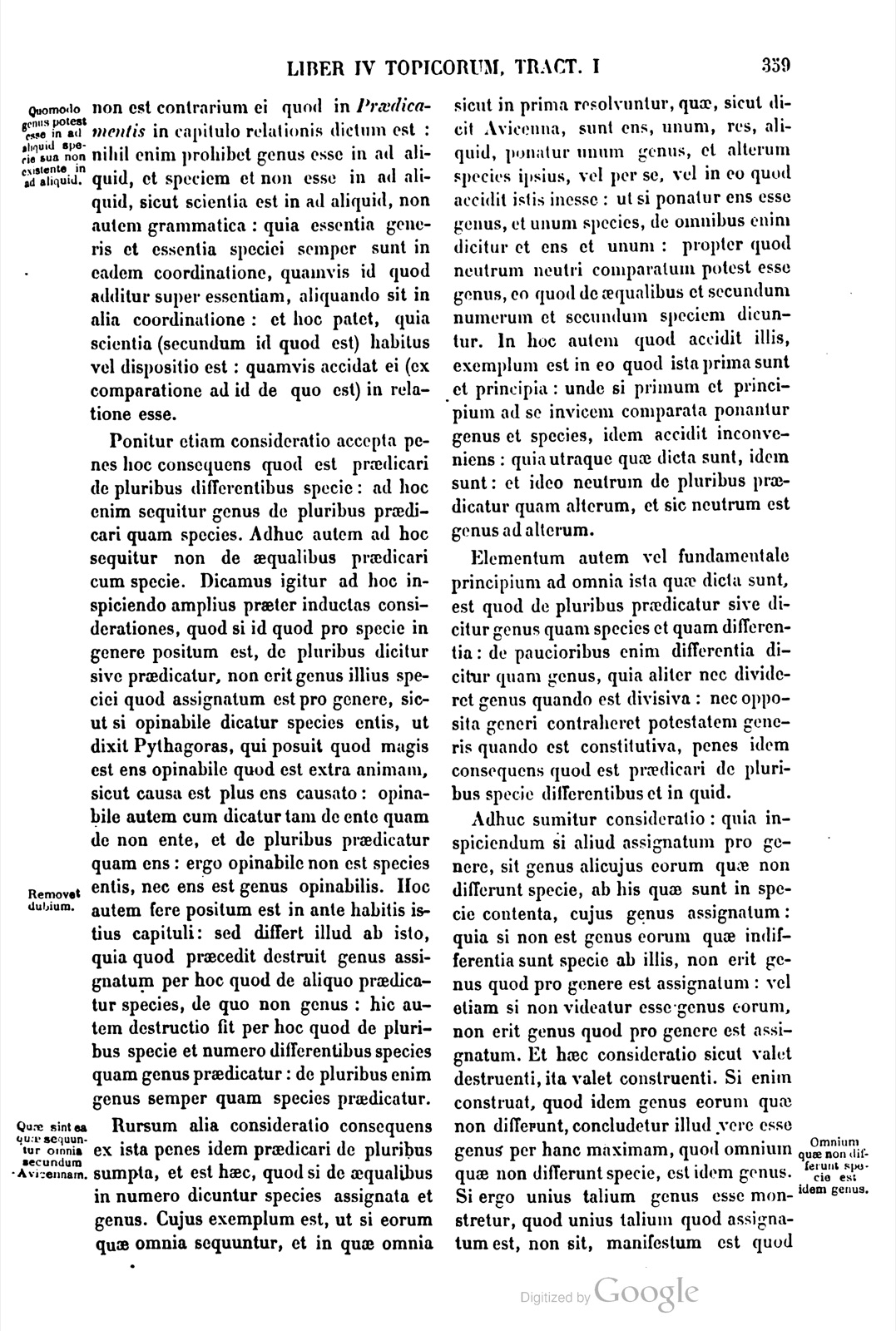
Elementum autem vel fundamentale principium ad omnia ista quae dicta sunt, est quod de pluribus praedicatur sive dicitur genus quam species et quam differentia: de paucioribus enim differentia dicitur quam genus, quia aliter nec divideret genus quando est divisiva: nec opposita generi contraheret potestatem generis quando est constitutiva, penes idem consequens quod est praedicari de pluribus specie differentibus et in quid.
Adhuc sumitur consideratio: quia inspiciendum si aliud assignatum pro genere, sit genus alicujus eorum quae non differunt specie, ab his quae sunt in specie contenta, cujus genus assignatum: quia si non est genus eorum quae indifferentia sunt specie ab illis, non erit genus quod pro genere est assignatum: vel etiam si non videatur esse genus eorum, non erit genus quod pro genere est assignatum. Et haec consideratio sicut valet destruenti, ita valet construenti. Si enim construat, quod idem genus eorum quae non differunt, concludetur illud vere esse genus per hanc maximam, quod omnium quae non differunt specie, est idem genus.
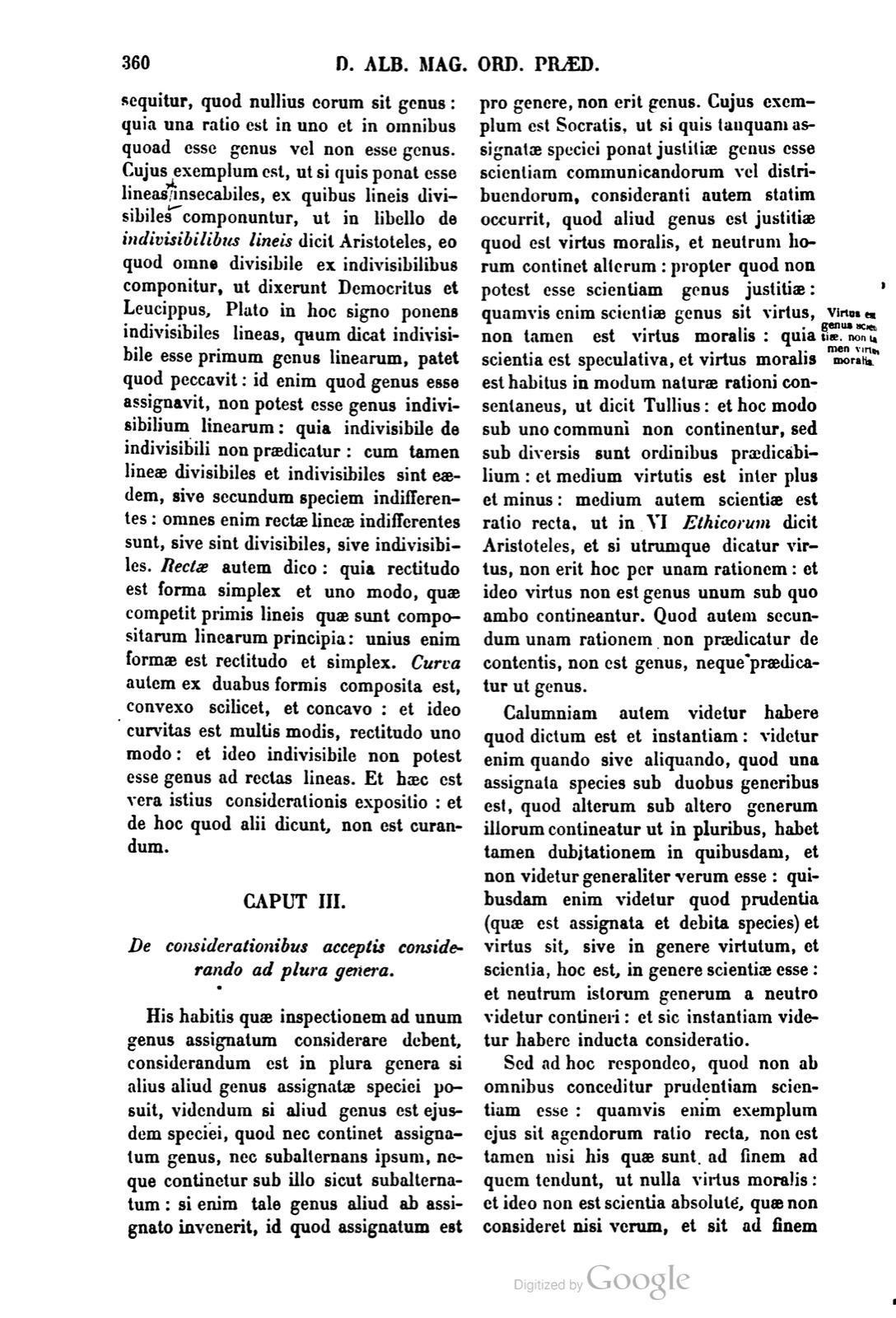
Si ergo unius talium genus esse monstretur, quod unius talium quod assignatum est, non sit, manifestum est quod sequitur, quod nullius eorum sit genus: quia una ratio est in uno et in omnibus quoad esse genus vel non esse genus. Cujus exemplum est, ut si quis ponat esse lineas insecabiles, ex quibus lineis divisibiles componuntur, ut in libello de indivisibilibus lineis dicit Aristoteles, eo quod omne divisibile ex indivisibilibus componitur, ut dixerunt Democritus et Leucippus, Plato in hoc signo ponens indivisibiles lineas, quum dicat indivisibile esse primum genus linearum, patet quod peccavit: id enim quod genus esse assignavit, non potest esse genus indivisibilium linearum: quia indivisibile de indivisibili non praedicatur: cum tamen lineae divisibiles et indivisibiles sint eaedem, sive secundum speciem indifferentes: omnes enim rectae lineae indifferentes sunt, sive sint divisibiles, sive indivisibiles. Rectae autem dico: quia rectitudo est forma simplex et uno modo, quae competit primis lineis quae sunt compositarum linearum principia: unius enim formae est rectitudo et simplex. Curva autem ex duabus formis composita est, convexo scilicet, et concavo: et ideo curvitas est multis modis, rectitudo uno modo: et ideo indivisibile non potest esse genus ad rectas lineas. Et haec est vera istius considerationis expositio: et de hoc quod alii dicunt, non est curandum.
But the element or foundational principle for all those things that have been said is that genus is predicated or said of more things than species and than difference. For difference is said of fewer things than genus, because otherwise it would neither divide the genus when it is divisive nor contract the power of the genus when it is constitutive, according to the same consequent which is being predicated of several things differing in species and in what a thing is.
Furthermore, a consideration is taken: one must inspect whether something else assigned as genus is the genus of one of those things which do not differ in species from those things that are contained in the species whose genus is assigned. For if it is not the genus of those things that are indifferent in species from them, it will not be the genus that has been assigned as genus; or even if it does not seem to be the genus of them, it will not be the genus that has been assigned as genus. And this consideration, just as it has force for destroying, so too it has force for constructing. For if it constructs that the same genus belongs to those things which do not differ, it will be concluded that it truly is a genus through this maxim, that of all things which do not differ in species, the genus is the same.
Therefore if it is shown that something is the genus of one such thing, but that what was assigned as the genus of one such thing is not its genus, it is manifest that it follows that it is the genus of none of them, because there is one account in one and in all with respect to being a genus or not being a genus. An example of this is: if someone posits that there are indivisible lines from which divisible lines are composed, as Aristotle says in the little book On Indivisible Lines, since every divisible thing is composed from indivisibles, as Democritus and Leucippus said. Plato, in positing indivisible lines by this sign, when he says that indivisible is the first genus of lines, clearly sinned. For that which he assigned to be genus cannot be the genus of indivisible lines, because indivisible is not predicated of indivisible, although divisible lines and indivisible lines are the same, or indifferent according to species; for all straight lines are indifferent, whether they are divisible or indivisible. But I say straight lines because straightness is a simple form and in one mode, which belongs to first lines that are the principles of composite lines; for straightness is of one form and simple. But a curved line is composed from two forms, namely convex and concave; and therefore curvature is in many modes, straightness in one mode. And therefore indivisible cannot be a genus for straight lines. And this is the true exposition of that consideration; and one should not care about what others say concerning this.
Notes
- And also in the Metaphysics, text comment 10, and book X, comment 6, and book II of the Physics, comment 4. (Et etiam in Metaphys., tex. com. 10, et X, comm. 6, et II Physic., comm. 4.) ↩
If a page does not appear, its photograph has not been uploaded yet.