Volume 2 · pp. 355–356
Book IV of the Topics. Treatise I. Chapter I. Proemium of the Book
A marker with ≈ is an approximate page boundary, placed by measure of the text; the page photographs remain the authority. In the paired views, clicking a page marker brings that page into view.
LIBER IV
TOPICORUM.
TRACTATUS I
DE PROBLEMATE GENERIS ET PROPRII.
CAPUT I.
Prooemium Libri.
In hoc quarto libro Topicorum post haec quae dicta sunt de determinatione problematis de accidente, quod non conversim praedicatur, et primum et remotissimum est elementum diffinitionis, perspiciendum de locis et considerationibus pertinentibus ad genus, hoc est, ad inesse ut genus vel non inesse, et de locis et considerationibus pertinentibus ad proprium, sive ad problema de proprio determinandum: quod genus requiritur ad bonitatem proprii, et proprium propter modum praedicandi conversim, immediatius est elementum diffinitionis, quam genus: sunt enim haec praedicata elementa eorum locorum quae pertinent ad diffinitiones: quia inesse ut diffinitio ex his elementaliter componitur: quia quod inest ut diffinitio, et inest simpliciter, et in quid, et conversim praedicatur: quorum primum est accidentis, secundum generis, tertium proprii: propter quod ante diffinitionem ista consideratione est necessarium: quia ita supponitur in eo quod inest ut diffinitio.
BOOK IV
OF THE TOPICS.
TREATISE I
ON THE PROBLEM OF GENUS AND PROPERTY.
CHAPTER I.
Proemium of the Book.
In this fourth book of the Topics, after the things that have been said about the determination of the problem concerning accident, which is not predicated convertibly and is the first and most remote element of definition, one must look into the loci and considerations pertaining to genus, that is, to inhering as genus or not inhering, and into the loci and considerations pertaining to property, or to the problem concerning property to be determined. Genus is required for the goodness of property, and property, because of the mode of predicating convertibly, is a more immediate element of definition than genus. For these predicates are elements of those loci which pertain to definitions, because inhering as definition is composed elementally from these: for what inheres as definition both inheres simply, and inheres in what a thing is, and is predicated convertibly; of these the first belongs to accident, the second to genus, the third to property. Therefore before definition this consideration is necessary, because in that which inheres as definition it is presupposed in that way.
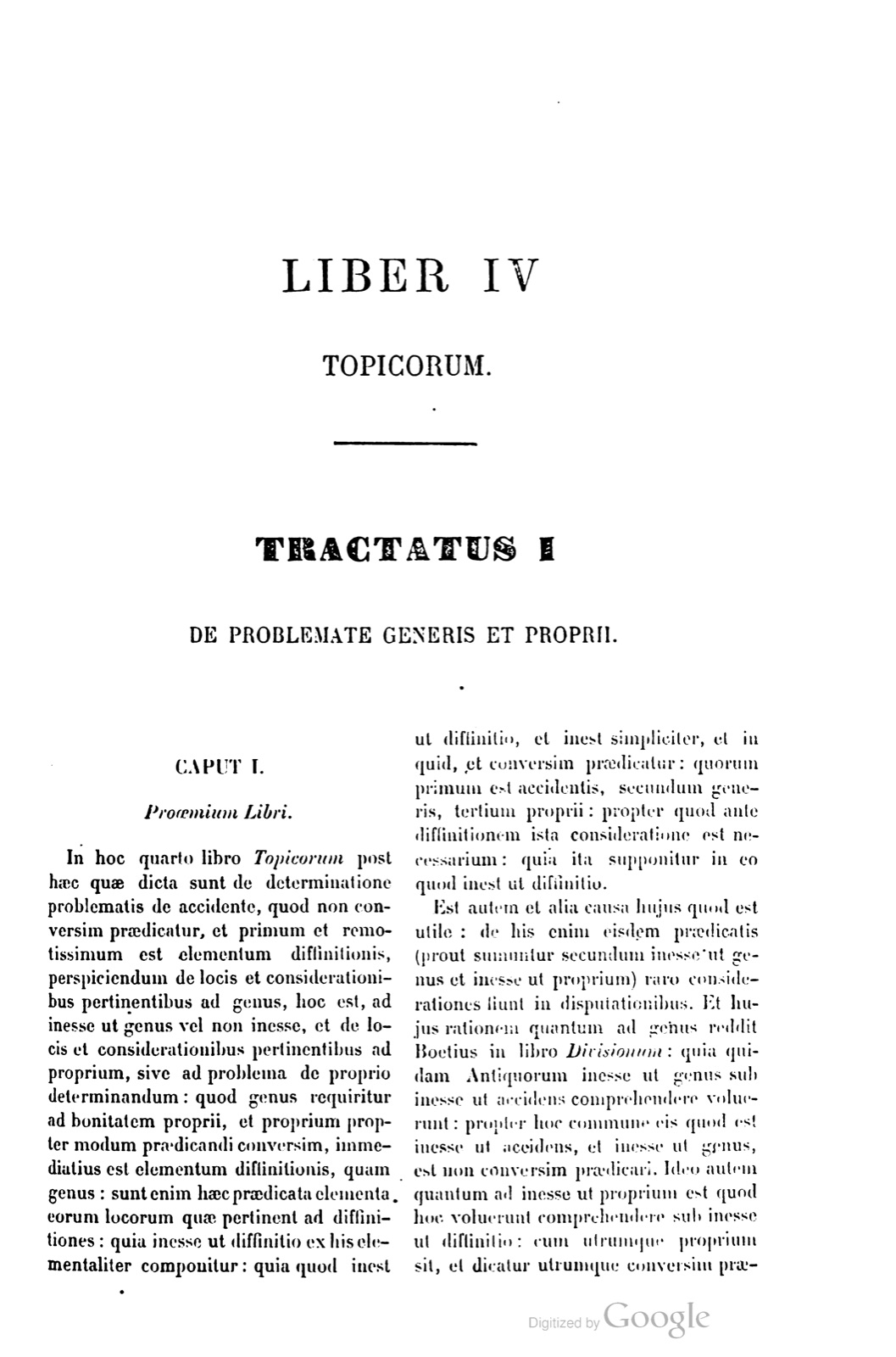
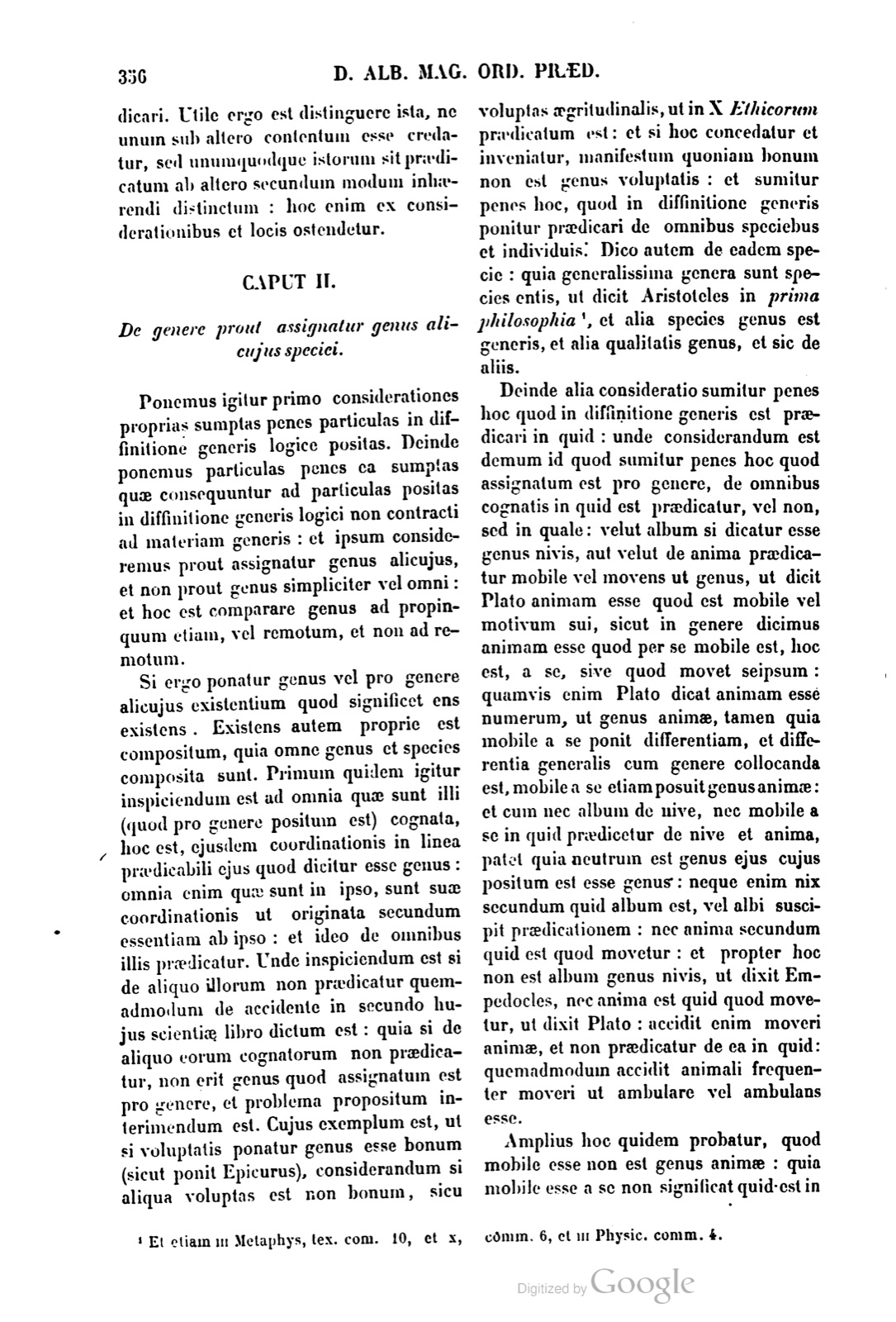
Est autem et alia causa hujus quod est utile: de his enim eisdem praedicatis prout sumuntur secundum inesse ut genus et inesse ut proprium, raro considerationes fiunt in disputationibus. Et hujus rationem quantum ad genus reddit Boetius in libro Divisionum: quia quidam Antiquorum inesse ut genus sub inesse ut accidens comprehendere voluerunt: propter hoc commune eis quod est inesse ut accidens, et inesse ut genus, est non conversim praedicari. Ideo autem quantum ad inesse ut proprium est quod hoc voluerunt comprehendere sub inesse ut diffinitio: cum utrumque proprium sit, et dicatur utrumque conversim praedicari. Utile ergo est distinguere ista, ne unum sub altero contentum esse credatur, sed unumquodque istorum sit praedicatum ab altero secundum modum inhaerendi distinctum: hoc enim ex considerationibus et locis ostendetur.
There is also another cause why this is useful: for concerning these same predicates, as they are taken according to inhering as genus and inhering as property, considerations are rarely made in disputations. And Boethius gives the reason for this, as concerns genus, in the book On Divisions: some of the Ancients wished to comprehend inhering as genus under inhering as accident, on account of this feature common to them, namely that inhering as accident and inhering as genus are not predicated convertibly. But as concerns inhering as property, they wished to comprehend it under inhering as definition because each is proper, and each is said to be predicated convertibly. Therefore it is useful to distinguish these things, lest one be believed to be contained under the other, but each of these be a predicate distinct from the other according to its mode of inhering. For this will be shown from considerations and loci.
If a page does not appear, its photograph has not been uploaded yet.