Volume 2 · pp. 353–354
Chapter II. On the determination of the indefinite
A marker with ≈ is an approximate page boundary, placed by measure of the text; the page photographs remain the authority. In the paired views, clicking a page marker brings that page into view.
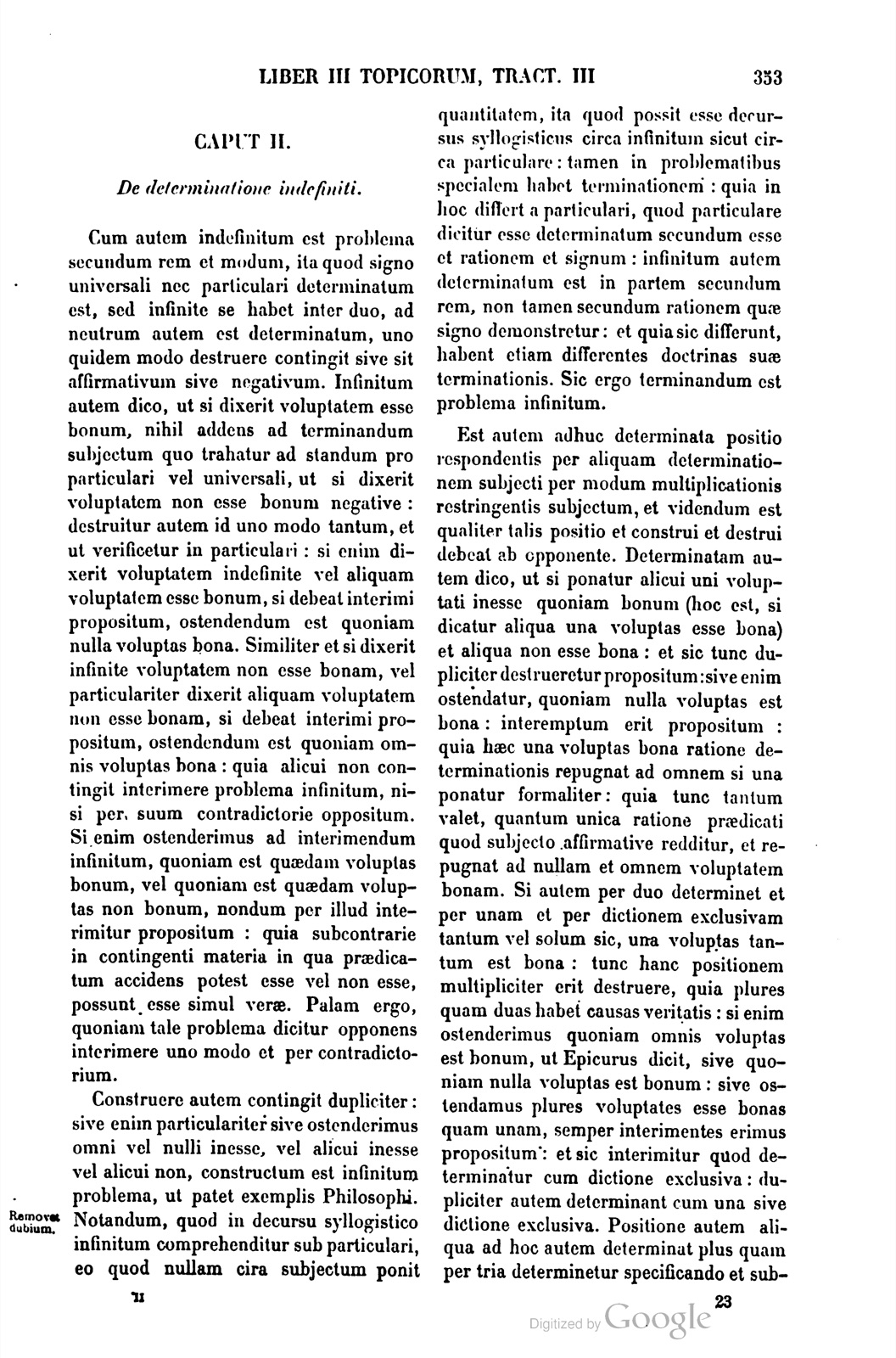
CAPUT II.
De determinatione indefiniti.
Cum autem indefinitum est problema secundum rem et modum, ita quod signo universali nec particulari determinatum est, sed infinite se habet inter duo, ad neutrum autem est determinatum, uno quidem modo destruere contingit sive sit affirmativum sive negativum. Infinitum autem dico, ut si dixerit voluptatem esse bonum, nihil addens ad terminandum subjectum quo trahatur ad standum pro particulari vel universali, ut si dixerit voluptatem non esse bonum negative: destruitur autem id uno modo tantum, et ut verificetur in particulari: si enim dixerit voluptatem indefinite vel aliquam voluptatem esse bonum, si debeat interimi propositum, ostendendum est quoniam nulla voluptas bona. Similiter et si dixerit infinite voluptatem non esse bonam, vel particulariter dixerit aliquam voluptatem non esse bonam, si debeat interimi propositum, ostendendum est quoniam omnis voluptas bona: quia alicui non contingit interimere problema infinitum, nisi per suum contradictorie oppositum. Si enim ostenderimus ad interimendum infinitum, quoniam est quaedam voluptas bonum, vel quoniam est quaedam voluptas non bonum, nondum per illud interimitur propositum: quia subcontrarie in contingenti materia in qua praedicatum accidens potest esse vel non esse, possunt esse simul verae. Palam ergo, quoniam tale problema dicitur opponens interimere uno modo et per contradictorium.
Construere autem contingit dupliciter: sive enim particulariter sive ostenderimus omni vel nulli inesse, vel alicui inesse vel alicui non, constructum est infinitum problema, ut patet exemplis Philosophi.
Notandum, quod in decursu syllogistico infinitum comprehenditur sub particulari, eo quod nullam circa subjectum ponit quantitatem, ita quod possit esse decursus syllogisticus circa infinitum sicut circa particulare: tamen in problematibus specialem habet terminationem: quia in hoc differt a particulari, quod particulare dicitur esse determinatum secundum esse et rationem et signum: infinitum autem determinatum est in partem secundum rem, non tamen secundum rationem quae signo demonstretur: et quia sic differunt, habent etiam differentes doctrinas suae terminationis. Sic ergo terminandum est problema infinitum.
Est autem adhuc determinata positio respondentis per aliquam determinationem subjecti per modum multiplicationis restringentis subjectum, et videndum est qualiter talis positio et construi et destrui debeat ab opponente. Determinatam autem dico, ut si ponatur alicui uni voluptati inesse quoniam bonum, hoc est, si dicatur aliqua una voluptas esse bona, et aliqua non esse bona: et sic tunc dupliciter destrueretur propositum: sive enim ostendatur, quoniam nulla voluptas est bona, interemptum erit propositum: quia haec una voluptas bona ratione determinationis repugnat ad omnem si una ponatur formaliter: quia tunc tantum valet, quantum unica ratione praedicati quod subjecto affirmative redditur, et repugnat ad nullam et omnem voluptatem bonam. Si autem per duo determinet et per unam et per dictionem exclusivam tantum vel solum sic, una voluptas tantum est bona: tunc hanc positionem multipliciter erit destruere, quia plures quam duas habet causas veritatis: si enim ostenderimus quoniam omnis voluptas est bonum, ut Epicurus dicit, sive quoniam nulla voluptas est bonum: sive ostendamus plures voluptates esse bonas quam unam, semper interimentes erimus propositum: et sic interimitur quod determinatur cum dictione exclusiva: dupliciter autem determinant cum una sive dictione exclusiva. Positione autem aliqua ad hoc autem determinat plus quam tria determinetur specificando et subjectum et universali et dictione exclusiva, ut si dicatur sic, quoniam prudentia una sola virtute moralium est scientia, quadrupliciter contingit interimere: ostenso enim quoniam omnis virtus est scientia, ut dicit Socrates, vel ostenso quod nulla virtus est scientia, vel ostenso quod aliqua alia est scientia, ut justitia quae est in rationabili parte animae sicut et prudentia propter scientiam destruendi vel communicandi, vel si monstretur quoniam eadem virtus quae est prudentia non est scientia, quolibet istorum modorum interemptum erit quod prudentia una sola virtutum est scientia.
CHAPTER II.
On the determination of the indefinite.
But when the problem is indefinite according to thing and mode, so that it has not been determined by a universal or particular sign, but holds itself indefinitely between two, and is determined to neither, it can be destroyed in one way, whether it is affirmative or negative. But I call indefinite the case in which someone says that pleasure is good, adding nothing to determine the subject by which it may be drawn to stand for the particular or the universal, as if he were to say negatively that pleasure is not good. But that is destroyed in only one way, and so that it may be verified in the particular. For if he says indefinitely that pleasure, or some pleasure, is good, if the proposed statement ought to be destroyed, it must be shown that no pleasure is good. Similarly, if he says indefinitely that pleasure is not good, or particularly says that some pleasure is not good, if the proposed statement ought to be destroyed, it must be shown that every pleasure is good, because one cannot destroy an indefinite problem except through its contradictorily opposite. For if, in order to destroy the indefinite, we were to show that there is some pleasure that is good, or that there is some pleasure that is not good, the proposed statement is not yet destroyed by that, because subcontraries, in contingent matter in which an accidental predicate can be or not be, can be true at the same time. Therefore it is plain that the opponent is said to destroy such a problem in one way and through the contradictory.
But construction can occur in two ways: for whether particularly, or whether we have shown that it inheres in every one or in none, or inheres in some one or does not inhere in some one, the indefinite problem has been constructed, as is clear from the examples of the Philosopher.
It must be noted that in the syllogistic course the indefinite is comprehended under the particular, because it posits no quantity concerning the subject, so that there can be a syllogistic course concerning the indefinite as concerning the particular. Nevertheless, in problems it has a special termination, because in this it differs from the particular: the particular is said to be determined according to being, reason, and sign; but the indefinite is determined to a part according to the thing, yet not according to a reason that is shown by a sign. And because they differ in this way, they also have different doctrines of their termination. Therefore the indefinite problem must be terminated in this way.
There is also a determined position of the respondent through some determination of the subject by way of a multiplication restricting the subject, and it must be seen how such a position ought both to be constructed and destroyed by the opponent. But I call determined the case in which it is posited that good inheres in some one pleasure, that is, if it is said that some one pleasure is good and that some other is not good. And thus then the proposed statement would be destroyed in two ways: for whether it is shown that no pleasure is good, the proposed statement will be destroyed, because this one good pleasure, by reason of determination, is opposed to every pleasure if one is posited formally; for then it has as much force as a single predicate-reason that is affirmatively rendered to the subject, and it is opposed to no pleasure and to every good pleasure. But if he determines through two things, both through one and through an exclusive diction, "only" or "alone," in this way, "one pleasure alone is good," then this position will have to be destroyed in many ways, because it has more than two causes of truth. For if we show that every pleasure is good, as Epicurus says, or that no pleasure is good, or if we show that more pleasures than one are good, we will always be destroying the proposed statement; and thus what is determined with an exclusive diction is destroyed. But they determine doubly, with "one" or with an exclusive diction. But if some position determines more than three for this, by specifying both the subject, and the universal, and the exclusive diction, as if it is said thus, that prudence alone, as one virtue of the moral virtues, is science, it can be destroyed in four ways: for by showing that every virtue is science, as Socrates says, or by showing that no virtue is science, or by showing that some other virtue is science, as justice, which is in the rational part of the soul just as prudence is because of the science of destroying or communicating, or if it is shown that the same virtue which is prudence is not science, by any of those ways the statement that prudence alone of the virtues is science will be destroyed.
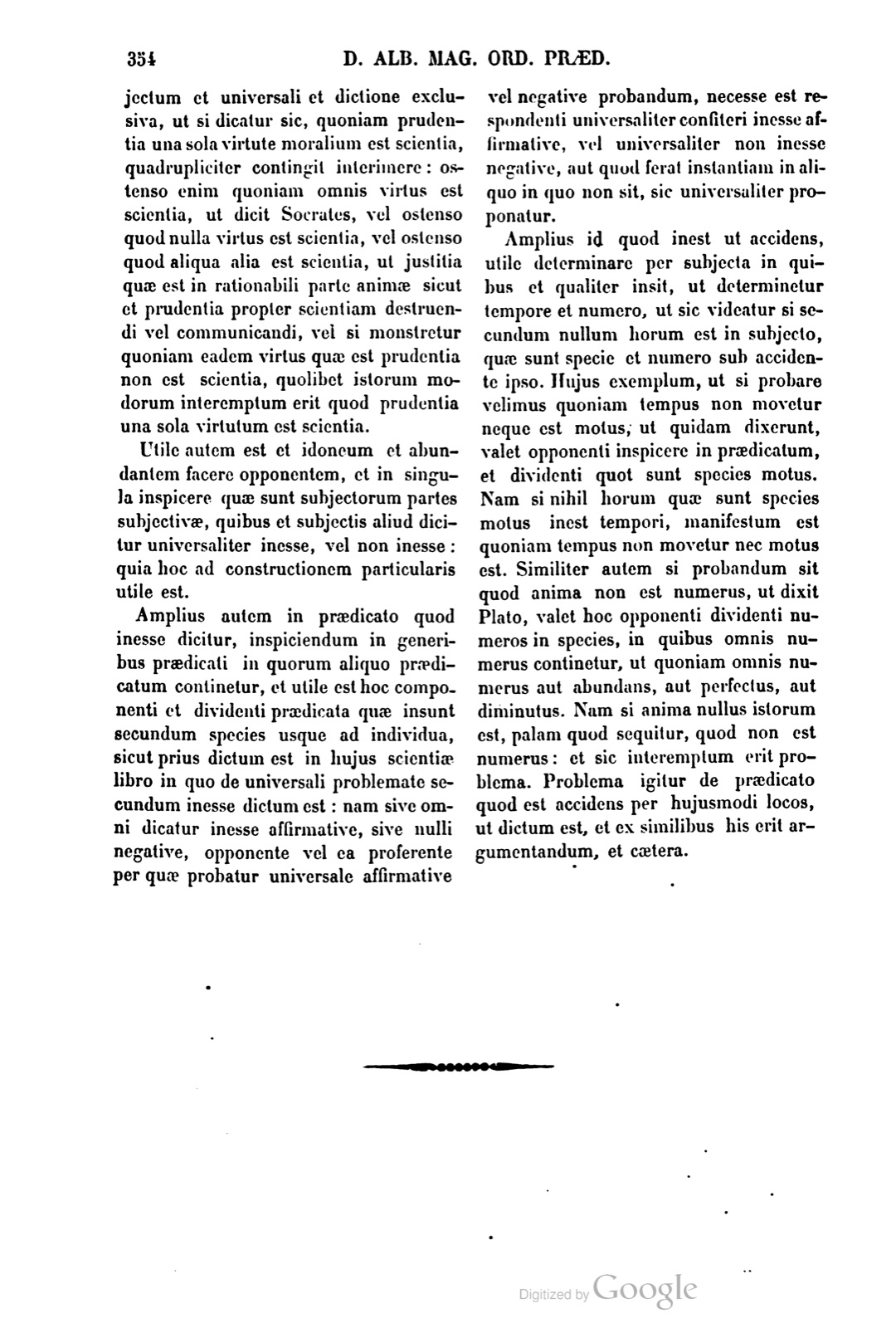
Utile autem est et idoneum et abundantem facere opponentem, et in singula inspicere quae sunt subjectorum partes subjectivae, quibus et subjectis aliud dicitur universaliter inesse, vel non inesse: quia hoc ad constructionem particularis utile est.
Amplius autem in praedicato quod inesse dicitur, inspiciendum in generibus praedicati in quorum aliquo praedicatum continetur, et utile est hoc componenti et dividenti praedicata quae insunt secundum species usque ad individua, sicut prius dictum est in hujus scientiae libro in quo de universali problemate secundum inesse dictum est: nam sive omni dicatur inesse affirmative, sive nulli negative, opponente vel ea proferente per quae probatur universale affirmative vel negative probandum, necesse est respondenti universaliter confiteri inesse affirmative, vel universaliter non inesse negative, aut quod ferat instantiam in aliquo in quo non sit, sic universaliter proponatur.
Amplius id quod inest ut accidens, utile determinare per subjecta in quibus et qualiter insit, ut determinetur tempore et numero, ut sic videatur si secundum nullum horum est in subjecto, quae sunt specie et numero sub accidente ipso. Hujus exemplum, ut si probare velimus quoniam tempus non movetur neque est motus, ut quidam dixerunt, valet opponenti inspicere in praedicatum, et dividenti quot sunt species motus. Nam si nihil horum quae sunt species motus inest tempori, manifestum est quoniam tempus non movetur nec motus est. Similiter autem si probandum sit quod anima non est numerus, ut dixit Plato, valet hoc opponenti dividenti numeros in species, in quibus omnis numerus continetur, ut quoniam omnis numerus aut abundans, aut perfectus, aut diminutus. Nam si anima nullus istorum est, palam quod sequitur, quod non est numerus: et sic interemptum erit problema. Problema igitur de praedicato quod est accidens per hujusmodi locos, ut dictum est, et ex similibus his erit argumentandum, et caetera.
It is useful also to make the opponent suitable and abundant, and to inspect in individual cases what the subjective parts of subjects are, in which and in which subjects something else is said universally to inhere or not to inhere, because this is useful for constructing the particular.
Moreover, in the predicate which is said to inhere, one must inspect the genera of the predicate, in some one of which the predicate is contained; and this is useful to the one composing and dividing the predicates which inhere according to species down to individuals, as was said earlier in the book of this science in which the universal problem according to inhering was discussed. For whether it is said affirmatively to inhere in every one, or negatively in none, when the opponent either brings forward those things through which the universal affirmative or negative to be proved is proved, the respondent must universally confess that it inheres affirmatively, or universally that it does not inhere negatively, or must bring an instance in something in which it is not so, if it is proposed universally in this way.
Moreover, it is useful to determine that which inheres as an accident through the subjects in which and how it inheres, so that it may be determined by time and number, so that it may thus be seen whether according to none of these it is in the subject, namely those which are under the accident itself in species and number. An example of this is: if we wish to prove that time is not moved and is not motion, as some have said, it is valid for the opponent to inspect the predicate and, by division, how many species of motion there are. For if none of these things that are species of motion inheres in time, it is manifest that time is not moved and is not motion. Similarly, if it must be proved that the soul is not number, as Plato said, this is valid for the opponent who divides numbers into species in which every number is contained, namely that every number is either abundant, or perfect, or diminished. For if the soul is none of these, it is plain that it follows that it is not number; and thus the problem will be destroyed. Therefore concerning the predicate which is accident one must argue through loci of this kind, as was said, and from things similar to these, and so forth.
If a page does not appear, its photograph has not been uploaded yet.