Volume 2 · pp. 348–349
TREATISE II. CHAPTERS I-II.
A marker with ≈ is an approximate page boundary, placed by measure of the text; the page photographs remain the authority. In the paired views, clicking a page marker brings that page into view.
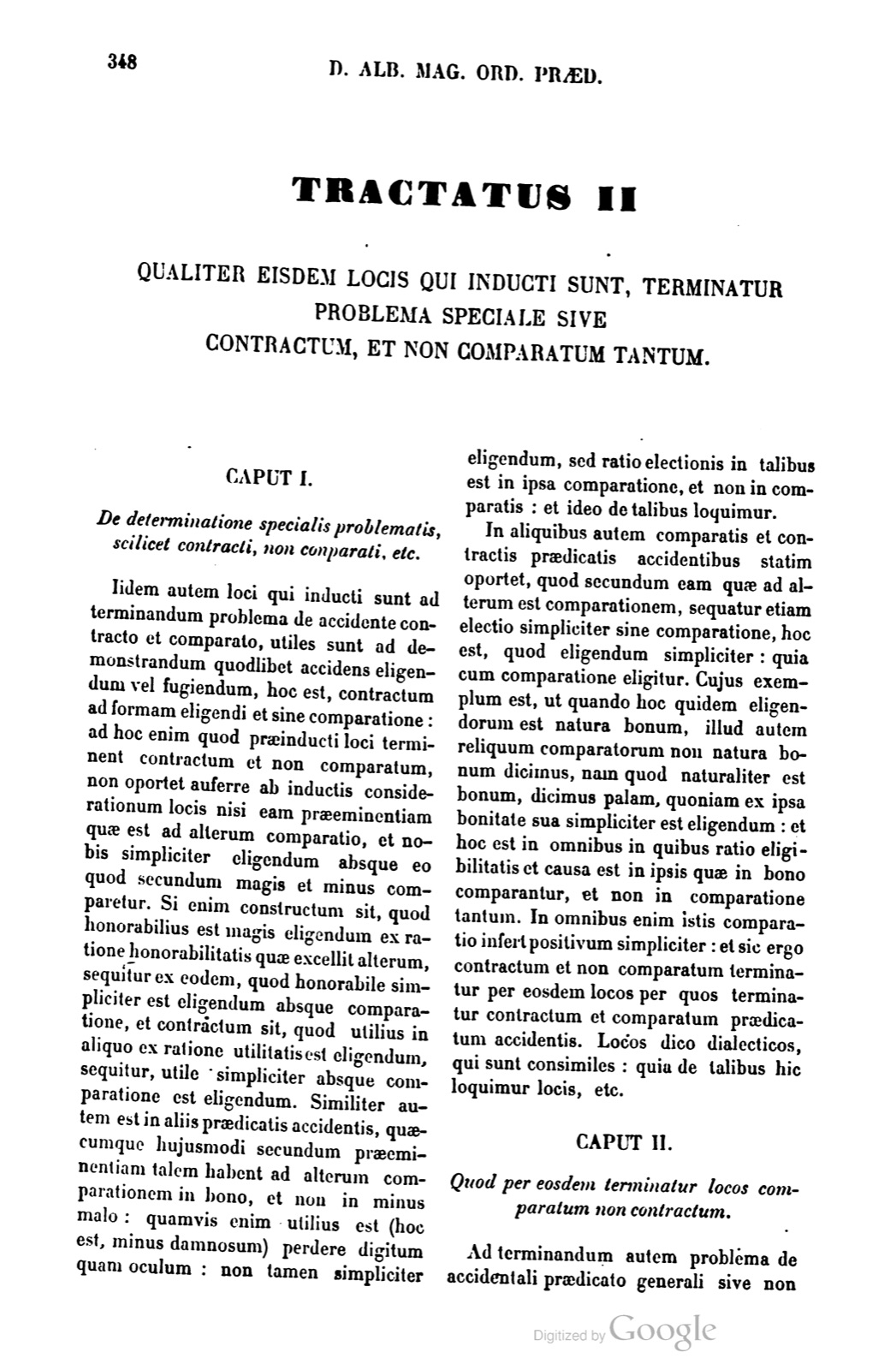
TRACTATUS II.
QUALITER EISDEM LOCIS QUI INDUCTI SUNT, TERMINATUR PROBLEMA SPECIALE SIVE CONTRACTUM, ET NON COMPARATUM TANTUM.
CAPUT I.
De determinatione specialis problematis, scilicet contracti, non comparati, etc.
Iidem autem loci qui inducti sunt ad terminandum problema de accidente contracto et comparato, utiles sunt ad demonstrandum quodlibet accidens eligendum vel fugiendum, hoc est, contractum ad formam eligendi et sine comparatione: ad hoc enim quod praeinducti loci terminent contractum et non comparatum, non oportet auferre ab inductis considerationum locis nisi eam praeeminentiam quae est ad alterum comparatio, et nobis simpliciter eligendum absque eo quod secundum magis et minus comparetur. Si enim constructum sit, quod honorabilius est magis eligendum ex ratione honorabilitatis quae excellit alterum, sequitur ex eodem, quod honorabile simpliciter est eligendum absque comparatione, et contractum sit, quod utilius in aliquo ex ratione utilitatis est eligendum, sequitur, utile simpliciter absque comparatione est eligendum. Similiter autem est in aliis praedicatis accidentis, quaecumque hujusmodi secundum praeeminentiam talem habent ad alterum comparationem in bono, et non in minus malo: quamvis enim utilius est (hoc est, minus damnosum) perdere digitum quam oculum: non tamen simpliciter eligendum, sed ratio electionis in talibus est in ipsa comparatione, et non in comparatis: et ideo de talibus loquimur.
In aliquibus autem comparatis et contractis praedicatis accidentibus statim oportet, quod secundum eam quae ad alterum est comparationem, sequatur etiam electio simpliciter sine comparatione, hoc est, quod eligendum simpliciter: quia cum comparatione eligitur. Cujus exemplum est, ut quando hoc quidem eligendorum est natura bonum, illud autem reliquum comparatorum non natura bonum dicimus, nam quod naturaliter est bonum, dicimus palam, quoniam ex ipsa bonitate sua simpliciter est eligendum: et hoc est in omnibus in quibus ratio eligibilitatis et causa est in ipsis quae in bono comparantur, et non in comparatione tantum. In omnibus enim istis comparatio infert positivum simpliciter: et sic ergo contractum et non comparatum terminatur per eosdem locos per quos terminatur contractum et comparatum praedicatum accidentis. Locos dico dialecticos, qui sunt consimiles: quia de talibus hic loquimur locis, etc.
CAPUT II.
Quod per eosdem terminatur locos comparatum non contractum.
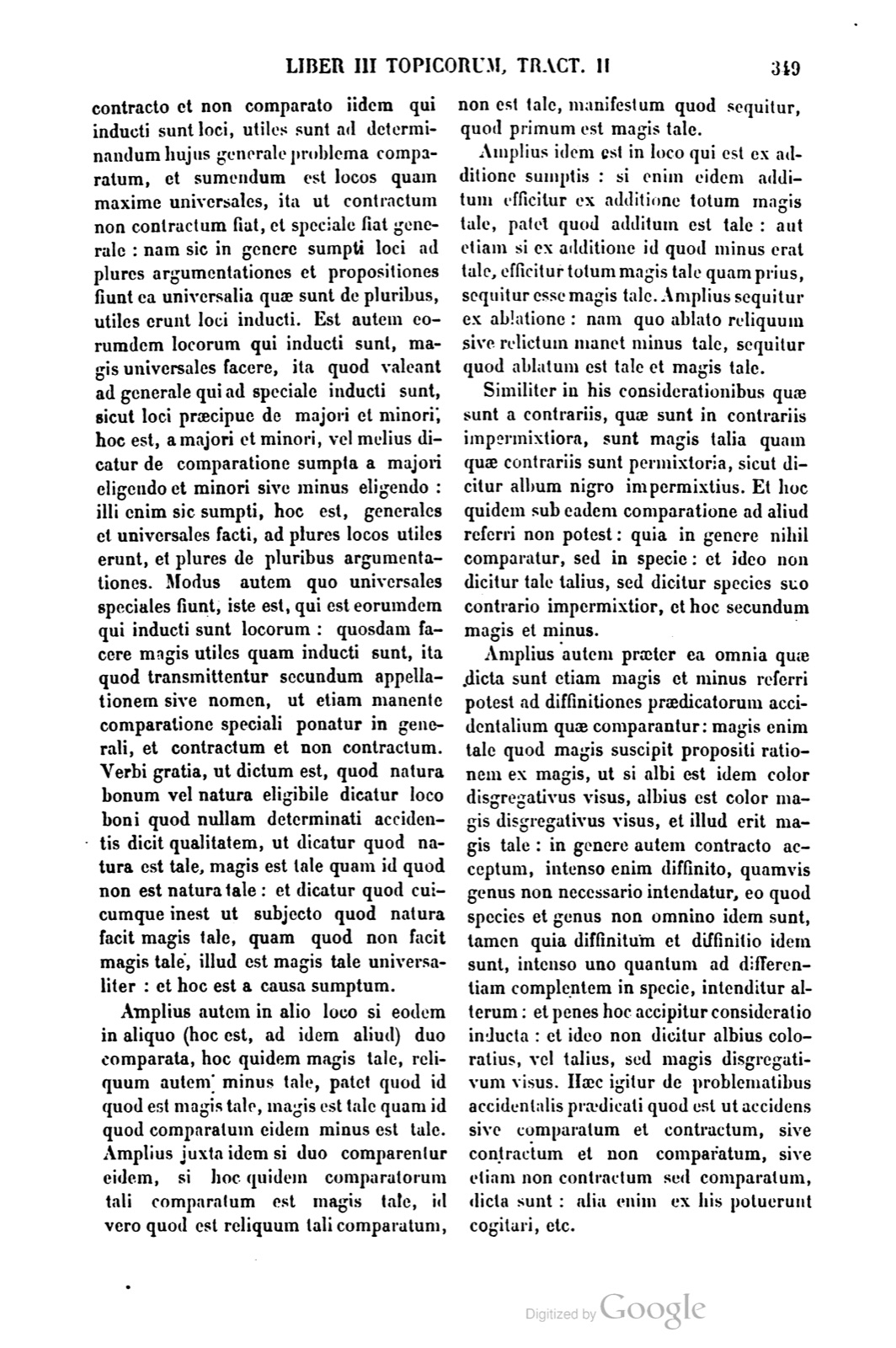
Ad terminandum autem problema de accidentali praedicato generali sive non contracto et non comparato iidem qui inducti sunt loci, utiles sunt ad determinandum hujus generale problema comparatum, et sumendum est locos quam maxime universales, ita ut contractum non contractum fiat, et speciale fiat generale: nam sic in genere sumpti loci ad plures argumentationes et propositiones fiunt ea universalia quae sunt de pluribus, utiles erunt loci inducti. Est autem eorumdem locorum qui inducti sunt, magis universales facere, ita quod valeant ad generale qui ad speciale inducti sunt, sicut loci praecipue de majori et minori, hoc est, a majori et minori, vel melius dicatur de comparatione sumpta a majori eligendo et minori sive minus eligendo: illi enim sic sumpti, hoc est, generales et universales facti, ad plures locos utiles erunt, et plures de pluribus argumentationes. Modus autem quo universales speciales fiunt, iste est, qui est eorumdem qui inducti sunt locorum: quosdam facere magis utiles quam inducti sunt, ita quod transmittentur secundum appellationem sive nomen, ut etiam manente comparatione speciali ponatur in generali, et contractum et non contractum. Verbi gratia, ut dictum est, quod natura bonum vel natura eligibile dicatur loco boni quod nullam determinati accidentis dicit qualitatem, ut dicatur quod natura est tale, magis est tale quam id quod non est natura tale: et dicatur quod cuicumque inest ut subjecto quod natura facit magis tale, quam quod non facit magis tale, illud est magis tale universaliter: et hoc est a causa sumptum.
TREATISE II.
HOW, BY THE SAME LOCI WHICH HAVE BEEN INTRODUCED, A SPECIAL PROBLEM, THAT IS, A CONTRACTED ONE, AND NOT ONLY A COMPARED ONE, IS TERMINATED.
CHAPTER I.
On the determination of a special problem, namely a contracted, not compared, problem, etc.
The same loci which have been introduced for terminating the problem concerning contracted and compared accident are useful for demonstrating that any accident whatever is to be chosen or to be fled, that is, contracted to the form of choosing and without comparison. For in order that the loci previously introduced may terminate the contracted and not compared thing, it is not necessary to remove from the introduced loci of considerations anything except that preeminence which is comparison to another, and the thing simply to be chosen by us apart from its being compared according to more and less. For if it has been constructed that what is more honorable is more to be chosen from the account of honorableness which excels another, it follows from the same point that the honorable simply is to be chosen apart from comparison; and if it has been contracted that what is more useful in something is to be chosen from the account of utility, it follows that the useful simply is to be chosen apart from comparison. It is similar in the other predicates of accident, whatever such predicates have comparison to another in good according to such preeminence, and not in a lesser evil. For although it is more useful, that is, less harmful, to lose a finger than an eye, nevertheless it is not simply to be chosen; rather, in such things the account of choice is in the comparison itself and not in the things compared. Therefore we speak of such things.
But in some compared and contracted accidental predicates it is at once necessary that, according to the comparison which is toward another, choice simply without comparison also follow, that is, what is to be chosen simply, because it is chosen with comparison. An example of this is when one of the things to be chosen is good by nature, while we say that the other remaining thing compared is not good by nature. For what is naturally good, we say openly, is simply to be chosen from its very goodness. And this is so in all things in which the account and cause of eligibility are in the very things compared in good, and not in comparison alone. For in all these cases comparison implies the positive simply. And thus, therefore, the contracted and not compared thing is terminated through the same loci through which the contracted and compared predicate of accident is terminated. I mean dialectical loci, which are similar, because here we are speaking about such loci, etc.
CHAPTER II.
That the compared, not contracted, problem is terminated through the same loci.
For terminating a problem concerning a general accidental predicate, that is, one not contracted and not compared, the same loci which have been introduced are useful for determining this general compared problem; and the loci must be taken as universal as possible, so that the contracted becomes not contracted, and the special becomes general. For loci thus taken in the genus become universals, which concern several things, for several argumentations and propositions; the introduced loci will be useful. It belongs to the same loci which have been introduced to make them more universal, so that those which were introduced for the special may have force for the general, especially loci concerning the greater and the lesser, that is, from the greater and lesser, or, better said, concerning comparison taken from the more chosen and from the lesser or less chosen. For those loci, thus taken, that is, made general and universal, will be useful for several loci and for several argumentations concerning several things. But the mode by which special things become universal is this, which belongs to the same loci that were introduced: to make certain loci more useful than they were when introduced, so that they are transferred according to appellation or name, so that, even while the special comparison remains, it is placed in the general, both contracted and not contracted. For example, as was said, what is good by nature or eligible by nature is said in place of good which states no quality of a determinate accident, so that it is said that what is such by nature is more such than what is not such by nature; and that whatever has as its subject what nature makes more such, rather than what does not make it more such, is more such universally. And this is taken from cause.
Amplius autem in alio loco si eodem in aliquo (hoc est, ad idem aliud) duo comparata, hoc quidem magis tale, reliquum autem minus tale, patet quod id quod est magis tale, magis est tale quam id quod comparatum eidem minus est tale. Amplius juxta idem si duo comparentur eidem, si hoc quidem comparatorum tali comparatum est magis tale, id vero quod est reliquum tali comparatum, non est tale, manifestum quod sequitur, quod primum est magis tale.
Amplius idem est in loco qui est ex additione sumptis: si enim eidem additum efficitur ex additione totum magis tale, patet quod additum est tale: aut etiam si ex additione id quod minus erat tale, efficitur totum magis tale quam prius, sequitur esse magis tale. Amplius sequitur ex ablatione: nam quo ablato reliquum sive relictum manet minus tale, sequitur quod ablatum est tale et magis tale.
Similiter in his considerationibus quae sunt a contrariis, quae sunt in contrariis impermixtiora, sunt magis talia quam quae contrariis sunt permixtoria, sicut dicitur album nigro impermixtius. Et hoc quidem sub eadem comparatione ad aliud referri non potest: quia in genere nihil comparatur, sed in specie: et ideo non dicitur tale talius, sed dicitur species suo contrario impermixtior, et hoc secundum magis et minus.
Amplius autem praeter ea omnia quae dicta sunt etiam magis et minus referri potest ad diffinitiones praedicatorum accidentalium quae comparantur: magis enim tale quod magis suscipit propositi rationem ex magis, ut si albi est idem color disgregativus visus, albius est color magis disgregativus visus, et illud erit magis tale: in genere autem contracto acceptum, intenso enim diffinito, quamvis genus non necessario intendatur, eo quod species et genus non omnino idem sunt, tamen quia diffinitum et diffinitio idem sunt, intenso uno quantum ad differentiam complentem in specie, intenditur alterum: et penes hoc accipitur consideratio inducta: et ideo non dicitur albius coloratius, vel talius, sed magis disgregativum visus. Haec igitur de problematibus accidentalis praedicati quod est ut accidens sive comparatum et contractum, sive contractum et non comparatum, sive etiam non contractum sed comparatum, dicta sunt: alia enim ex his potuerunt cogitari, etc.
Moreover, in another locus, if two things compared in the same thing in something, that is, to the same other thing, are such that one is more such and the remaining one less such, it is plain that what is more such is more such than that which, compared to the same thing, is less such. Furthermore, according to the same point, if two things are compared to the same thing, and if this one of the compared things, compared with something such, is more such, while that which is the remaining one compared with something such is not such, it is manifest that it follows that the first is more such.
Moreover, the same applies in the locus taken from addition: for if by being added to the same thing something makes the whole more such from the addition, it is plain that the added thing is such; or also, if from the addition that which was less such becomes a whole more such than before, it follows that it is more such. Furthermore, it follows from removal: for when something has been removed and the remaining or left thing remains less such, it follows that the removed thing is such and more such.
Similarly, in these considerations which are from contraries, the things which in contraries are more unmixed are more such than the things which are mixed with contraries, as white is said to be more unmixed with black. And this indeed cannot be referred to another under the same comparison, because in the genus nothing is compared, but in the species; and therefore such is not said to be more such, but a species is said to be more unmixed with its contrary, and this according to more and less.
Moreover, besides all those things which have been said, more and less can also be referred to the definitions of accidental predicates which are compared. For the more such is what more receives the proposed account from the more; as, if the same color dispersive of sight belongs to white, the whiter is a color more dispersive of sight, and that will be more such. But when it is accepted in a contracted genus, when the defined thing is intensified, although the genus is not necessarily intensified, because species and genus are not entirely the same, nevertheless, because the defined thing and the definition are the same, when one is intensified as to the difference completing it in the species, the other is intensified. And according to this the introduced consideration is received; and therefore it is not said that the whiter is more colored, or more such, but more dispersive of sight. Therefore these things have been said concerning the problems of the accidental predicate which is as accident, whether compared and contracted, or contracted and not compared, or even not contracted but compared; for other things could be thought from these, etc.
If a page does not appear, its photograph has not been uploaded yet.