Volume 2 · pp. 344–346
CHAPTER VII. On the comparison of good to good from cases, uses, acts, and works
A marker with ≈ is an approximate page boundary, placed by measure of the text; the page photographs remain the authority. In the paired views, clicking a page marker brings that page into view.
CAPUT VII.
De comparatione boni ad bonum a casibus et usibus et actibus et operibus.
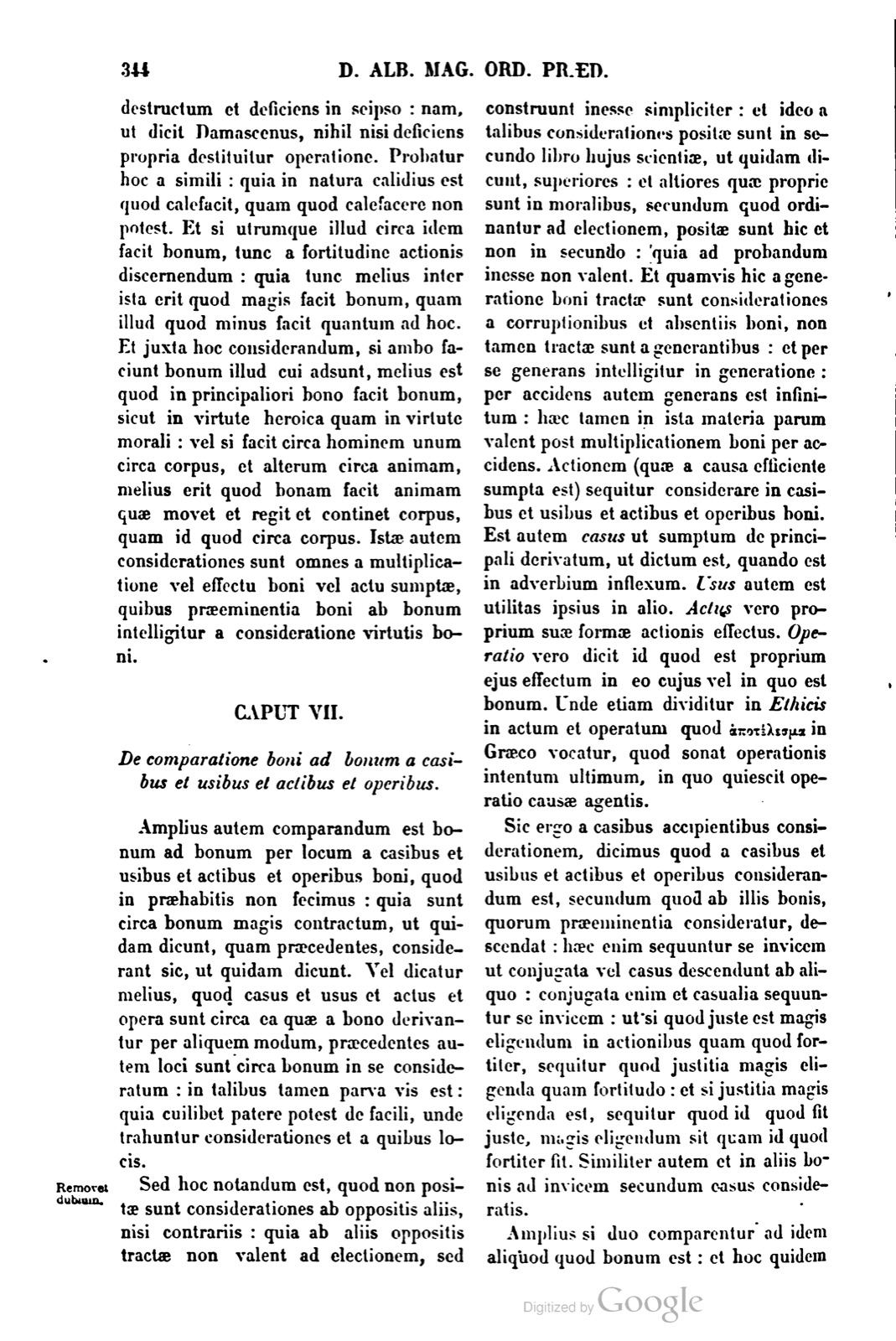
Amplius autem comparandum est bonum ad bonum per locum a casibus et usibus et actibus et operibus boni, quod in praehabitis non fecimus: quia sunt circa bonum magis contractum, ut quidam dicunt, quam praecedentes, considerant sic, ut quidam dicunt. Vel dicatur melius, quod casus et usus et actus et opera sunt circa ea quae a bono derivantur per aliquem modum, praecedentes autem loci sunt circa bonum in se consideratum: in talibus tamen parva vis est: quia cuilibet patere potest de facili, unde trahuntur considerationes et a quibus locis.
[Marginal label, printed page 344: Removet dubium.]
Sed hoc notandum est, quod non positae sunt considerationes ab oppositis aliis, nisi contrariis: quia ab aliis oppositis tractae non valent ad electionem, sed construunt inesse simpliciter: et ideo a talibus considerationes positae sunt in secundo libro hujus scientiae, ut quidam dicunt, superiores: et altiores quae proprie sunt in moralibus, secundum quod ordinantur ad electionem, positae sunt hic et non in secundo: quia ad probandum inesse non valent. Et quamvis hic a generatione boni tractae sunt considerationes a corruptionibus et absentiis boni, non tamen tractae sunt a generantibus: et per se generans intelligitur in generatione: per accidens autem generans est infinitum: haec tamen in ista materia parum valent post multiplicationem boni per accidens. Actionem (quae a causa efficiente sumpta est) sequitur considerare in casibus et usibus et actibus et operibus boni. Est autem casus ut sumptum de principali derivatum, ut dictum est, quando est in adverbium inflexum. Usus autem est utilitas ipsius in alio. Actus vero proprium suae formae actionis effectus. Operatio vero dicit id quod est proprium ejus effectum in eo cujus vel in quo est bonum. Unde etiam dividitur in Ethicis in actum et operatum quod ἀποτέλεσμα in Graeco vocatur, quod sonat operationis intentum ultimum, in quo quiescit operatio causae agentis.
Sic ergo a casibus accipientibus considerationem, dicimus quod a casibus et usibus et actibus et operibus considerandum est, secundum quod ab illis bonis, quorum praeeminentia consideratur, descendat: haec enim sequuntur se invicem ut conjugata vel casus descendunt ab aliquo: conjugata enim et casualia sequuntur se invicem: ut si quod juste est magis eligendum in actionibus quam quod fortiter, sequitur quod justitia magis eligenda quam fortitudo: et si justitia magis eligenda est, sequitur quod id quod fit juste, magis eligendum sit quam id quod fortiter fit. Similiter autem et in aliis bonis ad invicem secundum casus consideratis.
CHAPTER VII.
On the comparison of good to good from cases, uses, acts, and works.
Moreover, good must be compared to good through the locus from the cases, uses, acts, and works of the good, which we did not do in the preceding matters, because they concern a good more contracted, as some say, than the preceding considerations do; they consider in this way, as some say. Or it may be said better that cases, uses, acts, and works concern the things which are derived from good in some way, while the preceding loci concern good considered in itself. Yet in such matters there is little force, because it can easily be clear to anyone from where the considerations are drawn and from which loci.
[Marginal label, printed page 344: He removes a doubt.]
But this must be noted, that considerations have not been set down from other opposites except contraries, because considerations drawn from other opposites do not have force for choice, but construct being-in simply. And therefore considerations from such things were set down in the second book of this science, as some say, as higher ones; and higher ones, which are properly in morals insofar as they are ordered to choice, have been set down here and not in the second book, because they do not have force for proving being-in. And although here considerations have been treated from the generation of good, from the corruptions and absences of good, nevertheless they have not been treated from generators. What generates per se is understood in generation, but what generates per accidens is infinite. Yet these things in this matter have little force after the multiplication of good per accidens. After action, which has been taken from the efficient cause, it follows to consider in the cases, uses, acts, and works of good. A case, as was said, is what is taken as derived from the principal when it is inflected into an adverb. Use is its utility in another. Act, however, is the proper effect of the action of its form. Operation, however, names that which is its proper effect in that whose good it is or in which it is good. Hence also in the Ethics it is divided into act and product, which is called ἀποτέλεσμα in Greek, which signifies the final intended thing of operation, in which the operation of the acting cause rests.
Thus, therefore, taking the consideration from cases, we say that one must consider from cases, uses, acts, and works according as it descends from those goods whose preeminence is being considered. For these follow one another mutually as conjugates, or cases descend from something; for conjugates and case-forms follow one another mutually. For example, if what is justly done is more to be chosen in actions than what is done bravely, it follows that justice is more to be chosen than courage; and if justice is more to be chosen, it follows that what is done justly is more to be chosen than what is done bravely. And similarly in other goods considered with one another according to cases.
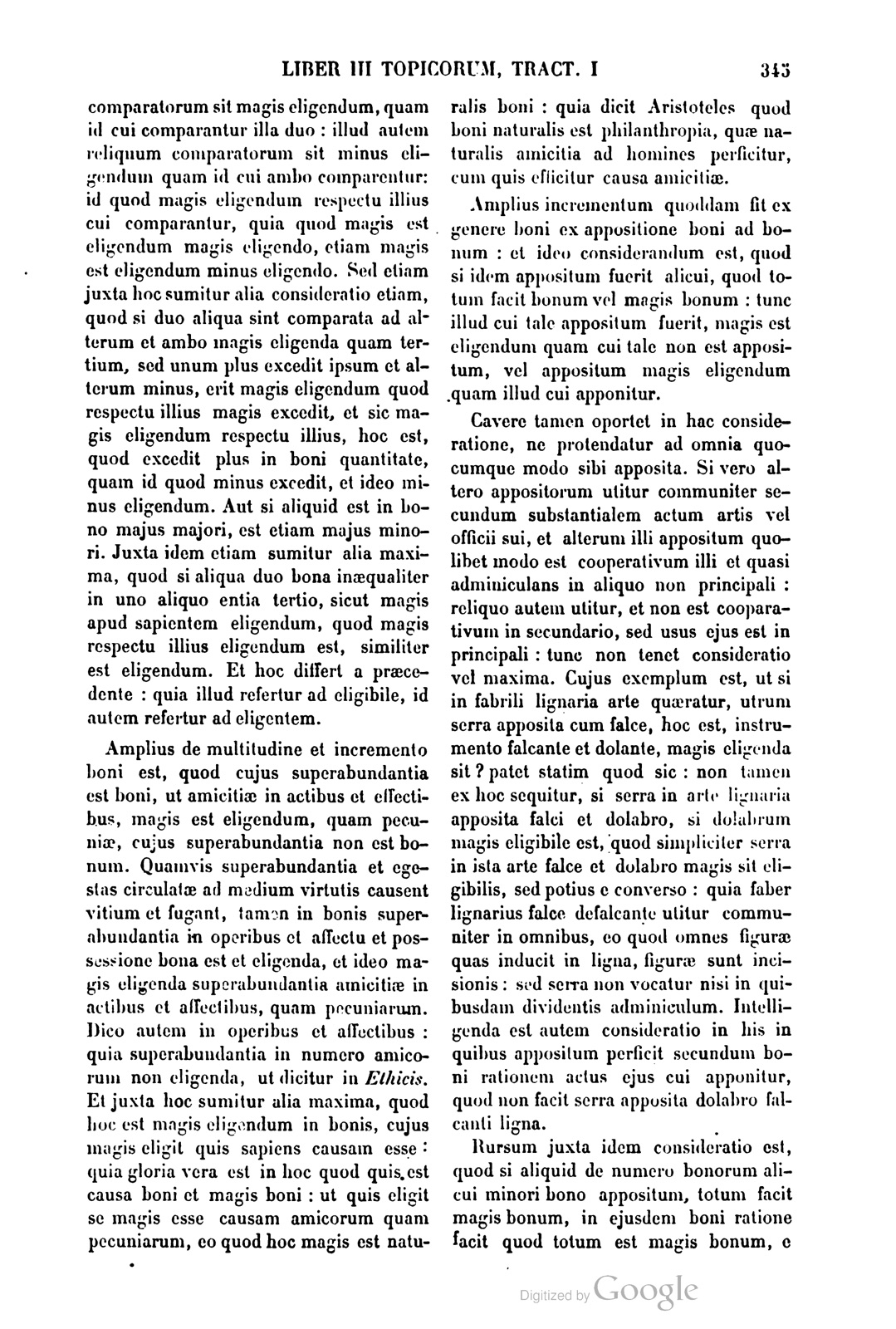
Amplius si duo comparentur ad idem aliquod quod bonum est: et hoc quidem comparatorum sit magis eligendum, quam id cui comparantur illa duo: illud autem reliquum comparatorum sit minus eligendum quam id cui ambo comparentur: id quod magis eligendum respectu illius cui comparantur, quia quod magis est eligendum magis eligendo, etiam magis est eligendum minus eligendo. Sed etiam juxta hoc sumitur alia consideratio etiam, quod si duo aliqua sint comparata ad alterum et ambo magis eligenda quam tertium, sed unum plus excedit ipsum et alterum minus, erit magis eligendum quod respectu illius magis excedit, et sic magis eligendum respectu illius, hoc est, quod excedit plus in boni quantitate, quam id quod minus excedit, et ideo minus eligendum. Aut si aliquid est in bono majus majori, est etiam majus minori. Juxta idem etiam sumitur alia maxima, quod si aliqua duo bona inaequaliter in uno aliquo entia tertio, sicut magis apud sapientem eligendum, quod magis respectu illius eligendum est, similiter est eligendum. Et hoc differt a praecedente: quia illud refertur ad eligibile, id autem refertur ad eligentem.
Amplius de multitudine et incremento boni est, quod cujus superabundantia est boni, ut amicitiae in actibus et effectibus, magis est eligendum, quam pecuniae, cujus superabundantia non est bonum. Quamvis superabundantia et egestas circulatae ad medium virtutis causent vitium et fugant, tamen in bonis superabundantia in operibus et affectu et possessione bona est et eligenda, et ideo magis eligenda superabundantia amicitiae in actibus et affectibus, quam pecuniarum. Dico autem in operibus et affectibus: quia superabundantia in numero amicorum non eligenda, ut dicitur in Ethicis. Et juxta hoc sumitur alia maxima, quod hoc est magis eligendum in bonis, cujus magis eligit quis sapiens causam esse: quia gloria vera est in hoc quod quis est causa boni et magis boni: ut quis eligit se magis esse causam amicorum quam pecuniarum, eo quod hoc magis est naturalis boni: quia dicit Aristoteles quod boni naturalis est philanthropia, quae naturalis amicitia ad homines perficitur, cum quis efficitur causa amicitiae.
Amplius incrementum quoddam fit ex genere boni ex appositione boni ad bonum: et ideo considerandum est, quod si idem appositum fuerit alicui, quod totum facit bonum vel magis bonum: tunc illud cui tale appositum fuerit, magis est eligendum quam cui tale non est appositum, vel appositum magis eligendum quam illud cui apponitur.
Moreover, if two things are compared to one same thing which is good, and this one of the compared things is more to be chosen than that to which those two are compared, while the remaining compared thing is less to be chosen than that to which both are compared, then what is more to be chosen with respect to that to which they are compared is more to be chosen, because what is more to be chosen than the more chosen is also more to be chosen than the less chosen. But also according to this another consideration is taken: if two things are compared to another and both are more to be chosen than a third, but one exceeds it more and the other less, what exceeds it more with respect to that will be more to be chosen, and so more to be chosen with respect to that, that is, what exceeds more in quantity of good, than what exceeds less and therefore is less to be chosen. Or if something is greater in good than the greater thing, it is also greater than the lesser. According to the same point another maxim is also taken: if two goods exist unequally in some third thing, as what is more to be chosen by the wise person, then what is more to be chosen with respect to that is likewise to be chosen. And this differs from the preceding consideration, because the former is referred to the eligible thing, while this one is referred to the one choosing.
Moreover, concerning the multitude and increase of good, that whose superabundance is good, as friendship in acts and effects, is more to be chosen than money, whose superabundance is not good. Although superabundance and need, when they are turned around the mean of virtue, cause vice and flee it, nevertheless among goods superabundance in works and affection and possession is good and to be chosen. Therefore the superabundance of friendship in acts and affections is more to be chosen than the superabundance of money. But I say in works and affections because superabundance in the number of friends is not to be chosen, as is said in the Ethics. And according to this another maxim is taken: among goods, that is more to be chosen of whose cause the wise person more chooses to be the cause, because true glory consists in this, that someone is the cause of good and of greater good. Thus someone chooses more to be the cause of friends than of money, because this is more a good of nature; for Aristotle says that philanthropy belongs to natural good, and natural friendship toward human beings is perfected when someone becomes a cause of friendship.
Moreover, a certain increase is made from the genus of good by the addition of good to good. Therefore one must consider that, if the same thing has been added to something and makes the whole good or more good, then that to which such a thing has been added is more to be chosen than that to which such a thing has not been added, or the added thing is more to be chosen than that to which it is added.
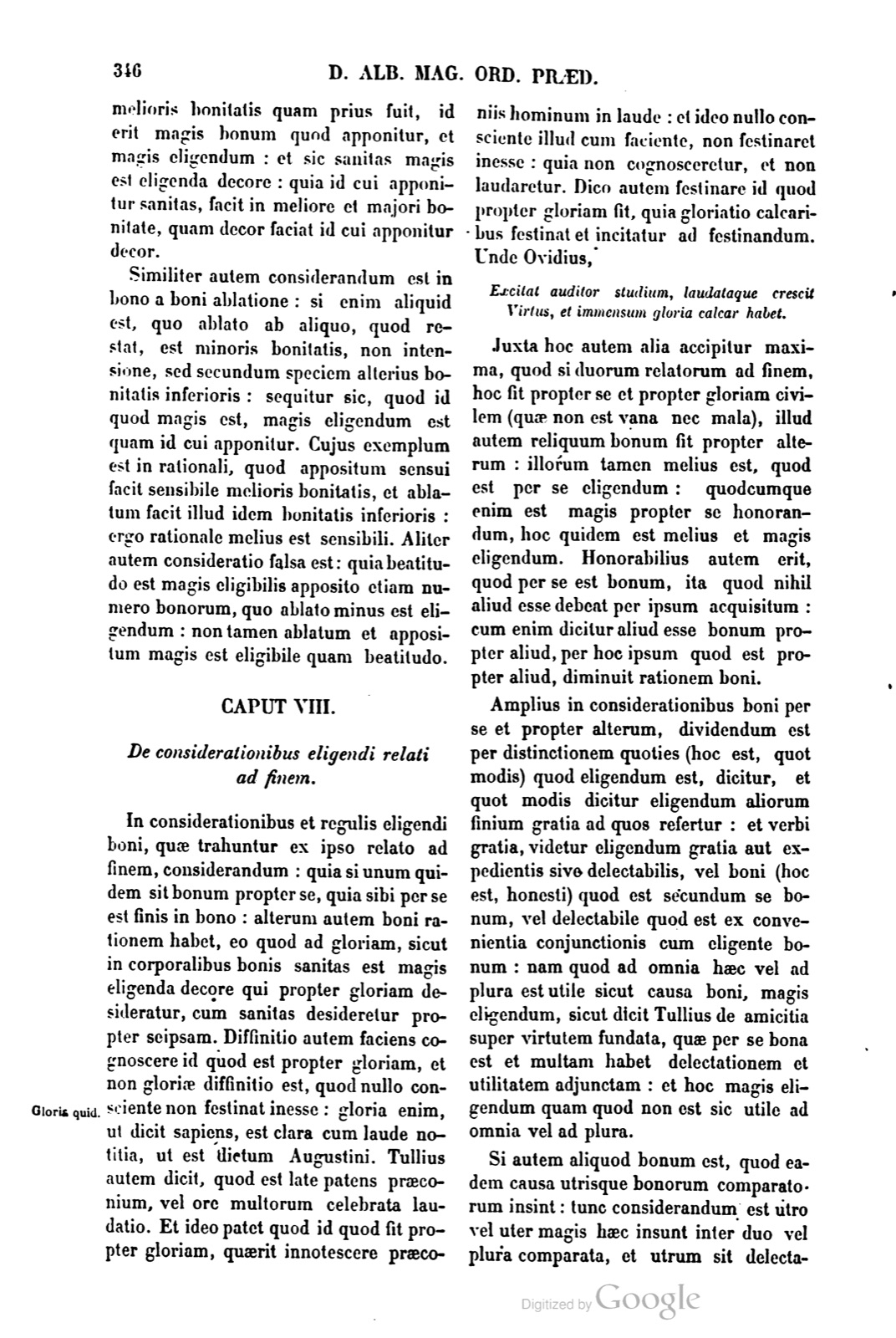
Cavere tamen oportet in hac consideratione, ne protendatur ad omnia quocumque modo sibi apposita. Si vero altero appositorum utitur communiter secundum substantialem actum artis vel officii sui, et alterum illi appositum quolibet modo est cooperativum illi et quasi adminiculans in aliquo non principali: reliquo autem utitur, et non est cooperativum in secundario, sed usus ejus est in principali: tunc non tenet consideratio vel maxima. Cujus exemplum est, ut si in fabrili lignaria arte quaeratur, utrum serra apposita cum falce, hoc est, instrumento falcante et dolante, magis eligenda sit? patet statim quod sic: non tamen ex hoc sequitur, si serra in arte lignaria apposita falci et dolabro, si dolabrum magis eligibile est, quod simpliciter serra in ista arte falce et dolabro magis sit eligibilis, sed potius e converso: quia faber lignarius falce defalcante utitur communiter in omnibus, eo quod omnes figurae quas inducit in ligna, figurae sunt incisionis: sed serra non vocatur nisi in quibusdam dividentis adminiculum. Intelligenda est autem consideratio in his in quibus appositum perficit secundum boni rationem actus ejus cui apponitur, quod non facit serra apposita dolabro falcanti ligna.
Rursum juxta idem consideratio est, quod si aliquid de numero bonorum alicui minori bono appositum, totum facit magis bonum, in ejusdem boni ratione facit quod totum est magis bonum, et melioris bonitatis quam prius fuit, id erit magis bonum quod apponitur, et magis eligendum: et sic sanitas magis est eligenda decore: quia id cui apponitur sanitas, facit in meliore et majori bonitate, quam decor faciat id cui apponitur decor.
Similiter autem considerandum est in bono a boni ablatione: si enim aliquid est, quo ablato ab aliquo, quod restat, est minoris bonitatis, non intensione, sed secundum speciem alterius bonitatis inferioris: sequitur sic, quod id quod magis est, magis eligendum est quam id cui apponitur. Cujus exemplum est in rationali, quod appositum sensui facit sensibile melioris bonitatis, et ablatum facit illud idem bonitatis inferioris: ergo rationale melius est sensibili. Aliter autem consideratio falsa est: quia beatitudo est magis eligibilis apposito etiam numero bonorum, quo ablato minus est eligendum: non tamen ablatum et appositum magis est eligibile quam beatitudo.
Yet one must beware in this consideration lest it be extended to all things added to a thing in whatever way. But if one uses one of the added things commonly according to the substantial act of his art or office, and the other thing added to it is in any way cooperative with it and, as it were, helping in something not principal, while he uses the remaining thing and it is not cooperative in the secondary thing but its use is in the principal thing, then the consideration or maxim does not hold. An example of this is if, in the carpenter's woodworking art, it is asked whether a saw added with a sickle, that is, with an instrument that cuts with a sickle and cuts with an axe, is more to be chosen. It is immediately plain that it is. Yet from this it does not follow that, if a saw in the woodworking art is added to a sickle and an axe, and if the axe is more eligible, the saw simply in that art is more eligible than the sickle and axe, but rather the reverse; because the carpenter commonly uses the sickle that cuts in all things, because all the shapes which he induces in wood are shapes of incision, whereas the saw is called in only in certain cases as an aid for one dividing. But the consideration must be understood in those things in which the added thing perfects, according to the account of good, the act of the thing to which it is added, which a saw added to an axe cutting wood does not do.
Again, according to the same point there is this consideration: if something from the number of goods, added to some lesser good, makes the whole more good, in the same account of good it makes the whole more good and of better goodness than it was before, that which is added will be more good and more to be chosen. And thus health is more to be chosen than beauty, because that to which health is added it makes in a better and greater goodness than beauty makes that to which beauty is added.
Similarly, one must consider in the good from the removal of good: if there is something by whose removal from something the thing that remains is of lesser goodness, not in intensity but according to the species of another and inferior goodness, it follows in this way that what is greater is more to be chosen than that to which it is added. An example of this is in the rational: when added to sense it makes the sensible thing of better goodness, and when removed it makes that same thing of inferior goodness; therefore the rational is better than the sensible. But otherwise the consideration is false, because happiness is more eligible even when the number of goods has been added, and when it is removed the thing is less to be chosen; nevertheless the thing removed and added is not more eligible than happiness.
If a page does not appear, its photograph has not been uploaded yet.