Volume 2 · pp. 343–344
CHAPTER VI. On the comparison of good to its absence or presence or abundance
A marker with ≈ is an approximate page boundary, placed by measure of the text; the page photographs remain the authority. In the paired views, clicking a page marker brings that page into view.
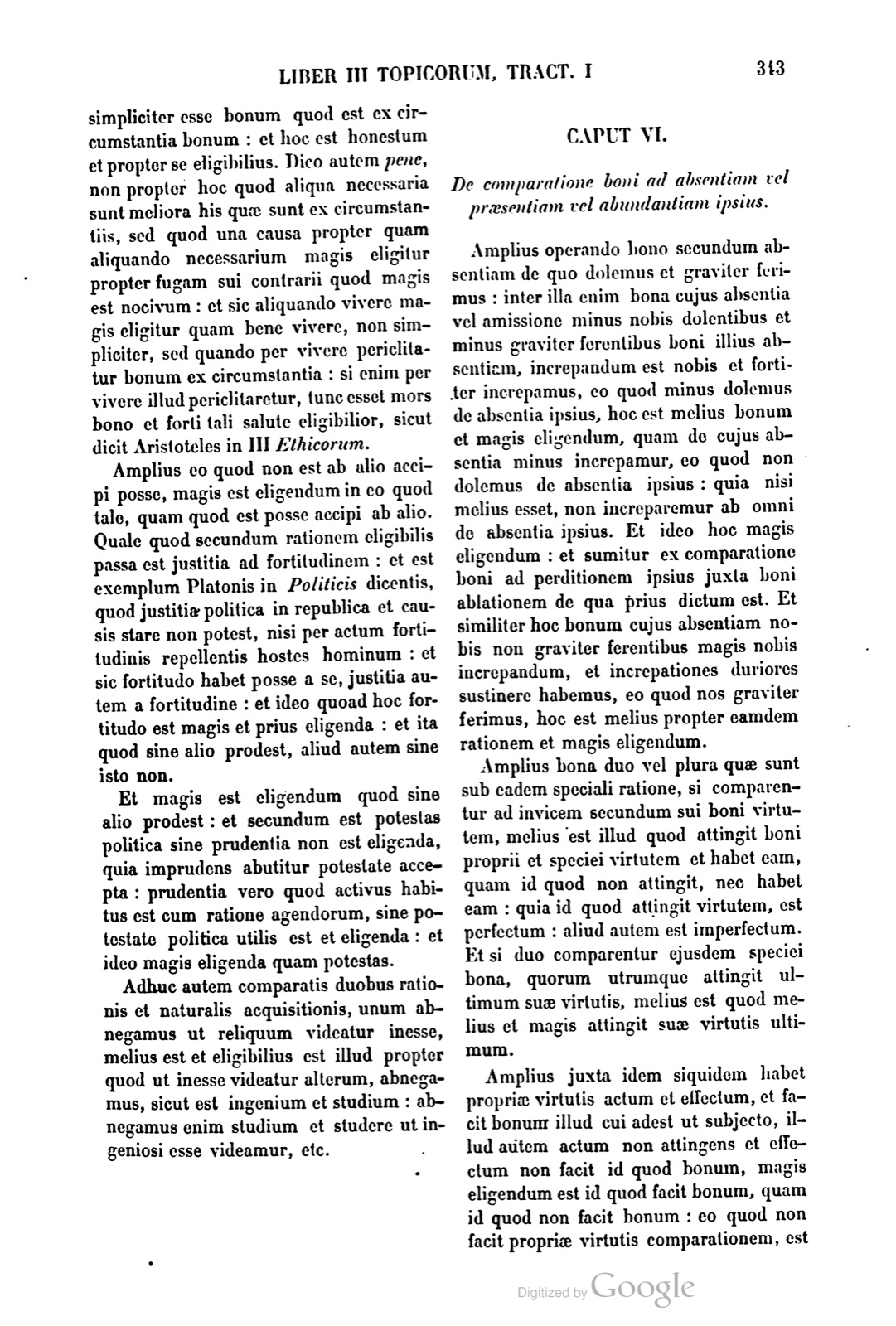
CAPUT VI.
De comparatione boni ad absentiam vel praesentiam vel abundantiam ipsius.
Amplius operando bono secundum absentiam de quo dolemus et graviter ferimus: inter illa enim bona cujus absentia vel amissione minus nobis dolentibus et minus graviter ferentibus boni illius absentiam, increpandum est nobis et fortiter increpamus, eo quod minus dolemus de absentia ipsius, hoc est melius bonum et magis eligendum, quam de cujus absentia minus increpamur, eo quod non dolemus de absentia ipsius: quia nisi melius esset, non increparemur ab omni de absentia ipsius. Et ideo hoc magis eligendum: et sumitur ex comparatione boni ad perditionem ipsius juxta boni ablationem de qua prius dictum est. Et similiter hoc bonum cujus absentiam nobis non graviter ferentibus magis nobis increpandum, et increpationes duriores sustinere habemus, eo quod nos graviter ferimus, hoc est melius propter eamdem rationem et magis eligendum.
Amplius bona duo vel plura quae sunt sub eadem speciali ratione, si comparentur ad invicem secundum sui boni virtutem, melius est illud quod attingit boni proprii et speciei virtutem et habet eam, quam id quod non attingit, nec habet eam: quia id quod attingit virtutem, est perfectum: aliud autem est imperfectum. Et si duo comparentur ejusdem speciei bona, quorum utrumque attingit ultimum suae virtutis, melius est quod melius et magis attingit suae virtutis ultimum.
CHAPTER VI.
On the comparison of good to its absence or presence or abundance.
Moreover, by operating upon the good according to absence, concerning which we grieve and take it heavily: among those goods, the good whose absence or loss, when we grieve less and bear less heavily the absence of that good, makes us blameworthy, and concerning which we strongly blame ourselves because we grieve less over its absence, is a better good and more to be chosen than the good concerning whose absence we are blamed less because we do not grieve over its absence. For unless it were better, we would not be blamed by everyone for its absence. Therefore this is more to be chosen; and it is taken from the comparison of good to its own destruction according to the removal of good, about which it was said before. And similarly, the good whose absence, when we do not bear it heavily, makes us more blameworthy and makes us have to sustain harsher rebukes because we are struck heavily, is a better good for the same reason and more to be chosen.
Moreover, if two or more goods which are under the same special account are compared with one another according to the virtue of their good, that one is better which reaches the virtue of its proper good and species and has it, than that which does not reach it and does not have it, because what reaches the virtue is perfect, while the other is imperfect. And if two goods of the same species are compared, each of which reaches the ultimate of its virtue, that is better which better and more reaches the ultimate of its virtue.
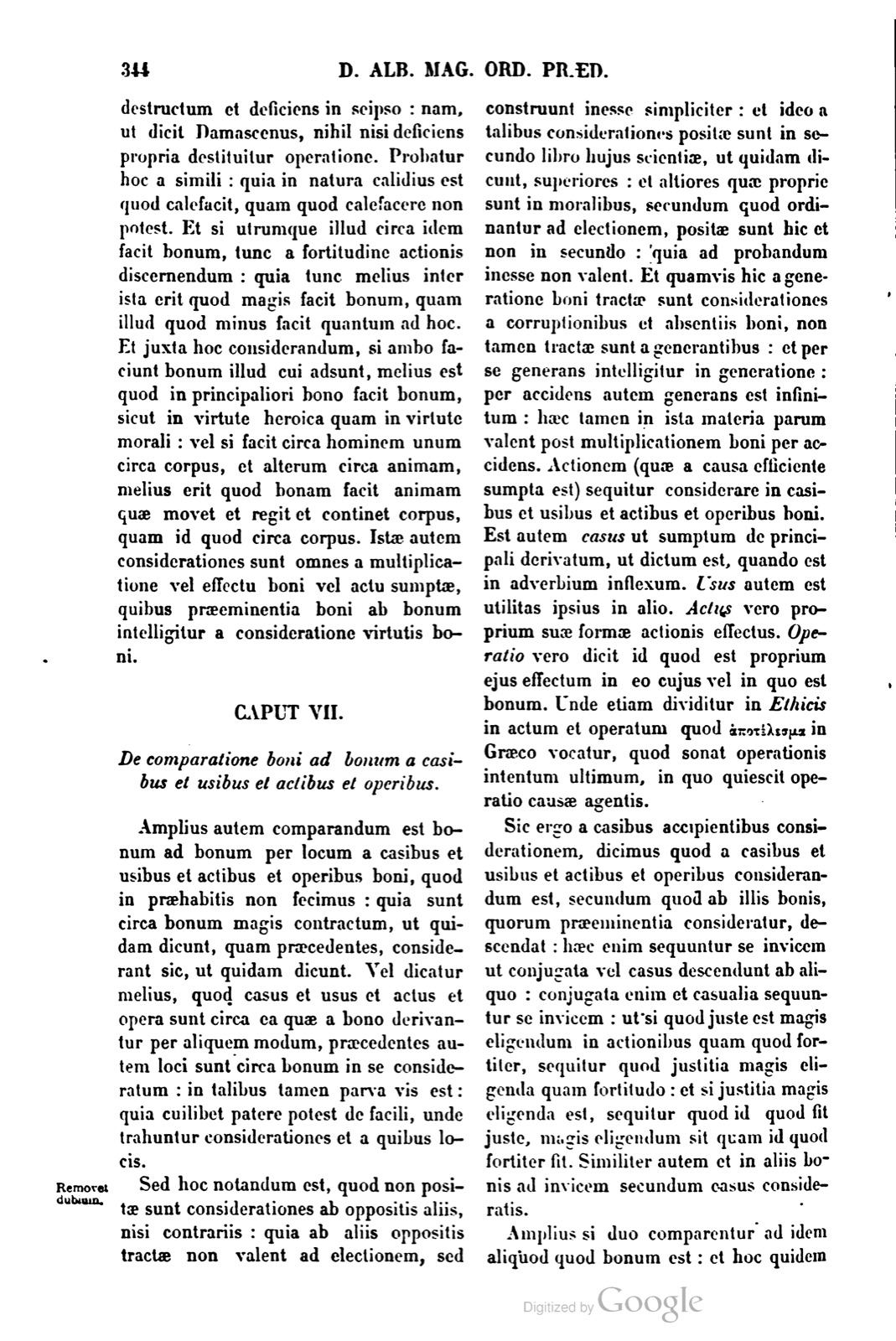
Amplius juxta idem siquidem habet propriae virtutis actum et effectum, et facit bonum illud cui adest ut subjecto, illud autem actum non attingens et effectum non facit id quod bonum, magis eligendum est id quod facit bonum, quam id quod non facit bonum: eo quod non facit propriae virtutis comparationem, est destructum et deficiens in seipso: nam, ut dicit Damascenus, nihil nisi deficiens propria destituitur operatione. Probatur hoc a simili: quia in natura calidius est quod calefacit, quam quod calefacere non potest. Et si utrumque illud circa idem facit bonum, tunc a fortitudine actionis discernendum: quia tunc melius inter ista erit quod magis facit bonum, quam illud quod minus facit quantum ad hoc. Et juxta hoc considerandum, si ambo faciunt bonum illud cui adsunt, melius est quod in principaliori bono facit bonum, sicut in virtute heroica quam in virtute morali: vel si facit circa hominem unum circa corpus, et alterum circa animam, melius erit quod bonam facit animam quae movet et regit et continet corpus, quam id quod circa corpus. Istae autem considerationes sunt omnes a multiplicatione vel effectu boni vel actu sumptae, quibus praeeminentia boni ab bonum intelligitur a consideratione virtutis boni.
Moreover, according to the same point, if one thing has the act and effect of its proper virtue and makes good the thing to which it is present as to a subject, while the other, not reaching the act and effect, does not make good that which is good, the thing that makes good is more to be chosen than the thing that does not make good; because what does not make a comparison of its proper virtue is destroyed and deficient in itself. For, as Damascene says, nothing except what is deficient is deprived of its proper operation. This is proved from a similar case: in nature, what heats is hotter than what cannot heat. And if each of those two makes good with regard to the same thing, then one must discern from the strength of the action, because then the better among those will be what makes good more than what makes good less as to this. And according to this one must consider, if both make good that to which they are present, that what makes good in a more principal good is better, as in heroic virtue rather than in moral virtue; or if one makes good with respect to the human being around the body, and the other around the soul, that will be better which makes the soul good, which moves, rules, and contains the body, than what acts around the body. But all these considerations are taken from the multiplication or effect of good or from act, by which the preeminence of good over good is understood from the consideration of the virtue of good.
If a page does not appear, its photograph has not been uploaded yet.