Volume 2 · pp. 341–343
Conclusion of Chapter V on inspection toward the good to be chosen
A marker with ≈ is an approximate page boundary, placed by measure of the text; the page photographs remain the authority. In the paired views, clicking a page marker brings that page into view.
Similiter in consideratione similium, quod similius est bono, melius esse dicitur, ut justitia quam justum magis est eligenda: quia magis similis est bono: cum justitia sit ens fixum et stans in genere boni: justum autem non est tale ens, ut prius dictum est: et ideo similior est bono quod est genus in moribus.
Et si duo comparentur ad duo, id quod meliori duorum similius est, quoad hoc magis est eligendum: quia hoc informatum est bonitate melioris, quod aliter in bono non esset similis illi. Quemadmodum Ajacem Ulysse quidem dicunt esse meliorem, eo quod in bonis et in heroicis virtutibus similior erat Achilli, qui optimus fuit quam Ulysses.
Instantia autem hujus consimilitudinis quaedam esse videtur, quae non sophisticam fert considerationem, sed ad rectum adducit intellectum: videtur tamen generaliter verum quod dictum est, quod Ajax similior Achilli in eo quod optimus est (hoc est, in virtutibus heroicis) altero quidem, hoc est, Ulysse existente bono, non similiter autem in optimis virtutibus: et ideo consideratio intelligitur de similitudine et in optimis virtutibus, et non in quibuscumque.
Unde etiam in talibus considerandum est si in ridiculosioribus meliori sit simile vel simili, velut simia homini est similior quam equus: tunc enim non sequitur quod id quod similius est meliori sit melius: non enim simia melior est equo et quolibet bruto.
Rursum autem per hunc locum considerandum in duobus comparatis ad unum melius ipsis, si hoc quidem in meliori sit simile bono: illud autem aliud cui comparatur in pejori, sit simile eidem: erit enim melius quod in meliori est simile, quia hoc melioris boni informatum est qualitate.
[Marginal label, printed page 341: Objectio textus.]
Habere autem instantiam et in hoc videtur, non quae considerationem impediat, sed quae ad rectum intellectum ducat considerationis: possibile enim est quod Ajax Achilli optimo parum sit similis in optimis. Parum autem dico in paucis esse similem. Ulysses autem Nestori bono minus sit similis in multis et valde.
[Marginal label, printed page 341: Solutio.]
Sed hujus solutio est, quod intelligitur de similitudine in pluribus et melioribus: et sic procedit consideratio.
[Marginal label, printed page 341: Alia objectio textus.]
Adhuc autem instantia videtur esse si hoc quidem comparatorum est simile meliori in pejoribus quae insunt meliori: illud autem aliud comparatorum simile sit pejori in moralibus, ut equus et asino in melioribus asini similis est, et simia homini ridiculosioribus et pejoribus.
[Marginal label, printed page 341: Solutio.]
Sed sicut dictum est, non sic procedit consideratio. Et istae consimilitudines, ut quidam dicunt, sumptae sunt in contracto bono ad quantitatem boni. Sed dicendum quod sumuntur, sicut dictum est in expositione earum.
Consideratio autem in qualitate boni accidentali: tunc id quod nobilius est secundum originem suam, magis est eligendum quam id quod minus est tale, et nobile, quod in origine est alterum ex principiorum et bonorum principio de quo procedit, ut dicit Victorinus.
[Marginal label, printed page 341: Quare difficulter acquisitum est magis eligendum.]
Adhuc autem in boni acquisitione sive sumptione considerandum est: quia quidquid difficilius est sumere, est magis eligendum. Magis amamus cum habemus ea quae difficile est sumere. Et hujus causa redditur tertio Ethicorum: quia apud sapientes non ponitur difficultas in acquirendo, nisi bonitas acquisiti vincat in bono laborem acquirentis: et ideo difficiliter acquisitum magis eligendum est secundum prudentiam sapientis: et sic intelligitur consideratio, quia aliter electio stulta esset, ut dicitur in Ethicis.
Similarly, in the consideration of similars, what is more similar to the good is said to be better, as justice is more to be chosen than the just thing, because it is more similar to good, since justice is a fixed being and standing in the genus of good; but the just thing is not such a being, as was said before; and therefore that which is a genus in morals is more similar to good.
And if two things are compared with two things, that which is more similar to the better of the two is, in this respect, more to be chosen, because this has been informed by the goodness of the better thing, since otherwise in the good it would not be similar to it. In this way they say Ajax was better than Ulysses, because in good things and in heroic virtues he was more similar to Achilles, who was best, than Ulysses was.
But there seems to be a certain instance against this likeness, one which does not bring a sophistical consideration but leads the understanding to the right sense. Yet what was said seems generally true: Ajax was more similar to Achilles in that in which he is best, that is, in heroic virtues, while the other, namely Ulysses, was good, but not similarly in the best virtues. Therefore the consideration is understood of likeness both in more things and in the best virtues, and not in just any things whatever.
Hence also in such matters one must consider whether something is similar to the better thing in more ridiculous respects or to a similar thing; for example, an ape is more similar to a human being than a horse is. For then it does not follow that what is more similar to the better is better, since an ape is not better than a horse and than any brute animal.
Again, through this locus one must consider, in two things compared to one thing better than they are, if the one is like the good in the better thing, while the other thing to which it is compared is like the same thing in the worse; for what is like in the better will be better, because this has been informed by the quality of the better good.
[Marginal label, printed page 341: Objection of the text.]
But it seems that there is an instance also in this, not one that impedes the consideration, but one that leads the consideration to the right understanding: for it is possible that Ajax is little similar to best Achilles in the best things. But I call being similar in few things "little." Yet Ulysses may be less similar to good Nestor in many things and greatly so.
[Marginal label, printed page 341: Solution.]
But the solution of this is that it is understood of likeness in more and better things; and thus the consideration proceeds.
[Marginal label, printed page 341: Another objection of the text.]
Furthermore, there seems to be an instance if one of the things compared is similar to the better in worse things that belong to the better, but the other thing compared is similar to the worse in morals, as a horse is similar to an ass in the better things of an ass, and an ape is similar to a human being in more ridiculous and worse things.
[Marginal label, printed page 341: Solution.]
But, as was said, the consideration does not proceed in that way. And those likenesses, as some say, are taken in the contracted good with respect to the quantity of good. But it must be said that they are taken as was said in their exposition.
The consideration in the accidental quality of the good is this: then that which is nobler according to its origin is more to be chosen than that which is less such and noble, since in origin it is the other from principles and from the principle of goods from which it proceeds, as Victorinus says.
[Marginal label, printed page 341: Why what is acquired with difficulty is more to be chosen.]
Furthermore, in the acquisition or taking-up of good one must consider that whatever is more difficult to take up is more to be chosen. We love more, when we possess them, the things which it is difficult to take up. And the cause of this is given in the third book of the Ethics: among wise men difficulty in acquiring is not posited unless the goodness of the acquired thing in good overcomes the labor of the one acquiring it. And therefore what is acquired with difficulty is more to be chosen according to the prudence of the wise person; and the consideration is understood in this way, because otherwise the choice would be foolish, as is said in the Ethics.
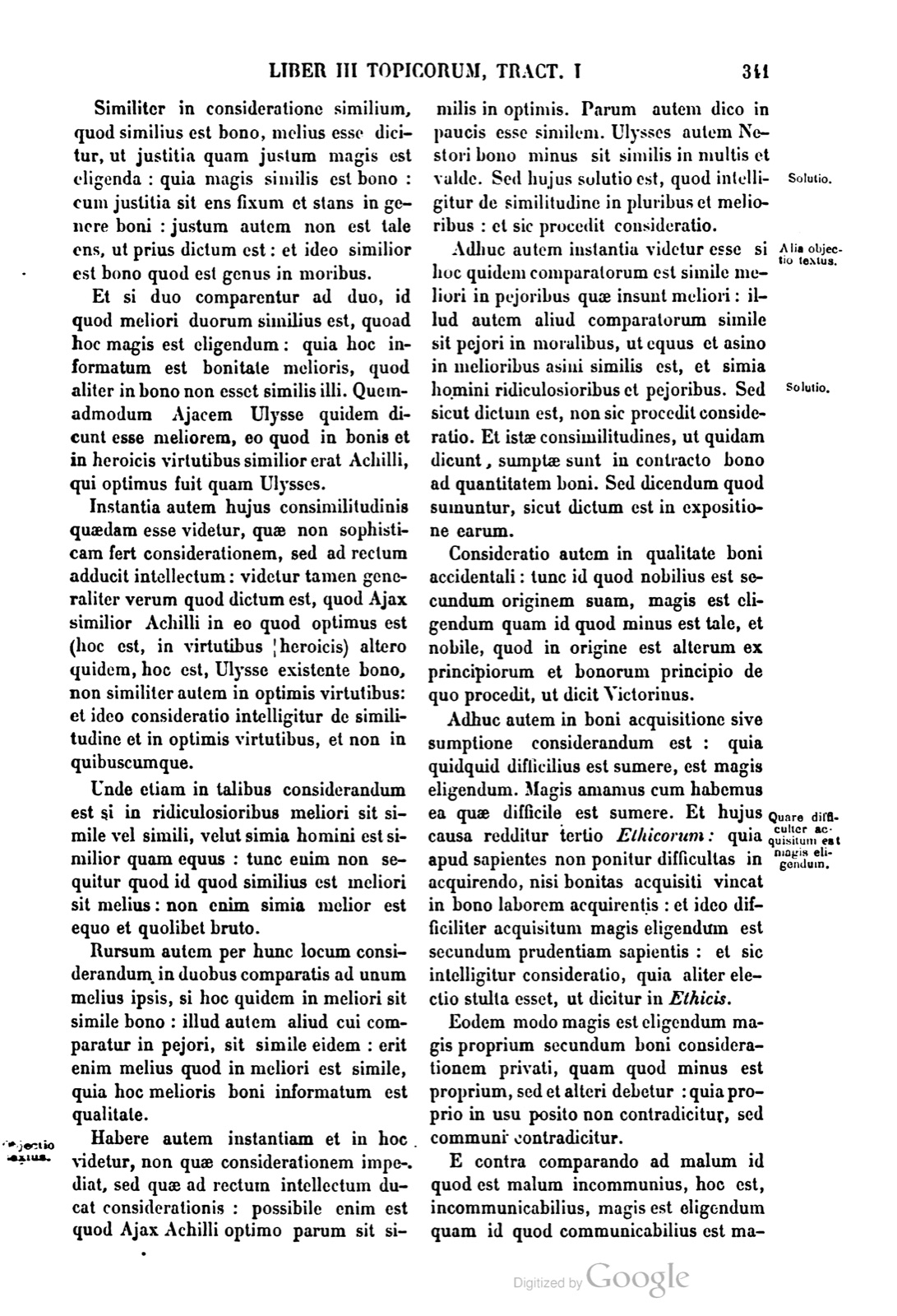
Eodem modo magis est eligendum magis proprium secundum boni considerationem privati, quam quod minus est proprium, sed et alteri debetur: quia proprio in usu posito non contradicitur, sed communi contradicitur.
E contra comparando ad malum id quod est malum incommunius, hoc est, incommunicabilius, magis est eligendum quam id quod communicabilius est malum: et prudentia est sive calliditas, quae communicabilius est malum. Et hujus ratio est, quia magis eligendum est id quod nulla difficultas sequitur in processu ad bonum, quam id quod sequitur adhuc difficultas in processu ad bonum: divinus autem cum sit astutus circa ea quae sunt ad finem, difficultatem habet in processu: quia alias virtutes non habet conjunctas sicut prudens: et ista est vera considerationis intentio, et probatur ex sexto Ethicorum.
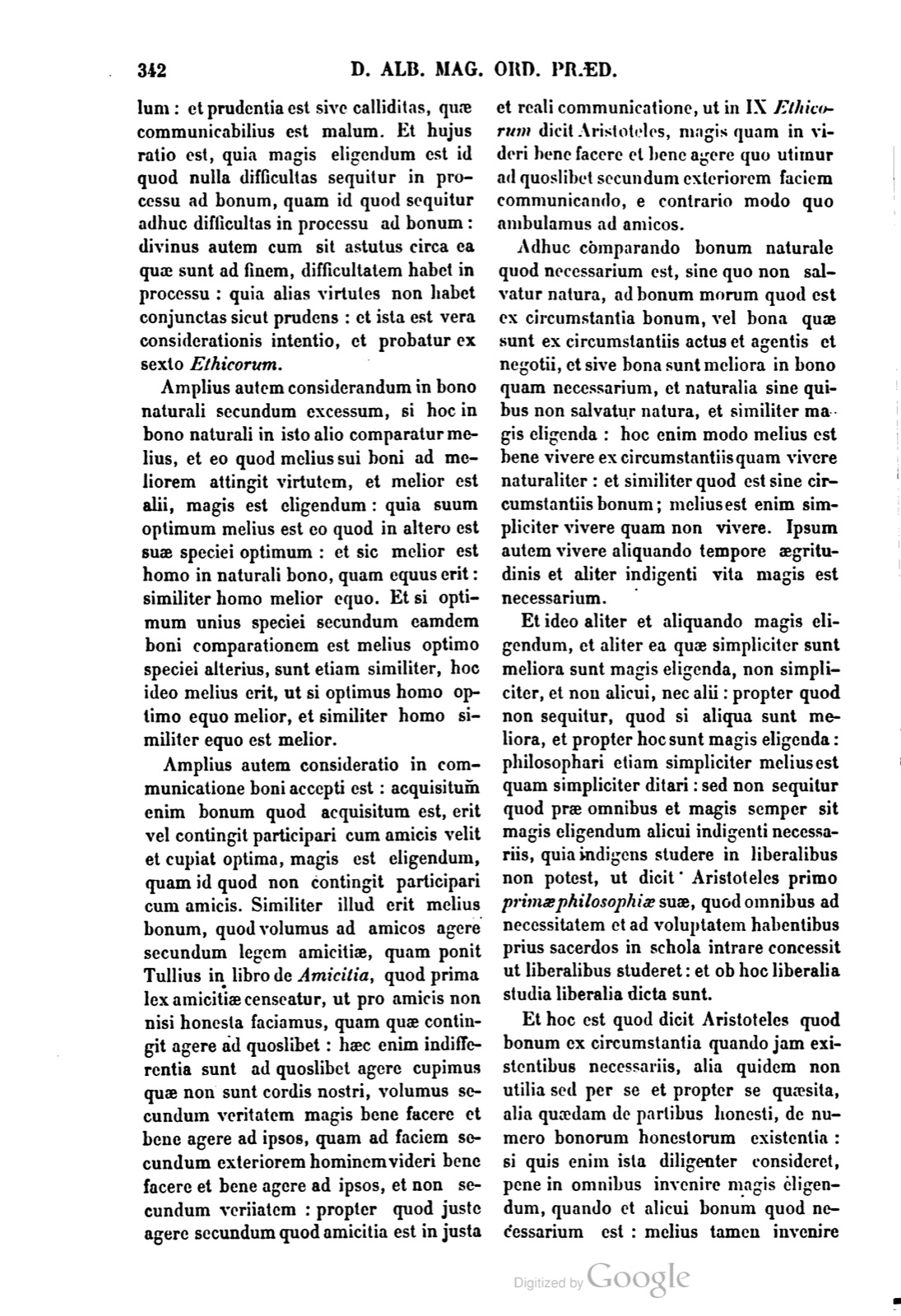
Amplius autem considerandum in bono naturali secundum excessum, si hoc in bono naturali in isto alio comparatur melius, et eo quod melius sui boni ad meliorem attingit virtutem, et melior est alii, magis est eligendum: quia suum optimum melius est eo quod in altero est suae speciei optimum: et sic melior est homo in naturali bono, quam equus erit: similiter homo melior equo. Et si optimum unius speciei secundum eamdem boni comparationem est melius optimo speciei alterius, sunt etiam similiter, hoc ideo melius erit, ut si optimus homo optimo equo melior, et similiter homo similiter equo est melior.
Amplius autem consideratio in communicatione boni accepti est: acquisitum enim bonum quod acquisitum est, erit vel contingit participari cum amicis velit et cupiat optima, magis est eligendum, quam id quod non contingit participari cum amicis. Similiter illud erit melius bonum, quod volumus ad amicos agere secundum legem amicitiae, quam ponit Tullius in libro de Amicitia, quod prima lex amicitiae censeatur, ut pro amicis non nisi honesta faciamus, quam quae contingit agere ad quoslibet: haec enim indifferentia sunt ad quoslibet agere cupimus quae non sunt cordis nostri, volumus secundum veritatem magis bene facere et bene agere ad ipsos, quam ad faciem secundum exteriorem hominem videri bene facere et bene agere ad ipsos, et non secundum veritatem: propter quod juste agere secundum quod amicitia est in justa et reali communicatione, ut in IX Ethicorum dicit Aristoteles, magis quam in videri bene facere et bene agere quo utimur ad quoslibet secundum exteriorem faciem communicando, e contrario modo quo ambulamus ad amicos.
Adhuc comparando bonum naturale quod necessarium est, sine quo non salvatur natura, ad bonum morum quod est ex circumstantia bonum, vel bona quae sunt ex circumstantiis actus et agentis et negotii, et sive bona sunt meliora in bono quam necessarium, et naturalia sine quibus non salvatur natura, et similiter magis eligenda: hoc enim modo melius est bene vivere ex circumstantiis quam vivere naturaliter: et similiter quod est sine circumstantiis bonum; melius est enim simpliciter vivere quam non vivere. Ipsum autem vivere aliquando tempore aegritudinis et aliter indigenti vita magis est necessarium.
In the same way, according to the consideration of private good, what is more proper is more to be chosen than what is less proper, but is also owed to another; because when the proper thing is put into use it is not contradicted, but the common thing is contradicted.
On the contrary, by comparing to evil, the evil which is more uncommon, that is, less communicable, is more to be chosen than that which is more communicable as evil; and prudence, or cleverness, is an evil that is more communicable. And the reason for this is that what is followed by no difficulty in the process toward good is more to be chosen than what is still followed by difficulty in the process toward good. But the diviner, since he is clever about the things that are toward an end, has difficulty in the process, because he does not have the other virtues joined as the prudent person does. And this is the true intention of the consideration, and it is proved from the sixth book of the Ethics.
Moreover, one must consider in natural good according to excess: if this natural good in that other thing is compared as better, and because the better thing of its good reaches a better virtue, and is better for another, it is more to be chosen; because its own best is better than what in the other is the best of its species. And thus a human being is better in natural good than a horse will be; similarly, a human being is better than a horse. And if the best of one species according to the same comparison of good is better than the best of another species, they too are similarly so; therefore this will be better, as, if the best human being is better than the best horse, likewise a human being similarly is better than a horse.
Moreover, there is a consideration in the communication of a received good: for an acquired good which has been acquired will be, or can be, shared with friends who wish and desire the best things, and is more to be chosen than what cannot be shared with friends. Similarly, that good will be better which we wish to do toward friends according to the law of friendship, which Tullius sets down in the book On Friendship, namely that the first law of friendship should be judged to be that we do nothing for friends except honorable things, than the things which one can do toward anyone at all. For these indifferent things we desire to do toward anyone at all, things that are not of our heart; according to truth we wish more to do good and to act well toward them than, according to appearance, according to the outward human being, to seem to do good and act well toward them, and not according to truth. For this reason acting justly, insofar as friendship consists in just and real communication, as Aristotle says in book IX of the Ethics, is more than seeming to do good and to act well, which we use toward anyone at all by communicating according to the outward appearance, in the opposite way from that in which we go toward friends.
Furthermore, by comparing the natural good which is necessary, without which nature is not preserved, to the moral good which is good from circumstance, or to goods which are from the circumstances of the act, the agent, and the affair, and whether these goods are better in good than the necessary good and the natural things without which nature is not preserved, they are likewise more to be chosen. For in this way living well from circumstances is better than living naturally; and likewise that which is good without circumstances is better, for simply to live is better than not to live. Yet life itself at some time of illness, and otherwise for one in need of life, is more necessary.
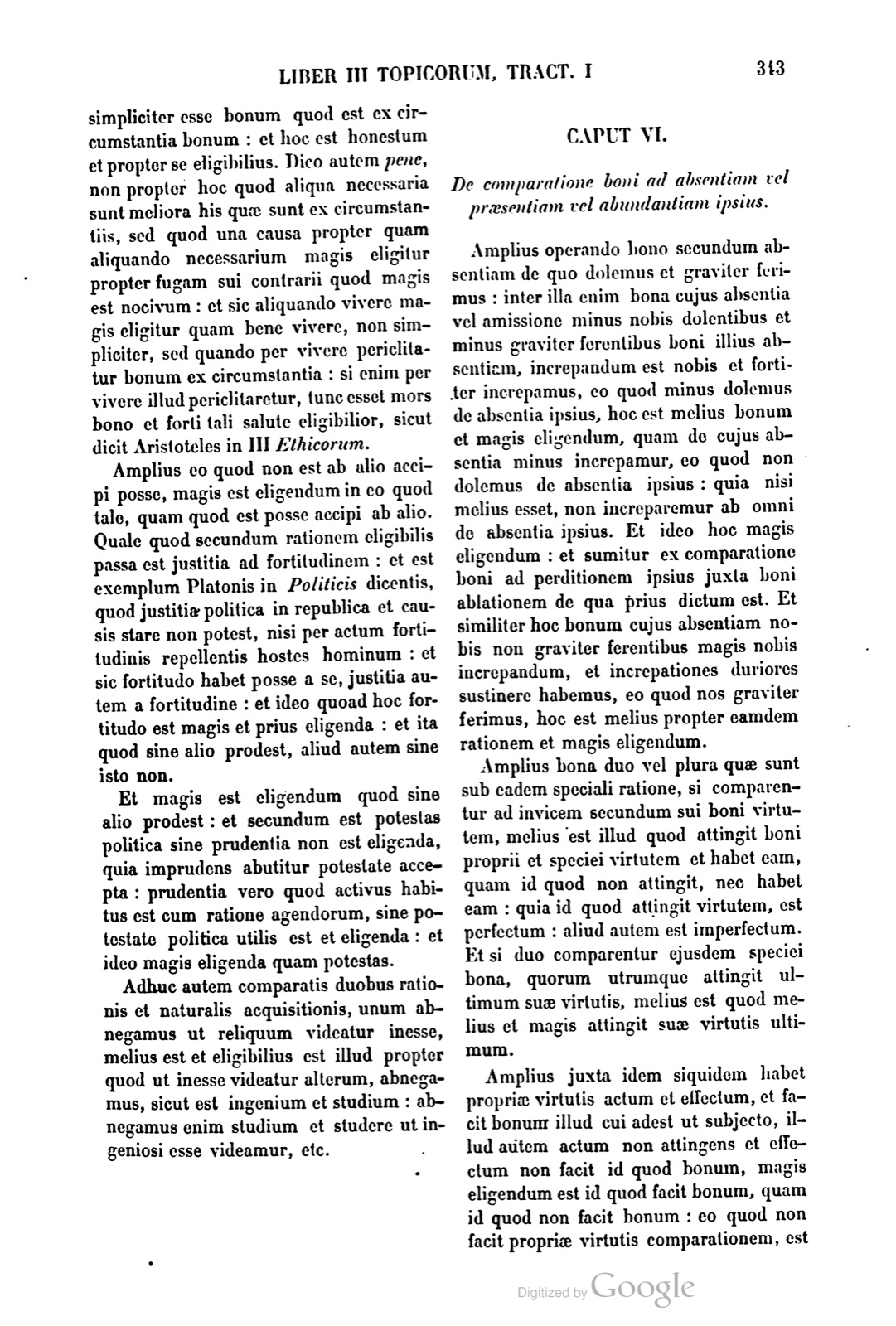
Et ideo aliter et aliquando magis eligendum, et aliter ea quae simpliciter sunt meliora sunt magis eligenda, non simpliciter, et non alicui, nec alii: propter quod non sequitur, quod si aliqua sunt meliora, et propter hoc sunt magis eligenda: philosophari etiam simpliciter melius est quam simpliciter ditari: sed non sequitur quod prae omnibus et magis semper sit magis eligendum alicui indigenti necessariis, quia indigens studere in liberalibus non potest, ut dicit Aristoteles primo primae philosophiae suae, quod omnibus ad necessitatem et ad voluptatem habentibus prius sacerdos in schola intrare concessit ut liberalibus studeret: et ob hoc liberalia studia liberalia dicta sunt.
Et hoc est quod dicit Aristoteles quod bonum ex circumstantia quando jam existentibus necessariis, alia quidem non utilia sed per se et propter se quaesita, alia quaedam de partibus honesti, de numero bonorum honestorum existentia: si quis enim ista diligenter consideret, pene in omnibus invenire magis eligendum, quando et alicui bonum quod necessarium est: melius tamen invenire simpliciter esse bonum quod est ex circumstantia bonum: et hoc est honestum et propter se eligibilius. Dico autem pene, non propter hoc quod aliqua necessaria sunt meliora his quae sunt ex circumstantiis, sed quod una causa propter quam aliquando necessarium magis eligitur propter fugam sui contrarii quod magis est nocivum: et sic aliquando vivere magis eligitur quam bene vivere, non simpliciter, sed quando per vivere periclitatur bonum ex circumstantia: si enim per vivere illud periclitaretur, tunc esset mors bono et forti tali salute eligibilior, sicut dicit Aristoteles in III Ethicorum.
Amplius eo quod non est ab alio accipi posse, magis est eligendum in eo quod tale, quam quod est posse accipi ab alio. Quale quod secundum rationem eligibilis passa est justitia ad fortitudinem: et est exemplum Platonis in Politicis dicentis, quod justitia politica in republica et causis stare non potest, nisi per actum fortitudinis repellentis hostes hominum: et sic fortitudo habet posse a se, justitia autem a fortitudine: et ideo quoad hoc fortitudo est magis et prius eligenda: et ita quod sine alio prodest, aliud autem sine isto non.
Et magis est eligendum quod sine alio prodest: et secundum est potestas politica sine prudentia non est eligenda, quia imprudens abutitur potestate accepta: prudentia vero quod activus habitus est cum ratione agendorum, sine potestate politica utilis est et eligenda: et ideo magis eligenda quam potestas.
Adhuc autem comparatis duobus rationis et naturalis acquisitionis, unum abnegamus ut reliquum videatur inesse, melius est et eligibilius est illud propter quod ut inesse videatur alterum, abnegamus, sicut est ingenium et studium: abnegamus enim studium et studere ut ingeniosi esse videamur, etc.
And therefore in one way and sometimes it is more to be chosen, and in another way those things which simply are better are more to be chosen, not simply and not for someone, nor for another. On account of this it does not follow that, if some things are better, they are on this account more to be chosen. To philosophize is also simply better than simply to be enriched; but it does not follow that before all things, and more and always, it is more to be chosen for someone in need of necessary things, because a needy person cannot study in liberal studies, as Aristotle says in the first book of his First Philosophy: after all had things for necessity and for pleasure, the priest first granted entry into the school so that they might study liberal things; and on account of this liberal studies were called liberal.
And this is what Aristotle says: the good from circumstance, when necessary things already exist, is not among useful things but among things sought per se and for their own sake, certain things from the parts of the honorable, existing among the number of honorable goods. For if someone considers these things diligently, he will find in almost all cases that what is more to be chosen is when even for someone there is the good that is necessary; yet he will find better simply to be the good which is good from circumstance; and this is honorable and more eligible for its own sake. But I say "almost," not because some necessary things are better than those which are from circumstances, but because one cause on account of which the necessary is sometimes more chosen is the flight from its contrary, which is more harmful. And thus sometimes to live is more chosen than to live well, not simply, but when through living the good from circumstance is endangered; for if that good were endangered through living, then death with such good and brave safety would be more eligible, as Aristotle says in book III of the Ethics.
Moreover, with regard to what cannot be received from another, in that it is such, it is more to be chosen than what can be received from another. Such is what, according to the account of the eligible, justice has undergone in relation to courage. And there is the example of Plato in the Politics, saying that political justice in the republic and in cases cannot stand except through the act of courage repelling the enemies of human beings; and thus courage has its power from itself, but justice has it from courage. Therefore in this respect courage is more and prior to be chosen; and so what is useful without another is more to be chosen, while the other is not useful without this.
And what is useful without another is more to be chosen; and the second case is that political power without prudence is not to be chosen, because an imprudent person abuses received power. Prudence, however, because it is an active habit with reason concerning things to be done, is useful and to be chosen without political power; and therefore it is more to be chosen than power.
Furthermore, when two things of rational and natural acquisition have been compared, and we deny one so that the remaining one may seem to be present, that is better and more eligible on account of which, so that the other may seem to be present, we deny the other, as in talent and study; for we deny study and studying so that we may seem to be talented, etc.
If a page does not appear, its photograph has not been uploaded yet.