Volume 2 · pp. 338–340
CHAPTERS III-V. On causes of good, concomitants of good, and motions toward good.
A marker with ≈ is an approximate page boundary, placed by measure of the text; the page photographs remain the authority. In the paired views, clicking a page marker brings that page into view.
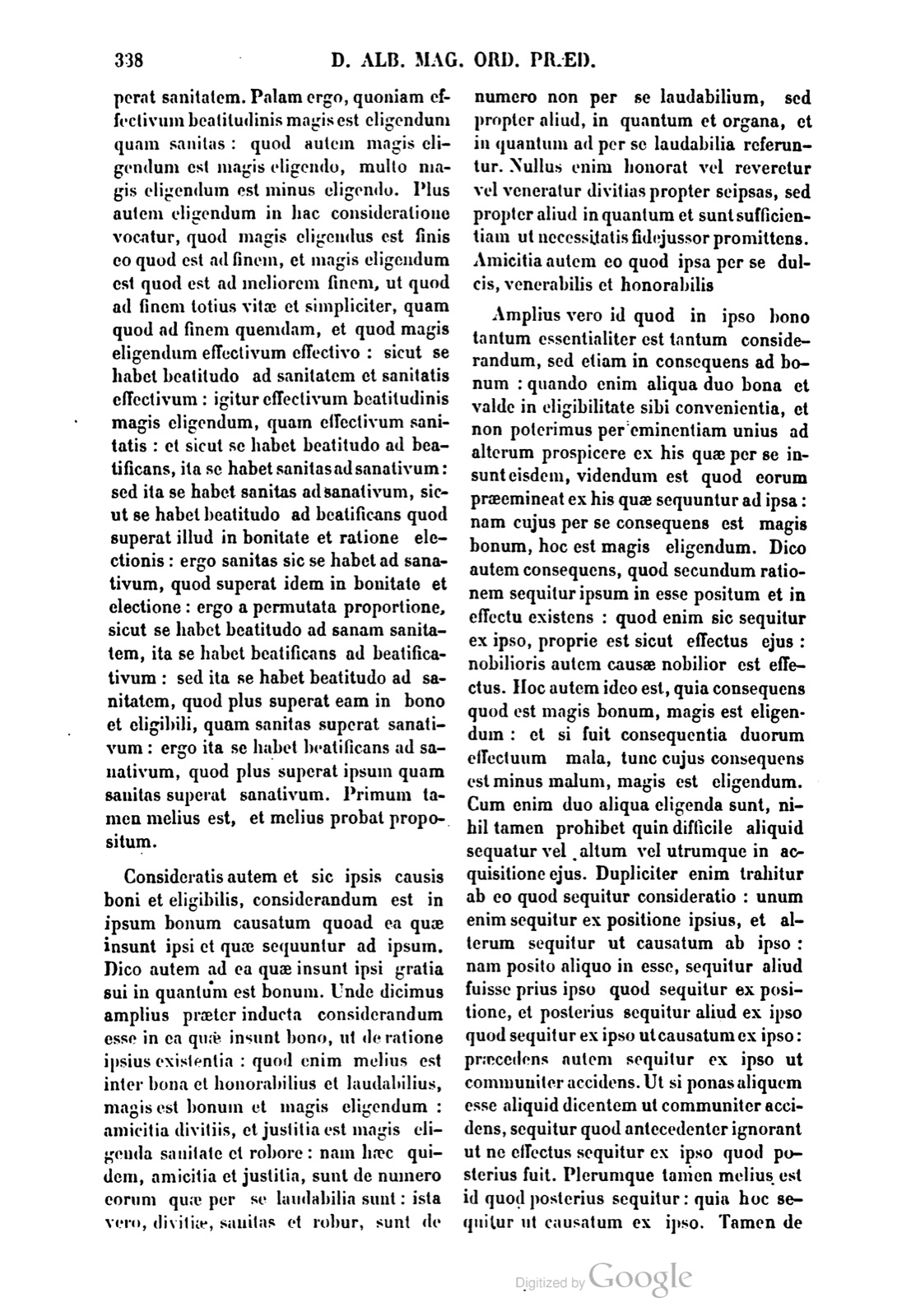
Consideratis autem et sic ipsis causis boni et eligibilis, considerandum est in ipsum bonum causatum quoad ea quae insunt ipsi et quae sequuntur ad ipsum. Dico autem ad ea quae insunt ipsi gratia sui in quantum est bonum. Unde dicimus amplius praeter inducta considerandum esse in ea quae insunt bono, ut de ratione ipsius existentia: quod enim melius est inter bona et honorabilius et laudabilius, magis est bonum et magis eligendum: amicitia divitiis, et justitia est magis eligenda sanitate et robore: nam haec quidem, amicitia et justitia, sunt de numero eorum quae per se laudabilia sunt: ista vero, divitiae, sanitas et robur, sunt de numero non per se laudabilium, sed propter aliud, in quantum et organa, et in quantum ad per se laudabilia referuntur. Nullus enim honorat vel reveretur vel veneratur divitias propter seipsas, sed propter aliud in quantum et sunt sufficientiam ut necessitatis fidejussor promittens. Amicitia autem eo quod ipsa per se dulcis, venerabilis et honorabilis.
Amplius vero id quod in ipso bono tantum essentialiter est tantum considerandum, sed etiam in consequens ad bonum: quando enim aliqua duo bona et valde in eligibilitate sibi convenientia, et non poterimus per eminentiam unius ad alterum prospicere ex his quae per se insunt eisdem, videndum est quod eorum praeemineat ex his quae sequuntur ad ipsa: nam cujus per se consequens est magis bonum, hoc est magis eligendum. Dico autem consequens, quod secundum rationem sequitur ipsum in esse positum et in effectu existens: quod enim sic sequitur ex ipso, proprie est sicut effectus ejus: nobilioris autem causae nobilior est effectus. Hoc autem ideo est, quia consequens quod est magis bonum, magis est eligendum: et si fuit consequentia duorum effectuum mala, tunc cujus consequens est minus malum, magis est eligendum. Cum enim duo aliqua eligenda sunt, nihil tamen prohibet quin difficile aliquid sequatur vel alterum vel utrumque in acquisitione ejus. Dupliciter enim trahitur ab eo quod sequitur consideratio: unum enim sequitur ex positione ipsius, et alterum sequitur ut causatum ab ipso: nam posito aliquo in esse, sequitur aliud fuisse prius ipso quod sequitur ex positione, et posterius sequitur aliud ex ipso quod sequitur ex ipso ut causatum ex ipso: praecedens autem sequitur ex ipso ut communiter accidens. Ut si ponas aliquem esse aliquid dicentem ut communiter accidens, sequitur quod antecedenter ignorant ut ne effectus sequitur ex ipso quod posterius fuit. Plerumque tamen melius est id quod posterius sequitur: quia hoc sequitur ut causatum ex ipso. Tamen de anterioribus et posterioribus sequentibus sumendum est secundum hanc considerationem utrum vis in quantum ad propositum utilius est. Quod autem dictum est, quaedam esse meliora, et quaedam laudabiliora, et quaedam honorabiliora, in Ethicis sic distincta sunt, quod meliora sunt per quantitatem bonitatis virtutis quae est ex ipsis ad actum, laudabiliora sunt praeconio virtutis digna, honorabiliora autem quibus honor praebetur qui est virtutis praemium in denominationibus et magnificentia collatae dignitatis vel conferendae.
CAPUT IV.
De inspectione ad ea quae insunt bono, ita quod concomitantur ipsum.
Amplius autem terminare problema de accidente per ea quae ut concomitantia insunt eligibili et bono: sicut quantitas discreta in numero bonorum, et sicut voluptas bona ex convenientia cum eligente, et sicut tempus quod est mensurans exemplum hujus. Dicamus igitur, quod plura bona paucioribus in eadem ratione bonis existentibus magis sunt eligenda. Dico autem plura dupliciter: sive plura numero, sive quando pauciora sunt contenta in pluribus tanquam pars ipsorum.
But once the very causes of the good and eligible have thus been considered, one must consider the caused good itself as to the things which are in it and which follow upon it. I mean as to those things which are in it for its own sake insofar as it is good. Hence, beyond the things introduced, we further say that one must consider those things which are in the good, as things belonging to the account of its existence: for what is better among goods and more honorable and more praiseworthy is more good and more to be chosen. Friendship is more to be chosen than riches, and justice than health and strength; for these, friendship and justice, are of the number of those things which are praiseworthy per se; but those others, riches, health, and strength, are of the number of things not praiseworthy per se, but for the sake of another, insofar as they are both instruments and insofar as they are referred to things praiseworthy per se. For no one honors or reveres or venerates riches for their own sake, but for the sake of another, insofar as they are a sufficiency promising as a surety of necessity. But friendship is sweet, venerable, and honorable in that it is per se.
Moreover, not only must that which is essentially in the good itself be considered, but also the consequent upon the good. For when there are two goods, and they greatly agree with each other in eligibility, and we cannot look to the eminence of one over the other from those things which are in them per se, one must see which of them is preeminent from those things which follow upon them. For that whose per se consequent is more good is more to be chosen. But I call consequent that which according to reason follows the thing itself when posited in being and existing in effect; for what follows from it in this way is properly as its effect, and of a nobler cause the effect is nobler. But this is so because the consequent which is more good is more to be chosen; and if the consequence of two effects was evil, then that whose consequent is less evil is more to be chosen. For when two things are to be chosen, nevertheless nothing prevents something difficult from following either one or both in the acquisition of it. For consideration is drawn from that which follows in two ways: one thing follows from the positing of it, and another follows as caused by it. For when something has been posited in being, another thing's having been prior to it follows, which follows from positing; and posteriorly another thing follows from it, which follows from it as caused by it. But the preceding follows from it as an accident commonly. Thus if you posit that someone is saying something as a common accident, it follows that antecedently they are ignorant, so that an effect does not follow from it which was posterior. Nevertheless for the most part what follows posteriorly is better, because this follows as caused by it. Yet concerning anterior and posterior things following, one must take, according to this consideration, which force is more useful with respect to the proposed point. But what was said, that some things are better, some more praiseworthy, and some more honorable, is distinguished thus in the Ethics: better things are through the quantity of the goodness of virtue which is from them to act; more praiseworthy things are worthy of the proclamation of virtue; but more honorable things are those to which honor is given, which is the reward of virtue, in denominations and in the magnificence of conferred or to-be-conferred dignity.
CHAPTER IV.
On inspection toward those things which are in the good, such that they accompany it.
Moreover, one must terminate the problem concerning accident through those things which, as concomitants, are in the eligible and good, such as discrete quantity in the number of goods, and good pleasure from agreement with the one choosing, and time which is measuring an example of this. Therefore let us say that more goods, when they are goods according to the same account, are more to be chosen than fewer. But I say more in two ways: either more in number, or when fewer are contained in more as a part of them.
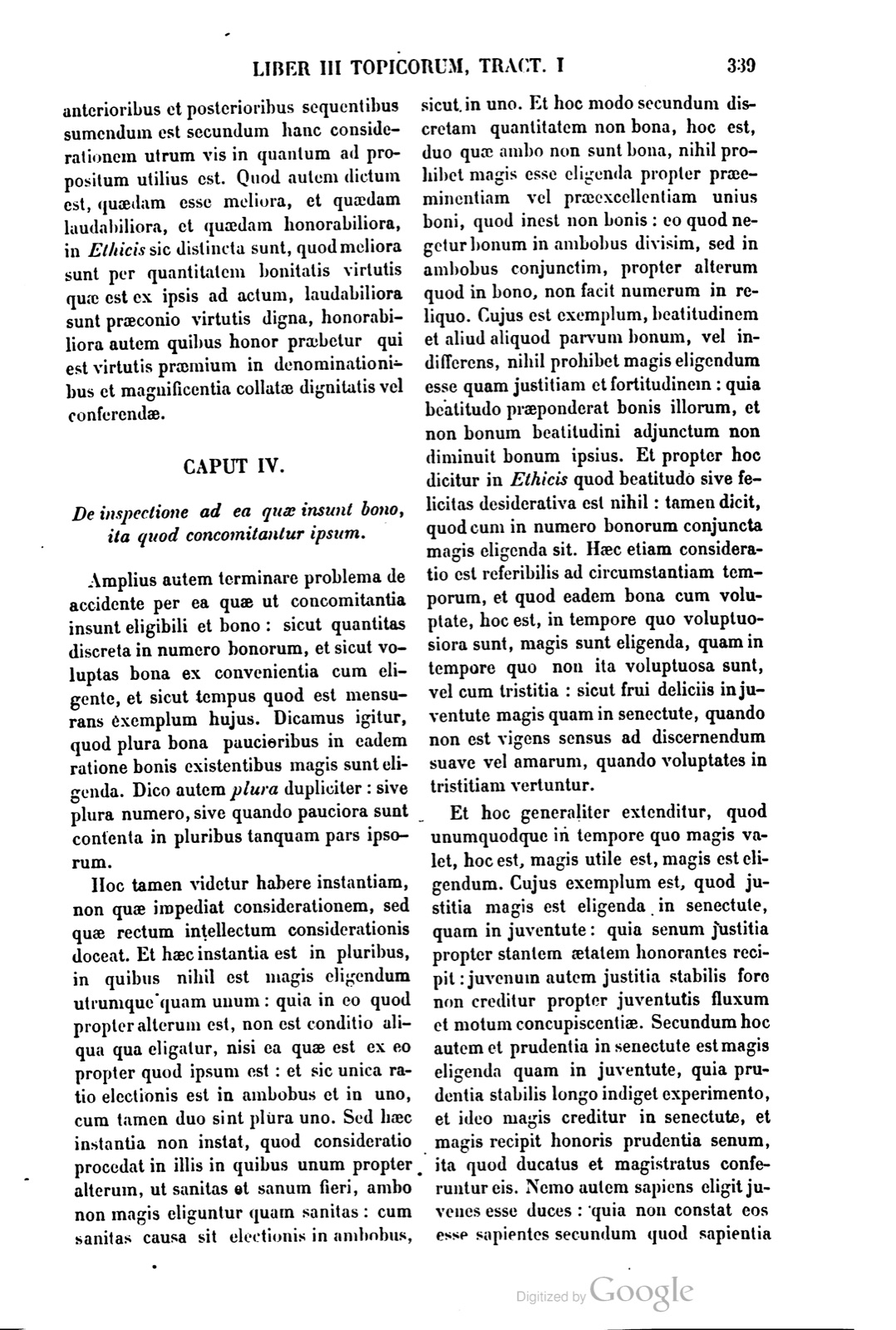
Hoc tamen videtur habere instantiam, non quae impediat considerationem, sed quae rectum intellectum considerationis doceat. Et haec instantia est in pluribus, in quibus nihil est magis eligendum utrumque quam unum: quia in eo quod propter alterum est, non est conditio aliqua qua eligatur, nisi ea quae est ex eo propter quod ipsum est: et sic unica ratio electionis est in ambobus et in uno, cum tamen duo sint plura uno. Sed haec instantia non instat, quod consideratio procedat in illis in quibus unum propter alterum, ut sanitas et sanum fieri, ambo non magis eliguntur quam sanitas: cum sanitas causa sit electionis in ambobus, propter quod ipsum est: et sic unica ratio electionis est in ambobus et in uno, cum tamen duo sint plura uno. Et hoc modo secundum discretam quantitatem non bona, hoc est, duo quae ambo non sunt bona, nihil prohibet magis esse eligenda propter praeeminentiam vel praeexcellentiam unius boni, quod inest non bonis: eo quod negetur bonum in ambobus divisim, sed in ambobus conjunctim, propter alterum quod in bono, non facit numerum in reliquo. Cujus est exemplum, beatitudinem et aliud aliquod parvum bonum, vel indifferens, nihil prohibet magis eligendum esse quam justitiam et fortitudinem: quia beatitudo praeponderat bonis illorum, et non bonum beatitudini adjunctum non diminuit bonum ipsius. Et propter hoc dicitur in Ethicis quod beatitudo sive felicitas desiderativa est nihil: tamen dicit, quod cum in numero bonorum conjuncta magis eligenda sit. Haec etiam consideratio est referibilis ad circumstantiam temporum, et quod eadem bona cum voluptate, hoc est, in tempore quo voluptuosiora sunt, magis sunt eligenda, quam in tempore quo non ita voluptuosa sunt, vel cum tristitia: sicut frui deliciis in juventute magis quam in senectute, quando non est vigens sensus ad discernendum suave vel amarum, quando voluptates in tristitiam vertuntur.
Et hoc generaliter extenditur, quod unumquodque in tempore quo magis valet, hoc est, magis utile est, magis est eligendum. Cujus exemplum est, quod justitia magis est eligenda in senectute, quam in juventute: quia senum justitia propter stantem aetatem honorantes recipit: juvenum autem justitia stabilis fore non creditur propter juventutis fluxum et motum concupiscentiae. Secundum hoc autem et prudentia in senectute est magis eligenda quam in juventute, quia prudentia stabilis longo indiget experimento, et ideo magis creditur in senectute, et magis recipit honoris prudentia senum, ita quod ducatus et magistratus conferuntur eis. Nemo autem sapiens eligit juvenes esse duces: quia non constat eos esse sapientes secundum quod sapientia dicit prudentiae ultimum et virtutem in optimo. Fortitudo autem e contrario magis eligenda in juventute, quia a juvenibus fortia requiruntur opera propter robur aetatis. Unde et Plato in Timaeo de re militari loquens dicit, quod ad rem militarem electa juventus est assumenda. Similiter et temperantia in juventute eligenda est, quia magis juvenes quam senes a concupiscentiis molestantur: et tunc necessarium est temperantia ut refraenetur motus concupiscentiae.
Yet this seems to have an instance, not one that impedes the consideration, but one that teaches the right understanding of the consideration. And this instance is in several things in which both together are not more to be chosen than one, because in that which is for the sake of another there is no condition by which it is chosen except that which is from that for the sake of which it is. And thus the account of choice is one in both and in one, although two are more than one. But this instance does not object, because the consideration proceeds in those things in which one is for the sake of another, as health and becoming healthy are both not chosen more than health, since health is the cause of choice in both, on account of which the thing itself is; and thus there is one account of choice in both and in one, although two are more than one. And in this way, according to discrete quantity, not-goods, that is, two things which both are not goods, can indeed be more to be chosen on account of the preeminence or pre-excellence of one good which is in the non-goods, because good is denied in both divisively, but not in both conjointly, on account of another thing which in the good does not make number in the remaining one. An example of this is that nothing prevents happiness and some other small or indifferent good from being more to be chosen than justice and courage, because happiness outweighs the goods of those, and the non-good joined to happiness does not diminish its good. And on account of this it is said in the Ethics that happiness or felicity is desirative of nothing; nevertheless he says that when joined in the number of goods it is more to be chosen. This consideration also can be referred to the circumstance of times, and that the same goods with pleasure, that is, in the time when they are more pleasant, are more to be chosen than in the time when they are not so pleasant, or when they are with sadness; as to enjoy delights in youth more than in old age, when sense is not vigorous for discerning the sweet or bitter, when pleasures are turned into sadness.
And this is generally extended, that each thing is more to be chosen in the time in which it has greater force, that is, is more useful. An example of this is that justice is more to be chosen in old age than in youth, because justice of old men receives those honoring it on account of a stable age; but the justice of young men is not believed to be stable because of the flux of youth and the motion of concupiscence. According to this, prudence also is more to be chosen in old age than in youth, because stable prudence needs long experience, and therefore it is more believed in old age, and the prudence of old men receives more honor, so that leaderships and magistracies are conferred upon them. But no wise person chooses young men to be leaders, because it is not established that they are wise according as wisdom says the ultimate of prudence and virtue in the best. Courage, however, is contrariwise more to be chosen in youth, because strong works are required from young men on account of the strength of age. Hence Plato also, speaking in the Timaeus about military affairs, says that chosen youth must be taken up for military affairs. Similarly temperance also is to be chosen in youth, because young men are more troubled by concupiscences than old men are; and then temperance is necessary so that the motion of concupiscence may be restrained.
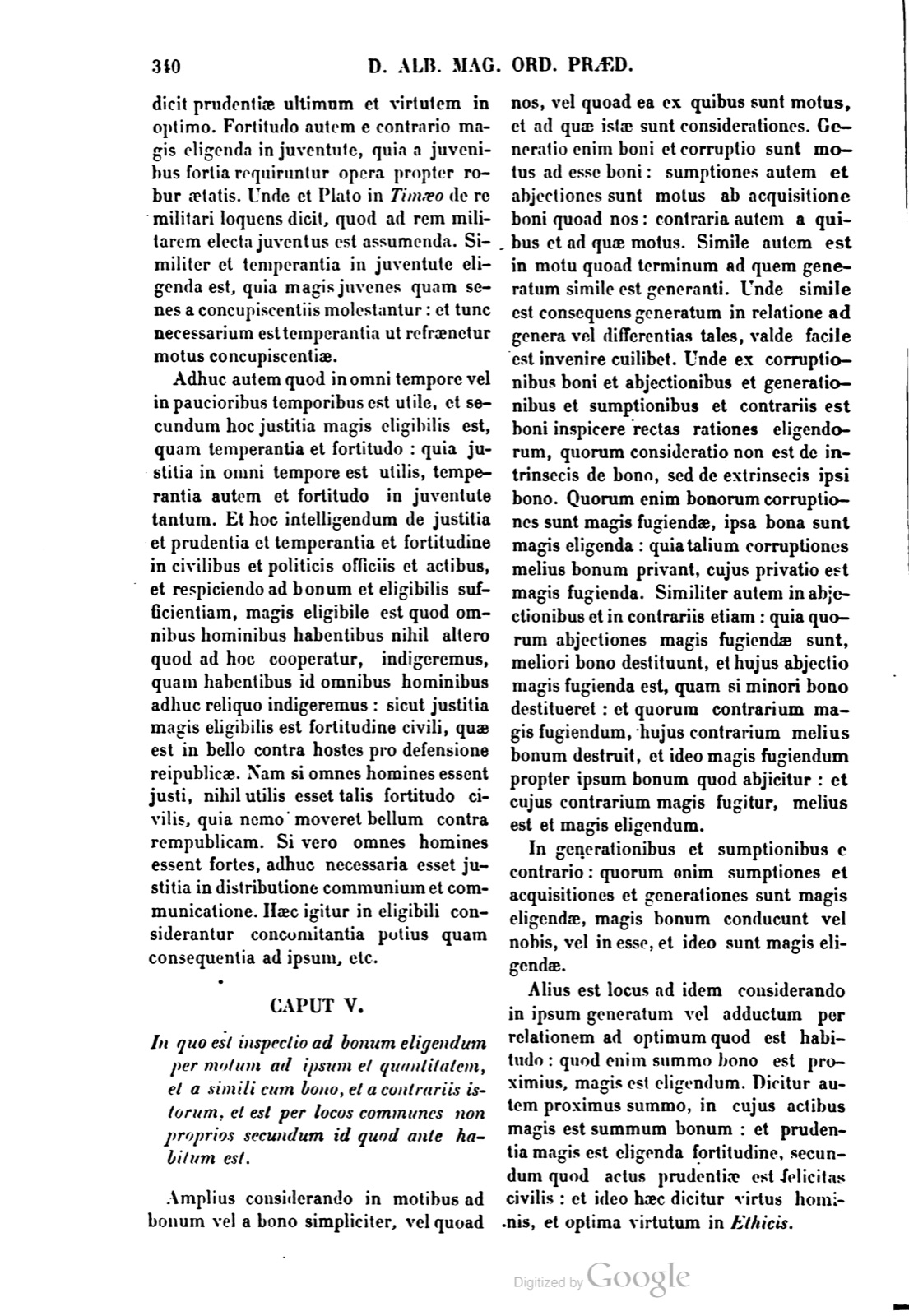
Adhuc autem quod in omni tempore vel in paucioribus temporibus est utile, et secundum hoc justitia magis eligibilis est, quam temperantia et fortitudo: quia justitia in omni tempore est utilis, temperantia autem et fortitudo in juventute tantum. Et hoc intelligendum de justitia et prudentia et temperantia et fortitudine in civilibus et politicis officiis et actibus, et respiciendo ad bonum et eligibilis sufficientiam, magis eligibile est quod omnibus hominibus habentibus nihil altero quod ad hoc cooperatur, indigeremus, quam habentibus id omnibus hominibus adhuc reliquo indigeremus: sicut justitia magis eligibilis est fortitudine civili, quae est in bello contra hostes pro defensione reipublicae. Nam si omnes homines essent justi, nihil utilis esset talis fortitudo civilis, quia nemo moveret bellum contra rempublicam. Si vero omnes homines essent fortes, adhuc necessaria esset justitia in distributione communium et communicatione. Haec igitur in eligibili considerantur concomitantia potius quam consequentia ad ipsum, etc.
CAPUT V.
In quo est inspectio ad bonum eligendum per motum ad ipsum et quantitatem, et a simili cum bono, et a contrariis istorum, et est per locos communes non proprios secundum id quod ante habitum est.
Amplius considerando in motibus ad bonum vel a bono simpliciter, vel quoad nos, vel quoad ea ex quibus sunt motus, et ad quae istae sunt considerationes. Generatio enim boni et corruptio sunt motus ad esse boni: sumptiones autem et abjectiones sunt motus ab acquisitione boni quoad nos: contraria autem a quibus et ad quae motus. Simile autem est in motu quoad terminum ad quem generatum simile est generanti. Unde simile est consequens generatum in relatione ad genera vel differentias tales, valde facile est invenire cuilibet. Unde ex corruptionibus boni et abjectionibus et generationibus et sumptionibus et contrariis est boni inspicere rectas rationes eligendorum, quorum consideratio non est de intrinsecis de bono, sed de extrinsecis ipsi bono. Quorum enim bonorum corruptiones sunt magis fugiendae, ipsa bona sunt magis eligenda: quia talium corruptiones melius bonum privant, cujus privatio est magis fugienda. Similiter autem in abjectionibus et in contrariis etiam: quia quorum abjectiones magis fugiendae sunt, meliori bono destituunt, et hujus abjectio magis fugienda est, quam si minori bono destitueret: et quorum contrarium magis fugiendum, hujus contrarium melius bonum destruit, et ideo magis fugiendum propter ipsum bonum quod abjicitur: et cujus contrarium magis fugitur, melius est et magis eligendum.
In generationibus et sumptionibus e contrario: quorum enim sumptiones et acquisitiones et generationes sunt magis eligendae, magis bonum conducunt vel nobis, vel in esse, et ideo sunt magis eligendae.
Alius est locus ad idem considerando in ipsum generatum vel adductum per relationem ad optimum quod est habitudo: quod enim summo bono est proximius, magis est eligendum. Dicitur autem proximus summo, in cujus actibus magis est summum bonum: et prudentia magis est eligenda fortitudine, secundum quod actus prudentiae est felicitas civilis: et ideo haec dicitur virtus hominis, et optima virtutum in Ethicis.
Furthermore, what is useful at every time or in more times is to be considered; and according to this justice is more eligible than temperance and courage, because justice is useful at every time, but temperance and courage only in youth. And this is to be understood of justice and prudence and temperance and courage in civil and political offices and acts. And by looking to the good and the sufficiency of the eligible, that is more eligible which, if all human beings had it, we would need nothing else that cooperates toward this, than that by which, if all human beings had it, we would still need the remaining thing. Thus justice is more eligible than civil courage, which exists in war against enemies for the defense of the commonwealth. For if all human beings were just, such civil courage would be useful for nothing, because no one would move war against the commonwealth. But if all human beings were brave, justice would still be necessary in the distribution and communication of common things. Therefore these things are considered in the eligible as concomitants rather than as consequents upon it, etc.
CHAPTER V.
In which there is inspection toward the good to be chosen through motion toward it and quantity, and from the similar with good, and from the contraries of these, and it is through common loci, not proper ones, according to what has been had before.
Moreover, by considering in motions toward good or from good simply, or as to us, or as to those things from which there are motions and to which these considerations are. For generation of good and corruption are motions toward the being of good; but takings-up and rejections are motions from the acquisition of good as to us; but contraries are those from which and to which motion is. The similar also is in motion as to the term to which, because the generated thing is similar to the generator. Hence it is very easy for anyone to find a generated consequent similar in relation to such genera or differences. Hence from corruptions of good and rejections and generations and takings-up and contraries of good one must inspect the right accounts of things to be chosen; and their consideration is not concerning intrinsic things of good, but concerning things extrinsic to the good itself. For the goods whose corruptions are more to be fled are themselves more to be chosen, because corruptions of such things deprive a better good, whose privation is more to be fled. Likewise also in rejections and in contraries, because the things whose rejections are more to be fled deprive one of a better good, and the rejection of this is more to be fled than if it deprived one of a lesser good; and the thing whose contrary is more to be fled destroys a better good by its contrary, and therefore it is more to be fled on account of the very good that is rejected; and that whose contrary is more fled is better and more to be chosen.
In generations and takings-up it is conversely: for the things whose takings-up and acquisitions and generations are more to be chosen bring a greater good either to us or into being, and therefore they are more to be chosen.
There is another locus toward the same point by considering the generated or brought-in thing itself through relation to the best, which is relation: for what is nearer to the highest good is more to be chosen. But that is called nearer to the highest in whose acts the highest good is more present; and prudence is more to be chosen than courage, according as the act of prudence is civil happiness; and therefore this is called the virtue of a human being, and the best of the virtues in the Ethics.
If a page does not appear, its photograph has not been uploaded yet.