Volume 2 · pp. 335–338
CHAPTERS II-III. On conditions of the good and the cause of good.
A marker with ≈ is an approximate page boundary, placed by measure of the text; the page photographs remain the authority. In the paired views, clicking a page marker brings that page into view.
Et sic propter se dicit privationem relationis ad ulteriorem finem: et hoc potest esse dupliciter: et similiter in genere ordinis ad finem in illo ordine intentum in quo quiescit motus appetentis et nihil quaerit plus ad habendum finem illum, nisi forte ut conservetur, ut infirmus quaerit sanitatem ut ultimum in motu ad sanitatem. Similiter tamen ut ultimum quaeritur beatitudo, sed illa quaeritur ut ultimum ad quod refertur tota vita.
[Marginal label, printed page 335: Quid per se bonum et quid per accidens.]
Adhuc autem dividitur bonum essentialiter in per se bonum, et per accidens bonum. Et per se bonum est, quod intra se habet causam et substantiam quod sit bonum, ut honestum, de quo dicit Tullius, quod sua substantiali vi nos trahit, et sua substantiali vi nos allicit. Hoc enim dicitur de natura sui movens ad eligendum ipsum. Per accidens autem bonum est, quod in se non habet causam electionis, sed in aliquo quodam ad quod ordinatur secundum aliquem modum sequendi ex ipso. Cujus exemplum est, ut amicos justos esse magis eligendum, eo quod est inimicos justos esse: quia amicitia, ut dicunt Aristoteles et Tullius et Theophrastus, fundatur supra virtutem quae est causa electionis boni amicorum, quod est causa electionis virtutis et honesti. Bonum autem eligere inimicis cum non fundetur supra virtutem, sed vitium inimicitiae, non potest esse inimicis, sed in alio quod est occasionatum ex ipso. Amicos ergo esse justos per se eligendum: inimicos autem esse justos secundum accidens eligimus, ut quod nihil nos noceant: quod occasionaliter, ex hoc quod justi sunt: quia justus non vult nocere alicui. Hic autem locus eligendi est idem cum eo quod immediate dictum est. Et quod id quod est propter se, magis est eligendum quam id quod est propter alterum. Sed modo quodam differt: quia ille est per respectum ad finem, iste est per respectum ad intrinsecam boni eligibilis naturam et privationem ejusdem, in eo quod per accidens eligitur. Uterque tamen est per se, vel per accidens. Quia igitur per se dicitur dupliciter, et per accidens dicitur dupliciter. Per se enim dicitur quod opponitur ad propter aliud: et sic virtus non per se eligitur, sed propter habitudinem. Et quod opponitur ad id quod est per accidens: et sic virtus eligitur per se, et non per accidens, sed gratia suiipsius. Similiter per accidens dicitur, quod gratia accidentis, vel ex ipso occasionari intelligitur vel eligitur. Et hoc sic intellecto planae sunt considerationes.
CAPUT III.
De inspectione causae boni in generali et speciali secundum quod causa regimen electionis.
Considerandum est in causa boni: tamen in communi in bono causato secundum quod ordinatur ad causam in commune, non descendendo ad hanc causam vel illam. Sic autem causa boni per se magis est eligenda, quam causa boni per accidens. Quemadmodum virtus in eligendo differt a fortuna. Nam virtus est causa bonorum per se. Fortuna autem causa bonorum fortunae subjacentium, quae sunt divitiae, potestas et gloria, quae sunt secundum se non bona, sed sunt bona ut organa beatitudinis et condecorantia beatitudinem.
[Marginal label, printed page 335: Bona fortunae sunt organa beatitudinis.]
And thus for its own sake means the privation of relation to a further end. And this can be in two ways; and similarly in the genus of order to an end, in that intended order in which the motion of the one desiring rests and seeks nothing more for having that end, except perhaps that it be preserved, as a sick person seeks health as the ultimate in the motion toward health. Similarly, however, happiness is sought as ultimate, but it is sought as the ultimate to which the whole life is referred.
[Marginal label, printed page 335: What good per se is and what good per accidens is.]
Furthermore, good is essentially divided into good per se and good per accidens. And good per se is what has within itself the cause and substance that it be good, as the honorable, concerning which Tullius says that by its substantial force it draws us, and by its substantial force it entices us. For this is said of what by its nature moves to choosing itself. But good per accidens is what does not have in itself the cause of choice, but in some other thing to which it is ordered according to some mode of following from it. An example of this is that it is more to be chosen that friends be just than that enemies be just, because friendship, as Aristotle and Tullius and Theophrastus say, is founded upon virtue, which is the cause of choosing the good of friends, which is the cause of choosing virtue and the honorable. But to choose good for enemies, since it is not founded upon virtue but upon the vice of enmity, cannot be in enemies, but in another thing that is occasioned from it. Therefore that friends be just is to be chosen per se; but we choose that enemies be just according to accident, namely that they harm us in nothing, which occurs occasionally from this, that they are just, because the just person does not wish to harm anyone. But this locus of choosing is the same as what was immediately stated: that what is for its own sake is more to be chosen than what is for another. Yet it differs in a certain mode, because that one is through respect to an end, this one through respect to the intrinsic nature of the eligible good and the privation of the same, in that which is chosen per accidens. Nevertheless each is per se or per accidens. Therefore because per se is said in two ways and per accidens is said in two ways: for per se is said of what is opposed to for the sake of another, and thus virtue is not chosen per se, but for the sake of a relation; and it is said of what is opposed to that which is per accidens, and thus virtue is chosen per se and not per accidens, but for the sake of itself. Similarly per accidens is said of what for the sake of an accident is understood or chosen, or is occasioned from it. And once this has been understood thus, the considerations are plain.
CHAPTER III.
On inspection of the cause of good in general and in special according as cause is the rule of choice.
One must consider in the cause of good, yet in common, in the caused good according as it is ordered to cause in common, without descending to this cause or that. Thus the cause of good per se is more to be chosen than the cause of good per accidens, in the way that virtue differs from fortune in choosing. For virtue is the cause of goods per se. But fortune is the cause of goods subject to fortune, which are riches, power, and glory, which are not good according to themselves, but are good as instruments of happiness and things adorning happiness.
[Marginal label, printed page 335: The goods of fortune are instruments of happiness.]
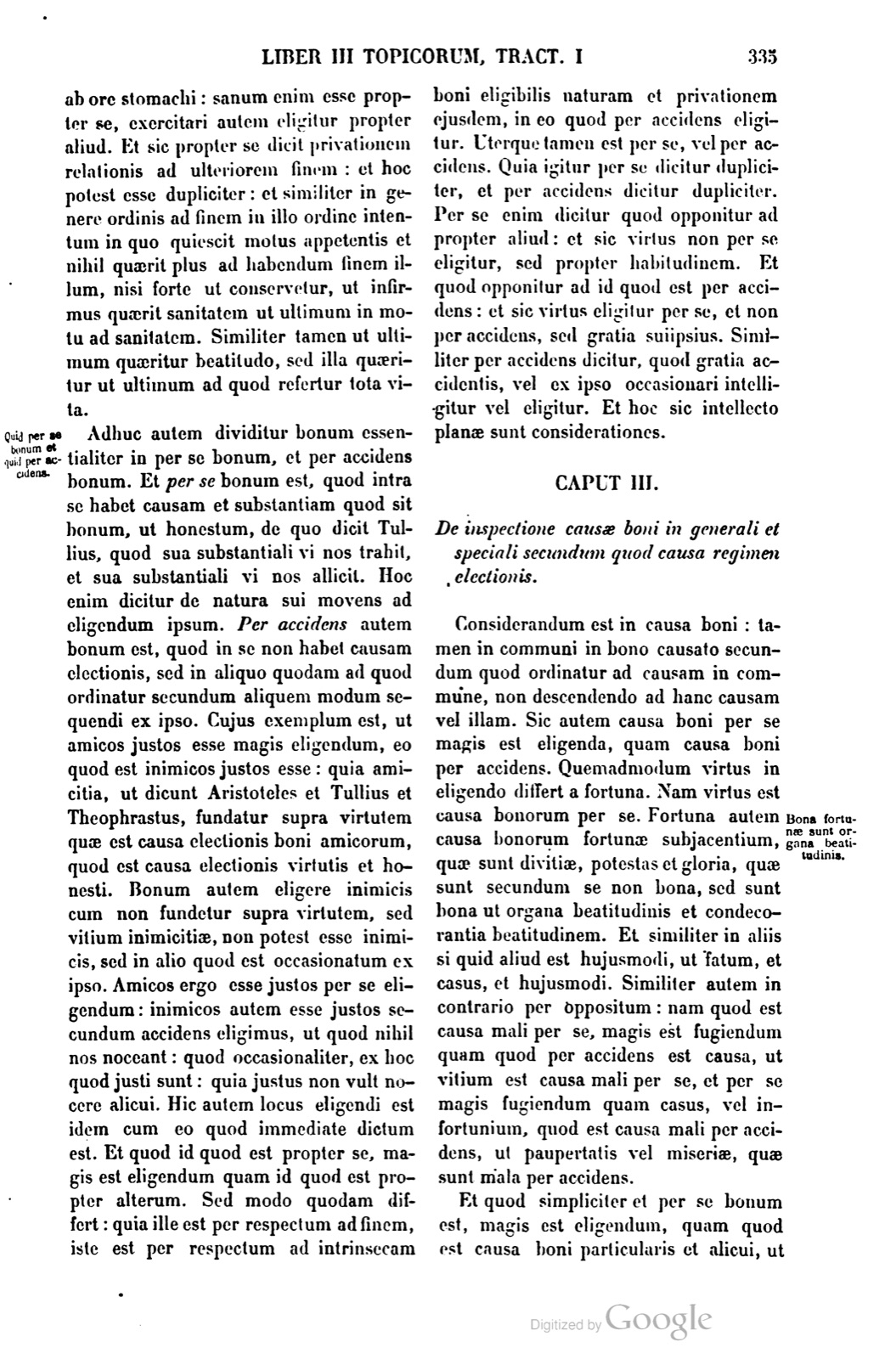
Et similiter in aliis si quid aliud est hujusmodi, ut fatum, et casus, et hujusmodi. Similiter autem in contrario per oppositum: nam quod est causa mali per se, magis est fugiendum quam quod per accidens est causa, ut vitium est causa mali per se, et per se magis fugiendum quam casus, vel infortunium, quod est causa mali per accidens, ut paupertatis vel miseriae, quae sunt mala per accidens.
Et quod simpliciter et per se bonum est, magis est eligendum, quam quod est causa boni particularis et alicui, ut sanum fieri vel sanari magis est eligendum quam secari, quod non est causa boni nisi indigenti sectione in quo, nisi fiat, putrescit membrum putridum.
Similiter inspiciendum est in causis specialibus, et post inspiciendum est in formali causa quae est dans esse et rei naturam propriam: et hoc modo quod natura propria sive naturaliter eligendum est, quoad hoc magis eligendum est, quam id quod non natura sui eligitur, ut justitia quae natura sui eligitur, est magis eligenda justo quod eligitur ut acquisitum: et dicitur justum et per justitiam communicativam vel distributivam ascitum et adeptum.
Et inspiciendum in causas naturales, non ex quibus fit bonum eligibile: quia talem naturam non habet in quantum est eligibile: sed inspiciendum in diversitatem causae materialis in qua est bonum eligibile quod melius et prius: ita quod justitia est subjectum boni: et videtur quod bonum est proprium talis subjecti, quia hoc fluit de substantialibus subjecti illius.
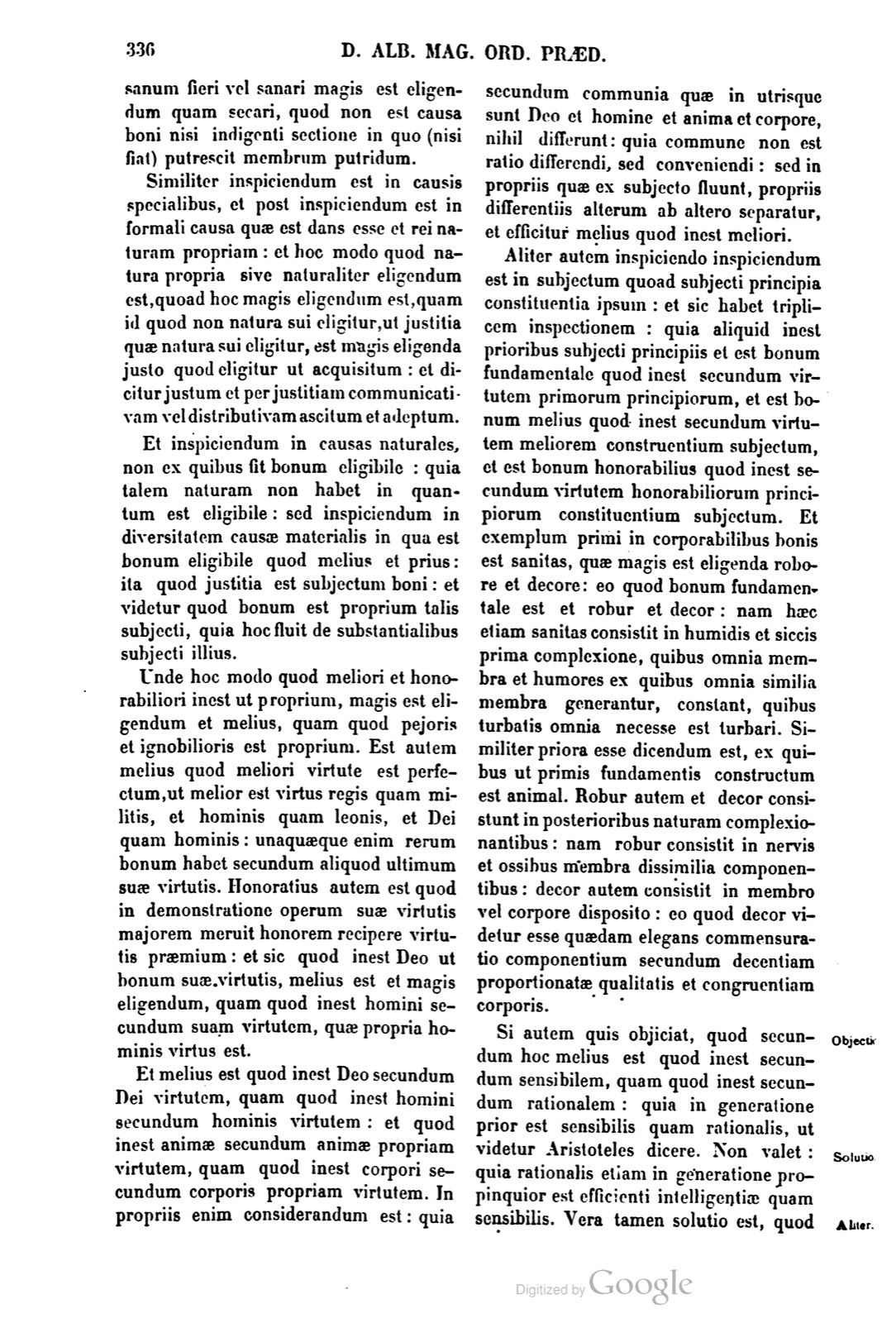
Unde hoc modo quod meliori et honorabiliori inest ut proprium, magis est eligendum et melius, quam quod pejoris et ignobilioris est proprium. Est autem melius quod meliori virtute est perfectum, ut melior est virtus regis quam militis, et hominis quam leonis, et Dei quam hominis: unaquaeque enim rerum bonum habet secundum aliquod ultimum suae virtutis. Honoratius autem est quod in demonstratione operum suae virtutis majorem meruit honorem recipere virtutis praemium: et sic quod inest Deo ut bonum suae virtutis, melius est et magis eligendum, quam quod inest homini secundum suam virtutem, quae propria hominis virtus est.
Et melius est quod inest Deo secundum Dei virtutem, quam quod inest homini secundum hominis virtutem: et quod inest animae secundum animae propriam virtutem, quam quod inest corpori secundum corporis propriam virtutem. In propriis enim considerandum est: quia secundum communia quae in utrisque sunt Deo et homine et anima et corpore, nihil differunt: quia commune non est ratio differendi, sed conveniendi: sed in propriis quae ex subjecto fluunt, propriis differentiis alterum ab altero separatur, et efficitur melius quod inest meliori.
Aliter autem inspiciendo inspiciendum est in subjectum quoad subjecti principia constituentia ipsum: et sic habet triplicem inspectionem: quia aliquid inest prioribus subjecti principiis et est bonum fundamentale quod inest secundum virtutem primorum principiorum, et est bonum melius quod inest secundum virtutem meliorem construentium subjectum, et est bonum honorabilius quod inest secundum virtutem honorabiliorum principiorum constituentium subjectum. Et exemplum primi in corporabilibus bonis est sanitas, quae magis est eligenda robore et decore: eo quod bonum fundamentale est et robur et decor: nam haec etiam sanitas consistit in humidis et siccis prima complexione, quibus omnia membra et humores ex quibus omnia similia membra generantur, constant, quibus turbatis omnia necesse est turbari. Similiter priora esse dicendum est, ex quibus ut primis fundamentis constructum est animal. Robur autem et decor consistunt in posterioribus naturam complexionantibus: nam robur consistit in nervis et ossibus membra dissimilia componentibus: decor autem consistit in membro vel corpore disposito: eo quod decor videtur esse quaedam elegans commensuratio componentium secundum decentiam proportionatae qualitatis et congruentiam corporis.
And similarly in other cases if there is some other thing of this sort, as fate and chance and such things. Likewise, in the contrary, by opposition: for what is a cause of evil per se is more to be fled than what is a cause per accidens, as vice is a cause of evil per se and is per se more to be fled than chance or misfortune, which is a cause of evil per accidens, as of poverty or misery, which are evils per accidens.
And what is simply and per se good is more to be chosen than what is the cause of a particular good and of a good for someone, as becoming healthy or being healed is more to be chosen than being cut, which is not the cause of good except for one needing cutting, in whom, unless it is done, the putrid limb decays.
Similarly one must inspect in special causes, and afterward one must inspect in the formal cause which gives being and the thing's proper nature; and in this way what is to be chosen by proper nature or naturally is, as to this, more to be chosen than that which is not chosen by its nature, as justice, which is chosen by its nature, is more to be chosen than the just thing which is chosen as acquired; and the just is said to be obtained and acquired through communicative or distributive justice.
And one must inspect into natural causes, not those from which the eligible good comes to be, because it does not have such a nature insofar as it is eligible, but one must inspect the diversity of the material cause in which the eligible good exists, which is better and prior, so that justice is the subject of good, and it seems that good is proper to such a subject, because this flows from the substantial things of that subject.
Hence in this way what is in the better and more honorable thing as proper is more to be chosen and better than what is proper to the worse and more ignoble. But what is perfected by a better virtue is better, as the virtue of a king is better than that of a soldier, and the virtue of a human being than that of a lion, and the virtue of God than that of a human being; for each thing has good according to some ultimate point of its virtue. But that is more honorable which in the demonstration of the works of its virtue has merited to receive greater honor as the reward of virtue; and thus what is in God as the good of his virtue is better and more to be chosen than what is in a human being according to his virtue, which is the proper virtue of a human being.
And what is in God according to the virtue of God is better than what is in a human being according to the virtue of a human being; and what is in the soul according to the soul's proper virtue is better than what is in the body according to the body's proper virtue. For in proper things one must consider, because according to common things which are in both God and human being and soul and body, they differ in nothing, since the common is not the account of differing but of agreeing; but in proper things which flow from the subject, by proper differences one is separated from the other, and what is in the better thing is made better.
But by inspecting in another way, one must inspect the subject as to the subject's principles constituting it; and thus it has threefold inspection, because something is in prior principles of the subject and is a fundamental good which is in according to the power of first principles, and there is a better good which is in according to the better power of those constructing the subject, and there is a more honorable good which is in according to the power of the more honorable principles constituting the subject. And the example of the first in bodily goods is health, which is more to be chosen than strength and beauty, because it is a fundamental good, and strength and beauty also are. For health consists in moist and dry things in the first complexion, by which all members and humors, from which all similar members are generated, stand, and when these have been disturbed, all things must be disturbed. Similarly those must be said to be prior from which the animal is constructed as from first foundations. But strength and beauty consist in posterior things giving complexion to nature; for strength consists in nerves and bones composing dissimilar members, but beauty consists in a disposed member or body, because beauty seems to be a certain elegant commensuration of the components according to the fittingness of proportioned quality and the congruence of the body.
[Marginal label, printed page 336: Objectio.]
Si autem quis objiciat, quod secundum hoc melius est quod inest secundum sensibilem, quam quod inest secundum rationalem: quia in generatione prior est sensibilis quam rationalis, ut videtur Aristoteles dicere.
[Marginal label, printed page 336: Solutio.]
Non valet: quia rationalis etiam in generatione propinquior est efficienti intelligentiae quam sensibilis.
[Marginal label, printed page 336: Aliter.]
Vera tamen solutio est, quod in materialibus quae ex materia educuntur, tenet consideratio. Anima autem non educitur de materia: quia non est corpus, nec harmonia corporis, nec ad harmoniam conveniens, sed umbra quaedam et imago intelligentiae. Haec autem alibi probata sunt.
[Marginal label, printed page 337: Removet dubium.]
Inspiciendum etiam ad finem sicut ad causam: finis enim in omnibus magis eligendus et volendus est, quam ea quae sunt ad finem: quia ea quae sunt ad finem, non eligimus nisi ut sunt ad finem: unde appetitior est finis secundum quod appetitus est voluntas, quia voluntas est finis. Et sic quod in Ethicis dicitur, quod electio non est finis, non est contrarium: quia sumitur ibi electio secundum quod est acceptatio rationis ejus quod ex consilio determinatum est. Consilium autem est eorum quae sunt ad finem. Hic autem sumitur electio secundum quod est actus rationis determinans in his melius, quae secundum boni rationem comparantur et librantur ad invicem.
Haec autem consideratio multiplicatur: quia ex quo finis gratia eliguntur et ea quae sunt ad finem, sequitur quod inter ea quae sunt ad finem, unum quod ordinatur duum sive duorum vel plurium, magis est eligendum quod fini est propinquius: quia hic in medicinis est bono finis.
Adhuc autem secundum hoc alia consideratio, quod id quod est ad vitae finem, in quantum vita hominis secundum optimum virtutis est hominis optimum, et magis eligibile, quam id quod est ordinatum ad aliquid aliud sicut ad finem: et hoc modo melius et eligibilius est, quod ad beatitudinem quae est totius vitae finis, contendit et ordinatur, quam quod ad prudentiam quae est proprie eorum quae conferunt ad vitam monasticam, vel oeconomicam, vel civilem conferendam.
Et iterum inter ea quae sunt ad finem, magis sunt eligenda possibilia quam impossibilia non adesse: quia sic electio non est de impossibili, sed voluntas, ut in Ethicis dicitur, sed possibile et impossibile dicitur per quod potest haberi finis intentus.
[Marginal label, printed page 336: Objection.]
But if someone objects that according to this, what is in according to the sensible is better than what is in according to the rational, because in generation the sensible is prior to the rational, as Aristotle seems to say.
[Marginal label, printed page 336: Solution.]
It is not valid, because the rational also in generation is nearer to the efficient intelligence than the sensible.
[Marginal label, printed page 336: Otherwise.]
Nevertheless the true solution is that the consideration holds in material things which are educed from matter. But the soul is not educed from matter, because it is not a body, nor the harmony of a body, nor something agreeing with harmony, but a certain shadow and image of intelligence. These things have been proved elsewhere.
[Marginal label, printed page 337: He removes a doubt.]
One must also inspect the end as cause; for the end in all things is more to be chosen and willed than the things which are toward the end, because we do not choose the things which are toward the end except as they are toward the end. Hence the end is more desirable according as appetite is will, because will is of the end. And thus what is said in the Ethics, that choice is not of the end, is not contrary, because choice is taken there according as it is the acceptance by reason of that which has been determined from counsel. But counsel concerns those things which are toward the end. Here, however, choice is taken according as it is an act of reason determining the better in these things which are compared and weighed with one another according to the account of good.
But this consideration is multiplied, because from the fact that the end and those things which are toward the end are chosen for the sake of something, it follows that among those things which are toward the end, one that is ordered to two or to two or several is more to be chosen if it is nearer to the end, because here in medical matters it is the good of the end.
Furthermore, according to this there is another consideration, that what is toward the end of life, insofar as the life of a human being according to the best of virtue is the human being's best, is more eligible than what is ordered to something else as to an end; and in this way that which strives toward and is ordered to happiness, which is the end of the whole life, is better and more eligible than what is ordered to prudence, which properly belongs to those things that contribute to furnishing monastic, economic, or civil life.
And again, among those things which are toward the end, possible things are more to be chosen than impossible things not being present, because thus choice is not about the impossible, but will is, as is said in the Ethics; but possible and impossible are said through that by which the intended end can be had.
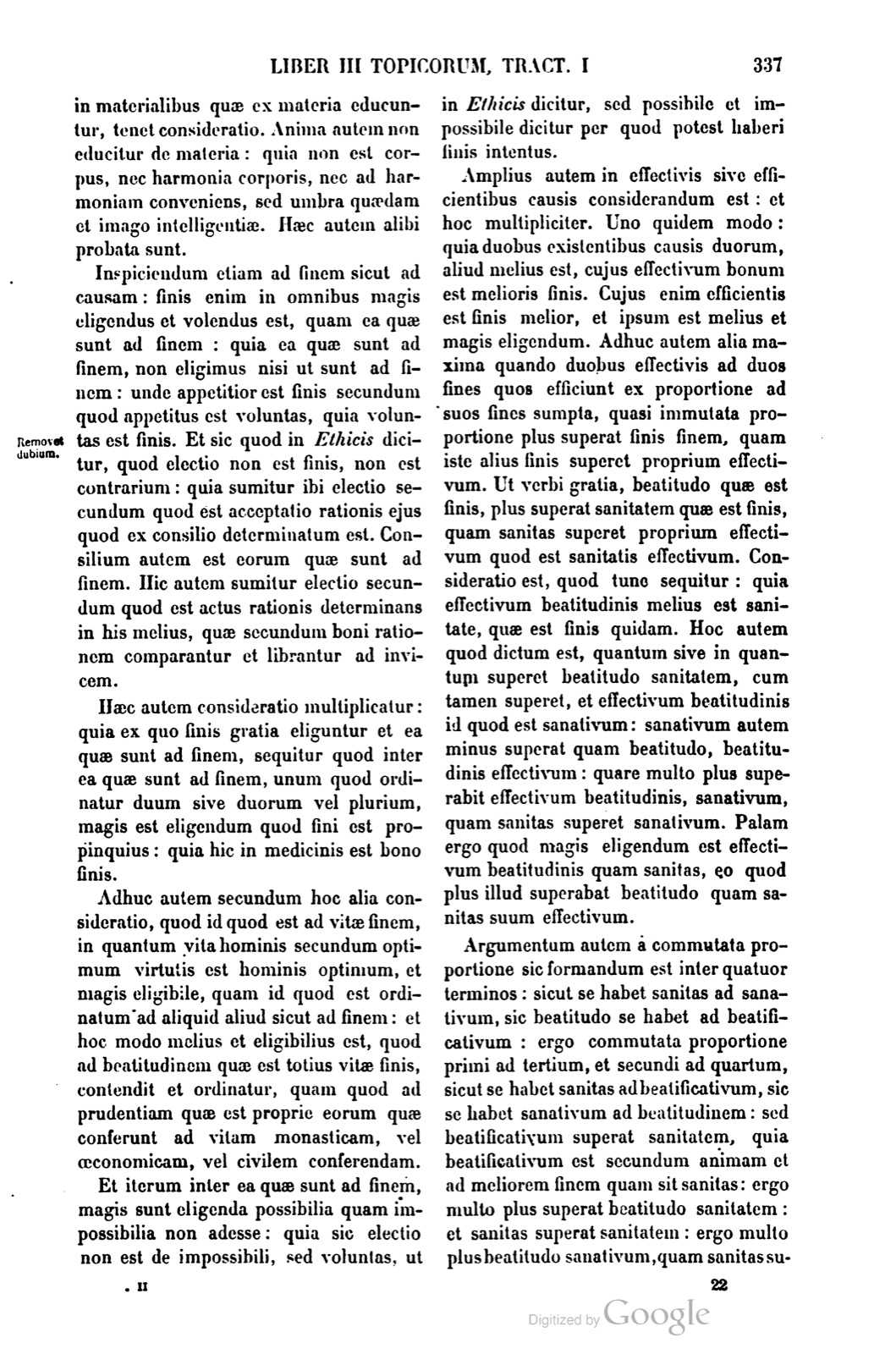
Amplius autem in effectivis sive efficientibus causis considerandum est: et hoc multipliciter. Uno quidem modo: quia duobus existentibus causis duorum, aliud melius est, cujus effectivum bonum est melioris finis. Cujus enim efficientis est finis melior, et ipsum est melius et magis eligendum. Adhuc autem alia maxima quando duobus effectivis ad duos fines quos efficiunt ex proportione ad suos fines sumpta, quasi immutata proportione plus superat finis finem, quam iste alius finis superet proprium effectivum. Ut verbi gratia, beatitudo quae est finis, plus superat sanitatem quae est finis, quam sanitas superet proprium effectivum quod est sanitatis effectivum. Consideratio est, quod tunc sequitur: quia effectivum beatitudinis melius est sanitate, quae est finis quidam. Hoc autem quod dictum est, quantum sive in quantum superet beatitudo sanitatem, cum tamen superet, et effectivum beatitudinis id quod est sanativum: sanativum autem minus superat quam beatitudo, beatitudinis effectivum: quare multo plus superabit effectivum beatitudinis, sanativum, quam sanitas superet sanativum. Palam ergo quod magis eligendum est effectivum beatitudinis quam sanitas, eo quod plus illud superabat beatitudo quam sanitas suum effectivum.
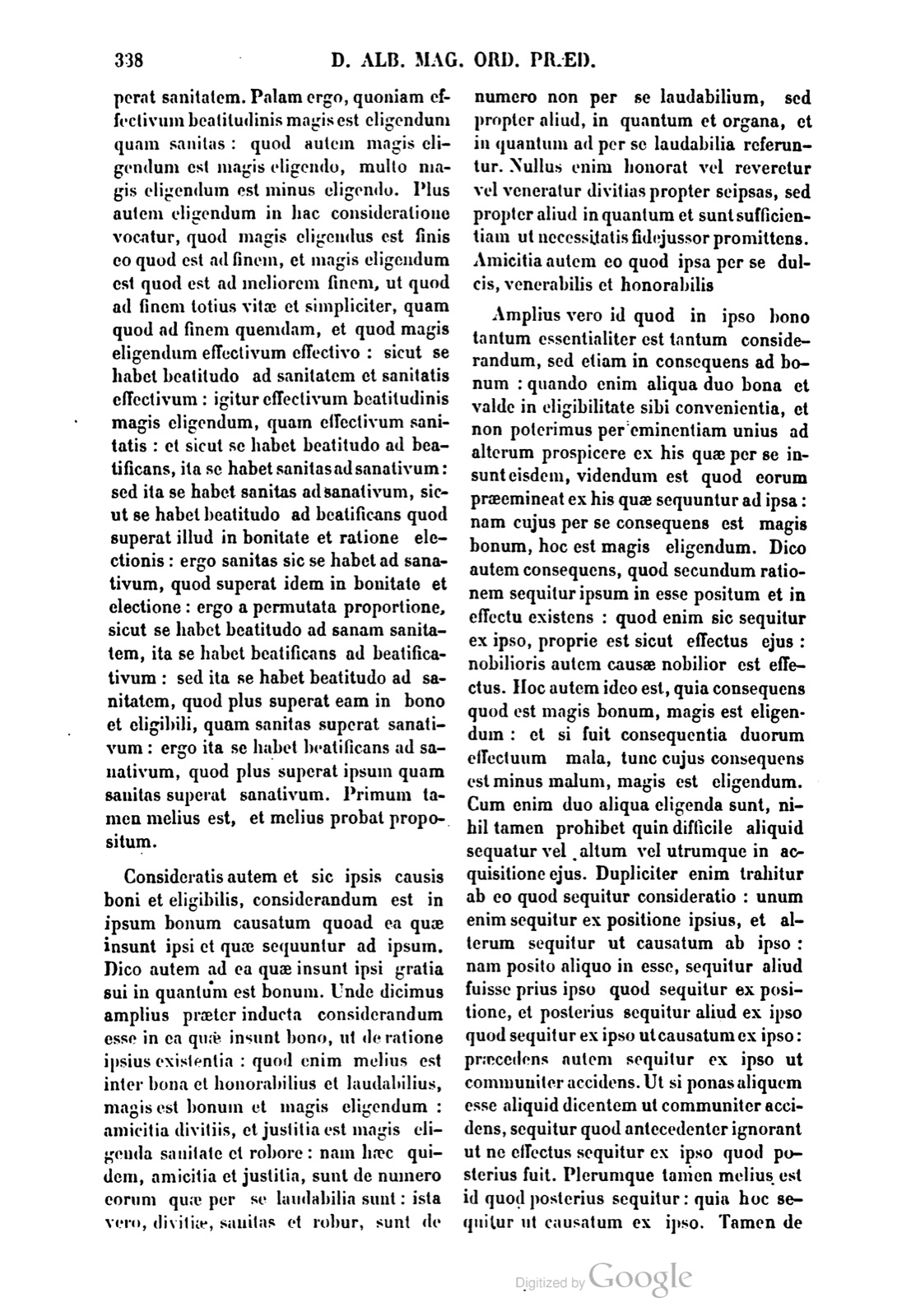
Argumentum autem a commutata proportione sic formandum est inter quatuor terminos: sicut se habet sanitas ad sanativum, sic beatitudo se habet ad beatificativum: ergo commutata proportione primi ad tertium, et secundi ad quartum, sicut se habet sanitas ad beatificativum, sic se habet sanativum ad beatitudinem: sed beatificativum superat sanitatem, quia beatificativum est secundum animam et ad meliorem finem quam sit sanitas: ergo multo plus superat beatitudo sanitatem: et sanitas superat sanitatem: ergo multo plus beatitudo sanativum, quam sanitas superat sanitatem. Palam ergo, quoniam effectivum beatitudinis magis est eligendum quam sanitas: quod autem magis eligendum est magis eligendo, multo magis eligendum est minus eligendo. Plus autem eligendum in hac consideratione vocatur, quod magis eligendus est finis eo quod est ad finem, et magis eligendum est quod est ad meliorem finem, ut quod ad finem totius vitae et simpliciter, quam quod ad finem quemdam, et quod magis eligendum effectivum effectivo: sicut se habet beatitudo ad sanitatem et sanitatis effectivum: igitur effectivum beatitudinis magis eligendum, quam effectivum sanitatis: et sicut se habet beatitudo ad beatificans, ita se habet sanitas ad sanativum: sed ita se habet sanitas ad sanativum, sicut se habet beatitudo ad beatificans quod superat illud in bonitate et ratione electionis: ergo sanitas sic se habet ad sanativum, quod superat idem in bonitate et electione: ergo a permutata proportione, sicut se habet beatitudo ad sanam sanitatem, ita se habet beatificans ad beatificativum: sed ita se habet beatitudo ad sanitatem, quod plus superat eam in bono et eligibili, quam sanitas superat sanativum: ergo ita se habet beatificans ad sanativum, quod plus superat ipsum quam sanitas superat sanativum. Primum tamen est, et melius probat propositum.
Moreover, in effectives or efficient causes one must consider, and this in many ways. In one way: because, when there are two causes of two things, that is better whose effective good belongs to the better end. For that efficient whose end is better is itself better and more to be chosen. Furthermore, there is another maxim when, with two effectives toward two ends which they effect, from the proportion taken to their ends, as by a changed proportion, the end surpasses the end more than this other end surpasses its proper effective. For example, happiness, which is an end, surpasses health, which is an end, more than health surpasses its proper effective, which is what produces health. The consideration is that then it follows, because what produces happiness is better than health, which is a certain end. But what has been said, how much or insofar as happiness surpasses health, since nevertheless it surpasses, and the effective of happiness surpasses that which is health-producing; but the health-producing surpasses less than happiness does the effective of happiness; therefore the effective of happiness will much more surpass the health-producing than health surpasses the health-producing. Therefore it is plain that the effective of happiness is more to be chosen than health, because happiness surpassed that thing more than health surpassed its own effective.
But the argument from changed proportion must be formed among four terms thus: as health has itself to the health-producing, so happiness has itself to the beatifying; therefore, by a changed proportion of the first to the third and of the second to the fourth, as health has itself to the beatifying, so the health-producing has itself to happiness. But the beatifying surpasses health, because the beatifying is according to the soul and toward a better end than health is; therefore happiness much more surpasses health. And health surpasses health; therefore happiness much more surpasses the health-producing than health surpasses health. Therefore it is plain that the effective of happiness is more to be chosen than health; but what is more to be chosen by a greater choosing is much more to be chosen by a lesser choosing. In this consideration, however, more to be chosen is called that the end is more to be chosen than what is toward the end, and what is toward a better end is more to be chosen, as what is toward the end of the whole life and simply is more to be chosen than what is toward a certain end, and that effective is more to be chosen than effective. As happiness has itself to health and the effective of health, therefore the effective of happiness is more to be chosen than the effective of health; and as happiness has itself to what beatifies, so health has itself to what heals. But health has itself to what heals as happiness has itself to what beatifies, which surpasses it in goodness and in the account of choice; therefore health has itself to the health-producing in such a way that it surpasses the same in goodness and choice; therefore from permuted proportion, as happiness has itself to sound health, so the one beatifying has itself to the beatificative. But happiness has itself to health in such a way that it surpasses it more in good and eligibility than health surpasses the health-producing; therefore the one beatifying has itself to the health-producing in such a way that it surpasses it more than health surpasses the health-producing. The first, however, is better and proves the proposed point better.
If a page does not appear, its photograph has not been uploaded yet.