Volume 2 · pp. 324–328
CHAPTERS VI-VIII. On similars, apposition, and means partly dialectical and partly sophistical from apposition.
A marker with ≈ is an approximate page boundary, placed by measure of the text; the page photographs remain the authority. In the paired views, clicking a page marker brings that page into view.
similitudo autem habituum duorum vel plurium ad unum vel unius ad plura vel plurium ad plura faciens proportionem et proportionalitatem secundum omnis proportionis differentias: quia quamvis proportio proprie sit in quantitate, tamen extenso nomine secundum quod locus a proportione accipitur in similitudine habitudinum quorumcumque similiter se habentium ad unum, et in communi in talibus omnibus est inspectio ad similia secundum inesse, vel in habitudine una sive similia.
[Marginal label, printed page 324: Proportio proprie est in quantitate.]
Ut verbi gratia, si disciplina una ponatur plurium et opinio est una, auditum habere est audire: quia disciplina et opinio una habitudine simili se habent ad ea in quibus sunt: et si visum habere est videre in habitu, ad minus est videre in habitu, auditum habere est audire: quia una simili habitudine habitus visus et habitus auditus se habent ad suos actus et habitus in usu acceptos. Similiter autem et aliis similibus istis, et in una proportione ad unum se habentibus, et in his quae sunt secundum rem sic similia, et in his quae similia esse videntur.
Potestas hujus loci a proportione est utilis ad utrumque et ad construendum et ad destruendum problema: nam si in aliquo aliquod similium se habet affirmative, et in aliis sic se habebit: et sic constructum est problema. Si autem in aliquo similium non sic se habeat, similiter in aliis similibus non sic se habebit: et sic destructum erit problema. Haec autem consideratio est in his quae singulariter se habent ad unum in communi. Considerandum etiam est in uno ad quod similiter se habent et in pluribus, sicut quando plura eodem modo se habent ad unum. Si dicatur scire idem est quod intelligere, inspiciendum est qualiter ambo se habeant ad idem sicut ad multa, hoc est, si eodem modo scire se habeat ad multa sicut intelligere, hoc est, utrum contingat multa intelligere simul, sicut contingit multa scire: intelligere autem non contingit multa simul. Si autem hoc non contingit, manifestum est quod scire non est intelligere.
[Marginal label, printed page 324: Quomodo plura contingat scire et intelligere: et quomodo unum tantum.]
Et in uno et eodem si scire dicatur secundum habitum, multa contingit simul scire: et si scire dicatur secundum actum, tunc scire est conclusionis, ad quod sciendum multa oportet scire actualiter relata ad ipsam, ut principia, et illationem quae est ut in agere. Similiter si intelligere accipiatur in actu, tunc intelligere est simpliciter intueri intelligibile: simplex autem virtus non potest esse nisi ad unum simplex, sicut linea terminatur ad unum punctum. Si autem in habitu accipiatur, tunc intellectus est habitus principalis, qui est in uno et non in pluribus secundum quod simplex habitus. Sic ergo considerandum est in similiter se habentibus ad aliquid.
Amplius in his quae una qualitate similia sunt, considerandum est ex magis et minus inesse per intentionem et remissionem qualitatis inhaerentis. Sic autem ejus quod secundum magis et minus inest, sunt loci quatuor a quibus trahuntur argumentationes ad problematis de accidente terminationem. Unus quidem locus est in comparando ad alterum: quia si praedicatur accipiendo ad subjectum est magis: quia si praedicatum est magis, sequitur ad subjectum simplex: et ideo unus locus est, si magis sequitur magis: sicut si voluptas bonum est, magis voluptas est magis bonum: et si injuriam ferre malum est, magis injuriam ferre, magis malum est: et hic comparatur magis ad inesse simpliciter, et magis inest et simpliciter inest. Hic autem locus utilis est ad utrumque, ad construendum problema et destruendum. Nam si consequens, hoc est, praedicatum, est accidentis incrementum, hoc est, intensum est secundum magis, hoc subjecti incremento, hoc est, intensionem subjecti, quemadmodum in exemplo inducto dictum est, manifestum quoniam accidit. Simpliciter autem ponebam inesse accidens. Si autem sequitur cum incremento praedicatum, quando incrementum accipit subjectum: tunc manifestum est quod simpliciter non accidit. Hoc inductione autem sumendum est, quia haec maxima hujus loci est, et non nisi ex posterioribus probari potest.
but likeness of two or several habits to one thing, or of one to several, or of several to several, makes proportion and proportionality according to the differences of every proportion. For although proportion is properly in quantity, nevertheless, with the name extended according as the locus from proportion is taken in the likeness of relations of whatever things have themselves similarly to one thing, and in common in all such cases there is inspection toward similars according to being-in, or toward things that are in one relation or are similar.
[Marginal label, printed page 324: Proportion is properly in quantity.]
For example, if one discipline is posited as being of several things, and opinion is one, to have hearing is to hear; because discipline and opinion have themselves by one similar relation to those things in which they are. And if to have sight is to see in habit, at least it is to see in habit; to have hearing is to hear, because by one similar relation the habit of sight and the habit of hearing have themselves to their acts and to habits taken in use. Similarly also in other things similar to these, and in those things having themselves in one proportion to one thing, both in those things which are thus similar according to reality and in those which seem to be similar.
The power of this locus from proportion is useful for both, for constructing and for destroying the problem. For if among some similars something has itself affirmatively, it will have itself thus in the others; and so the problem has been constructed. But if among some similars it does not have itself thus, likewise in the other similars it will not have itself thus; and so the problem will have been destroyed. But this consideration is in those things which have themselves singularly to one common thing. One must also consider in the one to which they have themselves similarly and in several, as when several things have themselves in the same way to one thing. If it is said that to know is the same as to understand, one must inspect how both have themselves to the same thing as to many, that is, whether to know has itself to many in the same way as to understand does, that is, whether it happens to understand many things at once, as it happens to know many things. But it does not happen to understand many things at once. Therefore if this does not happen, it is manifest that to know is not to understand.
[Marginal label, printed page 324: How it happens to know and to understand many things, and how only one.]
And in one and the same case, if to know is said according to habit, it happens to know many things at once; and if to know is said according to act, then knowing is of a conclusion, for knowing which it is necessary to know actually many things related to it, as principles and the inference which is as in acting. Similarly, if to understand is taken in act, then to understand is simply to behold the intelligible; but a simple power cannot be except toward one simple thing, just as a line is terminated at one point. But if it is taken in habit, then intellect is a principal habit, which is in one thing and not in many according as it is a simple habit. Thus, therefore, one must consider in things having themselves similarly toward something.
Moreover, in those things which are similar by one quality, one must consider from being-in more and less through the intension and remission of the inhering quality. Thus, of that which is in according to more and less, there are four loci from which argumentations are drawn for the termination of the problem concerning accident. One locus is in comparing to another, because if the predicate, taken in relation to the subject, is more, because if the predicate is more, it follows upon the simple subject. And therefore one locus is if more follows more; as if pleasure is good, more pleasure is more good; and if to suffer injury is evil, to suffer more injury is more evil. And here the more is compared to being-in simply, and the more is in and simply is in. But this locus is useful for both, for constructing and destroying the problem. For if the consequent, that is, the predicate, is an increase of the accident, that is, is intensified according to more, by this increase of the subject, that is, by the intension of the subject, as has been said in the example introduced, it is manifest that it happens. But I was positing that the accident is in simply. But if the predicate follows with increase when the subject receives increase, then it is manifest that it does not happen simply. But this must be taken by induction, because this is the maxim of this locus, and it can be proved only from posterior things.
Amplius autem secundus locus est uno praedicato de duobus subjectis dicto, sicut per locum a majori qui destructus est: si enim cui magis videtur praedicatum inesse, non inest, nec cui minus videtur inesse, inerit: sicut expugnare castrum videtur inesse regi et militi: et regi non convenit: ergo nec militi: et e converso tenet affirmative per locum a minori: si inest ei cui minus videtur inesse, inerit ei cui magis videtur inesse, ut si expugnatio castri inest militi, et regi.
Rursus tertius locus est de duobus praedicatis sive accidentibus de uno subjecto secundum magis et minus dictis, iterum per locum a majori et per locum a minori. Si enim in talibus praedicatur, quod magis videtur inesse, non inest: nec quod minus videtur inesse, inerit: et si praedicatum, quod minus videtur inesse subjecto, inest, et quod magis: sicut imperatori inest expugnatio castri et civitatis: et magis videtur inesse imperatori expugnatio castri quam civitatis, minus autem expugnatio civitatis quam castri: quia castrum a civitate defenditur, et non e converso. Et hic est tertius et constructivus et destructivus.
Amplius quartus locus est ejus quod est magis et minus duobus praedicatis et duobus subjectis cum magis et minus dictis, iterum per locum a majori et minori arguendum. Si enim praedicatum quod magis videtur inesse subjecto suo et non inest, nec quod minus: et si quod minus et quod magis, ut expugnatio castri inest regi, et expugnatio civitatis inest praesidi vel duci: si enim praeses potest expugnare civitatem, quod minus videtur, poterit et rex expugnare castrum, quod magis videtur inesse: et si rex non expugnat castrum, nec praeses civitatem, quod minus. Illorum enim quatuor locorum considerationes sumuntur ex comparatione ejus quod est magis et minus inesse ad simpliciter inhaerens. Secundus ex comparatione minus praedicati ad duo subjecta. Tertius ex comparatione duorum praedicatorum ad unum subjectum. Et quartus ex comparatione duorum accidentium sive praedicatorum ad duo subjecta.
Amplius autem adaptando tres ultimas considerationes ad similiter inesse, vel quod videtur similiter inesse quemadmodum in eo quod magis et minus et in posterius dictis tribus locis fieri dicebatur: sive enim unum quidem praedicatum duobus subjectis secundum magis et minus inesse dicebatur. Similiter autem inesse videtur: tunc si cui magis videtur inesse, non insit, sequitur quod nec inest alteri cui minus videtur inesse: et si cui minus, et cui magis. Si etiam duo praedicata similiter insunt eidem subjecto, si quod magis videtur inesse subjecto, non inest, nec reliquum quod minus videtur inesse, inerit: et si quod minus, et quod magis. Et si duo praedicata accidentia duobus subjectis simpliciter insint: nam si alterum illorum praedicatorum quod magis videtur, alteri subjecto non inest, nec reliquum quod minus videtur inesse subjecto suo, inerit: et si quod minus, et magis sequitur, sicut dicit tertia consideratio.
Ergo epilogando dicatur, quod magis et minus, et similiter inesse tot modis, ut dictum est, contingit argumentari ad problema de accidente. Manifestum ergo ex dictis et ex similibus dupliciter contingit argumentari, et ex similibus se habentibus ad aliquid vel ad aliqua, et est a proportione: et ex similiter inhaerentibus, et est locus a simili: et quia non a similiter inhaerentibus inhaerentia suscipiunt magis et minus, ideo consideratio secundum magis et minus non est nisi in similiter inhaerentibus cum magis et minus, et non in similiter se habentibus in proportione, ut patet: magis enim se habent ad invicem correlativa quam subjectum et passio: et tamen non sequitur, si passio dicitur de subjecto, quod correlativum dicatur de suo correlativo. Item cum dicitur, quod si magis ad minus, et simpliciter ad simpliciter, et e converso, et si simpliciter ad simpliciter, et magis ad magis: non enim suscipiunt magis et minus, nisi quae similiter et accidentaliter insunt, et in his in quibus unum est per se causa alterius: aliter enim sequitur, si homo est animal, magis homo est magis animal: et si bibere est bonum, sequitur quod magis bibere est magis bonum, quod est falsum: sed sequitur, si voluptas est bonum, quod magis voluptas est magis bonum: quia voluptas per se est causa boni delectabilis.
Moreover, the second locus is when one predicate is said of two subjects, as through the locus from the greater, which is destructive: for if that to which the predicate seems more to be in does not have it in, neither will that to which it seems less to be in have it in. Thus to storm a fortress seems to be in a king and in a soldier, and it does not belong to the king; therefore neither to the soldier. And conversely it holds affirmatively through the locus from the lesser: if it is in that to which it seems less to be in, it will be in that to which it seems more to be in, as if the storming of a fortress is in the soldier, then also in the king.
Again, the third locus is concerning two predicates or accidents said of one subject according to more and less, again through the locus from the greater and through the locus from the lesser. For if in such cases that which seems more to be in is predicated and is not in, neither will that which seems less to be in be in; and if the predicate which seems less to be in the subject is in, then also that which seems more. Thus the storming of a fortress and of a city is in an emperor, and the storming of a fortress seems to be in an emperor more than the storming of a city, but the storming of a city less than that of a fortress, because a fortress is defended by a city and not conversely. And this is the third locus, both constructive and destructive.
Moreover, the fourth locus is of that which is more and less, with two predicates and two subjects said with more and less, again to be argued through the locus from the greater and lesser. For if the predicate which seems more to be in its subject is not in, neither is that which seems less; and if that which seems less is in, then also that which seems more. Thus the storming of a fortress is in a king, and the storming of a city is in a president or leader. For if a president can storm a city, which seems less, then the king will be able also to storm a fortress, which seems more to be in; and if the king does not storm a fortress, neither does the president storm a city, which is less. For the considerations of those four loci are taken from comparison of that which is to be in more and less to what inheres simply. The second is from comparison of the lesser predicate to two subjects. The third is from comparison of two predicates to one subject. And the fourth is from comparison of two accidents or predicates to two subjects.
Moreover, by adapting the last three considerations to being-in similarly, or to that which seems to be in similarly, in the way in which it was said to happen in that which is more and less and in the three loci stated later: for if one predicate was said to be in two subjects according to more and less, but it seems to be in similarly, then if it is not in that to which it seems more to be in, it follows that it is not in the other to which it seems less to be in; and if it is in that to which it seems less, then also in that to which it seems more. If also two predicates are similarly in the same subject, if that which seems more to be in the subject is not in, neither will the remaining one, which seems less to be in, be in; and if that which seems less is in, then also that which seems more. And if two accidental predicates are simply in two subjects, then if one of those predicates which seems more is not in one subject, neither will the remaining one, which seems less to be in its subject, be in; and if that which seems less is in, the more also follows, as the third consideration says.
Therefore, by way of epilogue, let it be said that concerning more and less and similarly being-in, in so many ways, as has been said, one can argue to the problem concerning accident. Therefore it is manifest from the things said that from similars one can argue in two ways: both from similars having themselves to something or to some things, and this is from proportion; and from things similarly inhering, and this is the locus from the similar. And because inherences do not receive more and less from things similarly inhering, therefore the consideration according to more and less is only in things similarly inhering with more and less, and not in things having themselves similarly in proportion, as is plain. For correlatives have themselves more to one another than subject and passion do; and nevertheless it does not follow, if a passion is said of a subject, that the correlative is said of its correlative. Likewise when it is said that if more to less, and simply to simply, and conversely, and if simply to simply, then more to more: for only those things receive more and less which are in similarly and accidentally, and in those in which one is through itself cause of the other. Otherwise it would follow, if a human being is an animal, that a more human being is more animal; and if drinking is good, it follows that more drinking is more good, which is false. But it follows, if pleasure is good, that more pleasure is more good, because pleasure through itself is the cause of delectable good.
Adhuc notandum quod argumentum a majori et minori et conjugatis et a simili, cum sit ex quatuor terminis, non potest reduci ad syllogismum categoricum ostensivum: sed oportet quod reducatur ad syllogismum hypotheticum. Unde cum sic arguitur: voluptas est bona: ergo magis voluptas est magis bona: non conceditur nisi sub hypothesi, si aliud de altero dicitur, utroque sumpto simpliciter, dicitur alterum de altero, utroque sumpto cum magis et minus: et sic fit syllogismus hypotheticus, et non categoricus ostensivus. Hae autem omnes considerationes constructivae sunt et destructivae.
CAPUT VII.
Qualiter construitur problema de accidente per locum ab appositione.
Amplius autem construitur problema de accidente ex inspectione appositionis alicujus virtutis accidentis ad aliud quod est subjectum ipsius quod apponitur, ut si debeat ostendi de aliquo quod ipsum sit aliquale, considerandum est si aliquid quod est quale vel qualitas, appositum alteri facit ipsum magis quale, ita quod auget vel intendit qualitatem in ipso repertam: et si quod alterum est ab ipso quod appositum facit ipsum magis tale quam erat intrinseca qualitate ipsius, construetur problema, quod ipsum cujus ex appositione augetur qualitas, fuit et est aliquale et tale 1. Similiter autem et in quanto et aliis praedicamentis, vel in aliis quae circa haec considerantur, ut in separatione: quia si separatum ab ipso facit ipsum minus tale, constat quod et ipsum erit aliquale.
Secunda consideratio juxta idem est si aliquod appositum ad alterum facit ipsum magis tale quam fuit prius, sequitur quod ipsum erat aliquale, sicut bonum appositum alicui facit ipsum bonum vel magis bonum, et album appositum alicui facit ipsum album vel magis album, et quod ipsum sit album et bonum quod apponitur. Nec valet instantia quam quidam afferunt: sequitur ex illa, vinum facit ebrium, et magis ebrium, quia hoc intelligitur de agentibus univoce: univoce autem agunt ea in quibus agens et actum sunt in forma una et eadem secundum quam agit agens, et quam recipit patiens secundum actionem: sic autem non agit vinum ebrietatem.
Potestas autem hujus loci non est utilis in omnibus appositis, sed tantum utilis est in his quae secundum intensionem et remissionem suscipiunt magis et minus, in quibus ejus quod est, magis incrementum accidit fieri ex appositione, hoc est, in his quae secundum intensionem et remissionem suscipiunt magis et minus. Amplius autem iste locus non habet potestatem ut convertatur ad problematis destructionem, et constructivus est tantum: nam si non facit aliud ad quod appositum est bonum id quod apponitur, nondum manifestum est si ipsum non bonum: nam bonum malo appositum, non ex necessitate et semper totum bonum facit: neque album nigro appositum, ex necessitate album vel magis album, sed forte medium vel medio colore coloratum.
Furthermore, it must be noted that an argument from the greater and lesser and from conjugates and from the similar, since it is from four terms, cannot be reduced to a demonstrative categorical syllogism, but it must be reduced to a hypothetical syllogism. Hence when one argues thus: pleasure is good; therefore more pleasure is more good, it is not conceded except under a hypothesis, namely if one thing is said of another, each taken simply, then one is said of the other when each is taken with more and less. And thus a hypothetical syllogism is made, and not a demonstrative categorical one. But all these considerations are constructive and destructive.
CHAPTER VII.
In what way the problem concerning accident is constructed through the locus from apposition.
Moreover, the problem concerning accident is constructed from inspection of the apposition of some power of an accident to another thing which is the subject of that which is added. Thus, if it must be shown concerning something that it is of some quality, one must consider whether something which is a quale or a quality, when added to another, makes it more qualified, so that it increases or intensifies the quality found in it. And if what is other than it, when added, makes it more such than it was by its intrinsic quality, the problem will be constructed, namely that the thing whose quality is increased from the apposition was and is of some quality and such 1. Similarly also in quantity and the other predicaments, or in other things that are considered around these, as in separation, because if something separated from it makes it less such, it is established that it too will be of some quality.
The second consideration next to the same point is: if something added to another makes it more such than it was before, it follows that it was of some quality, just as a good thing added to something makes it good or more good, and a white thing added to something makes it white or more white, and that the thing which is added is white and good. Nor is the instance valid which some bring: it follows from that, wine makes drunk and more drunk, because this is understood concerning agents acting univocally. But those things act univocally in which the agent and the thing acted upon are in one and the same form according to which the agent acts and which the patient receives according to the action. But wine does not act drunkenness in this way.
But the power of this locus is not useful in all things added, but is useful only in those things which according to intension and remission receive more and less, in which it happens that an increase of what is more of the thing occurs from apposition, that is, in those things which according to intension and remission receive more and less. Moreover this locus does not have the power to be converted to the destruction of the problem, and it is constructive only. For if what is added does not make the other thing to which it is added good, it is not yet manifest whether it itself is not good; for a good thing added to an evil thing does not of necessity and always make the whole good, nor does white added to black of necessity make it white or more white, but perhaps a medium or something colored with a middle color.
Rursum alia consideratio et parte et toto in modo tracta, cujus pars fit ex aliquo apposito ad totum, ut legere bene pars est ejus quod est legere: sic enim considerando, quod magis et minus dicitur secundum partem inesse, hoc et simpliciter infert suum totum. Unde quod magis est album, est album: et quod magis est album, nec magis nec minus est bonum, vel bonum est bonum: et totum destructum destruit partem: quod enim non est bonum vel album, nec magis nec minus est bonum vel album 2. Ideo totum modale et pars modalis sunt sicut totum universale et pars universalis sive subjectiva se habentia: nam malum quod non est bonum, neque magis neque minus bonum de aliquo dicetur, sed dicetur magis vel minus malum. Et non convertitur hic locus ad problema destruendum: quia multa quae non dicuntur magis, insunt simpliciter: homo enim non dicitur magis et minus homo, non propter hoc sequitur, quod non sit simpliciter homo: a parte enim in modo ad suum totum simpliciter acceptum non valet processus nisi affirmative. Sic ergo construitur problema dialecticum per media constructiva tantum, quae habent convenientiam et similitudinem cum subjecto et praedicato problematis accidentalis.
CAPUT VIII.
Qualiter construitur problema per media partim dialectica et partim sophistica ex appositione.
Eodem modo etiam considerandum est in his quae sunt appositione determinationis secundum quid, hoc est, secundum aliud et ad aliud, et secundum quando, et secundum ubi. Nam si aliquid secundum quid contingit frequenter, sequitur quod contingit simpliciter, quamvis in aliquo habeat instantiam: sequitur enim, iste est crispus secundum caput, ergo est crispus: iste legit aliquando, ergo legit: iste disputat aliquando, ergo disputat. Videtur autem haec consideratio per quamdam elargationem dari praecedentis et parte in modo et toto: destructivus enim est locus iste sicut a toto modali: quia quod simpliciter non convenit ut impossibile, hoc nec convenit secundum quid, nec secundum quando, nec secundum ubi, vel alicubi.
Hic autem locus quia partim sophisticus instantiam habet, et instantiam quidem ad id quod est secundum quid est, quod homines sunt secundum quid studiosi, sicut secundum quid liberales, et secundum quid sunt casti: quia naturaliter nati sunt istas virtutes suscipere. Simpliciter autem non sunt studiosi vel liberales vel casti, qui sic naturaliter sunt studiosi vel boni vel casti vel liberales. Similiter autem instantia est ad id quod est quando: contingit enim secundum quando aliquid de numero corruptibilium non corrumpi, ut tempore augmenti: simpliciter tamen nihil corruptibilium contingit non corrumpi: omne enim corruptibile corrumpetur de necessitate. Eodem modo instantia est in ubi: alicubi expedit uti diaeta, ut in locis aegrotativis: simpliciter autem non expedit ea uti ut ubique. Amplius autem aliud exemplum de instantia ab ubi: alicubi enim non est possibile nisi unum esse tantum, ut in loco uno: simpliciter tamen non est possibile tantum unum esse, sed necesse est esse multa. Eodem modo instantia est contra ubi: quia ubi sive alicubi bonum est hoc, ut mactare patrem in Trivallis: non tamen simpliciter est bonum vel pium mactare patrem. Haec autem ultima instantia non significat duplicem instantiam contra ubi, sed significat quibusdam gentibus esse bonum: ubi enim non facit differentiam ad simpliciter: nihil enim differt si illae gentes sint ubique, bonum enim erit eis mactare partes, sicut et bonum est eis in Trivallis: et ideo ubi in hoc non facit differentiam ad simpliciter, sed quibusdam esse bonum. Rursum autem instantia quae contra quando dicta est, ut quando sive alicui expedit medicari, ut quando aegrotat, non tamen simpliciter expedit medicari: aut forte nec hoc quando significat illud quod instet per quando ad simpliciter, sed instet per cuidam, sicut in eo qui afficitur aliquo modo aegritudinis: nihil enim differt quandocumque secundum tempus, dummodo affectus sit secundum aegritudinem.
Again, there is another consideration drawn from part and whole in mode, of which the part comes to be from something added to the whole, as to read well is part of that which is to read. For by considering in this way, that more and less are said to be in according to a part, this also simply infers its whole. Hence what is more white is white; and what is more white is neither more nor less good, or good is good; and the whole, when destroyed, destroys the part, for what is not good or white is neither more nor less good or white 2. Therefore modal whole and modal part have themselves as universal whole and universal or subjective part. For evil, which is not good, will not be said of something as more or less good, but it will be said as more or less evil. And this locus is not converted to destroying the problem, because many things which are not said more are in simply. For a human being is not said more and less human being, but on account of this it does not follow that he is not simply a human being; for from a part in mode to its whole taken simply the process is not valid except affirmatively. Thus therefore the dialectical problem is constructed through constructive means only, which have agreement and likeness with the subject and predicate of the accidental problem.
CHAPTER VIII.
In what way the problem is constructed through means partly dialectical and partly sophistical from apposition.
In the same way also one must consider in those things which are by apposition of determination according to something, that is, according to another and toward another, and according to when, and according to where. For if something happens frequently according to something, it follows that it happens simply, although in some case it has an instance. For it follows: this person is curly according to the head; therefore he is curly. This person reads at some time; therefore he reads. This person disputes at some time; therefore he disputes. But this consideration seems to be given through a certain broadening of the preceding one from part in mode and whole; for this locus is destructive as from a modal whole, because what simply does not belong as impossible belongs neither according to something, nor according to when, nor according to where, or somewhere.
But because this locus, being partly sophistical, has an instance, the instance indeed to that which is according to something is that human beings are virtuous according to something, as they are liberal according to something, and are chaste according to something, because they are naturally born to receive these virtues. But simply they are not virtuous or liberal or chaste, who in this way are naturally virtuous or good or chaste or liberal. Similarly there is an instance to that which is when: for according to when it happens that something of the number of corruptible things is not corrupted, as in the time of increase; nevertheless simply nothing corruptible happens not to be corrupted, for every corruptible thing will be corrupted of necessity. In the same way there is an instance in where: somewhere it is expedient to use a diet, as in sickly places, but simply it is not expedient to use it as everywhere. Moreover, another example concerning an instance from where: for somewhere it is not possible for there to be anything except one only, as in one place; nevertheless simply it is not possible that there be only one, but it is necessary that there be many. In the same way the instance is against where, because where or somewhere this is good, as to slay one's father among the Trivalli; nevertheless it is not simply good or pious to slay one's father. But this last instance does not signify a double instance against where, but signifies that it is good for certain nations. For where does not make a difference in relation to simply; for it makes no difference if those nations are everywhere, since it will be good for them to slay parents, just as it is good for them among the Trivalli. And therefore where in this case does not make a difference in relation to simply, but rather being good for certain persons does. Again, the instance which was stated against when, as when or for someone it is expedient to be treated medically, as when he is sick, but nevertheless simply it is not expedient to be treated medically; or perhaps not even this when signifies that which would object through when against simply, but it objects through for someone, as in the one who is affected in some way with sickness. For it makes no difference whenever according to time, provided that he is affected according to sickness.
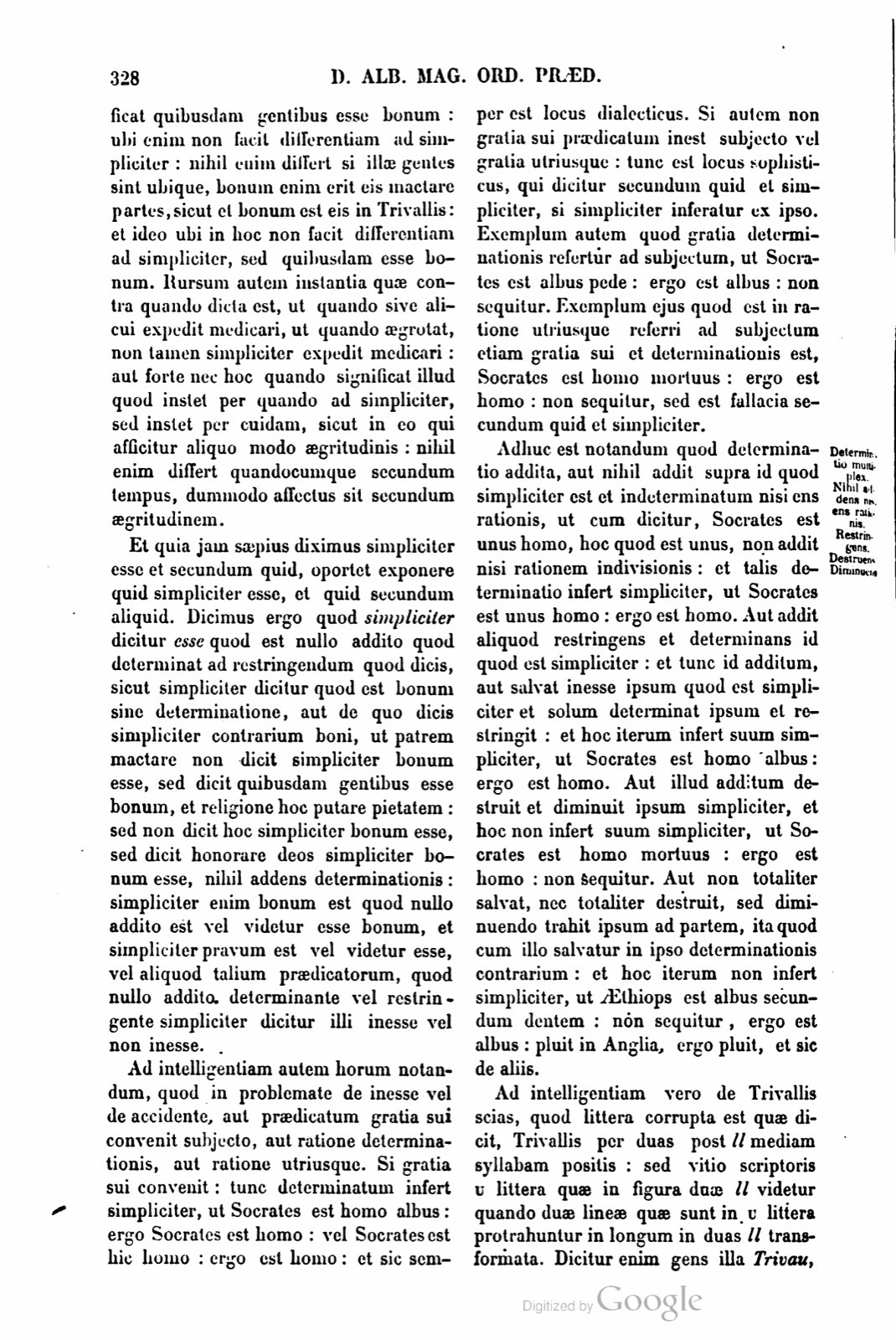
Et quia jam saepius diximus simpliciter esse et secundum quid, oportet exponere quid simpliciter esse, et quid secundum aliquid. Dicimus ergo quod simpliciter dicitur esse quod est nullo addito quod determinat ad restringendum quod dicis, sicut simpliciter dicitur quod est bonum sine determinatione, aut de quo dicis simpliciter contrarium boni, ut patrem mactare non dicit simpliciter bonum esse, sed dicit quibusdam gentibus esse bonum, et religione hoc putare pietatem: sed non dicit hoc simpliciter bonum esse, sed dicit honorare deos simpliciter bonum esse, nihil addens determinationis: simpliciter enim bonum est quod nullo addito est vel videtur esse bonum, et simpliciter pravum est vel videtur esse, vel aliquod talium praedicatorum, quod nullo addito determinante vel restringente simpliciter dicitur illi inesse vel non inesse.
Ad intelligentiam autem horum notandum, quod in problemate de inesse vel de accidente, aut praedicatum gratia sui convenit subjecto, aut ratione determinationis, aut ratione utriusque. Si gratia sui convenit: tunc determinatum infert simpliciter, ut Socrates est homo albus: ergo Socrates est homo: vel Socrates est hic homo: ergo est homo: et sic semper est locus dialecticus. Si autem non gratia sui praedicatum inest subjecto vel gratia utriusque: tunc est locus sophisticus, qui dicitur secundum quid et simpliciter, si simpliciter inferatur ex ipso. Exemplum autem quod gratia determinationis refertur ad subjectum, ut Socrates est albus pede: ergo est albus: non sequitur. Exemplum ejus quod est in ratione utriusque referri ad subjectum etiam gratia sui et determinationis est, Socrates est homo mortuus: ergo est homo: non sequitur, sed est fallacia secundum quid et simpliciter.
[Marginal label, printed page 328: Determinatio multiplex.] [Marginal label, printed page 328: Nihil addens nisi ens rationis.] [Marginal label, printed page 328: Restringens.] [Marginal label, printed page 328: Destruens.] [Marginal label, printed page 328: Diminuens.]
Adhuc est notandum quod determinatio addita, aut nihil addit supra id quod simpliciter est et indeterminatum nisi ens rationis, ut cum dicitur, Socrates est unus homo, hoc quod est unus, non addit nisi rationem indivisionis: et talis determinatio infert simpliciter, ut Socrates est unus homo: ergo est homo. Aut addit aliquod restringens et determinans id quod est simpliciter: et tunc id additum, aut salvat inesse ipsum quod est simpliciter et solum determinat ipsum et restringit: et hoc iterum infert suum simpliciter, ut Socrates est homo albus: ergo est homo. Aut illud additum destruit et diminuit ipsum simpliciter, et hoc non infert suum simpliciter, ut Socrates est homo mortuus: ergo est homo: non sequitur. Aut non totaliter salvat, nec totaliter destruit, sed diminuendo trahit ipsum ad partem, ita quod cum illo salvatur in ipso determinationis contrarium: et hoc iterum non infert simpliciter, ut Aethiops est albus secundum dentem: non sequitur, ergo est albus: pluit in Anglia, ergo pluit, et sic de aliis.
Ad intelligentiam vero de Trivallis scias, quod littera corrupta est quae dicit, Trivallis per duas post ll mediam syllabam positis: sed vitio scriptoris u littera quae in figura duae ll videtur quando duae lineae quae sunt in u littera protrahuntur in longum in duas ll transformata. Dicitur enim gens illa Trivau,
And because now we have more often said being simply and according to something, it is necessary to explain what being simply is and what being according to something is. Therefore we say that to be simply is said of what is with nothing added which determines toward restricting what you say, just as what is good without determination is said simply, or that of which you say simply the contrary of good. Thus to slay one's father does not say that it is good simply, but says that it is good for certain nations, and that by religion to think this piety; but it does not say that this is good simply, but says that to honor the gods is good simply, adding nothing of determination. For the simply good is what is or seems to be good with nothing added, and the simply depraved is or seems to be, or some such predicate is, what with no added determining or restricting thing is simply said to be in it or not to be in it.
But for the understanding of these things it must be noted that in the problem concerning being-in or concerning accident, either the predicate agrees with the subject for its own sake, or by reason of the determination, or by reason of both. If it agrees for its own sake, then the determinate infers the simple, as Socrates is a white human being; therefore Socrates is a human being; or Socrates is this human being; therefore he is a human being. And thus it is always a dialectical locus. But if the predicate is not in the subject for its own sake, or if it is by reason of both, then it is a sophistical locus, which is called according to something and simply, if the simple is inferred from it. But an example in which by reason of the determination it is referred to the subject is: Socrates is white in foot; therefore he is white; it does not follow. An example of that which is referred to the subject by the account of both, both for its own sake and for the sake of the determination, is: Socrates is a dead human being; therefore he is a human being; it does not follow, but it is the fallacy according to something and simply.
[Marginal label, printed page 328: Determination is multiple.] [Marginal label, printed page 328: Adding nothing except a being of reason.] [Marginal label, printed page 328: Restricting.] [Marginal label, printed page 328: Destroying.] [Marginal label, printed page 328: Diminishing.]
Furthermore it must be noted that an added determination either adds nothing beyond that which is simply and indeterminate except a being of reason, as when it is said, Socrates is one human being: this, that he is one, adds nothing except the account of undividedness; and such a determination infers simply, as Socrates is one human being, therefore he is a human being. Or it adds something restricting and determining that which is simply; and then that added thing either preserves the being-in itself which is simply and only determines and restricts it, and this again infers its simple, as Socrates is a white human being; therefore he is a human being. Or that added thing destroys and diminishes the simple itself, and this does not infer its simple, as Socrates is a dead human being; therefore he is a human being: it does not follow. Or it does not totally preserve nor totally destroy, but by diminishing draws it to a part, so that with it the contrary of the determination is preserved in the thing itself; and this again does not infer simply, as an Ethiopian is white according to the tooth: it does not follow, therefore he is white; it rains in England, therefore it rains, and so concerning other cases.
But for understanding concerning Trivallis, know that the letter is corrupt which says Trivallis with two l's placed after the middle syllable; but by the fault of the scribe, the letter u, which seems in shape to be two l's when the two lines which are in the letter u are extended in length, has been transformed into two l's. For that nation is called Trivau,
Notes
- This is the rule written in Posterior Analytics I, text-comment 5, that on account of which each thing is such, etc. Compare the note on page 31 of this volume II. (Haec est regula scripta in I Posterior. tex. com. 5 quod propter quod unumquodque tale est, etc. Cf. notam pag. 31 hujusce tomi II.) ↩
- And this is what is customarily said, that the comparative presupposes its positive. (Et hoc est quod dici solet, quod comparativum praesupponit suum positivum.) ↩
If a page does not appear, its photograph has not been uploaded yet.