Volume 2 · pp. 321–323
CHAPTER V. On the inspection of the problem concerning accident toward extrinsic things of the same, but nevertheless agreeing with it. CHAPTER VI. In what way, in the consideration of the problem concerning accident, one must attend to generations and corruptions, and to efficient and corrupting things and to similars.
A marker with ≈ is an approximate page boundary, placed by measure of the text; the page photographs remain the authority. In the paired views, clicking a page marker brings that page into view.
CAPUT V.
De inspectione problematis de accidente ad extrinseca ejusdem, sed tamen convenientia cum illo.
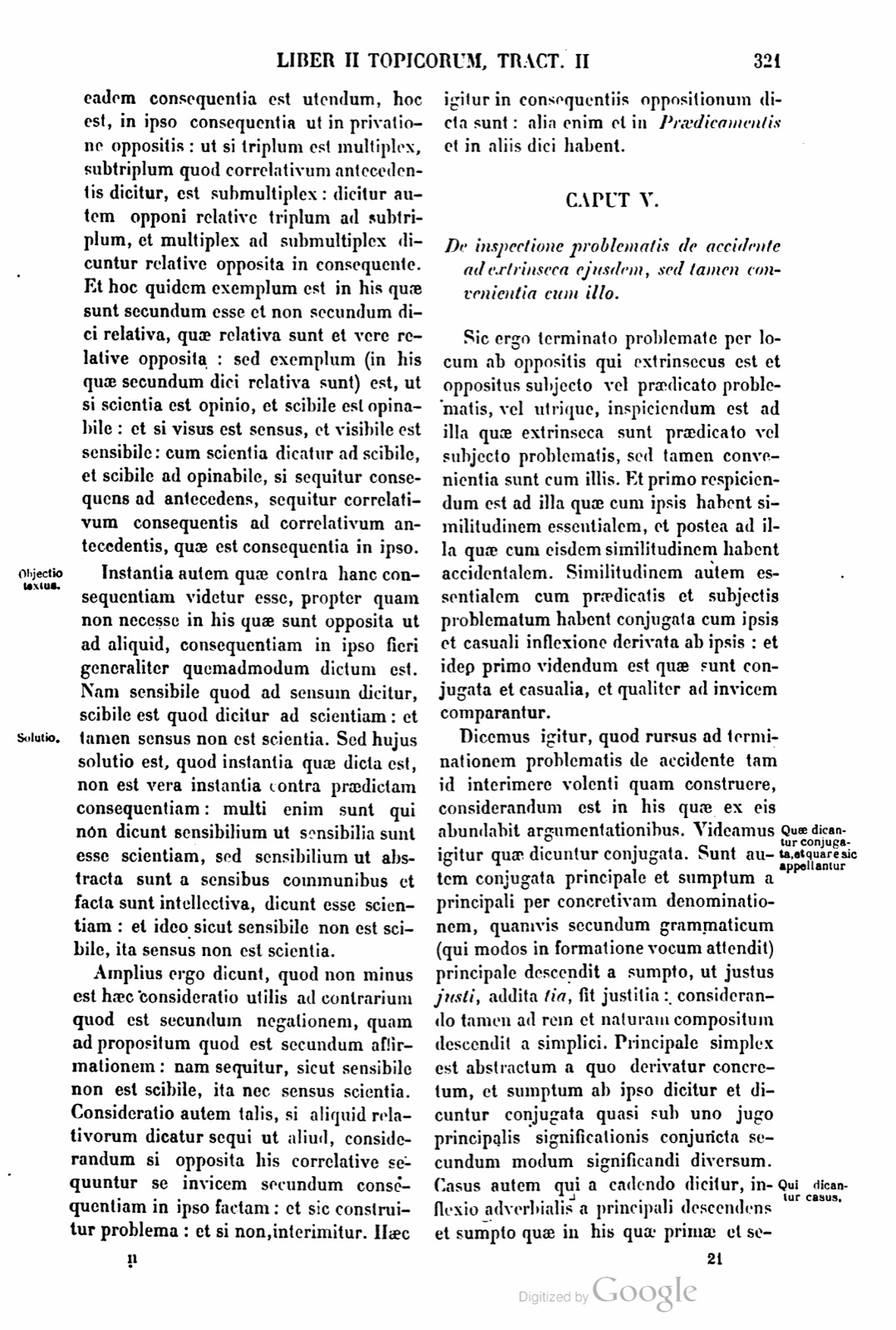
Sic ergo terminato problemate per locum ab oppositis qui extrinsecus est et oppositus subjecto vel praedicato problematis, vel utrique, inspiciendum est ad illa quae extrinseca sunt praedicato vel subjecto problematis, sed tamen convenientia sunt cum illis. Et primo respiciendum est ad illa quae cum ipsis habent similitudinem essentialem, et postea ad illa quae cum eisdem similitudinem habent accidentalem. Similitudinem autem essentialem cum praedicatis et subjectis problematum habent conjugata cum ipsis et casuali inflexione derivata ab ipsis: et ideo primo videndum est quae sunt conjugata et casualia, et qualiter ad invicem comparantur.
[Marginal label, printed page 321: Quae dicantur conjugata, et quare sic appellantur.]
Dicemus igitur, quod rursus ad terminationem problematis de accidente tam id interimere volenti quam construere, considerandum est in his quae ex eis abundabit argumentationibus. Videamus igitur quae dicuntur conjugata. Sunt autem conjugata principale et sumptum a principali per concretivam denominationem, quamvis secundum grammaticum, qui modos in formatione vocum attendit, principale descendit a sumpto, ut justus justi, addita tia, fit justitia: considerando tamen ad rem et naturam compositum descendit a simplici. Principale simplex est abstractum a quo derivatur concretum, et sumptum ab ipso dicitur et dicuntur conjugata quasi sub uno jugo principalis significationis conjuncta secundum modum significandi diversum.
[Marginal label, printed page 321: Qui dicantur casus.]
Casus autem qui a cadendo dicitur, inflexio adverbialis a principali descendens et sumpto quae in his quae primae et secundae derivationis, ut justitia, justus, justi, juste. Quandoque regulariter cadit per inflexionem ultimae syllabae, et quandoque cadit irregulariter, ut a bonus, boni, bene, in quo prima et ultima syllaba inflectuntur.
Dicuntur igitur conjugata quae sunt hujusmodi a justitia, justus, justa, justum, quae sunt conjugata, sunt sub uno et eodem jugo principalis significati, quod est justitia conjuncta, a quo non differunt nisi per modum significandi diversum. Dicuntur ergo conjugata hujus quae sunt ut justus, sta, stum, justitiae: quod principali significato conjuncta, et a nominibus tertiae declinationis sumpta, sicut fortia et fortis conjugata sunt fortitudini. Similiter perfectiva, aut conservativa alicujus habitus corporalis vel spiritualis derivata non per inflexionem, sed per denominationem dictam, propter aliquem modum quo se habent ad illum habitum vel formam, dicuntur illi habituali formae conjugata, sicut diaeta vel urina dicuntur sanitati conjugata, cujus sunt perfectiva et conservativa, ut salubria sive sanitatis effectiva sana dicuntur et conjugata sanitati: et euechiva, hoc est, euechiae factiva vel conservativa, conjugata sunt euechiae. Eodem autem modo in omnibus aliis. Ergo quaecumque conjugata qualiter, hoc est, aliqualiter, ut sumpta a principalibus denominatione, ut in communi dicatur, taliter, ut dictum est, solent dici. Casus autem per inflexionem venit in adverbium, qui modus actus verbi terminat, ut juste inflexum a nomine secundae declinationis, vel fortiter vel salubriter derivatum a sumpto tertiae declinationis, hi casus dicuntur: et est in eis modus adverbialis qui est modus verbi.
CHAPTER V.
On the inspection of the problem concerning accident toward extrinsic things of the same, but nevertheless agreeing with it.
Thus, therefore, once the problem has been terminated through the locus from opposites, which is extrinsic and opposed to the subject or predicate of the problem, or to both, one must inspect those things which are extrinsic to the predicate or subject of the problem, but nevertheless agree with them. And first one must look to those things which have an essential likeness with them, and afterward to those things which have an accidental likeness with the same. But things conjugate with them and derived from them by casual inflection have essential likeness with the predicates and subjects of problems; and therefore first one must see what conjugates and casuals are, and how they are compared with one another.
[Marginal label, printed page 321: What are called conjugates, and why they are so called.]
Therefore we shall say that again, for the termination of the problem concerning accident, both for one wishing to destroy it and for one wishing to construct it, one must consider among those things by which he will abound in arguments from them. Let us therefore see what are called conjugates. But conjugates are the principal and what is taken from the principal through concretive denomination, although according to the grammarian, who attends to the modes in the formation of words, the principal descends from the thing taken, as from just, of the just, with tia added, justice is made. Nevertheless, considering the thing and nature, the composite descends from the simple. The simple principal is the abstract from which the concrete is derived, and what is taken from it is called, and they are called, conjugates, as joined under one yoke of principal signification according to a diverse mode of signifying.
[Marginal label, printed page 321: What are called cases.]
But case, which is named from falling, is an adverbial inflection descending from the principal and from the thing taken, which is in those things of first and second derivation, as justice, just, of the just, justly. Sometimes it falls regularly through inflection of the last syllable, and sometimes it falls irregularly, as from good, of good, well, in which the first and last syllable are inflected.
Therefore those things of this sort are called conjugates from justice: just, just-feminine, just-neuter, which are conjugates, are under one and the same yoke of the principal signified, which is justice joined, from which they do not differ except through a diverse mode of signifying. Therefore conjugates of this are called those which are as just, just-feminine, just-neuter, of justice, joined to the principal signified and taken from nouns of the third declension, just as brave-neuter and brave are conjugates to bravery. Similarly, things perfective or preservative of some bodily or spiritual habit, derived not by inflection but by the stated denomination, on account of some mode by which they have themselves to that habit or form, are called conjugates of that habitual form, just as diet or urine are called conjugates of health, of which they are perfective and preservative, so that healthful things, or things effective of health, are called healthy and conjugates to health; and things productive or preservative of good bodily habit, that is, of euechia, are conjugates of euechia. And in the same way in all other cases. Therefore whatever things are conjugate in whatever way, that is, in some way, as things taken from principals by denomination, to speak commonly, are customarily said in such a way, as has been said. But case through inflection comes into an adverb, which terminates the mode of the act of the verb, as justly inflected from a noun of the second declension, or bravely or healthfully derived from what is taken from the third declension; these are called cases, and in them there is the adverbial mode, which is the mode of the verb.
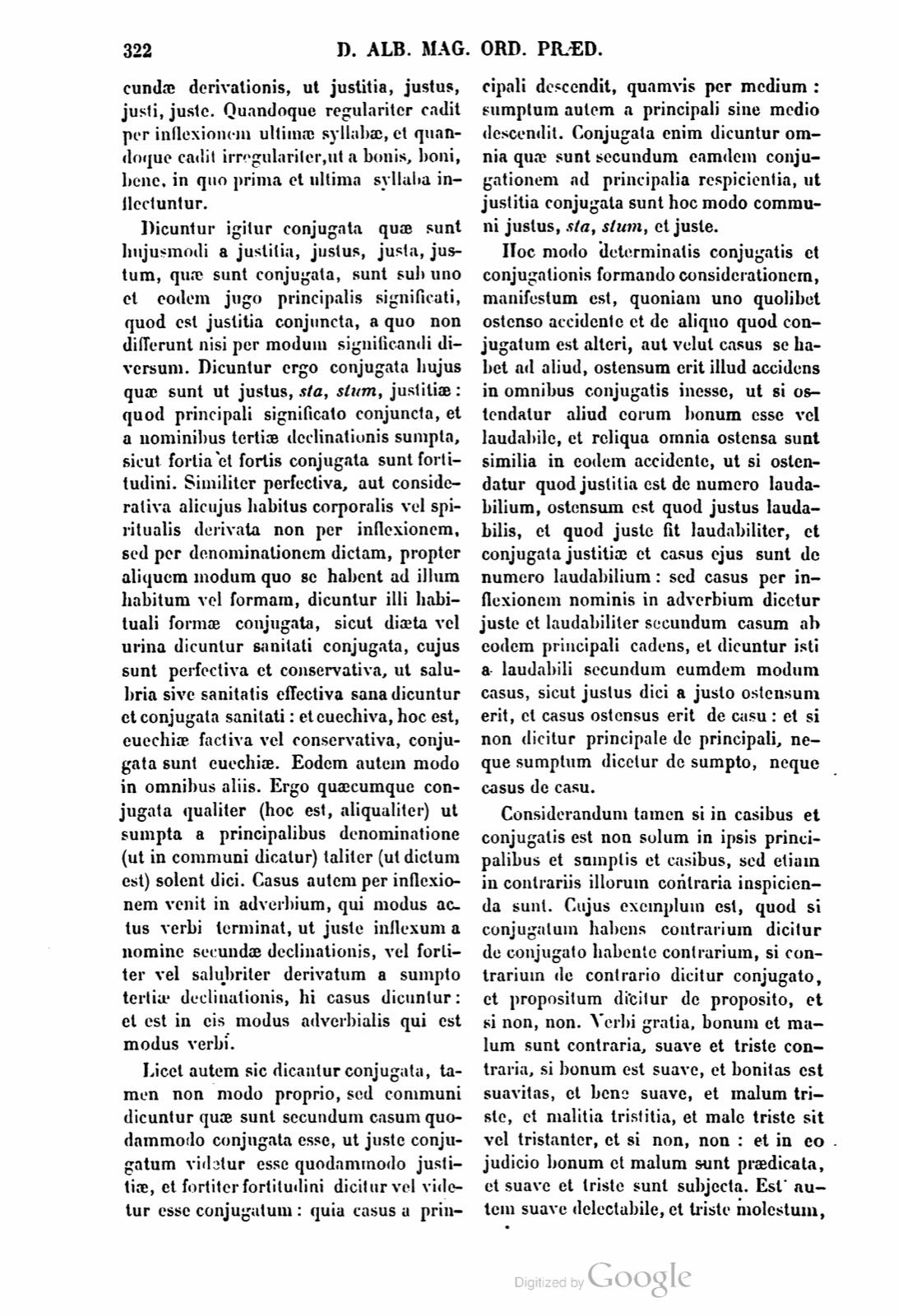
Licet autem sic dicantur conjugata, tamen non modo proprio, sed communi dicuntur quae sunt secundum casum quodammodo conjugata esse, ut juste conjugatum videtur esse quodammodo justitiae, et fortiter fortitudini dicitur vel videtur esse conjugatum: quia casus a principali descendit, quamvis per medium: sumptum autem a principali sine medio descendit. Conjugata enim dicuntur omnia quae sunt secundum eamdem conjugationem ad principalia respicientia, ut justitia conjugata sunt hoc modo communi justus, sta, stum, et juste.
Hoc modo determinatis conjugatis et conjugationis formando considerationem, manifestum est, quoniam uno quolibet ostenso accidente et de aliquo quod conjugatum est alteri, aut velut casus se habet ad aliud, ostensum erit illud accidens in omnibus conjugatis inesse, ut si ostendatur aliud eorum bonum esse vel laudabile, et reliqua omnia ostensa sunt similia in eodem accidente, ut si ostendatur quod justitia est de numero laudabilium, ostensum est quod justus laudabilis, et quod juste fit laudabiliter, et conjugata justitia et casus ejus sunt de numero laudabilium: sed casus per inflexionem nominis in adverbium dicetur juste et laudabiliter secundum casum ab eodem principali cadens, et dicuntur isti a laudabili secundum eumdem modum casus, sicut justus dici a justo ostensum erit, et casus ostensus erit de casu: et si non dicitur principale de principali, neque sumptum dicetur de sumpto, neque casus de casu.
Considerandum tamen si in casibus et conjugatis est non solum in ipsis principalibus et sumptis et casibus, sed etiam in contrariis illorum contraria inspicienda sunt. Cujus exemplum est, quod si conjugatum habens contrarium dicitur de conjugato habente contrarium, si contrarium de contrario dicitur conjugato, et propositum dicitur de proposito, et si non, non. Verbi gratia, bonum et malum sunt contraria, suave et triste contraria, si bonum est suave, et bonitas est suavitas, et bene suave, et malum triste, et malitia tristitia, et male triste sit vel tristanter, et si non, non: et in eo judicio bonum et malum sunt praedicata, et suave et triste sunt subjecta. Est autem suave delectabile, et triste molestum, quod tamen aliquando non est malum, sed bonum utile, sicut aduri vel incidi: unde si triste est malum, et suaviter est bonum: et si triste aliquando non est malum, et suave aliquando non erit bonum: neque suavitas bonitas, neque suaviter bene: aut si hoc triste est malum, et suave bonum. In principalioribus exemplum est Socratis qui dixit virtutes esse scientias, eo quod malus est ignorans, sic arguens: injustus est ignorans: ergo injustitia est ignorantia: et in contrario justitia scientia: quia si justitia est scientia, et injustitia erit ignorantia: et si quod juste est vel fit scienter vel experienter fit, sequitur tunc quod injuste est vel fit, ignoranter est vel fit. Sic autem in conjugatis in contrario non est verum.
But although they are called conjugates in this way, nevertheless not in the proper mode but in the common mode are those things called conjugate in some way which are according to case, as justly seems in some way to be conjugate to justice, and bravely is said or seems to be conjugate to bravery, because the case descends from the principal, although through a middle; but what is taken descends from the principal without a middle. For all those things are called conjugates which according to the same conjugation look back to principals, as in this common mode the conjugates of justice are just, just-feminine, just-neuter, and justly.
Once conjugates have been determined in this way, and by forming the consideration of conjugation, it is manifest that when any one accident has been shown, and concerning something that is conjugate to another, or has itself as a case to another, that accident will have been shown to be in all the conjugates. Thus if one of them is shown to be good or praiseworthy, all the remaining things have been shown to be similar in the same accident; as if it is shown that justice is of the number of praiseworthy things, it has been shown that the just person is praiseworthy, and that what is done justly is done praiseworthily, and that the conjugates of justice and its case are of the number of praiseworthy things. But by inflection of the noun into an adverb the case will be called justly and praiseworthily according to the case falling from the same principal, and these are said from praiseworthy according to the same mode of case, just as to be called just from the just will have been shown, and the case will have been shown from the case. And if the principal is not said of the principal, neither will what is taken be said of what is taken, nor the case of the case.
Nevertheless one must consider whether in cases and conjugates one must inspect not only in the principals themselves and the things taken and the cases, but also contraries in the contraries of those things. An example of this is that if a conjugate having a contrary is said of a conjugate having a contrary, and if the contrary is said of the contrary conjugate, then the proposed thing is said of the proposed thing, and if not, not. For example, good and evil are contraries, sweet and painful are contraries. If good is sweet, then goodness is sweetness, and well is sweetly, and evil is painful, and malice is painfulness, and evilly is or painfully; and if not, not. And in that judgment good and evil are predicates, and sweet and painful are subjects. But sweet is delectable, and painful is troublesome, which nevertheless is sometimes not evil but useful good, as to be burned or cut. Hence if the painful is evil, then sweetly is good; and if the painful is sometimes not evil, the sweet will sometimes not be good; neither will sweetness be goodness, nor sweetly well; or if this painful thing is evil, then the sweet is good. Among more principal examples there is the example of Socrates, who said that virtues are sciences, because an evil person is ignorant, arguing thus: the unjust person is ignorant; therefore injustice is ignorance; and in the contrary, justice is knowledge; because if justice is knowledge, injustice will also be ignorance; and if what is or is done justly is done knowingly or expertly, it then follows that what is or is done unjustly is or is done ignorantly. But in conjugates in the contrary this is not true.
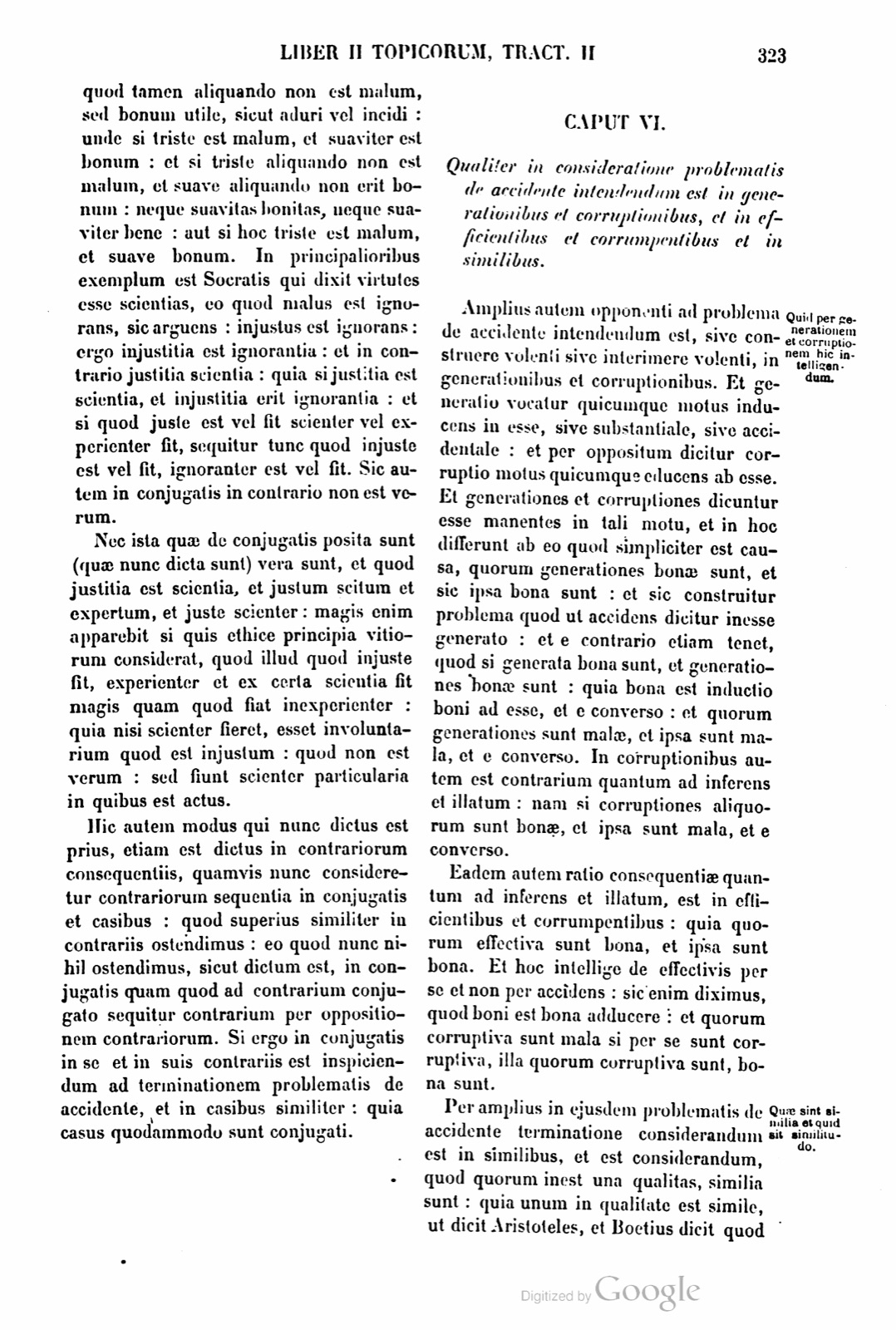
Nec ista quae de conjugatis posita sunt, quae nunc dicta sunt, vera sunt, et quod justitia est scientia, et justum scitum et expertum, et juste scienter: magis enim apparebit si quis ethice principia vitiorum considerat, quod illud quod injuste fit, experienter et ex certa scientia fit magis quam quod fiat inexperienter: quia nisi scienter fieret, esset involuntarium quod est injustum: quod non est verum: sed fiunt scienter particularia in quibus est actus.
Hic autem modus qui nunc dictus est prius, etiam est dictus in contrariorum consequentiis, quamvis nunc consideretur contrariorum sequentia in conjugatis et casibus: quod superius similiter in contrariis ostendimus: eo quod nunc nihil ostendimus, sicut dictum est, in conjugatis quam quod ad contrarium conjugato sequitur contrarium per oppositionem contrariorum. Si ergo in conjugatis in se et in suis contrariis est inspiciendum ad terminationem problematis de accidente, et in casibus similiter: quia casus quodammodo sunt conjugati.
CAPUT VI.
Qualiter in consideratione problematis de accidente intendendum est in generationibus et corruptionibus, et in efficientibus et corrumpentibus et in similibus.
[Marginal label, printed page 323: Quid per generationem et corruptionem hic intelligendum.]
Amplius autem opponenti ad problema de accidente intendendum est, sive construere volenti sive interimere volenti, in generationibus et corruptionibus. Et generatio vocatur quicumque motus inducens in esse, sive substantiale, sive accidentale: et per oppositum dicitur corruptio motus quicumque educens ab esse. Et generationes et corruptiones dicuntur esse manentes in tali motu, et in hoc differunt ab eo quod simpliciter est causa, quorum generationes bonae sunt, et sic ipsa bona sunt: et sic construitur problema quod ut accidens dicitur inesse generato: et e contrario etiam tenet, quod si generata bona sunt, et generationes bonae sunt: quia bona est inductio boni ad esse, et e converso: et quorum generationes sunt malae, et ipsa sunt mala, et e converso. In corruptionibus autem est contrarium quantum ad inferens et illatum: nam si corruptiones aliquorum sunt bonae, et ipsa sunt mala, et e converso.
Eadem autem ratio consequentiae quantum ad inferens et illatum, est in efficientibus et corrumpentibus: quia quorum effectiva sunt bona, et ipsa sunt bona. Et hoc intellige de effectivis per se et non per accidens: sic enim diximus, quod boni est bona adducere: et quorum corruptiva sunt mala si per se sunt corruptiva, illa quorum corruptiva sunt, bona sunt.
[Marginal label, printed page 323: Quae sint similia et quid sit similitudo.]
Per amplius in ejusdem problematis de accidente terminatione considerandum est in similibus, et est considerandum, quod quorum inest una qualitas, similia sunt: quia unum in qualitate est simile, ut dicit Aristoteles, et Boetius dicit quod similitudo est rerum differentium eadem qualitas.
Nor are those things true which have been posited concerning conjugates, which have now been said: that justice is knowledge, and the just thing known and experienced, and justly knowingly. For it will appear more if someone considers ethically the principles of vices, that what is done unjustly is done expertly and from certain knowledge rather than that it is done inexpertly, because unless it were done knowingly, what is unjust would be involuntary, which is not true; rather, the particular things in which the act is are done knowingly.
But this mode which has now been stated was also stated before in the consequences of contraries, although now the sequence of contraries is considered in conjugates and cases. This we showed above similarly in contraries, because now we show nothing in conjugates, as has been said, except that upon the contrary conjugate follows the contrary through the opposition of contraries. Therefore if in conjugates in themselves and in their contraries one must inspect for the termination of the problem concerning accident, likewise also in cases, because cases are in a certain way conjugates.
CHAPTER VI.
In what way, in the consideration of the problem concerning accident, one must attend to generations and corruptions, and to efficient and corrupting things and to similars.
[Marginal label, printed page 323: What is understood here through generation and corruption.]
Moreover, for the opponent toward the problem concerning accident, whether wishing to construct or wishing to destroy, one must attend to generations and corruptions. And generation is called any motion inducing into being, whether substantial or accidental; and by opposition corruption is called any motion leading out from being. And generations and corruptions are said to be things remaining in such motion, and in this they differ from that which simply is a cause. The things whose generations are good, they themselves are also good; and thus the problem is constructed, that what is said as accident is in the generated thing. And conversely it also holds, that if generated things are good, the generations also are good, because the induction of good into being is good, and conversely. And the things whose generations are evil, they themselves are evil, and conversely. But in corruptions the contrary holds as to the inferring thing and the inferred thing: for if the corruptions of some things are good, those things themselves are evil, and conversely.
But the same account of consequence as to the inferring thing and the inferred thing is in efficient and corrupting things, because the things whose effective causes are good are themselves good. And understand this of effective causes per se and not per accidens. For thus we said that it belongs to the good to bring forth good things; and the things whose corruptive causes are evil, if they are corruptive causes per se, those things whose corruptive causes they are are good.
[Marginal label, printed page 323: What similars are and what likeness is.]
Furthermore, in the termination of the same problem concerning accident one must consider in similars, and one must consider that things to which one quality belongs are similar, because one in quality is similar, as Aristotle says, and Boethius says that likeness is the same quality of different things.
If a page does not appear, its photograph has not been uploaded yet.