Volume 2 · pp. 319–321
CHAPTER IV. On the inspection of the problem concerning accident concerning the consequences of opposites.
A marker with ≈ is an approximate page boundary, placed by measure of the text; the page photographs remain the authority. In the paired views, clicking a page marker brings that page into view.
[Marginal label, printed page 319: Limitat regulam.]
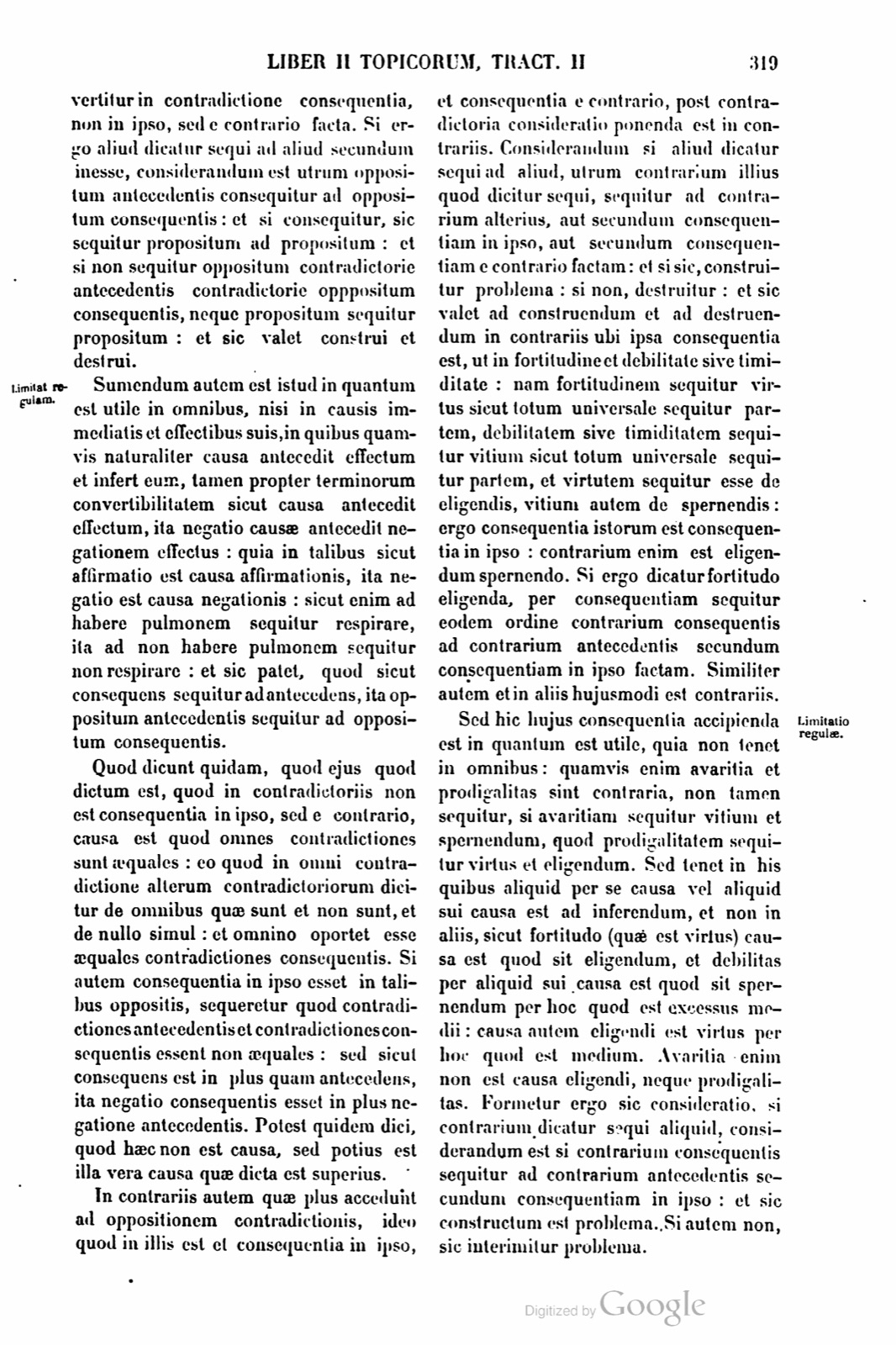
Sumendum autem est istud in quantum est utile in omnibus, nisi in causis immediatis et effectibus suis, in quibus quamvis naturaliter causa antecedit effectum et infert eum, tamen propter terminorum convertibilitatem sicut causa antecedit effectum, ita negatio causae antecedit negationem effectus: quia in talibus sicut affirmatio est causa affirmationis, ita negatio est causa negationis: sicut enim ad habere pulmonem sequitur respirare, ita ad non habere pulmonem sequitur non respirare: et sic patet, quod sicut consequens sequitur ad antecedens, ita oppositum antecedentis sequitur ad oppositum consequentis.
Quod dicunt quidam, quod ejus quod dictum est, quod in contradictoriis non est consequentia in ipso, sed e contrario, causa est quod omnes contradictiones sunt aequales: eo quod in omni contradictione alterum contradictoriorum dicitur de omnibus quae sunt et non sunt, et de nullo simul: et omnino oportet esse aequales contradictiones consequentis. Si autem consequentia in ipso esset in talibus oppositis, sequeretur quod contradictiones antecedentis et contradictiones consequentis essent non aequales: sed sicut consequens est in plus quam antecedens, ita negatio consequentis esset in plus negatione antecedentis. Potest quidem dici, quod haec non est causa, sed potius est illa vera causa quae dicta est superius.
In contrariis autem quae plus accedunt ad oppositionem contradictionis, ideo quod in illis est et consequentia in ipso, et consequentia e contrario, post contradictoria consideratio ponenda est in contrariis. Considerandum si aliud dicatur sequi ad aliud, utrum contrarium illius quod dicitur sequi, sequitur ad contrarium alterius, aut secundum consequentiam in ipso, aut secundum consequentiam e contrario factam: et si sic, construitur problema: si non, destruitur: et sic valet ad construendum et ad destruendum in contrariis ubi ipsa consequentia est, ut in fortitudine et debilitate sive timiditate: nam fortitudinem sequitur virtus sicut totum universale sequitur partem, debilitatem sive timiditatem sequitur vitium sicut totum universale sequitur partem, et virtutem sequitur esse de eligendis, vitium autem de spernendis: ergo consequentia istorum est consequentia in ipso: contrarium enim est eligendum spernendo. Si ergo dicatur fortitudo eligenda, per consequentiam sequitur eodem ordine contrarium consequentis ad contrarium antecedentis secundum consequentiam in ipso factam. Similiter autem et in aliis hujusmodi est contrariis.
[Marginal label, printed page 319: Limitatio regulae.]
Sed hic hujus consequentia accipienda est in quantum est utile, quia non tenet in omnibus: quamvis enim avaritia et prodigalitas sint contraria, non tamen sequitur, si avaritiam sequitur vitium et spernendum, quod prodigalitatem sequitur virtus et eligendum. Sed tenet in his quibus aliquid per se causa vel aliquid sui causa est ad inferendum, et non in aliis, sicut fortitudo, quae est virtus, causa est quod sit eligendum, et debilitas per aliquid sui causa est quod sit spernendum per hoc quod est excessus medii: causa autem eligendi est virtus per hoc quod est medium. Avaritia enim non est causa eligendi, neque prodigalitas. Formetur ergo sic consideratio, si contrarium dicatur sequi aliquid, considerandum est si contrarium consequentis sequitur ad contrarium antecedentis secundum consequentiam in ipso: et sic constructum est problema. Si autem non, sic interimitur problema.
[Marginal label, printed page 319: He limits the rule.]
But this must be taken insofar as it is useful in all things, except in immediate causes and their effects, in which, although a cause naturally antecedes the effect and infers it, nevertheless because of the convertibility of the terms, just as the cause antecedes the effect, so the denial of the cause antecedes the denial of the effect. For in such cases, just as affirmation is the cause of affirmation, so denial is the cause of denial. For just as upon having a lung follows breathing, so upon not having a lung follows not breathing. And thus it is plain that just as the consequent follows upon the antecedent, so the opposite of the antecedent follows upon the opposite of the consequent.
Certain persons say that the cause of what has been said, namely that in contradictories there is not consequence in itself but e contrario, is that all contradictions are equal, because in every contradiction one of the contradictories is said of all things that are and are not, and of nothing simultaneously; and the contradictions of the consequent must be altogether equal. But if consequence in itself existed in such opposites, it would follow that the contradictions of the antecedent and the contradictions of the consequent were not equal; but just as the consequent is more extensive than the antecedent, so the denial of the consequent would be more extensive than the denial of the antecedent. It can indeed be said that this is not the cause, but rather that true cause which was stated above.
But in contraries which come nearer to the opposition of contradiction, because in them there is both consequence in itself and consequence e contrario, after contradictories the consideration must be placed in contraries. If one thing is said to follow upon another, one must consider whether the contrary of that which is said to follow follows upon the contrary of the other, either according to consequence in itself or according to consequence made e contrario. And if it does, the problem is constructed; if not, it is destroyed. And thus it is valid for constructing and for destroying in contraries where the consequence itself exists, as in courage and weakness or timidity. For virtue follows courage as the universal whole follows the part; vice follows weakness or timidity as the universal whole follows the part; and being among things to be chosen follows virtue, while being among things to be despised follows vice. Therefore the consequence of these things is consequence in itself; for what is to be chosen is contrary to what is to be despised. Therefore if courage is said to be to be chosen, through consequence, in the same order, the contrary of the consequent follows upon the contrary of the antecedent according to consequence made in itself. Similarly also it is so in other contraries of this sort.
[Marginal label, printed page 319: Limitation of the rule.]
But here the consequence of this sort must be accepted insofar as it is useful, because it does not hold in all cases. For although avarice and prodigality are contraries, nevertheless it does not follow, if vice and what is to be despised follow avarice, that virtue and what is to be chosen follow prodigality. But it holds in those cases in which something is through itself a cause, or something of itself is a cause, for inferring, and not in others, as courage, which is a virtue, is a cause of its being to be chosen, and weakness is, through something of itself, a cause of its being to be despised through the fact that it is an excess of the mean; but the cause of choosing is virtue through the fact that it is a mean. For avarice is not a cause of choosing, nor is prodigality. Therefore let the consideration be formed thus: if a contrary is said to follow something, one must consider whether the contrary of the consequent follows upon the contrary of the antecedent according to consequence in itself; and thus the problem has been constructed. But if not, in this way the problem is destroyed.
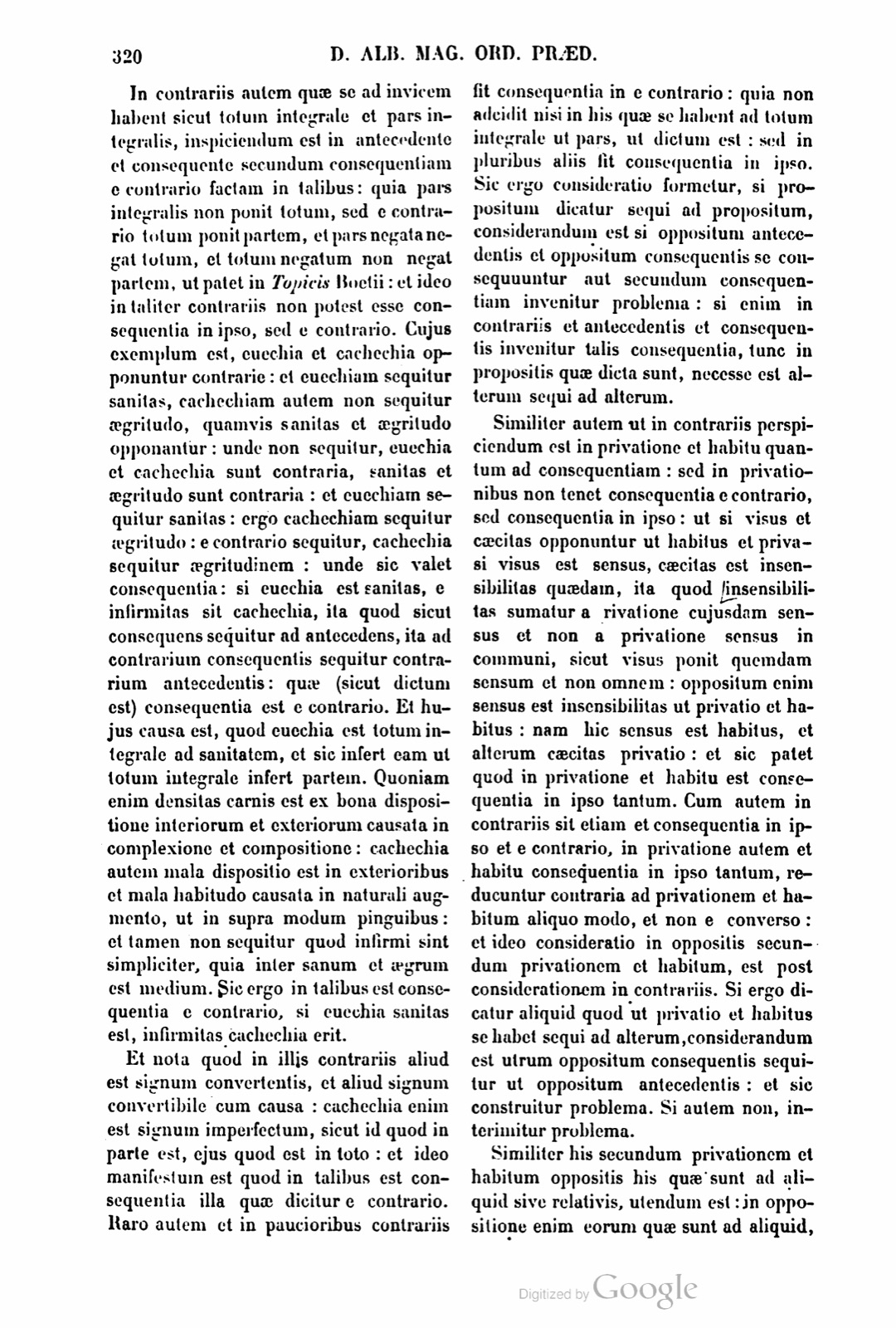
In contrariis autem quae se ad invicem habent sicut totum integrale et pars integralis, inspiciendum est in antecedente et consequente secundum consequentiam e contrario factam in talibus: quia pars integralis non ponit totum, sed e contrario totum ponit partem, et pars negata negat totum, et totum negatum non negat partem, ut patet in Topicis Boetii: et ideo in taliter contrariis non potest esse consequentia in ipso, sed e contrario. Cujus exemplum est, euechia et cachechia opponuntur contrarie: et euechiam sequitur sanitas, cachechiam autem non sequitur aegritudo, quamvis sanitas et aegritudo opponantur: unde non sequitur, euechia et cachechia sunt contraria, sanitas et aegritudo sunt contraria: et euechiam sequitur sanitas: ergo cachechiam sequitur aegritudo: e contrario sequitur, cachechia sequitur aegritudinem: unde sic valet consequentia: si euechia est sanitas, e contrario si infirmitas sit cachechia, ita quod sicut consequens sequitur ad antecedens, ita ad contrarium consequentis sequitur contrarium antecedentis: quae, sicut dictum est, consequentia est e contrario. Et hujus causa est, quod euechia est totum integrale ad sanitatem, et sic infert eam ut totum integrale infert partem. Quoniam enim densitas carnis est ex bona dispositione interiorum et exteriorum causata in complexione et compositione: cachechia autem mala dispositio est in exterioribus et mala habitudo causata in naturali augmento, ut in supra modum pinguibus: et tamen non sequitur quod infirmi sint simpliciter, quia inter sanum et aegrum est medium. Sic ergo in talibus est consequentia e contrario, si euechia sanitas est, infirmitas cachechia erit.
Et nota quod in illis contrariis aliud est signum convertentis, et aliud signum convertibile cum causa: cachechia enim est signum imperfectum, sicut id quod in parte est, ejus quod est in toto: et ideo manifestum est quod in talibus est consequentia illa quae dicitur e contrario. Raro autem et in paucioribus contrariis fit consequentia in e contrario: quia non accidit nisi in his quae se habent ad totum integrale ut pars, ut dictum est: sed in pluribus aliis fit consequentia in ipso. Sic ergo consideratio formetur, si propositum dicatur sequi ad propositum, considerandum est si oppositum antecedentis et oppositum consequentis se consequuntur aut secundum consequentiam invenitur problema: si enim in contrariis et antecedentis et consequentis invenitur talis consequentia, tunc in propositis quae dicta sunt, necesse est alterum sequi ad alterum.
Similiter autem ut in contrariis perspiciendum est in privatione et habitu quantum ad consequentiam: sed in privationibus non tenet consequentia e contrario, sed consequentia in ipso: ut si visus et caecitas opponuntur ut habitus et privatio, si visus est sensus, caecitas est insensibilitas quaedam, ita quod insensibilitas sumatur a privatione cujusdam sensus, et non a privatione sensus in communi, sicut visus ponit quemdam sensum et non omnem: oppositum enim sensus est insensibilitas ut privatio et habitus: nam hic sensus est habitus, et alterum caecitas privatio: et sic patet quod in privatione et habitu est consequentia in ipso tantum. Cum autem in contrariis sit etiam et consequentia in ipso et e contrario, in privatione autem et habitu consequentia in ipso tantum, reducuntur contraria ad privationem et habitum aliquo modo, et non e converso: et ideo consideratio in oppositis secundum privationem et habitum, est post considerationem in contrariis. Si ergo dicatur aliquid quod ut privatio et habitus se habet sequi ad alterum, considerandum est utrum oppositum consequentis sequitur ut oppositum antecedentis: et sic construitur problema. Si autem non, interimitur problema.
But in contraries which have themselves to one another as integral whole and integral part, one must inspect in antecedent and consequent according to consequence made e contrario in such things, because an integral part does not posit the whole, but conversely the whole posits the part, and the part, when denied, denies the whole, and the whole, when denied, does not deny the part, as is plain in Boethius's Topics. And therefore in contraries of this sort there cannot be consequence in itself, but there can be consequence e contrario. An example of this is: good habit of body and bad habit of body are opposed contrarily; and health follows good habit of body, but sickness does not follow bad habit of body, although health and sickness are opposed. Hence it does not follow: good habit and bad habit are contraries, health and sickness are contraries, and health follows good habit; therefore sickness follows bad habit. E contrario it follows: bad habit follows sickness. Hence the consequence is valid thus: if good habit is health, then, conversely, if infirmity exists, bad habit will be; so that, just as the consequent follows upon the antecedent, so upon the contrary of the consequent follows the contrary of the antecedent. This, as has been said, is consequence e contrario. And the cause of this is that good habit of body is an integral whole in relation to health, and thus it infers it as an integral whole infers a part. For density of flesh is from a good disposition of interior and exterior things caused in complexion and composition; but bad bodily habit is a bad disposition in exterior things and a bad condition caused in natural increase, as in those fat beyond measure. And nevertheless it does not follow that they are simply sick, because there is a middle between healthy and sick. Thus therefore in such cases there is consequence e contrario: if good bodily habit is health, infirmity will be bad bodily habit.
And note that in those contraries one thing is a sign of what converts, and another is a sign convertible with the cause. For bad bodily habit is an imperfect sign, as that which is in the part is a sign of that which is in the whole; and therefore it is manifest that in such cases there is that consequence which is called e contrario. But consequence e contrario occurs rarely and in the fewer cases among contraries, because it occurs only in those things which have themselves to an integral whole as a part, as has been said; but in many other cases consequence in itself occurs. Thus, therefore, let the consideration be formed: if the proposed thing is said to follow upon the proposed thing, one must consider whether the opposite of the antecedent and the opposite of the consequent follow one another, or whether the problem is found according to consequence. For if in the contraries both of antecedent and of consequent such consequence is found, then in the proposed things that have been stated, one must necessarily follow upon the other.
Similarly, as in contraries, one must inspect in privation and habit with respect to consequence; but in privations consequence e contrario does not hold, but consequence in itself does. Thus if sight and blindness are opposed as habit and privation, if sight is a sense, blindness is a certain insensibility, so that insensibility is taken from the privation of a certain sense and not from the privation of sense in common, just as sight posits a certain sense and not every sense. For the opposite of sense is insensibility as privation and habit: for this sense is habit, and the other, blindness, is privation. And thus it is plain that in privation and habit there is consequence in itself only. But since in contraries there is both consequence in itself and e contrario, while in privation and habit there is consequence in itself only, contraries are reduced to privation and habit in some way, and not conversely. And therefore the consideration in opposites according to privation and habit is after the consideration in contraries. Therefore if something that has itself as privation and habit is said to follow upon another, one must consider whether the opposite of the consequent follows as the opposite of the antecedent; and thus the problem is constructed. But if not, the problem is destroyed.
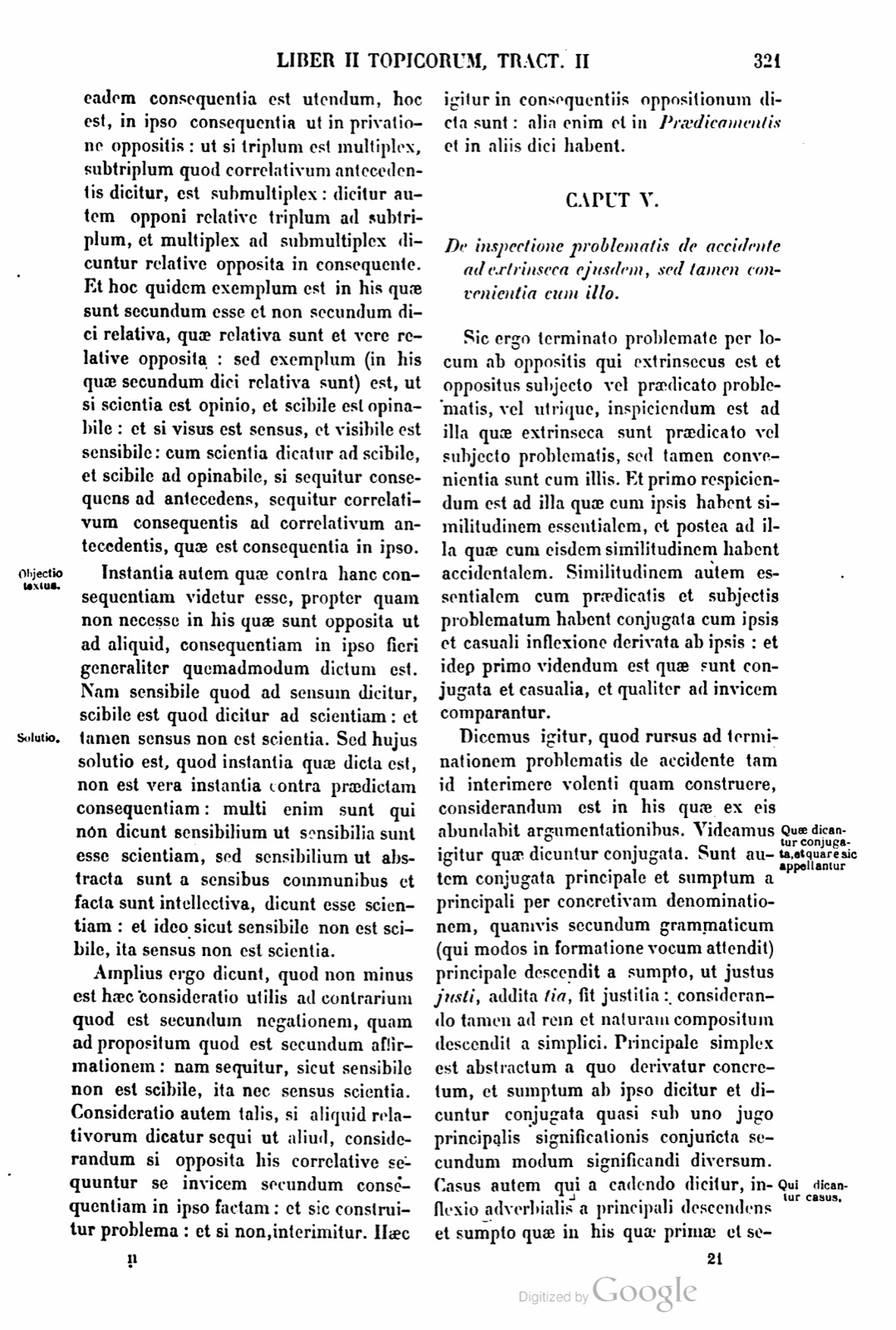
Similiter his secundum privationem et habitum oppositis his quae sunt ad aliquid sive relativis, utendum est: in oppositione enim eorum quae sunt ad aliquid, eadem consequentia est utendum, hoc est, in ipso consequentia ut in privatione oppositis: ut si triplum est multiplex, subtriplum quod correlativum antecedentis dicitur, est submultiplex: dicitur autem opponi relative triplum ad subtriplum, et multiplex ad submultiplex dicuntur relative opposita in consequente. Et hoc quidem exemplum est in his quae sunt secundum esse et non secundum dici relativa, quae relativa sunt et vere relative opposita: sed exemplum in his quae secundum dici relativa sunt, est, ut si scientia est opinio, et scibile est opinabile: et si visus est sensus, et visibile est sensibile: cum scientia dicatur ad scibile, et scibile ad opinabile, si sequitur consequens ad antecedens, sequitur correlativum consequentis ad correlativum antecedentis, quae est consequentia in ipso.
[Marginal label, printed page 321: Objectio textus.]
Instantia autem quae contra hanc consequentiam videtur esse, propter quam non necesse in his quae sunt opposita ut ad aliquid, consequentiam in ipso fieri generaliter quemadmodum dictum est. Nam sensibile quod ad sensum dicitur, scibile est quod dicitur ad scientiam: et tamen sensus non est scientia.
[Marginal label, printed page 321: Solutio.]
Sed hujus solutio est, quod instantia quae dicta est, non est vera instantia contra praedictam consequentiam: multi enim sunt qui non dicunt sensibilium ut sensibilia sunt esse scientiam, sed sensibilium ut abstracta sunt a sensibus communibus et facta sunt intellectiva, dicunt esse scientiam: et ideo sicut sensibile non est scibile, ita sensus non est scientia.
Amplius ergo dicunt, quod non minus est haec consideratio utilis ad contrarium quod est secundum negationem, quam ad propositum quod est secundum affirmationem: nam sequitur, sicut sensibile non est scibile, ita nec sensus scientia. Consideratio autem talis, si aliquid relativorum dicatur sequi ut aliud, considerandum si opposita his correlative sequuntur se invicem secundum consequentiam in ipso factam: et sic construitur problema: et si non, interimitur. Haec igitur in consequentiis oppositionum dicta sunt: alia enim et in Praedicamentis et in aliis dici habent.
Similarly, one must use these things that are toward something, or relatives, as with those opposed according to privation and habit. For in the opposition of those things that are toward something, the same consequence must be used, that is, consequence in itself as in things opposed by privation. Thus, if triple is multiple, subtriple, which is called the correlative of the antecedent, is submultiple. But triple is said to be opposed relatively to subtriple, and multiple and submultiple are said to be relatively opposed in the consequent. And this example indeed is in those relatives which are according to being and not according to being-said, which are relatives and truly relatively opposed. But the example in those which are relatives according to being-said is this: if knowledge is opinion, then the knowable is opinable; and if sight is sense, the visible is sensible. Since knowledge is said in relation to the knowable, and the knowable in relation to the opinable, if the consequent follows upon the antecedent, the correlative of the consequent follows upon the correlative of the antecedent, which is consequence in itself.
[Marginal label, printed page 321: Objection of the text.]
But the instance which seems to be against this consequence, on account of which it is not necessary that consequence in itself generally occur in those things which are opposed as toward something, in the way that has been said, is this. For the sensible, which is said in relation to sense, is the knowable, which is said in relation to knowledge; and nevertheless sense is not knowledge.
[Marginal label, printed page 321: Solution.]
But the solution of this is that the instance which has been stated is not a true instance against the aforesaid consequence. For there are many who do not say that there is knowledge of sensibles as they are sensibles, but say that there is knowledge of sensibles as they have been abstracted from the common senses and made intelligible; and therefore, just as the sensible is not the knowable, so sense is not knowledge.
Moreover, therefore, they say that this consideration is no less useful for the contrary which is according to denial than for the proposed thing which is according to affirmation. For it follows: just as the sensible is not the knowable, so neither is sense knowledge. But the consideration is such: if one of the relatives is said to follow as another, one must consider whether the things opposed to these correlatively follow one another according to consequence made in itself; and thus the problem is constructed; and if not, it is destroyed. Therefore these things have been said in the consequences of oppositions; for other things must be said both in the Categories and in other works.
If a page does not appear, its photograph has not been uploaded yet.