Volume 2 · pp. 317–319
CHAPTER III. On the consideration of the problem concerning accident, how it can be constructed and destroyed in many ways from inspection toward the consequences of opposites.
A marker with ≈ is an approximate page boundary, placed by measure of the text; the page photographs remain the authority. In the paired views, clicking a page marker brings that page into view.
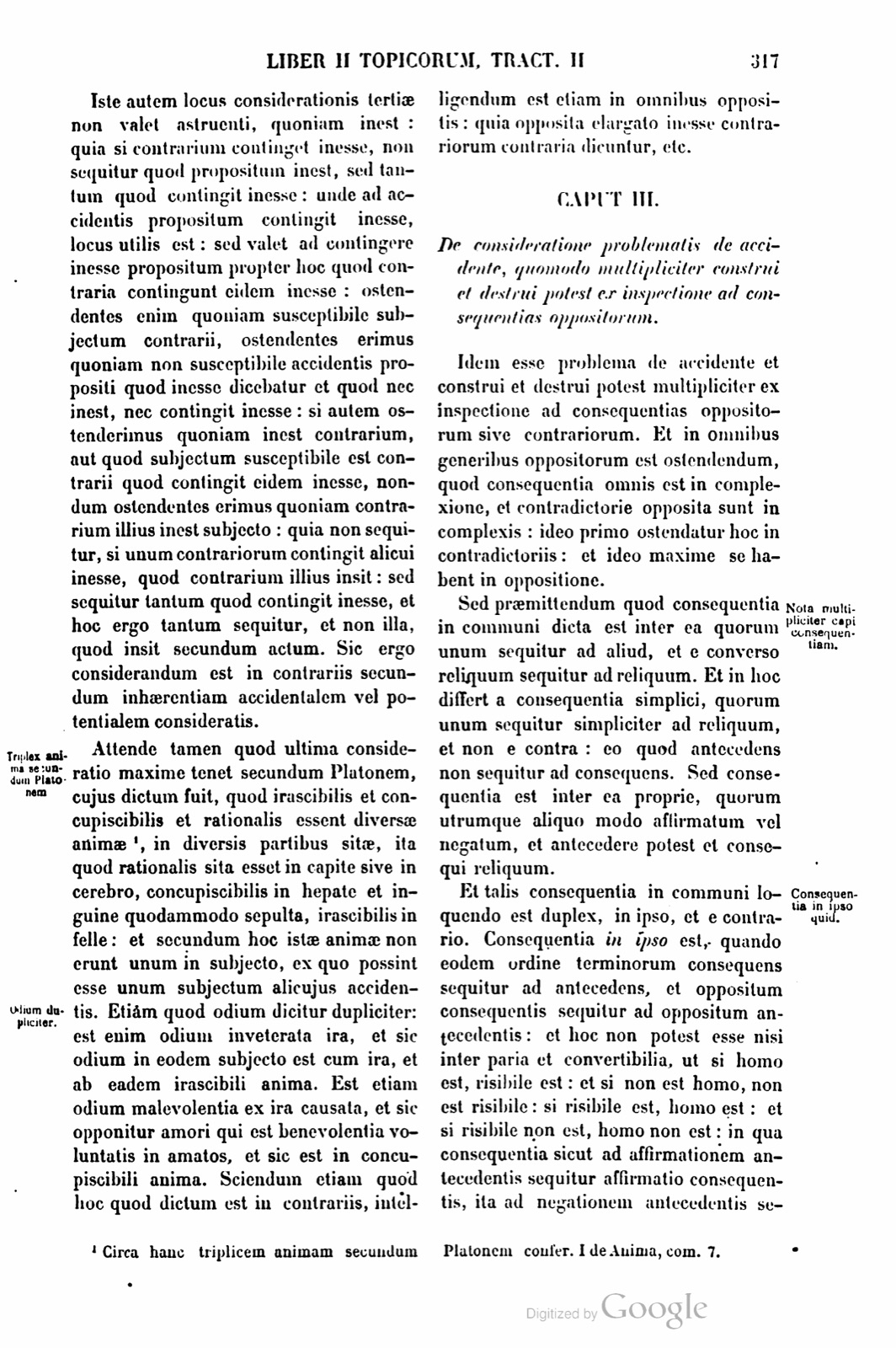
Iste autem locus considerationis tertiae non valet astruenti, quoniam inest: quia si contrarium continget inesse, non sequitur quod propositum inest, sed tantum quod contingit inesse: unde ad accidentis propositum contingit inesse, locus utilis est: sed valet ad contingere inesse propositum propter hoc quod contraria contingunt eidem inesse: ostendentes enim quoniam susceptibile subjectum contrarii, ostendentes erimus quoniam non susceptibile accidentis propositi quod inesse dicebatur et quod nec inest, nec contingit inesse: si autem ostenderimus quoniam inest contrarium, aut quod subjectum susceptibile est contrarii quod contingit eidem inesse, nondum ostendentes erimus quoniam contrarium illius inest subjecto: quia non sequitur, si unum contrariorum contingit alicui inesse, quod contrarium illius insit: sed sequitur tantum quod contingit inesse, et hoc ergo tantum sequitur, et non illa, quod insit secundum actum. Sic ergo considerandum est in contrariis secundum inhaerentiam accidentalem vel potentialem consideratis.
[Marginal label, printed page 317: Triplex anima secundum Platonem.]
Attende tamen quod ultima consideratio maxime tenet secundum Platonem, cujus dictum fuit, quod irascibilis et concupiscibilis et rationalis essent diversae animae 1, in diversis partibus sitae, ita quod rationalis sita esset in capite sive in cerebro, concupiscibilis in hepate et inguine quodammodo sepulta, irascibilis in felle: et secundum hoc istae animae non erunt unum in subjecto, ex quo possint esse unum subjectum alicujus accidentis.
[Marginal label, printed page 317: Odium dupliciter.]
Etiam quod odium dicitur dupliciter: est enim odium inveterata ira, et sic odium in eodem subjecto est cum ira, et ab eadem irascibili anima. Est etiam odium malevolentia ex ira causata, et sic opponitur amori qui est benevolentia voluntatis in amatos, et sic est in concupiscibili anima. Sciendum etiam quod hoc quod dictum est in contrariis, intelligendum est etiam in omnibus oppositis: quia opposita elargato inesse contrariorum contraria dicuntur, etc.
CAPUT III.
De consideratione problematis de accidente, quomodo multipliciter construi et destrui potest ex inspectione ad consequentias oppositorum.
Idem esse problema de accidente et construi et destrui potest multipliciter ex inspectione ad consequentias oppositorum sive contrariorum. Et in omnibus generibus oppositorum est ostendendum, quod consequentia omnis est in complexione, et contradictorie opposita sunt in complexis: ideo primo ostendatur hoc in contradictoriis: et ideo maxime se habent in oppositione.
This locus of the third consideration, however, is not valid for one asserting that it is in, because if the contrary will happen to be in, it does not follow that the proposed thing is in, but only that it happens to be in. Hence for the proposed accident it happens to be in, the locus is useful; but it is valid for the proposed thing's happening to be in on account of this, that contraries happen to be in the same thing. For by showing that the subject is receptive of the contrary, we shall be showing that it is not unreceptive of the proposed accident which was said to be in, and that it neither is in nor happens to be in. But if we have shown that the contrary is in, or that the subject is receptive of the contrary which happens to be in the same thing, we are not yet showing that its contrary is in the subject, because it does not follow, if one of the contraries happens to be in something, that its contrary is in it; rather, it follows only that it happens to be in. Therefore this much follows, and not that it is in according to act. Thus, therefore, one must consider in contraries considered according to accidental or potential inherence.
[Marginal label, printed page 317: The threefold soul according to Plato.]
Nevertheless attend to the fact that the last consideration chiefly holds according to Plato, whose statement was that the irascible, concupiscible, and rational were diverse souls 1, situated in diverse parts, so that the rational was situated in the head or in the brain, the concupiscible in the liver and in the groin, buried in a certain way, and the irascible in the gall. And according to this these souls will not be one in subject, from which they could be one subject of some accident.
[Marginal label, printed page 317: Hatred in two ways.]
Also, hatred is said in two ways: for hatred is inveterate anger, and thus hatred is in the same subject with anger and from the same irascible soul. There is also hatred as malevolence caused from anger, and thus it is opposed to love, which is benevolence of the will toward those loved, and thus it is in the concupiscible soul. One must also know that what has been said in contraries is to be understood in all opposites also, because opposites, by broadening the being-in of contraries, are called contraries of contraries, etc.
CHAPTER III.
On the consideration of the problem concerning accident, how it can be constructed and destroyed in many ways from inspection toward the consequences of opposites.
The same problem concerning accident can both be constructed and destroyed in many ways from inspection toward the consequences of opposites or contraries. And in all genera of opposites it must be shown that every consequence is in a complex expression, and that contradictorily opposed things are in complex expressions. Therefore this must first be shown in contradictories, and therefore they have themselves chiefly in opposition.
[Marginal label, printed page 317: Nota multipliciter capi consequentiam.]
Sed praemittendum quod consequentia in communi dicta est inter ea quorum unum sequitur ad aliud, et e converso reliquum sequitur ad reliquum. Et in hoc differt a consequentia simplici, quorum unum sequitur simpliciter ad reliquum, et non e contra: eo quod antecedens non sequitur ad consequens. Sed consequentia est inter ea proprie, quorum utrumque aliquo modo affirmatum vel negatum, et antecedere potest et consequi reliquum.
[Marginal label, printed page 317: Consequentia in ipso quid.]
Et talis consequentia in communi loquendo est duplex, in ipso, et e contrario. Consequentia in ipso est, quando eodem ordine terminorum consequens sequitur ad antecedens, et oppositum consequentis sequitur ad oppositum antecedentis: et hoc non potest esse nisi inter paria et convertibilia, ut si homo est, risibile est: et si non est homo, non est risibile: si risibile est, homo est: et si risibile non est, homo non est: in qua consequentia sicut ad affirmationem antecedentis sequitur affirmatio consequentis, ita ad negationem antecedentis sequitur negatio consequentis, et utrumque antecedit et sequitur alterum.
[Marginal label, printed page 318: Consequentia e contrario quid.]
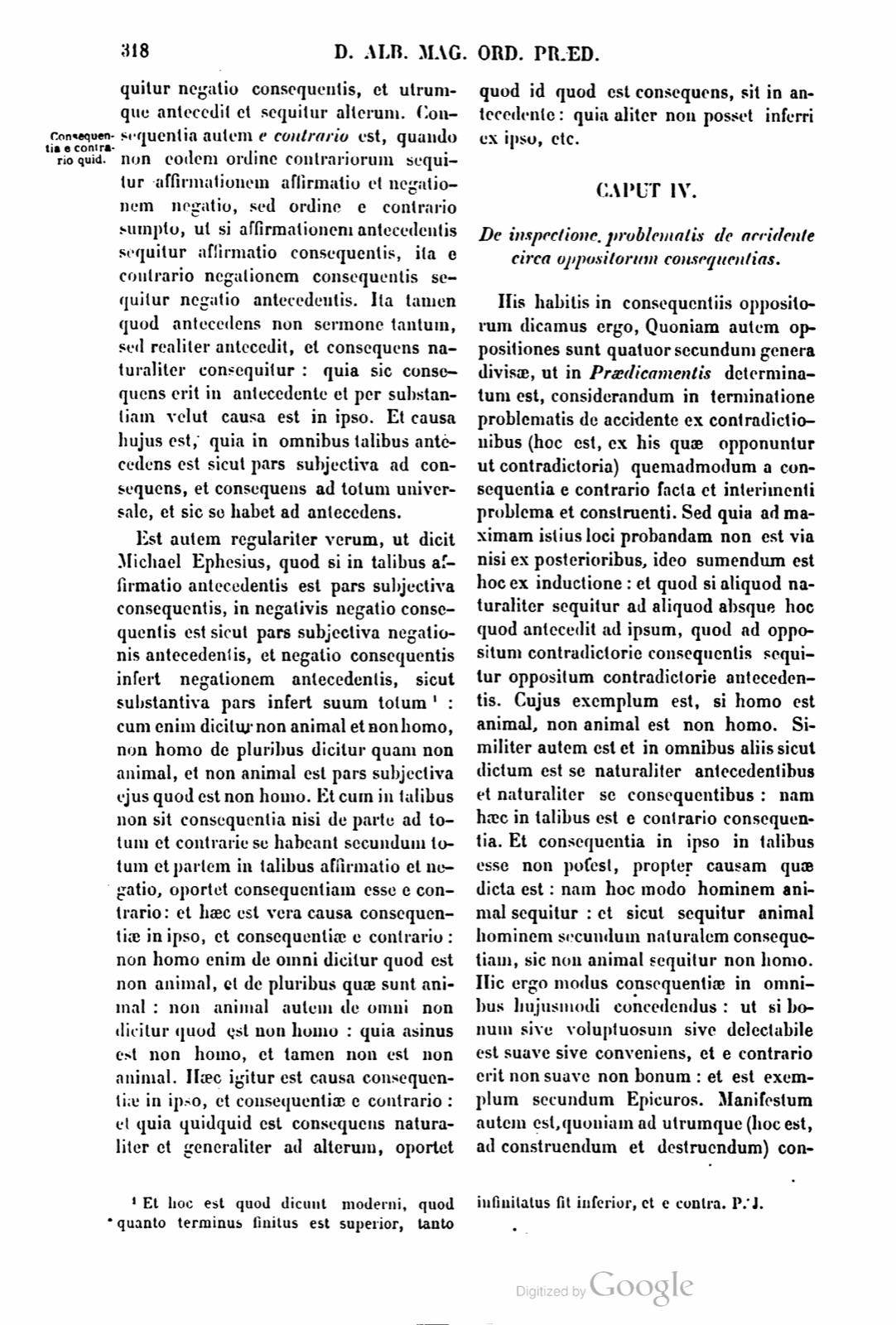
Consequentia autem e contrario est, quando non eodem ordine contrariorum sequitur affirmationem affirmatio et negationem negatio, sed ordine e contrario sumpto, ut si affirmationem antecedentis sequitur affirmatio consequentis, ita e contrario negationem consequentis sequitur negatio antecedentis. Ita tamen quod antecedens non sermone tantum, sed realiter antecedit, et consequens naturaliter consequitur: quia sic consequens erit in antecedente et per substantiam velut causa est in ipso. Et causa hujus est, quia in omnibus talibus antecedens est sicut pars subjectiva ad consequens, et consequens ad totum universale, et sic se habet ad antecedens.
Est autem regulariter verum, ut dicit Michael Ephesius, quod si in talibus affirmatio antecedentis est pars subjectiva consequentis, in negativis negatio consequentis est sicut pars subjectiva negationis antecedentis, et negatio consequentis infert negationem antecedentis, sicut substantiva pars infert suum totum 2: cum enim dicitur non animal et non homo, non homo de pluribus dicitur quam non animal, et non animal est pars subjectiva ejus quod est non homo. Et cum in talibus non sit consequentia nisi de parte ad totum et contrarie se habeant secundum totum et partem in talibus affirmatio et negatio, oportet consequentiam esse e contrario: et haec est vera causa consequentiae in ipso, et consequentiae e contrario: non homo enim de omni dicitur quod est non animal, et de pluribus quae sunt animal: non animal autem de omni non dicitur quod est non homo: quia asinus est non homo, et tamen non est non animal. Haec igitur est causa consequentiae in ipso, et consequentiae e contrario: et quia quidquid est consequens naturaliter et generaliter ad alterum, oportet quod id quod est consequens, sit in antecedente: quia aliter non posset inferri ex ipso, etc.
[Marginal label, printed page 317: Note that consequence is taken in many ways.]
But it must be premised that consequence, commonly so called, is between those things of which one follows upon another, and conversely the remaining follows upon the remaining. And in this it differs from simple consequence, of which one follows simply upon the remaining, and not conversely, because the antecedent does not follow upon the consequent. But consequence properly is between those things of which each, in some way affirmed or denied, can both antecede and follow the remaining one.
[Marginal label, printed page 317: What consequence in itself is.]
And such consequence, speaking commonly, is twofold, in itself and e contrario. Consequence in itself is when, with the same order of terms, the consequent follows upon the antecedent, and the opposite of the consequent follows upon the opposite of the antecedent. And this cannot be except between equals and convertibles, as if a human being is, a risible thing is; and if a human being is not, a risible thing is not; if a risible thing is, a human being is; and if a risible thing is not, a human being is not. In this consequence, just as the affirmation of the consequent follows upon the affirmation of the antecedent, so the denial of the consequent follows upon the denial of the antecedent, and each antecedes and follows the other.
[Marginal label, printed page 318: What consequence e contrario is.]
But consequence e contrario is when, not in the same order of contraries, affirmation follows affirmation and denial follows denial, but in an order taken from the contrary, as if the affirmation of the consequent follows the affirmation of the antecedent, so, conversely, the denial of the antecedent follows the denial of the consequent. Yet this is such that the antecedent antecedes not in speech only, but really, and the consequent naturally follows, because thus the consequent will be in the antecedent and through substance is in it as a cause. And the cause of this is that, in all such cases, the antecedent is as a subjective part in relation to the consequent, and the consequent is in relation to the universal whole, and thus it has itself to the antecedent.
But it is regularly true, as Michael of Ephesus says, that if in such cases the affirmation of the antecedent is a subjective part of the consequent, in negatives the denial of the consequent is as a subjective part of the denial of the antecedent, and the denial of the consequent infers the denial of the antecedent, as a substantive part infers its whole 2. For when non-animal and non-human are said, non-human is said of more things than non-animal, and non-animal is a subjective part of that which is non-human. And since in such cases there is no consequence except from part to whole, and affirmation and denial in such cases have themselves contrarily according to whole and part, the consequence must be e contrario. And this is the true cause of consequence in itself and of consequence e contrario: for non-human is said of every thing that is non-animal, and of more things which are animal; but non-animal is not said of every thing that is non-human, because an ass is non-human and yet is not non-animal. Therefore this is the cause of consequence in itself and of consequence e contrario; and because whatever is consequent naturally and generally upon another thing must be such that the thing which is consequent is in the antecedent, because otherwise it could not be inferred from it, etc.
CAPUT IV.
De inspectione problematis de accidente circa oppositorum consequentias.
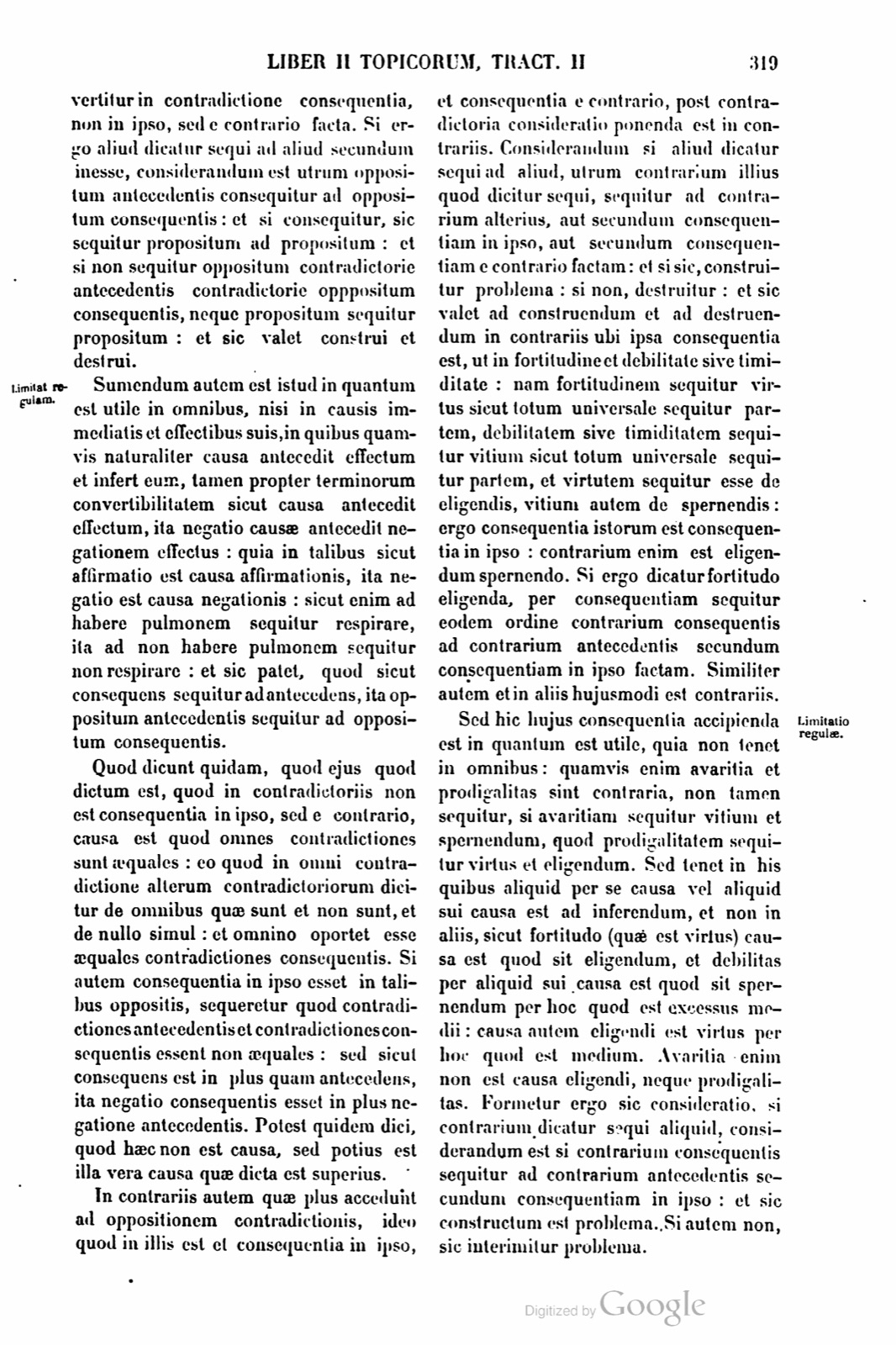
His habitis in consequentiis oppositorum dicamus ergo, Quoniam autem oppositiones sunt quatuor secundum genera divisae, ut in Praedicamentis determinatum est, considerandum in terminatione problematis de accidente ex contradictionibus, hoc est, ex his quae opponuntur ut contradictoria, quemadmodum a consequentia e contrario facta et interimenti problema et construenti. Sed quia ad maximam istius loci probandam non est via nisi ex posterioribus, ideo sumendum est hoc ex inductione: et quod si aliquid naturaliter sequitur ad aliquid absque hoc quod antecedit ad ipsum, quod ad oppositum contradictorie consequentis sequitur oppositum contradictorie antecedentis. Cujus exemplum est, si homo est animal, non animal est non homo. Similiter autem est et in omnibus aliis sicut dictum est se naturaliter antecedentibus et naturaliter se consequentibus: nam haec in talibus est e contrario consequentia. Et consequentia in ipso in talibus esse non potest, propter causam quae dicta est: nam hoc modo hominem animal sequitur: et sicut sequitur animal hominem secundum naturalem consequentiam, sic non animal sequitur non homo. Hic ergo modus consequentiae in omnibus hujusmodi concedendus: ut si bonum sive voluptuosum sive delectabile est suave sive conveniens, et e contrario erit non suave non bonum: et est exemplum secundum Epicuros. Manifestum autem est, quoniam ad utrumque, hoc est, ad construendum et destruendum, convertitur in contradictione consequentia, non in ipso, sed e contrario facta. Si ergo aliud dicatur sequi ad aliud secundum inesse, considerandum est utrum oppositum antecedentis consequitur ad oppositum consequentis: et si consequitur, sic sequitur propositum ad propositum: et si non sequitur oppositum contradictorie antecedentis contradictorie oppositum consequentis, neque propositum sequitur propositum: et sic valet construi et destrui.
CHAPTER IV.
On the inspection of the problem concerning accident concerning the consequences of opposites.
Having these things concerning the consequences of opposites, therefore let us say: since oppositions are four, divided according to genera, as has been determined in the Categories, one must consider, in the termination of the problem concerning accident from contradictions, that is, from those things which are opposed as contradictories, in what way it comes from consequence made e contrario, both for one destroying the problem and for one constructing it. But because there is no way to prove the maxim of this locus except from posterior things, therefore this must be taken from induction: that if something naturally follows upon something without the fact that it antecedes to it, then upon the contradictory opposite of the consequent follows the contradictory opposite of the antecedent. An example of this is: if a human being is an animal, a non-animal is a non-human. And similarly it is also in all other things naturally anteceding themselves and naturally consequent upon themselves, as has been said, for in such cases this consequence is e contrario. And consequence in itself cannot be in such cases, because of the cause that has been stated; for in this way animal follows human being, and just as animal follows human being according to natural consequence, so non-animal follows non-human. Therefore this mode of consequence must be conceded in all things of this sort, as if good, or pleasant, or delectable is sweet or fitting, then e contrario the not-sweet will be not-good; and the example is according to the Epicureans. But it is manifest that consequence in contradiction is converted to each side, that is, to constructing and destroying, made not in itself but e contrario. Therefore if one thing is said to follow upon another according to being-in, one must consider whether the opposite of the antecedent follows upon the opposite of the consequent; and if it follows, then the proposed thing follows upon the proposed thing; and if the contradictory opposite of the antecedent does not follow the contradictory opposite of the consequent, neither does the proposed thing follow the proposed thing. And thus it is valid for constructing and destroying.
Notes
- Concerning this threefold soul according to Plato, compare On the Soul I, commentary 7. (Circa hanc triplicem animam secundum Platonem confer. I de Anima, com. 7.) ↩
- And this is what the moderns say, that the more superior a finite term is, the more inferior the infinitated term becomes, and conversely. P.J. (Et hoc est quod dicunt moderni, quod quanto terminus finitus est superior, tanto infinitatus fit inferior, et e contra. P.J.) ↩
If a page does not appear, its photograph has not been uploaded yet.