Volume 2 · pp. 314–316
CHAPTER II. On inspection of the inherence and complex joining of contraries.
A marker with ≈ is an approximate page boundary, placed by measure of the text; the page photographs remain the authority. In the paired views, clicking a page marker brings that page into view.
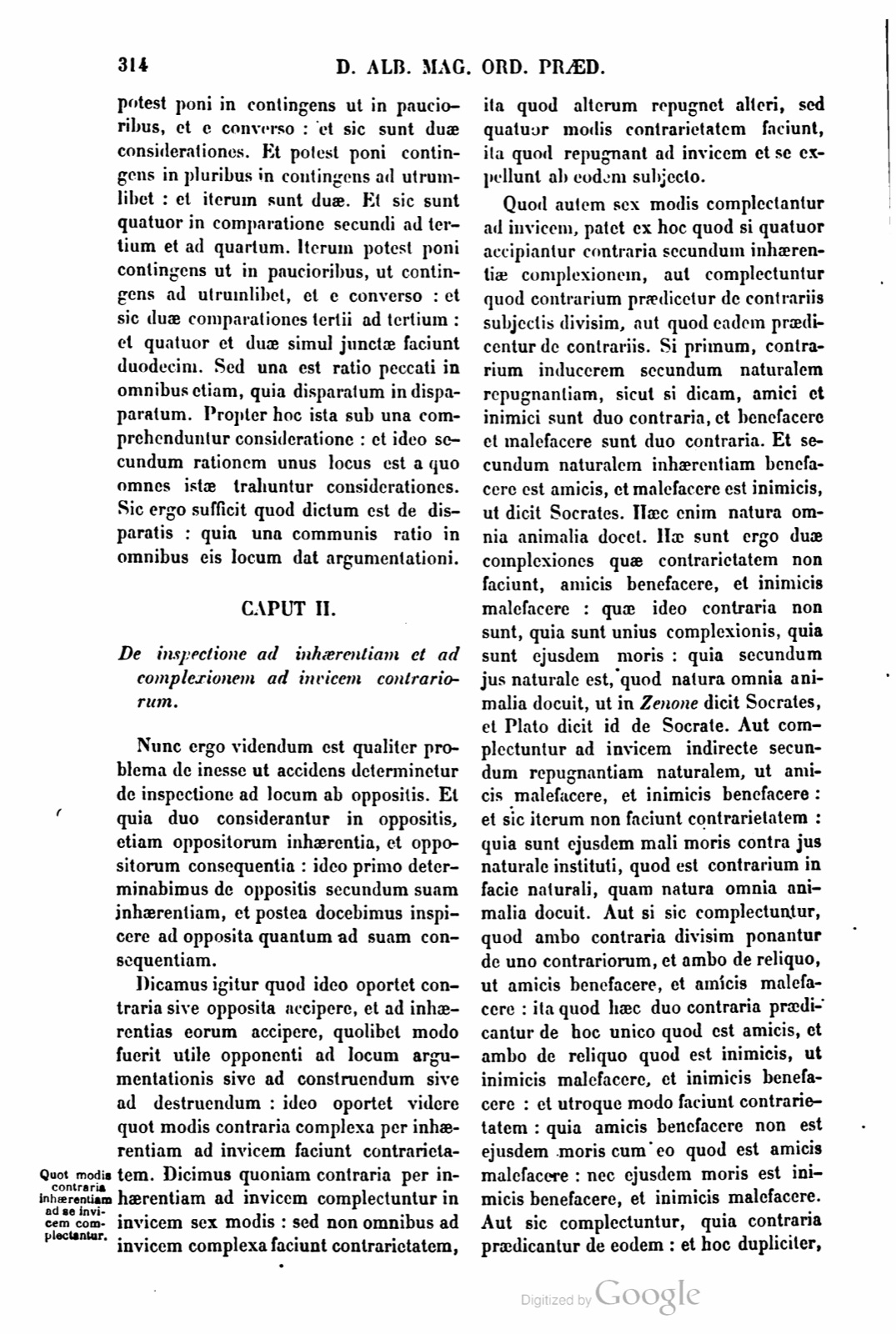
potest poni in contingens ut in paucioribus, et e converso: et sic sunt duae considerationes. Et potest poni contingens in pluribus in contingens ad utrumlibet: et iterum sunt duae. Et sic sunt quatuor in comparatione secundi ad tertium et ad quartum. Iterum potest poni contingens ut in paucioribus, ut contingens ad utrumlibet, et e converso: et sic duae comparationes tertii ad tertium: et quatuor et duae simul junctae faciunt duodecim. Sed una est ratio peccati in omnibus etiam, quia disparatum in disparatum. Propter hoc ista sub una comprehenduntur consideratione: et ideo secundum rationem unus locus est a quo omnes istae trahuntur considerationes. Sic ergo sufficit quod dictum est de disparatis: quia una communis ratio in omnibus eis locum dat argumentationi.
CAPUT II.
De inspectione ad inhaerentiam et ad complexionem ad invicem contrariorum.
Nunc ergo videndum est qualiter problema de inesse ut accidens determinetur de inspectione ad locum ab oppositis. Et quia duo considerantur in oppositis, etiam oppositorum inhaerentia, et oppositorum consequentia: ideo primo determinabimus de oppositis secundum suam inhaerentiam, et postea docebimus inspicere ad opposita quantum ad suam consequentiam.
Dicamus igitur quod ideo oportet contraria sive opposita accipere, et ad inhaerentias eorum accipere, quolibet modo fuerit utile opponenti ad locum argumentationis sive ad construendum sive ad destruendum: ideo oportet videre quot modis contraria complexa per inhaerentiam ad invicem faciunt contrarietatem.
[Marginal label, printed page 314: Quot modis contraria inhaerentiam ad se invicem complectantur.]
Dicimus quoniam contraria per inhaerentiam ad invicem complectuntur in invicem sex modis: sed non omnibus ad invicem complexa faciunt contrarietatem, ita quod alterum repugnet alteri, sed quatuor modis contrarietatem faciunt, ita quod repugnant ad invicem et se expellunt ab eodem subjecto.
Quod autem sex modis complectantur ad invicem, patet ex hoc quod si quatuor accipiantur contraria secundum inhaerentiae complexionem, aut complectuntur quod contrarium praedicetur de contrariis subjectis divisim, aut quod eadem praedicentur de contrariis. Si primum, contrarium inducerem secundum naturalem repugnantiam, sicut si dicam, amici et inimici sunt duo contraria, et benefacere et malefacere sunt duo contraria. Et secundum naturalem inhaerentiam benefacere est amicis, et malefacere est inimicis, ut dicit Socrates. Haec enim natura omnia animalia docet. Hae sunt ergo duae complexiones quae contrarietatem non faciunt, amicis benefacere, et inimicis malefacere: quae ideo contraria non sunt, quia sunt unius complexionis, quia sunt ejusdem moris: quia secundum jus naturale est, quod natura omnia animalia docuit, ut in Zenone dicit Socrates, et Plato dicit id de Socrate. Aut complectuntur ad invicem indirecte secundum repugnantiam naturalem, ut amicis malefacere, et inimicis benefacere: et sic iterum non faciunt contrarietatem: quia sunt ejusdem mali moris contra jus naturale instituti, quod est contrarium in facie naturali, quam natura omnia animalia docuit. Aut si sic complectuntur, quod ambo contraria divisim ponantur de uno contrariorum, et ambo de reliquo, ut amicis benefacere, et amicis malefacere: ita quod haec duo contraria praedicantur de hoc unico quod est amicis, et ambo de reliquo quod est inimicis, ut inimicis malefacere, et inimicis benefacere: et utroque modo faciunt contrarietatem: quia amicis benefacere non est ejusdem moris cum eo quod est amicis malefacere: nec ejusdem moris est inimicis benefacere, et inimicis malefacere. Aut sic complectuntur, quia contraria praedicantur de eodem: et hoc dupliciter, ut amicis benefacere, et amicis malefacere: et haec complexio facit iterum duas contrarietates, eo quod haec sunt contrarii moris: quia unum est de justitia naturali, et alterum dispositi secundum justitiam naturalem. Prima ergo complexio non facit contrarietatem, sed aliae quatuor faciunt contrarietatem, sicut ea quae sunt contrariorum affectuum habituum.
can be posited as contingent in the fewer cases, and conversely; and thus there are two considerations. And the contingent in the majority of cases can be posited as contingent toward either alternative; and again there are two. And thus there are four in the comparison of the second to the third and to the fourth. Again the contingent as in the fewer cases can be posited as contingent toward either alternative, and conversely; and thus there are two comparisons of the third to the third; and four and two joined together make twelve. But there is one account of the fault also in all of them, because a disparate is put in place of a disparate. On account of this, these are comprehended under one consideration; and therefore according to account there is one locus from which all these considerations are drawn. Thus therefore what has been said concerning disparates suffices, because one common account in all of them gives a locus to argumentation.
CHAPTER II.
On inspection toward the inherence and toward the complex joining of contraries to one another.
Now therefore one must see how the problem concerning being-in as accident is determined from inspection toward the locus from opposites. And because two things are considered in opposites, namely the inherence of opposites and the consequence of opposites, therefore first we shall determine concerning opposites according to their inherence, and afterward we shall teach how to inspect opposites as to their consequence.
Therefore let us say that one must accept contraries or opposites, and accept them toward their inherences, in whatever way this has been useful to the opponent for a locus of argumentation, whether for constructing or for destroying; therefore one must see in how many ways contraries joined by inherence to one another make contrariety.
[Marginal label, printed page 314: In how many ways contraries are joined to one another as to inherence.]
We say that contraries through inherence are joined to one another in six ways; but not when joined to one another in all ways do they make contrariety, so that one is repugnant to the other. Rather, in four ways they make contrariety, so that they are repugnant to one another and expel themselves from the same subject.
But that they are joined to one another in six ways is plain from this: if four contraries are accepted according to a complex joining of inherence, either they are joined so that a contrary is predicated of contrary subjects divisively, or so that the same things are predicated of contraries. If the first, I would induce a contrary according to natural repugnance, as if I say, friends and enemies are two contraries, and to do good and to do evil are two contraries. And according to natural inherence, to do good belongs to friends and to do evil belongs to enemies, as Socrates says. For nature teaches all animals these things. Therefore these are two complex joinings that do not make contrariety: to do good to friends and to do evil to enemies; these are not contrary because they are of one complex joining, because they are of the same moral condition, since it is according to natural right, which nature taught all animals, as Socrates says in Zeno, and Plato says this concerning Socrates. Or they are joined to one another indirectly according to natural repugnance, as to do evil to friends and to do good to enemies; and thus again they do not make contrariety, because they are of the same evil moral condition established against natural right, which is contrary in the natural face that nature taught all animals. Or if they are joined in such a way that both contraries are posited divisively of one of the contraries and both of the remaining one, as to do good to friends and to do evil to friends, so that these two contraries are predicated of this one thing which is friends, and both of the remaining thing which is enemies, as to do evil to enemies and to do good to enemies, in each way they make contrariety, because to do good to friends is not of the same moral condition as to do evil to friends, nor are to do good to enemies and to do evil to enemies of the same moral condition. Or they are joined in this way, because contraries are predicated of the same thing, and this in two ways, as to do good to friends and to do evil to friends; and this complex joining again makes two contrarieties, because these are of contrary moral condition, since one belongs to natural justice, and the other to one disposed according to natural justice. Therefore the first complex joining does not make contrariety, but the other four make contrariety, like those things which belong to the habits of contrary affections.
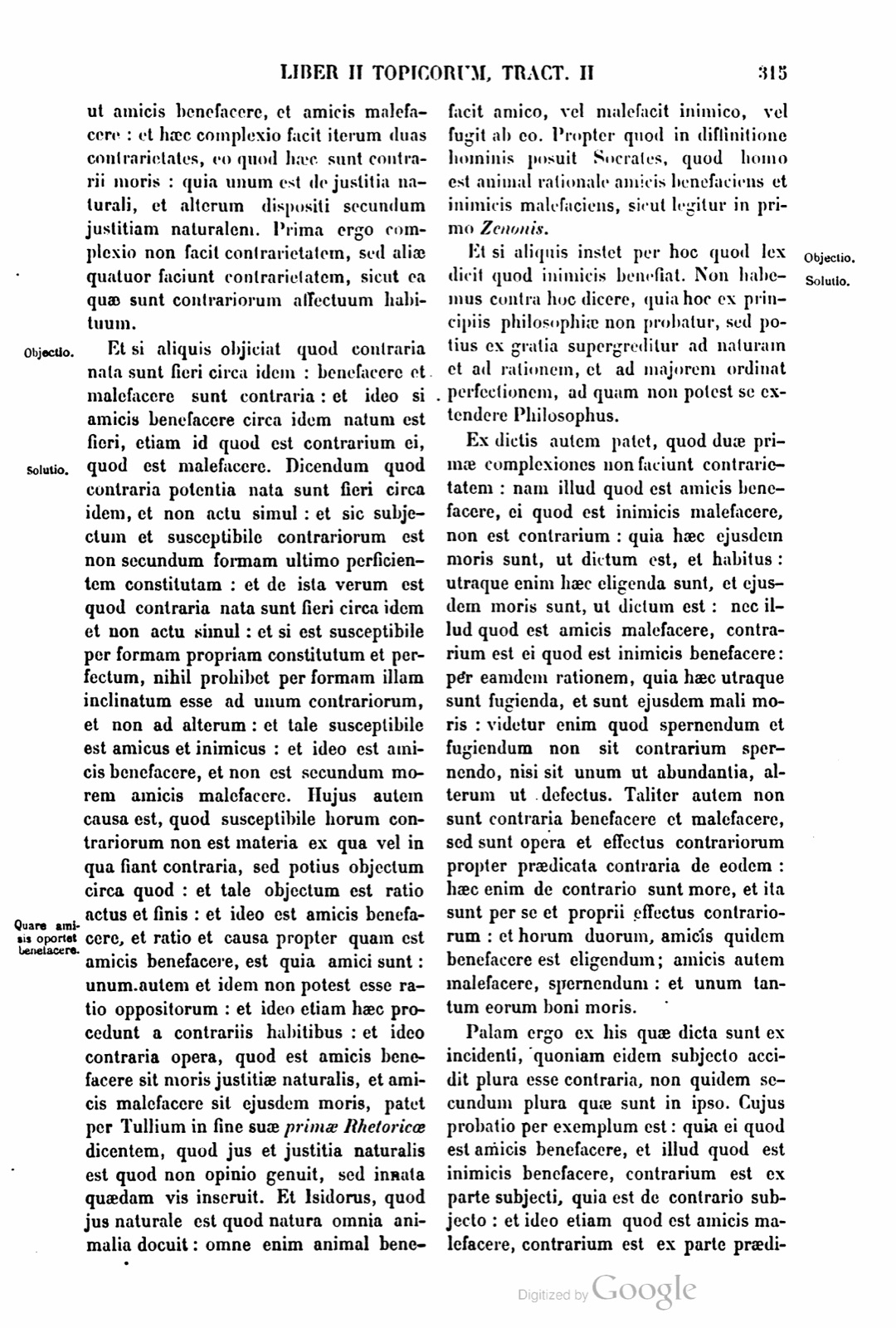
[Marginal label, printed page 315: Objectio.]
Et si aliquis objiciat quod contraria nata sunt fieri circa idem: benefacere et malefacere sunt contraria: et ideo si amicis benefacere circa idem natum est fieri, etiam id quod est contrarium ei, quod est malefacere.
[Marginal label, printed page 315: Solutio.]
Dicendum quod contraria potentia nata sunt fieri circa idem, et non actu simul: et sic subjectum et susceptibile contrariorum est non secundum formam ultimo perficientem constitutam: et de ista verum est quod contraria nata sunt fieri circa idem et non actu simul: et si est susceptibile per formam propriam constitutum et perfectum, nihil prohibet per formam illam inclinatum esse ad unum contrariorum, et non ad alterum: et tale susceptibile est amicus et inimicus: et ideo est amicis benefacere, et non est secundum morem amicis malefacere.
[Marginal label, printed page 315: Quare amicis oportet benefacere.]
Hujus autem causa est, quod susceptibile horum contrariorum non est materia ex qua vel in qua fiant contraria, sed potius objectum circa quod: et tale objectum est ratio actus et finis: et ideo amicis benefacere est ratio et causa propter quam est, quia amici sunt: unum autem et idem non potest esse ratio oppositorum: et ideo etiam haec procedunt a contrariis habitibus: et ideo contraria opera, quod est amicis benefacere sit moris justitiae naturalis, et amicis malefacere sit ejusdem moris, patet per Tullium in fine suae primae Rhetoricae dicentem, quod jus et justitia naturalis est quod non opinio genuit, sed innata quaedam vis inseruit. Et Isidorus, quod jus naturale est quod natura omnia animalia docuit: omne enim animal benefacit amico, vel malefacit inimico, vel fugit ab eo. Propter quod in diffinitione hominis posuit Socrates, quod homo est animal rationale amicis benefaciens et inimicis malefaciens, sicut legitur in primo Zenonis.
[Marginal label, printed page 315: Objectio.]
Et si aliquis instet per hoc quod lex dicit quod inimicis benefiat.
[Marginal label, printed page 315: Solutio.]
Non habemus contra hoc dicere, quia hoc ex principiis philosophiae non probatur, sed potius ex gratia supergreditur ad naturam et ad rationem, et ad majorem ordinat perfectionem, ad quam non potest se extendere Philosophus.
Ex dictis autem patet, quod duae primae complexiones non faciunt contrarietatem: nam illud quod est amicis benefacere, ei quod est inimicis malefacere, non est contrarium: quia haec ejusdem moris sunt, ut dictum est, et habitus: utraque enim haec eligenda sunt, et ejusdem moris sunt, ut dictum est: nec illud quod est amicis malefacere, contrarium est ei quod est inimicis benefacere: per eamdem rationem, quia haec utraque sunt fugienda, et sunt ejusdem mali moris: videtur enim quod spernendum et fugiendum non sit contrarium spernendo, nisi sit unum ut abundantia, alterum ut defectus. Taliter autem non sunt contraria benefacere et malefacere, sed sunt opera et effectus contrariorum propter praedicata contraria de eodem: haec enim de contrario sunt more, et ita sunt per se et proprii effectus contrariorum: et horum duorum, amicis quidem benefacere est eligendum; amicis autem malefacere, spernendum: et unum tantum eorum boni moris.
Palam ergo ex his quae dicta sunt ex incidenti, quoniam eidem subjecto accidit plura esse contraria, non quidem secundum plura quae sunt in ipso. Cujus probatio per exemplum est: quia ei quod est amicis benefacere, et illud quod est inimicis benefacere, contrarium est ex parte subjecti, quia est de contrario subjecto: et ideo etiam quod est amicis malefacere, contrarium est ex parte praedicati: sed contraria praedicata ad idem referuntur. Similiter autem se habent et in aliis apparebunt singularium dictorum, eodem modo, ut dictum est, ex parte subjecti vel praedicati considerantibus: semper enim unum ut hoc modo consideretur, pluribus est contrarium, et semper unum contrarium erit duobus. Et ideo ab opponente est accipere illud contrarium quodcumque ad positionem erit magis utile, hoc est, quo magis est argumentari ad positionem.
[Marginal label, printed page 315: Objection.]
And if someone objects that contraries are naturally apt to come to be about the same thing; to do good and to do evil are contraries; and therefore if to do good to friends is naturally apt to come to be about the same thing, so also is that which is contrary to it, namely to do evil.
[Marginal label, printed page 315: Solution.]
It must be said that contraries are potentially naturally apt to come to be about the same thing, and not actually at the same time. And thus the subject and receptive thing of contraries is not according to the form constituted as ultimately perfecting; and concerning that it is true that contraries are naturally apt to come to be about the same thing and not actually at the same time. And if the receptive thing is constituted and perfected by its proper form, nothing prevents it through that form from being inclined to one of the contraries and not to the other; and such a receptive thing is friend and enemy. And therefore there is to do good to friends, and according to moral condition there is not to do evil to friends.
[Marginal label, printed page 315: Why one ought to do good to friends.]
The cause of this is that the receptive thing of these contraries is not matter from which or in which contraries come to be, but rather the object about which they are; and such an object is the account of the act and end. And therefore to do good to friends is the account and cause on account of which it is, because they are friends; but one and the same thing cannot be the account of opposites. And therefore these proceed from contrary habits; and therefore that the contrary works, namely that doing good to friends belongs to the moral condition of natural justice, and doing evil to friends belongs to the same moral condition, is plain through Tullius at the end of his first Rhetoric, saying that right and natural justice is what opinion has not generated, but a certain innate power has inserted. And Isidore says that natural right is what nature has taught all animals: for every animal does good to a friend, or does evil to an enemy, or flees from him. On account of this Socrates placed in the definition of a human being that a human being is a rational animal doing good to friends and doing evil to enemies, as is read in the first book of Zeno.
[Marginal label, printed page 315: Objection.]
And if someone presses through this, that the law says that good should be done to enemies.
[Marginal label, printed page 315: Solution.]
We do not have to speak against this, because this is not proved from the principles of philosophy, but rather by grace it rises above nature and reason, and orders to a greater perfection to which the Philosopher cannot extend himself.
But from the things said it is plain that the first two complex joinings do not make contrariety. For that which is to do good to friends is not contrary to that which is to do evil to enemies, because these are of the same moral condition, as has been said, and of the same habit; for each of these is to be chosen and they are of the same moral condition, as has been said. Nor is that which is to do evil to friends contrary to that which is to do good to enemies, for the same reason, because each of these is to be fled and they are of the same evil moral condition. For what is to be despised and fled seems not to be contrary to what is to be despised, unless one is as abundance and the other as defect. But to do good and to do evil are not contraries in this way; rather, they are works and effects of contraries on account of contrary predicates concerning the same thing. For these are of contrary moral condition, and thus are through themselves and proper effects of contraries; and of these two, to do good to friends is to be chosen, but to do evil to friends is to be despised, and only one of them belongs to good moral condition.
Therefore from the things said incidentally it is plain that several contraries happen to the same subject, not indeed according to several things that are in it. The proof of this is by example: because to that which is to do good to friends, that which is to do good to enemies is contrary from the part of the subject, because it is concerning a contrary subject; and therefore also that which is to do evil to friends is contrary from the part of the predicate; but contrary predicates are referred to the same thing. Similarly they have themselves in other cases also, and will appear from singulars of the things said in the same way, as has been said, when they are considered from the part of subject or predicate. For always one thing, as it is considered in this way, is contrary to several, and always one contrary will be contrary to two. And therefore the opponent must accept whichever contrary will be more useful to the position, that is, by which it is better to argue toward the position.
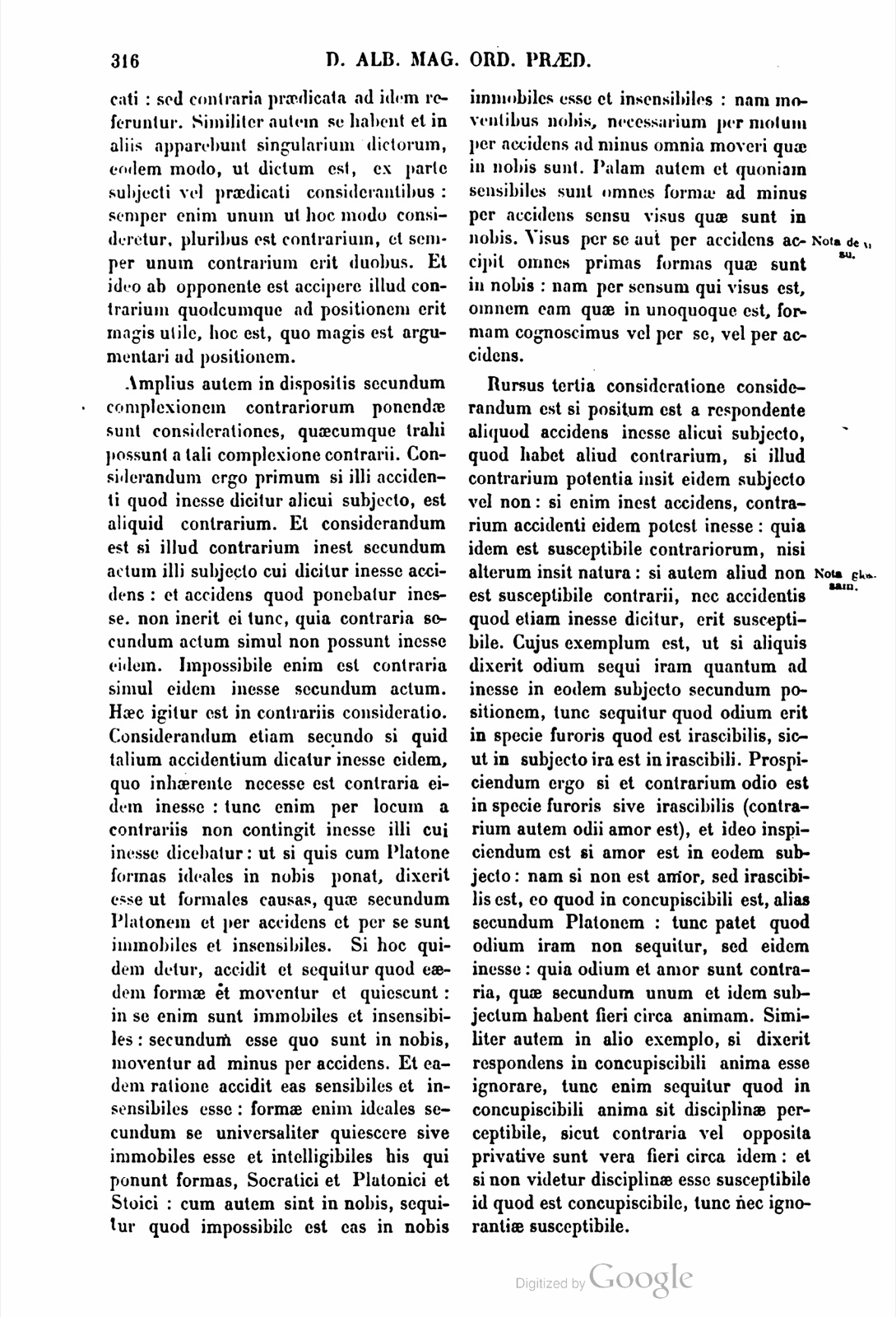
Amplius autem in dispositis secundum complexionem contrariorum ponendae sunt considerationes, quaecumque trahi possunt a tali complexione contrarii. Considerandum ergo primum si illi accidenti quod inesse dicitur alicui subjecto, est aliquid contrarium. Et considerandum est si illud contrarium inest secundum actum illi subjecto cui dicitur inesse accidens: et accidens quod ponebatur inesse, non inerit ei tunc, quia contraria secundum actum simul non possunt inesse eidem. Impossibile enim est contraria simul eidem inesse secundum actum. Haec igitur est in contrariis consideratio. Considerandum etiam secundo si quid talium accidentium dicatur inesse eidem, quo inhaerente necesse est contraria eidem inesse: tunc enim per locum a contrariis non contingit inesse illi cui inesse dicebatur: ut si quis cum Platone formas ideales in nobis ponat, dixerit esse ut formales causas, quae secundum Platonem et per accidens et per se sunt immobiles et insensibiles. Si hoc quidem detur, accidit et sequitur quod eaedem formae et moventur et quiescunt: in se enim sunt immobiles et insensibiles: secundum esse quo sunt in nobis, moventur ad minus per accidens. Et eadem ratione accidit eas sensibiles et insensibiles esse: formae enim ideales secundum se universaliter quiescere sive immobiles esse et intelligibiles his qui ponunt formas, Socratici et Platonici et Stoici: cum autem sint in nobis, sequitur quod impossibile est eas in nobis immobiles esse et insensibiles: nam moventibus nobis, necessarium per motum per accidens ad minus omnia moveri quae in nobis sunt. Palam autem et quoniam sensibiles sunt omnes formae ad minus per accidens sensu visus quae sunt in nobis.
[Marginal label, printed page 316: Nota de usu.]
Visus per se aut per accidens accipit omnes primas formas quae sunt in nobis: nam per sensum qui visus est, omnem eam quae in unoquoque est, formam cognoscimus vel per se, vel per accidens.
Rursus tertia consideratione considerandum est si positum est a respondente aliquod accidens inesse alicui subjecto, quod habet aliud contrarium, si illud contrarium potentia insit eidem subjecto vel non: si enim inest accidens, contrarium accidenti eidem potest inesse: quia idem est susceptibile contrariorum, nisi alterum insit natura: si autem aliud non est susceptibile contrarii, nec accidentis quod etiam inesse dicitur, erit susceptibile.
[Marginal label, printed page 316: Nota glossam.]
Cujus exemplum est, ut si aliquis dixerit odium sequi iram quantum ad inesse in eodem subjecto secundum positionem, tunc sequitur quod odium erit in specie furoris quod est irascibilis, sicut in subjecto ira est in irascibili. Prospiciendum ergo si et contrarium odio est in specie furoris sive irascibilis, contrarium autem odii amor est, et ideo inspiciendum est si amor est in eodem subjecto: nam si non est amor, sed irascibilis est, eo quod in concupiscibili est, alias secundum Platonem: tunc patet quod odium iram non sequitur, sed eidem inesse: quia odium et amor sunt contraria, quae secundum unum et idem subjectum habent fieri circa animam. Similiter autem in alio exemplo, si dixerit respondens in concupiscibili anima esse ignorare, tunc enim sequitur quod in concupiscibili anima sit disciplinae perceptibile, sicut contraria vel opposita privative sunt vera fieri circa idem: et si non videtur disciplinae esse susceptibile id quod est concupiscibile, tunc nec ignorantiae susceptibile.
Moreover, in things disposed according to the complex joining of contraries, whatever considerations can be drawn from such complex joining of the contrary must be posited. Therefore one must first consider whether there is something contrary to that accident which is said to be in some subject. And one must consider whether that contrary is actually in that subject in which the accident is said to be in; and then the accident that was being posited to be in will not be in it, because contraries according to act cannot be in the same thing simultaneously. For it is impossible for contraries to be in the same thing at the same time according to act. Therefore this is the consideration in contraries. Secondly, one must also consider whether something of such accidents is said to be in the same thing, with which inhering it is necessary that contraries be in the same thing. For then, through the locus from contraries, it does not happen to be in that in which it was said to be in; as if someone, with Plato, posits ideal forms in us and says that they are as formal causes, which according to Plato both per accidens and through themselves are immovable and insensible. If this indeed is granted, it happens and follows that the same forms both are moved and rest; for in themselves they are immovable and insensible, but according to the being by which they are in us, they are moved at least per accidens. And by the same account it happens that they are sensible and insensible, for ideal forms according to themselves universally rest or are immovable and intelligible to those who posit forms, the Socratics and Platonists and Stoics; but when they are in us, it follows that it is impossible for them to be immovable and insensible in us. For when we are moving, it is necessary that through motion, at least per accidens, all things that are in us are moved. But it is also plain that all forms that are in us are sensible, at least per accidens, by the sense of sight.
[Marginal label, printed page 316: Note concerning use.]
Sight through itself or per accidens receives all the first forms that are in us; for through the sense which is sight, we know every form that is in each thing, either through itself or per accidens.
Again, by a third consideration one must consider, if some accident has been posited by the respondent to be in some subject, which has another contrary, whether that contrary is potentially in the same subject or not. For if the accident is in, the contrary to the accident can be in the same thing, because the same thing is receptive of contraries, unless one is in by nature. But if the other thing is not receptive of the contrary, neither will it be receptive of the accident that is also said to be in.
[Marginal label, printed page 316: Note the gloss.]
An example of this is that if someone said that hatred follows anger as to being-in in the same subject according to the position, then it follows that hatred will be in the species of fury, which is the irascible power, just as anger is in the irascible as in a subject. Therefore one must inspect whether the contrary to hatred is also in the species of fury or of the irascible; but the contrary of hatred is love, and therefore one must inspect whether love is in the same subject. For if love is not there, but the irascible is, because love is in the concupiscible according to Plato in other places, then it is plain that hatred does not follow anger, but is in the same subject, because hatred and love are contraries which must come to be about the soul according to one and the same subject. Similarly also in another example, if the respondent said that ignorance is in the concupiscible soul, then it follows that in the concupiscible soul there is what is receptive of discipline, just as contraries or privatively opposed things are true to come to be about the same thing. And if what is concupiscible does not seem to be receptive of discipline, then neither is it receptive of ignorance.
If a page does not appear, its photograph has not been uploaded yet.