Volume 2 · pp. 307–310
CHAPTERS VII-VIII. On digression and on simple antecedents/consequents.
A marker with ≈ is an approximate page boundary, placed by measure of the text; the page photographs remain the authority. In the paired views, clicking a page marker brings that page into view.
CAPUT VII.
De consideratione ad antecedens vel consequens cum digressione ad modum sophisticum.
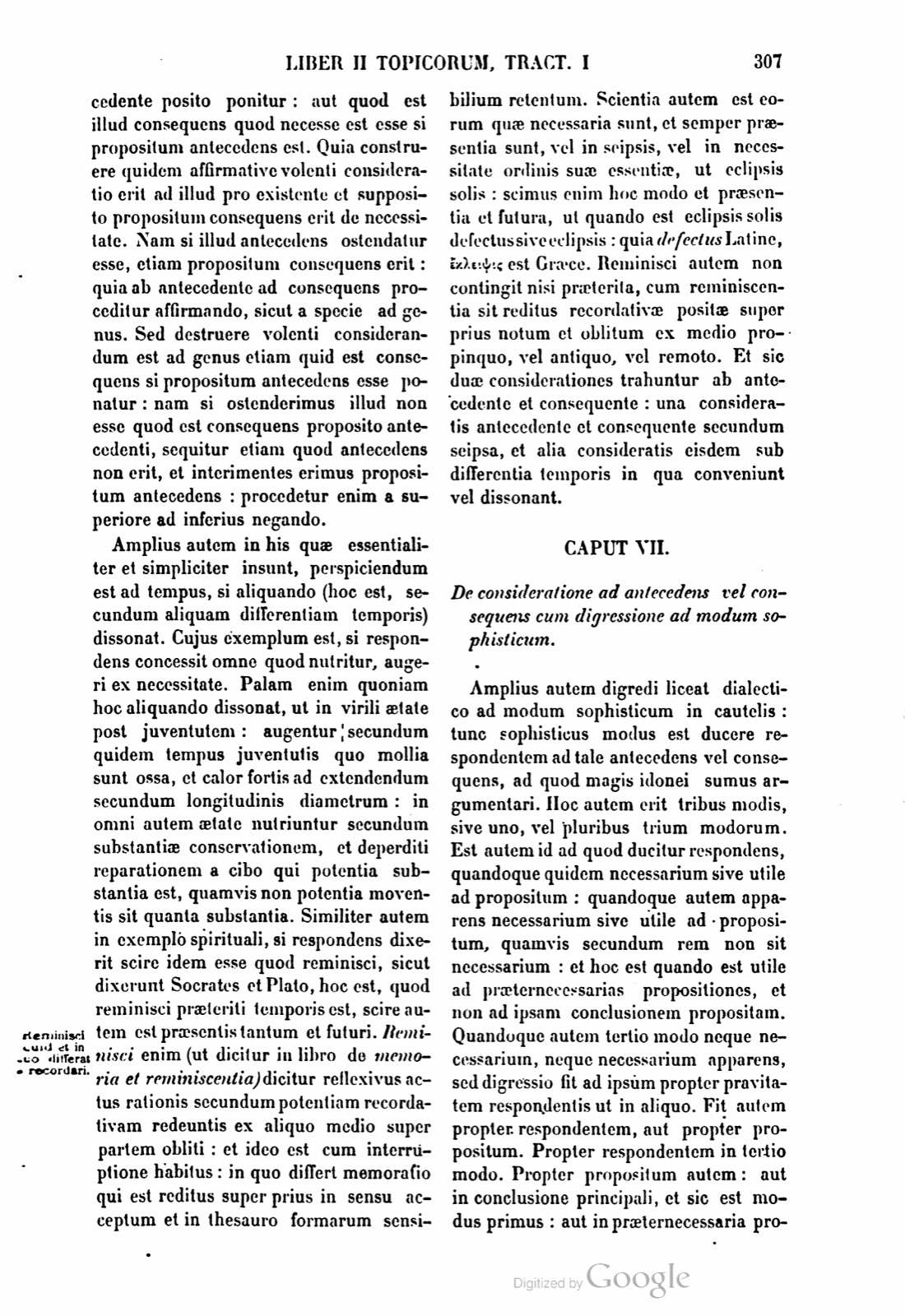
Amplius autem digredi liceat dialectico ad modum sophisticum in cautelis: tunc sophisticus modus est ducere respondentem ad tale antecedens vel consequens, ad quod magis idonei sumus argumentari. Hoc autem erit tribus modis, sive uno, vel pluribus trium modorum. Est autem id ad quod ducitur respondens, quandoque quidem necessarium sive utile ad propositum: quandoque autem apparens necessarium sive utile ad propositum, quamvis secundum rem non sit necessarium: et hoc est quando est utile ad praeternecessarias propositiones, et non ad ipsam conclusionem propositam. Quandoque autem tertio modo neque necessarium, neque necessarium apparens, sed digressio fit ad ipsum propter pravitatem respondentis ut in aliquo. Fit autem propter respondentem, aut propter propositum. Propter respondentem in tertio modo. Propter propositum autem: aut in conclusione principali, et sic est modus primus: aut in praeternecessaria propositione, et sic est modus secundus.
Secundum autem primum modum digressio fit: et quando negat ille qui respondet aliquid utilium proposito, tunc videt opponens illud tamen esse propositum confirmans. Sed cavendum est opponenti, quod id ad quod digreditur, sit de numero talium ad quod facile sit abundare argumentis: tunc respondens videns illud confirmari pluribus, de facili acquiescit proposito. Similiter autem transgrediendum est a proposito, et quando respondens est faciens inductionem instantiae propter quod propositum falsificatur, negatur tunc non simpliciter, sed cum instantia quam contra propositum fert: et sic per instantiam interimere conatur propositum: et tunc oportet digredi ut ostendatur non esse instantia quam inducit: quia aliter interimeretur propositum. Hoc autem cujus fert instantiam interempto, et propositum interimitur: ideo opponentem necesse occurrere instantiae quam affert respondens. Hic ergo est primus modus.
Secundus autem modus est apparens necessarium sive utile proposito ad quod digreditur; quando autem illud ad quod digreditur, videtur utile proposito, vel positioni ad probandum propositum, et non est utile principaliter intento ad quod sumitur: contra quod fiunt apparentes disputationes, sic negante id respondente qui conclusionem sive disputationem sustinet, negante simpliciter sine instantia, sive etiam negante respondente id quod videtur utile ab inductione probabili: et per instantiam quam probabiliter inducit iterum respondens, per positionem apparentis ad id quod propositum est factam, et per instantiam illius interimere conatur id quod propositum est: et ideo ad id debet opponens digredi.
CHAPTER VII.
On the consideration toward antecedent or consequent with digression to the sophistical mode.
Moreover, it is permitted for the dialectician to digress to the sophistical mode in cautions. Then the sophistical mode is to lead the respondent to such an antecedent or consequent toward which we are more suitable for arguing. But this will be in three ways, either in one or in several of the three ways. That to which the respondent is led is sometimes necessary or useful for the proposed point; sometimes apparently necessary or useful for the proposed point, although according to reality it is not necessary, and this is when it is useful for propositions besides the necessary ones and not for the proposed conclusion itself. Sometimes, in a third mode, it is neither necessary nor apparently necessary, but a digression is made to it because of the respondent's depravity in some respect. It is made either because of the respondent or because of the proposed point: because of the respondent in the third mode; because of the proposed point either in the principal conclusion, and thus it is the first mode, or in a proposition besides the necessary one, and thus it is the second mode.
According to the first mode, digression is made when the one who responds denies something useful to the proposed point; then the opponent nevertheless sees that it confirms the proposed point. But the opponent must beware that that to which he digresses be of the number of such things toward which it is easy to abound in arguments. Then the respondent, seeing that thing confirmed by several arguments, easily acquiesces in the proposed point. Similarly one must transgress from the proposed point also when the respondent is making an induction of an instance on account of which the proposed point is falsified; then it is denied, not simply, but with the instance that he brings against the proposed point, and thus through the instance he tries to destroy the proposed point. Then one must digress so that it may be shown not to be the instance that he introduces, because otherwise the proposed point would be destroyed. But when that of which he brings the instance has been destroyed, the proposed point also is destroyed; therefore the opponent must meet the instance that the respondent brings. This, therefore, is the first mode.
But the second mode is the apparently necessary or useful thing for the proposed point to which he digresses; for when that to which he digresses seems useful to the proposed point, or to the position for proving the proposed point, and is not useful to the principally intended thing for which it is taken, apparent disputations are made against it, when the respondent who sustains the conclusion or disputation denies that thing, denying simply without an instance, or when the respondent even denies what seems useful from a probable induction. And through the instance that the respondent again probably introduces, through the position of the apparent thing made toward what has been proposed, and through its instance, he tries to destroy what has been proposed; and therefore the opponent ought to digress to that.
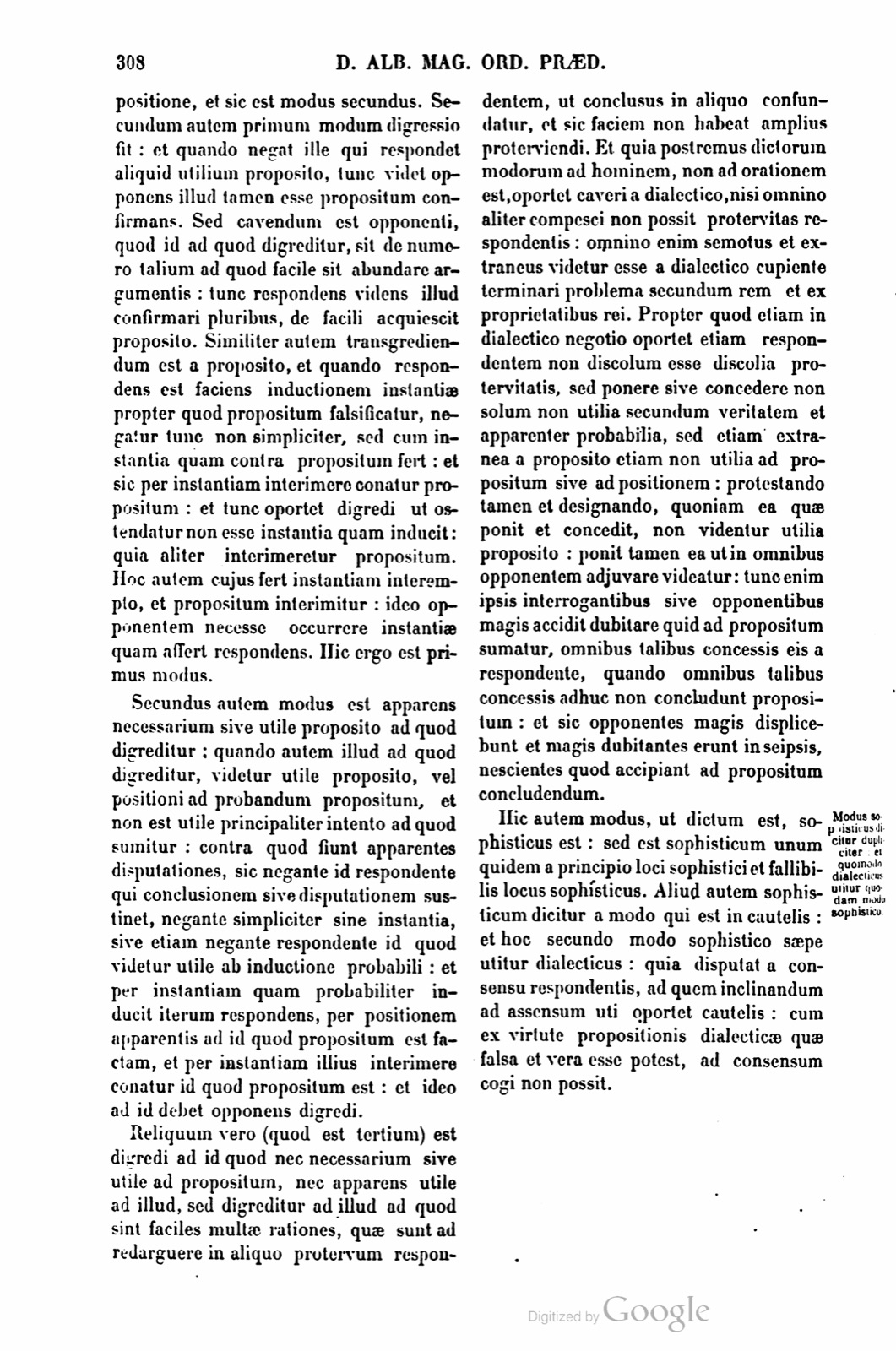
Reliquum vero, quod est tertium, est digredi ad id quod nec necessarium sive utile ad propositum, nec apparens utile ad illud, sed digreditur ad illud ad quod sint faciles multae rationes, quae sunt ad redarguere in aliquo protervum respondentem, ut conclusus in aliquo confundatur, et sic faciem non habeat amplius proterviendi. Et quia postremus dictorum modorum ad hominem, non ad orationem est, oportet caveri a dialectico, nisi omnino aliter compesci non possit protervitas respondentis: omnino enim semotus et extraneus videtur esse a dialectico cupiente terminari problema secundum rem et ex proprietatibus rei. Propter quod etiam in dialectico negotio oportet etiam respondentem non discolum esse discolia protervitatis, sed ponere sive concedere non solum non utilia secundum veritatem et apparenter probabilia, sed etiam extranea a proposito etiam non utilia ad propositum sive ad positionem: protestando tamen et designando, quoniam ea quae ponit et concedit, non videntur utilia proposito: ponit tamen ea ut in omnibus opponentem adjuvare videatur: tunc enim ipsis interrogantibus sive opponentibus magis accidit dubitare quid ad propositum sumatur, omnibus talibus concessis eis a respondente, quando omnibus talibus concessis adhuc non concludunt propositum: et sic opponentes magis displicebunt et magis dubitantes erunt in seipsis, nescientes quod accipiant ad propositum concludendum.
[Marginal label, printed page 308: Modus sophisticus dicitur dupliciter: et quo modo dialecticus utitur quodam modo sophistico.]
Hic autem modus, ut dictum est, sophisticus est: sed est sophisticum unum quidem locus sophisticus. Aliud autem sophisticum dicitur a modo qui est in cautelis: et hoc secundo modo sophistico saepe utitur dialecticus: quia disputat a consensu respondentis, ad quem inclinandum ad assensum uti oportet cautelis: cum ex virtute propositionis dialecticae quae falsa et vera esse potest, ad consensum cogi non possit.
CAPUT VIII.
De considerationibus quae fiunt post factam digressionem in antecedentibus et consequentibus simplicibus quae sunt ejusdem essentiae.
But the remaining mode, which is the third, is to digress to that which is neither necessary or useful for the proposed point, nor apparently useful for it, but he digresses to that toward which there are many easy reasons, which are for refuting the obstinate respondent in some respect, so that, having been concluded in some point, he may be confounded and thus no longer have a face for behaving obstinately. And because the last of the stated modes is ad hominem, not toward the speech, it must be avoided by the dialectician unless the obstinacy of the respondent cannot be restrained altogether otherwise. For it seems altogether remote and extraneous from the dialectician who desires that the problem be terminated according to the thing and from the properties of the thing. On account of this also in dialectical business the respondent too ought not to be difficult with the difficulty of obstinacy, but to posit or concede not only things not useful according to truth and apparently probable, but even things extraneous to the proposed point and not useful for the proposed point or for the position, nevertheless protesting and designating that the things he posits and concedes do not seem useful to the proposed point. Yet he posits them so that he may seem to aid the opponent in all things. Then indeed it more happens to those asking or opposing to doubt what may be taken for the proposed point, when all such things have been conceded to them by the respondent, when even after all such things have been conceded they still do not conclude the proposed point. And thus the opponents will be more displeased and more doubtful in themselves, not knowing what they should accept for concluding the proposed point.
[Marginal label, printed page 308: The sophistical mode is said in two ways, and how the dialectician uses a certain sophistical mode.]
But this mode, as has been said, is sophistical. Yet one sophistical thing is a sophistical locus. Another thing is called sophistical from the mode that is in cautions; and in this second sophistical mode the dialectician often uses something sophistical, because he disputes from the consent of the respondent, and for inclining him to assent one must use cautions, since he cannot be compelled to consent from the force of a dialectical proposition, which can be false and true.
CHAPTER VIII.
On the considerations that are made, after a digression has been made, in simple antecedents and consequents which are of the same essence.
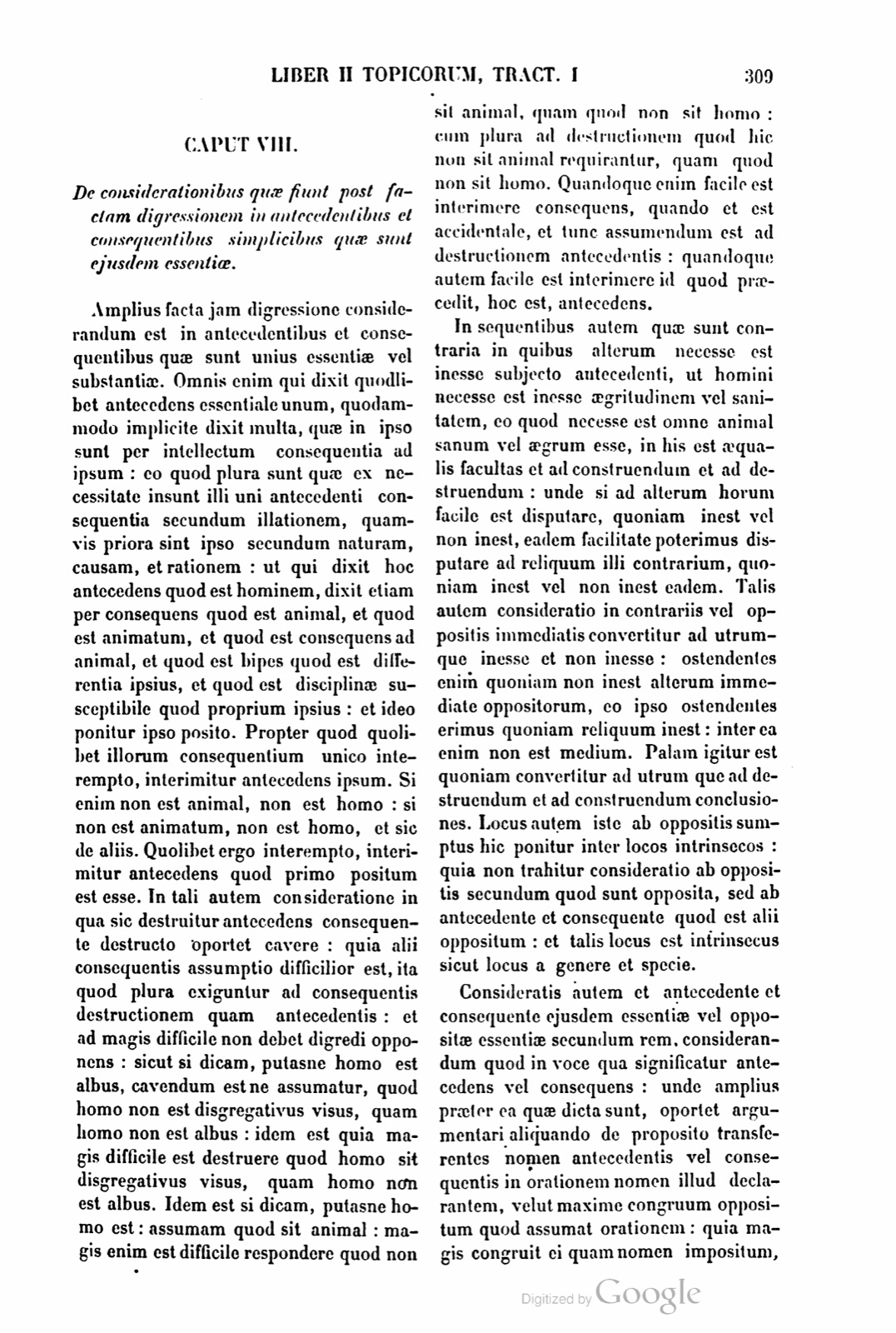
Amplius facta jam digressione considerandum est in antecedentibus et consequentibus quae sunt unius essentiae vel substantiae. Omnis enim qui dixit quodlibet antecedens essentiale unum, quodammodo implicite dixit multa, quae in ipso sunt per intellectum consequentia ad ipsum: eo quod plura sunt quae ex necessitate insunt illi uni antecedenti consequentia secundum illationem, quamvis priora sint ipso secundum naturam, causam, et rationem: ut qui dixit hoc antecedens quod est hominem, dixit etiam per consequens quod est animal, et quod est animatum, et quod est consequens ad animal, et quod est bipes quod est differentia ipsius, et quod est disciplinae susceptibile quod proprium ipsius: et ideo ponitur ipso posito. Propter quod quolibet illorum consequentium unico interempto, interimitur antecedens ipsum. Si enim non est animal, non est homo: si non est animatum, non est homo, et sic de aliis. Quolibet ergo interempto, interimitur antecedens quod primo positum est esse. In tali autem consideratione in qua sic destruitur antecedens consequente destructo oportet cavere: quia alii consequentis assumptio difficilior est, ita quod plura exiguntur ad consequentis destructionem quam antecedentis: et ad magis difficile non debet digredi opponens: sicut si dicam, putasne homo est albus, cavendum est ne assumatur, quod homo non est disgregativus visus, quam homo non est albus: idem est quia magis difficile est destruere quod homo sit disgregativus visus, quam homo non est albus. Idem est si dicam, putasne homo est: assumam quod sit animal: magis enim est difficile respondere quod non sit animal, quam quod non sit homo: cum plura ad destructionem quod hic non sit animal requirantur, quam quod non sit homo. Quandoque enim facile est interimere consequens, quando et est accidentale, et tunc assumendum est ad destructionem antecedentis: quandoque autem facile est interimere id quod praecedit, hoc est, antecedens.
In sequentibus autem quae sunt contraria in quibus alterum necesse est inesse subjecto antecedenti, ut homini necesse est inesse aegritudinem vel sanitatem, eo quod necesse est omne animal sanum vel aegrum esse, in his est aequalis facultas et ad construendum et ad destruendum: unde si ad alterum horum facile est disputare, quoniam inest vel non inest, eadem facilitate poterimus disputare ad reliquum illi contrarium, quoniam inest vel non inest eadem. Talis autem consideratio in contrariis vel oppositis immediatis convertitur ad utrumque inesse et non inesse: ostendentes enim quoniam non inest alterum immediate oppositorum, eo ipso ostendentes erimus quoniam reliquum inest: inter ea enim non est medium. Palam igitur est quoniam convertitur ad utrumque ad destruendum et ad construendum conclusiones. Locus autem iste ab oppositis sumptus hic ponitur inter locos intrinsecos: quia non trahitur consideratio ab oppositis secundum quod sunt opposita, sed ab antecedente et consequente quod est alii oppositum: et talis locus est intrinsecus sicut locus a genere et specie.
Furthermore, after a digression has now been made, one must consider in antecedents and consequents which are of one essence or substance. For everyone who has stated any one essential antecedent has in a certain way implicitly stated many things that are in it through understanding, consequent upon it, because there are several things which of necessity are in that one antecedent, consequent according to inference, although they are prior to it according to nature, cause, and account. Thus the one who stated this antecedent, which is human being, also stated consequently that it is animal, and that it is animated, and what is consequent upon animal, and that it is two-footed, which is its difference, and that it is receptive of discipline, which is its proper. And therefore it is posited when it itself has been posited. On account of this, when any one of those consequents has been destroyed, the antecedent itself is destroyed. For if it is not animal, it is not human being; if it is not animated, it is not human being, and so concerning the others. Therefore when any one is destroyed, the antecedent which was first posited to be is destroyed. But in such a consideration, in which the antecedent is thus destroyed once the consequent has been destroyed, one must beware, because the assumption of another consequent is more difficult, so that more things are required for the destruction of the consequent than of the antecedent; and the opponent ought not to digress to what is more difficult. Thus, if I say, do you think that a human being is white, one must beware lest it be assumed that a human being is not disgregative of sight rather than that a human being is not white; it is the same because it is more difficult to destroy that a human being is disgregative of sight than that a human being is not white. It is the same if I say, do you think that a human being is; I shall assume that it is animal, for it is more difficult to answer that it is not animal than that it is not a human being, since more things are required for the destruction of the statement that this is not an animal than that it is not a human being. For sometimes it is easy to destroy the consequent when it is also accidental, and then it must be assumed for the destruction of the antecedent; but sometimes it is easy to destroy what precedes, that is, the antecedent.
But in consequents which are contraries, in which one must of necessity be in the antecedent subject, as sickness or health must be in a human being, because every animal must be healthy or sick, in these there is equal faculty both for constructing and for destroying. Hence if it is easy to dispute toward one of these, that it is in or is not in, with the same ease we shall be able to dispute toward the remaining contrary to it, that it is in or is not in the same thing. But such consideration in immediate contraries or opposites is converted to each, being-in and not-being-in. For by showing that one of the immediate opposites is not in, by that very fact we shall be showing that the remaining one is in, for there is no middle between them. Therefore it is plain that it is converted to each for destroying and for constructing conclusions. But this locus taken from opposites is placed here among the intrinsic loci, because the consideration is not drawn from opposites according as they are opposites, but from the antecedent and consequent which is opposed to another; and such a locus is intrinsic like the locus from genus and species.
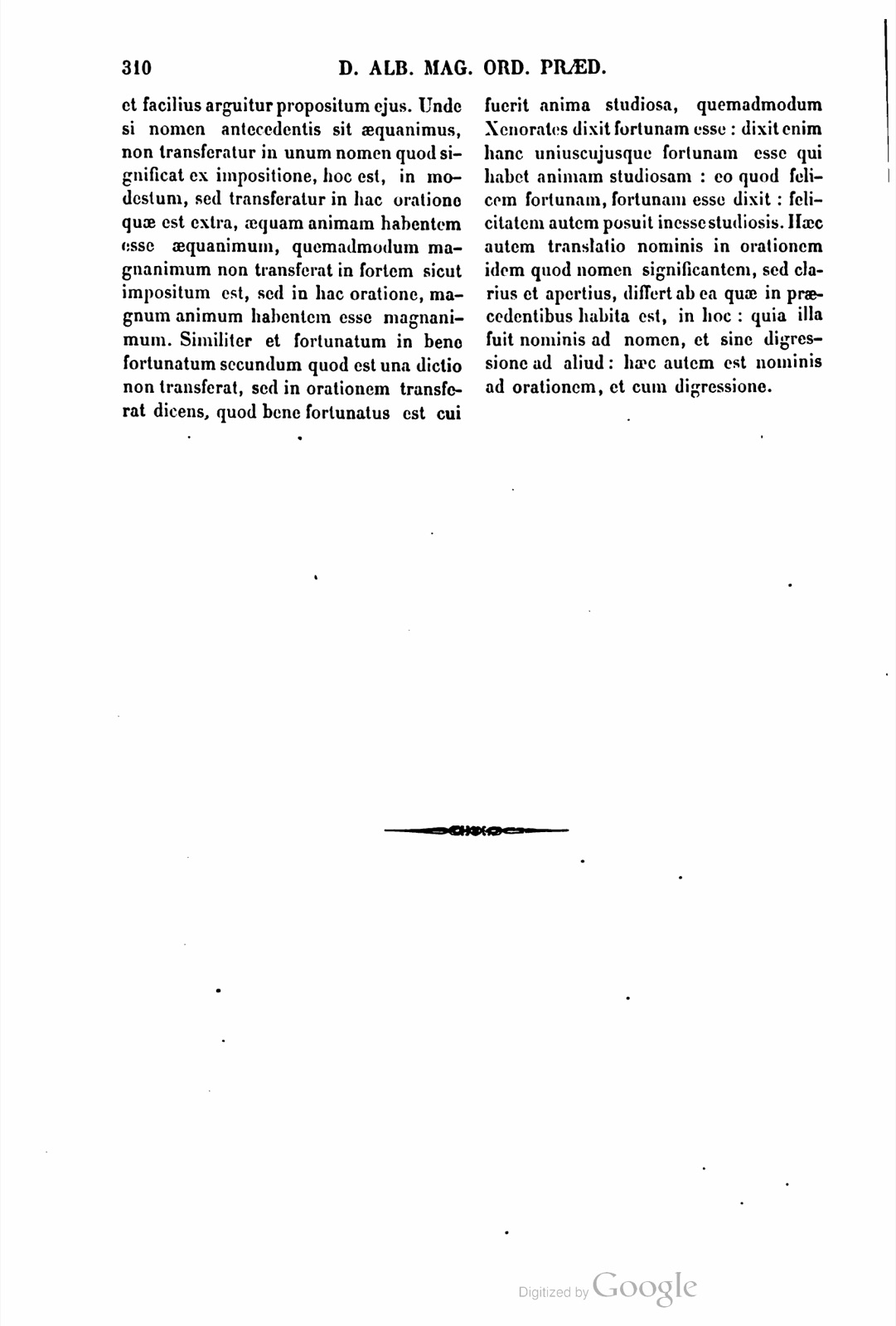
Consideratis autem et antecedente et consequente ejusdem essentiae vel oppositae essentiae secundum rem, considerandum quod in voce qua significatur antecedens vel consequens: unde amplius praeter ea quae dicta sunt, oportet argumentari aliquando de proposito transferentes nomen antecedentis vel consequentis in orationem nomen illud declarantem, velut maxime congruum oppositum quod assumat orationem: quia magis congruit ei quam nomen impositum, et facilius arguitur propositum ejus. Unde si nomen antecedentis sit aequanimus, non transferatur in unum nomen quod significat ex impositione, hoc est, in modestum, sed transferatur in hac oratione quae est extra, aequam animam habentem esse aequanimum, quemadmodum magnanimum non transferat in fortem sicut impositum est, sed in hac oratione, magnum animum habentem esse magnanimum. Similiter et fortunatum in bene fortunatum secundum quod est una dictio non transferat, sed in orationem transferat dicens, quod bene fortunatus est cui fuerit anima studiosa, quemadmodum Xenocrates dixit fortunam esse: dixit enim hanc uniuscujusque fortunam esse qui habet animam studiosam: eo quod felicem fortunam, fortunam esse dixit: felicitatem autem posuit inesse studiosis. Haec autem translatio nominis in orationem idem quod nomen significantem, sed clarius et apertius, differt ab ea quae in praecedentibus habita est, in hoc: quia illa fuit nominis ad nomen, et sine digressione ad aliud: haec autem est nominis ad orationem, et cum digressione.
But once the antecedent and consequent of the same essence or of an opposed essence according to reality have been considered, one must consider what is in the word by which the antecedent or consequent is signified. Hence, besides the things that have been said, one must sometimes argue about the proposed point by transferring the name of the antecedent or consequent into a speech declaring that name, as what is most congruously opposed, which should assume a speech, because it agrees with it more than the imposed name does, and its proposed point is argued more easily. Hence if the name of the antecedent is even-minded, it should not be transferred into one name which signifies by imposition, that is, into modest, but it should be transferred into this speech which is external: to be even-minded is to have an even soul. In the same way, magnanimous should not be transferred into brave as it was imposed, but into this speech: to be magnanimous is to have a great soul. Likewise he should not transfer fortunate into well-fortunate according as it is one diction, but should transfer it into a speech, saying that the well-fortunate is one whose soul is virtuous, as Xenocrates said fortune to be. For he said that this is the fortune of each one who has a virtuous soul, because he said that happy fortune is fortune, and he posited happiness to be in virtuous persons. But this translation of a name into a speech signifying the same thing as the name, but more clearly and more openly, differs from the one had in the preceding matters in this: that that one was of name to name and without digression to another thing, but this one is of name to speech and with digression.
If a page does not appear, its photograph has not been uploaded yet.