Volume 2 · pp. 305–307
CHAPTER VI. On genus, species, antecedent and consequent.
A marker with ≈ is an approximate page boundary, placed by measure of the text; the page photographs remain the authority. In the paired views, clicking a page marker brings that page into view.
est quod quaecumque insunt speciei, similiter insunt et generi: cum genus secundum actum et intellectum sit in specie. Cujus exemplum ut problema fiat, si est in genere prava et studiosa dispositio, et arguatur sic. Disciplina est prava et studiosa: ergo et dispositio est prava et studiosa: quia dispositio genus est disciplinae: et passio speciei probatur inesse generi per speciem.
[Marginal label, printed page 305: Quomodo intelligendum quod aliqua disciplina est prava.]
Sumitur autem disciplina generaliter pro quacumque doctrina, quae prava esse dicitur, quando est pravi alicujus, sicut ad furari et maechari, de quibus dicit Aristoteles in XI primae philosophiae 1, quod melius est vilia nescire. Et sic dicitur disciplina prava ratione adjuncti, sive ejus de quo est, et non ratione suiipsius in quantum disciplina est: adjunctum autem ipsius, ratione cujus prava est, est pravitas ad malum quae inclinat ad malum, scito malo, quod non faceret si malum nesciretur. Omnis enim scientia in se bona: quoniam dicit Boetius quod scientia mali bono deesse non potest. Sumitur autem hic dispositio generaliter non prout distinguitur contra habitum, sed prout est qualitas disponens.
Si autem has duas considerationes a genere et specie tractas secundum generalem potestatem inferendi suas conclusiones comparemus ad invicem, tunc primus locus a genere ad speciem tractus, falsus est, sive fallit ad affirmative concludendum: quia affirmative non proceditur semper a superiori ad inferius, nec tenet in affirmando nisi in essentialibus generi, sicut dictum est. Secundus autem locus a specie ad genus, secundum generalem inferentiam sumptus, est verior ad concludendum in affirmativis: quia affirmativus est processus ab inferiori ad superius. Cujus probatio est, quia non est necessarium, quod quaecumque praedicata generi insunt, et speciei insint. Et instantia est, quia animal in ambitu suae generalitatis est et volatile et quadrupes: et utrumque horum inest generi: homo autem species est animalis, neque est volatile, neque est quadrupes: et sic non sequitur a genere semper ad speciem affirmando. Sed quaecumque insunt speciei, similiter illa ut tota insunt etiam speciei et generi: et sic a specie ad genus proceditur affirmando. Si enim detur quod homo est studiosus, sequitur quod animal est studiosum, ad hoc quia homo est animal. Ad destruendum primus quidem locus a genere tractus universaliter est verus: quia a superiori ad inferius proceditur negando. Secundus autem ad destruendum est falsus, qui trahitur a specie ad genus: quia non valet procedendo ab inferiori ad superius negando. Hujus autem ratio est: quia quaecumque universaliter generi non insunt, illa non insunt speciei alicui generis illius: sed quaecumque non insunt huic vel illi speciei, non necesse est etiam non inesse generi.
[Marginal label, printed page 305: Apparens objectio.]
Si quis autem objiciat, quod nulla specie existente potest intelligi substantia animata sensibilis: et ut sic a genere omnis substantia animata sensibilis est animal: et tamen non est necesse descendere ad speciem in essentialibus.
[Marginal label, printed page 305: Solutio.]
Patet quod non valet, quia considerationes inductae sumuntur de genere prout dicit ambitum communitatis ad continendas species. Quando autem diffinitio generis ponitur de genere, non sumitur genus nisi secundum simplicitatem substantiae ipsius, prout genus divisum a specie secundum substantiam et esse generis: et haec quidem consideratio sumpta a genere sicut consequenti, et alia sumpta a specie sicut antecedente, de genere et specie tractae sunt, prout non in concretione, sed in simplici et abstracto et substantia considerantur.
it is true that whatever things are in the species are similarly in the genus, since the genus according to act and understanding is in the species. An example is this: let a problem be made whether an evil and virtuous disposition is in the genus, and let it be argued thus. Discipline is evil and virtuous; therefore disposition also is evil and virtuous, because disposition is the genus of discipline, and the passion of the species is proved to be in the genus through the species.
[Marginal label, printed page 305: How it is to be understood that some discipline is evil.]
But discipline is taken generally for any doctrine whatever, which is said to be evil when it is of some evil thing, as for stealing and committing adultery, concerning which Aristotle says in Metaphysics XI 1 that it is better not to know vile things. And thus discipline is called evil by reason of an adjunct, or of that of which it is, and not by reason of itself insofar as it is discipline. But its adjunct, by reason of which it is evil, is wickedness toward evil, which inclines to evil once the evil is known, which it would not do if the evil were not known. For every knowledge is good in itself, since Boethius says that knowledge of evil cannot be lacking to a good person. But disposition is taken here generally, not as it is distinguished against habit, but as it is a disposing quality.
But if we compare with one another these two considerations drawn from genus and species according to the general power of inferring their conclusions, then the first locus drawn from genus to species is false, or fails for concluding affirmatively, because one does not always proceed affirmatively from superior to inferior, nor does it hold in affirming except in things essential to the genus, as has been said. But the second locus from species to genus, taken according to general inference, is truer for concluding in affirmatives, because an affirmative process is from inferior to superior. The proof of this is that it is not necessary that whatever predicates are in the genus are also in the species. And the instance is that animal, in the scope of its generality, is both winged and quadruped, and each of these is in the genus; but human being is a species of animal, and is neither winged nor quadruped; and thus it does not always follow affirmatively from genus to species. But whatever things are in the species, those likewise, as wholes, are in both species and genus; and thus one proceeds affirmatively from species to genus. For if it is granted that a human being is virtuous, it follows that an animal is virtuous, because a human being is an animal. For destroying, the first locus drawn from genus is universally true, because one proceeds by denying from superior to inferior. But the second for destroying, which is drawn from species to genus, is false, because proceeding by denying from inferior to superior is not valid. The reason for this is that whatever things are universally not in the genus are not in any species of that genus; but whatever things are not in this or that species need not also not be in the genus.
[Marginal label, printed page 305: Apparent objection.]
But if someone objects that when no species exists, sensible animated substance can be understood, and that thus from the genus every sensible animated substance is animal, and nevertheless it is not necessary in essentials to descend to species.
[Marginal label, printed page 305: Solution.]
It is plain that this is not valid, because the considerations introduced are taken concerning genus as it says the scope of community for containing species. But when the definition of genus is posited concerning genus, genus is taken only according to the simplicity of its substance, insofar as genus is divided from species according to the substance and being of genus. And this consideration, taken from genus as consequent, and the other, taken from species as antecedent, have been drawn from genus and species as they are considered not in concretion but in the simple and abstract and in substance.
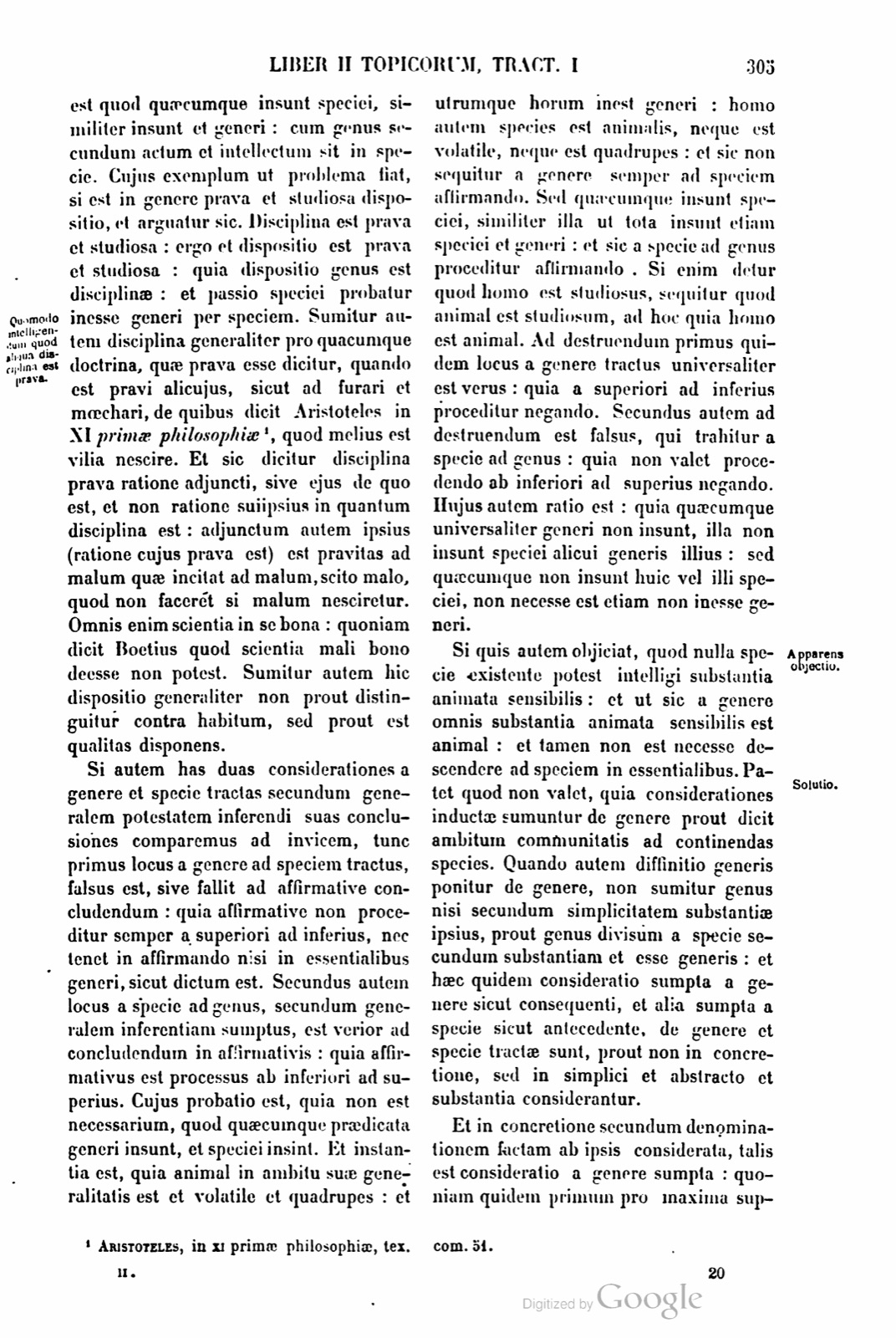
Et in concretione secundum denominationem factam ab ipsis considerata, talis est consideratio a genere sumpta: quoniam quidem primum pro maxima supponendum, quoniam necessarium est quod de quibus genus praedicatur, et specierum aliquam illius generis oportet praedicari: eo quod nihil est in genere, quod non sit in aliqua ejus specierum: et quaecumque genus habent, et dicuntur inesse generi, vel quaecumque denominative a genere aliquo dicuntur, et aliquam specierum necesse est habere, vel denominative dici ab aliqua specierum illius generis: ut si de aliquo praedicetur hoc genus, disciplina, necesse est quod de eodem praedicetur vel grammatica, vel musica, vel aliqua aliarum disciplinarum in specie determinatarum. Similiter si aliquis habendo disciplinam denominatur a disciplina ut disciplinatus, sequitur etiam quod grammaticam habebit, aut aliquam aliarum in specie determinatarum, vel ab aliqua denominabitur.
Consideratio tracta a genere sic in ambitu suarum specierum accepto, talis est: et si aliquid ponatur dictum vel denominatum a genere quolibet modo dictorum modorum, ut, gratia exempli, dicat animam moveri sive etiam motivam sui, ut Plato dixit animam esse numerum seipsam moventem, et sic denominat animam a motivo et motu: consideretur in speciebus motivi et moti, si secundum aliquam specierum convenit animam moveri a seipsa, verbi gratia ut si contingat ipsam augeri vel minui a seipsa generari vel corrumpi, quae sunt fines vel termini motus, vel quaecumque aliae species sunt motus: si secundum nullam speciem ipsius motus contingit animam moveri a seipsa, palam est quoniam anima a seipsa non movetur. Hic autem locus sic tractus a genere ad aliquam specierum, communis est secundum potestatem ad utrumque et construendum et destruendum. Et si enim secundum aliquam specierum movetur anima, palam est quoniam anima movetur a seipsa, et sic valet construendo: et si secundum nullam speciem motus anima movetur a seipsa, patet quoniam non movetur, et sic valet destruendo.
[Marginal label, printed page 306: Quomodo Plato dixit animam esse numerum seipsum moventem.]
Attendendum tamen hoc quod Plato non dixit animam esse numerum seipsum moventem motu qui est actus imperfectus, sed motu qui est actus perfectus, secundum quod motus est actus moventis, et non actus mobilis. Si enim est anima principium et causa vitae et motus talis in quo per essentiam sublevatur supra naturam, et ex hujus principio animae perfectio principium et causa est motus talis, probatur esse numerus a Platone et Socrate. Hoc autem qualiter fiat, alibi considerandum est.
Juxta autem has considerationes sumitur idoneitas ad arguendum: opponente enim non idoneo conari, hoc est, ut conetur abundare arguendo ad positionem intrinsecam circa id quod inest generi vel speciei, innitendum est ex diffinitionibus antecedentis sive speciei, et ex diffinitionibus consequentis sive generis, sive istae diffinitiones sint verae et essentiales diffinitiones propositae rei quae continetur in problemate proposito, sive esse videantur et non sint, sicut descriptiones quae virtutem videntur habere diffinitionis: et si non possit conari ad propositionem ab una diffinitione, ponat plures, et ab illis conetur. Quia tales diffinitiones, sic large diffinitiones vocatae, plures possunt esse ejusdem rei.
[Marginal label, printed page 306: Plures diffinitiones, id est, descriptiones possunt esse ejusdem rei.]
And when they are considered in concretion according to denomination made from them, such is the consideration taken from genus: first indeed it must be presupposed as a maxim that it is necessary that of those things of which a genus is predicated, some species of that genus must also be predicated, because nothing is in a genus which is not in some one of its species; and whatever things have a genus and are said to be in the genus, or whatever things are denominatively said from some genus, must also have some species, or must be denominatively said from some species of that genus. Thus if this genus, discipline, is predicated of something, it is necessary that of the same thing either grammar or music or some one of the other disciplines determined in species be predicated. Likewise, if someone by having discipline is denominated from discipline as disciplined, it also follows that he will have grammar, or some other of those determined in species, or will be denominated from some one of them.
The consideration drawn from genus thus accepted in the scope of its species is such: if something is posited as said or denominated from a genus in any one of the stated modes, as, for the sake of example, if one says that the soul is moved or is even self-moving, as Plato said that the soul is a self-moving number, and thus denominates the soul from mover and motion, one must consider in the species of mover and moved whether according to any species it belongs to the soul to be moved by itself. For example, whether it happens for it to be increased or diminished by itself, generated or corrupted, which are ends or terms of motion, or whatever other species of motion there are. If according to no species of motion itself it happens for the soul to be moved by itself, it is plain that the soul is not moved by itself. But this locus, drawn in this way from genus to some one of the species, is common in power for both constructing and destroying. For if the soul is moved according to some species, it is plain that the soul is moved by itself, and thus it is valid for constructing; and if the soul is not moved by itself according to any species of motion, it is plain that it is not moved, and thus it is valid for destroying.
[Marginal label, printed page 306: How Plato said that the soul is a self-moving number.]
Nevertheless this must be attended to, that Plato did not say that the soul is a self-moving number with motion that is an imperfect act, but with motion that is a perfect act, according as motion is the act of the mover and not the act of the movable. For if the soul is the principle and cause of life and of such motion in which through essence it is lifted above nature, and from this principle the perfection of the soul is the principle and cause of such motion, it is proved by Plato and Socrates to be a number. But how this happens must be considered elsewhere.
Next to these considerations, suitability for arguing is taken. For when the opponent is not suitable, in order to try, that is, so that he may try, to abound by arguing toward an intrinsic position concerning what is in the genus or species, one must rely on the definitions of the antecedent or species, and on the definitions of the consequent or genus, whether those definitions are true and essential definitions of the proposed thing contained in the proposed problem, or seem to be and are not, as descriptions which seem to have the force of definition. And if he cannot try toward the proposition from one definition, let him posit several and try from them, because such definitions, called definitions broadly in this way, can be several for the same thing.
[Marginal label, printed page 306: Several definitions, that is, descriptions, can belong to the same thing.]
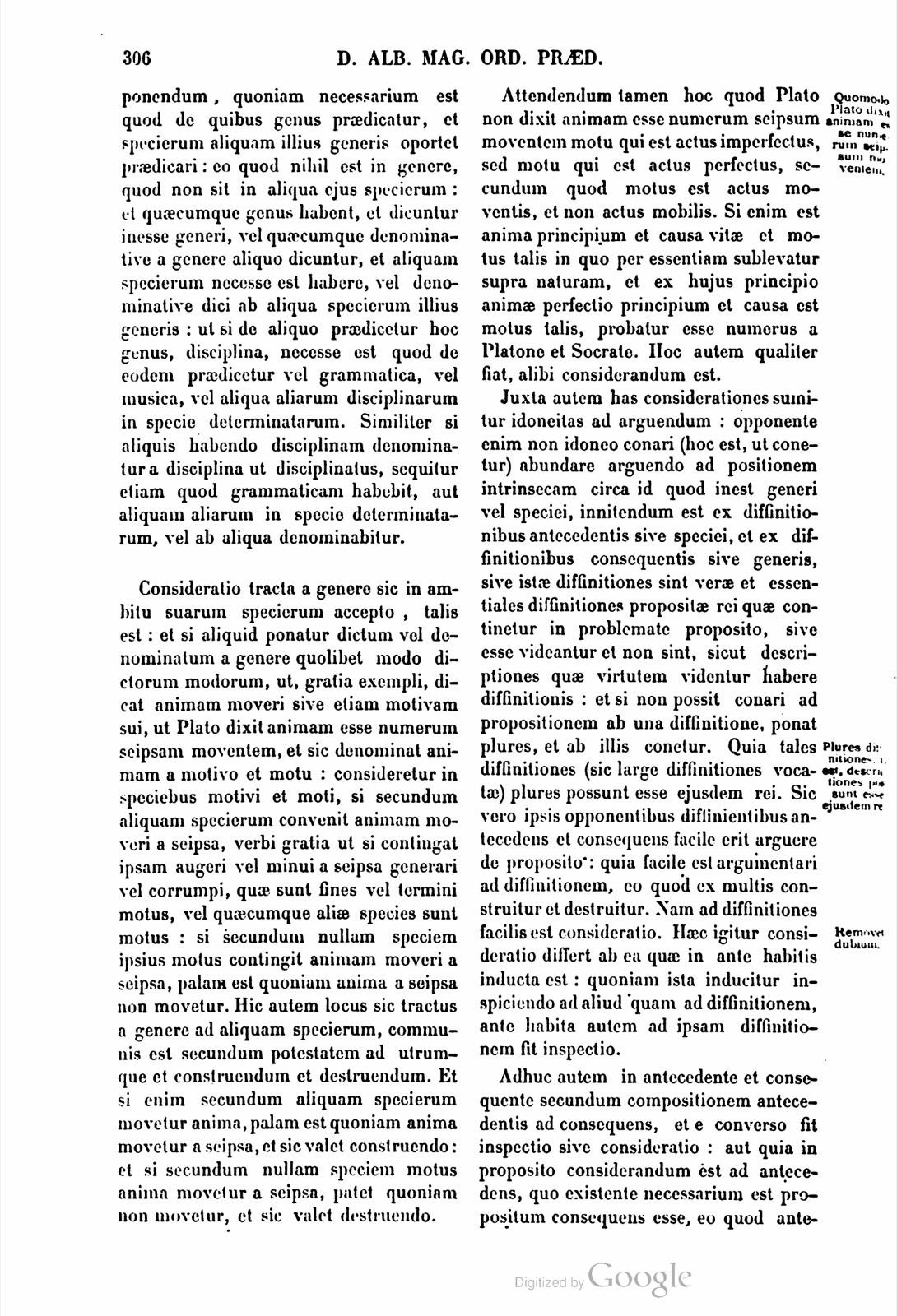
Sic vero ipsis opponentibus diffinientibus antecedens et consequens facile erit arguere de proposito: quia facile est argumentari ad diffinitionem, eo quod ex multis construitur et destruitur. Nam ad diffinitiones facilis est consideratio.
[Marginal label, printed page 306: Removet dubium.]
Haec igitur consideratio differt ab ea quae in ante habitis inducta est: quoniam ista inducitur inspiciendo ad aliud quam ad diffinitionem, ante habita autem ad ipsam diffinitionem fit inspectio.
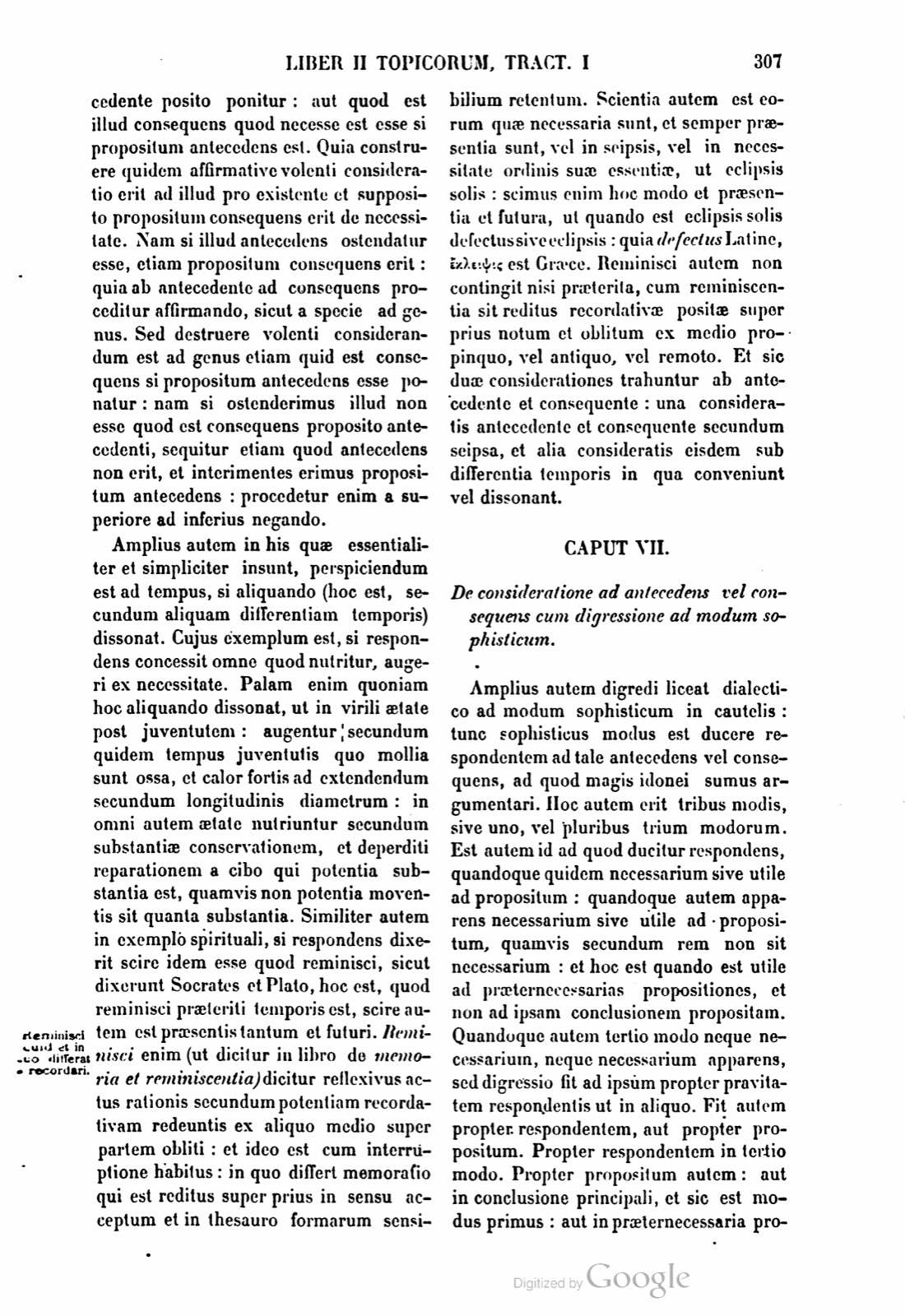
Adhuc autem in antecedente et consequente secundum compositionem antecedentis ad consequens, et e converso fit inspectio sive consideratio: aut quia in proposito considerandum est ad antecedens, quo existente necessarium est propositum consequens esse, eo quod antecedente posito ponitur: aut quod est illud consequens quod necesse est esse si propositum antecedens est. Quia construere quidem affirmative volenti consideratio erit ad illud pro existente et supposito propositum consequens erit de necessitate. Nam si illud antecedens ostendatur esse, etiam propositum consequens erit: quia ab antecedente ad consequens proceditur affirmando, sicut a specie ad genus. Sed destruere volenti considerandum est ad genus etiam quid est consequens si propositum antecedens esse ponatur: nam si ostenderimus illud non esse quod est consequens proposito antecedenti, sequitur etiam quod antecedens non erit, et interimentes erimus propositum antecedens: procedetur enim a superiore ad inferius negando.
Amplius autem in his quae essentialiter et simpliciter insunt, perspiciendum est ad tempus, si aliquando, hoc est, secundum aliquam differentiam temporis, dissonat. Cujus exemplum est, si respondens concessit omne quod nutritur, augeri ex necessitate. Palam enim quoniam hoc aliquando dissonat, ut in virili aetate post juventutem: augentur secundum quidem tempus juventutis quo mollia sunt ossa, et calor fortis ad extendendum secundum longitudinis diametrum: in omni autem aetate nutriuntur secundum substantiae conservationem, et deperditi reparationem a cibo qui potentia substantia est, quamvis non potentia moventis sit quanta substantia. Similiter autem in exemplo spirituali, si respondens dixerit scire idem esse quod reminisci, sicut dixerunt Socrates et Plato, hoc est, quod reminisci praeteriti temporis est, scire autem est praesentis tantum et futuri.
[Marginal label, printed page 307: Cur reminisci differat recordari.]
Reminisci enim, ut dicitur in libro de memoria et reminiscentia, dicitur reflexivus actus rationis secundum potentiam recordativam redeuntis ex aliquo medio super partem obliti: et ideo est cum interruptione habitus: in quo differt memoratio qui est reditus super prius in sensu acceptum et in thesauro formarum sensibilium retentum. Scientia autem est eorum quae necessaria sunt, et semper praesentia sunt, vel in seipsis, vel in necessitate ordinis suae essentiae, ut eclipsis solis: scimus enim hoc modo et praesentia et futura, ut quando est eclipsis solis defectus sive eclipsis: quia defectus Latine, ἔκλειψις est Graece. Reminisci autem non contingit nisi praeterita, cum reminiscentia sit reditus recordativae positae super prius notum et oblitum ex medio propinquo, vel antiquo, vel remoto. Et sic duae considerationes trahuntur ab antecedente et consequente: una consideratis antecedente et consequente secundum seipsa, et alia consideratis eisdem sub differentia temporis in qua conveniunt vel dissonant.
Thus, when the opponents themselves define antecedent and consequent, it will be easy to argue about the proposed point, because it is easy to argue toward a definition, since it is constructed and destroyed from many things. For consideration toward definitions is easy.
[Marginal label, printed page 306: He removes a doubt.]
Therefore this consideration differs from that which was introduced in the foregoing, because this one is introduced by inspecting something other than definition, while in the foregoing inspection is made toward the definition itself.
Furthermore, inspection or consideration is made in antecedent and consequent according to the composition of antecedent to consequent, and conversely: either because in the proposed matter one must consider the antecedent, upon whose existence it is necessary that the proposed consequent exist, since when the antecedent is posited, the consequent is posited; or because it is that consequent which must exist if the proposed antecedent exists. For for one wishing to construct affirmatively, the consideration will be toward that existing and supposed, and the proposed consequent will be of necessity. For if that antecedent is shown to be, the proposed consequent also will be, because one proceeds by affirming from antecedent to consequent, as from species to genus. But one wishing to destroy must consider also the genus, what the consequent is if the proposed antecedent is posited to be. For if we have shown that what is consequent upon the proposed antecedent is not, it also follows that the antecedent will not be, and we shall be destroying the proposed antecedent; for one will proceed by denying from superior to inferior.
Moreover, in those things which are essentially and simply in, one must look to time, whether it differs at some time, that is, according to some difference of time. An example is if the respondent conceded that everything nourished is increased of necessity. For it is plain that this differs at some time, as in manly age after youth. Things are increased during the time of youth, when the bones are soft and the heat is strong for extending according to the diameter of length; but in every age they are nourished according to the conservation of substance and the repair of what has been lost from food which is potentially substance, although it is not potentially a moving quantitative substance. Likewise in a spiritual example, if the respondent said that to know is the same as to recollect, as Socrates and Plato said, that is, that to recollect belongs to past time, but knowing belongs only to the present and future.
[Marginal label, printed page 307: Why to recollect differs from to remember.]
For to recollect, as is said in the book On Memory and Recollection, is called a reflexive act of reason according to the remembering power returning from some middle upon a forgotten part; and therefore it is with interruption of habit. In this it differs from remembering, which is a return upon what was previously received in sense and retained in the storehouse of sensible forms. But knowledge is of those things that are necessary and always present, either in themselves or in the necessity of the order of their essence, as an eclipse of the sun. For in this way we know both present and future things, as when there is an eclipse of the sun, a failure or eclipse, because failure in Latin is ἔκλειψις in Greek. But recollecting does not happen except concerning past things, since recollection is the return of the remembering power placed upon something previously known and forgotten from a near, old, or remote middle. And thus two considerations are drawn from antecedent and consequent: one by considering antecedent and consequent according to themselves, and the other by considering the same under the difference of time in which they agree or differ.
Notes
- Aristotle, in Metaphysics XI, text-comment 51. (ARISTOTELES, in XI primae philosophiae, tex. com. 51.) ↩
If a page does not appear, its photograph has not been uploaded yet.