Volume 2 · pp. 298–300
CHAPTER IV. On inspection of the definition of the subject or predicate.
A marker with ≈ is an approximate page boundary, placed by measure of the text; the page photographs remain the authority. In the paired views, clicking a page marker brings that page into view.
CAPUT IV.
De determinatione ejusdem problematis de accidente per inspectionem ad diffinitionem subjecti vel praedicati problematis vel utriusque.
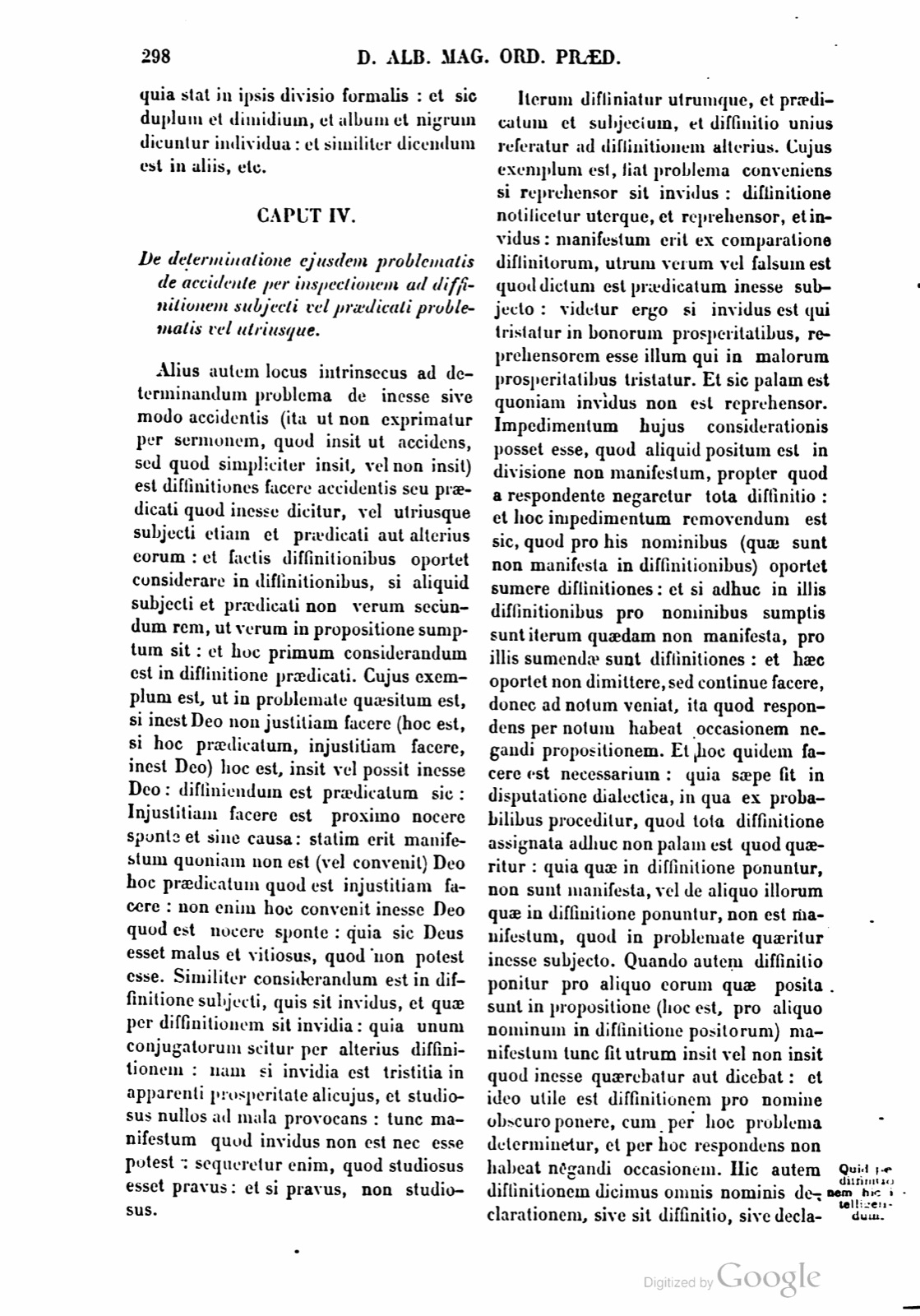
Alius autem locus intrinsecus ad determinandum problema de inesse sive modo accidentis, ita ut non exprimatur per sermonem, quod insit ut accidens, sed quod simpliciter insit, vel non insit, est diffinitiones facere accidentis seu praedicati quod inesse dicitur, vel utriusque subjecti etiam et praedicati aut alterius eorum: et factis diffinitionibus oportet considerare in diffinitionibus, si aliquid subjecti et praedicati non verum secundum rem, ut verum in propositione sumptum sit: et hoc primum considerandum est in diffinitione praedicati. Cujus exemplum est, ut in problemate quaesitum est, si inest Deo non justitiam facere, hoc est, si hoc praedicatum, injustitiam facere, inest Deo, hoc est, insit vel possit inesse Deo: diffiniendum est praedicatum sic: injustitiam facere est proximo nocere sponte et sine causa: statim erit manifestum quoniam non est, vel convenit, Deo hoc praedicatum quod est injustitiam facere: non enim hoc convenit inesse Deo quod est nocere sponte: quia sic Deus esset malus et vitiosus, quod non potest esse. Similiter considerandum est in diffinitione subjecti, quis sit invidus, et quae per diffinitionem sit invidia: quia unum conjugatorum scitur per alterius diffinitionem: nam si invidia est tristitia in apparenti prosperitate alicujus, et studiosus nullos ad mala provocans: tunc manifestum quod invidus non est nec esse potest: sequeretur enim, quod studiosus esset pravus: et si pravus, non studiosus.
Iterum diffiniatur utrumque, et praedicatum et subjectum, et diffinitio unius referatur ad diffinitionem alterius. Cujus exemplum est, fiat problema conveniens si reprehensor sit invidus: diffinitione notificetur uterque, et reprehensor, et invidus: manifestum erit ex comparatione diffinitorum, utrum verum vel falsum est quod dictum est praedicatum inesse subjecto: videtur ergo si invidus est qui tristatur in bonorum prosperitatibus, reprehensorem esse illum qui in malorum prosperitatibus tristatur. Et sic palam est quoniam invidus non est reprehensor.
Impedimentum hujus considerationis posset esse, quod aliquid positum est in divisione non manifestum, propter quod a respondente negaretur tota diffinitio: et hoc impedimentum removendum est sic, quod pro his nominibus quae sunt non manifesta in diffinitionibus, oportet sumere diffinitiones: et si adhuc in illis diffinitionibus pro nominibus sumptis sunt iterum quaedam non manifesta, pro illis sumendae sunt diffinitiones: et haec oportet non dimittere, sed continue facere, donec ad notum veniat, ita quod respondens per notum habeat occasionem negandi propositionem. Et hoc quidem facere est necessarium: quia saepe fit in disputatione dialectica, in qua ex probabilibus proceditur, quod tota diffinitione assignata adhuc non palam est quod quaeritur: quia quae in diffinitione ponuntur, non sunt manifesta, vel de aliquo illorum quae in diffinitione ponuntur, non est manifestum, quod in problemate quaeritur inesse subjecto. Quando autem diffinitio ponitur pro aliquo eorum quae posita sunt in propositione, hoc est, pro aliquo nominum in diffinitione positorum, manifestum tunc fit utrum insit vel non insit quod inesse quaerebatur aut dicebat: et ideo utile est diffinitionem pro nomine obscuro ponere, cum per hoc problema determinetur, et per hoc respondens non habeat negandi occasionem.
[Marginal label, printed page 298: Quid per diffinitionem hic intelligendum.]
Hic autem diffinitionem dicimus omnis nominis declarationem, sive sit diffinitio, sive declaratio, sive descriptio, sive nominis interpretatio: eo quod haec omnia prout sunt principium inferendi in syllogismo dialectico, per unum modum communem sunt dispositio medii syllogismi dialectici. Et ideo non distinguitur diffinitio a descriptione vel nominis interpretatione: quia prout sunt dispositio medii uno modo ad inferendum dispositionem. Sed si referuntur ad rem quam notificat, oporteret ista distinguere: quia aliter notificat rem ista tria, et aliter diffinitio, quia per substantialia: et aliter descriptio, quia per accidentalia: et aliter nominis interpretatio, quia per causam quae illa imposuit: et hoc modo haec tria sunt tres loci intrinseci, sicut in Topicis suis dicit Boetius. Sed haec non considerantur sic, sed ut unumquodque istorum, sicut notum faciens manifestum ad considerandum hic sumitur: et ideo uno nomine indistincte haec signatur idoneitas istius considerationis quae penes rem sumpta est hic: quia adhuc praeter ea quae dicta sunt.
CHAPTER IV.
On the determination of the same problem concerning accident through inspection of the definition of the subject or predicate of the problem, or of both.
But another intrinsic locus for determining the problem concerning being-in or the mode of accident, so that it is not expressed through speech that it is in as accident, but that it is simply in or is not in, is to make definitions of the accident or of the predicate that is said to be in, or of both, namely also of subject and predicate, or of one of them. And when the definitions have been made, one must consider in the definitions whether something of subject and predicate is not true according to the thing, as true has been taken in the proposition; and this must first be considered in the definition of the predicate. An example of this is that in a problem it has been asked whether not doing justice is in God, that is, whether this predicate, to do injustice, is in God, that is, is in or can be in God. The predicate must be defined thus: to do injustice is to harm one's neighbor voluntarily and without cause. Immediately it will be manifest that this predicate which is to do injustice is not, or does not belong, to God; for this does not belong to be in God, namely to harm voluntarily, because thus God would be evil and vicious, which cannot be. Similarly one must consider in the definition of the subject, who the envious person is, and what envy is through definition, because one of conjugates is known through the definition of the other. For if envy is sadness at the apparent prosperity of someone, and the virtuous person provokes no one to evils, then it is manifest that he is not envious and cannot be; for it would follow that the virtuous person would be depraved, and if depraved, not virtuous.
Again, let each be defined, both predicate and subject, and let the definition of one be referred to the definition of the other. An example of this is: let a suitable problem be made whether a reprover is envious; let each, both reprover and envious person, be made known by definition. From the comparison of the defined things it will be manifest whether what has been said, that the predicate is in the subject, is true or false. Therefore if the envious person seems to be one who is saddened at the prosperities of good things, the reprover seems to be one who is saddened at the prosperities of evil things. And thus it is plain that the envious person is not the reprover.
An impediment of this consideration could be that something not manifest is placed in the division, on account of which the whole definition would be denied by the respondent. And this impediment must be removed in this way: for those names which are not manifest in the definitions, one must take definitions; and if still in those definitions taken for the names there are again certain things not manifest, definitions must be taken for those. And one must not leave these aside, but do this continuously until it comes to something known, so that through what is known the respondent may have an occasion of denying the proposition. And doing this is necessary, because it often happens in dialectical disputation, in which one proceeds from probable things, that when the whole definition has been assigned, what is sought is still not plain, because the things that are placed in the definition are not manifest, or concerning some one of those things that are placed in the definition, it is not manifest that what is sought in the problem is in the subject. But when a definition is placed for one of the things that have been placed in the proposition, that is, for one of the names placed in the definition, then it becomes manifest whether what was being sought or said to be in is in or is not in. And therefore it is useful to place a definition for an obscure name, since through this the problem is determined, and through this the respondent does not have an occasion for denying.
[Marginal label, printed page 298: What is to be understood here by definition.]
Here, however, by definition we mean the declaration of every name, whether it is definition, or declaration, or description, or interpretation of the name, because all these, insofar as they are a principle of inferring in a dialectical syllogism, are by one common mode a disposition of the middle of the dialectical syllogism. And therefore definition is not distinguished from description or interpretation of a name, because, insofar as they are the disposition of the middle, they are ordered in one way to inferring a disposition. But if they are referred to the thing which it makes known, one would have to distinguish these, because these three make the thing known in one way, and definition in another, because it makes known through substantial things; and description in another, because through accidental things; and interpretation of a name in another, because through the cause that imposed it; and in this way these three are three intrinsic loci, as Boethius says in his Topics. But these are not considered so, but each one of these is here taken as something known making manifest for consideration; and therefore by one name, indistinctly, this suitability of that consideration which has been taken here with respect to the thing is marked, because there are still things besides those that have been said.
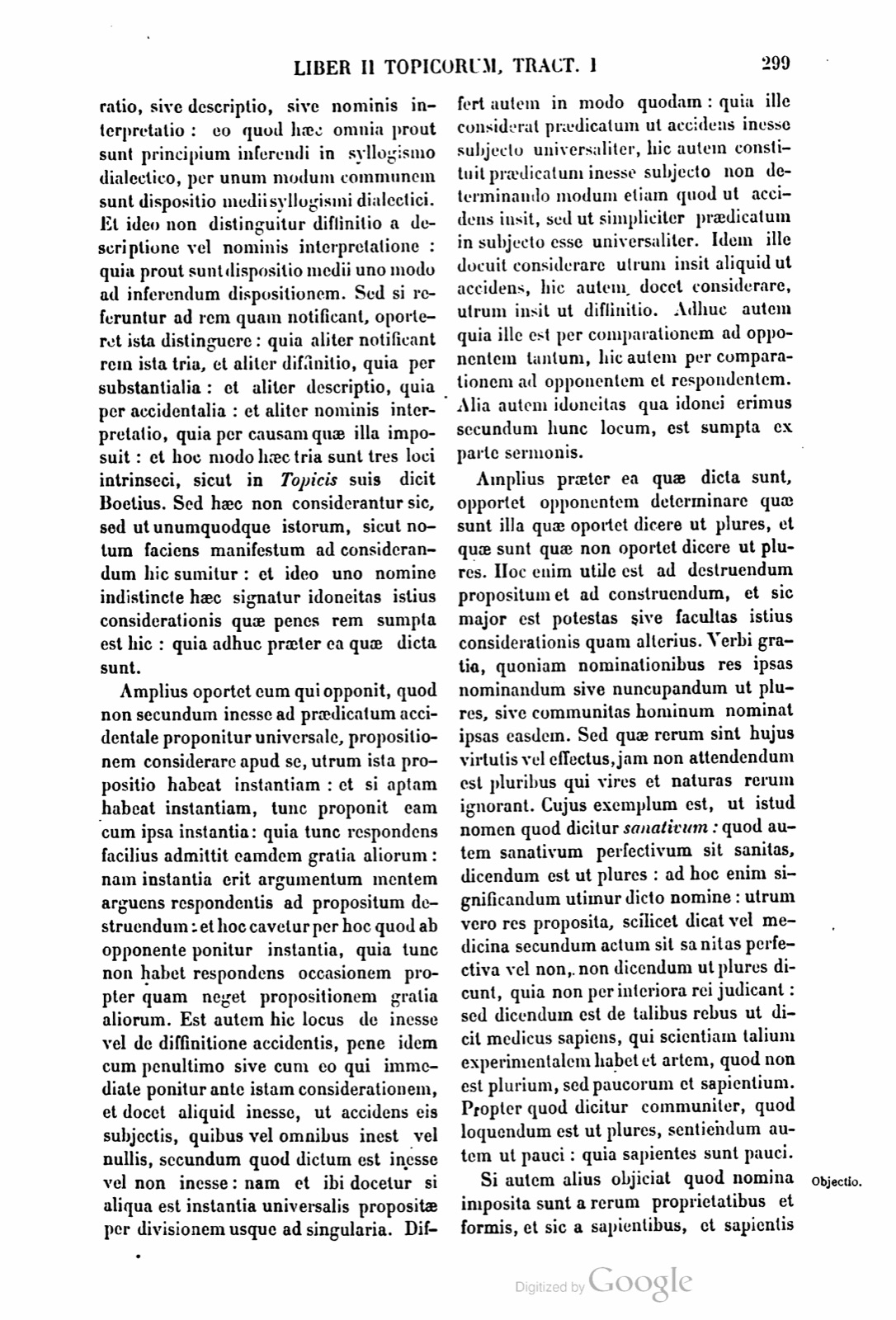
Amplius oportet eum qui opponit, quod non secundum inesse ad praedicatum accidentale proponitur universale, propositionem considerare apud se, utrum ista propositio habeat instantiam: et si aptam habeat instantiam, tunc proponit eam cum ipsa instantia: quia tunc respondens facilius admittit eamdem gratia aliorum: nam instantia erit argumentum mentem arguens respondentis ad propositum destruendum: et hoc cavetur per hoc quod ab opponente ponitur instantia, quia tunc non habet respondens occasionem propter quam neget propositionem gratia aliorum. Est autem hic locus de inesse vel de diffinitione accidentis, pene idem cum penultimo sive cum eo qui immediate ponitur ante istam considerationem, et docet aliquid inesse, ut accidens eis subjectis, quibus vel omnibus inest vel nullis, secundum quod dictum est inesse vel non inesse: nam et ibi docetur si aliqua est instantia universalis propositae per divisionem usque ad singularia. Differt autem in modo quodam: quia ille considerat praedicatum ut accidens inesse subjecto universaliter, hic autem constituit praedicatum inesse subjecto non determinando modum etiam quod ut accidens insit, sed ut simpliciter praedicatum in subjecto esse universaliter. Idem ille docuit considerare utrum insit aliquid ut accidens, hic autem docet considerare, utrum insit ut diffinitio. Adhuc autem quia ille est per comparationem ad opponentem tantum, hic autem per comparationem ad opponentem et respondentem. Alia autem idoneitas qua idonei erimus secundum hunc locum, est sumpta ex parte sermonis.
Amplius praeter ea quae dicta sunt, oportet opponentem determinare quae sunt illa quae oportet dicere ut plures, et quae sunt quae non oportet dicere ut plures. Hoc enim utile est ad destruendum propositum et ad construendum, et sic major est potestas sive facultas istius considerationis quam alterius. Verbi gratia, quoniam nominationibus res ipsas nominandum sive nuncupandum ut plures, sive communitas hominum nominat ipsas easdem. Sed quae rerum sint hujus virtutis vel effectus, jam non attendendum est pluribus qui vires et naturas rerum ignorant. Cujus exemplum est, ut istud nomen quod dicitur sanativum: quod autem sanativum perfectivum sit sanitas, dicendum est ut plures: ad hoc enim significandum utimur dicto nomine: utrum vero res proposita, scilicet diaeta vel medicina secundum actum sit sanitas perfectiva vel non, non dicendum ut plures dicunt, quia non per interiora rei judicant: sed dicendum est de talibus rebus ut dicit medicus sapiens, qui scientiam talium experimentalem habet et artem, quod non est plurium, sed paucorum et sapientium. Propter quod dicitur communiter, quod loquendum est ut plures, sentiendum autem ut pauci: quia sapientes sunt pauci.
[Marginal label, printed page 299: Objectio.]
Si autem alius objiciat quod nomina imposita sunt a rerum proprietatibus et formis, et sic a sapientibus, et sapientis est hoc considerare, et loquendum est vocabulis et utendum prout sunt imposita: et sic videtur quod loquendum sit ut sapientes.
[Marginal label, printed page 300: Solutio. Quare non est loquendum ut sapientes, sed ut plures et quomodo hoc intelligendum.]
Further, the one who opposes must consider with himself the proposition, which is not proposed according to being-in with respect to an accidental predicate as universal, whether that proposition has an instance; and if it has a suitable instance, then he proposes it together with the instance itself, because then the respondent more easily admits it for the sake of the others. For the instance will be an argument convicting the mind of the respondent for destroying the proposed point; and this is guarded by the fact that an instance is posited by the opponent, because then the respondent does not have an occasion on account of which he denies the proposition for the sake of the others. But this locus concerning being-in or concerning the definition of accident is almost the same as the penultimate one or as that which is placed immediately before this consideration, and it teaches that something is in, as accident, in those subjects in which either it is in all or in none, according as being-in or not being-in has been said. For there also it is taught whether there is some instance of the universal proposed proposition through division down to singulars. But it differs in a certain mode, because that one considers the predicate as accident to be in the subject universally, but this one establishes the predicate to be in the subject, not determining the mode also that it is in as accident, but that as predicate it is simply in the subject universally. That one taught one to consider whether something is in as accident; but this one teaches one to consider whether it is in as definition. Moreover, because that one is through comparison to the opponent only, but this one through comparison to the opponent and the respondent. But another suitability by which we shall be suitable according to this locus is taken from the part of speech.
Further, besides the things that have been said, the opponent must determine what those things are which one ought to say as the many say, and what the things are which one ought not to say as the many say. For this is useful for destroying the proposed point and for constructing it, and thus the power or faculty of this consideration is greater than that of the other. For example, because by names the things themselves must be named or called as the many, or the community of human beings, names those same things. But what things have this power or effect of the things is not now to be attended from the many, who are ignorant of the powers and natures of things. An example of this is this name which is called health-making: but that the health-making is perfective of health must be said as the many say, for we use the said name for signifying this. But whether the proposed thing, namely diet or medicine according to act, is perfective of health or not, must not be said as the many say, because they do not judge through the inner things of the thing; rather, concerning such things one must speak as the wise physician says, who has experimental knowledge and art of such things, which belongs not to the many but to the few and wise. On account of this it is commonly said that one must speak as the many, but understand as the few, because the wise are few.
[Marginal label, printed page 299: Objection.]
But if another objects that names have been imposed from the properties and forms of things, and thus by the wise, and that it belongs to the wise person to consider this, and that one must speak and use words as they have been imposed; and thus it seems that one must speak as the wise.
[Marginal label, printed page 300: Solution. Why one must not speak as the wise, but as the many, and how this is to be understood.]
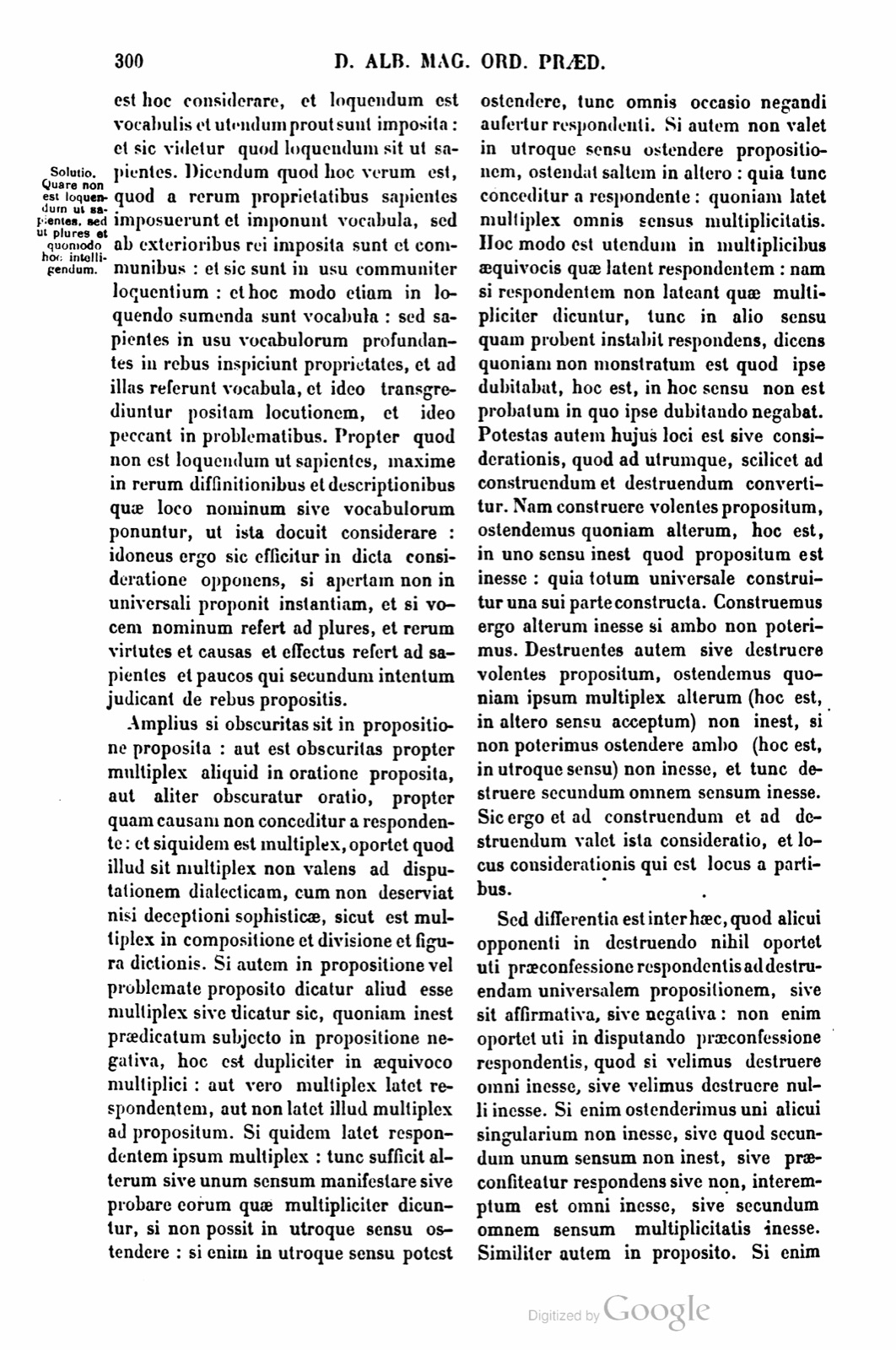
Dicendum quod hoc verum est, quod a rerum proprietatibus sapientes imposuerunt et imponunt vocabula, sed ab exterioribus rei imposita sunt et communibus: et sic sunt in usu communiter loquentium: et hoc modo etiam in loquendo sumenda sunt vocabula: sed sapientes in usu vocabulorum profundantes in rebus inspiciunt proprietates, et ad illas referunt vocabula, et ideo transgrediuntur positam locutionem, et ideo peccant in problematibus. Propter quod non est loquendum ut sapientes, maxime in rerum diffinitionibus et descriptionibus quae loco nominum sive vocabulorum ponuntur, ut ista docuit considerare: idoneus ergo sic efficitur in dicta consideratione opponens, si apertam non in universali proponit instantiam, et si vocem nominum refert ad plures, et rerum virtutes et causas et effectus refert ad sapientes et paucos qui secundum intentum judicant de rebus propositis.
Amplius si obscuritas sit in propositione proposita: aut est obscuritas propter multiplex aliquid in oratione proposita, aut aliter obscuratur oratio, propter quam causam non conceditur a respondente: et siquidem est multiplex, oportet quod illud sit multiplex non valens ad disputationem dialecticam, cum non deserviat nisi deceptioni sophisticae, sicut est multiplex in compositione et divisione et figura dictionis. Si autem in propositione vel problemate proposito dicatur aliud esse multiplex sive dicatur sic, quoniam inest praedicatum subjecto in propositione negativa, hoc est dupliciter in aequivoco multiplici: aut vero multiplex latet respondentem, aut non latet illud multiplex ad propositum. Si quidem latet respondentem ipsum multiplex: tunc sufficit alterum sive unum sensum manifestare sive probare eorum quae multipliciter dicuntur, si non possit in utroque sensu ostendere: si enim in utroque sensu potest ostendere, tunc omnis occasio negandi aufertur respondenti. Si autem non valet in utroque sensu ostendere propositionem, ostendat saltem in altero: quia tunc conceditur a respondente: quoniam latet multiplex omnis sensus multiplicitatis. Hoc modo est utendum in multiplicibus aequivocis quae latent respondentem: nam si respondentem non lateant quae multipliciter dicuntur, tunc in alio sensu quam probent instabit respondens, dicens quoniam non monstratum est quod ipse dubitabat, hoc est, in hoc sensu non est probatum in quo ipse dubitando negabat.
Potestas autem hujus loci est sive considerationis, quod ad utrumque, scilicet ad construendum et destruendum convertitur. Nam construere volentes propositum, ostendemus quoniam alterum, hoc est, in uno sensu inest quod propositum est inesse: quia totum universale construitur una sui parte constructa. Construemus ergo alterum inesse si ambo non poterimus. Destruentes autem sive destruere volentes propositum, ostendemus quoniam ipsum multiplex alterum, hoc est, in altero sensu acceptum, non inest, si non poterimus ostendere ambo, hoc est, in utroque sensu, non inesse, et tunc destruere secundum omnem sensum inesse. Sic ergo et ad construendum et ad destruendum valet ista consideratio, et locus considerationis qui est locus a partibus.
Sed differentia est inter haec, quod alicui opponenti in destruendo nihil oportet uti praeconfessione respondentis ad destruendam universalem propositionem, sive sit affirmativa, sive negativa: non enim oportet uti in disputando praeconfessione respondentis, quod si velimus destruere omni inesse, sive velimus destruere nulli inesse. Si enim ostenderimus uni alicui singularium non inesse, sive quod secundum unum sensum non inest, sive praeconfiteatur respondens sive non, interemptum est omni inesse, sive secundum omnem sensum multiplicitatis inesse. Similiter autem in proposito. Si enim
It must be said that this is true, that the wise have imposed and do impose words from the properties of things, but they were imposed from the exterior and common things of the thing; and thus they are in the use of those commonly speaking, and in this way also words must be taken in speaking. But the wise, going deeply into things in the use of words, inspect the properties and refer the words to those, and therefore they transgress the posited locution, and therefore they sin in problems. On account of this one must not speak as the wise, especially in definitions and descriptions of things which are put in place of names or words, as this consideration has taught. Therefore the opponent is made suitable in the said consideration in this way: if he proposes an evident instance, not in the universal, and if he refers the voice of names to the many, and refers the powers and causes and effects of things to the wise and the few, who judge concerning the proposed things according to intention.
Further, if there is obscurity in the proposed proposition, either the obscurity is on account of something multiple in the proposed speech, or the speech is obscured otherwise, for which cause it is not conceded by the respondent. And if indeed it is multiple, it must be a multiple that is not valid for dialectical disputation, since it serves only sophistical deception, as is the multiple in composition and division and figure of diction. But if in the proposed proposition or problem something else is said to be multiple, or if it is said thus, that the predicate is in the subject in a negative proposition, this is twofold in an equivocal multiple: either the multiple is hidden from the respondent, or that multiple is not hidden with respect to the proposed point. If indeed the multiple itself is hidden from the respondent, then it suffices to manifest or prove one or one sense of the things that are said multiply, if one cannot show it in both senses. For if he can show it in both senses, then every occasion of denying is taken away from the respondent. But if he is not able to show the proposition in both senses, let him show it at least in the other; because then it is conceded by the respondent, since every sense of the multiplicity of the multiple is hidden. This is the way one must use equivocal multiples that are hidden from the respondent; for if the things said multiply are not hidden from the respondent, then the respondent will object in another sense than the one they prove, saying that what he was doubting has not been shown, that is, that it has not been proved in the sense in which he, doubting, was denying.
But the power of this locus or consideration is that it is converted to both, namely to constructing and destroying. For when we wish to construct the proposed point, we shall show that the other, that is, in one sense, is in, what has been proposed to be in, because the whole universal is constructed when one of its parts has been constructed. Therefore we shall construct that the other is in if we cannot construct both. But when destroying, or wishing to destroy, the proposed point, we shall show that the multiple itself, in the other, that is, accepted in the other sense, is not in, if we cannot show that both, that is, in each sense, are not in, and then we destroy being-in according to every sense. Thus therefore this consideration is valid both for constructing and for destroying, and the locus of the consideration is the locus from parts.
But the difference is between these, that in destroying a universal proposition an opponent need not use any prior confession of the respondent, whether the proposition is affirmative or negative. For in disputing one need not use the respondent's prior confession that if we wish to destroy belonging to every one, or if we wish to destroy belonging to no one. For if we have shown that it is not in any one singular, or that according to one sense it is not in, whether the respondent confesses it beforehand or not, being-in to every one is destroyed, or being-in according to every sense of multiplicity. Similarly also in the proposed matter. For if
If a page does not appear, its photograph has not been uploaded yet.