Volume 2 · pp. 295–298
CHAPTERS II-III. On the accidental predicate and on sufficiently enumerated parts.
A marker with ≈ is an approximate page boundary, placed by measure of the text; the page photographs remain the authority. In the paired views, clicking a page marker brings that page into view.
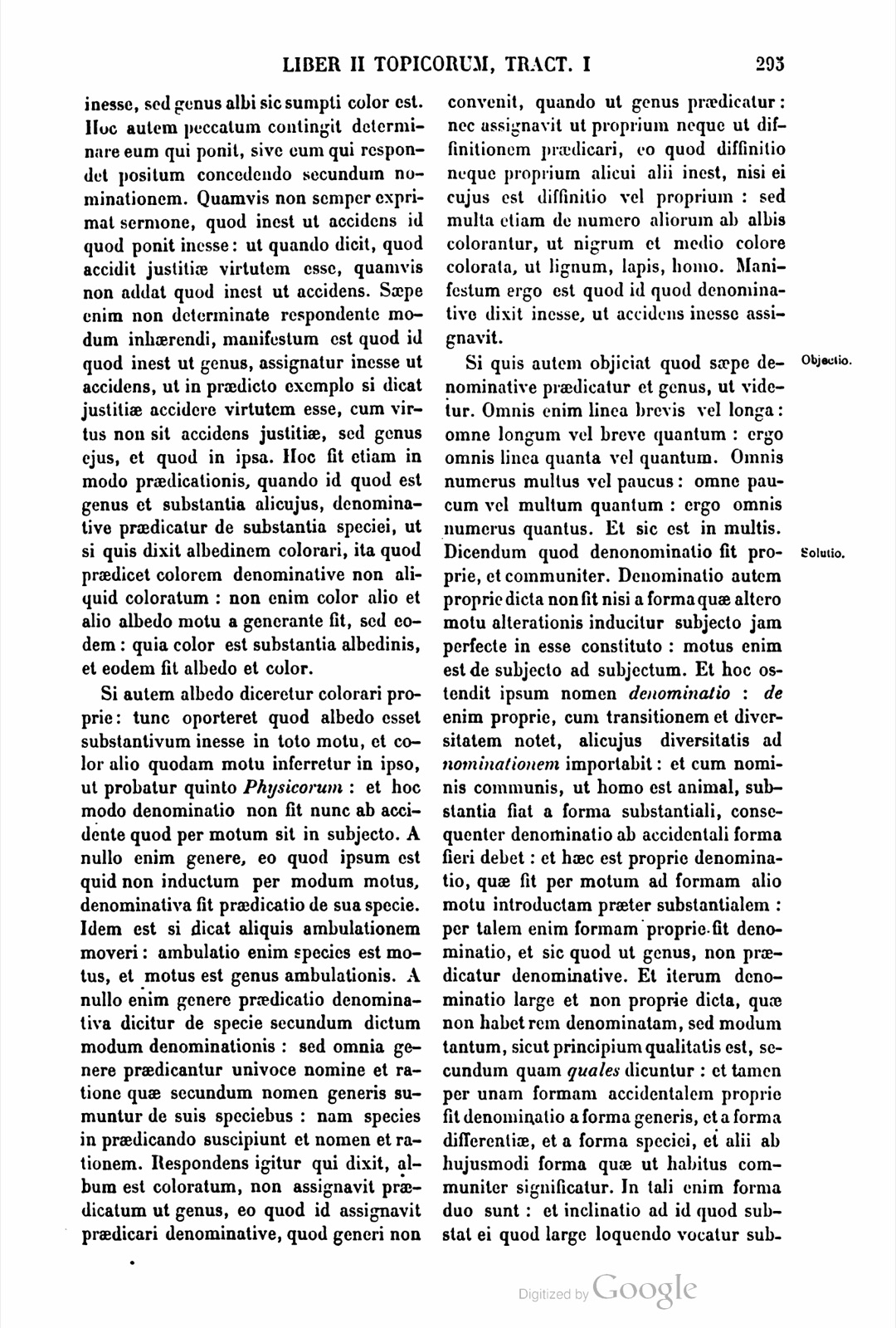
inesse, sed genus albi sic sumpti color est. Hoc autem peccatum contingit determinare eum qui ponit, sive eum qui respondet positum concedendo secundum nominationem. Quamvis non semper exprimat sermone, quod inest ut accidens id quod ponit inesse: ut quando dicit, quod accidit justitiae virtutem esse, quamvis non addat quod inest ut accidens. Saepe enim non determinate respondente modum inhaerendi, manifestum est quod id quod inest ut genus, assignatur inesse ut accidens, ut in praedicto exemplo si dicat justitiae accidere virtutem esse, cum virtus non sit accidens justitiae, sed genus ejus, et quod in ipsa. Hoc fit etiam in modo praedicationis, quando id quod est genus et substantia alicujus, denominative praedicatur de substantia speciei, ut si quis dixit albedinem colorari, ita quod praedicet colorem denominative non aliquid coloratum: non enim color alio et alio albedo motu a generante fit, sed eodem: quia color est substantia albedinis, et eodem fit albedo et color.
Si autem albedo diceretur colorari proprie: tunc oporteret quod albedo esset substantivum inesse in toto motu, et color alio quodam motu inferretur in ipso, ut probatur quinto Physicorum: et hoc modo denominatio non fit nunc ab accidente quod per motum sit in subjecto. A nullo enim genere, eo quod ipsum est quid non inductum per modum motus, denominativa fit praedicatio de sua specie. Idem est si dicat aliquis ambulationem moveri: ambulatio enim species est motus, et motus est genus ambulationis. A nullo enim genere praedicatio denominativa dicitur de specie secundum dictum modum denominationis: sed omnia genere praedicantur univoce nomine et ratione quae secundum nomen generis sumuntur de suis speciebus: nam species in praedicando suscipiunt et nomen et rationem. Respondens igitur qui dixit, album est coloratum, non assignavit praedicatum ut genus, eo quod id assignavit praedicari denominative, quod generi non convenit, quando ut genus praedicatur: nec assignavit ut proprium neque ut diffinitionem praedicari, eo quod diffinitio neque proprium alicui alii inest, nisi ei cujus est diffinitio vel proprium: sed multa etiam de numero aliorum ab albis colorantur, ut nigrum et medio colore colorata, ut lignum, lapis, homo. Manifestum ergo est quod id quod denominative dixit inesse, ut accidens inesse assignavit.
[Marginal label, printed page 295: Objectio.]
Si quis autem objiciat quod saepe denominative praedicatur et genus, ut videtur. Omnis enim linea brevis vel longa: omne longum vel breve quantum: ergo omnis linea quanta vel quantum. Omnis numerus multus vel paucus: omne paucum vel multum quantum: ergo omnis numerus quantus. Et sic est in multis.
[Marginal label, printed page 295: Solutio.]
Dicendum quod denominatio fit proprie, et communiter. Denominatio autem proprie dicta non fit nisi a forma quae altero motu alterationis inducitur subjecto jam perfecte in esse constituto: motus enim est de subjecto ad subjectum. Et hoc ostendit ipsum nomen denominatio: de enim proprie, cum transitionem et diversitatem notet, alicujus diversitatis ad nominationem importabit: et cum nominis communis, ut homo est animal, substantia fiat a forma substantiali, consequenter denominatio ab accidentali forma fieri debet: et haec est proprie denominatio, quae fit per motum ad formam alio motu introductam praeter substantialem: per talem enim formam proprie fit denominatio, et sic quod ut genus, non praedicatur denominative. Et iterum denominatio large et non proprie dicta, quae non habet rem denominatam, sed modum tantum, sicut principium qualitatis est, secundum quam quales dicuntur: et tamen per unam formam accidentalem proprie fit denominatio a forma generis, et a forma differentiae, et a forma speciei, et alii ab hujusmodi forma quae ut habitus communiter significatur. In tali enim forma duo sunt: et inclinatio ad id quod substat ei quod large loquendo vocatur subjectum, et quo est dispositio ad actum vel finem: et quoad primum substantialis forma constituit subjectum, et quoad secundum est dispositio ipsius, quae habet modum qualitatis, et ab hac accipit modum denominationis, ut cum dicitur homo humanus qui humana agit, et animalis homo qui totaliter suas prosequitur concupiscentias, et sic de aliis. Et linea dicitur esse faciens quantitatis dimensionem, et breve et longum hoc modo quanta dicuntur: et hoc modo unitas dicitur una, quia facit actum unitatis in unitate sicut in aliis, facit enim eam in se indivisam, et ab illis divisam: et hoc modo dicitur unitas una, et bonitas bona. Et in talibus, ut diximus, non est vera denominatio, sed modus denominationis. Hoc tamen modo non dicitur albedo alba, et scientia sciens, vel sapientia sapiens: quia tales formae accidentales non habent talem differentiae respectum ad subjectum, et ad actum vel finem per inclinationem ad subjectum non constituunt subjectum, sed constituuntur ab eo: et ideo sunt dispositiones ad actum vel finem respicientes: propter quod non ita reflectuntur in seipsis denominative. Et haec est vera solutio dubitationis, quamvis quidam aliter dicant, de quorum dictis non est curandum.
but the genus of white so taken is color. But this fault happens to determine the one who posits, or the one who responds by conceding what has been posited according to naming, although he does not always express in speech that what he posits to be in is in as accident; as when he says that it happens to justice to be virtue, although he does not add that it is in as accident. For often, when the respondent does not determinately state the mode of inhering, it is manifest that what is in as genus is assigned to be in as accident, as in the aforesaid example if he says that it happens to justice to be virtue, since virtue is not an accident of justice, but its genus and that which is in it. This also happens in the mode of predication, when that which is the genus and substance of something is predicated denominatively of the substance of the species, as if someone said that whiteness is colored, so that he predicates color denominatively and not something colored; for color is not made by one motion and whiteness by another from the generator, but by the same motion, because color is the substance of whiteness, and by the same motion whiteness and color come to be.
But if whiteness were properly said to be colored, then whiteness would have to be substantive being-in throughout the whole motion, and color would be brought into it by some other motion, as is proved in the fifth book of the Physics; and in this way denomination is not now made from an accident that is in a subject through motion. For from no genus, because it is a what, not introduced by way of motion, is denominative predication made of its species. It is the same if someone says that walking is moved; for walking is a species of motion, and motion is the genus of walking. For denominative predication is said from no genus of a species according to the stated mode of denomination; but all things are predicated by genus univocally in name and account, which according to the name of the genus are taken of their species; for species in predication receive both the name and the account. Therefore the respondent who said, white is colored, did not assign the predicate as genus, because he assigned that to be predicated denominatively, which does not belong to a genus when it is predicated as genus; nor did he assign it to be predicated as proper or as definition, because definition or proper is not in anything else except that of which it is definition or proper. But many things also from the number of things other than white things are colored, as black and things colored with a middle color, as wood, stone, and a human being. Therefore it is manifest that what he said to be in denominatively, he assigned to be in as accident.
[Marginal label, printed page 295: Objection.]
But if someone objects that often even genus is predicated denominatively, as it seems. For every line is short or long; everything long or short is quantitative; therefore every line is quantified or a quantum. Every number is many or few; everything few or many is quantitative; therefore every number is quantified. And so it is in many cases.
[Marginal label, printed page 295: Solution.]
It must be said that denomination is made properly and commonly. But denomination properly said is made only from a form that is introduced by another motion of alteration into a subject already perfectly constituted in being; for motion is from subject to subject. And the name denomination itself shows this: for de properly, since it notes transition and diversity, will import some diversity toward naming. And since the substance of a common name, as when a human being is an animal, is made from a substantial form, consequently denomination ought to be made from an accidental form; and this is denomination properly, which is made through motion to a form introduced by another motion besides the substantial form. For by such a form denomination is properly made, and thus what is as genus is not predicated denominatively. And again there is denomination said broadly and not properly, which does not have a denominated thing, but only a mode, as the principle of quality is that according to which things are called qualified; and nevertheless through one accidental form denomination is properly made from the form of genus, and from the form of difference, and from the form of species, and other things from a form of this kind which is commonly signified as habit. For in such a form there are two things: both an inclination to that which underlies what, broadly speaking, is called subject, and that by which there is disposition to act or end. And as to the first, the substantial form constitutes the subject; and as to the second, it is the disposition of the subject, which has the mode of quality, and from this it receives the mode of denomination, as when a human being is called human who does human things, and an animal-like human being who wholly pursues his concupiscences, and so concerning others. And line is said to be making the dimension of quantity, and short and long are in this way called quanta; and in this way unity is called one, because it makes the act of unity in unity as in other things, for it makes it undivided in itself and divided from those things; and in this way unity is called one and goodness good. And in such things, as we have said, there is not true denomination, but a mode of denomination. Yet in this way whiteness is not called white, nor knowledge knowing, or wisdom wise, because such accidental forms do not have such a respect of difference to subject, and to act or end through inclination to the subject they do not constitute the subject, but are constituted by it; and therefore they are dispositions looking toward act or end. On account of this they are not reflected back upon themselves denominatively in that way. And this is the true solution of the doubt, although certain persons speak otherwise, concerning whose sayings one should not care.
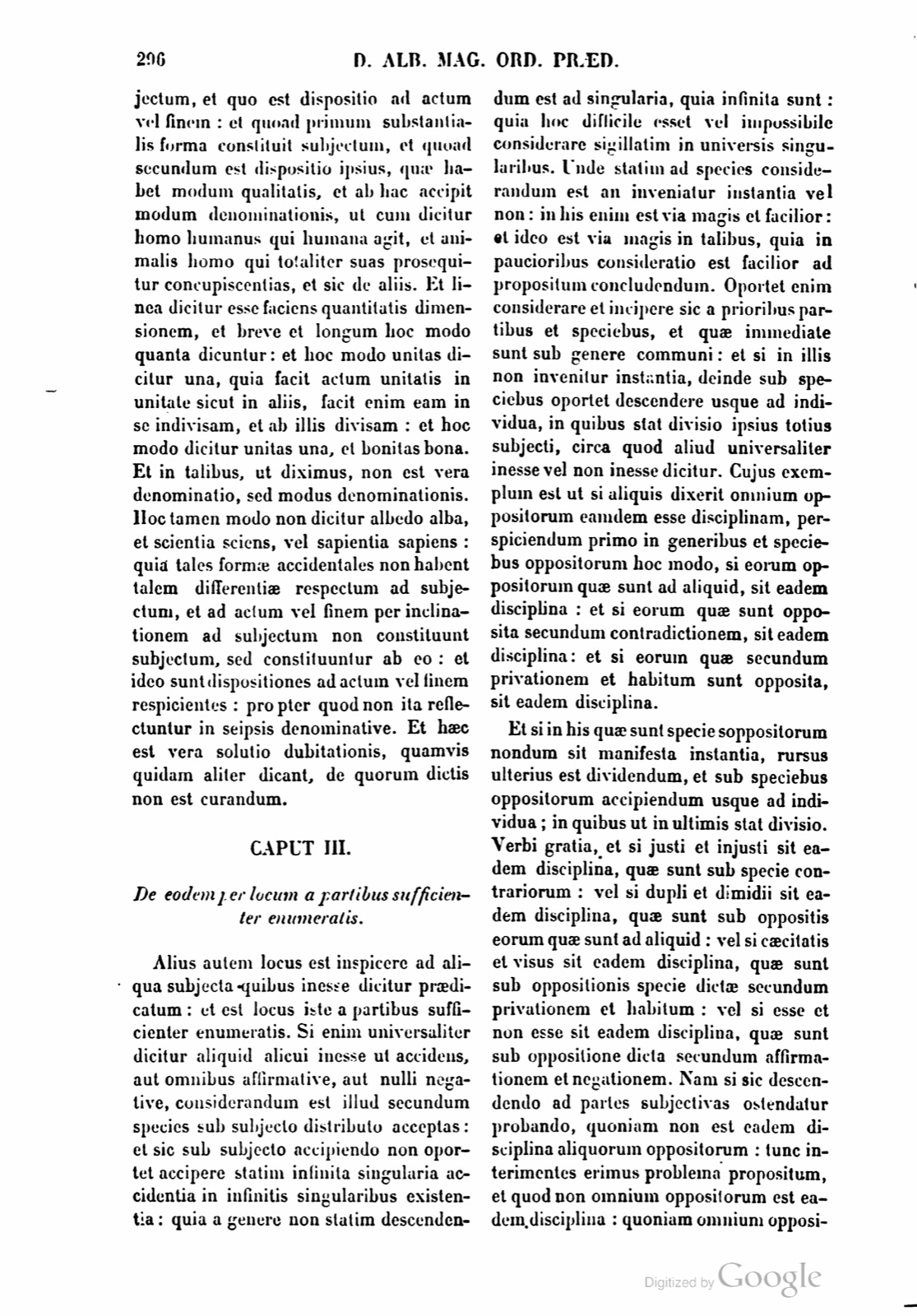
CAPUT III.
De eodem per locum a partibus sufficienter enumeratis.
Alius autem locus est inspicere ad aliqua subjecta quibus inesse dicitur praedicatum: et est locus iste a partibus sufficienter enumeratis. Si enim universaliter dicitur aliquid alicui inesse ut accidens, aut omnibus affirmative, aut nulli negative, considerandum est illud secundum species sub subjecto distributo acceptas: et sic sub subjecto accipiendo non oportet accipere statim infinita singularia accidentia in infinitis singularibus existentia: quia a genere non statim descendendum est ad singularia, quia infinita sunt: quia hoc difficile esset vel impossibile considerare sigillatim in universis singularibus. Unde statim ad species considerandum est an inveniatur instantia vel non: in his enim est via magis et facilior: et ideo est via magis in talibus, quia in paucioribus consideratio est facilior ad propositum concludendum. Oportet enim considerare et incipere sic a prioribus partibus et speciebus, et quae immediate sunt sub genere communi: et si in illis non invenitur instantia, deinde sub speciebus oportet descendere usque ad individua, in quibus stat divisio ipsius totius subjecti, circa quod aliud universaliter inesse vel non inesse dicitur. Cujus exemplum est ut si aliquis dixerit omnium oppositorum eamdem esse disciplinam, perspiciendum primo in generibus et speciebus oppositorum hoc modo, si eorum oppositorum quae sunt ad aliquid, sit eadem disciplina: et si eorum quae sunt opposita secundum contradictionem, sit eadem disciplina: et si eorum quae secundum privationem et habitum sunt opposita, sit eadem disciplina.
CHAPTER III.
On the same matter through the locus from sufficiently enumerated parts.
But another locus is to inspect certain subjects in which the predicate is said to be in; and this locus is from sufficiently enumerated parts. For if something is said universally to be in something as accident, either in all affirmatively or in none negatively, it must be considered according to the species accepted under the distributed subject; and thus, in accepting things under the subject, one must not at once accept infinite singular accidents existing in infinite singulars, because from a genus one must not at once descend to singulars, since they are infinite, because this would be difficult or impossible to consider one by one in all singulars. Hence at once one must consider according to species whether an instance is found or not; for in these the way is better and easier, and therefore the way is better in such things, because consideration among fewer things is easier for concluding the proposed point. For one must consider and begin thus from the prior parts and species, and those which are immediately under the common genus; and if an instance is not found in those, then under the species one must descend all the way to individuals, in which the division of that whole subject stands, concerning which something else is universally said to be in or not to be in. An example is this: if someone said that there is the same discipline of all opposites, one must first look in the genera and species of opposites in this way, whether there is the same discipline of those opposites that are relative to something; and whether there is the same discipline of those that are opposed according to contradiction; and whether there is the same discipline of those that are opposed according to privation and habit.
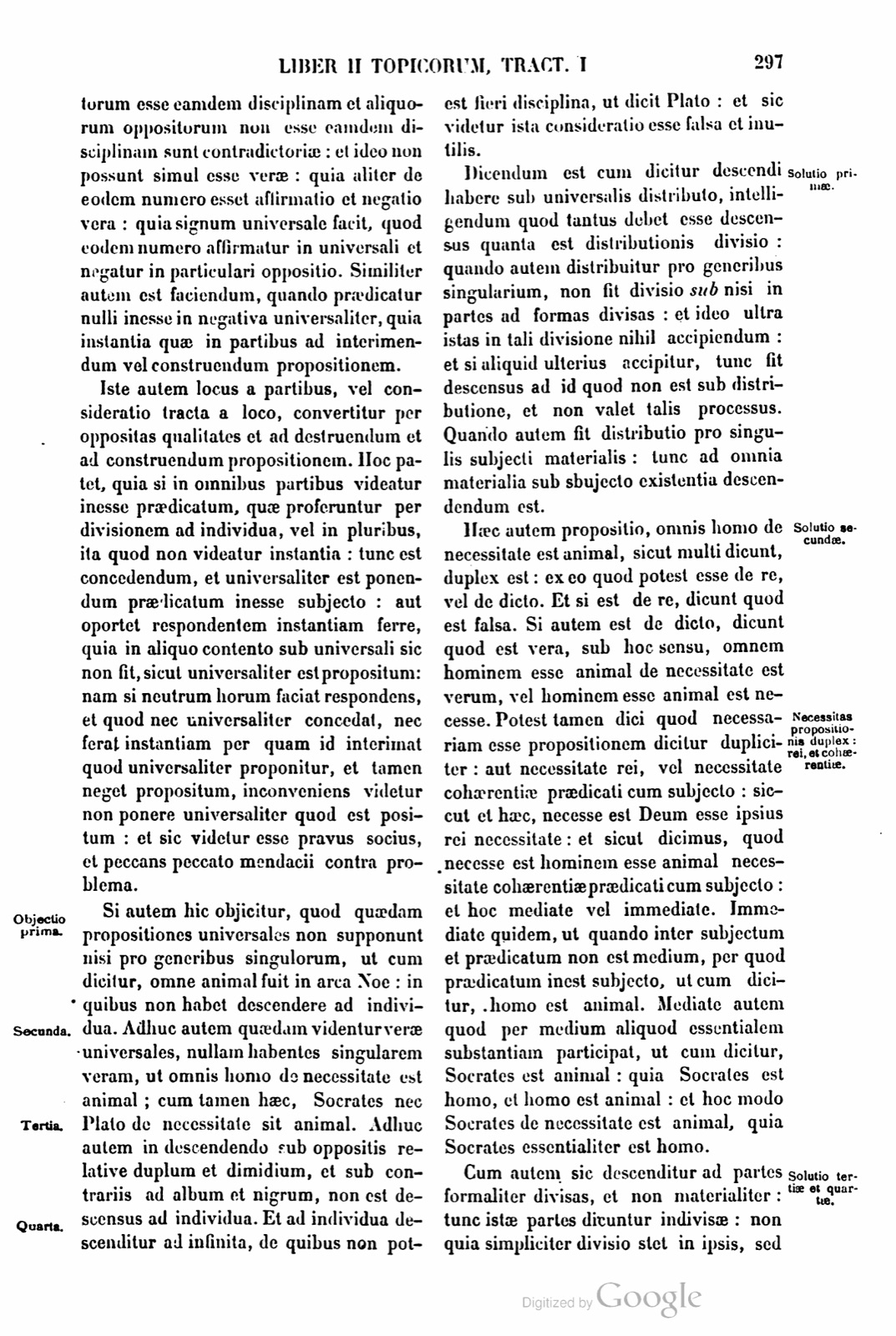
Et si in his quae sunt specie oppositorum nondum sit manifesta instantia, rursus ulterius est dividendum, et sub speciebus oppositorum accipiendum usque ad individua, in quibus ut in ultimis stat divisio. Verbi gratia, et si justi et injusti sit eadem disciplina, quae sunt sub specie contrariorum: vel si dupli et dimidii sit eadem disciplina, quae sunt sub oppositis eorum quae sunt ad aliquid: vel si caecitatis et visus sit eadem disciplina, quae sunt sub oppositionis specie dictae secundum privationem et habitum: vel si esse et non esse sit eadem disciplina, quae sunt sub oppositione dicta secundum affirmationem et negationem. Nam si sic descendendo ad partes subjectivas ostendatur probando, quoniam non est eadem disciplina aliquorum oppositorum: tunc interimentes erimus problema propositum, et quod non omnium oppositorum est eadem disciplina: quoniam omnium oppositorum esse eamdem disciplinam et aliquorum oppositorum non esse eamdem disciplinam sunt contradictoriae: et ideo non possunt simul esse verae: quia aliter de eodem numero esset affirmatio et negatio vera: quia signum universale facit, quod eodem numero affirmatur in universali et negatur in particulari oppositio. Similiter autem est faciendum, quando praedicatur nulli inesse in negativa universaliter, quia instantia quae in partibus ad interimendum vel construendum propositionem.
Iste autem locus a partibus, vel consideratio tracta a loco, convertitur per oppositas qualitates et ad destruendum et ad construendum propositionem. Hoc patet, quia si in omnibus partibus videatur inesse praedicatum, quae proferuntur per divisionem ad individua, vel in pluribus, ita quod non videatur instantia: tunc est concedendum, et universaliter est ponendum praedicatum inesse subjecto: aut oportet respondentem instantiam ferre, quia in aliquo contento sub universali sic non fit, sicut universaliter est propositum: nam si neutrum horum faciat respondens, et quod nec universaliter concedat, nec ferat instantiam per quam id interimat quod universaliter proponitur, et tamen neget propositum, inconveniens videtur non ponere universaliter quod est positum: et sic videtur esse pravus socius, et peccans peccato mendacii contra problema.
[Marginal label, printed page 297: Objectio prima.]
And if in these things that are species of opposites an instance is not yet manifest, again it must be divided further, and things must be accepted under the species of opposites all the way to individuals, in which division stands as in ultimates. For example, whether there is the same discipline of the just and the unjust, which are under the species of contraries; or whether there is the same discipline of double and half, which are under the opposites of those things which are relative to something; or whether there is the same discipline of blindness and sight, which are under the species of opposition stated according to privation and habit; or whether there is the same discipline of being and not-being, which are under opposition stated according to affirmation and negation. For if, by thus descending to subjective parts, it is shown by proving that there is not the same discipline of some opposites, then we shall be destroying the proposed problem, and the proposition that there is not the same discipline of all opposites, because for all opposites to have the same discipline and for some opposites not to have the same discipline are contradictories; and therefore they cannot be true at the same time, because otherwise concerning the same number there would be a true affirmation and a true negation, because the universal sign makes the opposition such that the same number is affirmed in the universal and denied in the particular. Similarly one must act when being-in is predicated of none in a universal negative, because there is an instance in the parts for destroying or constructing the proposition.
But this locus from parts, or the consideration drawn from the locus, is converted by opposite qualities both for destroying and for constructing a proposition. This is plain, because if the predicate seems to be in all the parts that are brought forward through division down to individuals, or in more of them, so that no instance appears, then it must be conceded, and the predicate must be posited universally to be in the subject; or the respondent must bring an instance, because in something contained under the universal it does not happen as it is universally proposed. For if the respondent does neither of these, and neither concedes universally nor brings an instance by which he destroys what is universally proposed, and nevertheless denies the proposed point, it seems unfitting not to posit universally what has been posited; and thus he seems to be a depraved companion and one sinning by the fault of falsehood against the problem.
[Marginal label, printed page 297: First objection.]
Si autem hic objicitur, quod quaedam propositiones universales non supponunt nisi pro generibus singulorum, ut cum dicitur, omne animal fuit in arca Noe: in quibus non habet descendere ad individua.
[Marginal label, printed page 297: Secunda.]
Adhuc autem quaedam videntur verae universales, nullam habentes singularem veram, ut omnis homo de necessitate est animal; cum tamen haec, Socrates nec Plato de necessitate sit animal.
[Marginal label, printed page 297: Tertia.]
Adhuc autem in descendendo sub oppositis relative duplum et dimidium, et sub contrariis ad album et nigrum, non est descensus ad individua.
[Marginal label, printed page 297: Quarta.]
Et ad individua descenditur ad infinita, de quibus non potest fieri disciplina, ut dicit Plato: et sic videtur ista consideratio esse falsa et inutilis.
[Marginal label, printed page 297: Solutio prima.]
Dicendum est cum dicitur descendi habere sub universalis distributo, intelligendum quod tantus debet esse descensus quanta est distributionis divisio: quando autem distribuitur pro generibus singularium, non fit divisio sub nisi in partes ad formas divisas: et ideo ultra istas in tali divisione nihil accipiendum: et si aliquid ulterius accipitur, tunc fit descensus ad id quod non est sub distributione, et non valet talis processus. Quando autem fit distributio pro singulis subjecti materialis: tunc ad omnia materialia sub subjecto existentia descendendum est.
[Marginal label, printed page 297: Solutio secunda.]
Haec autem propositio, omnis homo de necessitate est animal, sicut multi dicunt, duplex est: ex eo quod potest esse de re, vel de dicto. Et si est de re, dicunt quod est falsa. Si autem est de dicto, dicunt quod est vera, sub hoc sensu, omnem hominem esse animal de necessitate est verum, vel hominem esse animal est necesse.
[Marginal label, printed page 297: Necessitas propositionis duplex: rei, et cohaerentiae.]
Potest tamen dici quod necessariam esse propositionem dicitur dupliciter: aut necessitate rei, vel necessitate cohaerentiae praedicati cum subjecto: sicut et haec, necesse est Deum esse ipsius rei necessitate: et sicut dicimus, quod necesse est hominem esse animal necessitate cohaerentiae praedicati cum subjecto: et hoc mediate vel immediate. Immediate quidem, ut quando inter subjectum et praedicatum non est medium, per quod praedicatum inest subjecto, ut cum dicitur, homo est animal. Mediate autem quod per medium aliquod essentialem substantiam participat, ut cum dicitur, Socrates est animal: quia Socrates est homo, et homo est animal: et hoc modo Socrates de necessitate est animal, quia Socrates essentialiter est homo.
[Marginal label, printed page 297: Solutio tertiae et quartae.]
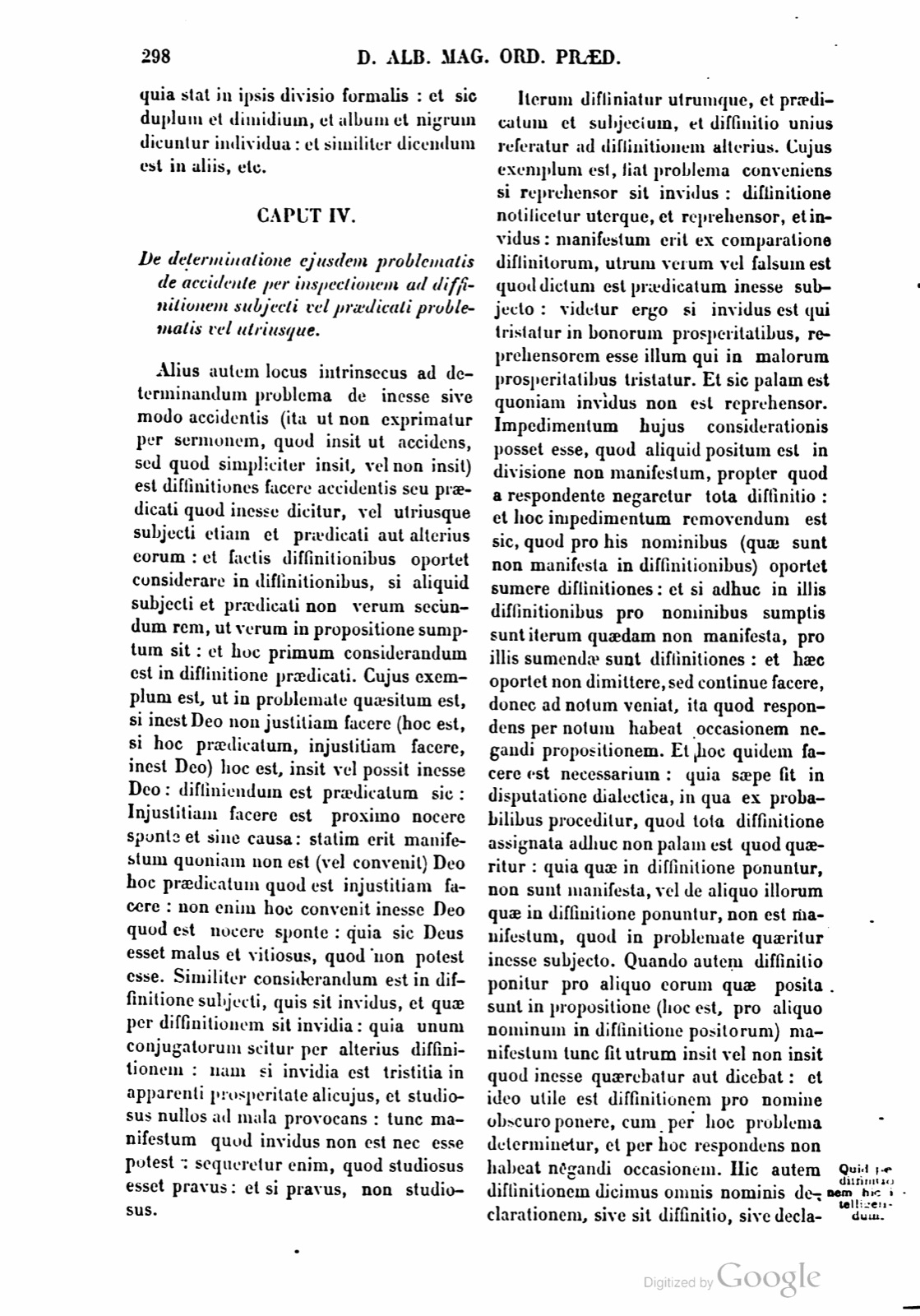
Cum autem sic descenditur ad partes formaliter divisas, et non materialiter: tunc istae partes dicuntur indivisae: non quia simpliciter divisio stet in ipsis, sed quia stat in ipsis divisio formalis: et sic duplum et dimidium, et album et nigrum dicuntur individua: et similiter dicendum est in aliis, etc.
But if it is objected here that certain universal propositions suppose only for the genera of singulars, as when it is said, every animal was in Noah's ark; in these one does not have to descend to individuals.
[Marginal label, printed page 297: Second.]
Furthermore, certain propositions seem to be true universals while having no true singular, as every human being is of necessity an animal; and nevertheless this is not true, that Socrates or Plato of necessity is an animal.
[Marginal label, printed page 297: Third.]
Furthermore, in descending under opposites relatively, double and half, and under contraries to white and black, there is no descent to individuals.
[Marginal label, printed page 297: Fourth.]
And one descends to individuals to infinite things, concerning which there cannot be discipline, as Plato says; and thus that consideration seems to be false and useless.
[Marginal label, printed page 297: First solution.]
It must be said, when it is said that one descends to have under a distributed universal, that it must be understood that the descent ought to be as great as the division of the distribution is. But when it is distributed for the genera of singulars, division under it is made only into parts according to divided forms; and therefore beyond these nothing is to be accepted in such a division; and if something further is accepted, then there is a descent to that which is not under the distribution, and such a process is not valid. But when distribution is made for individual things of the material subject, then one must descend to all material things existing under the subject.
[Marginal label, printed page 297: Second solution.]
But this proposition, every human being is of necessity an animal, as many say, is twofold, from the fact that it can be about the thing or about the saying. And if it is about the thing, they say that it is false. But if it is about the saying, they say that it is true, under this sense: for every human being to be an animal is true of necessity, or a human being to be an animal is necessary.
[Marginal label, printed page 297: The necessity of a proposition is twofold: of the thing, and of coherence.]
Nevertheless it can be said that a proposition is said to be necessary in two ways: either by necessity of the thing, or by necessity of the coherence of the predicate with the subject; as also this, it is necessary that God is, by the necessity of the thing itself; and as we say that it is necessary for a human being to be an animal by the necessity of the coherence of the predicate with the subject. And this is mediately or immediately. Immediately, indeed, as when between subject and predicate there is no middle through which the predicate is in the subject, as when it is said, a human being is an animal. Mediately, however, when through some middle it participates in essential substance, as when it is said, Socrates is an animal, because Socrates is a human being and a human being is an animal; and in this way Socrates is of necessity an animal, because Socrates is essentially a human being.
[Marginal label, printed page 297: Solution of the third and fourth.]
But when descent is thus made to parts formally divided and not materially, then those parts are called undivided, not because division simply stands in them, but because formal division stands in them; and thus double and half, and white and black, are called individuals; and similarly one must speak in other cases, and so forth.
If a page does not appear, its photograph has not been uploaded yet.