Volume 2 · pp. 293–294
CHAPTERS I-II. On the things to be avoided and on the intrinsic locus with respect to the predicate.
A marker with ≈ is an approximate page boundary, placed by measure of the text; the page photographs remain the authority. In the paired views, clicking a page marker brings that page into view.
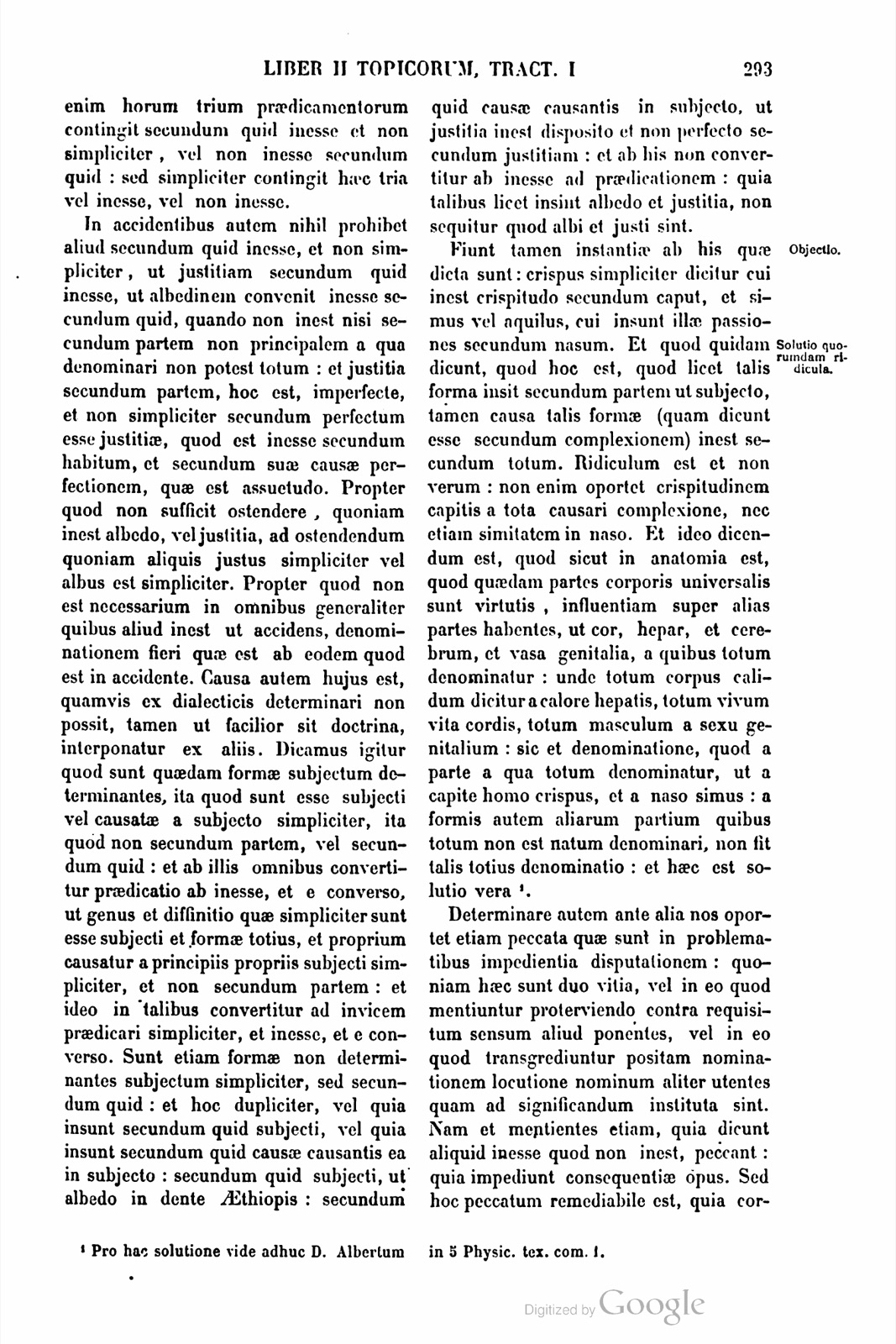
enim horum trium praedicamentorum quid contingit secundum quid inesse et non simpliciter, vel non inesse secundum quid: sed simpliciter contingit haec tria vel inesse, vel non inesse.
In accidentibus autem nihil prohibet aliud secundum quid inesse, et non simpliciter, ut justitiam secundum quid inesse, ut albedinem convenit inesse secundum quid, quando non inest nisi secundum partem non principalem a qua denominari non potest totum: et justitia secundum partem, hoc est, imperfecte, et non simpliciter secundum perfectum esse justitiae, quod est inesse secundum habitum, et secundum suae causae perfectionem, quae est assuetudo. Propter quod non sufficit ostendere, quoniam inest albedo, vel justitia, ad ostendendum quoniam aliquis justus simpliciter vel albus est simpliciter. Propter quod non est necessarium in omnibus generaliter quibus aliud inest ut accidens, denominationem fieri quae est ab eodem quod est in accidente. Causa autem hujus est, quamvis ex dialecticis determinari non possit, tamen ut facilior sit doctrina, interponatur ex aliis. Dicamus igitur quod sunt quaedam formae subjectum determinantes, ita quod sunt esse subjecti vel causatae a subjecto simpliciter, ita quod non secundum partem, vel secundum quid: et ab illis omnibus convertitur praedicatio ab inesse, et e converso, ut genus et diffinitio quae simpliciter sunt esse subjecti et formae totius, et proprium causatur a principiis propriis subjecti simpliciter, et non secundum partem: et ideo in talibus convertitur ad invicem praedicari simpliciter, et inesse, et e converso. Sunt etiam formae non determinantes subjectum simpliciter, sed secundum quid: et hoc dupliciter, vel quia insunt secundum quid subjecti, vel quia insunt secundum quid causae causantis ea in subjecto: secundum quid subjecti, ut albedo in dente Aethiopis: secundum quid causae causantis in subjecto, ut justitia inest disposito et non perfecto secundum justitiam: et ab his non convertitur ab inesse ad praedicationem: quia talibus licet insint albedo et justitia, non sequitur quod albi et justi sint.
[Marginal label, printed page 293: Objectio.]
Fiunt tamen instantiae ab his quae dicta sunt: crispus simpliciter dicitur cui inest crispitudo secundum caput, et simus vel aquilus, cui insunt illae passiones secundum nasum.
[Marginal label, printed page 293: Solutio quorumdam ridicula.]
Et quod quidam dicunt, quod hoc est, quod licet talis forma insit secundum partem ut subjecto, tamen causa talis formae, quam dicunt esse secundum complexionem, inest secundum totum. Ridiculum est et non verum: non enim oportet crispitudinem capitis a tota causari complexione, nec etiam simitatem in naso. Et ideo dicendum est, quod sicut in anatomia est, quod quaedam partes corporis universalis sunt virtutis, influentiam super alias partes habentes, ut cor, hepar, et cerebrum, et vasa genitalia, a quibus totum denominatur: unde totum corpus calidum dicitur a calore hepatis, totum vivum vita cordis, totum masculum a sexu genitalium: sic et denominatione, quod a parte a qua totum denominatur, ut a capite homo crispus, et a naso simus: a formis autem aliarum partium quibus totum non est natum denominari, non fit talis totius denominatio: et haec est solutio vera 1.
Determinare autem ante alia nos oportet etiam peccata quae sunt in problematibus impedientia disputationem: quoniam haec sunt duo vitia, vel in eo quod mentiuntur proterviendo contra requisitum sensum aliud ponentes, vel in eo quod transgrediuntur positam nominationem locutione nominum aliter utentes quam ad significandum instituta sint. Nam et mentientes etiam, quia dicunt aliquid inesse quod non inest, peccant: quia impediunt consequentiae opus. Sed hoc peccatum remediabile est, quia corrigi potest disputative ducendo ad inconveniens respondentem mentientem. Et quia extraneis nominibus res, de quibus est sermo, appellant, ut qui hominem dicunt plantam propter proceritatem et spissionem. Et illud peccatum non est remediabile per disputationem, quia ex tropis et metaphoris nullus est processus syllogisticus: eo quod transgreditur positam locutionem sive nominationem: et peccatum mendacii est in voce relata ad rem: aliud vero est in sermone relato ad loquentem. Haec igitur duo peccata in problematibus cavenda sunt.
for of these three predicaments something happens to be in according to something and not simply, or not to be in according to something; but simply these three things happen either to be in or not to be in.
In accidents, however, nothing prevents one thing from being in according to something and not simply, as justice from being in according to something, as whiteness is fittingly said to be in according to something, when it is not in except according to a non-principal part from which the whole cannot be denominated; and justice according to a part, that is, imperfectly, and not simply according to the perfect being of justice, which is to be in according to habit, and according to the perfection of its cause, which is habituation. On account of this it does not suffice to show that whiteness or justice is in, for showing that someone is simply just or is simply white. On account of this it is not necessary generally in all things in which something else is in as accident, that denomination be made from the same thing that is in the accident. The cause of this, although it cannot be determined from dialectical matters, nevertheless, so that the teaching may be easier, should be inserted from other matters. Therefore let us say that there are certain forms determining the subject, so that they are the being of the subject or are caused by the subject simply, so that not according to a part or according to something; and from all these predication is converted from being-in, and conversely, as genus and definition, which simply are the being of the subject and forms of the whole, and a proper is caused by the proper principles of the subject simply and not according to a part; and therefore in such things to be predicated simply and to be in are mutually converted, and conversely. There are also forms that do not determine the subject simply, but according to something; and this in two ways, either because they are in according to something of the subject, or because they are in according to something of the cause causing them in the subject: according to something of the subject, as whiteness in the tooth of an Ethiopian; according to something of the cause causing in the subject, as justice is in one disposed and not perfected according to justice; and from these there is no conversion from being-in to predication, because although whiteness and justice are in such things, it does not follow that they are white and just.
[Marginal label, printed page 293: Objection.]
Nevertheless instances arise from the things that have been said: one is called curly simply in whom curliness is in according to the head, and snub-nosed or aquiline, in whom those passions are in according to the nose.
[Marginal label, printed page 293: The ridiculous solution of certain persons.]
And as to what certain persons say, that this is because, although such a form is in according to a part as in a subject, nevertheless the cause of such a form, which they say is according to complexion, is in according to the whole. This is ridiculous and not true; for it is not necessary that curliness of the head be caused by the whole complexion, nor also snubness in the nose. And therefore it must be said that, as in anatomy, there are certain parts of the universal body which are of power, having influence over the other parts, as the heart, liver, brain, and genital vessels, from which the whole is denominated; hence the whole body is called warm from the heat of the liver, the whole living from the life of the heart, the whole male from the sex of the genitals. So also in denomination: it is made from the part from which the whole is denominated, as a human being is curly from the head, and snub from the nose; but from the forms of other parts by which the whole is not naturally denominated, such a denomination of the whole is not made; and this is the true solution 1.
But before other things we must also determine the faults that are in problems and impede disputation, because these are two vices: either in this, that they lie obstinately by positing something else contrary to the required sense, or in this, that they transgress the posited naming by using a locution of names otherwise than they were established for signifying. For even those who lie, because they say that something is in which is not in, sin, because they impede the work of consequence. But this fault is remediable, because it can be corrected disputatively by leading the lying respondent to an impossibility. And because they call the things about which the speech is with alien names, as those who call a human being a plant because of height and thickness. And that fault is not remediable through disputation, because from tropes and metaphors there is no syllogistic process, since it transgresses the posited locution or naming; and the fault of falsehood is in the voice referred to the thing, but the other is in speech referred to the speaker. Therefore these two faults must be avoided in problems.
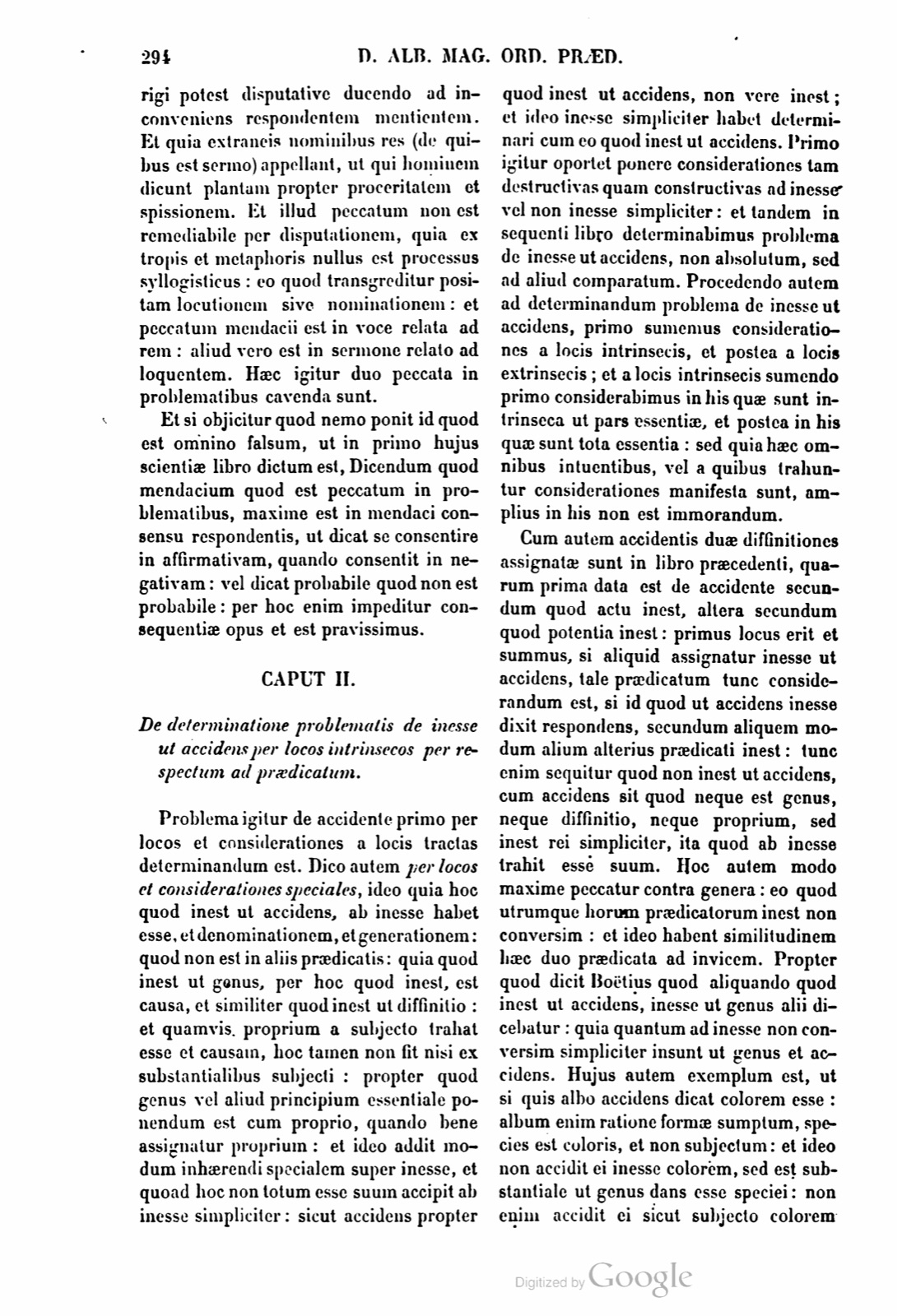
Et si objicitur quod nemo ponit id quod est omnino falsum, ut in primo hujus scientiae libro dictum est, dicendum quod mendacium quod est peccatum in problematibus, maxime est in mendaci consensu respondentis, ut dicat se consentire in affirmativam, quando consentit in negativam: vel dicat probabile quod non est probabile: per hoc enim impeditur consequentiae opus et est pravissimus.
CAPUT II.
De determinatione problematis de inesse ut accidens per locos intrinsecos per respectum ad praedicatum.
Problema igitur de accidente primo per locos et considerationes a locis tractas determinandum est. Dico autem per locos et considerationes speciales, ideo quia hoc quod inest ut accidens, ab inesse habet esse, et denominationem, et generationem: quod non est in aliis praedicatis: quia quod inest ut genus, per hoc quod inest, est causa, et similiter quod inest ut diffinitio: et quamvis, proprium a subjecto trahat esse et causam, hoc tamen non fit nisi ex substantialibus subjecti: propter quod genus vel aliud principium essentiale ponendum est cum proprio, quando bene assignatur proprium: et ideo addit modum inhaerendi specialem super inesse, et quoad hoc non totum esse suum accipit ab inesse simpliciter: sicut accidens propter quod inest ut accidens, non vere inest: et ideo inesse simpliciter habet determinari cum eo quod inest ut accidens. Primo igitur oportet ponere considerationes tam destructivas quam constructivas ad inesse vel non inesse simpliciter: et tandem in sequenti libro determinabimus problema de inesse ut accidens, non absolutum, sed ad aliud comparatum. Procedendo autem ad determinandum problema de inesse ut accidens, primo sumemus considerationes a locis intrinsecis, et postea a locis extrinsecis; et a locis intrinsecis sumendo primo considerabimus in his quae sunt intrinseca ut pars essentiae, et postea in his quae sunt tota essentia: sed quia haec omnibus intuentibus, vel a quibus trahuntur considerationes manifesta sunt, amplius in his non est immorandum.
Cum autem accidentis duae diffinitiones assignatae sunt in libro praecedenti, quarum prima data est de accidente secundum quod actu inest, altera secundum quod potentia inest: primus locus erit et summus, si aliquid assignatur inesse ut accidens, tale praedicatum tunc considerandum est, si id quod ut accidens inesse dixit respondens, secundum aliquem modum alium alterius praedicati inest: tunc enim sequitur quod non inest ut accidens, cum accidens sit quod neque est genus, neque diffinitio, neque proprium, sed inest rei simpliciter, ita quod ab inesse trahit esse suum. Hoc autem modo maxime peccatur contra genera: eo quod utrumque horum praedicatorum inest non conversim: et ideo habent similitudinem haec duo praedicata ad invicem. Propter quod dicit Boetius quod aliquando quod inest ut accidens, inesse ut genus alii dicebatur: quia quantum ad inesse non conversim simpliciter insunt ut genus et accidens. Hujus autem exemplum est, ut si quis albo accidens dicat colorem esse: album enim ratione formae sumptum, species est coloris, et non subjectum: et ideo non accidit ei inesse colorem, sed est substantiale ut genus dans esse speciei: non enim accidit ei sicut subjecto colorem
And if it is objected that no one posits what is altogether false, as was said in the first book of this science, it must be said that the lie which is a fault in problems is especially in the lying consent of the respondent, as when he says that he consents to the affirmative when he consents to the negative; or he says that what is not probable is probable; for through this the work of consequence is impeded, and he is most depraved.
CHAPTER II.
On the determination of the problem concerning being-in as accident through intrinsic loci with respect to the predicate.
Therefore the problem concerning accident must first be determined through loci and considerations drawn from loci. But I say through special loci and considerations, because that which is in as accident has being, denomination, and generation from being-in; this is not so in the other predicates, because what is in as genus is, through the fact that it is in, a cause, and similarly what is in as definition. And although a proper draws being and cause from the subject, nevertheless this happens only from the substantial things of the subject; on account of which genus or another essential principle must be posited together with the proper when the proper is well assigned; and therefore it adds a special mode of inhering over being-in, and as to this it does not receive its whole being from being-in simply, as an accident does, on account of which what is in as accident is not truly in; and therefore being-in simply has to be determined together with what is in as accident. Therefore first one must posit considerations, both destructive and constructive, for being-in or not being-in simply; and at length in the following book we shall determine the problem concerning being-in as accident, not absolutely, but compared to another thing. But in proceeding to determine the problem concerning being-in as accident, first we shall take considerations from intrinsic loci, and afterward from extrinsic loci; and, taking from intrinsic loci, first we shall consider in those things which are intrinsic as a part of the essence, and afterward in those things which are the whole essence. But because these things are manifest to all who look, or from which the considerations are drawn, one must not dwell further in them.
But since two definitions of accident were assigned in the preceding book, of which the first was given concerning accident according as it is actually in, the other according as it is potentially in, the first and highest locus will be this: if something is assigned to be in as accident, then such a predicate must be considered, namely whether that which the respondent said to be in as accident is in, according to some other mode, as another predicate. For then it follows that it is not in as accident, since accident is that which is neither genus, nor definition, nor proper, but is in a thing simply, so that it draws its being from being-in. But in this way one errs especially against genera, because each of these predicates is in non-conversely; and therefore these two predicates have likeness to one another. On account of this Boethius says that sometimes that which is in as accident was said by some to be being-in as genus, because as to being-in, genus and accident are in simply non-conversely. But an example of this is if someone says that color is an accident of white: for white, taken by reason of form, is a species of color and not a subject; and therefore color does not happen to be in it, but is substantial as a genus giving being to the species; for color does not happen to be in it as in a subject
Notes
- For this solution see also D. Albert in Physics V, text-comment 1. (Pro hac solutione vide adhuc D. Albertum in 5 Physic. tex. com. 1.) ↩
If a page does not appear, its photograph has not been uploaded yet.