Volume 2 · pp. 290–292
BOOK II, TREATISE I, CHAPTER I.
A marker with ≈ is an approximate page boundary, placed by measure of the text; the page photographs remain the authority. In the paired views, clicking a page marker brings that page into view.
Printed page 290 is blank.
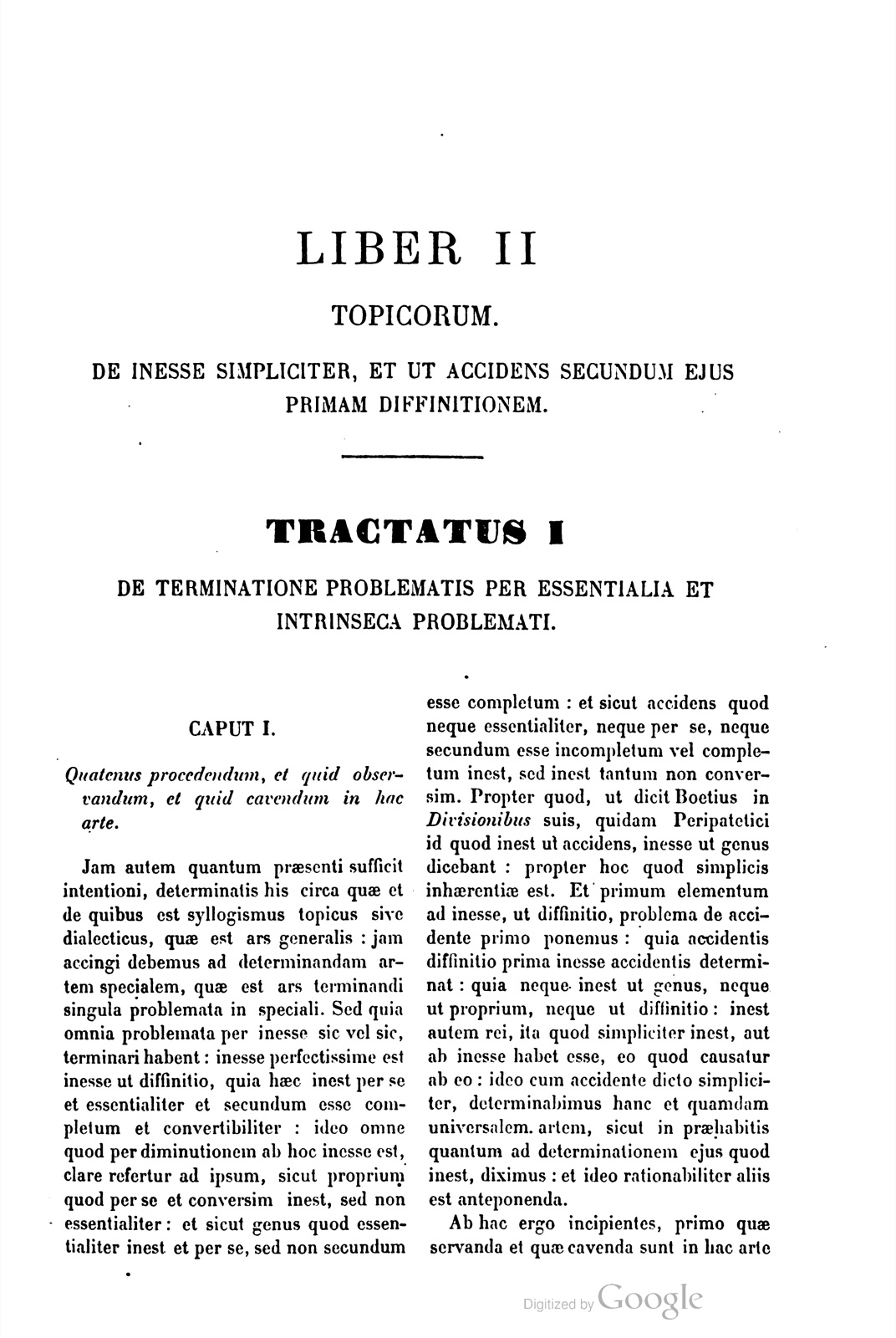
LIBER II TOPICORUM.
DE INESSE SIMPLICITER, ET UT ACCIDENS SECUNDUM EJUS PRIMAM DIFFINITIONEM.
TRACTATUS I.
DE TERMINATIONE PROBLEMATIS PER ESSENTIALIA ET INTRINSECA PROBLEMATI.
CAPUT I.
Quatenus procedendum, et quid observandum, et quid cavendum in hac arte.
Jam autem quantum praesenti sufficit intentioni, determinatis his circa quae et de quibus est syllogismus topicus sive dialecticus, quae est ars generalis: jam accingi debemus ad determinandam artem specialem, quae est ars terminandi singula problemata in speciali. Sed quia omnia problemata per inesse sic vel sic, terminari habent: inesse perfectissime est inesse ut diffinitio, quia haec inest per se et essentialiter et secundum esse completum et convertibiliter: ideo omne quod per diminutionem ab hoc inesse est, clare refertur ad ipsum, sicut proprium quod per se et conversim inest, sed non essentialiter: et sicut genus quod essentialiter inest et per se, sed non secundum esse completum: et sicut accidens quod neque essentialiter, neque per se, neque secundum esse incompletum vel completum inest, sed inest tantum non conversim. Propter quod, ut dicit Boetius in Divisionibus suis, quidam Peripatetici id quod inest ut accidens, inesse ut genus dicebant: propter hoc quod simplicis inhaerentiae est. Et primum elementum ad inesse, ut diffinitio, problema de accidente primo ponemus: quia accidentis diffinitio prima inesse accidentis determinat: quia neque inest ut genus, neque ut proprium, neque ut diffinitio: inest autem rei, ita quod simpliciter inest, aut ab inesse habet esse, eo quod causatur ab eo: ideo cum accidente dicto simpliciter, determinabimus hanc et quamdam universalem artem, sicut in praehabitis quantum ad determinationem ejus quod inest, diximus: et ideo rationabiliter aliis est anteponenda.
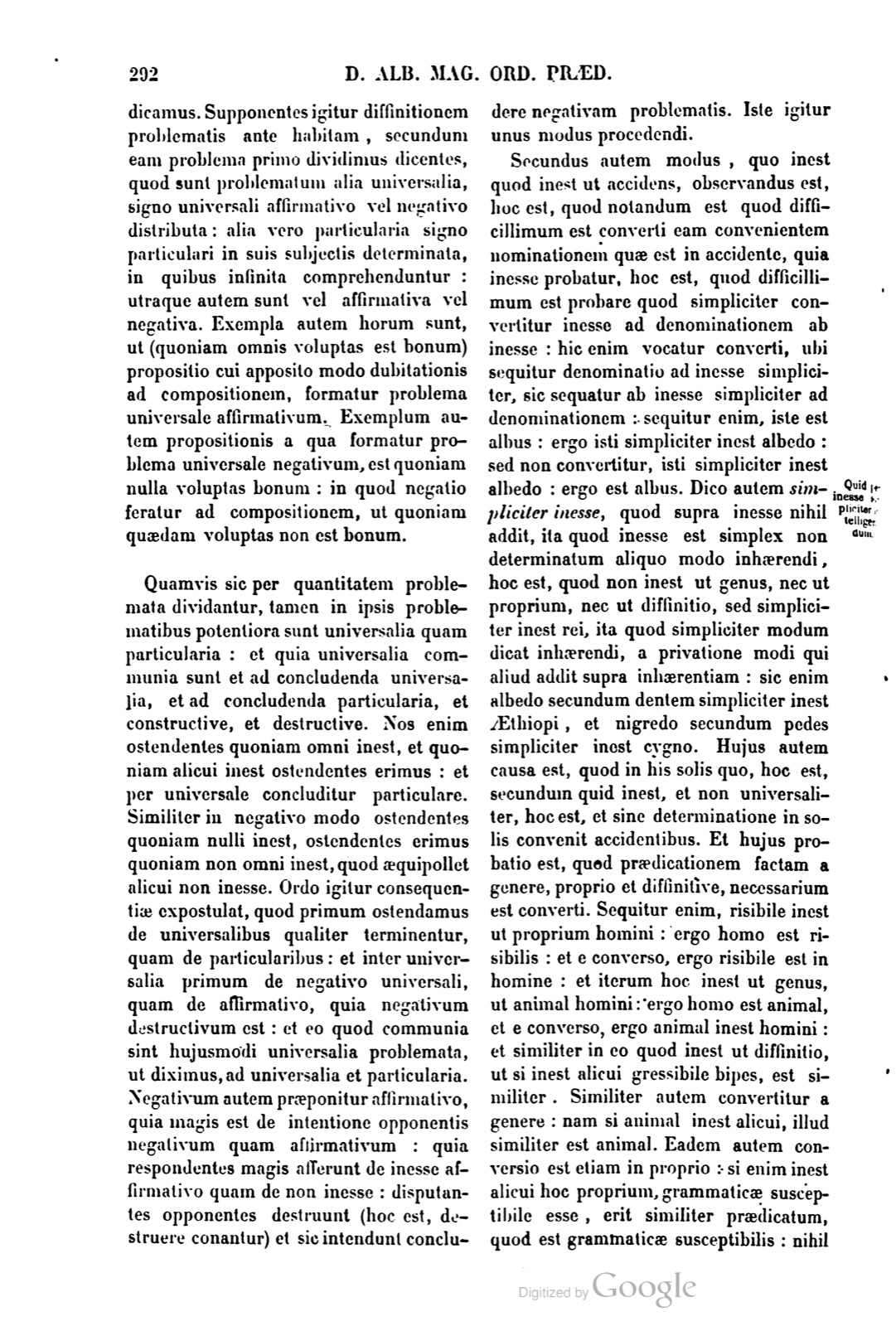
Ab hac ergo incipientes, primo quae servanda et quae cavenda sunt in hac arte dicamus. Supponentes igitur diffinitionem problematis ante habitam, secundum eam problema primo dividimus dicentes, quod sunt problematum alia universalia, signo universali affirmativo vel negativo distributa: alia vero particularia signo particulari in suis subjectis determinata, in quibus infinita comprehenduntur: utraque autem sunt vel affirmativa vel negativa. Exempla autem horum sunt, ut quoniam omnis voluptas est bonum, propositio cui apposito modo dubitationis ad compositionem, formatur problema universale affirmativum. Exemplum autem propositionis a qua formatur problema universale negativum, est quoniam nulla voluptas bonum: in quod negatio feratur ad compositionem, ut quoniam quaedam voluptas non est bonum.
Printed page 290 is blank.
BOOK II OF THE TOPICS.
ON BEING-IN SIMPLY, AND AS AN ACCIDENT ACCORDING TO ITS FIRST DEFINITION.
TREATISE I.
ON THE TERMINATION OF A PROBLEM THROUGH THINGS ESSENTIAL AND INTRINSIC TO THE PROBLEM.
CHAPTER I.
How far one must proceed, and what must be observed, and what must be avoided in this art.
Now, insofar as suffices for the present intention, once those things have been determined around which and concerning which there is a topical or dialectical syllogism, which is the general art, we must now gird ourselves for determining the special art, which is the art of terminating individual problems in particular. But because all problems must be terminated through being-in thus or thus, being-in most perfectly is being-in as definition, because this is in through itself and essentially and according to complete being and convertibly. Therefore everything that exists by diminution from this being-in is clearly referred to it, as proper, which is in through itself and conversely, but not essentially; and as genus, which is in essentially and through itself, but not according to complete being; and as accident, which is in neither essentially, nor through itself, nor according to incomplete or complete being, but is in only non-conversely. On account of this, as Boethius says in his Divisions, certain Peripatetics said that what is in as accident is being-in as a genus, because it is of simple inherence. And we shall first place the first element toward being-in, as definition, the problem concerning accident, because the first definition of accident determines the being-in of accident, because it is in neither as genus, nor as proper, nor as definition; but it is in a thing in such a way that it is in simply, or from being-in it has being, because it is caused by it. Therefore, with accident said simply, we shall determine this and a certain universal art, just as in the foregoing we spoke as to the determination of that which is in; and therefore it is reasonably to be placed before the others.
Therefore, beginning from this, let us first say what things are to be kept and what things are to be avoided in this art. Therefore, supposing the definition of problem had before, according to it we first divide problem, saying that among problems some are universal, distributed by a universal affirmative or negative sign; but others are particular, determined in their subjects by a particular sign, in which infinite things are comprehended; but each kind is either affirmative or negative. Examples of these are such as: because every pleasure is good, a proposition to which, when the mode of doubt is added toward composition, a universal affirmative problem is formed. But an example of a proposition from which a universal negative problem is formed is: because no pleasure is good; into which negation is borne to the composition, as because some pleasure is not good.

Quamvis sic per quantitatem problemata dividantur, tamen in ipsis problematibus potentiora sunt universalia quam particularia: et quia universalia communia sunt et ad concludenda universalia, et ad concludenda particularia, et constructive, et destructive. Nos enim ostendentes quoniam omni inest, et quoniam alicui inest ostendentes erimus: et per universale concluditur particulare. Similiter in negativo modo ostendentes quoniam nulli inest, ostendentes erimus quoniam non omni inest, quod aequipollet alicui non inesse. Ordo igitur consequentiae expostulat, quod primum ostendamus de universalibus qualiter terminentur, quam de particularibus: et inter universalia primum de negativo universali, quam de affirmativo, quia negativum destructivum est: et eo quod communia sint hujusmodi universalia problemata, ut diximus, ad universalia et particularia. Negativum autem praeponitur affirmativo, quia magis est de intentione opponentis negativum quam affirmativum: quia respondentes magis afferunt de inesse affirmativo quam de non inesse: disputantes opponentes destruunt, hoc est, destruere conantur, et sic intendunt concludere negativam problematis. Iste igitur unus modus procedendi.
Secundus autem modus, quo inest quod inest ut accidens, observandus est, hoc est, quod notandum est quod difficillimum est converti eam convenientem nominationem quae est in accidente, quia inesse probatur, hoc est, quod difficillimum est probare quod simpliciter convertitur inesse ad denominationem ab inesse: hic enim vocatur converti, ubi sequitur denominatio ad inesse simpliciter, sic sequatur ab inesse simpliciter ad denominationem: sequitur enim, iste est albus: ergo isti simpliciter inest albedo: sed non convertitur, isti simpliciter inest albedo: ergo est albus.
Although problems are thus divided by quantity, nevertheless in problems themselves universals are more powerful than particulars, because universals are common both for concluding universals and for concluding particulars, both constructively and destructively. For by showing that it belongs to every one, we shall also be showing that it belongs to some one; and through the universal the particular is concluded. Likewise in the negative mode, by showing that it belongs to none, we shall be showing that it does not belong to every one, which is equivalent to not belonging to some one. Therefore the order of consequence demands that we first show concerning universals how they are terminated, rather than concerning particulars; and among universals first concerning the universal negative rather than the affirmative, because the negative is destructive; and because universal problems of this kind are common, as we have said, to universals and particulars. But the negative is placed before the affirmative because the negative is more of the intention of the opponent than the affirmative, because respondents bring forward more concerning affirmative being-in than concerning not being-in; disputants who oppose destroy, that is, attempt to destroy, and thus intend to conclude the negative of the problem. This, therefore, is one mode of proceeding.
But the second mode, by which what is in is in as accident, must be observed, that is, it must be noted that it is most difficult to convert that suitable denomination which exists in accident, because being-in is proved; that is, it is most difficult to prove that being-in simply is converted to denomination from being-in. For here it is called to be converted when denomination follows upon being-in simply, so that it would follow from being-in simply to denomination. For this follows: this thing is white, therefore whiteness is in this thing simply. But it is not converted: whiteness is in this thing simply, therefore it is white.
[Marginal label, printed page 292: Quid est inesse simpliciter intelligendum.]
Dico autem simpliciter inesse, quod supra inesse nihil addit, ita quod inesse est simplex non determinatum aliquo modo inhaerendi, hoc est, quod non inest ut genus, nec ut proprium, nec ut diffinitio, sed simpliciter inest rei, ita quod simpliciter modum dicat inhaerendi, a privatione modi qui aliud addit supra inhaerentiam: sic enim albedo secundum dentem simpliciter inest Aethiopi, et nigredo secundum pedes simpliciter inest cygno. Hujus autem causa est, quod in his solis quo, hoc est, secundum quid inest, et non universaliter, hoc est, et sine determinatione in solis convenit accidentibus. Et hujus probatio est, quod praedicationem factam a genere, proprio et diffinitive, necessarium est converti. Sequitur enim, risibile inest ut proprium homini: ergo homo est risibilis: et e converso, ergo risibile est in homine: et iterum hoc inest ut genus, ut animal homini: ergo homo est animal, et e converso, ergo animal inest homini: et similiter in eo quod inest ut diffinitio, ut si inest alicui gressibile bipes, est similiter. Similiter autem convertitur a genere: nam si animal inest alicui, illud similiter est animal. Eadem autem conversio est etiam in proprio: si enim inest alicui hoc proprium, grammaticae susceptibile esse erit similiter praedicatum, quod est grammaticae susceptibilis: nihil
[Marginal label, printed page 292: What is to be understood by being-in simply.]
But I call being-in simply that which adds nothing over being-in, so that being-in is simple, not determined by some mode of inhering, that is, that it is not in as genus, nor as proper, nor as definition, but is simply in the thing, so that simply it says a mode of inhering, from privation of the mode that adds something else above inherence. For thus whiteness according to the tooth is simply in an Ethiopian, and blackness according to the feet is simply in a swan. But the cause of this is that in these alone "where," that is, according to something, it is in, and not universally, that is, and without determination, fits only accidents. And the proof of this is that predication made from genus, proper, and definitively must be converted. For it follows: risible is in man as proper; therefore man is risible; and conversely, therefore risible is in man. And again this is in as genus, as animal in man; therefore man is animal, and conversely, therefore animal is in man. And similarly in that which is in as definition, as if two-footed walking is in something, it is similarly. Likewise it is converted from genus, for if animal is in something, that thing similarly is animal. But the same conversion is also in proper: for if this proper is in something, being receptive of grammar will similarly be predicated, which is being receptive of grammar: nothing
If a page does not appear, its photograph has not been uploaded yet.