Volume 2 · pp. 285–287
CHAPTERS VI-VIII. On the multiple, differences, and likeness.
A marker with ≈ is an approximate page boundary, placed by measure of the text; the page photographs remain the authority. In the paired views, clicking a page marker brings that page into view.
Considerandum autem non solum si propositi, cujus quaeritur multiplicitas, sint diversa genera et non subalternatim posita, ut dictum est: sed considerandum in contrario, si contrarium hujus secundum diversa multipliciter dicitur, palam est quoniam et propositum ad minus secundum habilitatem, quamvis forte contrarium prout in diversis generibus est, nomen unum non habeat: quia a nobis est utrum sit unius nominis vel diversorum: in hoc autem nulla vis est. Non tantum ad differentias est utile inspicere ad multiplicis inventionem: sed et utile est inspicere ad totam diffinitionem, quae est essentia completa diffiniti, cujus quaeritur multiplicitas, quae fit ex toto composito distincto. Dico autem compositum ut compositum ex genere et eo quod dicitur esse in ipso, ut album quando ponitur in corpore, et quando ponitur in voce, ut in generibus, compositum est corpus album, et compositum est vox alba: si enim diffiniatur corpus album et vox alba, si album univoce est in illis, tunc perempto sive ablato eo quod utrique proprium est, et in quo unum separatur ab altero, quod est corpus et vox, ejus quod remanet, unam oportet relinqui rationem in utroque. Hoc autem in aequivocis non accidit, quia in illis ejus quod relinquitur diversa est ratio, ut patet in illis quae nunc dicta sunt: quia album est quod relinquitur, et ex hoc in duobus dictis generibus non est: nam hoc quidem etiam album in corpore erit corpus talem colorem habens: in diffinitione enim accidentis praecipue denominative dicti cadit subjectum: illud autem etiam in voce erit vox bene audibilis. Interempto ergo a diffinitionibus istis corpore et voce, quae sunt propria et privata et separata genera, non idem et una ratione est dictum in utroque genere quod restat, quod est album, non unius est rationis in talibus.
Tamen saepe etiam in ipsis diffinitionibus in quas inspicitur, latet assequens, hoc est, diffinitioni communicans aequivocum: propter quod etiam in diffinitionibus considerandum eadem consideratione si aliquid sit positum aequivoce. Cujus exemplum est, ut alius dicat diffiniendo significativum sanitatis, sanativum, quod mediocriter se habet ordinativum ad medium sive temperamentum sanitatis: et eodem modo quod mediocriter se habet ad sanitatem, diffiniat et perfectivum sanitatis: non enim statim per transitoriam inspectionem discedendum est ab inspectione diffinitionis, sed inspiciendum quid hoc est, in qua significatione dixit, mediocriter se habens ad sanitatem, secundum utrumque sanitatis etiam significativum et sanitatis perfectivum. Et considerandum est si hoc mediocriter etiam sanitatem in una significatione dixit diffiniendo tantum esse secundum significationem quantum est significare medium sanitatis: illud autem mediocre in alterius diffinitione tale dixit, quod sit significare qualis quidem habitus sanitatis, quia medii et contemperati: patet quia mediocriter se habens ad sanitatem in his diffinitionibus aequivocum et multiplex est.
Amplius autem considerando in accidentibus deprehenditur multiplex: si enim ea quae sunt sub una voce, non sunt comparabilia secundum unam formam in voce figuratam. Dico autem comparabilia simpliciter, vel secundum magis et minus et aeque: omnia enim univoca comparantur secundum magis et minus accidentia, secundum prius et posterius analoga: et ideo si in illa forma comparari non possunt ea quae sub eadem voce figurantur, erunt proculdubio aequivoca, et multipliciter dicta, ut alba vox et vestis alba non comparantur in albedine: quia vox nec magis nec minus, nec aeque alba dicitur ut vestis. Et similiter acutus humor et acuta vox in accidente comparari non possunt: haec enim nec similiter, hoc est, aeque, nec magis nec minus unum altero dicitur acutum. Propter quod aequivocum est et album et acutum in diversis generibus dictum. Nam omne univocum in forma quam significat nomen, comparabile est, quod eamdem formam et nomen idem participat: aut non similiter, hoc est, secundum aeque, dicetur, ut homo et asinus animal: aut alterum dicetur magis vel minus, ut nix dicitur albior veste.
One must consider not only whether the proposed thing whose multiplicity is sought has diverse genera and genera not placed subalternately, as has been said; but one must consider in the contrary: if the contrary of this is said multiply according to diverse things, it is plain that the proposed thing is also said multiply, at least according to aptitude, although perhaps the contrary, insofar as it is in diverse genera, does not have one name; because it belongs to us to consider whether it is of one name or of diverse names, but in this there is no force. It is useful not only to inspect differences for the discovery of the multiple, but it is also useful to inspect the whole definition, which is the complete essence of the thing defined, whose multiplicity is sought, which is made from the whole distinct composite. I call composite as composed from genus and that which is said to be in it, as white when it is placed in body and when it is placed in voice, as in genera: the composite is white body and the composite is white voice. For if white body and white voice are defined, if white is univocal in them, then when that which is proper to each and in which one is separated from the other, namely body and voice, has been removed or taken away, one account of that which remains ought to be left in each. But this does not happen in equivocals, because in them there is a diverse account of that which is left, as is plain in those things that have now been said: because white is what is left, and from this it is not the same in the two said genera. For this white in body will be a body having such a color; for in the definition of an accident, especially one said denominatively, the subject falls. But that white in voice will be a voice well audible. Therefore, with body and voice removed from these definitions, which are proper and private and separate genera, what remains, which is white, is not said as the same and by one account in each genus; in such things it is not of one account.
Yet often even in the definitions themselves into which inspection is made, something following lies hidden, that is, an equivocal communicating with the definition; on account of this, even in definitions one must consider by the same consideration whether something has been posited equivocally. An example of this is that one person, by defining the significative of health, may call health-making what has itself moderately as ordering to the mean or temperament of health; and in the same way he may define what has itself moderately toward health as also perfective of health. For one must not immediately depart from inspection of the definition by a passing inspection, but one must inspect what this is, in what signification he said "having itself moderately toward health," according to each, both significative of health and perfective of health. And one must consider whether by defining he said this moderately also to be health in one signification only according to signification, insofar as it is to signify the mean of health; but whether that other moderate in the definition of the other he called such that it signifies a certain habit of health, because of the middle and well-tempered; it is plain that having itself moderately toward health in these definitions is equivocal and multiple.
Furthermore, by considering accidents the multiple is detected: for if those things that are under one voice are not comparable according to one form figured in the voice. But I call comparable simply, or according to more and less and equally; for all univocal accidents are compared according to more and less, analogues according to prior and posterior. And therefore if in that form the things that are figured under the same voice cannot be compared, they will without doubt be equivocal and said multiply, as white voice and white garment are not compared in whiteness, because voice is not said to be more white, less white, or equally white as a garment. And likewise sharp flavor and sharp voice cannot be compared in accident, for one of these is called sharp neither similarly, that is, equally, nor more nor less than the other. On account of this both white and sharp said in diverse genera are equivocal. For every univocal thing is comparable in the form that the name signifies, which participates the same form and the same name: either it will be said not similarly, that is, not according to equality, as man and ass are animal; or one will be said more or less, as snow is said to be whiter than a garment.
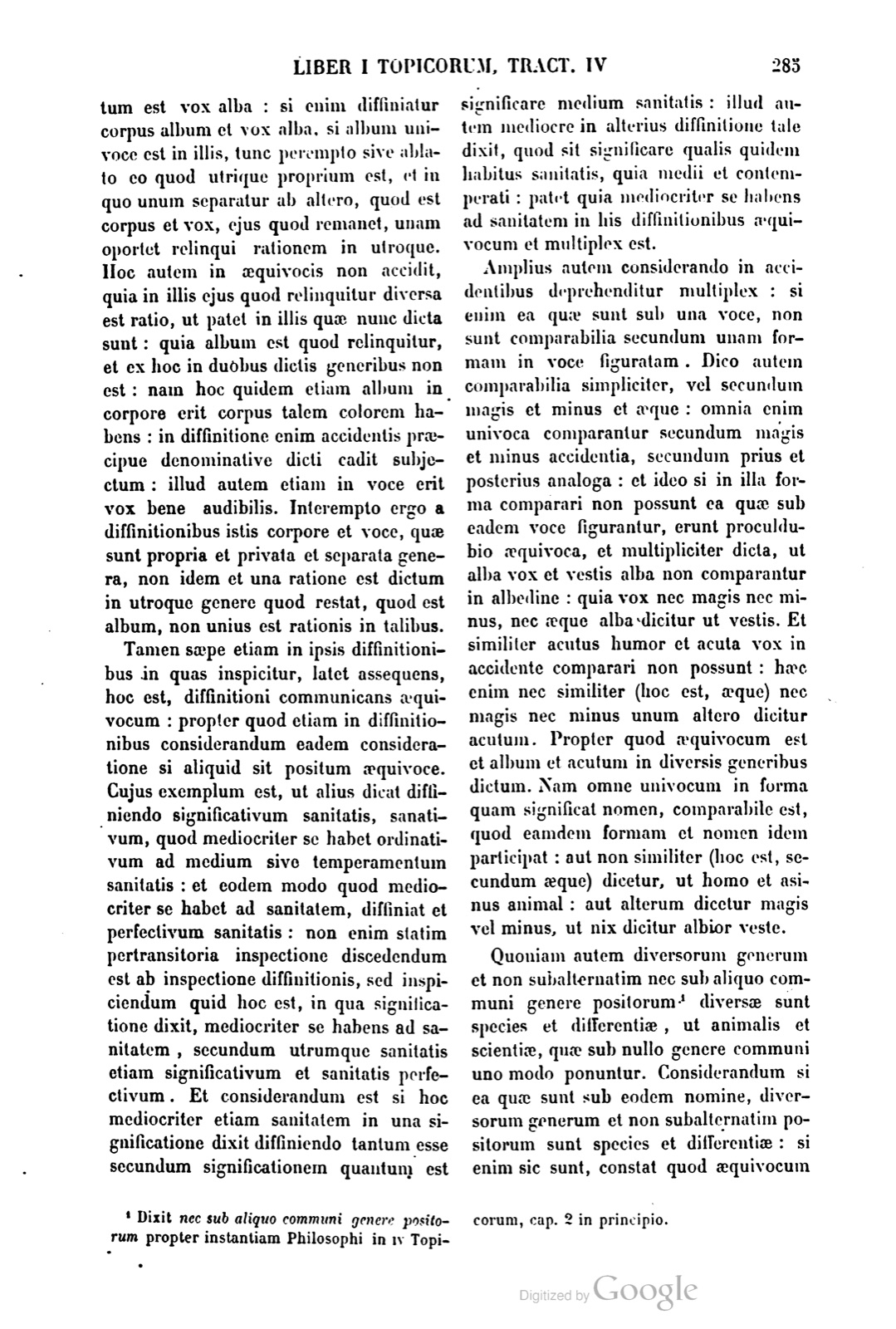
Quoniam autem diversorum generum et non subalternatim nec sub aliquo communi genere positorum 1 diversae sunt species et differentiae, ut animalis et scientiae, quae sub nullo genere communi uno modo ponuntur. Considerandum si ea quae sunt sub eodem nomine, diversorum generum et non subalternatim positorum sunt species et differentiae: si enim sic sunt, constat quod aequivocum nomen est. Cujus exemplum est, quod acutum est species et differentia vocis, et angulatae magnitudinis: differt enim vox a voce, eo quod una sit acuta: propter hoc acutum est aequivocum in voce et magnitudine: diversorum enim generum, etc.
Rursum autem in diversa genera considerando, si eorum quae sub eodem nomine significata, diversae sunt species et differentiae et non subalternatim positae, item est aequivocum, ut coloris qui in corporibus dicitur color albus, et coloris qui est in melodiis musicis, sunt diversae differentiae, et non subalternatim positae: nam coloris qui est in corporibus, sunt aggregativi et disgregativi: ejus vero coloris qui est in melodiis, non sunt eaedem differentiae et clare et non clare audibile: propter quod color erit aequivocum: nam eorumdem, hoc est, eorum quae dicuntur ut eadem, sunt eaedem differentiae et divisivae et constitutivae.
Amplius adhuc considerando in id quod est idem: quoniam species in aliquo genere constituta non est differentia, cum species nullius generis vel speciei differentiae sunt: quia species sunt in esse perfecto constitutae: singularium enim eorum species est inspiciendum, si eorum quae sunt sub eodem communi nomine proposito, cujus multiplicitas quaeritur, hoc quidem species est, illud autem significatum est differentia. Cujus exemplum album quod in corpore acceptum, est species coloris: album autem quod est in voce, est differentia. Cujus probatio est: quia differt vox a voce: eo quod alba vel clara sit, alia autem non alba sive obscura sit: aequivocum est ergo album.
[Marginal label, printed page 286: Objectio.]
Si quis autem huic objiciet quod corporeum et incorporeum sunt diversa, et non subalternatim posita: et tamen eorum est una differentia quae rationale dicitur, quae homini convenit et Deo, ut dicit Porphyrius. Ridendum est potius quam solvendum. Ergo de eo quod est de multiplici dicto instrumento per haec quae dicta sunt et hujusmodi, hoc est, per similia his, est perspiciendum.
But since of diverse genera and things not placed subalternately nor under some common genus 1 there are diverse species and differences, as of animal and knowledge, which are not placed under any one common genus in one way, one must consider whether those things which are under the same name are species and differences of diverse genera and not placed subalternately. For if they are so, it is established that the name is equivocal. An example of this is that sharp is a species and difference of voice and of angled magnitude; for voice differs from voice because one is sharp. On account of this sharp is equivocal in voice and magnitude, for they are of diverse genera, and so forth.
Again, by considering in diverse genera, if of those things signified under the same name there are diverse species and differences and they are not placed subalternately, likewise it is equivocal; as of color, which in bodies is called white color, and of color which is in musical melodies, there are diverse differences and not subalternately placed. For of color that is in bodies there are gathering and scattering differences; but of that color that is in melodies there are not the same differences, but clearly audible and not clearly audible. On account of this color will be equivocal; for of the same things, that is, of those things that are called as the same, there are the same differences, both divisive and constitutive.
Furthermore, by still considering into that which is the same: since a species constituted in some genus is not a difference, since species are the differences of no genus or species; because species are constituted in perfect being. Therefore, concerning the singulars of them, one must inspect whether, of those things which are under the same common proposed name whose multiplicity is sought, this is a species but that signified thing is a difference. An example is white, which, accepted in body, is a species of color; but white which is in voice is a difference. The proof is that voice differs from voice because one is white or clear, but another is not white or is obscure. Therefore white is equivocal.
[Marginal label, printed page 286: Objection.]
But if someone objects to this that corporeal and incorporeal are diverse and not subalternately placed, and nevertheless there is one difference of them, which is called rational, which belongs to man and to God, as Porphyry says, it is to be laughed at rather than solved. Therefore, concerning that which belongs to the instrument of what is said multiply, it must be inspected through these things that have been said and things of this kind, that is, through things similar to these.
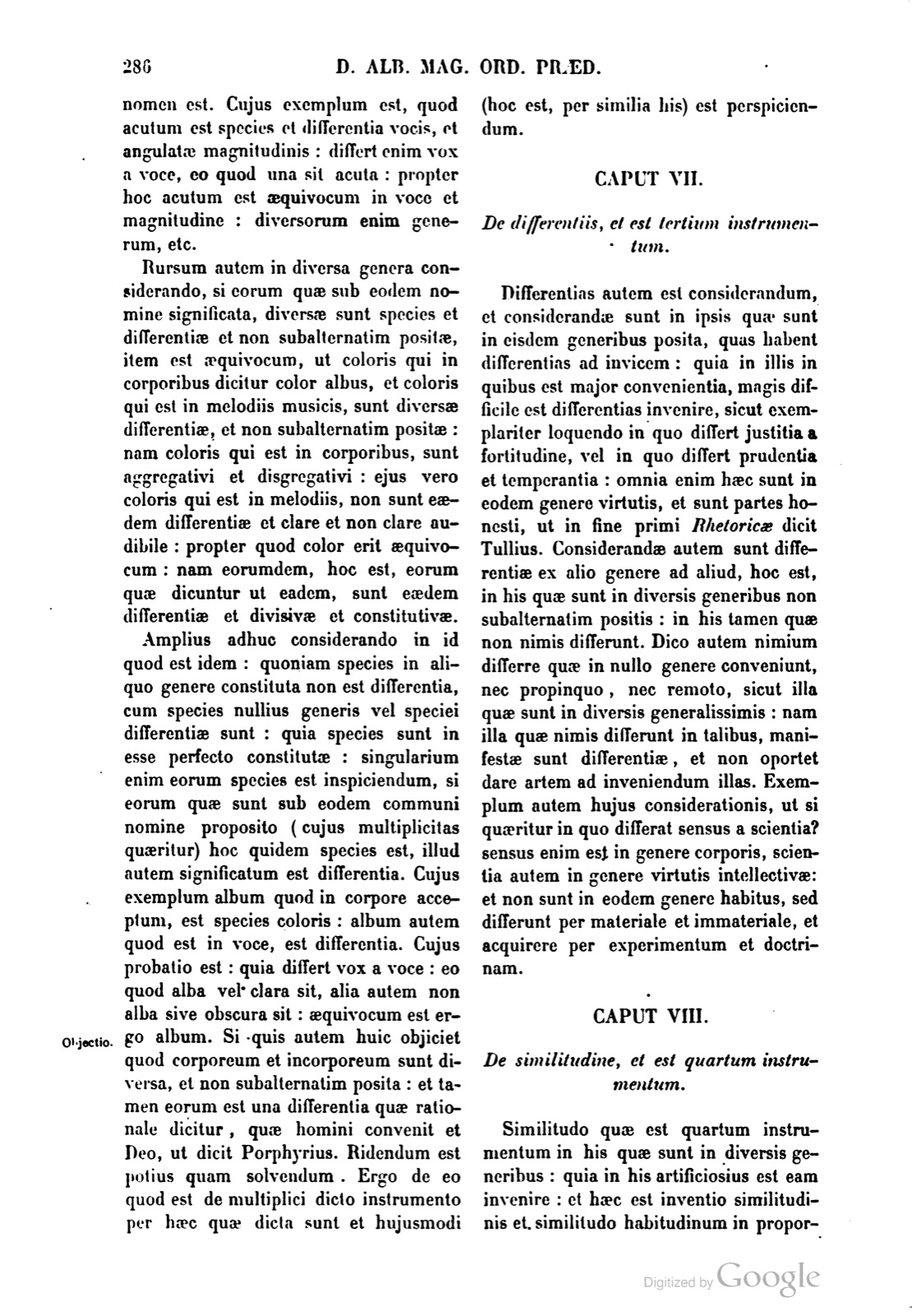
CAPUT VII.
De differentiis, et est tertium instrumentum.
Differentias autem est considerandum, et considerandae sunt in ipsis quae sunt in eisdem generibus posita, quas habent differentias ad invicem: quia in illis in quibus est major convenientia, magis difficile est differentias invenire, sicut exemplariter loquendo in quo differt justitia a fortitudine, vel in quo differt prudentia et temperantia: omnia enim haec sunt in eodem genere virtutis, et sunt partes honesti, ut in fine primi Rhetoricae dicit Tullius. Considerandae autem sunt differentiae ex alio genere ad aliud, hoc est, in his quae sunt in diversis generibus non subalternatim positis: in his tamen quae non nimis differunt. Dico autem nimium differre quae in nullo genere conveniunt, nec propinquo, nec remoto, sicut illa quae sunt in diversis generalissimis: nam illa quae nimis differunt in talibus, manifestae sunt differentiae, et non oportet dare artem ad inveniendum illas. Exemplum autem hujus considerationis, ut si quaeritur in quo differat sensus a scientia? sensus enim est in genere corporis, scientia autem in genere virtutis intellectivae: et non sunt in eodem genere habitus, sed differunt per materiale et immateriale, et acquirere per experimentum et doctrinam.
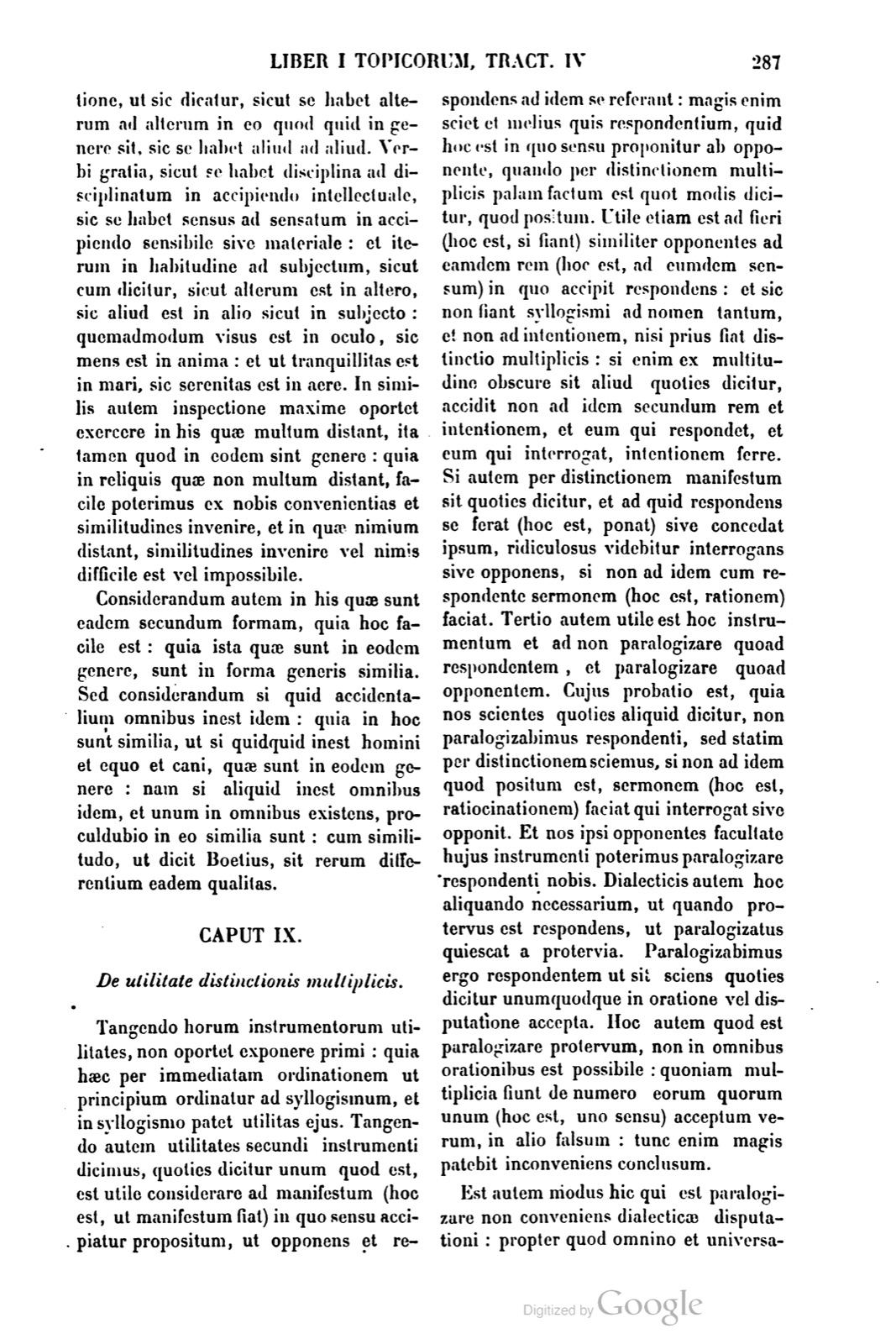
CAPUT VIII.
De similitudine, et est quartum instrumentum.
Similitudo quae est quartum instrumentum in his quae sunt in diversis generibus: quia in his artificiosius est eam invenire: et haec est inventio similitudinis et, similitudo habitudinum in proportione, ut sic dicatur, sicut se habet alterum ad alterum in eo quod quid in genere sit, sic se habet aliud ad aliud. Verbi gratia, sicut se habet disciplina ad disciplinatum in accipiendo intellectuale, sic se habet sensus ad sensatum in accipiendo sensibile sive materiale: et iterum in habitudine ad subjectum, sicut cum dicitur, sicut alterum est in altero, sic aliud est in alio sicut in subjecto: quemadmodum visus est in oculo, sic mens est in anima: et ut tranquillitas est in mari, sic serenitas est in aere. In similis autem inspectione maxime oportet exercere in his quae multum distant, ita tamen quod in eodem sint genere: quia in reliquis quae non multum distant, facile poterimus ex nobis convenientias et similitudines invenire, et in quae nimium distant, similitudines invenire vel nimis difficile est vel impossibile.
Considerandum autem in his quae sunt eadem secundum formam, quia hoc facile est: quia ista quae sunt in eodem genere, sunt in forma generis similia. Sed considerandum si quid accidentalium omnibus inest idem: quia in hoc sunt similia, ut si quidquid inest homini et equo et cani, quae sunt in eodem genere: nam si aliquid inest omnibus idem, et unum in omnibus existens, proculdubio in eo similia sunt: cum similitudo, ut dicit Boetius, sit rerum differentium eadem qualitas.
CHAPTER VII.
On differences, and this is the third instrument.
But differences must be considered, and they must be considered in the very things which are placed in the same genera, what differences they have in relation to one another, because in those things in which there is greater agreement, it is more difficult to find differences; for example, in what justice differs from fortitude, or in what prudence and temperance differ: for all these are in the same genus of virtue and are parts of the honorable, as Tullius says at the end of the first book of the Rhetoric. But differences from one genus to another must be considered, that is, in those things that are in diverse genera not placed subalternately, yet in those things that do not differ too much. I call those things differ too much that agree in no genus, neither near nor remote, as those things that are in diverse most general genera; for differences are manifest in such things that differ too much, and it is not necessary to give an art for finding them. An example of this consideration is if it is asked in what sense differs from knowledge. For sense is in the genus of body, but knowledge is in the genus of intellective virtue; and they are not in the same genus of habit, but they differ through material and immaterial, and through acquiring by experience and teaching.
CHAPTER VIII.
On likeness, and this is the fourth instrument.
Likeness, which is the fourth instrument, is in those things which are in diverse genera, because in these it is more artful to find it; and this is discovery of likeness and likeness of dispositions in proportion, so that it is said thus: as one thing has itself to another in that which it is in a genus, so another thing has itself to another. For example, as discipline has itself to the disciplined thing in receiving the intellectual, so sense has itself to the sensed thing in receiving the sensible or material. And again in disposition to subject, as when it is said: as one thing is in another, so another thing is in another as in a subject; as sight is in the eye, so mind is in the soul; and as tranquility is in the sea, so serenity is in the air. But in inspection of the similar, one must especially exercise oneself in those things that are much distant, yet in such a way that they are in the same genus, because in the remaining things that are not much distant we shall easily be able from ourselves to find agreements and likenesses, and in those things that are too distant it is either too difficult or impossible to find likenesses.
One must consider in those things that are the same according to form, because this is easy: because those things which are in the same genus are similar in the form of the genus. But one must consider whether some accident is the same and belongs to all, because in this they are similar, as if something belongs to man and horse and dog, which are in the same genus; for if something the same belongs to all, existing as one in all, without doubt they are similar in this, since likeness, as Boethius says, is the same quality of different things.
Notes
- He said "nor placed under some common genus" because of an instance of the Philosopher in Topics IV, chapter 2, at the beginning. (Dixit nec sub aliquo communi genere positorum propter instantiam Philosophi in IV Topicorum, cap. 2 in principio.) ↩
If a page does not appear, its photograph has not been uploaded yet.