Volume 2 · pp. 283–284
CHAPTERS V-VI. On distinction of the multiple in cases and genera.
A marker with ≈ is an approximate page boundary, placed by measure of the text; the page photographs remain the authority. In the paired views, clicking a page marker brings that page into view.
Disputare autem hic de diffinitione generis oppositionis et differentia et ordine, non est opportunum: eo quod non intendit hic de hoc, sed in Praedicamentis. Hic autem non inducuntur genera oppositionum nisi ad multiplicis inventionem. Nec etiam oportet hic disputare quae mediata sint contraria, et quae immediata, etiam quae plura habeant media, et quae unum: et propter quod propter eamdem causam, et quia tales quaestiones sufficienter per rationes dialecticas terminari non possunt, et his dimittantur rationibus, quia plus impediunt quam praedictae valeant: in aliis enim a nobis est disputandum.
CAPUT V.
De distinctione multiplicis in his quae conveniunt ei quod est multiplex.
[Marginal label, printed page 283: Casus pro inflexione nominis adverbium.]
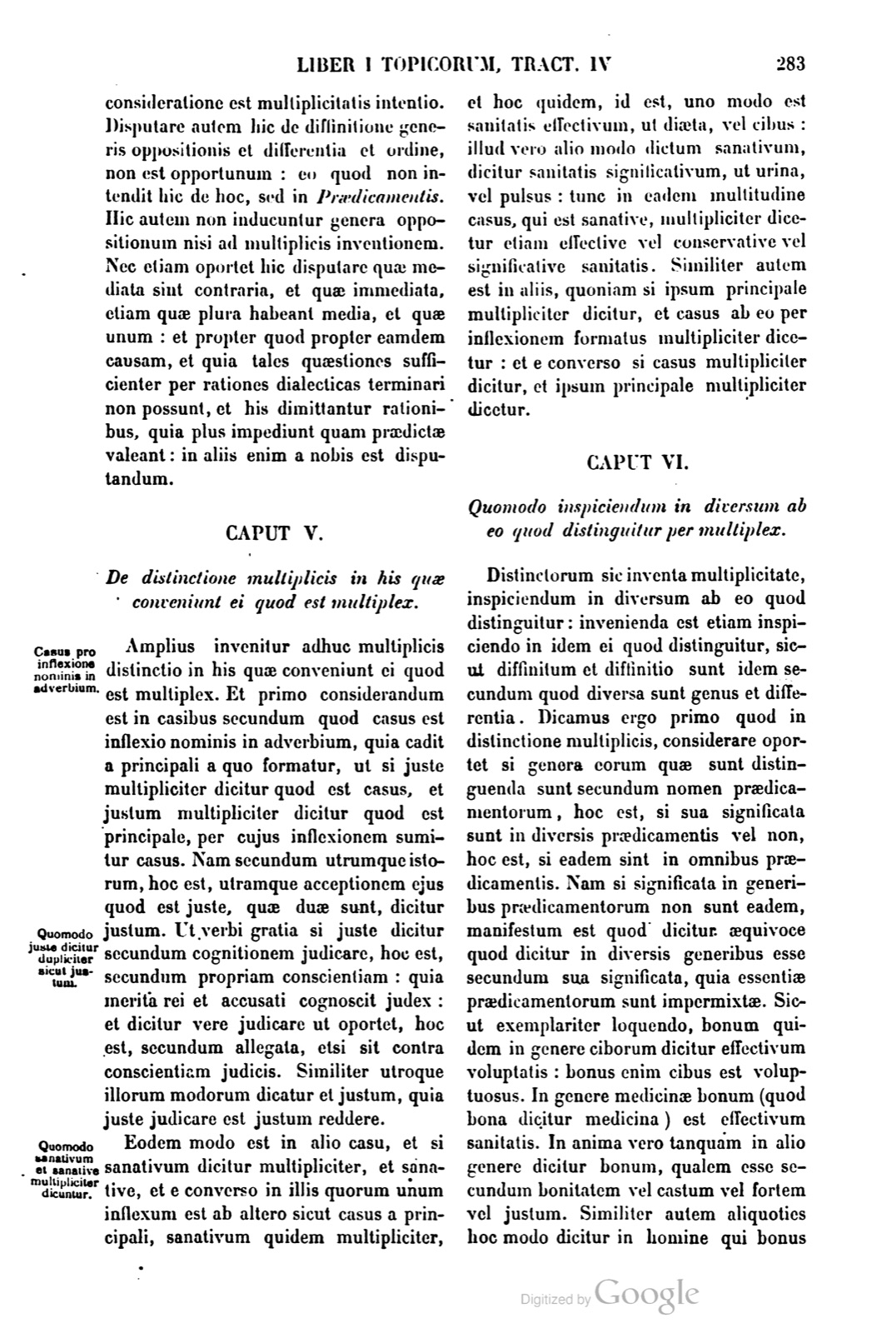
Amplius invenitur adhuc multiplicis distinctio in his quae conveniunt ei quod est multiplex. Et primo considerandum est in casibus secundum quod casus est inflexio nominis in adverbium, quia cadit a principali a quo formatur, ut si juste multipliciter dicitur quod est casus, et justum multipliciter dicitur quod est principale, per cujus inflexionem sumitur casus. Nam secundum utrumque istorum, hoc est, utramque acceptionem ejus quod est juste, quae duae sunt, dicitur justum.
[Marginal label, printed page 283: Quomodo juste dicitur sicut justum.]
Ut verbi gratia si juste dicitur secundum cognitionem judicare, hoc est, secundum propriam conscientiam, quia merita rei et accusati cognoscit judex: et dicitur vere judicare ut oportet, hoc est, secundum allegata, etsi sit contra conscientiam judicis. Similiter utroque illorum modorum dicatur et justum, quia juste judicare est justum reddere.
[Marginal label, printed page 283: Quomodo sanativum et sanative multipliciter dicuntur.]
Eodem modo est in alio casu, et si sanativum dicitur multipliciter, et sanative, et e converso in illis quorum unum inflexum est ab altero sicut casus a principali, sanativum quidem multipliciter, et hoc quidem, id est, uno modo est sanitatis effectivum, ut diaeta, vel cibus: illud vero alio modo dictum sanativum, dicitur sanitatis significativum, ut urina, vel pulsus: tunc in eadem multitudine casus, qui est sanative, multipliciter dicetur etiam effective vel conservative vel significative sanitatis. Similiter autem est in aliis, quoniam si ipsum principale multipliciter dicitur, et casus ab eo per inflexionem formatus multipliciter dicitur: et e converso si casus multipliciter dicitur, et ipsum principale multipliciter dicetur.
CAPUT VI.
Quomodo inspiciendum in diversum ab eo quod distinguitur per multiplex.
Distinctorum sic inventa multiplicitate, inspiciendum in diversum ab eo quod distinguitur: invenienda est etiam inspiciendo in idem ei quod distinguitur, sicut diffinitum et diffinitio sunt idem secundum quod diversa sunt genus et differentia. Dicamus ergo primo quod in distinctione multiplicis, considerare oportet si genera eorum quae sunt distinguenda sunt secundum nomen praedicamentorum, hoc est, si sua significata sunt in diversis praedicamentis vel non, hoc est, si eadem sint in omnibus praedicamentis. Nam si significata in generibus praedicamentorum non sunt eadem, manifestum est quod dicitur aequivoce quod dicitur in diversis generibus esse secundum sua significata, quia essentiae praedicamentorum sunt impermixtae. Sicut exemplariter loquendo, bonum quidem in genere ciborum dicitur effectivum voluptatis: bonus enim cibus est voluptuosus. In genere medicinae bonum, quod bona dicitur medicina, est effectivum sanitatis. In anima vero tanquam in alio genere dicitur bonum, qualem esse secundum bonitatem vel castum vel fortem vel justum. Similiter autem aliquoties hoc modo dicitur in homine qui bonus dicitur, quia qualis est secundum aliquam virtutem. Aliquoties autem in alio genere dicitur bonum, ut quando quod in illo tempore melius est, et si non simpliciter sit, plerumque dicitur bonum secundum quantitatem, ut quantum sufficit est bonum, et superfluum et diminutum ab illo malum: et in medio dicitur bonum, quod nec superfluit, nec deficit a mensura: dicitur enim mediocre bonum quod medium virtutis attingit: propter quod aequivocum est bonum in omnibus his generibus dictum.
But to dispute here about the definition of the genus of opposition and about difference and order is not opportune, because here he does not intend to treat of this, but in the Categories. Here, however, the genera of oppositions are introduced only for the discovery of the multiple. Nor must one dispute here which contraries are mediate and which immediate, also which have several middles and which have one; both because of the same cause, and because such questions cannot be sufficiently terminated through dialectical reasons, let them be dismissed by these reasons, because they impede more than the aforesaid points are worth; for we must dispute about them elsewhere.
CHAPTER V.
On the distinction of the multiple in the things that agree with what is multiple.
[Marginal label, printed page 283: Case as inflection of a noun into an adverb.]
Furthermore, the distinction of the multiple is still found in those things that agree with what is multiple. And first one must consider in cases according as case is an inflection of a noun into an adverb, because it falls from the principal from which it is formed, as if justly, which is a case, is said multiply, then just, which is the principal through whose inflection the case is taken, is said multiply. For according to each of those, that is, each acceptance of justly, of which there are two, just is said.
[Marginal label, printed page 283: How justly is said as just is.]
For example, if justly is said of judging according to knowledge, that is, according to one's proper conscience, because the judge knows the merits of the matter and of the accused; and it is said of judging truly as one ought, that is, according to the things alleged, even if it is against the conscience of the judge. Similarly, in each of those modes just also is said, because to judge justly is to render what is just.
[Marginal label, printed page 283: How health-making and healthily are said multiply.]
In the same way it is in another case: if health-making is said multiply, so is healthily, and conversely in those things of which one is inflected from another as a case from a principal. Health-making, indeed, is said multiply: and this, that is, in one way, is effective of health, as diet or food; but that other thing, called health-making in another way, is called significative of health, as urine or pulse. Then in the same multitude the case, which is healthily, will also be said multiply, either effectively or conservatively or significatively of health. Likewise it is in other things, because if the principal itself is said multiply, the case formed from it by inflection is also said multiply; and conversely, if the case is said multiply, the principal itself will be said multiply.
CHAPTER VI.
How one must inspect into what is diverse from that which is distinguished through the multiple.
When the multiplicity of the things distinguished has thus been found, one must inspect into what is diverse from that which is distinguished; it must also be found by inspecting into what is the same as that which is distinguished, as the defined and the definition are the same according as genus and difference are diverse. Therefore let us say first that in the distinction of the multiple one must consider whether the genera of the things to be distinguished are according to the name of the predicaments, that is, whether their signified things are in diverse predicaments or not, that is, whether they are the same in all predicaments. For if the signified things in the genera of predicaments are not the same, it is manifest that what is said to be in diverse genera according to its signified things is said equivocally, because the essences of the predicaments are unmixed. Speaking by example, good in the genus of foods is said as effective of pleasure, for good food is pleasurable. In the genus of medicine, good, which is called good medicine, is effective of health. But in the soul as in another genus, good is said as to be of what quality according to goodness, either chaste or brave or just. Likewise sometimes in this way it is said in a man who is called good, because he is of some quality according to some virtue. But sometimes good is said in another genus, as when what is better at that time, even if it is not so simply, is commonly called good according to quantity, so that what suffices is good, and the excessive and deficient from it are bad; and what neither exceeds nor falls short of measure is called good in the middle; for a moderate good is said to be what touches the mean of virtue. On account of this, good said in all these genera is equivocal.
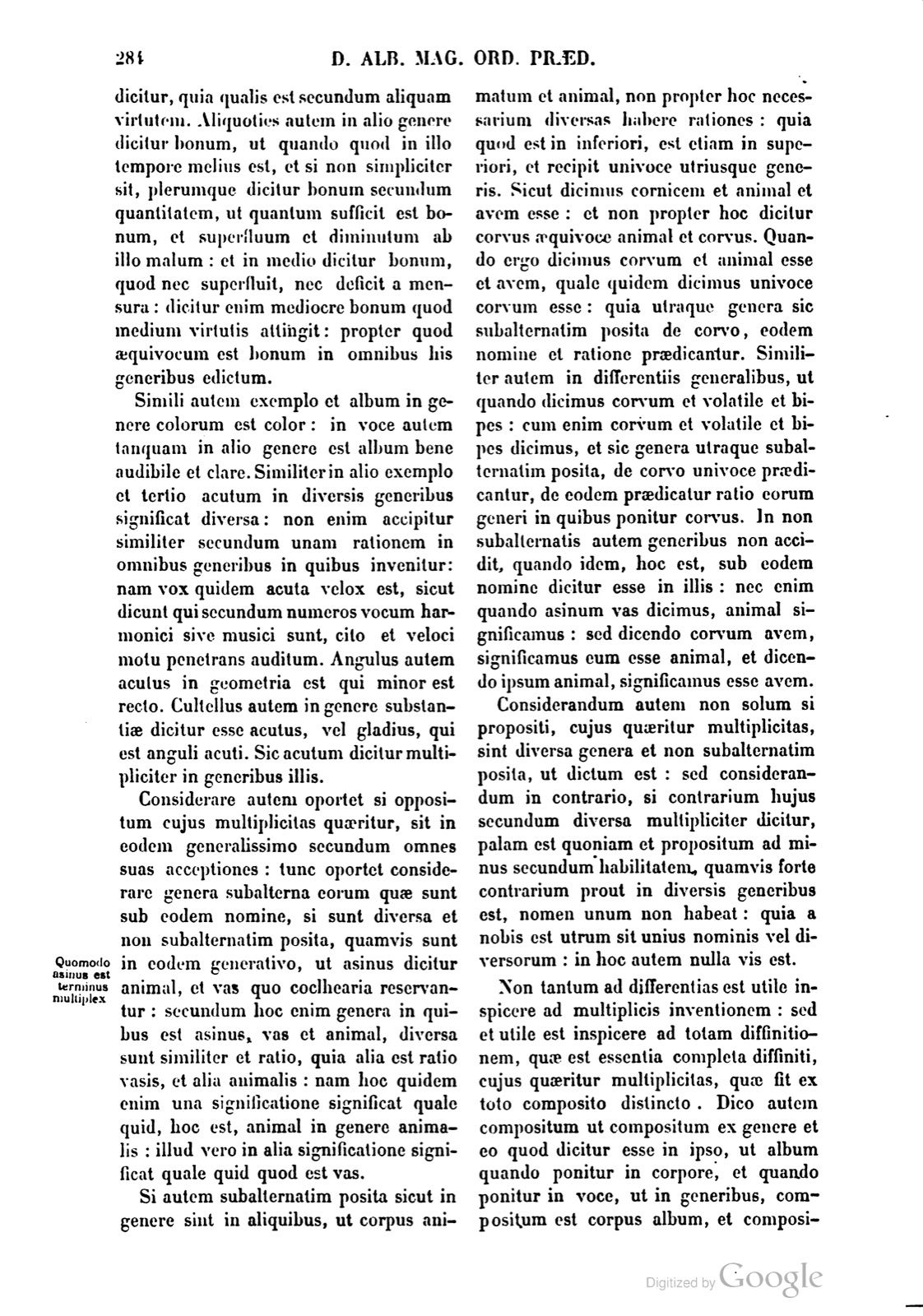
Simili autem exemplo et album in genere colorum est color: in voce autem tanquam in alio genere est album bene audibile et clare. Similiter in alio exemplo et tertio acutum in diversis generibus significat diversa: non enim accipitur similiter secundum unam rationem in omnibus generibus in quibus invenitur: nam vox quidem acuta velox est, sicut dicunt qui secundum numeros vocum harmonici sive musici sunt, cito et veloci motu penetrans auditum. Angulus autem acutus in geometria est qui minor est recto. Cultellus autem in genere substantiae dicitur esse acutus, vel gladius, qui est anguli acuti. Sic acutum dicitur multipliciter in generibus illis.
Considerare autem oportet si oppositum cujus multiplicitas quaeritur, sit in eodem generalissimo secundum omnes suas acceptiones: tunc oportet considerare genera subalterna eorum quae sunt sub eodem nomine, si sunt diversa et non subalternatim posita, quamvis sunt in eodem generativo, ut asinus dicitur animal, et vas quo cochlearia reservantur: secundum hoc enim genera in quibus est asinus, vas et animal, diversa sunt similiter et ratio, quia alia est ratio vasis, et alia animalis: nam hoc quidem enim una significatione significat quale quid, hoc est, animal in genere animalis: illud vero in alia significatione significat quale quid quod est vas.
[Marginal label, printed page 284: Quomodo asinus est terminus multiplex.]
Si autem subalternatim posita sicut in genere sint in aliquibus, ut corpus animatum et animal, non propter hoc necessarium diversas habere rationes: quia quod est in inferiori, est etiam in superiori, et recipit univoce utriusque generis. Sicut dicimus cornicem et animal et avem esse: et non propter hoc dicitur corvus aequivoce animal et corvus. Quando ergo dicimus corvum et animal esse et avem, quale quidem dicimus univoce corvum esse: quia utraque genera sic subalternatim posita de corvo, eodem nomine et ratione praedicantur. Similiter autem in differentiis generalibus, ut quando dicimus corvum et volatile et bipes: cum enim corvum et volatile et bipes dicimus, et sic genera utraque subalternatim posita, de corvo univoce praedicantur, de eodem praedicatur ratio eorum generi in quibus ponitur corvus. In non subalternatis autem generibus non accidit, quando idem, hoc est, sub eodem nomine dicitur esse in illis: nec enim quando asinum vas dicimus, animal significamus: sed dicendo corvum avem, significamus eum esse animal, et dicendo ipsum animal, significamus esse avem.
By a similar example, white in the genus of colors is a color; but in voice, as in another genus, white is well audible and clear. Likewise in another and third example, sharp signifies diverse things in diverse genera; for it is not taken similarly according to one account in all the genera in which it is found. For a sharp voice is swift, as those who are harmonic or musical according to the numbers of voices say, penetrating hearing by a quick and swift motion. But an acute angle in geometry is one that is smaller than a right angle. But a knife in the genus of substance, or a sword, is said to be sharp, which is of an acute angle. Thus sharp is said multiply in those genera.
One must also consider whether the opposite whose multiplicity is sought is in the same most general genus according to all its acceptances; then one must consider the subalternate genera of those things that are under the same name, whether they are diverse and not placed subalternately, although they are in the same generative genus, as ass is called an animal and a vessel in which spoons are kept. According to this, the genera in which ass exists, vessel and animal, are similarly diverse and the account is diverse, because one account is of vessel and another of animal; for this in one signification signifies a qualified something, that is, animal in the genus of animal, but that in another signification signifies a qualified something that is a vessel.
[Marginal label, printed page 284: How ass is a multiple term.]
But if in some things they are placed subalternately as in a genus, as animated body and animal, it is not necessary on this account that they have diverse accounts, because what is in the lower is also in the higher, and it receives each genus univocally. Thus we say that a crow is both an animal and a bird, and on this account crow is not said equivocally to be animal and crow. Therefore when we say that a crow is both animal and bird, we say univocally of what quality the crow is, because both genera thus placed subalternately are predicated of crow by the same name and account. Likewise in general differences, as when we say that a crow is both winged and two-footed; for when we say crow and winged and two-footed, and thus both genera placed subalternately, they are predicated univocally of crow, and the account of those genera in which crow is placed is predicated of the same thing. But in non-subalternate genera this does not happen when the same thing, that is, under the same name, is said to be in them; for when we call an ass a vessel, we do not signify an animal; but by calling a crow a bird, we signify that it is an animal, and by calling it an animal, we signify it to be a bird.
If a page does not appear, its photograph has not been uploaded yet.