Volume 2 · pp. 279–280
CHAPTER III. On the distinction of the multiple in contrary extremes, which belongs to the second instrument.
A marker with ≈ is an approximate page boundary, placed by measure of the text; the page photographs remain the authority. In the paired views, clicking a page marker brings that page into view.
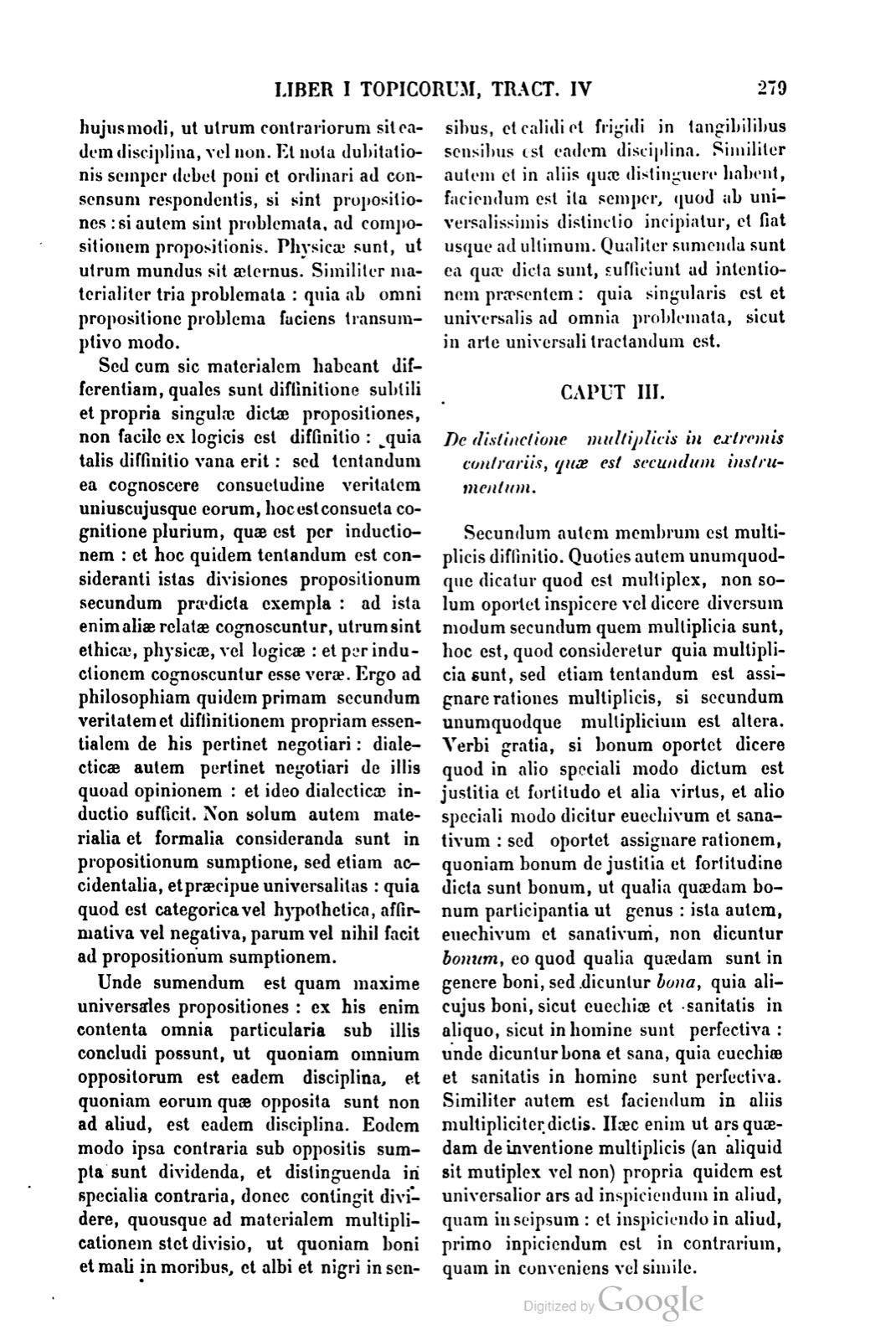
CAPUT III.
De distinctione multiplicis in extremis contrariis, quae est secundum instrumentum.
Secundum autem membrum est multiplicis diffinitio. Quoties autem unumquodque dicatur quod est multiplex, non solum oportet inspicere vel dicere diversum modum secundum quem multiplicia sunt, hoc est, quod consideretur quia multiplicia sunt, sed etiam tentandum est assignare rationes multiplicis, si secundum unumquodque multiplicium est altera. Verbi gratia, si bonum oportet dicere quod in alio speciali modo dictum est justitia et fortitudo et alia virtus, et alio speciali modo dicitur euechivum et sanativum: sed oportet assignare rationem, quoniam bonum de justitia et fortitudine dicta sunt bonum, ut qualia quaedam bonum participantia ut genus: ista autem, euechivum et sanativum, non dicuntur bonum, eo quod qualia quaedam sunt in genere boni, sed dicuntur bona, quia alicujus boni, sicut euechiae et sanitatis in aliquo, sicut in homine sunt perfectiva: unde dicuntur bona et sana, quia euechiae et sanitatis in homine sunt perfectiva. Similiter autem est faciendum in aliis multipliciter dictis. Haec enim ut ars quaedam de inventione multiplicis, an aliquid sit multiplex vel non, propria quidem est universalior ars ad inspiciendum in aliud, quam in seipsum: et inspiciendo in aliud, primo inspiciendum est in contrarium, quam in conveniens vel simile.
Dicamus igitur, quod utrum aliquid multipliciter vel simpliciter, hoc est, non multipliciter, dicitur specie, hoc est, secundum suam speciem et nomen speciei, per haec quae statim dicuntur, considerandum est. Primum quidem, hoc est, universaliori et meliori consideratione, perspiciendum est in contrario ipsius, utrum illud multipliciter dicitur, sive dissonet ab eo, ut contrarium a contrario, nomine uno est conveniens, specie formae dissonet, sive nomine diverso dissonet, et etiam specie nominis: quaedam enim contraria statim nominibus et figura vocis diversa, ut calidum et frigidum: quaedam etiam una figura vocis significantur: et de his post dicemus, ut acuto quidem quod in figura vocis cum acuto consonet in angulis et saporibus: sed acuto quidem in voce contrarium est grave: in magnitudine autem angulari acuto contrarium est obtusum sive hebes. Patet ergo quoniam contrarium acuto in communitate vocis accepto dicitur multipliciter et diversa ratione. Si autem contrarium multipliciter dicitur et in diversa ratione ad unum, et in diversa ratione ad aliud opponitur alteri, et unius uno modo dicti non sunt diversae rationes, jam secundum utrumque horum diversum et oppositum in ratione diversa erit contrarium. Rursum alio exemplo hoc considerandum. Gravi in voce acutum in voce est contrarium: gravi in magnitudine, quod vocatur grave mole magnitudinis, est contrarium non acutum, sed leve. Propter quod per eamdem considerationem rationum multipliciter secundum aequivocationem grave dicitur: ideo quia contrarium ipsius multipliciter diversis vocibus dicitur, quia in multis est non figura nominis convenientibus. Similiter est in alio exemplo de bono sive de boni multitudine: et haec multiplicitas non est boni ut est bonum, sed est boni hujus: si quidem bono ut est animalis, quod est animalis naturale bonum, opponitur faedum: secundum hoc enim bonum animalis est pulchrum in commensuratione partium, et compositione humanorum ad aequale suae naturae: ei vero bono quod est in domo, opponitur pestilens.
CHAPTER III.
On the distinction of the multiple in contrary extremes, which belongs to the second instrument.
But the second member is the definition of the multiple. As to how many times each thing that is multiple is said, one must not only inspect or say the diverse mode according to which things are multiple, that is, consider that they are multiple, but one must also try to assign the accounts of the multiple, if according to each of the multiple things there is another account. For example, if it is necessary to say that the good, which in one special mode is called justice and fortitude and another virtue, and in another special mode is called what makes good condition and what makes health; but one must assign the account, because good said of justice and fortitude is called good as certain qualities participating in good as a genus. But those things, what makes good condition and what makes health, are not called good because they are certain qualities in the genus of good, but are called good because they are perfective of some good, such as good condition and health in someone, as in a human being; hence they are called good and healthy because they are perfective of good condition and health in a human being. The same must be done in other things said multiply. For this, as a certain art concerning the discovery of the multiple, whether something is multiple or not, is indeed a more universal art for inspecting into another thing than into itself; and in inspecting into another thing, one must first inspect into the contrary rather than into the agreeing or similar.
Therefore let us say that whether something is said multiply or simply, that is, not multiply, in species, that is, according to its species and the name of species, must be considered through these things which are said immediately. First, by the more universal and better consideration, one must look into its contrary, whether that is said multiply, or whether it differs from it as contrary from contrary, agreeing in one name but differing in species of form, or whether it differs by diverse name and also by species of name. For certain contraries are immediately diverse in names and figure of voice, as hot and cold; certain things also are signified by one figure of voice, and of these we shall speak afterward, as with sharp, which in figure of voice agrees with sharp in angles and flavors; but to sharp in voice the contrary is grave, while in angular magnitude the contrary of sharp is obtuse or blunt. Therefore it is plain that the contrary of sharp, taken in the community of voice, is said multiply and by diverse account. But if a contrary is said multiply and is opposed to one thing in a diverse account and to another thing in a diverse account, and the accounts of one thing said in one way are not diverse, then according to each of these the diverse and opposed thing in diverse account will be a contrary. Again, this must be considered in another example. To grave in voice, sharp in voice is contrary; to grave in magnitude, which is called grave by the mass of magnitude, the contrary is not sharp but light. On account of this, through the same consideration of accounts, grave is said multiply according to equivocation: because its contrary is said multiply by diverse words, since in many things the figure of name is not agreeing. It is similar in another example concerning good or concerning the multitude of good; and this multiplicity is not of good as it is good, but is of this good. If indeed, to good as it belongs to animal, which is the natural good of animal, foul is opposed; for according to this the good of animal is beautiful in the commensuration of parts and in the composition of human things toward what is equal to its nature. But to the good that is in a house, pestilential is opposed.
[Marginal label, printed page 280: Bona domus quae sit.]
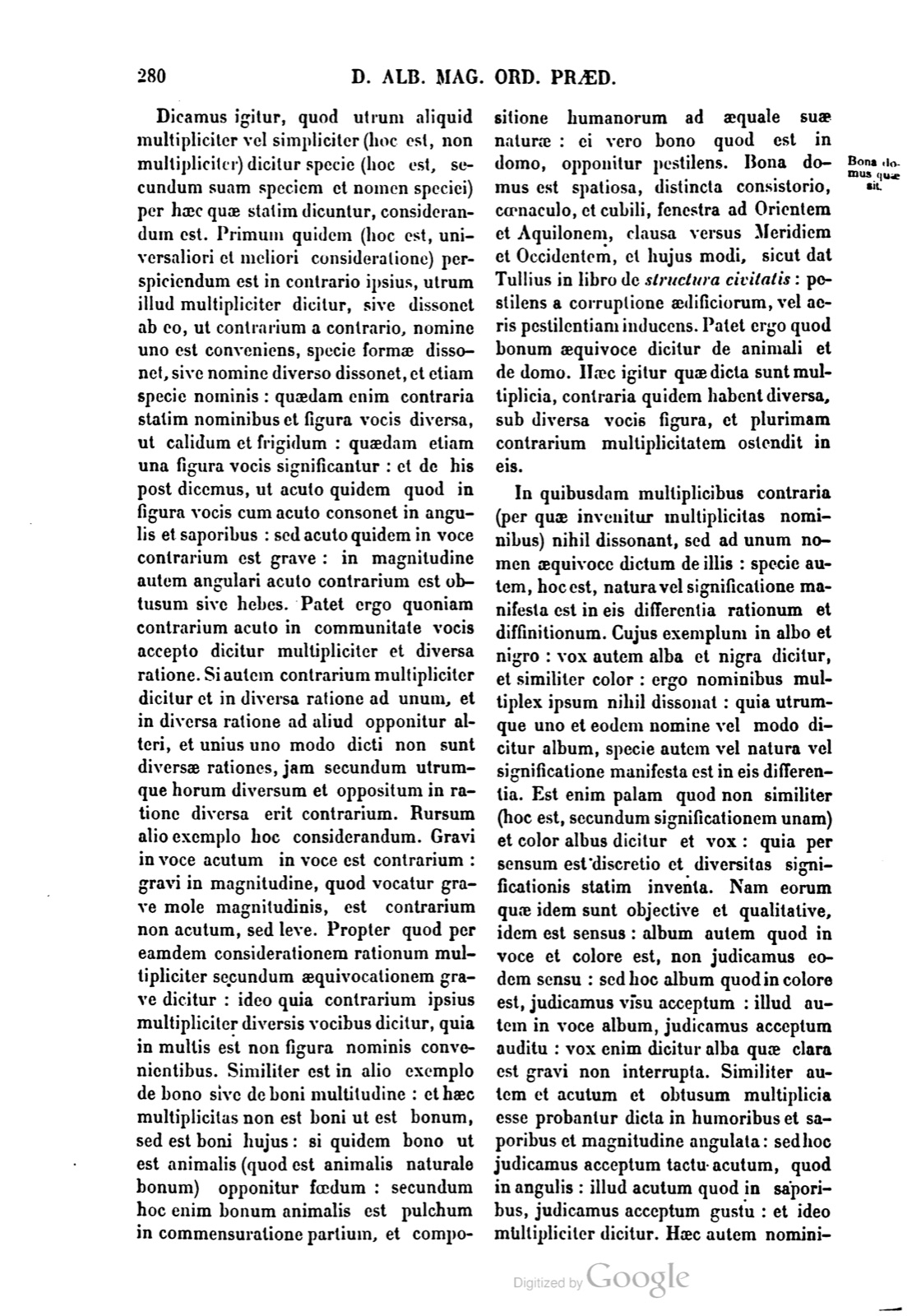
Bona domus est spatiosa, distincta consistorio, coenaculo, et cubili, fenestra ad Orientem et Aquilonem, clausa versus Meridiem et Occidentem, et hujusmodi, sicut dat Tullius in libro de structura civitatis: pestilens a corruptione aedificiorum, vel acris pestilentiam inducens. Patet ergo quod bonum aequivoce dicitur de animali et de domo. Haec igitur quae dicta sunt multiplicia, contraria quidem habent diversa, sub diversa vocis figura, et plurimam etiam contrarium multiplicitatem ostendit in eis.
In quibusdam multiplicibus contraria, per quae invenitur multiplicitas nominibus, nihil dissonant, sed ad unum nomen aequivoce dictum de illis: specie autem, hoc est, natura vel significatione manifesta est in eis differentia rationum et diffinitionum. Cujus exemplum in albo et nigro: vox autem alba et nigra dicitur, et similiter color: ergo nominibus multiplex ipsum nihil dissonat: quia utrumque uno et eodem nomine vel modo dicitur album, specie autem vel natura vel significatione manifesta est in eis differentia. Est enim palam quod non similiter, hoc est, secundum significationem unam, et color albus dicitur et vox: quia per sensum est discretio et diversitas significationis statim inventa. Nam eorum quae idem sunt objective et qualitative, idem est sensus: album autem quod in voce et colore est, non judicamus eodem sensu: sed hoc album quod in colore est, judicamus visu acceptum: illud autem in voce album, judicamus acceptum auditu: vox enim dicitur alba quae clara est gravi non interrupta. Similiter autem et acutum et obtusum multiplicia esse probantur dicta in humoribus et saporibus et magnitudine angulata: sed hoc judicamus acceptum tactu acutum, quod in angulis: illud acutum quod in saporibus, judicamus acceptum gustu: et ideo multipliciter dicitur.
[Marginal label, printed page 280: What a good house is.]
A good house is spacious, distinguished by sitting-room, dining-room, and bedroom, with window toward East and North, closed toward South and West, and things of this kind, as Tullius gives in the book On the Structure of the City; pestilential comes from corruption of buildings, or from air inducing pestilence. Therefore it is plain that good is said equivocally of animal and of house. Therefore these things that are said to be multiple have diverse contraries under a diverse figure of voice, and the contrary also shows very great multiplicity in them.
In certain multiple things the contraries, through which multiplicity is found in names, differ in nothing, but are related to one name said equivocally of those things; but in species, that is, in nature or manifest signification, there is in them a difference of accounts and definitions. An example of this is in white and black: voice is called white and black, and similarly color; therefore the multiple itself differs in nothing by names, because each is called white by one and the same name or mode, but in species or nature or manifest signification there is a difference in them. For it is plain that color and voice are not called white similarly, that is, according to one signification, because through sense a distinction and diversity of signification is immediately found. For of those things that are the same objectively and qualitatively, the sense is the same; but we do not judge the white which is in voice and color by the same sense. Rather we judge this white which is in color as received by sight; but that white in voice we judge as received by hearing. For a voice is called white when it is clear and not interrupted by a grave sound. Likewise both sharp and obtuse are proved to be said multiply in humors and flavors and angular magnitude; but we judge this sharp, which is in angles, as received by touch; that sharp which is in flavors we judge as received by taste; and therefore it is said multiply.
If a page does not appear, its photograph has not been uploaded yet.