Volume 2 · pp. 272–275
CHAPTER IV. On the species of dialectical reasoning.
A marker with ≈ is an approximate page boundary, placed by measure of the text; the page photographs remain the authority. In the paired views, clicking a page marker brings that page into view.
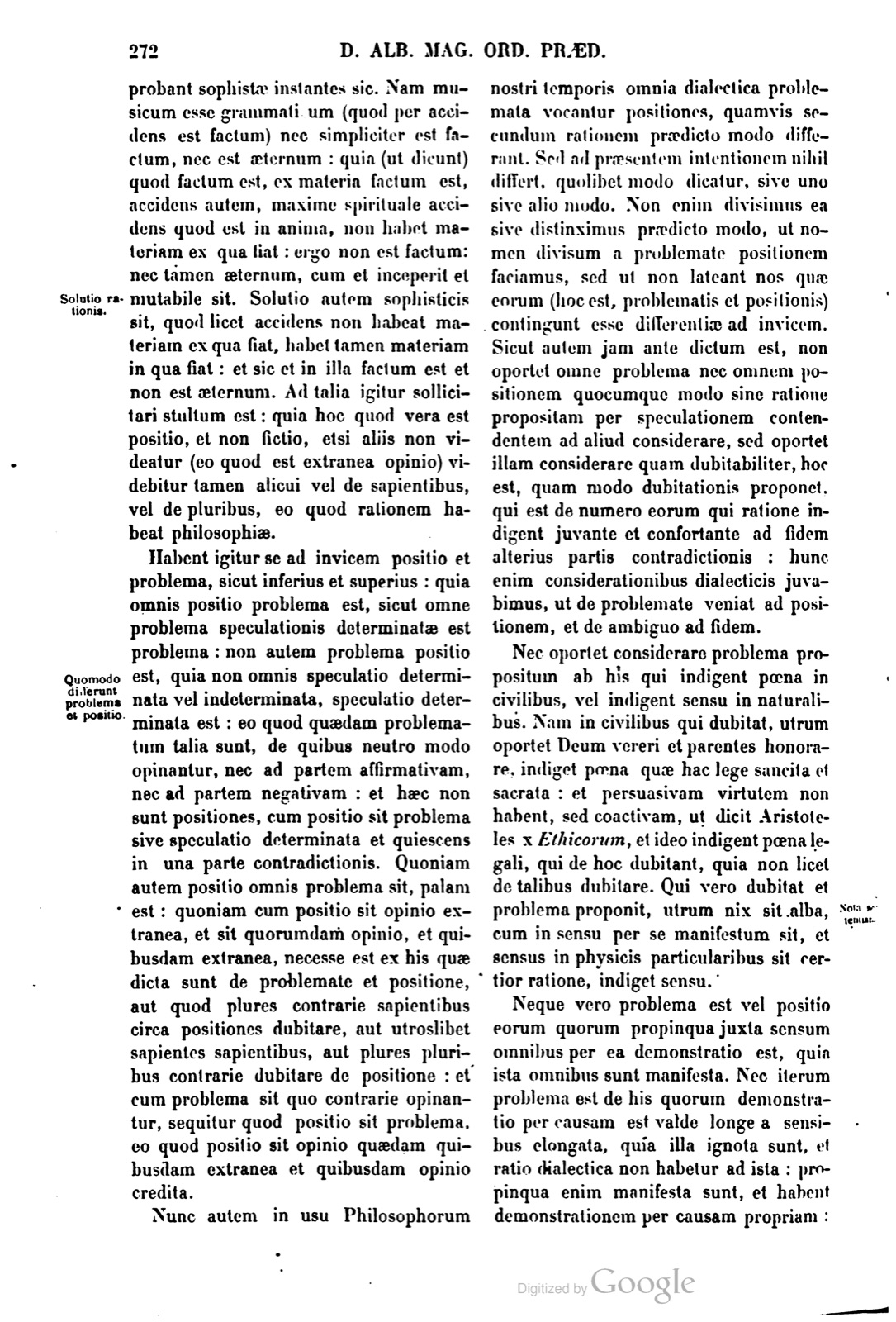
ista vero quae longe distant, sunt plus elongata a nobis, quam quod ad ista argumentari valeamus secundum exercitativam potestatem, ad quam est dialectica. Hoc tamen notandum quod hic valde stricte sumitur positio et pro probabili opinione inhaerente intrinsece hic diffinitur: et ideo dicitur quod de nulla positione possumus neutro modo opinari, quia positio est opinio firmata in uno. In octavo autem in sequentibus hujus scientiae accipietur positio in communi ad probabile et improbabile et neutrum de quo contrarie aliquis potest opinari. Hoc autem in sequentibus et modicum in propriis locis est hujus scientiae.
CAPUT IV.
De speciebus ratiocinationis dialecticae.
Habitis autem jam principiis incomplexis et complexis integralibus ratiocinationis dialecticae, nunc determinandum est de partibus ejus subjectivis, in quas ut in species dividitur ratiocinatio dialectica. Determinatis enim his quae ut complexa et incomplexa integrando constituunt ratiocinationem dialecticam, oportet determinare quot et quae dialecticarum ratiocinationum sunt species. Quae non ideo dicuntur species, quod ex aequo dividant ratiocinationem dialecticam: quia syllogismus per prius participat nomen ratiocinationis dialecticae, et inductio per posterius: sed ideo dicuntur species, quia sunt modi ejusdem ratiocinationis communitate analogiae dictae de ipsis. Est autem haec una quaedam species ratiocinationis dialecticae inductio, illa vero syllogismus. Et quidam volunt exemplum contineri sub inductione, enthymema vero sub syllogismo: sed non oportet cum non accipiantur hic species ratiocinationis similiter sicut in secundo Priorum, sed tantum species ratiocinationis dialecticae et completae: et prius quidem in ante habitis dictum est quid syllogismus est dialecticus.
Inductio autem est a singularibus in universalia progressio. Quia vero inductio non nominat orationem, vel orationum collectionem sicut syllogismus, ideo oratio non ponitur in sua diffinitione in genere orationis sicut in syllogismo, sed nomine suo nominat motum ductionis: et ideo dicitur progressio, hoc est, ab inferiore ad superius egressio. Motus autem iste incipit a singularibus, non uno, sed omnibus divisim acceptis, vel per se, vel ut dicatur, et sic de singulis. Terminus vero ad quem est universalia, quae ideo pluraliter dicuntur a singularibus ad universalia progredi, et non dicitur ad universale: quia multiplex est universale: est enim universale rei et vocis per signum distributivum, et est universale intellectus, quod secundum se a singularibus collectum accipitur: et in omni sive in qualibet inductione est progressio in inductione ad universalia et non ad unum universale, hoc est, uno modo acceptum.
But those things which are far distant are more removed from us than that we might be able to argue toward them according to the exercitative power for which dialectic exists. Yet this must be noted, that here position is taken very strictly and here is defined as probable opinion inhering intrinsically; and therefore it is said that concerning no position can we opine in neither way, because position is an opinion fixed in one. But in the eighth book, in what follows in this science, position will be taken commonly for the probable, the improbable, and the neutral concerning which someone can opine contrarily. But this belongs in what follows, and a little here in the proper places of this science.
CHAPTER IV.
On the species of dialectical reasoning.
Now that the incomplex and complex integral principles of dialectical reasoning have been had, one must determine concerning its subjective parts, into which dialectical reasoning is divided as into species. For after those things have been determined which, as complex and incomplex, constitute dialectical reasoning by integrating it, one must determine how many and what the species of dialectical reasonings are. They are not called species because they divide dialectical reasoning equally: because syllogism participates in the name of dialectical reasoning priorly, and induction posteriorly; but they are called species because they are modes of the same reasoning in the community of analogy said of them. Now one certain species of dialectical reasoning is induction, and the other is syllogism. And certain people wish example to be contained under induction, but enthymeme under syllogism; but this is not necessary, since here species of reasoning are not taken in the same way as in the second book of the Prior Analytics, but only as species of dialectical and complete reasoning; and indeed in the things had before it was said what a dialectical syllogism is.
But induction is a progression from singulars into universals. But because induction does not name a speech or collection of speeches as syllogism does, therefore speech is not placed in its definition under the genus of speech as in syllogism, but by its own name it names the motion of leading; and therefore it is called progression, that is, a going-out from the lower to the higher. But this motion begins from singulars, not one, but all taken separately, or through themselves, or as it may be said, and thus concerning the singulars. But the term to which it goes is universals, which are therefore said in the plural, to progress from singulars to universals, and it is not said to progress to a universal, because universal is multiple: for there is a universal of thing and of word through a distributive sign, and there is a universal of intellect, which is taken according to itself as collected from singulars; and in every, or in any, induction there is a progression in induction to universals and not to one universal, that is, accepted in one mode.
[Marginal label, printed page 273: Quare inductio est progressio.]
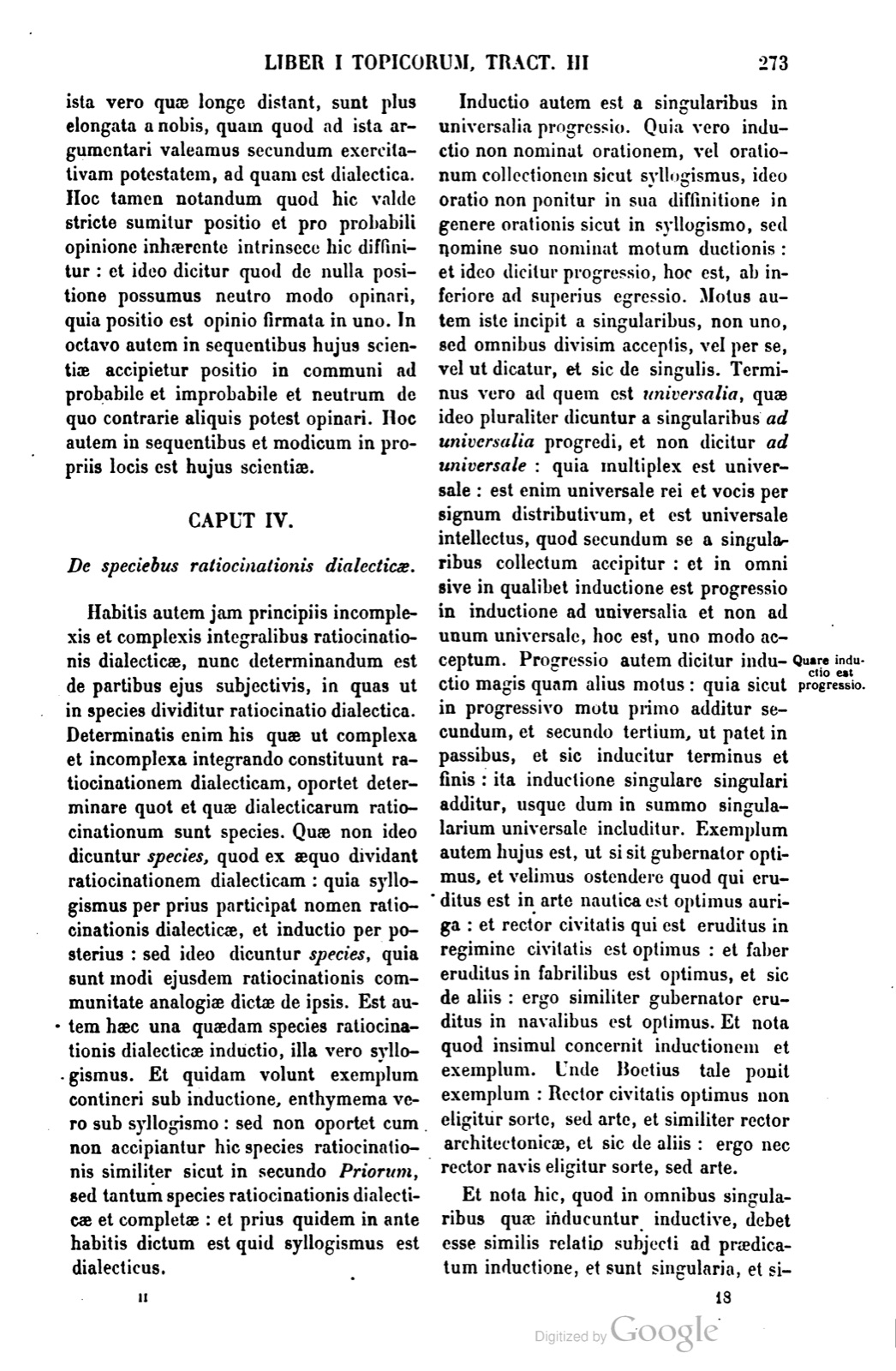
Progressio autem dicitur inductio magis quam alius motus: quia sicut in progressivo motu primo additur secundum, et secundo tertium, ut patet in passibus, et sic inducitur terminus et finis: ita inductione singulare singulari additur, usque dum in summo singularium universale includitur. Exemplum autem hujus est, ut si sit gubernator optimus, et velimus ostendere quod qui eruditus est in arte nautica est optimus auriga: et rector civitatis qui est eruditus in regimine civitatis est optimus: et faber eruditus in fabrilibus est optimus, et sic de aliis: ergo similiter gubernator eruditus in navalibus est optimus. Et nota quod insimul concernit inductionem et exemplum. Unde Boetius tale ponit exemplum: Rector civitatis optimus non eligitur sorte, sed arte, et similiter rector architectonicae, et sic de aliis: ergo nec rector navis eligitur sorte, sed arte. Et nota hic, quod in omnibus singularibus quae inducuntur inductive, debet esse similis relatio subjecti ad praedicatum inductione, et sunt singularia, et similitudo.
Et quoad singularia quae sensibus offeruntur, dicitur quod inductio quoad nos est verisimilior quam syllogismus, et non dicitur verior. Ratione autem similitudinis quae est inter singularia partiendo praedicatum, dicitur planior, quia in aeque se habent quoad praedicatum singularia, et nullum alteri supereminet. Sicut diffiniens planum dixit Plato, quod planum est cujus partes partibus in aeque se habent. In syllogismo autem una propositio est ut major, et altera ut minor sub majori stans, et non aeque, sed coarctans eam. Secundo autem quia sensibus percipiuntur et objiciuntur singularia, dicitur inductio secundum sensum notior: propter quod etiam inductione ex singularibus collatis ad universale infertur universale, et sic principium sunt, et universale illatum vel principiatum.
[Marginal label, printed page 273: Why induction is progression.]
But progression is called induction more than another motion, because just as in progressive motion the second is first added, and to the second the third, as is plain in steps, and thus the term and end is induced, so in induction singular is added to singular until in the summit of singulars the universal is included. An example of this is that, if there is a best governor and we wish to show that he who is trained in the nautical art is the best pilot, and that the ruler of a city who is trained in the rule of a city is best, and that a craftsman trained in crafts is best, and so concerning others, therefore similarly a governor trained in naval matters is best. And note that at the same time this concerns induction and example. Hence Boethius places such an example: the best ruler of a city is not chosen by lot but by art, and similarly the ruler of architecture, and so concerning others; therefore neither is the ruler of a ship chosen by lot but by art. And note here that in all the singulars which are introduced inductively, there ought to be a similar relation of subject to predicate in the induction, and there are singulars, and likeness.
And with respect to singulars that are offered to the senses, it is said that induction with respect to us is more truthlike than syllogism, and it is not said to be truer. But by reason of the likeness which exists among singulars by distributing the predicate, it is called plainer, because the singulars have themselves equally with respect to the predicate, and none stands above another. Just as Plato, defining plane, said that plane is that whose parts have themselves equally to parts. But in a syllogism one proposition is as major, and the other as minor standing under the major, and not equally, but narrowing it. Secondly, because singulars are perceived and placed before the senses, induction is said to be better known according to sense; on account of this, also by induction from singulars compared to a universal the universal is inferred, and thus they are a principle, and the universal is what is inferred or principled.
[Marginal label, printed page 274: Quare inductio dicitur pluribus communis.]
Quia autem plures sequuntur judicium sensus, ideo inductio in pluribus communis est, syllogismus autem sapientibus. Syllogismus autem e converso procedens a toto ad partem, violentior est inferendo et probando: quia pars ex toto infertur quae virtute est in toto, et totum habet influentiam entitatis super partem, et non e converso: et ad contradictiones in obviationibus sive contradictorias conclusiones per syllogismum ad impossibile ducentem, efficacior quam inductio: et ideo ratione ostensivi syllogismi dicitur violentior: quia obligatione principiorum concludit, et ratione syllogismi ad impossibile dicitur ad contradicendum efficacior.
[Marginal label, printed page 274: Sufficientia rationum dialecticarum.]
Via igitur in ratione dialectica: aut est ex prioribus quoad nos, aut ex prioribus secundum naturam. Primo quidem modo aut est completa, aut incompleta. Si completa, sic est a singularibus ad universalia universaliter accepta, et est inductio. Si autem est incompleta, tunc est de parte ad partem, sive de singulari ad singulare, et est exemplum quod sub inductione continetur. Si autem sit ex prioribus secundum naturam, aut completa, aut incompleta in medio et principiis. Si completa, est syllogismus. Si incompleta, est enthymema quod sub syllogismo continetur.
[Marginal label, printed page 274: Alia sufficientia.]
Vel sic: omnis processus vel est a parte ad totum, vel a toto ad partem. Si est a parte ad totum: aut est processus ad terminum, vel ad medium. Primo modo est inductio, secundo modo exemplum. Similiter processus a toto ad partem: aut cum determinatione et contradictione totius ad determinatam partem, et sic est syllogismus in quo minor contrahit et determinat majorem, ut patet cum dicitur: omne animal currit: omnis homo est animal: ergo omnis homo currit. In quo animal determinatur in minori ad hominem, et sic de homine concluditur. Aut est sine determinatione totius, et sic est enthymema. Non est autem processus a toto ad totum: quia inter totum et totum non est aliud continuans: processus autem omnis in aliquo continuante motum vult esse processus, non de toto ad partem: est enim forma totius continens partem. Processus autem de partibus ad totum, est iterum in forma totius collecta ex partibus, et processus de parte ad partem in forma totius secundum unum modum sparsa in partibus. In forma autem partis non est alius processus, quia forma partis non est commune continens, sed singulare distinctum et segregatum.
[Marginal label, printed page 274: Why induction is called common to more people.]
But because more people follow the judgment of sense, therefore induction is common among more people, but syllogism among the wise. But syllogism, proceeding conversely from whole to part, is more violent in inferring and proving, because the part is inferred from the whole, which is virtually in the whole, and the whole has an influence of being upon the part, and not conversely; and for contradictions in objections or contradictory conclusions by a syllogism leading to the impossible, it is more efficacious than induction. And therefore by reason of demonstrative syllogism it is called more violent, because it concludes by the obligation of principles; and by reason of syllogism to the impossible it is said to be more efficacious for contradicting.
[Marginal label, printed page 274: Sufficiency of dialectical reasonings.]
Therefore the way in dialectical reasoning is either from things prior with respect to us, or from things prior according to nature. In the first way, indeed, it is either complete or incomplete. If complete, then it is from singulars to universals universally accepted, and it is induction. But if it is incomplete, then it is from part to part, or from singular to singular, and it is example, which is contained under induction. But if it is from things prior according to nature, it is either complete or incomplete in middle and principles. If complete, it is syllogism. If incomplete, it is enthymeme, which is contained under syllogism.
[Marginal label, printed page 274: Another sufficiency.]
Or thus: every process is either from part to whole, or from whole to part. If it is from part to whole, then either it is a process to a term, or to a middle. In the first way it is induction, in the second way example. Similarly, a process from whole to part is either with determination and contradiction of the whole to a determinate part, and thus it is syllogism, in which the minor contracts and determines the major, as is plain when it is said: every animal runs; every man is an animal; therefore every man runs. In this, animal is determined in the minor to man, and thus it is concluded concerning man. Or it is without determination of the whole, and thus it is enthymeme. But there is not a process from whole to whole, because between whole and whole there is not another thing continuing it; but every process wishes to be a process in something continuing motion, not from whole to part: for there is a form of the whole containing the part. But a process from parts to whole is again in the form of the whole collected from parts, and a process from part to part is in the form of the whole spread in the parts according to one mode. But in the form of the part there is no other process, because the form of the part is not a common containing thing, but a distinct and segregated singular.
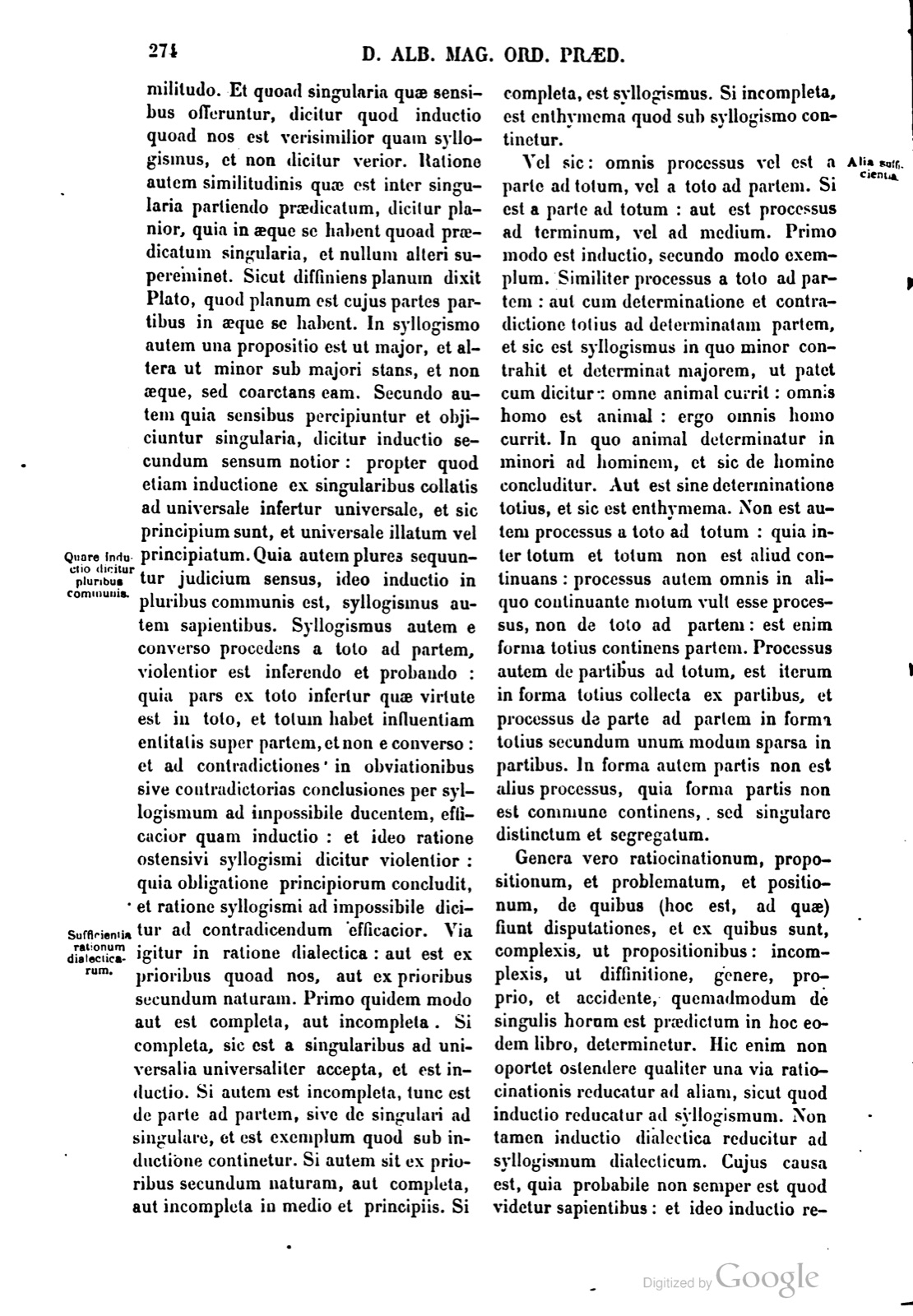
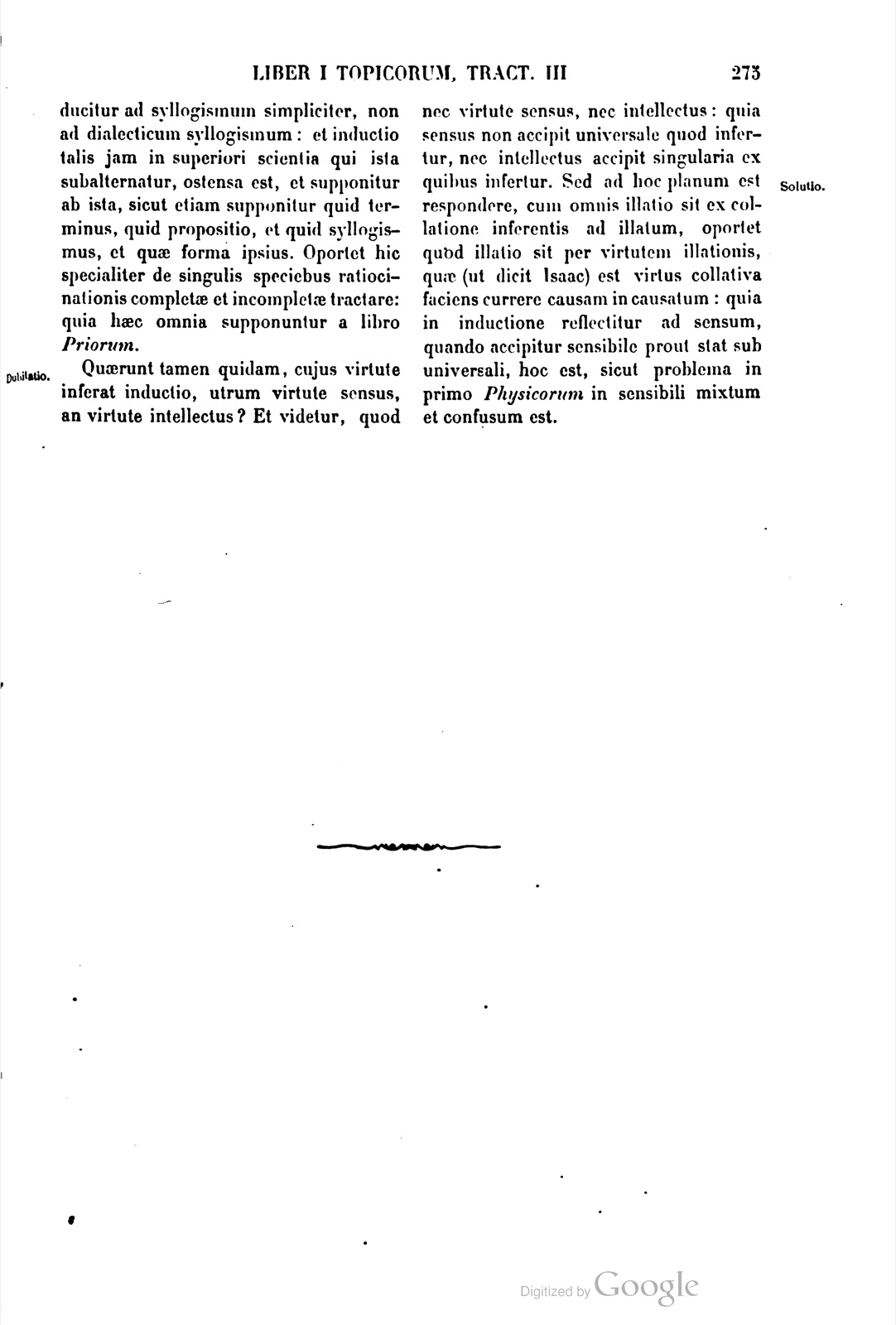
Genera vero ratiocinationum, propositionum, et problematum, et positionum, de quibus, hoc est, ad quae, fiunt disputationes, et ex quibus sunt, est ex complexis, ut propositionibus: incomplexis, ut diffinitione, genere, proprio, et accidente, quemadmodum de singulis horum est praedictum in hoc eodem libro, determinetur. Hic enim non oportet ostendere qualiter una via ratiocinationis reducatur ad aliam, sicut quod inductio reducatur ad syllogismum. Non tamen inductio dialectica reducitur ad syllogismum dialecticum. Cujus causa est, quia probabile non semper est quod videtur sapientibus: et ideo inductio reducitur ad syllogismum simpliciter, non ad dialecticum syllogismum: et inductio talis jam in superiori scientia cui ista subalternatur, ostensa est, et supponitur ab ista, sicut etiam supponitur quid terminus, quid propositio, et quid syllogismus, et quae forma ipsius. Oportet hic specialiter de singulis speciebus ratiocinationis completae et incompletae tractare: quia haec omnia supponuntur a libro Priorum.
[Marginal label, printed page 275: Dubitatio.]
Quaerunt tamen quidam, cujus virtute inferat inductio, utrum virtute sensus, an virtute intellectus? Et videtur, quod nec virtute sensus, nec intellectus: quia sensus non accipit universale quod infertur, nec intellectus accipit singularia ex quibus infertur.
[Marginal label, printed page 275: Solutio.]
Sed ad hoc planum est respondere, cum omnis illatio sit ex collatione inferentis ad illatum, oportet quod illatio sit per virtutem illationis, quae, ut dicit Isaac, est virtus collativa faciens currere causam in causatum: quia in inductione reflectitur ad sensum, quando accipitur sensibile prout stat sub universali, hoc est, sicut problema in primo Physicorum in sensibili mixtum et confusum est.
But let the genera of reasonings, propositions, problems, and positions, concerning which, that is, toward which, disputations are made, and from which they are, be determined from complexes, as from propositions, and from incomplexes, as from definition, genus, proper, and accident, just as it has been said beforehand concerning the individual ones of these in this same book. For here it is not necessary to show how one way of reasoning is reduced to another, as that induction is reduced to syllogism. Yet dialectical induction is not reduced to dialectical syllogism. The cause of this is that the probable is not always what seems so to the wise; and therefore induction is reduced to syllogism simply, not to dialectical syllogism. And such induction has already been shown in the higher science to which this one is subordinated, and is supposed by this one, just as it is also supposed what a term is, what a proposition is, what a syllogism is, and what its form is. Here one must treat specially of the individual species of complete and incomplete reasoning, because all these are supposed from the book of the Prior Analytics.
[Marginal label, printed page 275: Doubt.]
Nevertheless certain people ask by whose power induction infers, whether by the power of sense or by the power of intellect. And it seems that it infers neither by the power of sense nor of intellect, because sense does not receive the universal that is inferred, nor does intellect receive the singulars from which it is inferred.
[Marginal label, printed page 275: Solution.]
But to this it is plain to respond, since every inference is from the comparing of the inferring thing to the inferred thing, that the inference must be through the power of inference, which, as Isaac says, is a collative power making the cause run into the caused: because in induction one is reflected back to sense when the sensible is received as it stands under the universal, that is, as a problem in the first book of the Physics is mixed and confused in the sensible.
If a page does not appear, its photograph has not been uploaded yet.