Volume 2 · pp. 269–271
CHAPTER II. On the problem, what it is and of what kind of division it is.
A marker with ≈ is an approximate page boundary, placed by measure of the text; the page photographs remain the authority. In the paired views, clicking a page marker brings that page into view.
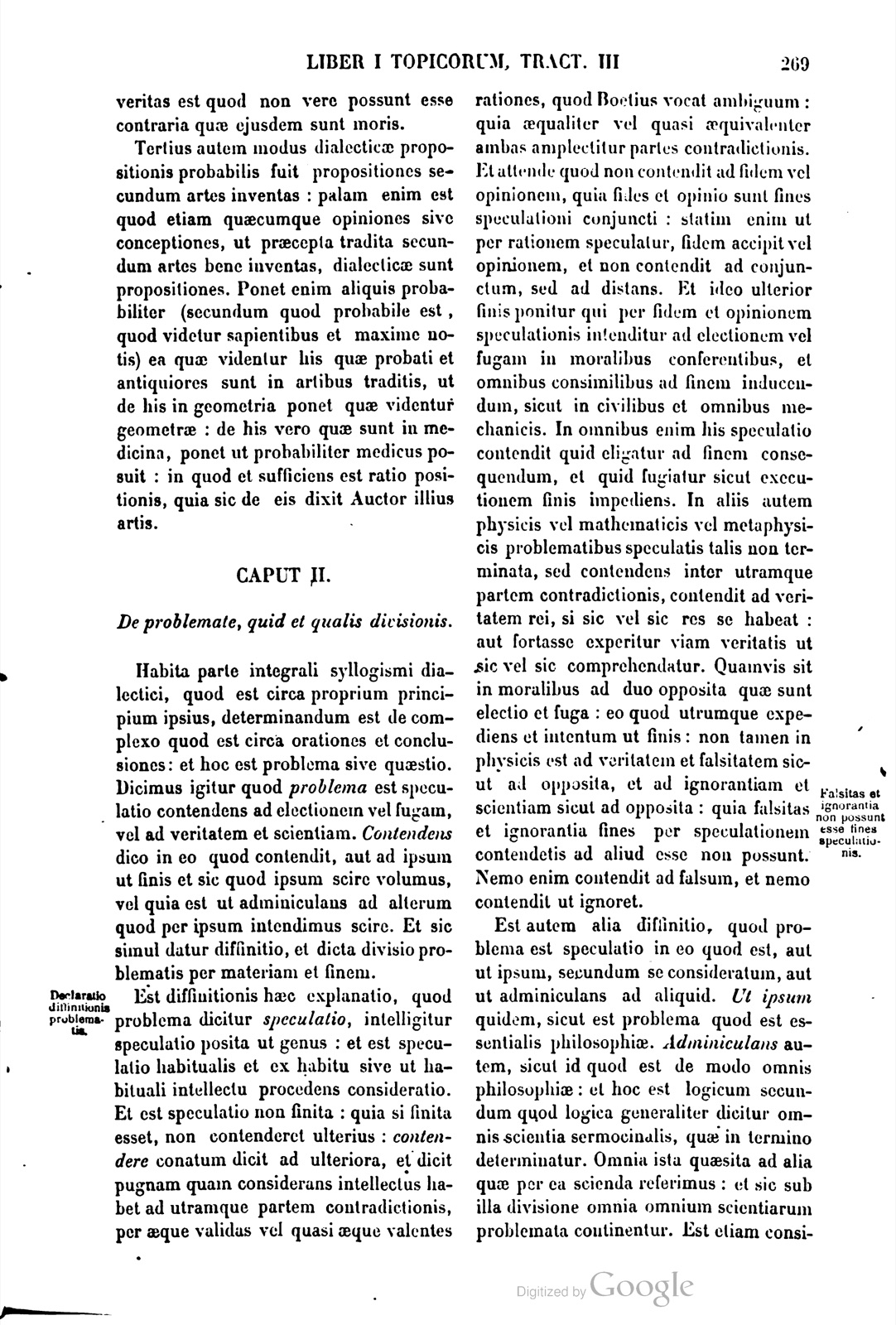
veritas est quod non vere possunt esse contraria quae ejusdem sunt moris.
Tertius autem modus dialecticae propositionis probabilis fuit propositiones secundum artes inventas: palam enim est quod etiam quaecumque opiniones sive conceptiones, ut praecepta tradita secundum artes bene inventas, dialecticae sunt propositiones. Ponet enim aliquis probabiliter, secundum quod probabile est quod videtur sapientibus et maxime notis, ea quae videntur his quae probati et antiquiores sunt in artibus traditis, ut de his in geometria ponet quae videntur geometrae; de his vero quae sunt in medicina, ponet ut probabiliter medicus posuit: in quod et sufficiens est ratio positionis, quia sic de eis dixit Auctor illius artis.
CAPUT II.
De problemate, quid et qualis divisionis.
Habita parte integrali syllogismi dialectici, quod est circa proprium principium ipsius, determinandum est de complexo quod est circa orationes et conclusiones: et hoc est problema sive quaestio. Dicimus igitur quod problema est speculatio contendens ad electionem vel fugam, vel ad veritatem et scientiam. Contendens dico in eo quod contendit, aut ad ipsum ut finis, et sic quod ipsum scire volumus, vel quia est ut adminiculans ad alterum quod per ipsum intendimus scire. Et sic simul datur diffinitio, et dicta divisio problematis per materiam et finem.
[Marginal label, printed page 269: Declaratio diffinitionis problematis.]
Est diffinitionis haec explanatio, quod problema dicitur speculatio, intelligitur speculatio posita ut genus: et est speculatio habitualis et ex habitu sive ut habituali intellectu procedens consideratio. Et est speculatio non finita: quia si finita esset, non contenderet ulterius. Contendere conatum dicit ad ulteriora, et dicit pugnam quam considerans intellectus habet ad utramque partem contradictionis, per aeque validas vel quasi aeque valentes rationes, quod Boetius vocat ambiguum: quia aequaliter vel quasi aequivalenter ambas amplectitur partes contradictionis. Et attende quod non contendit ad fidem vel opinionem, quia fides et opinio sunt fines speculationi conjuncti: statim enim ut per rationem speculatur, fidem accipit vel opinionem, et non contendit ad conjunctum, sed ad distans. Et ideo ulterior finis ponitur qui per fidem et opinionem speculationis intenditur ad electionem vel fugam in moralibus conferentibus, et omnibus consimilibus ad finem inducendum, sicut in civilibus et omnibus mechanicis. In omnibus enim his speculatio contendit quid eligatur ad finem consequendum, et quid fugiatur sicut executionem finis impediens. In aliis autem physicis vel mathematicis vel metaphysicis problematibus speculatis talis non terminata, sed contendens inter utramque partem contradictionis, contendit ad veritatem rei, si sic vel sic res se habeat: aut fortasse experitur viam veritatis ut sic vel sic comprehendatur. Quamvis sit in moralibus ad duo opposita quae sunt electio et fuga, eo quod utrumque expediens et intentum ut finis, non tamen in physicis est ad veritatem et falsitatem sicut ad opposita, et ad ignorantiam et scientiam sicut ad opposita: quia falsitas et ignorantia fines per speculationem contendentis ad aliud esse non possunt. Nemo enim contendit ad falsum, et nemo contendit ut ignoret.
truth is that things which are of the same manner cannot truly be contraries.
The third mode of a probable dialectical proposition was propositions according to discovered arts: for it is plain that any opinions or conceptions whatever, as precepts handed down according to arts well discovered, are dialectical propositions. For someone will posit as probable, according as the probable is what seems so to the wise and especially to the notable, those things that seem so to those approved and older in the arts handed down; as concerning matters in geometry he will posit the things that seem so to the geometer, but concerning the things that are in medicine he will posit what the physician has probably posited. And in this there is a sufficient reason of position, because the author of that art spoke thus concerning them.
CHAPTER II.
On the problem, what it is and of what kind of division it is.
Having had the integral part of the dialectical syllogism, which is about its proper principle, one must determine concerning the complex thing that is about speeches and conclusions; and this is a problem or question. Therefore we say that a problem is speculation contending toward choice or flight, or toward truth and knowledge. I say "contending" in this, that it contends either toward the very thing as an end, and thus because we wish to know the very thing, or because it is as something assisting another thing which through it we intend to know. And thus at the same time the definition is given, and the stated division of problem by matter and end.
[Marginal label, printed page 269: Explanation of the definition of problem.]
This is the explanation of the definition: when problem is called speculation, speculation is understood as placed as the genus; and it is habitual speculation and consideration proceeding from a habit or as from habitual understanding. And it is not finished speculation, because if it were finished, it would not contend further. To contend says an effort toward further things, and says the struggle that the considering intellect has toward each part of the contradiction, through equally valid or almost equally valid reasons, which Boethius calls ambiguous, because it equally or almost equivalently embraces both parts of the contradiction. And attend that it does not contend toward faith or opinion, because faith and opinion are ends joined to speculation; for immediately, as one speculates through reason, he receives faith or opinion, and he does not contend toward what is joined but toward what is distant. And therefore a further end is posited, which through faith and opinion of speculation is intended toward choice or flight in moral matters that confer, and in all similar things leading to an end, as in civil and all mechanical matters. For in all these, speculation contends about what is to be chosen for attaining the end, and what is to be fled as impeding the execution of the end. But in other physical or mathematical or metaphysical problems speculated upon, such speculation, not terminated but contending between each part of the contradiction, contends toward the truth of the thing, whether the thing has itself thus or thus; or perhaps it tests the way of truth, so that it may be comprehended thus or thus. Although in moral matters it is toward two opposites, which are choice and flight, because each is expedient and intended as an end, nevertheless in physical matters it is not toward truth and falsity as toward opposites, and toward ignorance and knowledge as toward opposites, because falsity and ignorance cannot be ends through the speculation of one contending toward another thing. For no one contends toward the false, and no one contends so that he may be ignorant.
[Marginal label, printed page 269: Falsitas et ignorantia non possunt esse fines speculationis.]
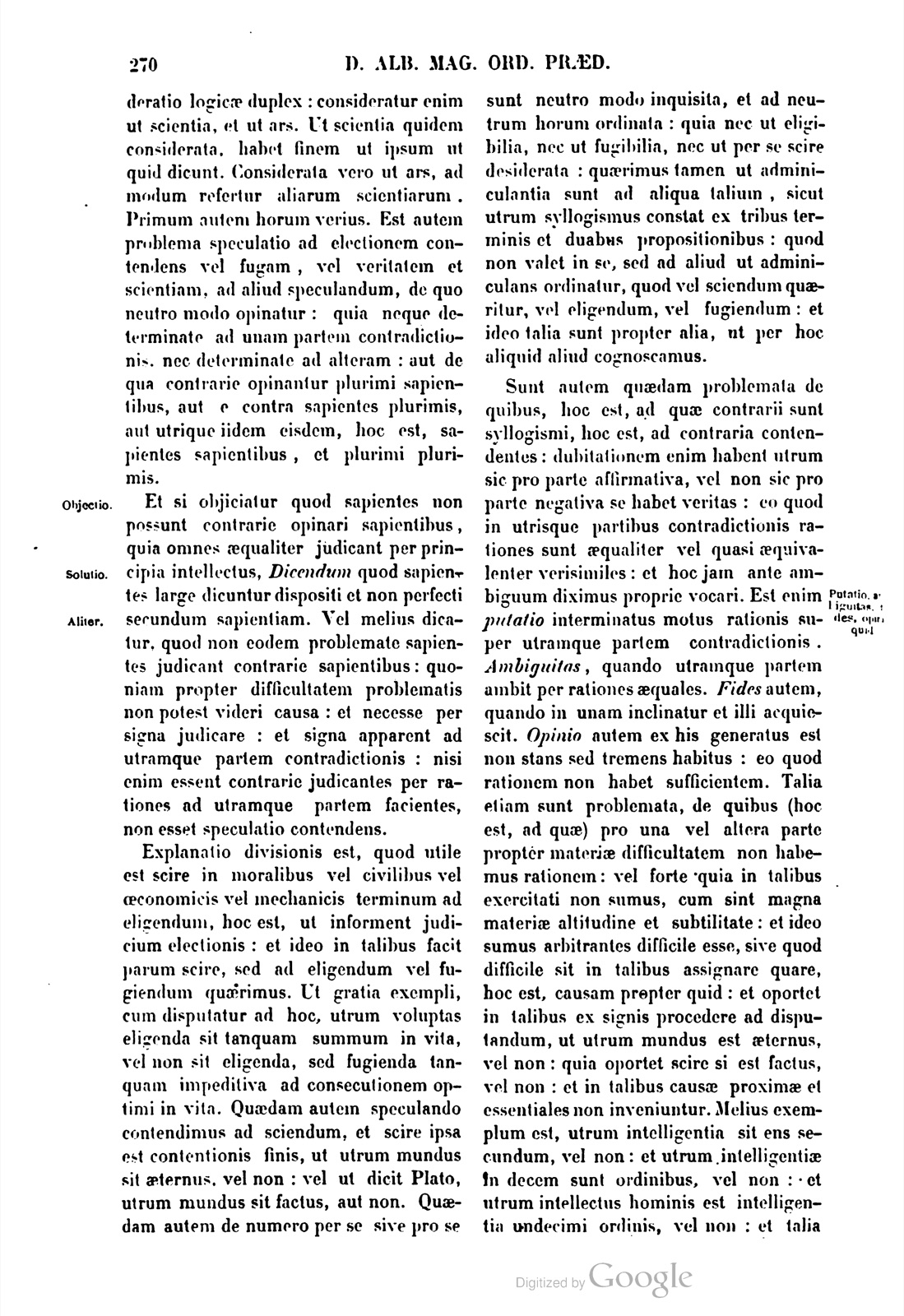
Est autem alia diffinitio, quod problema est speculatio in eo quod est, aut ut ipsum, secundum se consideratum, aut ut adminiculans ad aliquid. Ut ipsum quidem, sicut est problema quod est essentialis philosophiae. Adminiculans autem, sicut id quod est de modo omnis philosophiae: et hoc est logicum secundum quod logica generaliter dicitur omnis scientia sermocinalis, quae in termino determinatur. Omnia ista quaesita ad alia quae per ea scienda referimus: et sic sub illa divisione omnia omnium scientiarum problemata continentur.
Est etiam consideratio logicae duplex: consideratur enim ut scientia, et ut ars. Ut scientia quidem considerata, habet finem ut ipsum ut quid dicunt. Considerata vero ut ars, ad modum refertur aliarum scientiarum. Primum autem horum verius. Est autem problema speculatio ad electionem contendens vel fugam, vel veritatem et scientiam, ad aliud speculandum, de quo neutro modo opinatur: quia neque determinate ad unam partem contradictionis, nec determinate ad alteram: aut de qua contrarie opinantur plurimi sapientibus, aut e contra sapientes plurimis, aut utrique iidem eisdem, hoc est, sapientes sapientibus, et plurimi plurimis.
[Marginal label, printed page 270: Objectio.]
Et si objiciatur quod sapientes non possunt contrarie opinari sapientibus, quia omnes aequaliter judicant per principia intellectus.
[Marginal label, printed page 270: Solutio.]
Dicendum quod sapientes large dicuntur dispositi et non perfecti secundum sapientiam.
[Marginal label, printed page 270: Aliter.]
Vel melius dicatur, quod non eodem problemate sapientes judicant contrarie sapientibus: quoniam propter difficultatem problematis non potest videri causa, et necesse per signa judicare: et signa apparent ad utramque partem contradictionis: nisi enim essent contrarie judicantes per rationes ad utramque partem facientes, non esset speculatio contendens.
Explanatio divisionis est, quod utile est scire in moralibus vel civilibus vel oeconomicis vel mechanicis terminum ad eligendum, hoc est, ut informent judicium electionis: et ideo in talibus facit parum scire, sed ad eligendum vel fugiendum quaerimus. Ut gratia exempli, cum disputatur ad hoc, utrum voluptas eligenda sit tanquam summum in vita, vel non sit eligenda, sed fugienda tanquam impeditiva ad consecutionem optimi in vita. Quaedam autem speculando contendimus ad sciendum, et scire ipsa est contentionis finis, ut utrum mundus sit aeternus, vel non: vel ut dicit Plato, utrum mundus sit factus, aut non. Quaedam autem de numero per se sive pro se sunt neutro modo inquisita, et ad neutrum horum ordinata: quia nec ut eligibilia, nec ut fugibilia, nec ut per se scire desiderata: quaerimus tamen ut adminiculantia sunt ad aliqua talium, sicut utrum syllogismus constat ex tribus terminis et duabus propositionibus: quod non valet in se, sed ad aliud ut adminiculans ordinatur, quod vel sciendum quaeritur, vel eligendum, vel fugiendum: et ideo talia sunt propter alia, ut per hoc aliquid aliud cognoscamus.
[Marginal label, printed page 269: Falsity and ignorance cannot be ends of speculation.]
There is also another definition: that a problem is speculation in that which is, either as the very thing, considered according to itself, or as assisting something. As the very thing, as there is a problem that belongs to essential philosophy. But as assisting, as that which concerns the mode of every philosophy; and this is logical according as logic is generally called every sermocinal science which is determined in a term. We refer all these things sought to other things which are to be known through them; and thus under that division the problems of all sciences are contained.
There is also a twofold consideration of logic: it is considered as science and as art. Considered as science, it has the end as the very thing, as to what things say. But considered as art, it is referred to the mode of the other sciences. The first of these is truer. A problem, then, is speculation contending toward choice or flight, or truth and knowledge, for speculating another thing, about which it opines in neither way: because neither determinately toward one part of the contradiction, nor determinately toward the other; or about which the many opine contrary to the wise, or conversely the wise contrary to the many, or both, the same groups contrary to the same groups, that is, wise to wise and many to many.
[Marginal label, printed page 270: Objection.]
And if it is objected that the wise cannot opine contrary to the wise, because all judge equally through the principles of understanding.
[Marginal label, printed page 270: Solution.]
It must be said that the wise are called wise broadly as disposed persons and not as perfected according to wisdom.
[Marginal label, printed page 270: Otherwise.]
Or it may be better said that the wise do not judge contrary to the wise about the same problem, because on account of the difficulty of the problem the cause cannot be seen, and it is necessary to judge through signs; and the signs appear toward both parts of the contradiction. For unless they were judging contrarily through reasons making for both parts, it would not be contending speculation.
The explanation of the division is that in moral or civil or economic or mechanical matters it is useful to know the term for choosing, that is, so that they may inform the judgment of choice; and therefore in such matters knowing does little, but we inquire for choosing or fleeing. For the sake of example, when one disputes toward this, whether pleasure is to be chosen as the highest thing in life, or is not to be chosen but fled as impeding the attainment of the best in life. But certain things we contend by speculating in order to know, and knowledge itself is the end of the contention, as whether the world is eternal or not; or, as Plato says, whether the world has been made or not. But certain things, of the number of those that are through themselves or for themselves, are sought in neither way and are ordered to neither of these, because neither as choiceworthy nor as things to be fled, nor as desired to be known through themselves; nevertheless we inquire about them insofar as they are assisting toward some such things, as whether a syllogism consists of three terms and two propositions. This has no value in itself, but is ordered to another as assisting, which is sought either as something to be known, or to be chosen, or to be fled; and therefore such things are for the sake of other things, so that through this we may know something else.
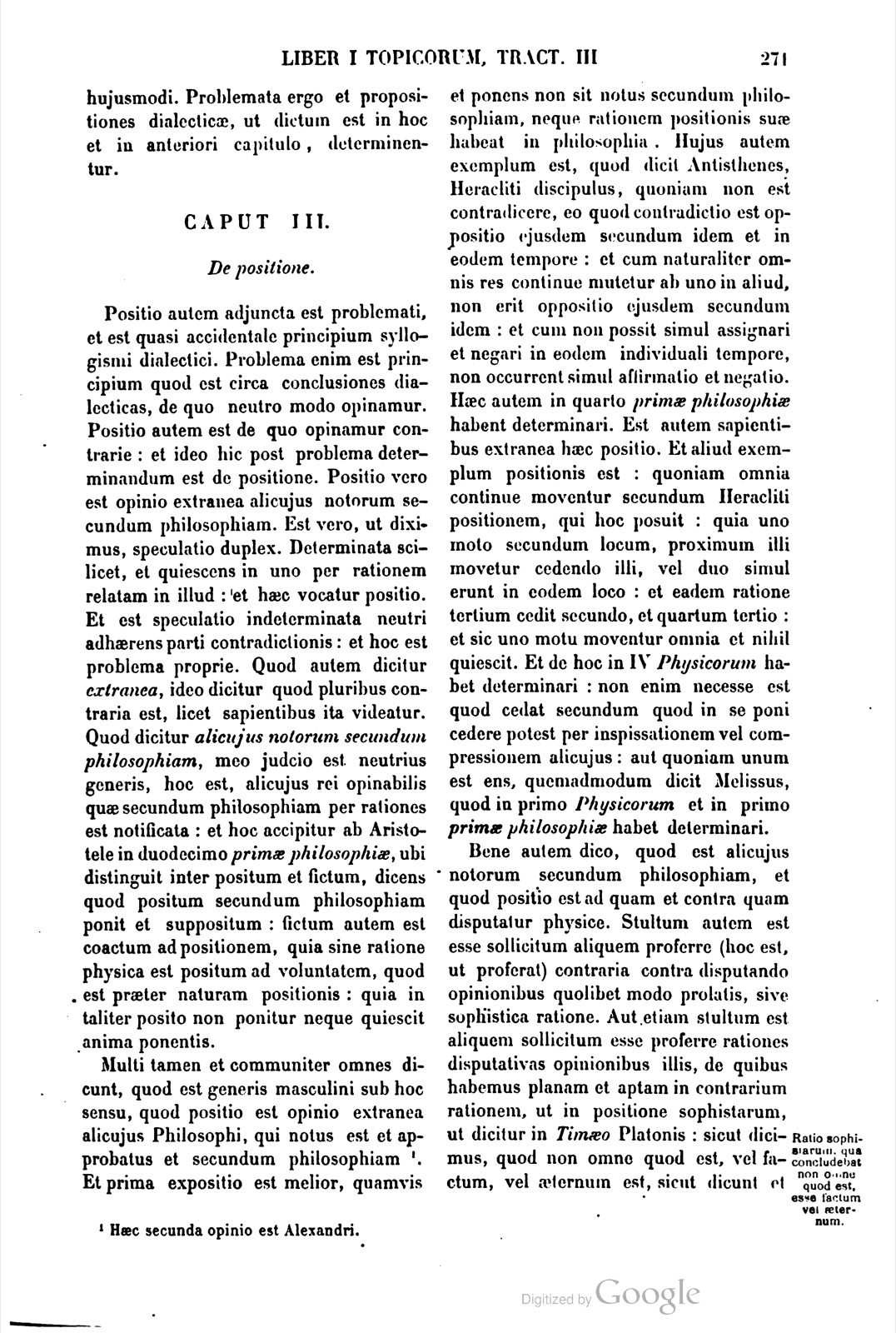
Sunt autem quaedam problemata de quibus, hoc est, ad quae contrarii sunt syllogismi, hoc est, ad contraria contendentes: dubitationem enim habent utrum sic pro parte affirmativa, vel non sic pro parte negativa se habet veritas: eo quod in utrisque partibus contradictionis rationes sunt aequaliter vel quasi aequivalenter verisimiles: et hoc jam ante ambiguum diximus proprie vocari.
[Marginal label, printed page 270: Putatio, ambiguitas, fides, opinio quid proprie.]
Est enim putatio interminatus motus rationis super utramque partem contradictionis. Ambiguitas, quando utramque partem ambit per rationes aequales. Fides autem, quando in unam inclinatur et illi acquiescit. Opinio autem ex his generatus est non stans sed tremens habitus: eo quod rationem non habet sufficientem. Talia etiam sunt problemata, de quibus, hoc est, ad quae, pro una vel altera parte propter materiae difficultatem non habemus rationem: vel forte quia in talibus exercitati non sumus, cum sint magna materiae altitudine et subtilitate: et ideo sumus arbitrantes difficile esse, sive quod difficile sit in talibus assignare quare, hoc est, causam propter quid: et oportet in talibus ex signis procedere ad disputandum, ut utrum mundus est aeternus, vel non: quia oportet scire si est factus, vel non: et in talibus causae proximae et essentiales non inveniuntur. Melius exemplum est, utrum intelligentia sit ens secundum, vel non: et utrum intelligentiae in decem sunt ordinibus, vel non: et utrum intellectus hominis est intelligentia undecimi ordinis, vel non: et talia hujusmodi. Problemata ergo et propositiones dialecticae, ut dictum est in hoc et in anteriori capitulo, determinentur.
There are, however, certain problems concerning which, that is, toward which, there are contrary syllogisms, that is, syllogisms contending toward contraries: for they have doubt whether truth has itself thus on the affirmative side, or not thus on the negative side, because in both parts of the contradiction the reasons are equally or almost equivalently truthlike; and this we already before said is properly called ambiguous.
[Marginal label, printed page 270: What thinking, ambiguity, faith, and opinion are properly.]
For thinking is an unterminated motion of reason over both parts of the contradiction. Ambiguity is when it goes around both parts through equal reasons. Faith, however, is when it is inclined into one and rests in it. Opinion, however, generated from these, is a habit not standing but trembling, because it does not have a sufficient reason. Such also are problems concerning which, that is, toward which, for one or the other part, on account of the difficulty of the matter we do not have a reason; or perhaps because we are not exercised in such matters, since they are of great height and subtlety of matter; and therefore we are judging that it is difficult, or that in such matters it is difficult to assign the why, that is, the cause on account of which. And in such matters one must proceed from signs for disputing, as whether the world is eternal or not, because one must know if it has been made or not; and in such matters proximate and essential causes are not found. A better example is whether intelligence is a second being or not; and whether the intelligences are in ten orders or not; and whether the intellect of a human being is an intelligence of the eleventh order or not; and such things of this kind. Therefore let dialectical problems and propositions be determined, as has been said in this and in the preceding chapter.
If a page does not appear, its photograph has not been uploaded yet.