Volume 2 · pp. 266–268
Treatise III. Chapter I. Concerning the Dialectical Proposition, What It Is, and Through What Things It Is Divided.
A marker with ≈ is an approximate page boundary, placed by measure of the text; the page photographs remain the authority. In the paired views, clicking a page marker brings that page into view.
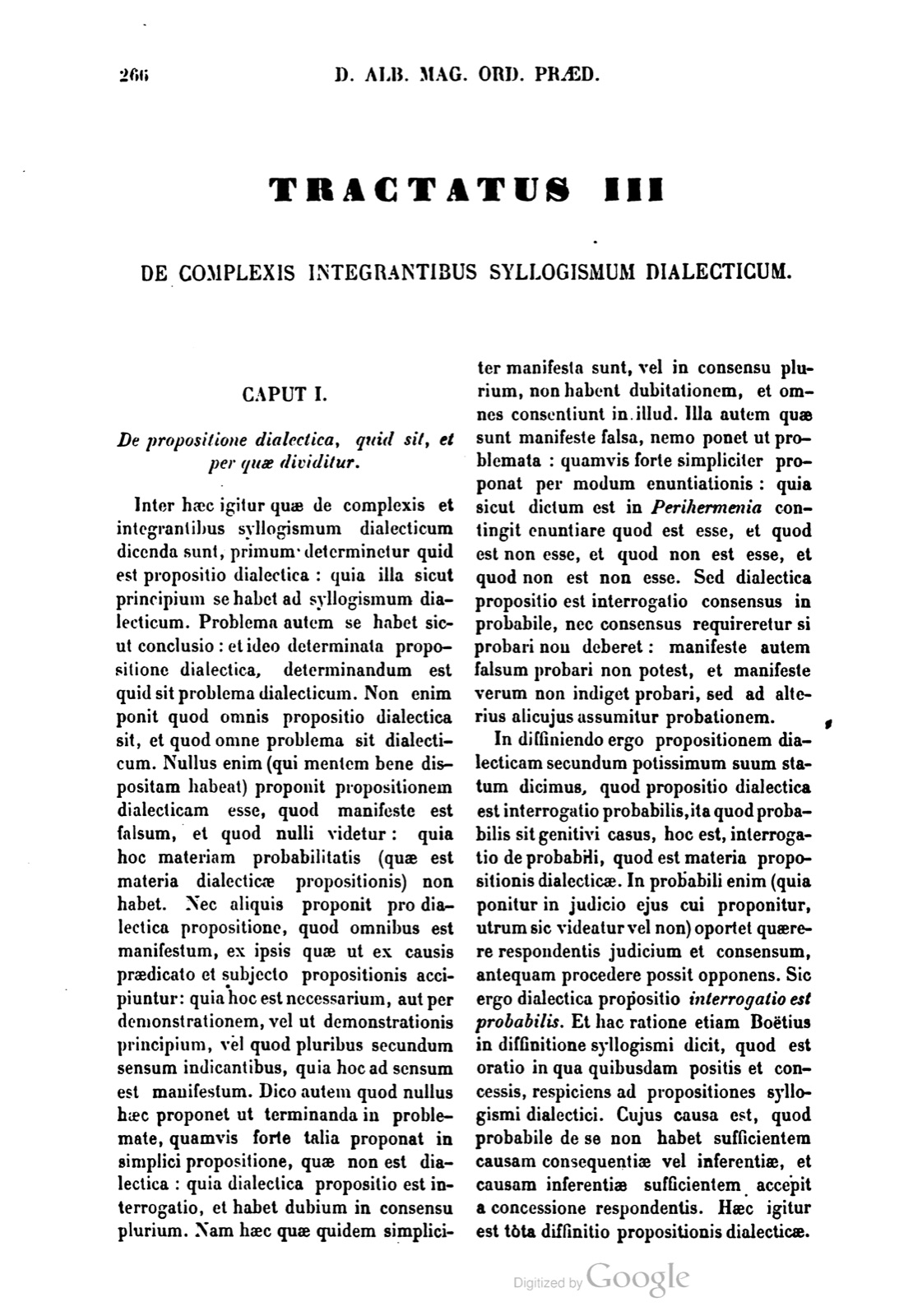
TRACTATUS III.
DE COMPLEXIS INTEGRANTIBUS SYLLOGISMUM DIALECTICUM.
CAPUT I.
De propositione dialectica, quid sit, et per quae dividitur.
Inter haec igitur quae de complexis et integrantibus syllogismum dialecticum dicenda sunt, primum determinetur quid est propositio dialectica: quia illa sicut principium se habet ad syllogismum dialecticum. Problema autem se habet sicut conclusio: et ideo determinata propositione dialectica, determinandum est quid sit problema dialecticum. Non enim ponit quod omnis propositio dialectica sit, et quod omne problema sit dialecticum. Nullus enim (qui mentem bene dispositam habeat) proponit propositionem dialecticam esse, quod manifeste est falsum, et quod nulli videtur: quia hoc materiam probabilitatis (quae est materia dialecticae propositionis) non habet. Nec aliquis proponit pro dialectica propositione, quod omnibus est manifestum, ex ipsis quae ut ex causis praedicato et subjecto propositionis accipiuntur: quia hoc est necessarium, aut per demonstrationem, vel ut demonstrationis principium, vel quod pluribus secundum sensum indicantibus, quia hoc ad sensum est manifestum. Dico autem quod nullus haec proponet ut terminanda in problemate, quamvis forte talia proponat in simplici propositione, quae non est dialectica: quia dialectica propositio est interrogatio, et habet dubium in consensu plurium. Nam haec quae quidem simpliciter manifesta sunt, vel in consensu plurium, non habent dubitationem, et omnes consentiunt in illud. Illa autem quae sunt manifeste falsa, nemo ponet ut problemata: quamvis forte simpliciter proponat per modum enuntiationis: quia sicut dictum est in Perihermenia contingit enuntiare quod est esse, et quod est non esse, et quod non est esse, et quod non est non esse. Sed dialectica propositio est interrogatio consensus in probabile, nec consensus requireretur si probari non deberet: manifeste autem falsum probari non potest, et manifeste verum non indiget probari, sed ad alterius alicujus assumitur probationem.
In diffiniendo ergo propositionem dialecticam secundum potissimum suum statum dicimus, quod propositio dialectica est interrogatio probabilis, ita quod probabilis sit genitivi casus, hoc est, interrogatio de probabili, quod est materia propositionis dialecticae. In probabili enim (quia ponitur in judicio ejus cui proponitur, utrum sic videatur vel non) oportet quaerere respondentis judicium et consensum, antequam procedere possit opponens. Sic ergo dialectica propositio interrogatio est probabilis. Et hac ratione etiam Boetius in diffinitione syllogismi dicit, quod est oratio in qua quibusdam positis et concessis, respiciens ad propositiones syllogismi dialectici. Cujus causa est, quod probabile de se non habet sufficientem causam consequentiae vel inferentiae, et causam inferentiae sufficientem accepit a concessione respondentis. Haec igitur est tota diffinitio propositionis dialecticae.
[Marginal label, printed page 267: Quid sit probabile.]
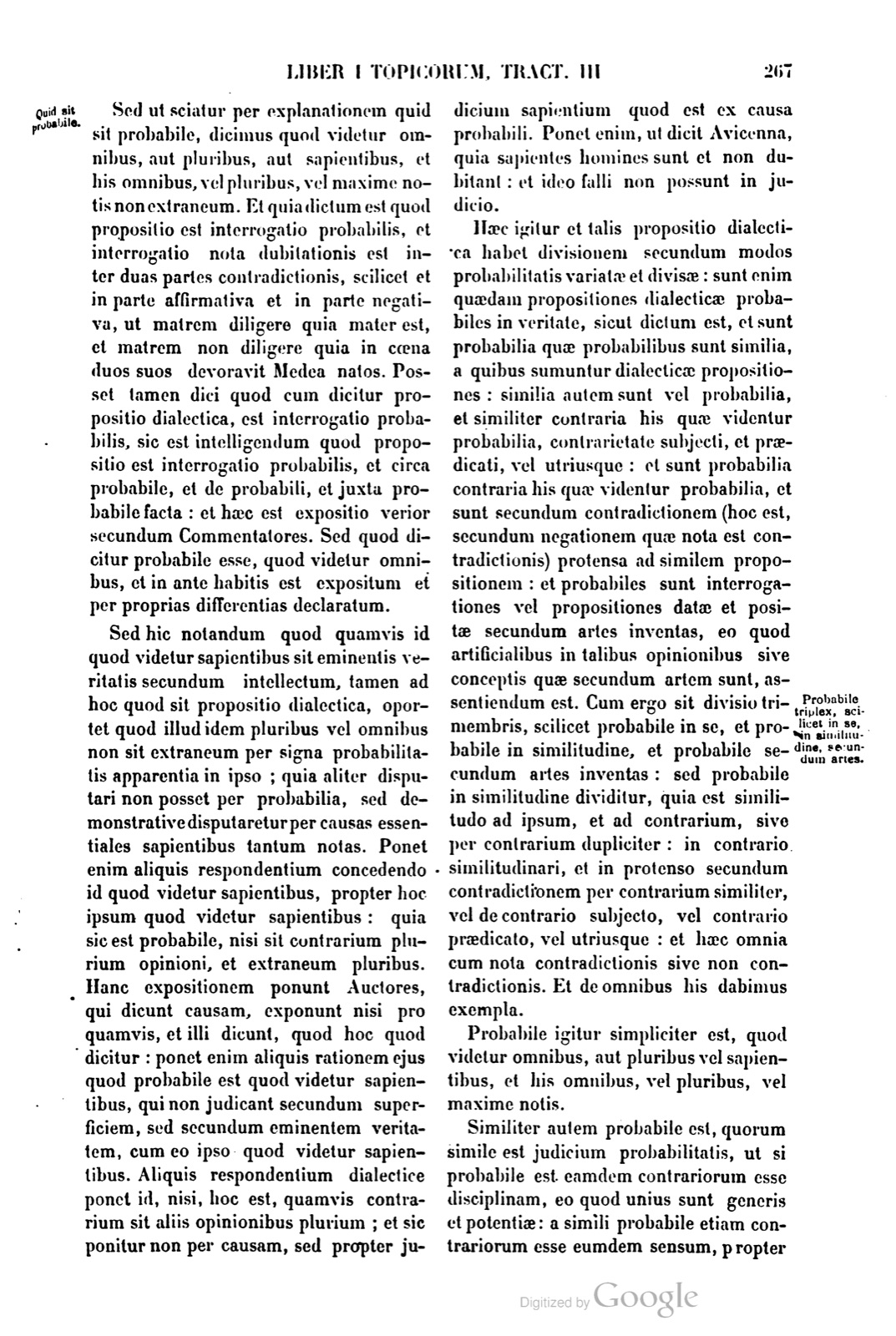
Sed ut sciatur per explanationem quid sit probabile, dicimus quod videtur omnibus, aut pluribus, aut sapientibus, et his omnibus, vel pluribus, vel maxime notis non extraneum. Et quia dictum est quod propositio est interrogatio probabilis, et interrogatio nota dubitationis est inter duas partes contradictionis, scilicet et in parte affirmativa et in parte negativa, ut matrem diligere quia mater est, et matrem non diligere quia in coena duos suos devoravit Medea natos. Posset tamen dici quod cum dicitur propositio dialectica, est interrogatio probabilis, sic est intelligendum quod propositio est interrogatio probabilis, et circa probabile, et de probabili, et juxta probabile facta: et haec est expositio verior secundum Commentatores. Sed quod dicitur probabile esse, quod videtur omnibus, et in ante habitis est expositum et per proprias differentias declaratum.
TREATISE III.
ON THE COMPLEX THINGS INTEGRATING THE DIALECTICAL SYLLOGISM.
CHAPTER I.
Concerning the Dialectical Proposition, What It Is, and Through What Things It Is Divided.
Therefore among these things that must be said about the complex things and the things integrating the dialectical syllogism, first let it be determined what a dialectical proposition is, because it stands toward dialectical syllogism as its principle. But a problem stands as a conclusion; and therefore, once dialectical proposition has been determined, it must be determined what a dialectical problem is. For he does not posit that every proposition is dialectical and that every problem is dialectical. For no one who has a well-disposed mind proposes as a dialectical proposition what is manifestly false and what seems so to no one, because this does not have the matter of probability, which is the matter of a dialectical proposition. Nor does anyone propose as a dialectical proposition what is manifest to all from the very things that are received as causes for the predicate and subject of the proposition, because this is necessary, either through demonstration, or as a principle of demonstration, or because it is indicated by many according to sense, since this is manifest to sense. But I say that no one will propose these things as to be terminated in a problem, although perhaps he may propose such things in a simple proposition which is not dialectical; because a dialectical proposition is an interrogation and has doubt in the consent of many. For those things that are simply manifest, or are in the consent of many, do not have doubt, and all consent to them. But things that are manifestly false no one will posit as problems, although perhaps he may simply propose them by way of enunciation, because, as was said in On Interpretation, it is possible to enunciate that what is is, that what is is not, that what is not is, and that what is not is not. But a dialectical proposition is an interrogation of consent concerning the probable, and consent would not be required if it ought not to be proved. But the manifestly false cannot be proved, and the manifestly true does not need to be proved, but is assumed for the proof of some other thing.
Therefore in defining dialectical proposition according to its strongest state, we say that a dialectical proposition is an interrogation of the probable, so that probable is in the genitive case, that is, an interrogation concerning the probable, which is the matter of dialectical proposition. For in the probable, because it is placed in the judgment of the one to whom it is proposed, whether it seems so or not, one must seek the judgment and consent of the respondent before the opponent can proceed. Thus therefore dialectical proposition is an interrogation of the probable. And for this reason Boethius also in the definition of syllogism says that it is a speech in which, when certain things have been posited and conceded, looking to the propositions of the dialectical syllogism. The cause of this is that the probable of itself does not have a sufficient cause of consequence or inference, and it receives a sufficient cause of inference from the concession of the respondent. This therefore is the whole definition of dialectical proposition.
[Marginal label, printed page 267: What the probable is.]
But so that it may be known by explanation what the probable is, we say that it is what seems so to all, or to many, or to the wise, and among these to all, or to many, or to the most noted, and is not alien. And because it has been said that a proposition is an interrogation of the probable, and interrogation is a note of doubt between the two parts of contradiction, namely both in the affirmative part and in the negative part, as loving one's mother because she is one's mother, and not loving one's mother because Medea devoured her two sons at supper. Nevertheless it could be said that when it is said that dialectical proposition is an interrogation of the probable, it is to be understood in this way: that proposition is an interrogation that is probable, and is about the probable, and concerning the probable, and made next to the probable; and this is the truer exposition according to the Commentators. But what is said, that probable is what seems so to all, has been expounded in the preceding matters and declared through its proper differences.
Sed hic notandum quod quamvis id quod videtur sapientibus sit eminentis veritatis secundum intellectum, tamen ad hoc quod sit propositio dialectica, oportet quod illud idem pluribus vel omnibus non sit extraneum per signa probabilitatis apparentia in ipso; quia aliter disputari non posset per probabilia, sed demonstrative disputaretur per causas essentiales sapientibus tantum notas. Ponet enim aliquis respondentium concedendo id quod videtur sapientibus, propter hoc ipsum quod videtur sapientibus: quia sic est probabile, nisi sit contrarium plurium opinioni, et extraneum pluribus. Hanc expositionem ponunt Auctores, qui dicunt causam, exponunt nisi pro quamvis, et illi dicunt, quod hoc quod dicitur: ponet enim aliquis rationem ejus quod probabile est quod videtur sapientibus, qui non judicant secundum superficiem, sed secundum eminentem veritatem, cum eo ipso quod videtur sapientibus. Aliquis respondentium dialectice ponet id, nisi, hoc est, quamvis contrarium sit aliis opinionibus plurium; et sic ponitur non per causam, sed propter judicium sapientium quod est ex causa probabili. Ponet enim, ut dicit Avicenna, quia sapientes homines sunt et non dubitant: et ideo falli non possunt in judicio.
[Marginal label, printed page 267: Probabile triplex, scilicet in se, secundum similitudinem, secundum artes.]
Haec igitur et talis propositio dialectica habet divisionem secundum modos probabilitatis variatae et divisae: sunt enim quaedam propositiones dialecticae probabiles in veritate, sicut dictum est, et sunt probabilia quae probabilibus sunt similia, a quibus sumuntur dialecticae propositiones: similia autem sunt vel probabilia, et similiter contraria his quae videntur probabilia, contrarietate subjecti, et praedicati, vel utriusque: et sunt probabilia contraria his quae videntur probabilia, et sunt secundum contradictionem (hoc est, secundum negationem quae nota est contradictionis) protensa ad similem propositionem: et probabiles sunt interrogationes vel propositiones datae et positae secundum artes inventas, eo quod artificialibus in talibus opinionibus sive conceptis quae secundum artem sunt, assentiendum est. Cum ergo sit divisio trimembris, scilicet probabile in se, et probabile in similitudine, et probabile secundum artes inventas: sed probabile in similitudine dividitur, quia est similitudo ad ipsum, et ad contrarium, sive per contrarium dupliciter: in contrario similitudinari, et in protenso secundum contradictionem per contrarium similiter, vel de contrario subjecto, vel contrario praedicato, vel utriusque: et haec omnia cum nota contradictionis sive non contradictionis. Et de omnibus his dabimus exempla.
Probabile igitur simpliciter est, quod videtur omnibus, aut pluribus vel sapientibus, et his omnibus, vel pluribus, vel maxime notis.
Similiter autem probabile est, quorum simile est judicium probabilitatis, ut si probabile est eamdem contrariorum esse disciplinam, eo quod unius sunt generis et potentiae: a simili probabile etiam contrariorum esse eumdem sensum, propter simile et per locum a simili terminatur. Similiter autem si probabile est unam numero scientiam esse grammaticam propter subjecti communis unitatem, probabile erit a simili et musicam esse unam scientiam propter simile judicium. Si autem probabile est plures esse grammaticas propter partes subjecti quae plures sunt, probabile erit et musicas plures esse: omnia enim haec similia et cognata ad invicem videntur. Et de rebus similibus, ut dicit Boetius, est idem judicium.
But here it must be noted that although that which seems so to the wise is of eminent truth according to understanding, nevertheless for it to be a dialectical proposition, that same thing must not be alien to many or to all through signs of probability appearing in it; because otherwise disputation could not proceed through probable things, but demonstration would proceed through essential causes known only to the wise. For some one of the respondents will posit by conceding what seems so to the wise, on account of this very fact that it seems so to the wise, because in this way it is probable, unless it is contrary to the opinion of many and alien to many. The Authors set down this exposition, who state the cause, and explain unless as although; and they say that this statement, for someone will posit the account of that which is probable because it seems so to the wise, who do not judge according to surface but according to eminent truth, together with the very fact that it seems so to the wise. Some respondent will dialectically posit it, unless, that is, although it is contrary to other opinions of the many; and thus it is posited not because of the cause, but because of the judgment of the wise, which is from a probable cause. For he will posit it, as Avicenna says, because the wise are human beings and do not doubt; and therefore they cannot be deceived in judgment.
[Marginal label, printed page 267: The probable is threefold, namely in itself, according to likeness, according to arts.]
Therefore this and such a dialectical proposition has a division according to the modes of probability varied and divided. For certain dialectical propositions are probable in truth, as was said; and there are probable things that are similar to probable things, from which dialectical propositions are taken. But similar things are either probable, and similarly contrary to those things that seem probable by contrariety of subject, of predicate, or of both; and there are probable things contrary to those that seem probable, and they are extended according to contradiction, that is, according to negation which is the note of contradiction, to a similar proposition; and interrogations or propositions given and posited according to discovered arts are probable, because assent must be given in such matters to artificial opinions or concepts that are according to art. Therefore, since the division is three-membered, namely probable in itself, probable in likeness, and probable according to discovered arts; but probable in likeness is divided, because there is likeness to the thing itself and to the contrary, or through the contrary in two ways: to be likened in the contrary, and in what is extended according to contradiction through the contrary similarly, either concerning a contrary subject, or a contrary predicate, or both; and all these with a note of contradiction or of non-contradiction. And concerning all these we shall give examples.
The probable simply, therefore, is what seems so to all, or to many, or to the wise, and among these to all, or to many, or to the most noted.
Similarly, those things are probable whose judgment of probability is similar, as if it is probable that there is the same discipline of contraries, because they belong to one genus and power; from the similar, it is also probable that there is the same sense of contraries, because of likeness, and it is terminated through the place from the similar. Similarly, if it is probable that grammar is one science in number because of the unity of the common subject, from the similar it will also be probable that music is one science because of a similar judgment. But if it is probable that there are several grammars because the parts of the subject are several, it will also be probable that there are several musics; for all these seem similar and akin to one another. And concerning similar things, as Boethius says, the judgment is the same.
[Marginal label, printed page 268: Nota quid intelligat hic per propositiones protensas secundum contradictionem.]
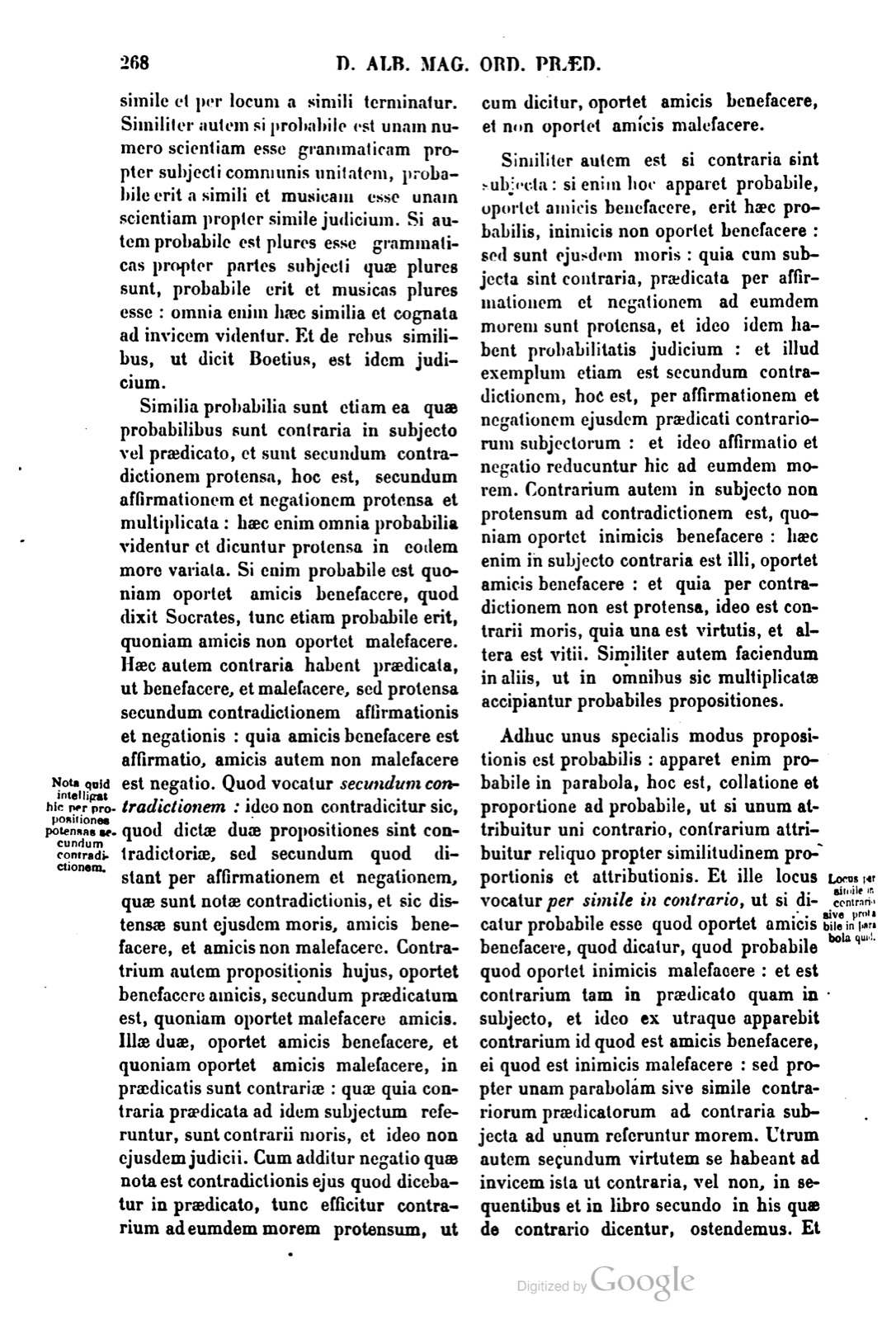
Similia probabilia sunt etiam ea quae probabilibus sunt contraria in subjecto vel praedicato, et sunt secundum contradictionem protensa, hoc est, secundum affirmationem et negationem protensa et multiplicata: haec enim omnia probabilia videntur et dicuntur protensa in eodem more variata. Si enim probabile est quoniam oportet amicis benefacere, quod dixit Socrates, tunc etiam probabile erit, quoniam amicis non oportet malefacere. Haec autem contraria habent praedicata, ut benefacere, et malefacere, sed protensa secundum contradictionem affirmationis et negationis: quia amicis benefacere est affirmatio, amicis autem non malefacere est negatio. Quod vocatur secundum contradictionem: ideo non contradicitur sic, quod dictae duae propositiones sint contradictoriae, sed secundum quod distant per affirmationem et negationem, quae sunt notae contradictionis, et sic distensae sunt ejusdem moris, amicis benefacere, et amicis non malefacere. Contrarium autem propositionis hujus, oportet benefacere amicis, secundum praedicatum est, quoniam oportet malefacere amicis. Illae duae, oportet amicis benefacere, et quoniam oportet amicis malefacere, in praedicatis sunt contrariae: quae quia contraria praedicata ad idem subjectum referuntur, sunt contrarii moris, et ideo non ejusdem judicii. Cum additur negatio quae nota est contradictionis ejus quod dicebatur in praedicato, tunc efficitur contrarium ad eumdem morem protensum, ut cum dicitur, oportet amicis benefacere, et non oportet amicis malefacere.
Similiter autem est si contraria sint subjecta: si enim hoc apparet probabile, oportet amicis benefacere, erit haec probabilis, inimicis non oportet benefacere: sed sunt ejusdem moris: quia cum subjecta sint contraria, praedicata per affirmationem et negationem ad eumdem morem sunt protensa, et ideo idem habent probabilitatis judicium: et illud exemplum etiam est secundum contradictionem, hoc est, per affirmationem et negationem ejusdem praedicati contrariorum subjectorum: et ideo affirmatio et negatio reducuntur hic ad eumdem morem. Contrarium autem in subjecto non protensum ad contradictionem est, quoniam oportet inimicis benefacere: haec enim in subjecto contraria est illi, oportet amicis benefacere: et quia per contradictionem non est protensa, ideo est contrarii moris, quia una est virtutis, et altera est vitii. Similiter autem faciendum in aliis, ut in omnibus sic multiplicatae accipiantur probabiles propositiones.
[Marginal label, printed page 268: Locus per simile in contrario sive probabile in parabola quid.]
Adhuc unus specialis modus propositionis est probabilis: apparet enim probabile in parabola, hoc est, collatione et proportione ad probabile, ut si unum attribuitur uni contrario, contrarium attribuitur reliquo propter similitudinem proportionis et attributionis. Et ille locus vocatur per simile in contrario, ut si dicatur probabile esse quod oportet amicis benefacere, quod dicatur, quod probabile quod oportet inimicis malefacere: et est contrarium tam in praedicato quam in subjecto, et ideo ex utraque apparebit contrarium id quod est amicis benefacere, ei quod est inimicis malefacere: sed propter unam parabolam sive simile contrariorum praedicatorum ad contraria subjecta ad unum referuntur morem. Utrum autem secundum virtutem se habeant ad invicem ista ut contraria, vel non, in sequentibus et in libro secundo in his quae de contrario dicentur, ostendemus. Et
[Marginal label, printed page 268: Note what he understands here by propositions extended according to contradiction.]
Similar probable things are also those that are contrary to probable things in subject or predicate, and are extended according to contradiction, that is, extended and multiplied according to affirmation and negation. For all these probable things seem and are called extended in the same manner with variation. For if it is probable that one ought to benefit friends, which Socrates said, then it will also be probable that one ought not to harm friends. But these have contrary predicates, to benefit and to harm, but extended according to the contradiction of affirmation and negation, because to benefit friends is affirmation, but not to harm friends is negation. This is called according to contradiction; therefore they are not contradicted in such a way that the two stated propositions are contradictory, but according as they stand apart through affirmation and negation, which are notes of contradiction, and thus, being stretched out, they are of the same manner: to benefit friends and not to harm friends. But the contrary of this proposition, one ought to benefit friends, is according to the predicate, because one ought to harm friends. Those two, one ought to benefit friends and one ought to harm friends, are contrary in predicates; and because contrary predicates are referred to the same subject, they are of a contrary manner and therefore not of the same judgment. When negation is added, which is the note of contradiction of that which was being said in the predicate, then a contrary extended to the same manner is effected, as when it is said: one ought to benefit friends, and one ought not to harm friends.
It is similar if the subjects are contrary: for if this appears probable, one ought to benefit friends, this will be probable, one ought not to benefit enemies; but they are of the same manner, because, since the subjects are contrary, the predicates are extended through affirmation and negation to the same manner, and therefore they have the same judgment of probability. And that example too is according to contradiction, that is, through affirmation and negation of the same predicate belonging to contrary subjects; and therefore affirmation and negation are reduced here to the same manner. But the contrary in subject not extended to contradiction is that one ought to benefit enemies; for this is contrary in subject to that proposition, one ought to benefit friends; and because it has not been extended through contradiction, it is therefore of contrary manner, because one belongs to virtue and the other to vice. The same must be done in other cases, so that in all cases probable propositions multiplied in this way are received.
[Marginal label, printed page 268: What the place through the similar in the contrary, or the probable in comparison, is.]
Furthermore, one special mode of proposition is probable: for the probable appears in parabola, that is, in comparison and proportion to the probable, as if one thing is attributed to one contrary, the contrary is attributed to the remaining one because of likeness of proportion and attribution. And that place is called through the similar in the contrary, as if it is said to be probable that one ought to benefit friends, that it is said to be probable that one ought to harm enemies; and it is contrary both in predicate and in subject, and therefore from each side what is contrary will appear: what it is to benefit friends is contrary to what it is to harm enemies. But because of one parabola or likeness of contrary predicates to contrary subjects, they are referred to one manner. But whether these things are related to one another according to virtue as contraries or not, we shall show in the following things and in the second book, in those matters that will be said about the contrary. And
If a page does not appear, its photograph has not been uploaded yet.