Volume 2 · pp. 263–265
Chapter VIII. Concerning the Sufficiency of These Four Predicates. Chapter IX. That These Four Predicates Are in All Predicaments.
A marker with ≈ is an approximate page boundary, placed by measure of the text; the page photographs remain the authority. In the paired views, clicking a page marker brings that page into view.
CAPUT VIII.
De sufficientia horum quatuor praedicatorum.
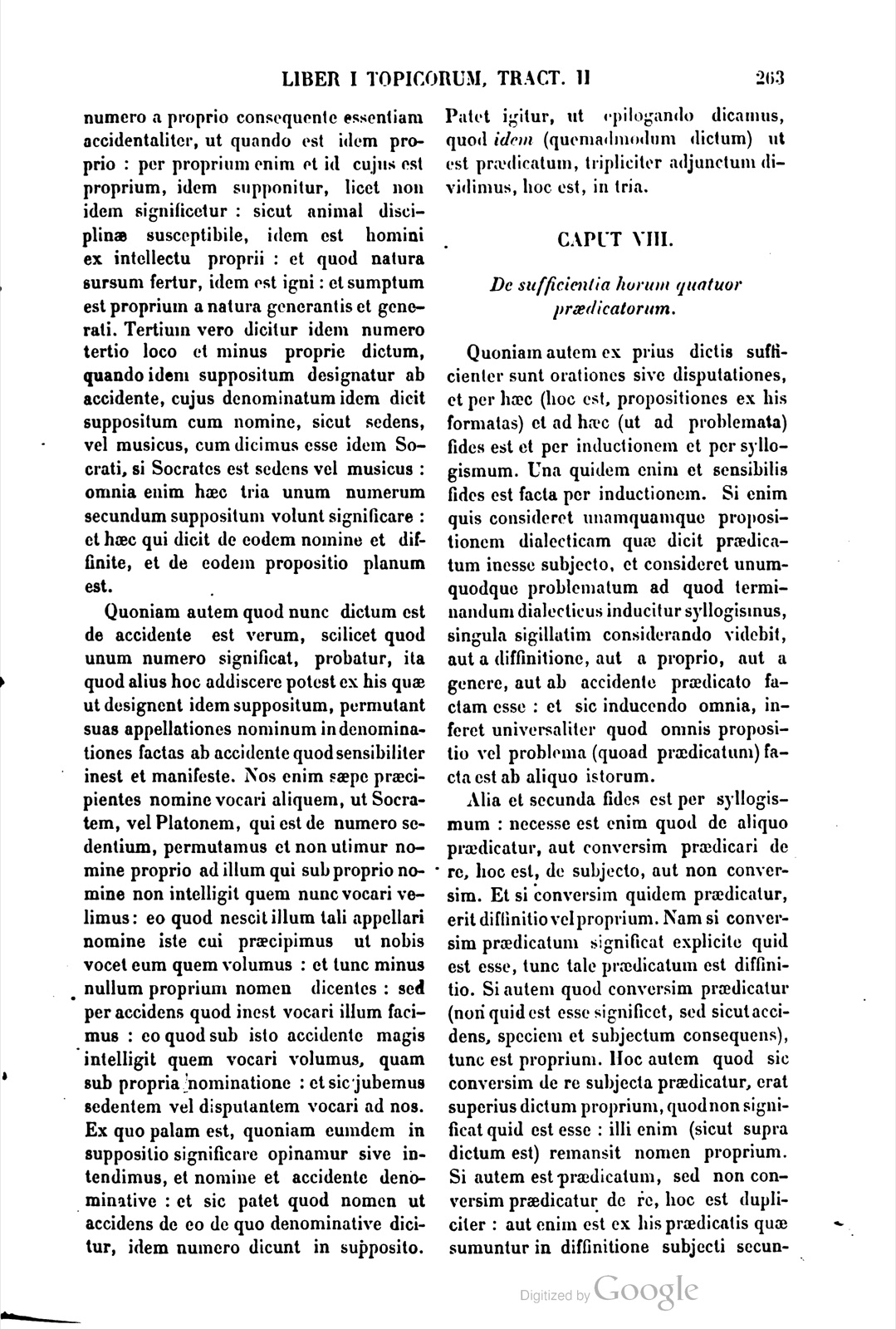
Quoniam autem ex prius dictis sufficienter sunt orationes sive disputationes, et per haec (hoc est, propositiones ex his formatas) et ad haec (ut ad problemata) fides est et per inductionem et per syllogismum. Una quidem enim et sensibilis fides est facta per inductionem. Si enim quis consideret unamquamque propositionem dialecticam quae dicit praedicatum inesse subjecto, et consideret unumquodque problematum ad quod terminandum dialecticus inducitur syllogismus, singula sigillatim considerando videbit, aut a diffinitione, aut a proprio, aut a genere, aut ab accidente praedicato factam esse: et sic inducendo omnia, inferet universaliter quod omnis propositio vel problema (quoad praedicatum) facta est ab aliquo istorum.
Alia et secunda fides est per syllogismum: necesse est enim quod de aliquo praedicatur, aut conversim praedicari de re, hoc est, de subjecto, aut non conversim. Et si conversim quidem praedicatur, erit diffinitio vel proprium. Nam si conversim praedicatum significat explicite quid est esse, tunc tale praedicatum est diffinitio. Si autem quod conversim praedicatur (non quid est esse significet, sed sicut accidens, speciem et subjectum consequens), tunc est proprium. Hoc autem quod sic conversim de re subjecta praedicatur, erat superius dictum proprium, quod non significat quid est esse: illi enim (sicut supra dictum est) remansit nomen proprium. Si autem est praedicatum, sed non conversim praedicatur de re, hoc est dupliciter: aut enim est ex his praedicatis quae sumuntur in diffinitione subjecti secundum primum modum dicenti per se: aut non est de illis, sed est praedicatum non sumptum in diffinitione subjecti. Et si est ex his quae in diffinitione subjecti dicuntur et sumuntur, tunc est genus, vel differentia generalis quae cum genere locanda est, eo quod descriptio ex diffinitione fit ex genere vel differentia vel differentiis. Si vero est praedicatum, et non ex his quae dicuntur in diffinitione subjecti de quo praedicatur, palam quoniam est accidens commune, quod individui accidens vocatur. Nam accidens in superius assignata diffinitione dicebatur, quod nec diffinitio, nec genus, nec proprium est, sed simpliciter sive determinato modo inhaerentiae inest rei, et ab inesse habet esse.
[Marginal label, printed page 264: Removet dubium.]
Quamvis autem aliqua conveniant in eadem substantiali differentia, non tamen habent specialem modum quo dicantur idem, quia ultima differentia est actus et forma constituens: et ideo facit idem specie: quia non convenienter potest dici idem differentia, quia differentia potius est nomen diversitatis quam unitatis et identitatis.
Si autem syllogismum formare vis, quo formatur horum sufficientia, formabis. Omne quod praedicatur conversim et non conversim, in quid vel in quale, genus est, vel diffinitio, vel proprium, vel accidens. Sed omne quod praedicatur in propositione dialectica, praedicatur conversim vel non conversim, in quid vel in quale. Ergo omne quod praedicatur in propositione dialectica, vel est diffinitio, vel genus, vel proprium, vel accidens.
CHAPTER VIII.
Concerning the Sufficiency of These Four Predicates.
Since, from the things said before, speeches or disputations have been sufficiently set forth, and through these, that is, propositions formed from these things, and toward these, as toward problems, credibility is had both by induction and by syllogism. For one credibility, indeed a sensible one, is made by induction. For if someone considers each dialectical proposition that says that a predicate is in a subject, and considers each of the problems for whose termination a dialectical syllogism is introduced, by considering each singly he will see that it has been made either from definition, or from proper, or from genus, or from accident as predicate; and thus by inducing all he will infer universally that every proposition or problem, with respect to the predicate, is made from one of these.
Another and second credibility is through syllogism: for it is necessary that what is predicated of something either be predicated conversely of the thing, that is, of the subject, or not conversely. And if it is predicated conversely, it will be definition or proper. For if the predicate predicated conversely explicitly signifies what being is, then such a predicate is definition. But if what is predicated conversely does not signify what being is, but as an accident consequent upon the species and subject, then it is proper. But this which is thus predicated conversely of the subject thing was called proper above, which does not signify what being is; for to it, as was said above, the name proper remained. But if it is a predicate and yet is not predicated conversely of the thing, this is in two ways: for either it is from those predicates that are taken in the definition of the subject according to the first mode of saying through itself, or it is not of those but is a predicate not taken in the definition of the subject. And if it is from those things that are said and taken in the definition of the subject, then it is genus, or a general difference which must be placed with genus, because description from definition is made from genus or difference or differences. But if it is a predicate and not from those things that are said in the definition of the subject of which it is predicated, it is plain that it is common accident, which is called accident of the individual. For accident in the definition assigned above was said to be that which is neither definition, nor genus, nor proper, but is in the thing simply or in a determinate mode of inherence, and has being from being-in.
[Marginal label, printed page 264: He removes a doubt.]
Although some things agree in the same substantial difference, nevertheless they do not have a special mode by which they are called same, because the ultimate difference is act and a constituting form; and therefore it makes same in species, because it cannot suitably be said to be same in difference, since difference is a name of diversity rather than of unity and identity.
But if you wish to form a syllogism by which their sufficiency is formed, you will form it thus. Everything that is predicated conversely and not conversely, in what or in quale, is genus, or definition, or proper, or accident. But everything that is predicated in a dialectical proposition is predicated conversely or not conversely, in what or in quale. Therefore everything that is predicated in a dialectical proposition is either definition, or genus, or proper, or accident.
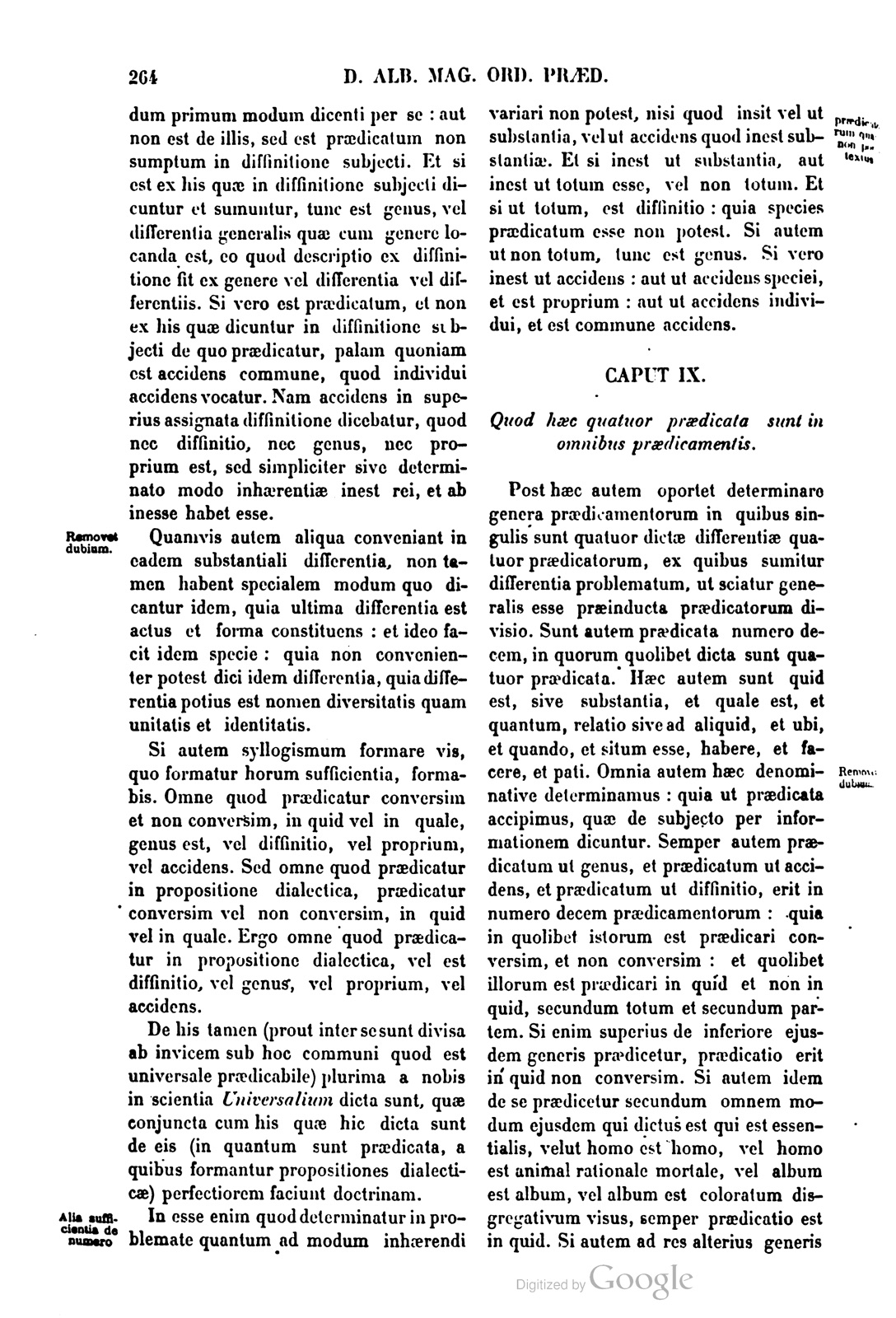
De his tamen (prout inter se sunt divisa ab invicem sub hoc communi quod est universale praedicabile) plurima a nobis in scientia Universalium dicta sunt, quae conjuncta cum his quae hic dicta sunt de eis (in quantum sunt praedicata, a quibus formantur propositiones dialecticae) perfectiorem faciunt doctrinam.
[Marginal label, printed page 264: Alia sufficientia eorumdem.]
In esse enim quod determinatur in problemate quantum ad modum inhaerendi variari non potest, nisi quod insit vel ut substantia, vel ut accidens quod inest substantiae. Et si inest ut substantia, aut inest ut totum esse, vel non totum. Et si ut totum, est diffinitio: quia species praedicatum esse non potest. Si autem ut non totum, tunc est genus. Si vero inest ut accidens: aut ut accidens speciei, et est proprium: aut ut accidens individui, et est commune accidens.
CAPUT IX.
Quod haec quatuor praedicata sunt in omnibus praedicamentis.
Post haec autem oportet determinare genera praedicamentorum in quibus singulis sunt quatuor dictae differentiae quatuor praedicatorum, ex quibus sumitur differentia problematum, ut sciatur generalis esse praeinducta praedicatorum divisio. Sunt autem praedicata numero decem, in quorum quolibet dicta sunt quatuor praedicata. Haec autem sunt quid est, sive substantia, et quale est, et quantum, relatio sive ad aliquid, et ubi, et quando, et situm esse, habere, et facere, et pati. Omnia autem haec denominative determinamus: quia ut praedicata accipimus, quae de subjecto per informationem dicuntur. Semper autem praedicatum ut genus, et praedicatum ut accidens, et praedicatum ut diffinitio, erit in numero decem praedicamentorum: quia in quolibet istorum est praedicari conversim, et non conversim: et quolibet illorum est praedicari in quid et non in quid, secundum totum et secundum partem. Si enim superius de inferiore ejusdem generis praedicetur, praedicatio erit in quid non conversim. Si autem idem de se praedicetur secundum omnem modum ejusdem qui dictus est qui est essentialis, velut homo est homo, vel homo est animal rationale mortale, vel album est album, vel album est coloratum disgregativum visus, semper praedicatio est in quid. Si autem ad res alterius generis comparetur ut praedicetur, praedicabitur vel in quale speciei, et erit proprium, vel in quale subjecti et individui, et erit accidens. Nam omnes propositiones dialecticae sunt sumptae ab his quatuor quae in omnibus generibus sunt praedicamentorum: omnes enim significant (quantum ad sua praedicata) aut quid est, hoc est substantiam absolute, aut quale secundum quod est praedicamentum, aut quantum secundum quod est praedicamentum, aut significant aliquid aliorum praedicamentorum, hoc est, rem in quodam praedicamento constitutam.
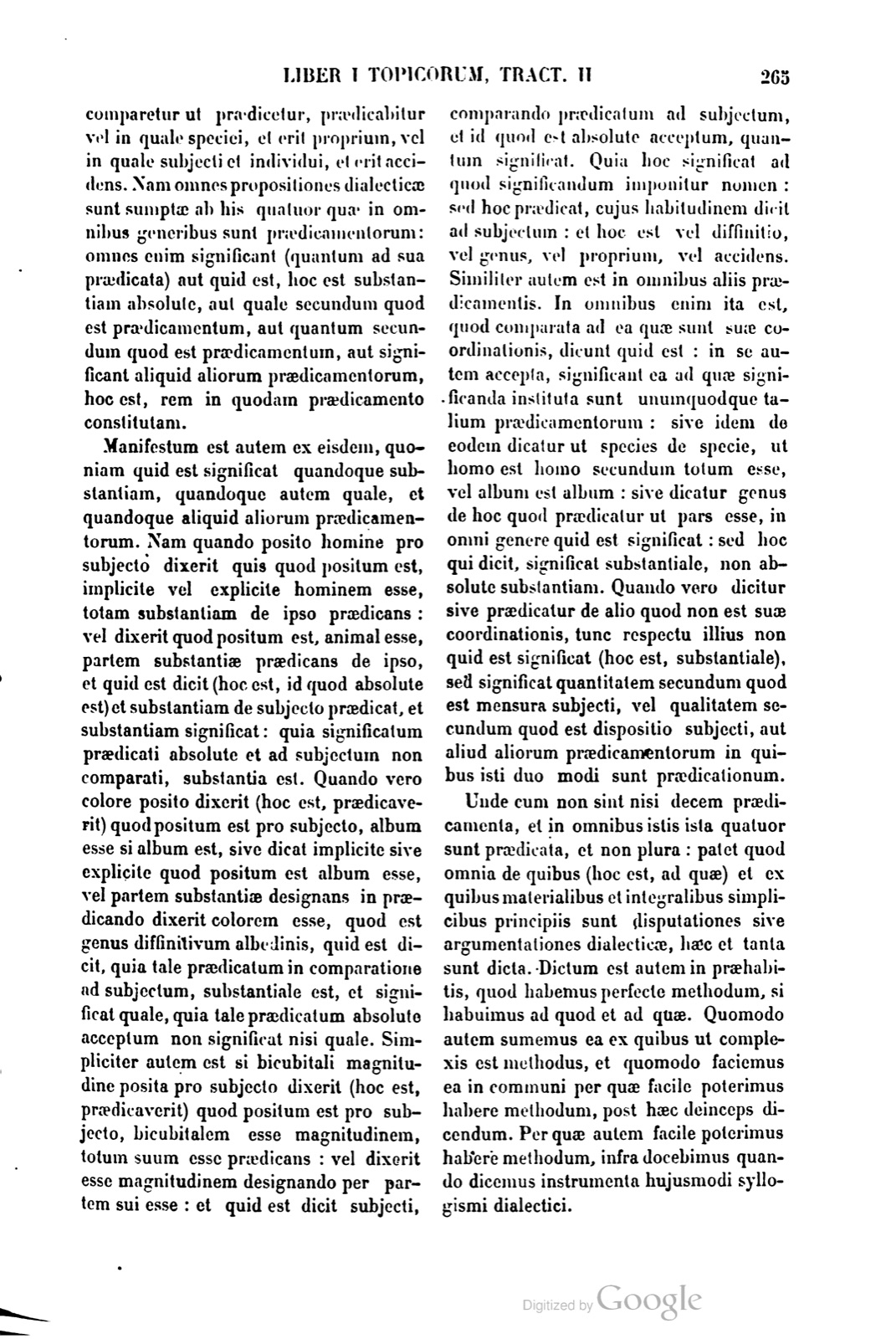
Manifestum est autem ex eisdem, quoniam quid est significat quandoque substantiam, quandoque autem quale, et quandoque aliquid aliorum praedicamentorum. Nam quando posito homine pro subjecto dixerit quis quod positum est, implicite vel explicite hominem esse, totam substantiam de ipso praedicans: vel dixerit quod positum est, animal esse, partem substantiae praedicans de ipso, quid est dicit (hoc est, id quod absolute est) et substantiam de subjecto praedicat, et substantiam significat: quia significatum praedicati absolute et ad subjectum non comparati, substantia est. Quando vero colore posito dixerit (hoc est, praedicaverit) quod positum est pro subjecto, album esse si album est, sive dicat implicite sive explicite quod positum est album esse, vel partem substantiae designans in praedicando dixerit colorem esse, quod est genus diffinitivum albedinis, quid est dicit, quia tale praedicatum in comparatione ad subjectum, substantiale est, et significat quale, quia tale praedicatum absolute acceptum non significat nisi quale. Simpliciter autem est si bicubitali magnitudine posita pro subjecto dixerit (hoc est, praedicaverit) quod positum est pro subjecto, bicubitalem esse magnitudinem, totum suum esse praedicans: vel dixerit esse magnitudinem designando per partem sui esse: et quid est dicit subjecti, comparando praedicatum ad subjectum, et id quod est absolute acceptum, quantum significat. Quia hoc significat ad quod significandum imponitur nomen: sed hoc praedicat, cujus habitudinem dicit ad subjectum: et hoc est vel diffinitio, vel genus, vel proprium, vel accidens.
Concerning these things, however, insofar as they are divided from one another under this common thing which is the universal predicable, many things have been said by us in the science of Universals, which, joined with the things said here about them, insofar as they are predicates from which dialectical propositions are formed, make a more perfect doctrine.
[Marginal label, printed page 264: Another sufficiency of the same things.]
For the being which is determined in a problem with respect to the mode of inhering cannot be varied except that it be in either as substance or as accident which is in substance. And if it is in as substance, it is in either as the whole being or not as the whole. And if as the whole, it is definition, because species cannot be a predicate. But if as not the whole, then it is genus. If, however, it is in as accident, then either as accident of the species, and it is proper, or as accident of the individual, and it is common accident.
CHAPTER IX.
That These Four Predicates Are in All Predicaments.
After these things, however, it is necessary to determine the genera of predicaments in each of which are the four stated differences of the four predicates, from which the difference of problems is taken, so that the previously introduced division of predicates may be known to be general. Now the predicates are ten in number, in each of which the four stated predicates exist. These are what-it-is, or substance, what quality it is, how much it is, relation or toward something, where, when, being situated, having, acting, and being acted upon. We determine all these denominatively, because we receive them as predicates that are said of a subject by information. But always the predicate as genus, and the predicate as accident, and the predicate as definition, will be in the number of the ten predicaments, because in any one of these there is being predicated conversely and not conversely, and in any one of them there is being predicated in what and not in what, according to whole and according to part. For if a higher thing is predicated of a lower thing of the same genus, the predication will be in what and not conversely. But if the same is predicated of itself according to every mode of the same which has been called essential, as human being is human being, or human being is rational mortal animal, or white is white, or white is color disgregative of sight, the predication is always in what. But if it is compared to things of another genus so that it may be predicated, it will be predicated either in the quale of the species, and it will be proper, or in the quale of the subject and individual, and it will be accident. For all dialectical propositions are taken from these four, which exist in all the genera of predicaments; for all signify, with respect to their predicates, either what-it-is, that is, substance absolutely, or quale according as it is a predicament, or quantity according as it is a predicament, or they signify something of the other predicaments, that is, a thing constituted in some predicament.
It is manifest from the same things that what-it-is sometimes signifies substance, sometimes quale, and sometimes something of the other predicaments. For when, with human being posited as subject, someone says that what is posited is, implicitly or explicitly, to be human being, predicating the whole substance of it; or says that what is posited is animal, predicating a part of the substance of it, he says what-it-is, that is, that which is absolutely, and predicates substance of the subject and signifies substance, because the signified of the predicate taken absolutely and not compared to the subject is substance. But when, with color posited, he has said, that is, predicated, that what is posited as subject is white, if it is white, or whether he says implicitly or explicitly that what is posited is to be white, or, designating a part of the substance in predicating, has said that it is color, which is the definitional genus of whiteness, he says what-it-is, because such a predicate in comparison to the subject is substantial, and it signifies quale, because such a predicate taken absolutely signifies nothing except quale. It is simply the same if, with a two-cubit magnitude posited as subject, he has said, that is, predicated, that what is posited as subject is two-cubit magnitude, predicating its whole being; or has said that it is magnitude, designating it through a part of its being; and he says the what-it-is of the subject, by comparing the predicate to the subject, and that which it is, taken absolutely, signifies quantity. For it signifies that for the signifying of which the name is imposed; but it predicates this, whose relation it says to the subject; and this is either definition, or genus, or proper, or accident.
Similiter autem est in omnibus aliis praedicamentis. In omnibus enim ita est, quod comparata ad ea quae sunt suae coordinationis, dicunt quid est: in se autem accepta, significant ea ad quae significanda instituta sunt unumquodque talium praedicamentorum: sive idem de eodem dicatur ut species de specie, ut homo est homo secundum totum esse, vel album est album: sive dicatur genus de hoc quod praedicatur ut pars esse, in omni genere quid est significat: sed hoc qui dicit, significat substantiale, non absolute substantiam. Quando vero dicitur sive praedicatur de alio quod non est suae coordinationis, tunc respectu illius non quid est significat (hoc est, substantiale), sed significat quantitatem secundum quod est mensura subjecti, vel qualitatem secundum quod est dispositio subjecti, aut aliud aliorum praedicamentorum in quibus isti duo modi sunt praedicationum.
Unde cum non sint nisi decem praedicamenta, et in omnibus istis ista quatuor sunt praedicata, et non plura: patet quod omnia de quibus (hoc est, ad quae) et ex quibus materialibus et integralibus simplicibus principiis sunt disputationes sive argumentationes dialecticae, haec et tanta sunt dicta. Dictum est autem in praehabitis, quod habemus perfecte methodum, si habuimus ad quod et ad quae. Quomodo autem sumemus ea ex quibus ut complexis est methodus, et quomodo faciemus ea in communi per quae facile poterimus habere methodum, post haec deinceps dicendum. Per quae autem facile poterimus habere methodum, infra docebimus quando dicemus instrumenta hujusmodi syllogismi dialectici.
Similarly it is in all other predicaments. For in all it is so, that when they are compared to those things that are of their own coordination, they say what-it-is; but accepted in themselves they signify those things for the signifying of which each of such predicaments has been instituted. Whether the same is said of the same as species of species, as human being is human being according to the whole being, or white is white; or whether genus is said of that which is predicated as part of being, in every genus it signifies what-it-is. But one who says this signifies the substantial, not substance absolutely. But when it is said or predicated of another thing that is not of its own coordination, then with respect to that thing it does not signify what-it-is, that is, the substantial, but signifies quantity insofar as it is the measure of the subject, or quality insofar as it is the disposition of the subject, or some other of the other predicaments in which those two modes of predications are found.
Whence, since there are only ten predicaments, and in all of these there are these four predicates and no more, it is clear that all the things concerning which, that is, toward which, and from which material, integral, and simple principles dialectical disputations or argumentations are made have been stated, and they are so many. But it has been said in what preceded that we have the method perfectly if we have had toward what and to what. But how we shall take those things from which, as from complexes, the method exists, and how in common we shall make those things through which we will easily be able to have the method, must be said next after these things. Through what things we will easily be able to have the method, however, we shall teach below when we shall speak of the instruments of this kind of dialectical syllogism.
If a page does not appear, its photograph has not been uploaded yet.