Volume 2 · pp. 261–263
Chapter VII. Concerning the Adjunct That Is Same or Diverse.
A marker with ≈ is an approximate page boundary, placed by measure of the text; the page photographs remain the authority. In the paired views, clicking a page marker brings that page into view.
CAPUT VII.
De adjuncto quod est idem vel diversum.
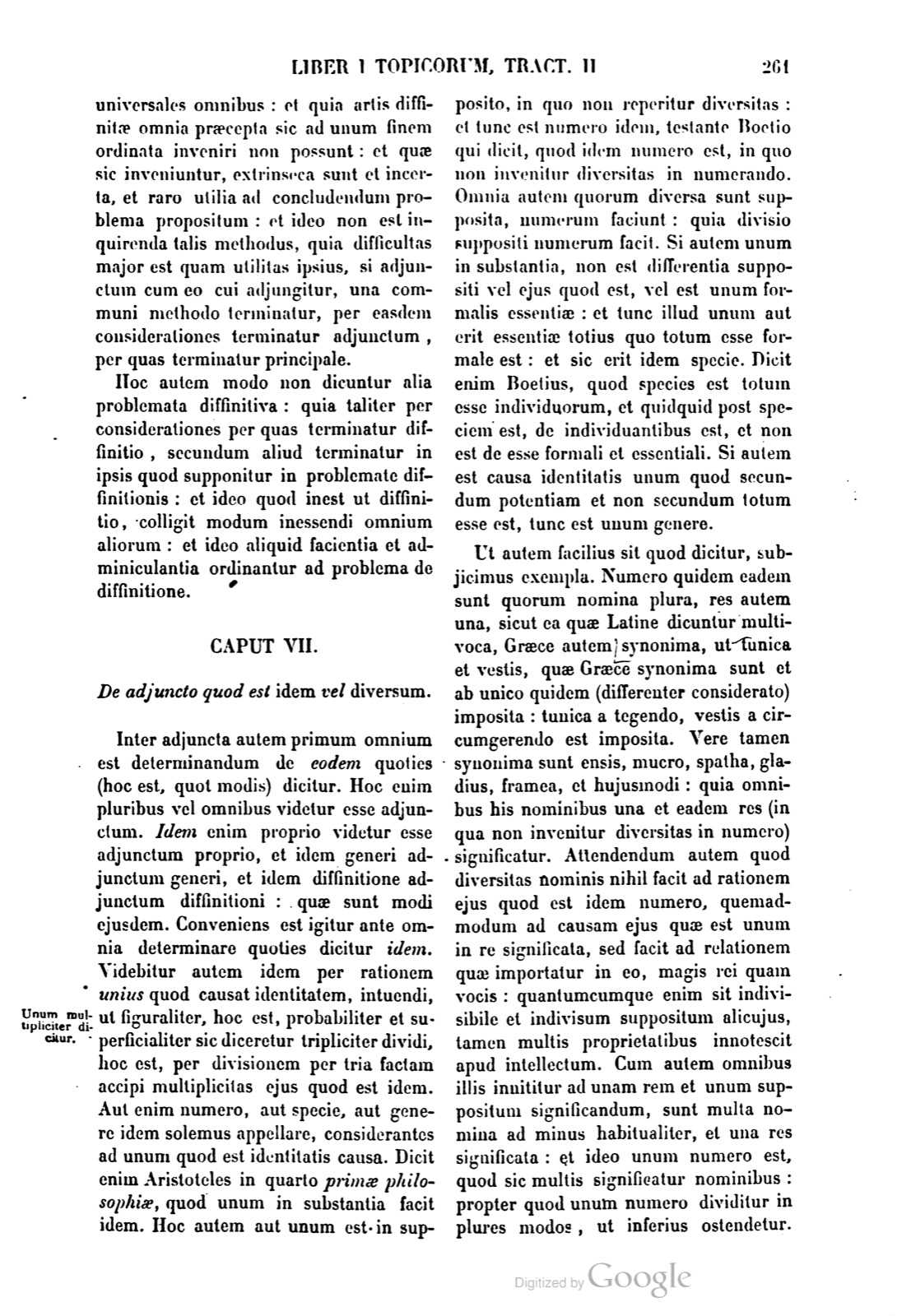
Inter adjuncta autem primum omnium est determinandum de eodem quoties (hoc est, quot modis) dicitur. Hoc enim pluribus vel omnibus videtur esse adjunctum. Idem enim proprio videtur esse adjunctum proprio, et idem generi adjunctum generi, et idem diffinitione adjunctum diffinitioni: quae sunt modi ejusdem. Conveniens est igitur ante omnia determinare quoties dicitur idem.
[Marginal label, printed page 261: Unum multipliciter dicitur.]
Videbitur autem idem per rationem unius quod causat identitatem, intuendi ut figuraliter, hoc est, probabiliter et superficialiter sic diceretur tripliciter dividi, hoc est, per divisionem per tria factam accipi multiplicitas ejus quod est idem. Aut enim numero, aut specie, aut genere idem solemus appellare, considerantes ad unum quod est identitatis causa. Dicit enim Aristoteles in quarto primae philosophiae, quod unum in substantia facit idem. Hoc autem aut unum est in supposito, in quo non reperitur diversitas: et tunc est numero idem, testante Boetio qui dicit, quod idem numero est, in quo non invenitur diversitas in numerando. Omnia autem quorum diversa sunt supposita, numerum faciunt: quia divisio suppositi numerum facit. Si autem unum in substantia, non est differentia suppositi vel ejus quod est, vel est unum formalis essentiae: et tunc illud unum aut erit essentiae totius quo totum esse formale est: et sic erit idem specie. Dicit enim Boetius, quod species est totum esse individuorum, et quidquid post speciem est, de individuantibus est, et non est de esse formali et essentiali. Si autem est causa identitatis unum quod secundum potentiam et non secundum totum esse est, tunc est unum genere.
Ut autem facilius sit quod dicitur, subjicimus exempla. Numero quidem eadem sunt quorum nomina plura, res autem una, sicut ea quae Latine dicuntur multivoca, Graece autem synonima, ut tunica et vestis, quae Graece synonima sunt et ab unico quidem (differenter considerato) imposita: tunica a tegendo, vestis a circumgerendo est imposita. Vere tamen synonima sunt ensis, mucro, spatha, gladius, framea, et hujusmodi: quia omnibus his nominibus una et eadem res (in qua non invenitur diversitas in numero) significatur. Attendendum autem quod diversitas nominis nihil facit ad rationem ejus quod est idem numero, quemadmodum ad causam ejus quae est unum in re significata, sed facit ad relationem quae importatur in eo, magis rei quam vocis: quantumcumque enim sit indivisibile et indivisum suppositum alicujus, tamen multis proprietatibus innotescit apud intellectum. Cum autem omnibus illis innititur ad unam rem et unum suppositum significandum, sunt multa nomina ad minus habitualiter, et una res significata: et ideo unum numero est, quod sic multis significatur nominibus: propter quod unum numero dividitur in plures modos, ut inferius ostendetur.
Specie autem sunt idem, quae cum sint plura numero suppositi, tamen indifferentia sunt secundum speciem et sunt idem specie: quia indifferentia est causa identitatis, et indifferentia speciei causa est ejusdem in specie quae est essentialis (ut dicit Boetius) similitudo individuorum, sicut hic homo omni homini, hic equus omni equo est idem specie. Similiter autem genere sunt eadem, quaecumque sub eodem sunt genere, in quibus sicut veritas est indifferentia generis, causa est ejus quod est idem. Hi ergo sunt modi figuraliter considerando quibus dicitur idem prout est praedicatum adjunctum.
CHAPTER VII.
Concerning the Adjunct That Is Same or Diverse.
Among adjuncts, first of all it must be determined about same, how many times, that is, in how many modes it is said. For this seems to be joined to many or to all. Same seems joined to proper with proper, same joined to genus with genus, and same in definition joined to definition; these are modes of same. Therefore before all things it is suitable to determine how many times same is said.
[Marginal label, printed page 261: One is said in many ways.]
Same will be seen through the account of the one which causes identity, so that, looking figurally, that is, probably and superficially, it would be said to be divided in three ways, that is, the multiplicity of what is same is taken through a division made through three. For we are accustomed to call a thing same either in number, or in species, or in genus, considering the one which is the cause of identity. For Aristotle says in the fourth book of First Philosophy that one in substance makes same. But this one is either in the supposit, in which no diversity is found; and then it is the same in number, with Boethius testifying, who says that the same in number is that in which no diversity is found in numbering. But all things whose supposits are diverse make number, because division of supposit makes number. But if it is one in substance, it is not a difference of supposit or of that which is, or it is a one of formal essence; and then that one will either belong to the whole essence by which the whole formal being is, and thus it will be the same in species. For Boethius says that species is the whole being of individuals, and whatever is after species belongs to individuating things and is not of formal and essential being. But if the cause of identity is one that is according to potency and not according to the whole being, then it is one in genus.
So that what is said may be easier, we add examples. Those things are the same in number whose names are many but whose thing is one, as those things that in Latin are called multivocal and in Greek synonymal, as tunic and garment, which in Greek are synonymal and imposed from one thing considered differently: tunic is imposed from covering, garment from going around. Truly synonymal, however, are sword, point, broadsword, blade, spear, and things of this sort, because by all these names one and the same thing, in which diversity in number is not found, is signified. But it must be attended that diversity of name contributes nothing to the account of what is the same in number, as to the cause of what is one in the signified thing, but it contributes to the relation that is imported in it, more of the thing than of the word. For however indivisible and undivided the supposit of something may be, nevertheless it becomes known to the intellect by many properties. But when by all those names it rests on signifying one thing and one supposit, there are many names at least habitually and one thing signified; and therefore what is thus signified by many names is one in number; on account of this one in number is divided into several modes, as will be shown below.
Those things are the same in species which, although they are many in the number of supposit, nevertheless are without difference according to species and are the same in species, because absence of difference is the cause of identity, and absence of difference in species is the cause of the same in species, which is the essential likeness of individuals, as Boethius says; thus this human being is the same in species with every human being, and this horse with every horse. Similarly, those things are the same in genus, whatever things are under the same genus, in which, just as truth is absence of difference of genus, it is the cause of what is the same. Therefore these are the modes, when considered figurally, by which same is said insofar as it is an adjunct predicate.
[Marginal label, printed page 262: Dubitatio Philosophi.]
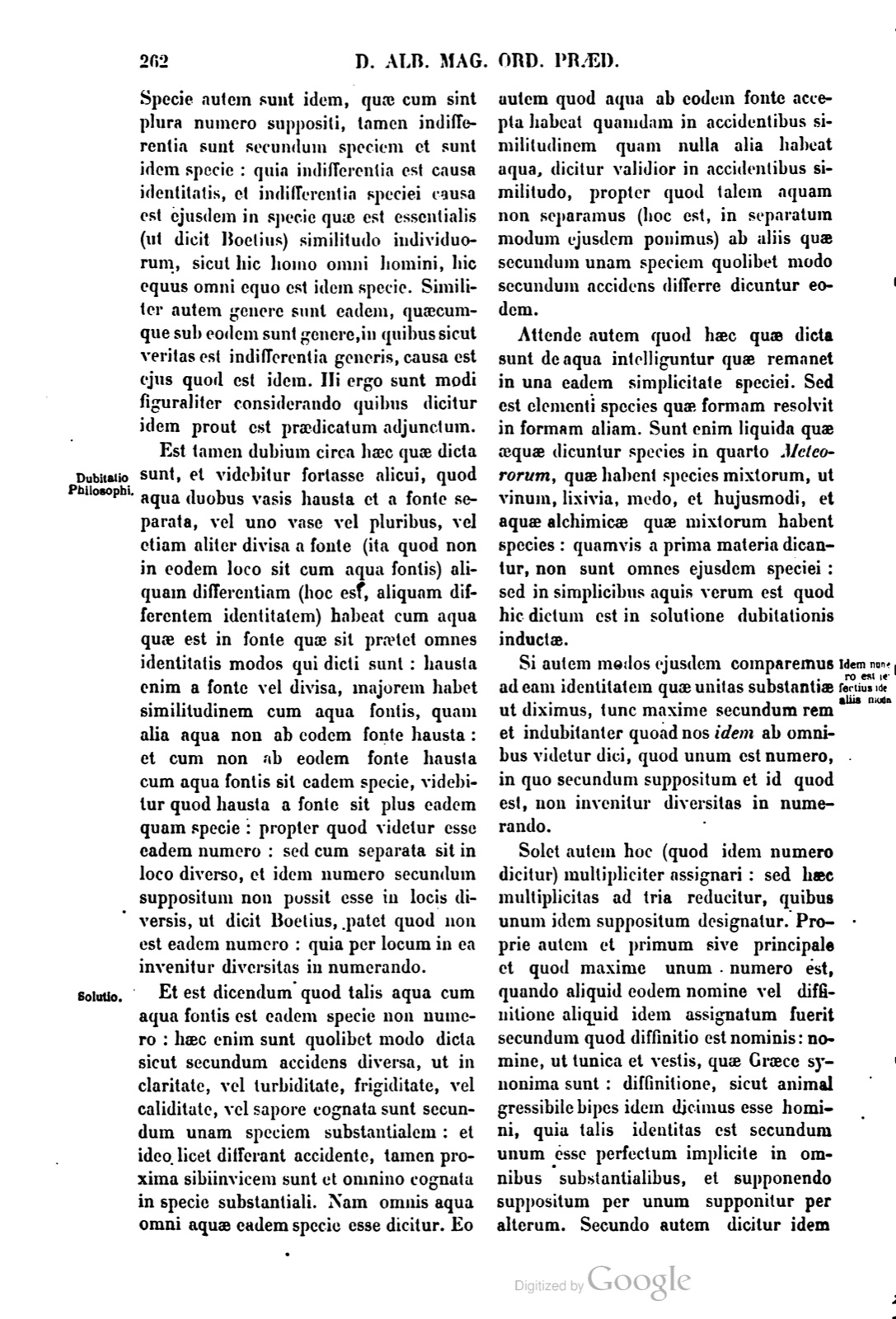
Est tamen dubium circa haec quae dicta sunt, et videbitur fortasse alicui, quod aqua duobus vasis hausta et a fonte separata, vel uno vase vel pluribus, vel etiam aliter divisa a fonte (ita quod non in eodem loco sit cum aqua fontis) aliquam differentiam (hoc est, aliquam differentem identitatem) habeat cum aqua quae est in fonte quae sit praeter omnes identitatis modos qui dicti sunt: hausta enim a fonte vel divisa, majorem habet similitudinem cum aqua fontis, quam alia aqua non ab eodem fonte hausta: et cum non ab eodem fonte hausta cum aqua fontis sit eadem specie, videbitur quod hausta a fonte sit plus eadem quam specie: propter quod videtur esse eadem numero: sed cum separata sit in loco diverso, et idem numero secundum suppositum non possit esse in locis diversis, ut dicit Boetius, patet quod non est eadem numero: quia per locum in ea invenitur diversitas in numerando.
[Marginal label, printed page 262: Solutio.]
Et est dicendum quod talis aqua cum aqua fontis est eadem specie non numero: haec enim sunt quolibet modo dicta sicut secundum accidens diversa, ut in claritate, vel turbiditate, frigiditate, vel caliditate, vel sapore cognata sunt secundum unam speciem substantialem: et ideo licet differant accidente, tamen proxima sibi invicem sunt et omnino cognata in specie substantiali. Nam omnis aqua omni aquae eadem specie esse dicitur. Eo autem quod aqua ab eodem fonte accepta habeat quamdam in accidentibus similitudinem quam nulla alia habeat aqua, dicitur validior in accidentibus similitudo, propter quod talem aquam non separamus (hoc est, in separatum modum ejusdem ponimus) ab aliis quae secundum unam speciem quolibet modo secundum accidens differre dicuntur eodem.
Attende autem quod haec quae dicta sunt de aqua intelliguntur quae remanet in una eadem simplicitate speciei. Sed est elementi species quae formam resolvit in formam aliam. Sunt enim liquida quae aquae dicuntur species in quarto Meteororum, quae habent species mixtorum, ut vinum, lixivia, medo, et hujusmodi, et aquae alchimicae quae mixtorum habent species: quamvis a prima materia dicantur, non sunt omnes ejusdem speciei: sed in simplicibus aquis verum est quod hic dictum est in solutione dubitationis inductae.
[Marginal label, printed page 262: Idem numero est perfectius idem aliis modis.]
Si autem modos ejusdem comparemus ad eam identitatem quae unitas substantiae ut diximus, tunc maxime secundum rem et indubitanter quoad nos idem ab omnibus videtur dici, quod unum est numero, in quo secundum suppositum et id quod est, non invenitur diversitas in numerando.
[Marginal label, printed page 262: Doubt of the Philosopher.]
Nevertheless there is a doubt concerning these things that have been said, and perhaps it will seem to someone that water drawn into two vessels and separated from the spring, or into one vessel or several, or also divided from the spring in another way, so that it is not in the same place with the water of the spring, has some difference, that is, some different identity, with the water that is in the spring, which is beyond all the modes of identity that have been stated. For water drawn from the spring or divided from it has a greater likeness with the water of the spring than other water not drawn from the same spring; and since water not drawn from the same spring is the same in species as the water of the spring, it will seem that water drawn from the spring is more the same than in species. On account of this it seems to be the same in number. But since it has been separated in a diverse place, and the same in number according to supposit cannot be in diverse places, as Boethius says, it is clear that it is not the same in number, because through place diversity in numbering is found in it.
[Marginal label, printed page 262: Solution.]
And it must be said that such water is the same in species with the water of the spring, not the same in number. For these things are said in every way as diverse according to accident, as in clarity, or turbidity, coldness, warmth, or taste they are akin according to one substantial species. Therefore although they differ by accident, nevertheless they are very near to one another and altogether akin in substantial species. For every water is said to be the same in species as every water. But because water taken from the same spring has a certain likeness in accidents which no other water has, the likeness is said to be stronger in accidents; on account of this we do not separate such water, that is, we do not put it into a separated mode of same, from other waters that are said to differ according to accident in some way while being the same according to one species.
But attend that the things said about water are understood of water that remains in one and the same simplicity of species. But there is a species of element that resolves one form into another form. For there are liquids that are called species of water in the fourth book of the Meteors, which have species of mixtures, such as wine, lye, mead, and things of this sort, and alchemical waters that have species of mixtures. Although they are said from prime matter, they are not all of the same species; but in simple waters what has been said here in the solution of the introduced doubt is true.
[Marginal label, printed page 262: Same in number is more perfectly same than same in the other modes.]
But if we compare the modes of same to that identity which is unity of substance, as we have said, then most of all according to the thing and indubitably as far as we are concerned, that which is one in number seems to be called same by everyone, since in it no diversity in numbering is found according to the supposit and that which is.
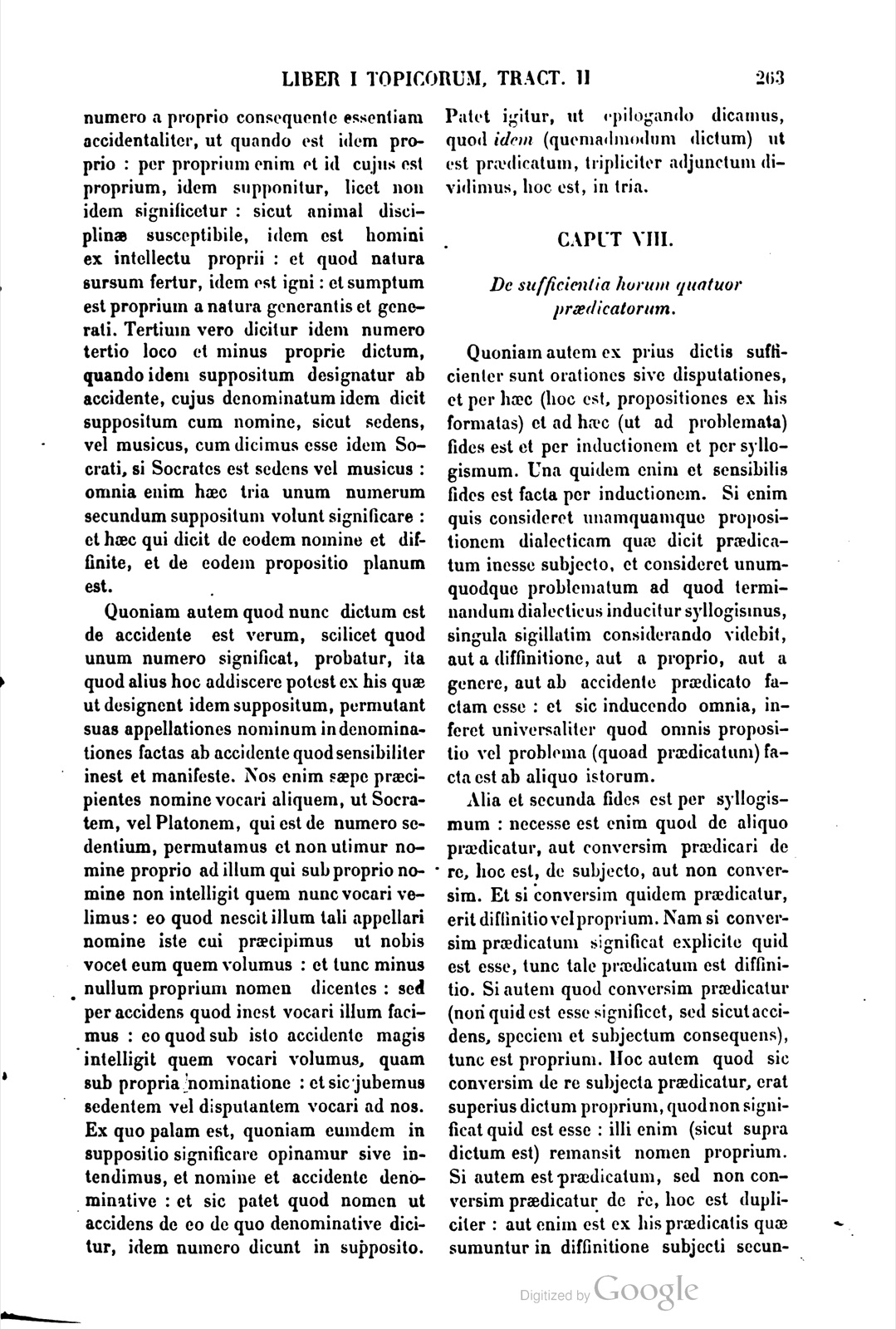
Solet autem hoc (quod idem numero dicitur) multipliciter assignari: sed haec multiplicitas ad tria reducitur, quibus unum idem suppositum designatur. Proprie autem et primum sive principale et quod maxime unum numero est, quando aliquid eodem nomine vel diffinitione aliquid idem assignatum fuerit secundum quod diffinitio est nominis: nomine, ut tunica et vestis, quae Graece synonima sunt: diffinitione, sicut animal gressibile bipes idem dicimus esse homini, quia talis identitas est secundum unum esse perfectum implicite in omnibus substantialibus, et supponendo suppositum per unum supponitur per alterum. Secundo autem dicitur idem numero a proprio consequente essentiam accidentaliter, ut quando est idem proprio: per proprium enim et id cujus est proprium, idem supponitur, licet non idem significetur: sicut animal disciplinae susceptibile, idem est homini ex intellectu proprii: et quod natura sursum fertur, idem est igni: et sumptum est proprium a natura generantis et generati. Tertium vero dicitur idem numero tertio loco et minus proprie dictum, quando idem suppositum designatur ab accidente, cujus denominatum idem dicit suppositum cum nomine, sicut sedens, vel musicus, cum dicimus esse idem Socrati, si Socrates est sedens vel musicus: omnia enim haec tria unum numerum secundum suppositum volunt significare: et haec qui dicit de eodem nomine et diffinite, et de eodem propositio planum est.
Quoniam autem quod nunc dictum est de accidente est verum, scilicet quod unum numero significat, probatur, ita quod alius hoc addiscere potest ex his quae ut designent idem suppositum, permutant suas appellationes nominum in denominationes factas ab accidente quod sensibiliter inest et manifeste. Nos enim saepe praecipientes nomine vocari aliquem, ut Socratem, vel Platonem, qui est de numero sedentium, permutamus et non utimur nomine proprio ad illum qui sub proprio nomine non intelligit quem nunc vocari velimus: eo quod nescit illum tali appellari nomine iste cui praecipimus ut nobis vocet eum quem volumus: et tunc nullum proprium nomen dicentes: sed per accidens quod inest vocari illum facimus: eo quod sub isto accidente magis intelligit quem vocari volumus, quam sub propria nominatione: et sic jubemus sedentem vel disputantem vocari ad nos. Ex quo palam est, quoniam eumdem in supposito significare opinamur sive intendimus, et nomine et accidente denominative: et sic patet quod nomen ut accidens de eo de quo denominative dicitur, idem numero dicunt in supposito.
Patet igitur, ut epilogando dicamus, quod idem (quemadmodum dictum) ut est praedicatum, tripliciter adjunctum dividimus, hoc est, in tria.
Now this, namely that something is called the same in number, is customarily assigned in many ways; but this multiplicity is reduced to three, by which one and the same supposit is designated. Properly and first or principally, and what is most of all one in number, is when something the same has been assigned by the same name or definition, according as definition is of the name: by name, as tunic and garment, which are synonymal in Greek; by definition, as we say that walking two-footed animal is the same as human being, because such identity is according to one perfect being implicitly in all substantial things, and by supposing the supposit through one, it is supposed through the other. Secondly, the same in number is said from a proper accidentally consequent upon the essence, as when it is the same by proper. For through the proper and that of which it is proper, the same thing is supposed, although the same thing is not signified; as animal capable of discipline is the same as human being from the understanding of the proper, and what is borne upward by nature is the same as fire; and the proper is taken from the nature of the generating thing and of the generated thing. Thirdly, however, the same in number is said in the third place and less properly, when the same supposit is designated by an accident whose denominated term says the same supposit as the name, as sitting or musical, when we say it is the same as Socrates if Socrates is sitting or musical; for all these three wish to signify one number according to supposit. And this is plain to the one who speaks of the same by name and definitely, and whose proposition is about the same.
But that what has now been said about accident is true, namely that it signifies one in number, is proved in such a way that another can learn this from those things which, in order to designate the same supposit, change their appellations of names into denominations made from an accident that is sensibly and manifestly in. For often, when ordering someone to be called by name, as Socrates or Plato, who is among the number of those sitting, we make a change and do not use the proper name for the one whom we wish now to be called under his proper name, because the person whom we order to call him to us does not know that he is called by such a name. And then, saying no proper name, we make him be called by an accident that is in, because under that accident he understands the one whom we wish to be called more than under his proper naming; and thus we order the sitting or disputing one to be called to us. From this it is clear that we think or intend the same thing in supposit to be signified both by name and denominatively by accident; and thus it is clear that a name as accident and that of which it is said denominatively say the same in number in supposit.
Therefore it is clear, to speak by way of epilogue, that same, as has been said, insofar as it is a predicate, we have divided as a threefold adjunct, that is, into three.
If a page does not appear, its photograph has not been uploaded yet.