Volume 2 · pp. 259–261
Chapter VI. That All Problems Are Ordered to the Problem Concerning Definition.
A marker with ≈ is an approximate page boundary, placed by measure of the text; the page photographs remain the authority. In the paired views, clicking a page marker brings that page into view.
CAPUT VI.
Quod omnia problemata ordinantur ad problema de diffinitione.
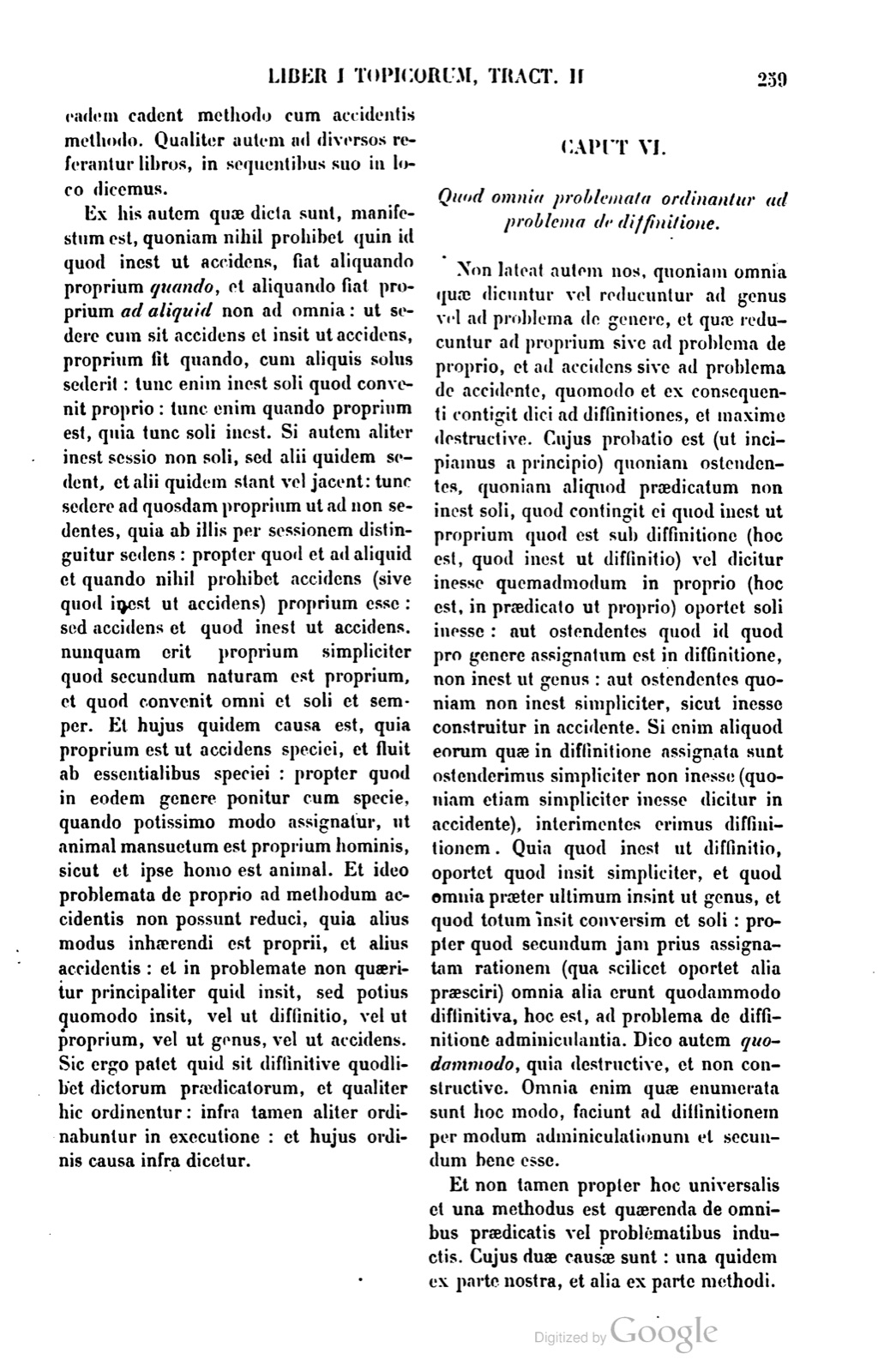
Non lateat autem nos, quoniam omnia quae dicuntur vel reducuntur ad genus vel ad problema de genere, et quae reducuntur ad proprium sive ad problema de proprio, et ad accidens sive ad problema de accidente, quomodo et ex consequenti contingit dici ad diffinitiones, et maxime destructive. Cujus probatio est (ut incipiamus a principio) quoniam ostendentes, quoniam aliquod praedicatum non inest soli, quod contingit ei quod inest ut proprium quod est sub diffinitione (hoc est, quod inest ut diffinitio) vel dicitur inesse quemadmodum in proprio (hoc est, in praedicato ut proprio) oportet soli inesse: aut ostendentes quod id quod pro genere assignatum est in diffinitione, non inest ut genus: aut ostendentes quoniam non inest simpliciter, sicut inesse construitur in accidente. Si enim aliquod eorum quae in diffinitione assignata sunt ostenderimus simpliciter non inesse (quoniam etiam simpliciter inesse dicitur in accidente), interimentes erimus diffinitionem. Quia quod inest ut diffinitio, oportet quod insit simpliciter, et quod omnia praeter ultimum insint ut genus, et quod totum insit conversim et soli: propter quod secundum jam prius assignatam rationem (qua scilicet oportet alia praesciri) omnia alia erunt quodammodo diffinitiva, hoc est, ad problema de diffinitione adminiculantia. Dico autem quodammodo, quia destructive, et non constructive. Omnia enim quae enumerata sunt hoc modo, faciunt ad diffinitionem per modum adminiculationum et secundum bene esse.
Et non tamen propter hoc universalis et una methodus est quaerenda de omnibus praedicatis vel problematibus inductis. Cujus duae causae sunt: una quidem ex parte nostra, et alia ex parte methodi. Nobis enim non facile est invenire talem methodum quae sic unitur ad quatuor praedicata haec vel problemata: quia praedicata (quum diversa inter se sint quantum ad modum inhaerendi qui quaeritur in problemate) difficile est nobis invenire commune in quo uniuntur sicut uno communi, quod sit ejusdem rationis in omnibus: et si inveniatur, non potest inveniri qualiter illud commune per singula propria contractum adaptetur ad singula: et si inveniatur commune omnino, talis methodus erit incerta: quia illud commune non per unam rationem inest singulis: et erit raro utilis, quia raro invenitur qualiter et quibus propriis illud commune coaptetur ad propositum, cum dialectica ex communibus et probabilibus procedat: et sic rara utilis erit ad propositum quodcumque problema. Et sic in se est inutilis et incerta methodus, propter hoc quod commune non una ratione erit, sed analogice: et nobis erit difficilis ad inveniendum propter difficultatem reductionis istorum in unum commune ad omnia. Sed propria assignata methodo de unoquoque istorum per proprias considerationes non communes, hoc est ad finem intentum deductio propositi tantum: quia tunc singulis libris perficitur propria methodus: et omnibus his simul acceptis interrogatur una communis methodus, quae est a nullo istorum determinate denominata, sed in communi vocatur methodus dialectica. Propter quod quia communis methodus est difficilis et raro utilis (ad diffinitiones enim solas utilis est et quodammodo et non simpliciter) ideo singulariter de singulis horum per se, quemadmodum prius dictum est, dividentium, idem divisim tractandum est.
CHAPTER VI.
That All Problems Are Ordered to the Problem Concerning Definition.
But let it not escape us that all things that are said of, or are reduced to, genus or to a problem concerning genus, and the things reduced to proper or to a problem concerning proper, and to accident or to a problem concerning accident, can in some way and consequently be said with respect to definitions, and especially destructively. The proof of this is, to begin from the beginning, that when we show that some predicate is not in one alone, which belongs to that which is in as proper and is under definition, that is, which is in as definition, or is said to be in as in a proper, that is, in a predicate as proper, it must be in one alone; or when we show that what has been assigned as genus in the definition is not in as genus; or when we show that it is not in simply, as being-in is constructed in accident. For if we shall have shown that some one of the things assigned in the definition simply is not in, since also to be in simply is said in accident, we shall be destroying the definition. For what is in as definition must be in simply, and all things except the ultimate must be in as genus, and the whole must be in conversely and alone. On account of this, according to the account already assigned before, namely that other things must be foreknown, all other things will in a certain way be definitive, that is, aiding the problem concerning definition. But I say in a certain way because they do so destructively and not constructively. For all the things enumerated in this way contribute to definition by way of aids and according to its well-being.
And nevertheless, on account of this, one universal method is not to be sought concerning all the predicates or problems introduced. There are two causes of this: one on our part, and the other on the part of the method. For it is not easy for us to find such a method which is thus united to these four predicates or problems, because, since the predicates are diverse among themselves with respect to the mode of inhering that is sought in the problem, it is difficult for us to find the common thing in which they are united as in one common thing that is of the same account in all of them. And if it is found, it cannot be found how that common thing, contracted by the proper things belonging to each, is adapted to each. And if a common thing is found altogether, such a method will be uncertain, because that common thing will not be in each by one account; and it will rarely be useful, because it is rarely found how and by what proper things that common thing is fitted to the proposed object, since dialectic proceeds from common and probable things; and thus it will rarely be useful for any proposed problem. And thus in itself the method is useless and uncertain, because the common thing will not be by one account but analogically; and for us it will be difficult to discover because of the difficulty of reducing those things into one common thing for all. But when a proper method has been assigned for each of those through proper and not common considerations, this is the deduction of the proposed thing only to the intended end; because then the proper method is completed in the individual books, and when all these things are taken together one common method is asked for, which is not determinately denominated from any of those things but is commonly called the dialectical method. Therefore, because the common method is difficult and rarely useful, for it is useful only for definitions and in a certain way and not simply, for that reason, as was said before, the same thing must be treated separately and distinctly concerning each of these things divided through themselves.
Ea autem quae sunt de numero eorum praedicatorum quae principalibus sunt adjuncta, et ad ista reducibilia sunt adjungenda ad praedicata principalia sibi convenientia, ut de eodem et diverso ad diffinitionem, et de differentia generali ad genus, et accidente comparato ad accidens, et sic de aliis. Haec autem adjuncta sumus nuncupantes diffinitiva et generalia et accidentalia, propter hoc quod considerationibus diffinitionis vel generis et accidentis terminantur. Ea autem praedicata quae dicta sunt, penes ea quae sunt praedicata principalibus adjuncta. Penes autem dico, quod nihil adjunctum adhuc est proprio, vel quia adjuncta in speciali adhuc non ostendimus, sicut faciemus in sequentibus specialiter de singulis adjuncta prosequentes.
Est autem hic notandum quod quamvis (sicut dictum est) omnia sint aliquo modo distincta, non tamen potest una universalis esse methodus de omnibus quae sit ex communibus ad omnia problemata terminanda: illa enim non posset esse intrinsecus, quia intrinseca cujuslibet non sunt omnia: nec potest esse omnia: sed oporteret quod esset per locos extrinsecos, et sic esset juncta, quia illi loci parum certificant: et incidit in eis frequenter petitio principii, sicut in loco ab oppositis et a simili et hujusmodi, ubi aeque ignotum est inferens sicut illatum.
But the things that are of the number of those predicates that are joined to the principal predicates, and that are reducible to them, must be joined to the principal predicates suitable to them, as concerning same and diverse to definition, concerning general difference to genus, and concerning accident compared to accident, and so concerning the others. Now we are naming these adjuncts definitive, general, and accidental, because they are terminated by the considerations of definition, genus, and accident. But the predicates that have been mentioned are considered in relation to those things that are predicates joined to the principal predicates. I say in relation to them because nothing adjunct has yet been joined to proper, either because we have not yet shown the adjuncts in special, as we shall do in the following matters when we pursue the adjuncts specially one by one.
Here it must be noted that although, as was said, all things are in some way distinct, nevertheless there cannot be one universal method concerning all things that proceeds from common things to terminate all problems. For that method could not be intrinsic, because the intrinsic things of each are not all things; nor can it be all things. Rather it would have to proceed through extrinsic places, and thus it would be joined, because those places make little certain; and begging the principle frequently occurs in them, as in the place from opposites and from similar things and the like, where what infers is equally unknown as what is inferred.
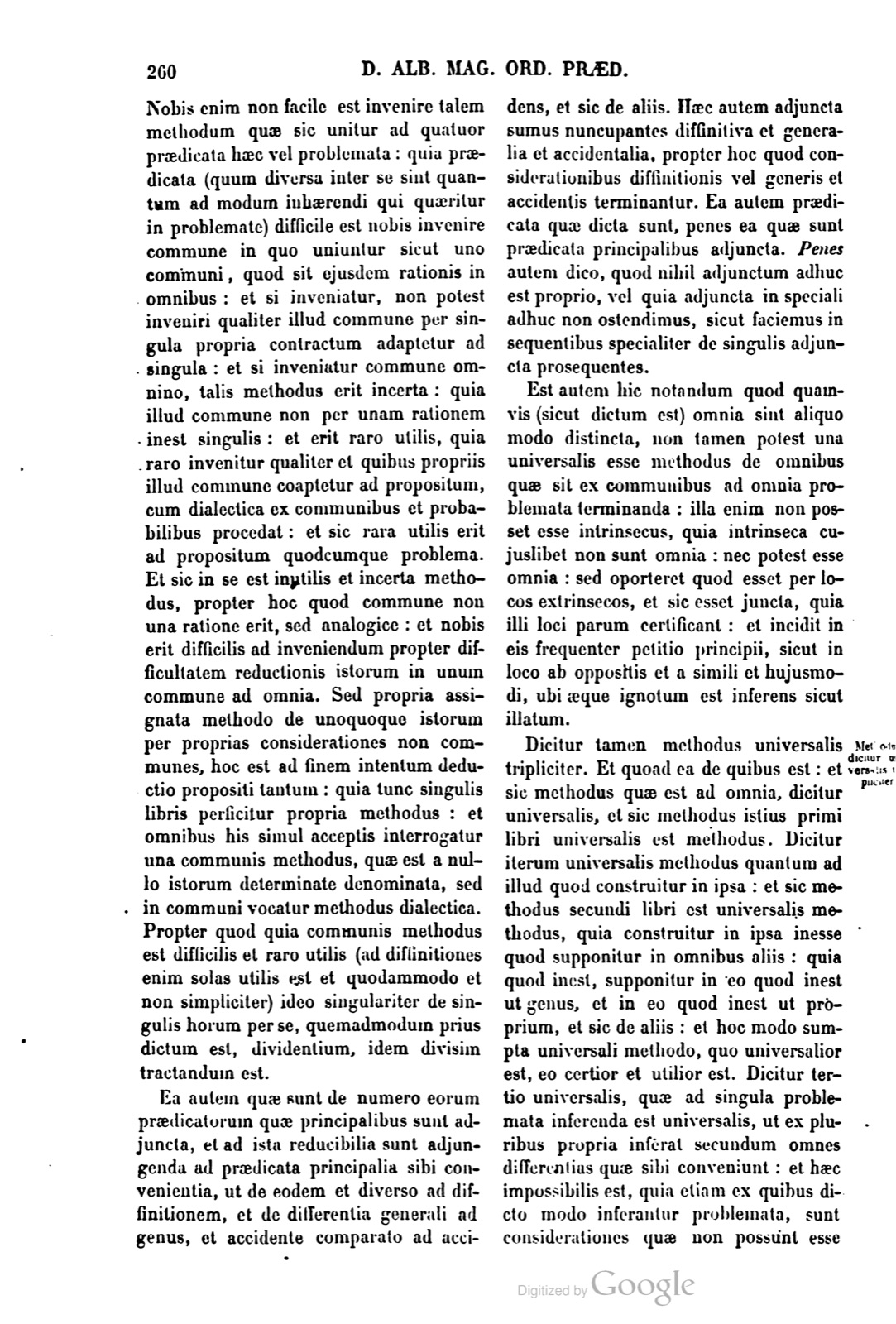
[Marginal label, printed page 260: Methodus universalis tripliciter dicitur.]
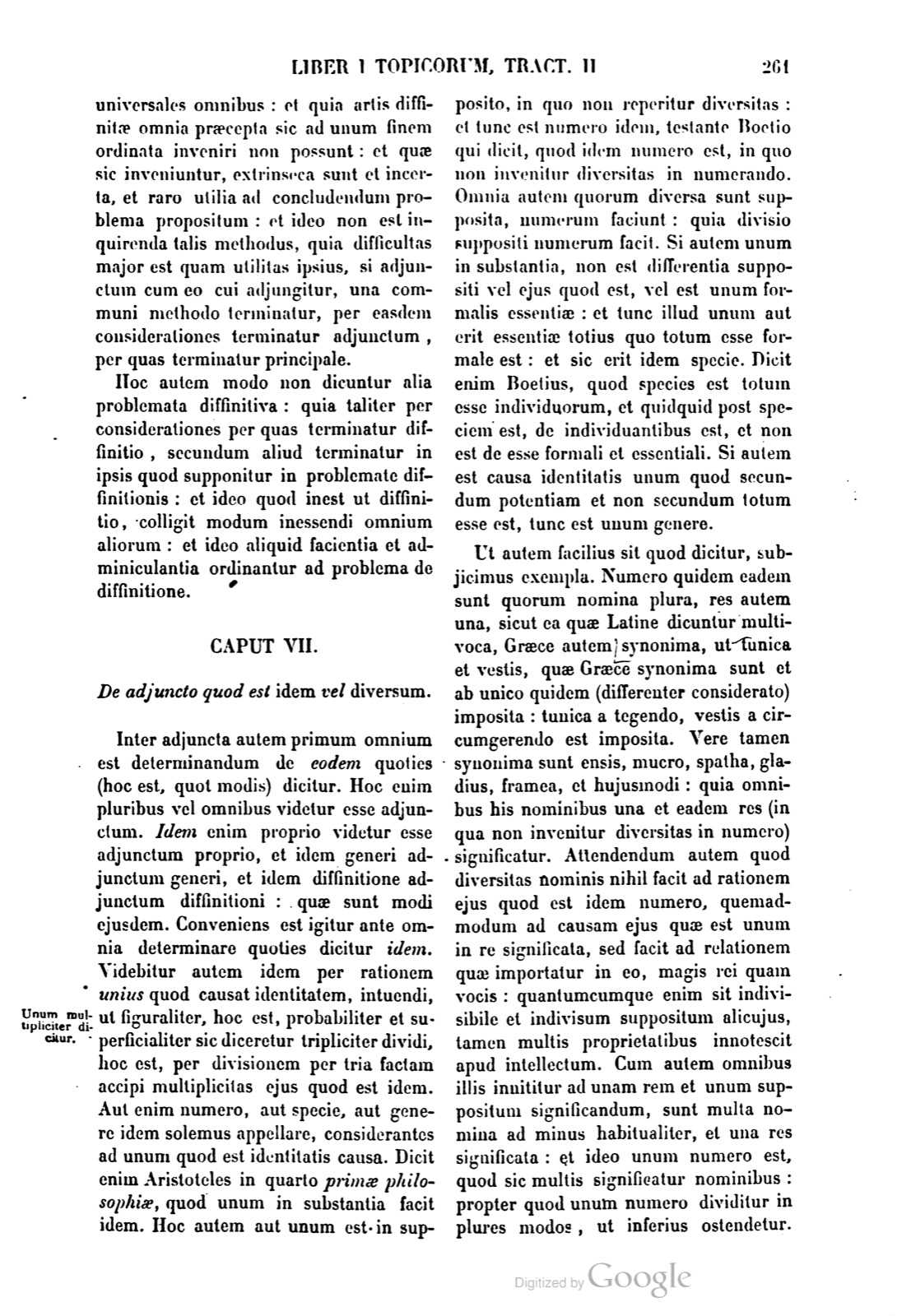
Dicitur tamen methodus universalis tripliciter. Et quoad ea de quibus est: et sic methodus quae est ad omnia, dicitur universalis, et sic methodus istius primi libri universalis est methodus. Dicitur iterum universalis methodus quantum ad illud quod construitur in ipsa: et sic methodus secundi libri est universalis methodus, quia construitur in ipsa inesse quod supponitur in omnibus aliis: quia quod inest, supponitur in eo quod inest ut genus, et in eo quod inest ut proprium, et sic de aliis: et hoc modo sumpta universali methodo, quo universalior est, eo certior et utilior est. Dicitur tertio universalis, quae ad singula problemata inferenda est universalis, ut ex pluribus propria inferat secundum omnes differentias quae sibi conveniunt: et haec impossibilis est, quia etiam ex quibus dicto modo inferantur problemata, sunt considerationes quae non possunt esse universales omnibus: et quia artis diffinitae omnia praecepta sic ad unum finem ordinata inveniri non possunt: et quae sic inveniuntur, extrinseca sunt et incerta, et raro utilia ad concludendum problema propositum: et ideo non est inquirenda talis methodus, quia difficultas major est quam utilitas ipsius, si adjunctum cum eo cui adjungitur, una communi methodo terminatur, per easdem considerationes terminatur adjunctum, per quas terminatur principale.
Hoc autem modo non dicuntur alia problemata diffinitiva: quia taliter per considerationes per quas terminatur diffinitio, secundum aliud terminatur in ipsis quod supponitur in problemate diffinitionis: et ideo quod inest ut diffinitio, colligit modum inessendi omnium aliorum: et ideo aliquid facientia et adminiculantia ordinantur ad problema de diffinitione.
[Marginal label, printed page 260: Universal method is said in three ways.]
Nevertheless universal method is said in three ways. First, with respect to the things of which it is; and thus the method that is directed to all things is called universal, and in this way the method of this first book is a universal method. Again, a method is called universal with respect to that which is constructed in it; and in this way the method of the second book is a universal method, because in it there is constructed the being-in that is presupposed in all the others, because what is in is presupposed in what is in as genus, and in what is in as proper, and so in the others. And with universal method taken in this way, the more universal it is, the more certain and useful it is. Thirdly, that method is called universal which is universal for inferring individual problems, so that from many things it may infer proper things according to all the differences that belong to it; and this is impossible, because even the things from which problems are inferred in the stated way are considerations that cannot be universal for all. And because all the precepts of a definite art, ordered in this way to one end, cannot be found; and the things that are found in this way are extrinsic and uncertain and rarely useful for concluding the proposed problem; therefore such a method is not to be sought, because its difficulty is greater than its usefulness. If the adjunct together with that to which it is joined is terminated by one common method, the adjunct is terminated through the same considerations through which the principal thing is terminated.
In this way, however, the other problems are not called definitive, because in such a manner, through the considerations by which definition is terminated, what is presupposed in them in the problem of definition is terminated according to another thing; and therefore what is in as definition gathers together the mode of being-in of all the others. And therefore things that do something and give aid are ordered to the problem concerning definition.
If a page does not appear, its photograph has not been uploaded yet.