Volume 2 · pp. 257–259
Continuation of Chapter IV and Chapter V. Concerning Accident and What Is Reducible to the Method Concerning Accident, etc.
A marker with ≈ is an approximate page boundary, placed by measure of the text; the page photographs remain the authority. In the paired views, clicking a page marker brings that page into view.
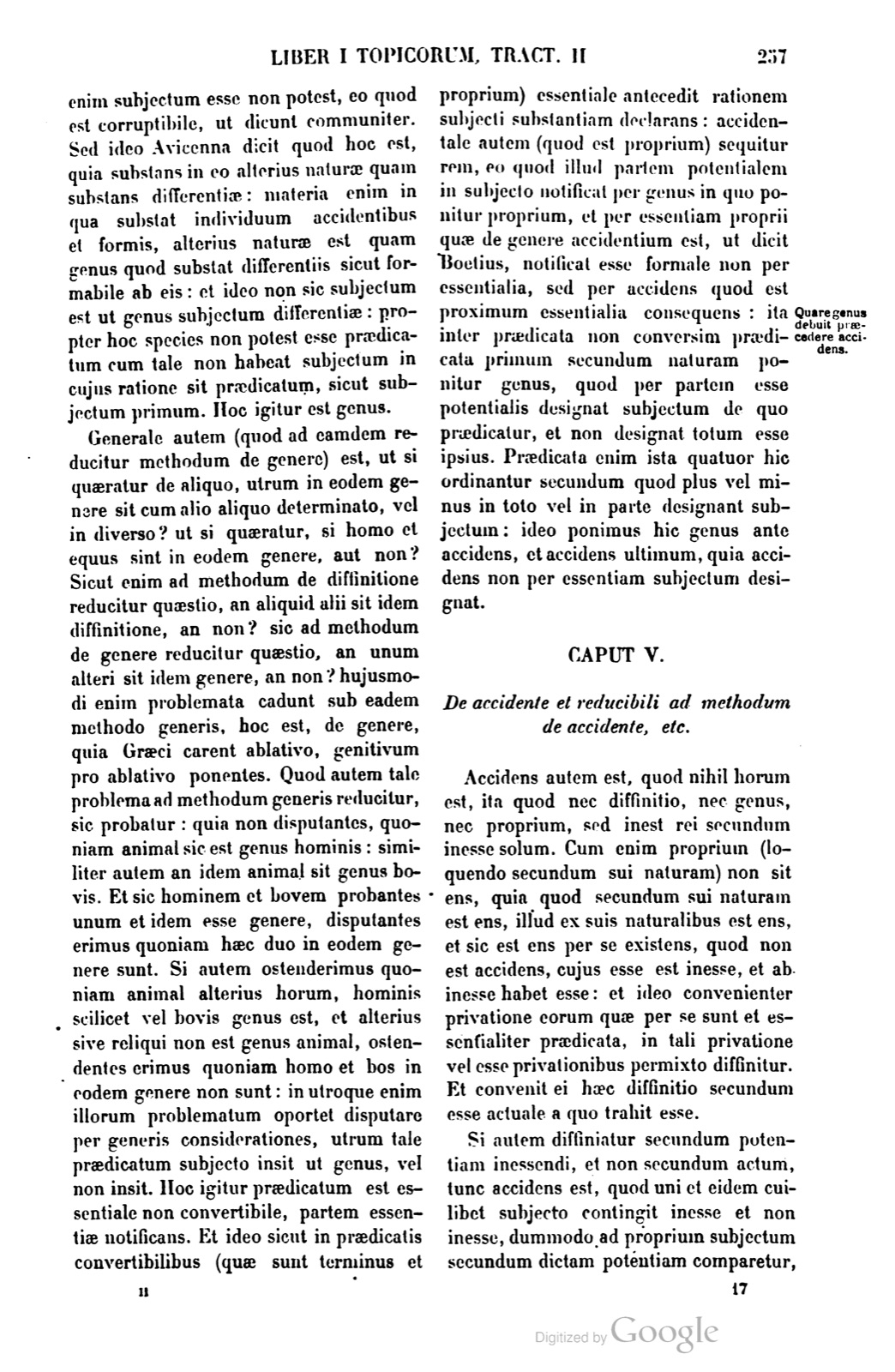
enim subjectum esse non potest, eo quod est corruptibile, ut dicunt communiter. Sed ideo Avicenna dicit quod hoc est, quia substans in eo alterius naturae quam substans differentiae: materia enim in qua substat individuum accidentibus et formis, alterius naturae est quam genus quod substat differentiis sicut formabile ab eis: et ideo non sic subjectum est ut genus subjectum differentiae: propter hoc species non potest esse praedicatum cum tale non habeat subjectum in cujus ratione sit praedicatum, sicut subjectum primum. Hoc igitur est genus.
Generale autem (quod ad eamdem reducitur methodum de genere) est, ut si quaeratur de aliquo, utrum in eodem genere sit cum alio aliquo determinato, vel in diverso? ut si quaeratur, si homo et equus sint in eodem genere, aut non? Sicut enim ad methodum de diffinitione reducitur quaestio, an aliquid alii sit idem diffinitione, an non? sic ad methodum de genere reducitur quaestio, an unum alteri sit idem genere, an non? hujusmodi enim problemata cadunt sub eadem methodo generis, hoc est, de genere, quia Graeci carent ablativo, genitivum pro ablativo ponentes. Quod autem tale problema ad methodum generis reducitur, sic probatur: quia non disputantes, quoniam animal sic est genus hominis: similiter autem an idem animal sit genus bovis. Et sic hominem et bovem probantes unum et idem esse genere, disputantes erimus quoniam haec duo in eodem genere sunt. Si autem ostenderimus quoniam animal alterius horum, hominis scilicet vel bovis genus est, et alterius sive reliqui non est genus animal, ostendentes erimus quoniam homo et bos in eodem genere non sunt: in utroque enim illorum problematum oportet disputare per generis considerationes, utrum tale praedicatum subjecto insit ut genus, vel non insit. Hoc igitur praedicatum est essentiale non convertibile, partem essentiae notificans. Et ideo sicut in praedicatis convertibilibus (quae sunt terminus et proprium) essentiale antecedit rationem subjecti substantiam declarans: accidentale autem (quod est proprium) sequitur rem, eo quod illud partem potentialem in subjecto notificat per genus in quo ponitur proprium, et per essentiam proprii quae de genere accidentium est, ut dicit Boetius, notificat esse formale non per essentialia, sed per accidens quod est proximum essentialia consequens: ita inter praedicata non conversim praedicata primum secundum naturam ponitur genus, quod per partem esse potentialis designat subjectum de quo praedicatur, et non designat totum esse ipsius. Praedicata enim ista quatuor hic ordinantur secundum quod plus vel minus in toto vel in parte designant subjectum: ideo ponimus hic genus ante accidens, et accidens ultimum, quia accidens non per essentiam subjectum designat.
[Marginal label, printed page 257: Quare genus debuit praecedere accidens.]
CAPUT V.
De accidente et reducibili ad methodum de accidente, etc.
Accidens autem est, quod nihil horum est, ita quod nec diffinitio, nec genus, nec proprium, sed inest rei secundum inesse solum. Cum enim proprium (loquendo secundum sui naturam) non sit ens, quia quod secundum sui naturam est ens, illud ex suis naturalibus est ens, et sic est ens per se existens, quod non est accidens, cujus esse est inesse, et ab inesse habet esse: et ideo convenienter privatione eorum quae per se sunt et essentialiter praedicata, in tali privatione vel esse privationibus permixto diffinitur. Et convenit ei haec diffinitio secundum esse actuale a quo trahit esse.
For it cannot be a subject, because it is corruptible, as people commonly say. But Avicenna therefore says that this is so because what underlies in it is of another nature than what underlies difference: for the matter in which the individual underlies accidents and forms is of another nature than the genus that underlies differences as something formable by them; and therefore it is not a subject in such a way as genus is the subject of difference. On account of this species cannot be predicated, since such a thing does not have a subject in whose account it is predicated, as the first subject does. This, therefore, is genus.
But the general, which is reduced to the same method concerning genus, is as when it is asked about something whether it is in the same genus with some other determinate thing, or in a diverse genus; as if it is asked whether human being and horse are in the same genus or not. For just as the question whether something is the same as another in definition or not is reduced to the method concerning definition, so the question whether one thing is the same as another in genus or not is reduced to the method concerning genus. Problems of this kind fall under the same method of genus, that is, concerning genus, because the Greeks lack the ablative and put the genitive in place of the ablative. That such a problem is reduced to the method of genus is proved thus: because we are not disputing that animal thus is the genus of human being, and similarly whether the same animal is the genus of ox. And thus, proving human being and ox to be one and the same in genus, we will be disputing that these two are in the same genus. But if we shall have shown that animal is the genus of one of these, namely of human being or of ox, and that it is not the genus-animal of the other or remaining one, we will be showing that human being and ox are not in the same genus; for in each of those problems one must dispute through considerations of genus whether such a predicate is in the subject as genus or is not in it. This predicate, therefore, is essential, non-convertible, and makes known a part of the essence. And therefore, just as among convertible predicates, which are term and proper, the essential precedes the account of the subject by declaring the substance, but the accidental, which is proper, follows the thing, because it makes known the potential part in the subject through the genus in which the proper is placed, and through the essence of the proper, which belongs to the genus of accidents, as Boethius says, it makes known formal being not through essential things but through an accident that is the proximate consequent upon essential things: so among predicates not predicated conversely, genus is placed first according to nature, because through the part of potential being it designates the subject of which it is predicated and does not designate the whole being of it. For these four predicates are ordered here according as they designate the subject more or less in whole or in part; therefore here we place genus before accident, and accident last, because accident does not designate the subject through essence.
[Marginal label, printed page 257: Why genus had to precede accident.]
CHAPTER V.
Concerning Accident and What Is Reducible to the Method Concerning Accident, etc.
Accident, however, is that which is none of these, in such a way that it is neither definition, nor genus, nor proper, but is in the thing according to being-in alone. For since proper, speaking according to its own nature, is not a being, because what according to its own nature is a being is a being from its own natural principles and thus is a being existing through itself, which is not accident, whose being is to be in and which has being from being-in: therefore it is suitably defined by the privation of those things that are predicated through themselves and essentially, in such a privation or in being mixed with privations. And this definition belongs to it according to actual being from which it draws being.
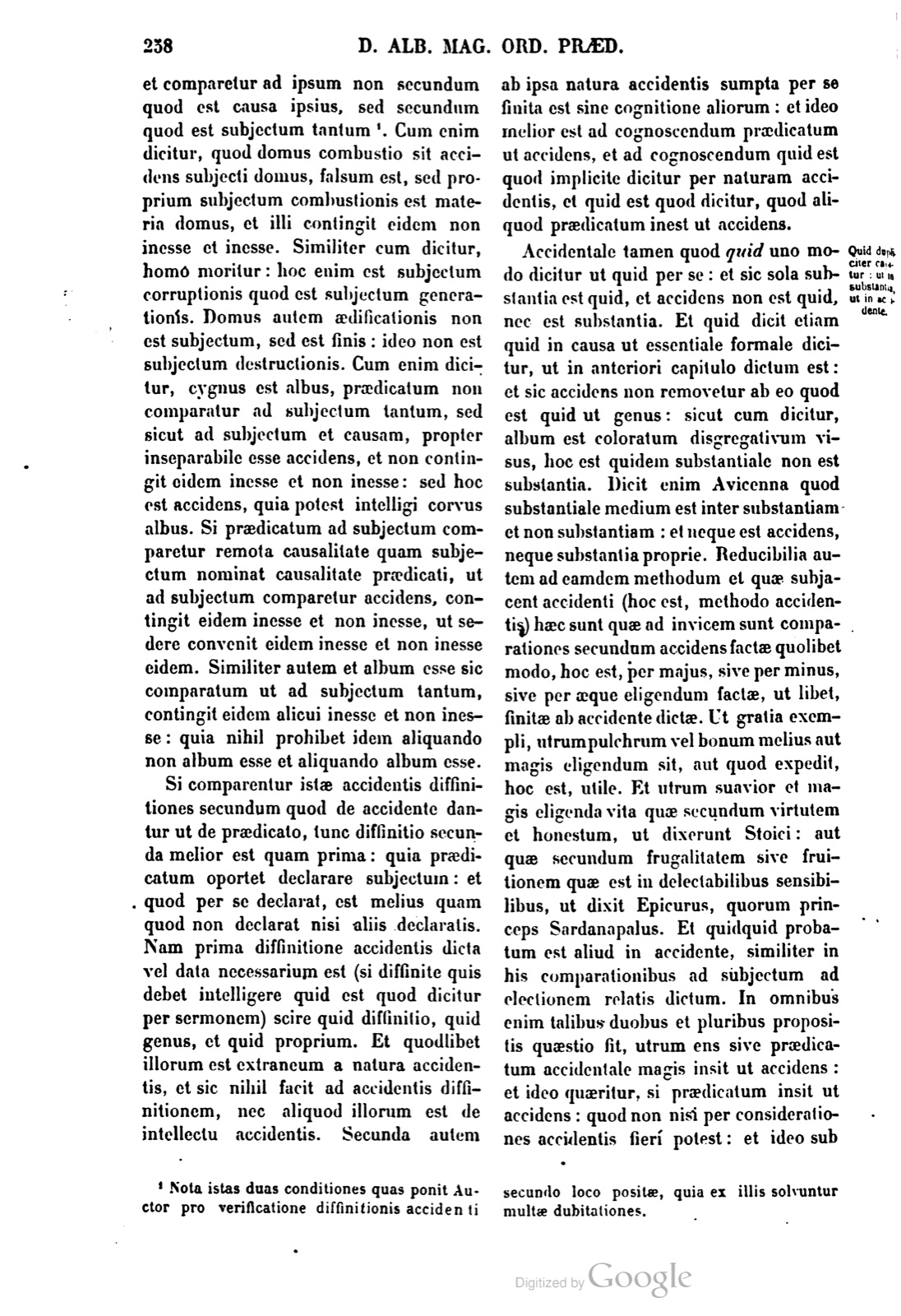
Si autem diffiniatur secundum potentiam inessendi, et non secundum actum, tunc accidens est, quod uni et eidem cuilibet subjecto contingit inesse et non inesse, dummodo ad proprium subjectum secundum dictam potentiam comparetur, et comparetur ad ipsum non secundum quod est causa ipsius, sed secundum quod est subjectum tantum 1. Cum enim dicitur, quod domus combustio sit accidens subjecti domus, falsum est, sed proprium subjectum combustionis est materia domus, et illi contingit eidem non inesse et inesse. Similiter cum dicitur, homo moritur: hoc enim est subjectum corruptionis quod est subjectum generationis. Domus autem aedificationis non est subjectum, sed est finis: ideo non est subjectum destructionis. Cum enim dicitur, cygnus est albus, praedicatum non comparatur ad subjectum tantum, sed sicut ad subjectum et causam, propter inseparabile esse accidens, et non contingit eidem inesse et non inesse: sed hoc est accidens, quia potest intelligi corvus albus. Si praedicatum ad subjectum comparetur remota causalitate quam subjectum nominat causalitate praedicati, ut ad subjectum comparetur accidens, contingit eidem inesse et non inesse, ut sedere convenit eidem inesse et non inesse eidem. Similiter autem et album esse sic comparatum ut ad subjectum tantum, contingit eidem alicui inesse et non inesse: quia nihil prohibet idem aliquando non album esse et aliquando album esse.
Si comparentur istae accidentis diffinitiones secundum quod de accidente dantur ut de praedicato, tunc diffinitio secunda melior est quam prima: quia praedicatum oportet declarare subjectum: et quod per se declarat, est melius quam quod non declarat nisi aliis declaratis. Nam prima diffinitione accidentis dicta vel data necessarium est (si diffinite quis debet intelligere quid est quod dicitur per sermonem) scire quid diffinitio, quid genus, et quid proprium. Et quodlibet illorum est extraneum a natura accidentis, et sic nihil facit ad accidentis diffinitionem, nec aliquid illorum est de intellectu accidentis. Secunda autem ab ipsa natura accidentis sumpta per se finita est sine cognitione aliorum: et ideo melior est ad cognoscendum praedicatum ut accidens, et ad cognoscendum quid est quod implicite dicitur per naturam accidentis, et quid est quod dicitur, quod aliquod praedicatum inest ut accidens.
[Marginal label, printed page 258: Quid dupliciter caditur: ut in substantia, ut in accidente.]
Accidentale tamen quod quid uno modo dicitur ut quid per se: et sic sola substantia est quid, et accidens non est quid, nec est substantia. Et quid dicit etiam quid in causa ut essentiale formale dicitur, ut in anteriori capitulo dictum est: et sic accidens non removetur ab eo quod est quid ut genus: sicut cum dicitur, album est coloratum disgregativum visus, hoc est quidem substantiale non est substantia. Dicit enim Avicenna quod substantiale medium est inter substantiam et non substantiam: et neque est accidens, neque substantia proprie. Reducibilia autem ad eamdem methodum et quae subjacent accidenti (hoc est, methodo accidentis) haec sunt quae ad invicem sunt comparationes secundum accidens factae quolibet modo, hoc est, per majus, sive per minus, sive per aeque eligendum factae, ut libet, finitae ab accidente dictae. Ut gratia exempli, utrum pulchrum vel bonum melius aut magis eligendum sit, aut quod expedit, hoc est, utile. Et utrum suavior et magis eligenda vita quae secundum virtutem et honestum, ut dixerunt Stoici: aut quae secundum frugalitatem sive fruitionem quae est in delectabilibus sensibilibus, ut dixit Epicurus, quorum princeps Sardanapalus. Et quidquid probatum est aliud in accidente, similiter in his comparationibus ad subjectum ad electionem relatis dictum. In omnibus enim talibus duobus et pluribus propositis quaestio fit, utrum ens sive praedicatum accidentale magis insit ut accidens: et ideo quaeritur, si praedicatum insit ut accidens: quod non nisi per considerationes accidentis fieri potest: et ideo sub eadem cadent methodo cum accidentis methodo. Qualiter autem ad diversos referantur libros, in sequentibus suo in loco dicemus.
But if it is defined according to the potency of being-in, and not according to act, then accident is that which can belong and not belong to any one and the same subject, provided that it is compared to the proper subject according to the stated potency, and is compared to it not according as it is its cause, but according as it is only the subject 1. For when it is said that the burning of a house is an accident of the subject, the house, this is false; rather the proper subject of burning is the matter of the house, and it can belong and not belong to that same thing. Similarly, when it is said, a human being dies, this is the subject of corruption, which is the subject of generation. But a house is not the subject of building, but its end; therefore it is not the subject of destruction. For when it is said, the swan is white, the predicate is not compared only to the subject, but as to subject and cause, because the accident is inseparable, and it cannot belong and not belong to the same thing; but this is an accident, because a white raven can be understood. If the predicate is compared to the subject with the causality that the subject names in relation to the causality of the predicate removed, so that accident is compared to the subject as to subject, it can belong and not belong to the same thing, as sitting can belong and not belong to the same thing. Similarly, being white, compared in this way as only to the subject, can belong and not belong to some same thing, because nothing prevents the same thing from at one time not being white and at another time being white.
If these definitions of accident are compared according as they are given concerning accident as a predicate, then the second definition is better than the first, because the predicate ought to declare the subject, and what declares through itself is better than what declares only when other things have been declared. For with the first definition of accident stated or given, it is necessary, if someone ought to understand definitely what is said through the discourse, to know what definition is, what genus is, and what proper is. And each of those is external to the nature of accident, and thus contributes nothing to the definition of accident, nor is any one of them included in the understanding of accident. But the second, taken from the very nature of accident, is by itself bounded without cognition of other things; and therefore it is better for knowing the predicate as accident, and for knowing what is implicitly said through the nature of accident, and what it means when it is said that some predicate is in as accident.
[Marginal label, printed page 258: What is said in two ways: as in substance, as in accident.]
Nevertheless the accidental quod quid is in one way said as a what through itself, and thus substance alone is what, and accident is not what, nor is it substance. And what also says what in a cause, as the formal essential is said, as was said in the preceding chapter; and thus accident is not removed from that which is what as genus, as when it is said, white is a color disgregative of sight; this indeed is substantial, but it is not substance. For Avicenna says that the substantial is a middle between substance and non-substance; and it is neither accident nor substance properly. But the things reducible to the same method and the things subject to accident, that is, to the method of accident, are these: comparisons made to one another according to accident in any manner whatever, that is, made according to more, or according to less, or according to equally to-be-chosen, as one pleases, being defined from accident. For example, whether the beautiful or the good is better or more to be chosen, or that which is expedient, that is, useful. And whether the life that is according to virtue and honorableness is sweeter and more to be chosen, as the Stoics said, or the life according to frugality or enjoyment which is in sensible delectables, as Epicurus said, whose chief was Sardanapalus. And whatever else has been proved in accident is similarly said in these comparisons referred to the subject and to choice. For in all such cases, when two or more things have been proposed, the question is made whether the being or accidental predicate is in more as accident; and therefore it is asked whether the predicate is in as accident. This can be done only through considerations of accident; and therefore they will fall under the same method as the method of accident. But how they are referred to diverse books we shall say below in its own place.
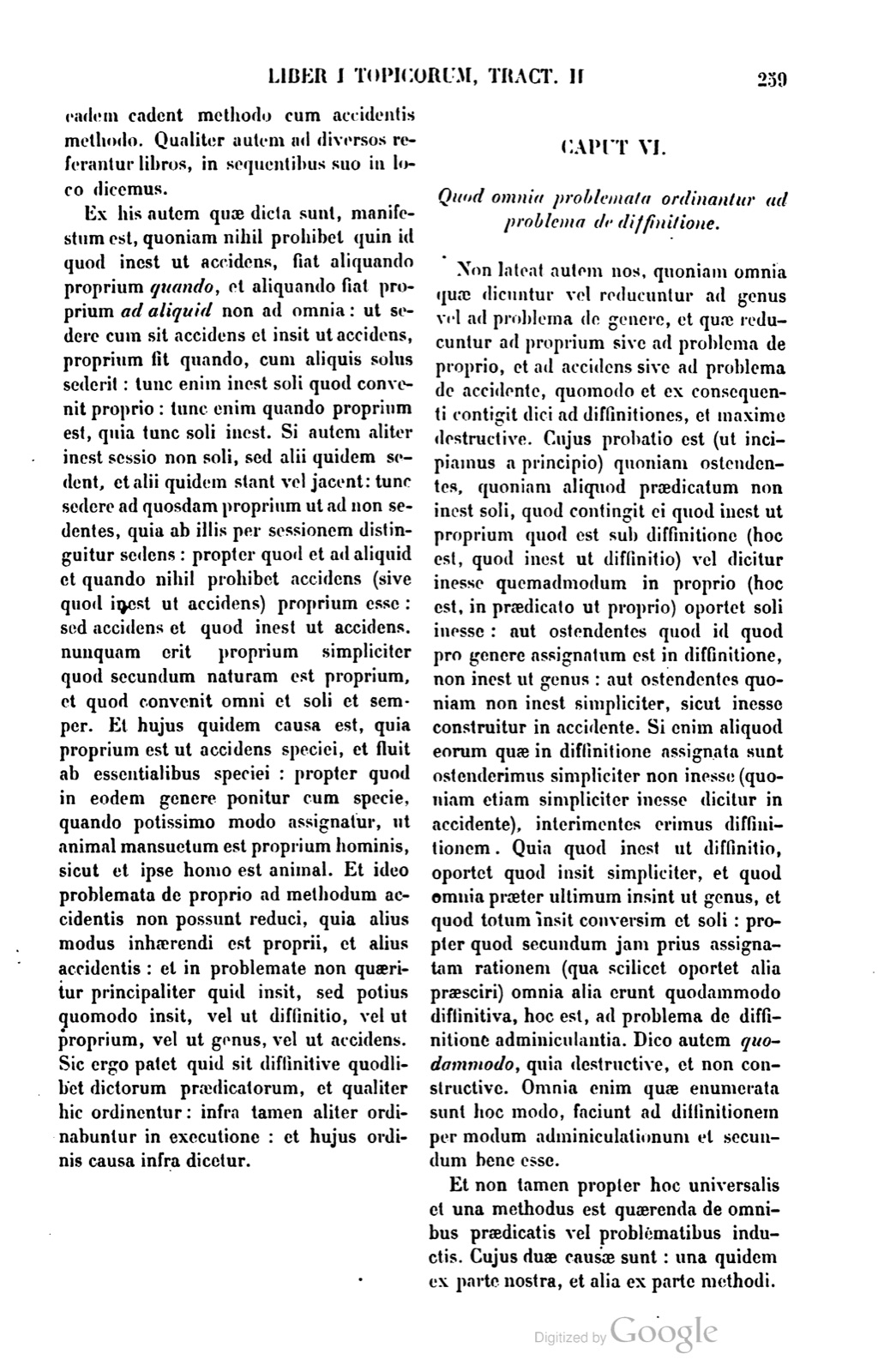
Ex his autem quae dicta sunt, manifestum est, quoniam nihil prohibet quin id quod inest ut accidens, fiat aliquando proprium quando, et aliquando fiat proprium ad aliquid non ad omnia: ut sedere cum sit accidens et insit ut accidens, proprium fit quando, cum aliquis solus sederit: tunc enim inest soli quod convenit proprio: tunc enim quando proprium est, quia tunc soli inest. Si autem aliter inest sessio non soli, sed alii quidem sedent, et alii quidem stant vel jacent: tunc sedere ad quosdam proprium ut ad non sedentes, quia ab illis per sessionem distinguitur sedens: propter quod et ad aliquid et quando nihil prohibet accidens (sive quod inest ut accidens) proprium esse: sed accidens et quod inest ut accidens nunquam erit proprium simpliciter quod secundum naturam est proprium, et quod convenit omni et soli et semper. Et hujus quidem causa est, quia proprium est ut accidens speciei, et fluit ab essentialibus speciei: propter quod in eodem genere ponitur cum specie, quando potissimo modo assignatur, ut animal mansuetum est proprium hominis, sicut et ipse homo est animal. Et ideo problemata de proprio ad methodum accidentis non possunt reduci, quia alius modus inhaerendi est proprii, et alius accidentis: et in problemate non quaeritur principaliter quid insit, sed potius quomodo insit, vel ut diffinitio, vel ut proprium, vel ut genus, vel ut accidens. Sic ergo patet quid sit diffinitive quodlibet dictorum praedicatorum, et qualiter hic ordinentur: infra tamen aliter ordinabuntur in executione: et hujus ordinis causa infra dicetur.
From the things that have been said, it is manifest that nothing prevents that which is in as accident from at some time becoming proper according to when, and at another time becoming proper in relation to something and not to all things. Sitting, since it is accident and is in as accident, becomes proper according to when, when someone alone has sat; for then it is in him alone, which belongs to proper; then, according to when, it is proper, because then it is in him alone. But if sitting is in otherwise, not in him alone, but some are sitting and some are standing or lying, then sitting is proper in relation to certain persons, as to those not sitting, because the sitting person is distinguished from them by sitting. On account of this nothing prevents accident, or what is in as accident, from being proper both in relation to something and according to when; but accident and what is in as accident will never be proper simply, which according to nature is proper and belongs to every one, to it alone, and always. The cause of this is that proper is as an accident of the species and flows from the essentials of the species; on account of this it is placed in the same genus with the species when it is assigned in the strongest mode, as tame animal is proper to human being, just as human being itself is animal. Therefore problems concerning proper cannot be reduced to the method of accident, because one mode of inhering belongs to proper and another belongs to accident; and in a problem the principal question is not what is in, but rather how it is in, whether as definition, or as proper, or as genus, or as accident. Thus therefore it is clear what each of the said predicates is definitively, and how they are ordered here; below, however, they will be ordered otherwise in execution, and the cause of this order will be stated below.
Notes
- Note those two conditions which the Author posits for the verification of the definition of accident placed in the second place, because from them many doubts are solved. (Nota istas duas conditiones quas ponit Auctor pro verificatione diffinitionis accidenti secundo loco positae, quia ex illis solvuntur multae dubitationes.) ↩
If a page does not appear, its photograph has not been uploaded yet.