Volume 2 · pp. 255–256
Chapter IV. What Genus Is insofar as It Is a Predicate, and Concerning What Is Reducible to the Method of Genus.
A marker with ≈ is an approximate page boundary, placed by measure of the text; the page photographs remain the authority. In the paired views, clicking a page marker brings that page into view.
CAPUT IV.
Quid genus secundum quod est praedicatum, et de reducibili ad methodum generis.
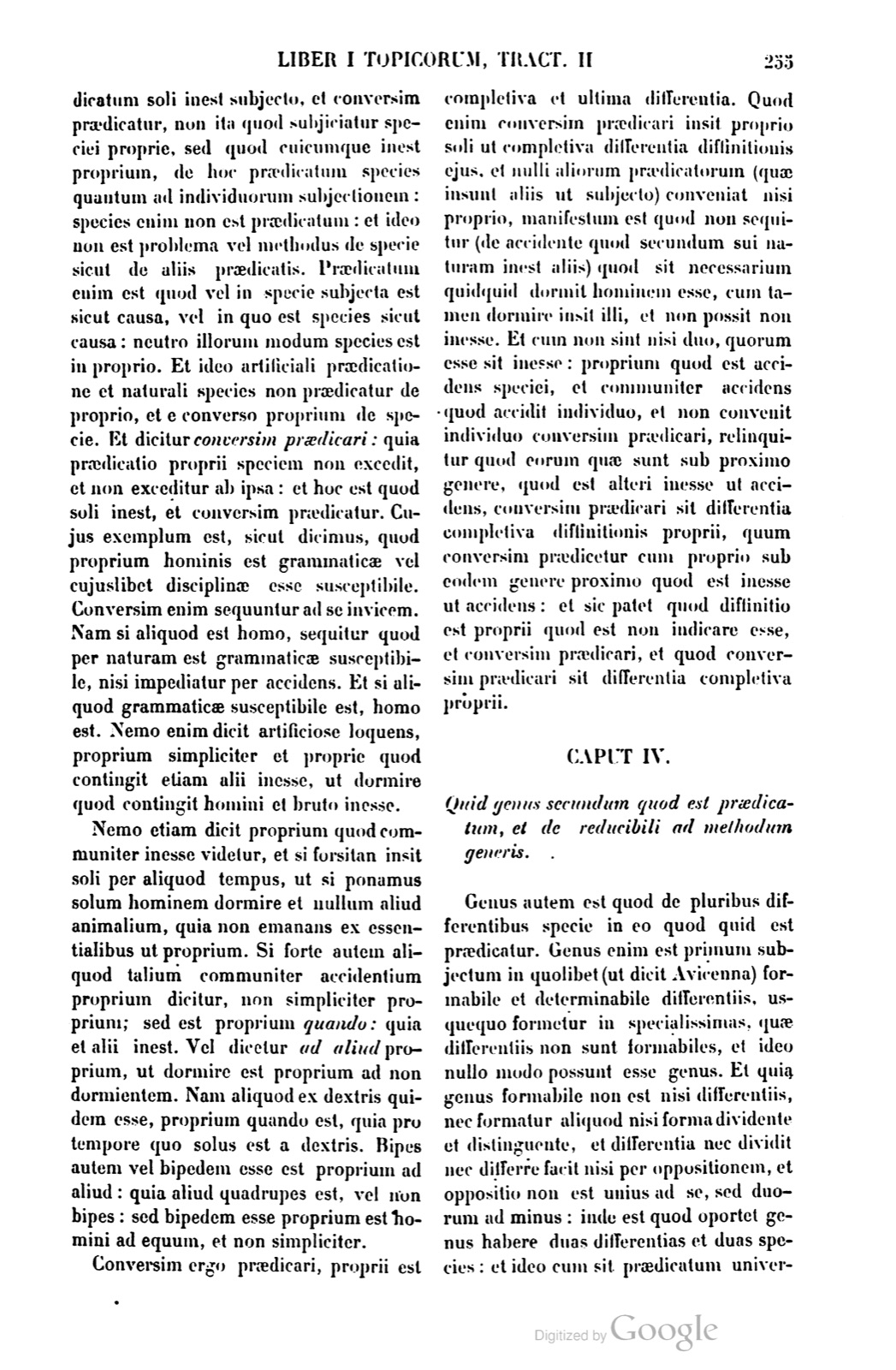
Genus autem est quod de pluribus differentibus specie in eo quod quid est praedicatur. Genus enim est primum subjectum in quolibet, ut dicit Avicenna, formabile et determinabile differentiis, usquequo formetur in specialissimas, quae differentiis non sunt formabiles, et ideo nullo modo possunt esse genus. Et quia genus formabile non est nisi differentiis, nec formatur aliquod nisi forma dividente et distinguente, et differentia nec dividit nec differre facit nisi per oppositionem, et oppositio non est unius ad se, sed duorum ad minus: inde est quod oportet genus habere duas differentias et duas species: et ideo cum sit praedicatum universale quod de pluribus proxime subjectis praedicatur, sequitur de necessitate, quod proxime est et per se praedicatum de pluribus differentibus specie. Species autem cum dicat complementum in esse, differentia formari non potest ulterius, sed multiplicari potest per materiam in individua. Genus autem cum dicat id quod est in potentia et confusum et indistinctum et incompletum, formationem differentiarum accipit, ut potentia etiam recipit actum: propter quod formalem recipit divisionem, quae ad minus in duabus oppositis est differentiis, quae duas constituunt species.
[Marginal label, printed page 256: Quare genus praedicatur in quid.]
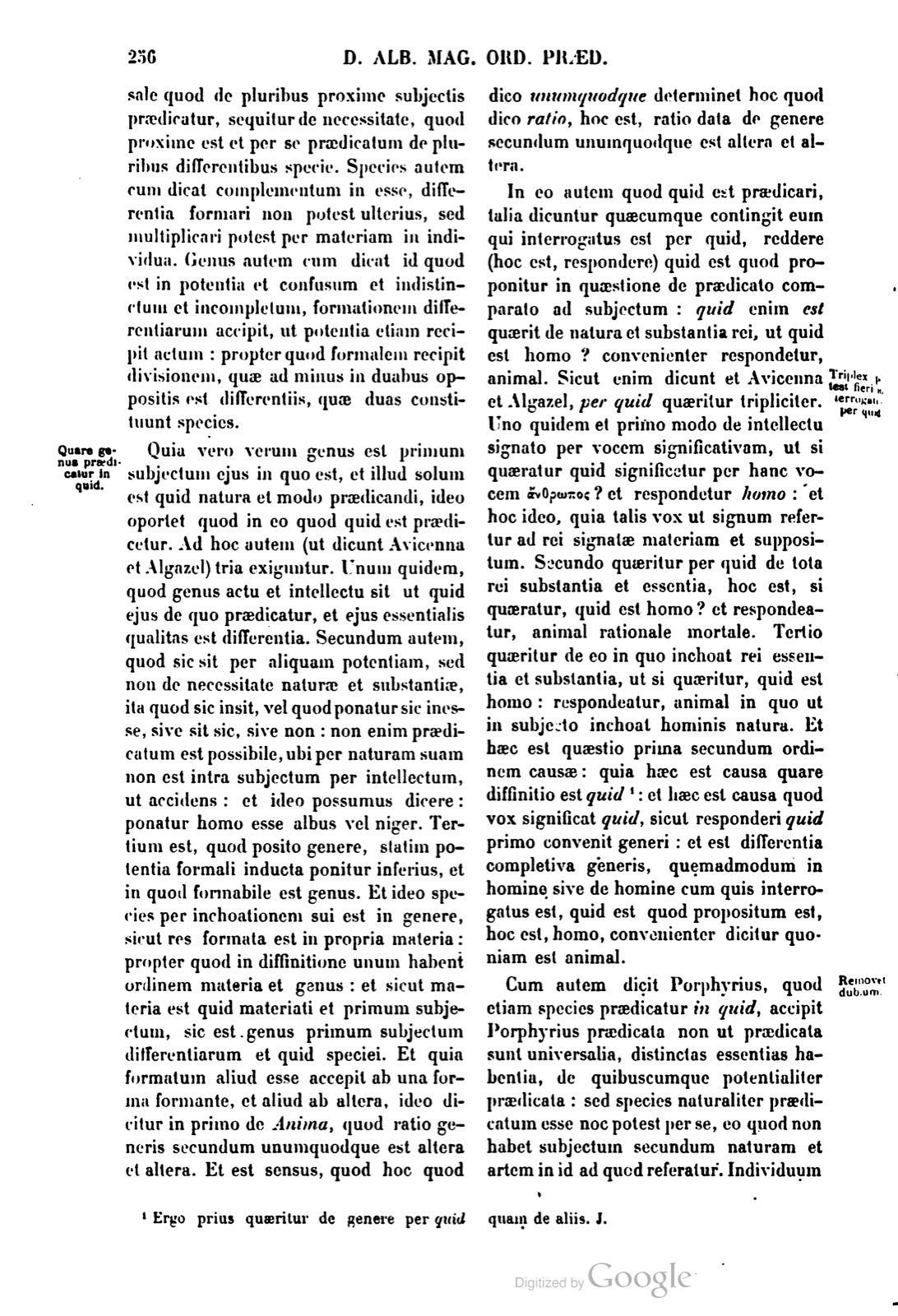
Quia vero verum genus est primum subjectum eius in quo est, et illud solum est quid natura et modo praedicandi, ideo oportet quod in eo quod quid est praedicetur. Ad hoc autem, ut dicunt Avicenna et Algazel, tria exiguntur. Unum quidem, quod genus actu et intellectu sit ut quid eius de quo praedicatur, et eius essentialis qualitas est differentia. Secundum autem, quod sic sit per aliquam potentiam, sed non de necessitate naturae et substantiae, ita quod sic insit, vel quod ponatur sic inesse, sive sit sic, sive non: non enim praedicatum est possibile, ubi per naturam suam non est intra subjectum per intellectum, ut accidens: et ideo possumus dicere: ponatur homo esse albus vel niger. Tertium est, quod posito genere, statim potentia formali inducta ponitur inferius, et in quod formabile est genus. Et ideo species per inchoationem sui est in genere, sicut res formata est in propria materia: propter quod in diffinitione unum habent ordinem materia et genus: et sicut materia est quid materiati et primum subjectum, sic est genus primum subjectum differentiarum et quid speciei. Et quia formatum aliud esse accepit ab una forma formante, et aliud ab altera, ideo dicitur in primo de Anima, quod ratio generis secundum unumquodque est altera et altera. Et est sensus, quod hoc quod dico unumquodque determinet hoc quod dico ratio, hoc est, ratio data de genere secundum unumquodque est altera et altera.
CHAPTER IV.
What genus is insofar as it is a predicate, and concerning what is reducible to the method of genus.
But genus is what is predicated of several things differing in species in respect of what it is. For genus is the first subject in anything, as Avicenna says, formable and determinable by differences, until it is formed into the most special things, which are not formable by differences and therefore in no way can be genus. And because a genus is formable only by differences, and nothing is formed except by a form dividing and distinguishing, and difference neither divides nor makes to differ except through opposition, and opposition is not of one thing to itself but of at least two things, thence it is that genus must have two differences and two species. And therefore, since it is a universal predicate that is predicated of several proximate subjects, it follows of necessity that it is proximately and per se predicated of several things differing in species. But species, since it states a completion in being, cannot be formed further by difference, but can be multiplied through matter into individuals. But genus, since it states what is in potency and confused and indistinct and incomplete, receives the formation of differences, as potency also receives act; on account of which it receives formal division, which is at least in two opposite differences, which constitute two species.
[Marginal label, printed page 256: Why genus is predicated in what.]
But because true genus is the first subject of that in which it is, and that alone is what by nature and by the mode of predicating, therefore it must be predicated in that which is what. For this, as Avicenna and Algazel say, three things are required. One indeed is that genus actually and intellectually be as the what of that of which it is predicated, and its essential quality is difference. The second is that it be so through some potency, but not from necessity of nature and substance, in such a way that it is thus in, or that it is posited to be in thus, whether it is so or not; for a predicate is not possible where by its own nature it is not within the subject through intellect, as accident is; and therefore we can say: let a human being be posited to be white or black. The third is that, when the genus has been posited, immediately, once formal potency has been brought in, the inferior is posited, and that in which genus is formable. And therefore species through the inchoation of itself is in genus, as a formed thing is in its proper matter: on account of which in definition matter and genus have one order; and just as matter is the what of the thing made of matter and the first subject, so genus is the first subject of differences and the what of species. And because what is formed has received one being from one forming form and another from another, therefore it is said in the first book On the Soul that the account of genus according to each thing is one and another. And the sense is that what I call each thing determines what I call account, that is, the account given of genus according to each thing is one and another.
[Marginal label, printed page 256: Triplex est fieri interrogationis per quid.]
In eo autem quod quid est praedicari, talia dicuntur quaecumque contingit eum qui interrogatus est per quid, reddere, hoc est, respondere, quid est quod proponitur in quaestione de praedicato comparato ad subjectum: quid enim est quaerit de natura et substantia rei, ut quid est homo? convenienter respondetur, animal. Sicut enim dicunt et Avicenna et Algazel, per quid quaeritur tripliciter. Uno quidem et primo modo de intellectu signato per vocem significativam, ut si quaeratur quid significetur per hanc vocem ἄνθρωπος? et respondetur homo: et hoc ideo, quia talis vox ut signum refertur ad rei signatae materiam et suppositum. Secundo quaeritur per quid de tota rei substantia et essentia, hoc est, si quaeratur, quid est homo? et respondeatur, animal rationale mortale. Tertio quaeritur de eo in quo inchoat rei essentia et substantia, ut si quaeritur, quid est homo? respondeatur, animal in quo ut in subjecto inchoat hominis natura. Et haec est quaestio prima secundum ordinem causae: quia haec est causa quare diffinitio est quid 1: et haec est causa quod vox significat quid, sicut responderi quid primo convenit generi: et est differentia completiva generis, quemadmodum in homine sive de homine cum quis interrogatus est, quid est quod propositum est, hoc est, homo, convenienter dicitur quoniam est animal.
[Marginal label, printed page 256: Removet dubium.]
Cum autem dicit Porphyrius, quod etiam species praedicatur in quid, accipit Porphyrius praedicata non ut praedicata sunt universalia, distinctas essentias habentia, de quibuscumque potentialiter praedicata: sed species naturaliter praedicatum esse non potest per se, eo quod non habet subjectum secundum naturam et artem in id ad quod referatur. Individuum
[Marginal label, printed page 256: There is a threefold way that the interrogation through what is made.]
But in being predicated in that which is what, such things are said as it falls to the one who has been interrogated through what to give back, that is, to respond, what the thing is that is proposed in the question concerning the predicate compared to the subject: for what is seeks concerning the nature and substance of the thing, as, what is a human being? Animal is suitably answered. For as Avicenna and Algazel say, inquiry through what is made in three ways. In one and first way, concerning the understanding signified through a significative word, as if it is asked what is signified through this word ἄνθρωπος? and human being is answered; and this is because such a word as sign is referred to the matter and supposit of the thing signified. Second, inquiry through what is made concerning the whole substance and essence of the thing, that is, if it is asked, what is a human being? and rational mortal animal is answered. Third, inquiry is made concerning that in which the essence and substance of the thing begins, as if it is asked, what is a human being? animal is answered, in which as in a subject the nature of human being begins. And this is the first question according to the order of cause, because this is the cause why definition is what 1; and this is the cause why a word signifies what, just as to be answered as what first belongs to genus; and it is the completing difference of genus, as in human being or concerning human being, when someone has been asked what that proposed thing is, that is, human being, it is suitably said that it is animal.
[Marginal label, printed page 256: He removes a doubt.]
But when Porphyry says that species also is predicated in what, Porphyry takes predicates not as predicates are universals, having distinct essences, predicated potentially of any things whatever; but species naturally cannot be a predicate per se, because it does not have a subject according to nature and art toward that to which it is referred. The individual
Notes
- Therefore inquiry is made about genus through what before it is made about the others. J. (Ergo prius quaeritur de genere per quid quam de aliis. J.) ↩
If a page does not appear, its photograph has not been uploaded yet.