Volume 2 · pp. 254–255
Chapter III. What Proper Is insofar as It Is a Predicate.
A marker with ≈ is an approximate page boundary, placed by measure of the text; the page photographs remain the authority. In the paired views, clicking a page marker brings that page into view.
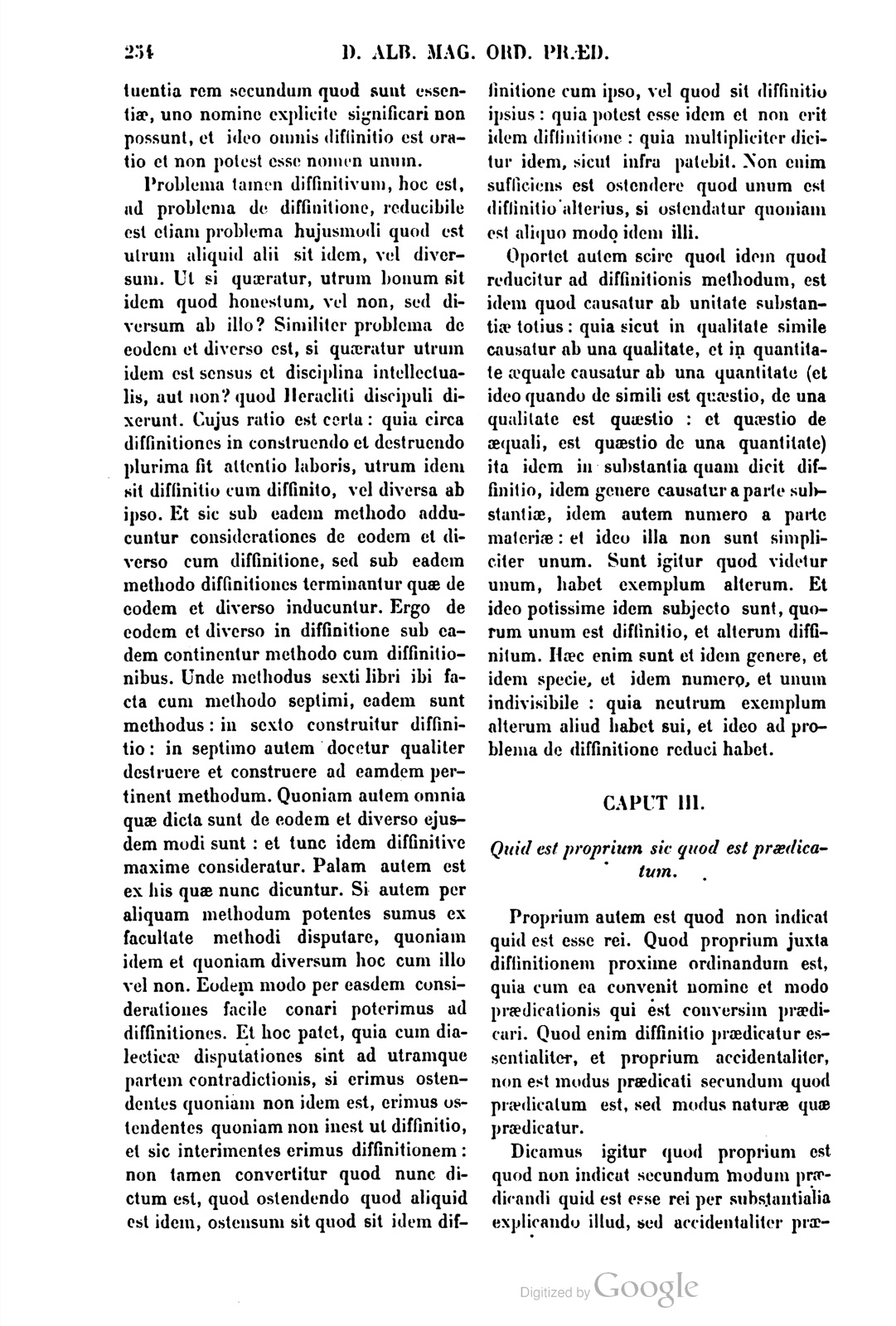
CAPUT III.
Quid est proprium sic quod est praedicatum.
Proprium autem est quod non indicat quid est esse rei. Quod proprium iuxta diffinitionem proxime ordinandum est, quia cum ea convenit nomine et modo praedicationis qui est conversim praedicari. Quod enim diffinitio praedicatur essentialiter, et proprium accidentaliter, non est modus praedicati secundum quod praedicatum est, sed modus naturae quae praedicatur.
Dicamus igitur quod proprium est quod non indicat secundum modum praedicandi quid est esse rei per substantialia explicando illud, sed accidentaliter praedicatum soli inest subjecto, et conversim praedicatur, non ita quod subiiciatur speciei proprie, sed quod cuicumque inest proprium, de hoc praedicatum species quantum ad individuorum subiectionem: species enim non est praedicatum: et ideo non est problema vel methodus de specie sicut de aliis praedicatis. Praedicatum enim est quod vel in specie subjecta est sicut causa, vel in quo est species sicut causa: neutro illorum modum species est in proprio. Et ideo artificiali praedicatione et naturali species non praedicatur de proprio, et e converso proprium de specie. Et dicitur conversim praedicari: quia praedicatio proprii speciem non excedit, et non exceditur ab ipsa: et hoc est quod soli inest, et conversim praedicatur. Cuius exemplum est, sicut dicimus, quod proprium hominis est grammaticae vel cuiuslibet disciplinae esse susceptibile. Conversim enim sequuntur ad se invicem. Nam si aliquod est homo, sequitur quod per naturam est grammaticae susceptibile, nisi impediatur per accidens. Et si aliquod grammaticae susceptibile est, homo est. Nemo enim dicit artificiose loquens, proprium simpliciter et proprie quod contingit etiam alii inesse, ut dormire quod contingit homini et bruto inesse. Nemo etiam dicit proprium quod communiter inesse videtur, et si forsitan insit soli per aliquod tempus, ut si ponamus solum hominem dormire et nullum aliud animalium, quia non emanans ex essentialibus ut proprium. Si forte autem aliquod talium communiter accidentium proprium dicitur, non simpliciter proprium; sed est proprium quando: quia et alii inest. Vel dicetur ad aliud proprium, ut dormire est proprium ad non dormientem. Nam aliquod ex dextris quidem esse, proprium quando est, quia pro tempore quo solus est a dextris. Bipes autem vel bipedem esse est proprium ad aliud: quia aliud quadrupes est, vel non bipes: sed bipedem esse proprium est homini ad equum, et non simpliciter.
CHAPTER III.
What proper is insofar as it is a predicate.
But proper is that which does not indicate what the being of a thing is. This proper must be ordered most proximately beside definition, because it agrees with it in name and in the mode of predication, which is to be predicated conversely. For the fact that definition is predicated essentially and proper accidentally is not the mode of the predicate insofar as it is predicate, but the mode of the nature that is predicated.
Therefore let us say that proper is that which, according to the mode of predicating, does not indicate what the being of a thing is by explaining it through substantial things, but as predicated accidentally is in the subject alone and is predicated conversely, not in such a way that it is subjected to the species properly, but that to whatever the proper belongs, of this the species is predicated with respect to the subjection of individuals. For species is not a predicate, and therefore there is not a problem or method about species as about the other predicates. For a predicate is that which either is in the subject species as a cause, or that in which species is as a cause; in neither of those ways is species in the proper. And therefore by artificial and natural predication species is not predicated of proper, and conversely proper is not predicated of species. And it is said to be predicated conversely because the predication of proper does not exceed the species, and is not exceeded by it; and this is what belongs to it alone and is predicated conversely. An example of this is as when we say that the proper of human being is to be capable of grammar or of any discipline. For they follow one another conversely. For if something is a human being, it follows that by nature it is capable of grammar, unless it is impeded by accident. And if something is capable of grammar, it is a human being. For no one speaking artfully calls proper simply and properly what also happens to be in another thing, such as sleeping, which happens to be in a human being and in a brute animal. Nor does anyone call proper what seems to be in commonly, even if perhaps it is in only one thing for some time, as if we posit that only a human being sleeps and none of the other animals, because it does not emanate from essential things as proper does. But if perhaps some one of such common accidents is called proper, it is not proper simply; rather it is proper when, because it is also in another. Or it will be called proper relative to another, as sleeping is proper relative to not sleeping. For to be something on the right is indeed proper when, because for the time in which it alone is on the right. But two-footed or to be two-footed is proper relative to another, because another is four-footed or not two-footed; but to be two-footed is proper to human being relative to horse, and not simply.
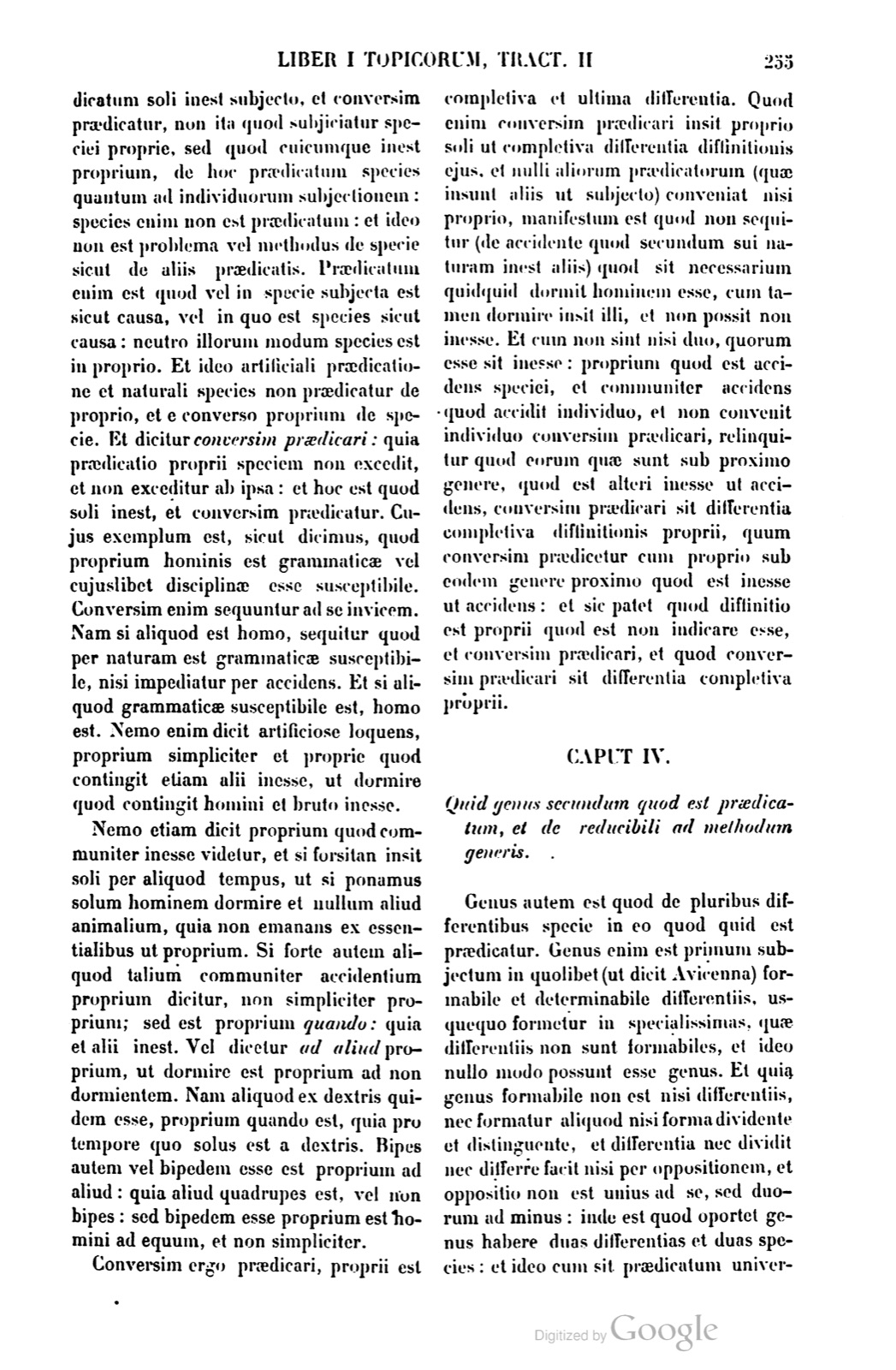
Conversim ergo praedicari, proprii est completiva et ultima differentia. Quod enim conversim praedicari insit proprio soli ut completiva differentia diffinitionis eius, et nulli aliorum praedicatorum, quae insunt aliis ut subjecto, conveniat nisi proprio, manifestum est quod non sequitur de accidente quod secundum sui naturam inest aliis, quod sit necessarium quidquid dormit hominem esse, cum tamen dormire insit illi, et non possit non inesse. Et cum non sint nisi duo, quorum esse sit inesse: proprium quod est accidens speciei, et communiter accidens quod accidit individuo, et non convenit individuo conversim praedicari, relinquitur quod eorum quae sunt sub proximo genere, quod est alteri inesse ut accidens, conversim praedicari sit differentia completiva diffinitionis proprii, quum conversim praedicetur cum proprio sub eodem genere proximo quod est inesse ut accidens: et sic patet quod diffinitio est proprii quod est non indicare esse, et conversim praedicari, et quod conversim praedicari sit differentia completiva proprii.
Therefore to be predicated conversely is the completing and ultimate difference of proper. For that being predicated conversely belongs to proper alone as the completing difference of its definition, and belongs to none of the other predicates that are in others as in a subject except proper, is manifest because it does not follow concerning an accident that according to its own nature is in others, that whatever sleeps is necessarily a human being, although nevertheless sleeping is in that one and cannot not be in it. And since there are only two whose being is being-in, namely proper, which is the accident of species, and common accident, which happens to the individual, and it does not belong to the individual to be predicated conversely, it remains that, of the things under the proximate genus, which is to be in another as accident, being predicated conversely is the completing difference of the definition of proper, since it is predicated conversely with proper under the same proximate genus, which is to be in as accident. And thus it is clear that the definition of proper is that it does not indicate being and is predicated conversely, and that being predicated conversely is the completing difference of proper.
If a page does not appear, its photograph has not been uploaded yet.