Volume 2 · pp. 253–254
Chapter II. What Term or Definition Is and What Things Are Reduced to the Method Concerning Definition.
A marker with ≈ is an approximate page boundary, placed by measure of the text; the page photographs remain the authority. In the paired views, clicking a page marker brings that page into view.
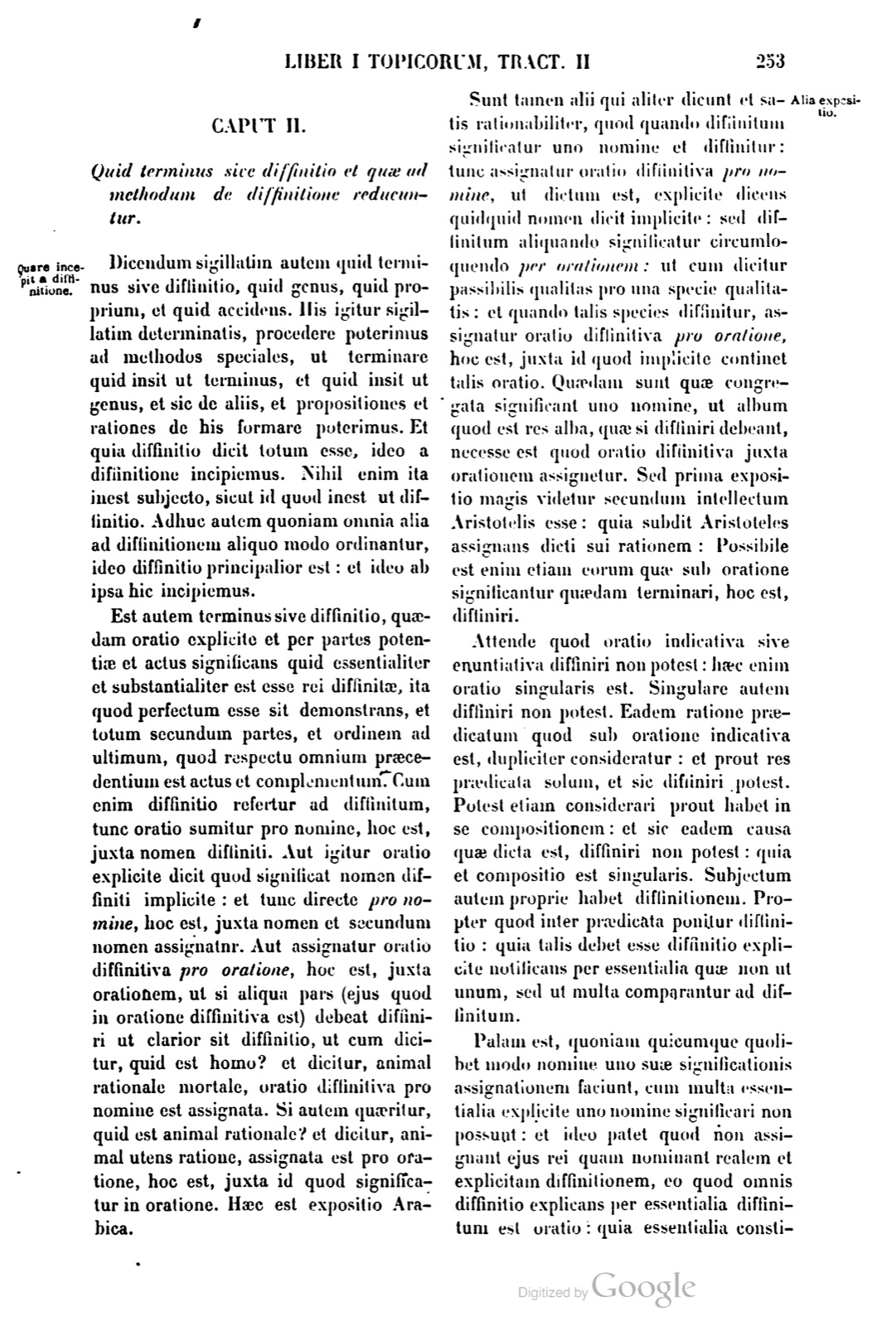
CAPUT II.
Quid terminus sive diffinitio et quae ad methodum de diffinitione reducuntur.
[Marginal label, printed page 253: Quare incepit a diffinitione.]
Dicendum sigillatim autem quid terminus sive diffinitio, quid genus, quid proprium, et quid accidens. His igitur sigillatim determinatis, procedere poterimus ad methodos speciales, ut terminare quid insit ut terminus, et quid insit ut genus, et sic de aliis, et propositiones et rationes de his formare poterimus. Et quia diffinitio dicit totum esse, ideo a diffinitione incipiemus. Nihil enim ita inest subjecto, sicut id quod inest ut diffinitio. Adhuc autem quoniam omnia alia ad diffinitionem aliquo modo ordinantur, ideo diffinitio principalior est: et ideo ab ipsa hic incipiemus.
Est autem terminus sive diffinitio, quaedam oratio explicite et per partes potentiae et actus significans quid essentialiter et substantialiter est esse rei diffinitae, ita quod perfectum esse sit demonstrans, et totum secundum partes, et ordinem ad ultimum, quod respectu omnium praecedentium est actus et complementum. Cum enim diffinitio refertur ad diffinitum, tunc oratio sumitur pro nomine, hoc est, iuxta nomen diffiniti. Aut igitur oratio explicite dicit quod significat nomen diffiniti implicite: et tunc directe pro nomine, hoc est, iuxta nomen et secundum nomen assignatur. Aut assignatur oratio diffinitiva pro oratione, hoc est, iuxta orationem, ut si aliqua pars eius quod in oratione diffinitiva est, debeat diffiniri ut clarior sit diffinitio, ut cum dicitur, quid est homo? et dicitur, animal rationale mortale, oratio diffinitiva pro nomine est assignata. Si autem quaeritur, quid est animal rationale? et dicitur, animal utens ratione, assignata est pro oratione, hoc est, iuxta id quod significatur in oratione. Haec est expositio Arabica.
[Marginal label, printed page 253: Alia expositio.]
Sunt tamen alii qui aliter dicunt et satis rationabiliter, quod quando diffinitum significatur uno nomine et diffinitur: tunc assignatur oratio diffinitiva pro nomine, ut dictum est, explicite dicens quidquid nomen dicit implicite: sed diffinitum aliquando significatur circumloquendo per orationem: ut cum dicitur passibilis qualitas pro una specie qualitatis: et quando talis species diffinitur, assignatur oratio diffinitiva pro oratione, hoc est, iuxta id quod implicite continet talis oratio. Quaedam sunt quae congregata significant uno nomine, ut album quod est res alba, quae si diffiniri debeant, necesse est quod oratio diffinitiva iuxta orationem assignetur. Sed prima expositio magis videtur secundum intellectum Aristotelis esse: quia subdit Aristoteles assignans dicti sui rationem: Possibile est enim etiam eorum quae sub oratione significantur quaedam terminari, hoc est, diffiniri.
Attende quod oratio indicativa sive enuntiativa diffiniri non potest: haec enim oratio singularis est. Singulare autem diffiniri non potest. Eadem ratione praedicatum quod sub oratione indicativa est, dupliciter consideratur: et prout res praedicata solum, et sic diffiniri potest. Potest etiam considerari prout habet in se compositionem: et sic eadem causa quae dicta est, diffiniri non potest: quia et compositio est singularis. Subjectum autem proprie habet diffinitionem. Propter quod inter praedicata ponitur diffinitio: quia talis debet esse diffinitio explicite notificans per essentialia quae non ut unum, sed ut multa comparantur ad diffinitum.
CHAPTER II.
What term or definition is, and what things are reduced to the method concerning definition.
[Marginal label, printed page 253: Why he began from definition.]
But it must be said one by one what term or definition is, what genus is, what proper is, and what accident is. Therefore, once these have been determined one by one, we shall be able to proceed to the special methods, so as to determine what is in as term, and what is in as genus, and so concerning the others, and we shall be able to form propositions and arguments concerning these. And because definition says the whole being, therefore we shall begin from definition. For nothing is in a subject in such a way as that which is in as definition. Furthermore, because all other things are ordered in some way to definition, therefore definition is more principal; and therefore we shall begin here from it.
Now term or definition is a certain speech explicitly and through parts of potency and act signifying what the being of the defined thing is essentially and substantially, in such a way that it demonstrates perfect being, both the whole according to parts and the order to the ultimate, which with respect to all preceding things is act and completion. For when definition is referred to the defined thing, then speech is taken for name, that is, beside the name of the defined thing. Therefore either the speech explicitly says what the name of the defined thing signifies implicitly, and then it is assigned directly for the name, that is, beside the name and according to the name. Or definitive speech is assigned for speech, that is, beside speech, as if some part of that which is in the definitive speech must be defined so that the definition may be clearer, as when it is said, what is a human being? and it is said, a rational mortal animal, the definitive speech is assigned for the name. But if it is asked, what is a rational animal? and it is said, an animal using reason, it is assigned for the speech, that is, beside that which is signified in the speech. This is the Arabic exposition.
[Marginal label, printed page 253: Another exposition.]
There are nevertheless others who speak otherwise and quite reasonably, that when the thing defined is signified by one name and is defined, then the definitive speech is assigned for the name, as has been said, explicitly saying whatever the name says implicitly; but sometimes the thing defined is signified by circumlocution through a speech, as when passible quality is said for one species of quality; and when such a species is defined, the definitive speech is assigned for the speech, that is, beside that which such speech implicitly contains. Certain things, when gathered together, signify by one name, as white, which is a white thing; if such things must be defined, it is necessary that the definitive speech be assigned beside the speech. But the first exposition seems more according to the understanding of Aristotle, because Aristotle subjoins, assigning the reason for his saying: For it is possible also that certain things of those things that are signified under speech be terminated, that is, defined.
Attend that indicative or enunciative speech cannot be defined: for this speech is singular. But the singular cannot be defined. For the same reason, the predicate that is under indicative speech is considered in two ways: both as only the thing predicated, and in this way it can be defined. It can also be considered insofar as it has composition in itself, and in this way for the same cause that has been stated it cannot be defined, because composition also is singular. But the subject properly has definition. On account of this definition is placed among the predicates: because such a definition ought to be one explicitly making known through essential things that are compared to the defined thing not as one thing, but as many things.
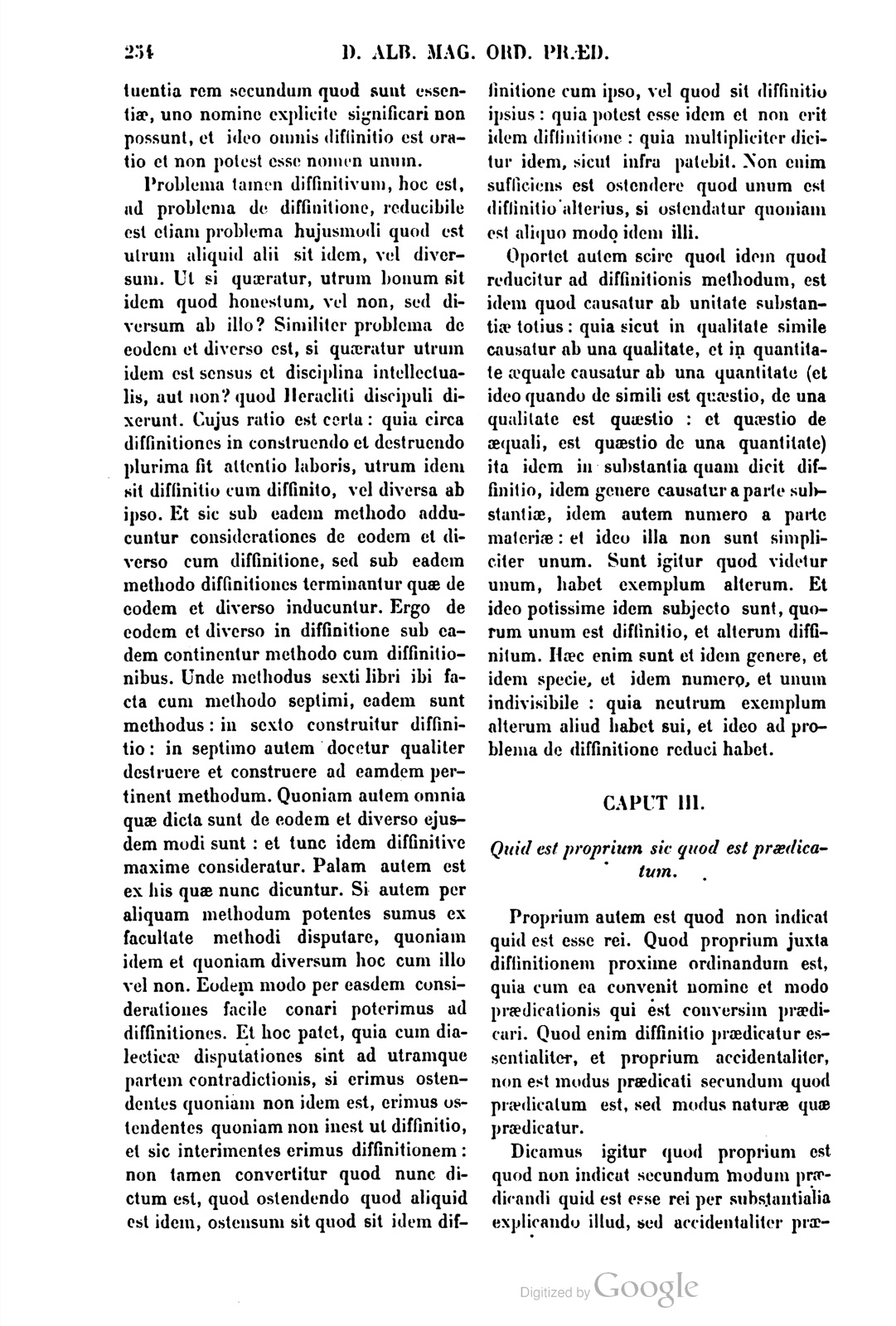
Palam est, quoniam quicumque quolibet modo nomine uno suae significationis assignationem faciunt, cum multa essentialia explicite uno nomine significari non possunt: et ideo patet quod non assignant eius rei quam nominant realem et explicitam diffinitionem, eo quod omnis diffinitio explicans per essentialia diffinitum est oratio: quia essentialia constituentia rem secundum quod sunt essentiae, uno nomine explicite significari non possunt, et ideo omnis diffinitio est oratio et non potest esse nomen unum.
Problema tamen diffinitivum, hoc est, ad problema de diffinitione, reducibile est etiam problema huiusmodi quod est utrum aliquid alii sit idem, vel diversum. Ut si quaeratur, utrum bonum sit idem quod honestum, vel non, sed diversum ab illo? Similiter problema de eodem et diverso est, si quaeratur utrum idem est sensus et disciplina intellectualis, aut non? quod Heracliti discipuli dixerunt. Cuius ratio est certa: quia circa diffinitiones in construendo et destruendo plurima fit attentio laboris, utrum idem sit diffinitio cum diffinito, vel diversa ab ipso. Et sic sub eadem methodo adducuntur considerationes de eodem et diverso cum diffinitione, sed sub eadem methodo diffinitiones terminantur quae de eodem et diverso inducuntur. Ergo de eodem et diverso in diffinitione sub eadem continentur methodo cum diffinitionibus. Unde methodus sexti libri ibi facta cum methodo septimi, eadem sunt methodus: in sexto construitur diffinitio: in septimo autem docetur qualiter destruere et construere ad eamdem pertinent methodum. Quoniam autem omnia quae dicta sunt de eodem et diverso eiusdemmodi sunt: et tunc idem diffinitive maxime consideratur. Palam autem est ex his quae nunc dicuntur. Si autem per aliquam methodum potentes sumus ex facultate methodi disputare, quoniam idem et quoniam diversum hoc cum illo vel non. Eodem modo per easdem considerationes facile conari poterimus ad diffinitiones. Et hoc patet, quia cum dialecticae disputationes sint ad utramque partem contradictionis, si erimus ostendentes quoniam non idem est, erimus ostendentes quoniam non inest ut diffinitio, et sic interimentes erimus diffinitionem: non tamen convertitur quod nunc dictum est, quod ostendendo quod aliquid est idem, ostensum sit quod sit idem diffinitione cum ipso, vel quod sit diffinitio ipsius: quia potest esse idem et non erit idem diffinitione: quia multipliciter dicitur idem, sicut infra patebit. Non enim sufficiens est ostendere quod unum est diffinitio alterius, si ostendatur quoniam est aliquo modo idem illi.
Oportet autem scire quod idem quod reducitur ad diffinitionis methodum, est idem quod causatur ab unitate substantiae totius: quia sicut in qualitate simile causatur ab una qualitate, et in quantitate aequale causatur ab una quantitate, et ideo quando de simili est quaestio, de una qualitate est quaestio: et quaestio de aequali, est quaestio de una quantitate, ita idem in substantia quam dicit diffinitio, idem genere causatur a parte substantiae, idem autem numero a parte materiae: et ideo illa non sunt simpliciter unum. Sunt igitur quod videtur unum, habet exemplum alterum. Et ideo potissime idem subjecto sunt, quorum unum est diffinitio, et alterum diffinitum. Haec enim sunt et idem genere, et idem specie, et idem numero, et unum indivisibile: quia neutrum exemplum alterum aliud habet sui, et ideo ad problema de diffinitione reduci habet.
It is plain that whoever in any way makes the assignment of his signification by one name, since many essential things cannot be signified explicitly by one name, therefore clearly they do not assign the real and explicit definition of that thing which they name, because every definition explaining the thing defined through essential things is a speech: because essential things constituting the thing according as they are essences cannot be signified explicitly by one name, and therefore every definition is speech and cannot be one name.
Nevertheless a definitive problem, that is, a problem reducible to the problem about definition, is also a problem of this kind, namely whether something is the same as another thing or diverse from it. For example, if it is asked whether the good is the same as the honorable, or not, but diverse from it. Similarly there is a problem concerning same and diverse if it is asked whether sense and intellectual discipline are the same, or not, which the disciples of Heraclitus said. The reason for this is certain: because around definitions, in constructing and destroying, very much attention of labor is given to whether definition is the same as the defined thing, or diverse from it. And thus considerations concerning same and diverse are brought under the same method with definition; but definitions that are brought in concerning same and diverse are terminated under the same method. Therefore concerning same and diverse in definition, they are contained under the same method with definitions. Whence the method of the sixth book made there with the method of the seventh are the same method: in the sixth the definition is constructed; but in the seventh it is taught how destroying and constructing belong to the same method. But since all the things that have been said about same and diverse are of the same mode, then same is considered especially definitively. But this is plain from the things now being said. For if by some method, from the faculty of the method, we are able to dispute that this is the same as that, and that this is diverse from that, or not, in the same way by the same considerations we shall easily be able to strive toward definitions. And this is clear, because since dialectical disputations are toward each part of a contradiction, if we are showing that it is not the same, we shall be showing that it is not in as definition, and thus we shall be destroying the definition. Yet what has now been said is not converted, namely that by showing that something is the same, it has been shown that it is the same in definition with it, or that it is its definition; because it can be the same and will not be the same in definition, because same is said in many ways, as will be clear below. For it is not sufficient to show that one thing is the definition of another if it is shown that it is in some way the same as it.
But one must know that the same which is reduced to the method of definition is the same that is caused by the unity of the substance of the whole: because just as in quality the similar is caused by one quality, and in quantity the equal is caused by one quantity, and therefore when there is a question about the similar, there is a question about one quality, and a question about the equal is a question about one quantity, so the same in substance, which definition states, is caused as same in genus on the part of substance, but same in number on the part of matter; and therefore those are not simply one. Therefore what seems one has another example. And therefore those things most powerfully are the same in subject, of which one is definition and the other is the defined thing. For these are the same in genus, the same in species, the same in number, and one indivisible thing, because neither example has anything of itself other than the other; and therefore it must be reduced to the problem concerning definition.
If a page does not appear, its photograph has not been uploaded yet.