Volume 2 · pp. 250–252
Treatise II. On the Method of Definition, Genus, Proper, and Accident. Chapter I. From What Things the Method Is.
A marker with ≈ is an approximate page boundary, placed by measure of the text; the page photographs remain the authority. In the paired views, clicking a page marker brings that page into view.
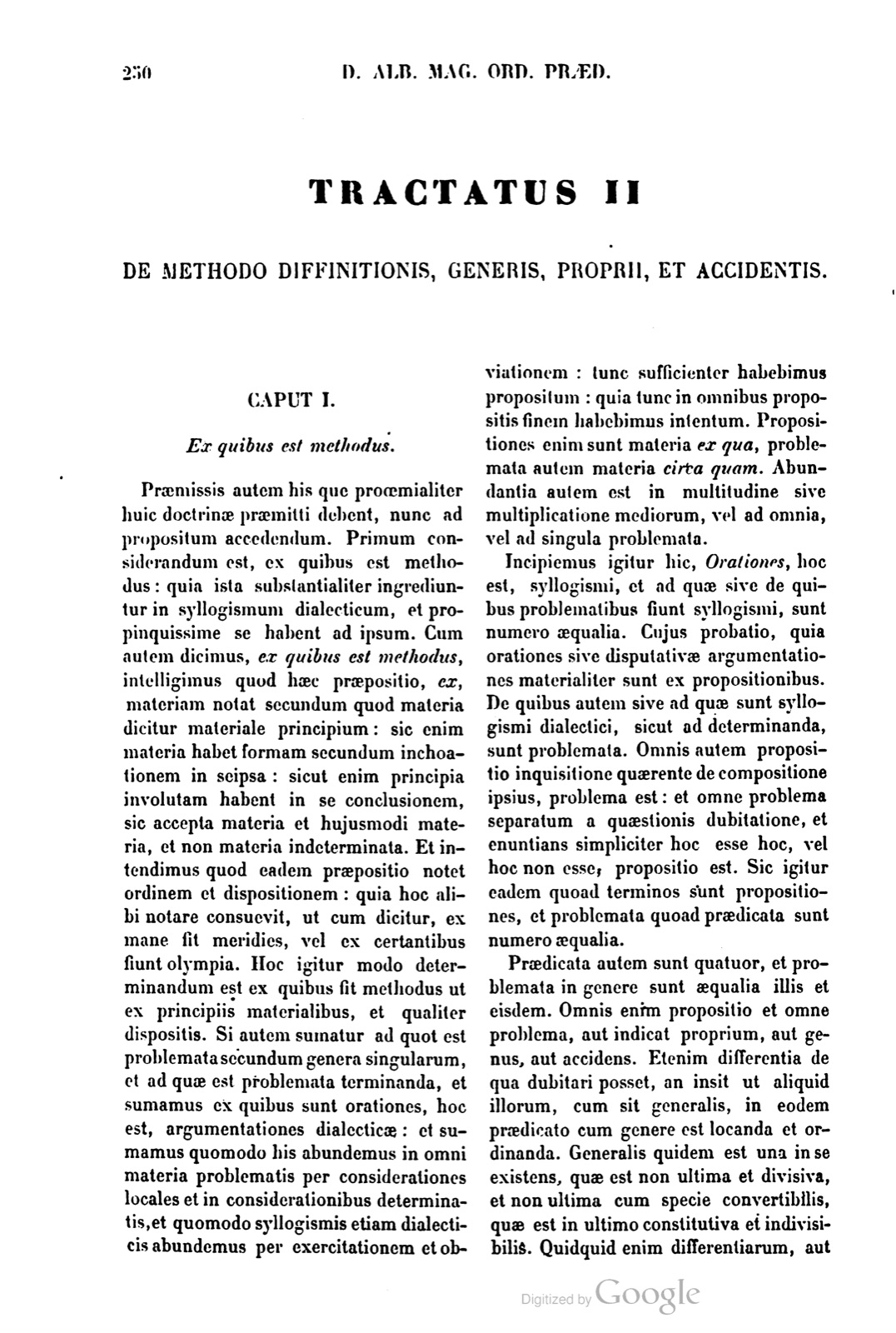
TRACTATUS II.
DE METHODO DIFFINITIONIS, GENERIS, PROPRII, ET ACCIDENTIS.
CAPUT I.
Ex quibus est methodus.
Praemissis autem his quae prooemialiter huic doctrinae praemitti debent, nunc ad propositum accedendum. Primum considerandum est, ex quibus est methodus: quia ista substantialiter ingrediuntur in syllogismum dialecticum, et propinquissime se habent ad ipsum. Cum autem dicimus, ex quibus est methodus, intelligimus quod haec praepositio, ex, materiam notat secundum quod materia dicitur materiale principium: sic enim materia habet formam secundum inchoationem in seipsa: sicut enim principia involutam habent in se conclusionem, sic accepta materia et huiusmodi materia, et non materia indeterminata. Et intendimus quod eadem praepositio notet ordinem et dispositionem: quia hoc alibi notare consuevit, ut cum dicitur, ex mane fit meridies, vel ex certantibus fiunt olympia. Hoc igitur modo determinandum est ex quibus fit methodus ut ex principiis materialibus, et qualiter dispositis. Si autem sumatur ad quot est problemata secundum genera singularum, et ad quae est problemata terminanda, et sumamus ex quibus sunt orationes, hoc est, argumentationes dialecticae: et sumamus quomodo his abundemus in omni materia problematis per considerationes locales et in considerationibus determinatis, et quomodo syllogismis etiam dialecticis abundemus per exercitationem et obviationem: tunc sufficienter habebimus propositum: quia tunc in omnibus propositis finem habebimus intentum. Propositiones enim sunt materia ex qua, problemata autem materia circa quam. Abundantia autem est in multitudine sive multiplicatione mediorum, vel ad omnia, vel ad singula problemata.
Incipiemus igitur hic, Orationes, hoc est, syllogismi, et ad quae sive de quibus problematibus fiunt syllogismi, sunt numero aequalia. Cuius probatio, quia orationes sive disputativae argumentationes materialiter sunt ex propositionibus. De quibus autem sive ad quae sunt syllogismi dialectici, sicut ad determinanda, sunt problemata. Omnis autem propositio inquisitione quaerente de compositione ipsius, problema est: et omne problema separatum a quaestionis dubitatione, et enuntians simpliciter hoc esse hoc, vel hoc non esse, propositio est. Sic igitur eadem quoad terminos sunt propositiones, et problemata quoad praedicata sunt numero aequalia.
Praedicata autem sunt quatuor, et problemata in genere sunt aequalia illis et eisdem. Omnis enim propositio et omne problema, aut indicat proprium, aut genus, aut accidens. Etenim differentia de qua dubitari posset, an insit ut aliquid illorum, cum sit generalis, in eodem praedicato cum genere est locanda et ordinanda. Generalis quidem est una in se existens, quae est non ultima et divisiva, et non ultima cum specie convertibilis, quae est in ultimo constitutiva et indivisibilis. Quidquid enim differentiarum, aut ultima est illarum, aut praedicatum essentiale non convertibile, quod ad ultimam se habet ut potentia ad actum, et ita ut genus, hoc est, generalis forma: quia, sicut dicit Averroes 1, genus enim est forma generalis, habens se sicut formale indistinctum ad ultimum distinguens ipsum esse specificum ad actum: talis igitur differentia in plus est, quam genus: et ut essentiale est ut genus, et dicit id quod est in potentia formali indistincta sicut est genus: cum genere ergo inter praedicata locatur. Ultima autem differentia, quae in plus non est, sed convertibilis, dicit actum purum: et ideo cum specie locatur ad subjectum, et non est ad praedicatum. Ista sunt igitur praedicata principalia, de quibus quaeritur in problematibus, et ad quae terminanda inducuntur syllogismi.
TREATISE II.
ON THE METHOD OF DEFINITION, GENUS, PROPER, AND ACCIDENT.
CHAPTER I.
From what things the method is.
Now that these things that ought to be set before this doctrine proemially have been set before, we must now approach the proposed matter. First it must be considered from what things the method is: because these things enter substantially into dialectical syllogism, and are most proximate to it. But when we say, from what things the method is, we understand that this preposition, from, notes matter according as matter is called a material principle: for in this way matter has form according to an inchoation in itself; for as principles have the conclusion wrapped within themselves, so does accepted matter and matter of this kind, and not indeterminate matter. And we intend that the same preposition note order and disposition, because elsewhere it has been accustomed to note this, as when it is said, from morning comes midday, or from those contending come Olympic games. Therefore in this way it must be determined from what things the method is made as from material principles, and how they are disposed. But if it is taken for how many problems there are according to the genera of individual things, and to what things the problems are to be terminated, and if we take from what things speeches, that is, dialectical argumentations, are; and if we take how we may abound in these in every matter of a problem through local considerations and in determinate considerations, and how we may also abound in dialectical syllogisms through exercise and obviation: then we shall have the proposed thing sufficiently, because then in all proposed things we shall have the intended end. For propositions are the matter from which; but problems are the matter about which. Abundance, however, is in the multitude or multiplication of middles, either for all problems or for individual problems.
Therefore we shall begin here: speeches, that is, syllogisms, and the things to which or concerning which problems syllogisms are made, are equal in number. The proof of this is that speeches, or disputative argumentations, are materially from propositions. But the things concerning which or to which dialectical syllogisms are, as things to be determined, are problems. Every proposition, when inquiry seeks concerning its composition, is a problem; and every problem separated from the doubt of a question, and enunciating simply that this is this, or that this is not this, is a proposition. Thus, therefore, propositions and problems are the same as to terms, and are equal in number as to predicates.
But predicates are four, and problems in genus are equal to them and the same as they. For every proposition and every problem indicates either a proper, or a genus, or an accident. For even difference, concerning which one could doubt whether it belongs as one of those, since it is general, must be placed and ordered in the same predicate with genus. General difference indeed is one existing in itself, which is not ultimate and divisive, and is not ultimate and convertible with species, which is constitutive and indivisible in the ultimate. For whatever belongs to differences either is the ultimate of them, or is an essential non-convertible predicate, which stands toward the ultimate as potency toward act, and thus as genus, that is, as general form: because, as Averroes says 1, genus is a general form, having itself as an indistinct formal thing toward the ultimate thing distinguishing its specific being into act. Therefore such a difference is wider than genus; and as essential it is as genus, and says that which is in indistinct formal potency, as genus is; therefore it is placed with genus among the predicates. But the ultimate difference, which is not wider but convertible, says pure act: and therefore it is placed with species toward the subject, and is not toward the predicate. Therefore these are the principal predicates concerning which inquiry is made in problems, and to the terminating of which syllogisms are brought in.
[Marginal label, printed page 251: Ordo inter praedicata dialectica, et unde sumatur ratio ordinis.]
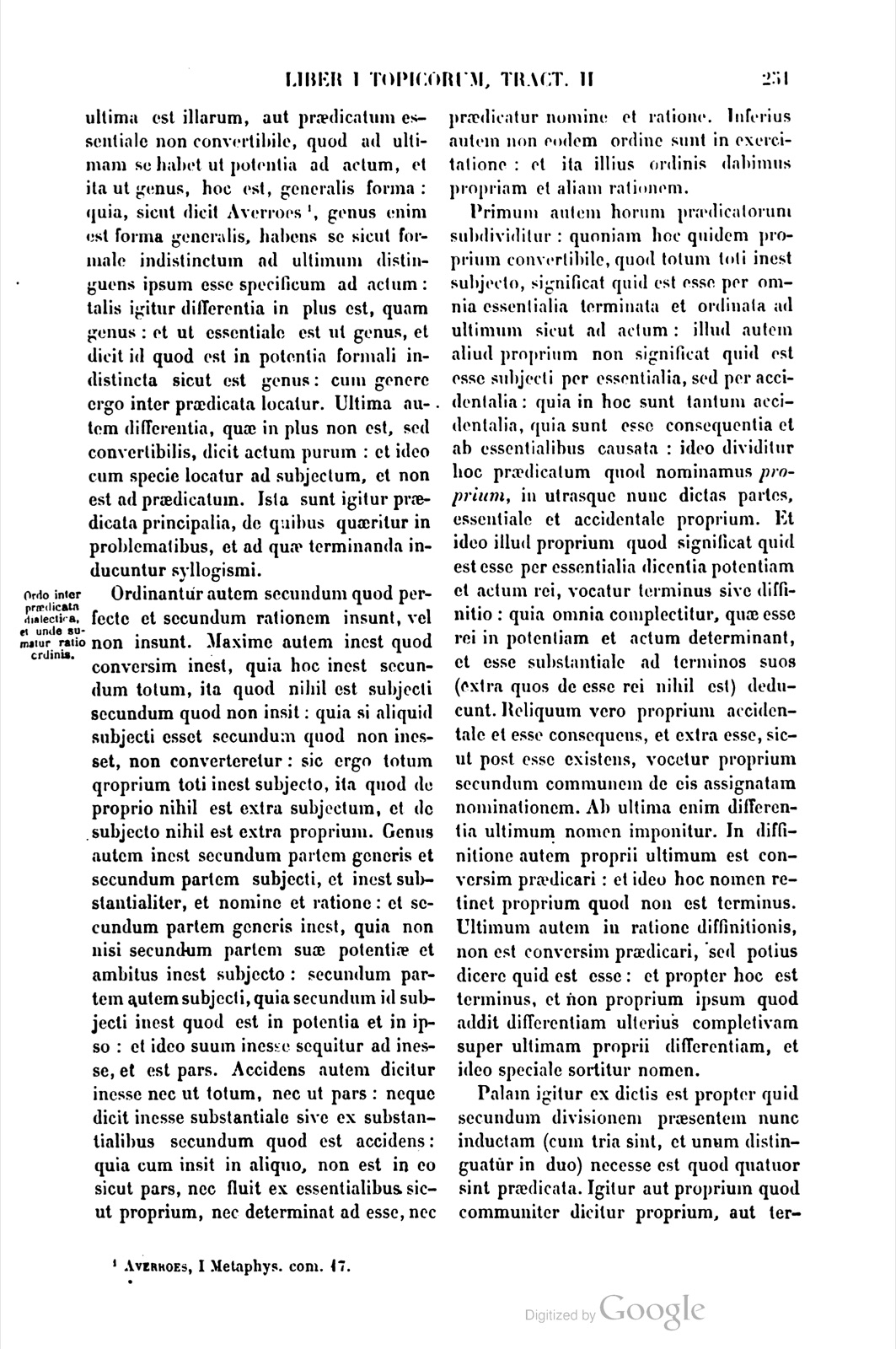
Ordinantur autem secundum quod perfecte et secundum rationem insunt, vel non insunt. Maxime autem inest quod conversim inest, quia hoc inest secundum totum, ita quod nihil est subjecti secundum quod non insit: quia si aliquid subjecti esset secundum quod non inesset, non converteretur: sic ergo totum proprium toti inest subjecto, ita quod de proprio nihil est extra subjectum, et de subjecto nihil est extra proprium. Genus autem inest secundum partem generis et secundum partem subjecti, et inest substantialiter, et nomine et ratione: et secundum partem generis inest, quia non nisi secundum partem suae potentiae et ambitus inest subjecto; secundum partem autem subjecti, quia secundum id subjecti inest quod est in potentia et in ipso: et ideo suum inesse sequitur ad inesse, et est pars. Accidens autem dicitur inesse nec ut totum, nec ut pars: neque dicit inesse substantiale sive ex substantialibus secundum quod est accidens: quia cum insit in aliquo, non est in eo sicut pars, nec fluit ex essentialibus sicut proprium, nec determinat ad esse, nec praedicatur nomine et ratione. Inferius autem non eodem ordine sunt in exercitatione: et ita illius ordinis dabimus propriam et aliam rationem.
Primum autem horum praedicatorum subdividitur: quoniam hoc quidem proprium convertibile, quod totum toti inest subjecto, significat quid est esse per omnia essentialia terminata et ordinata ad ultimum sicut ad actum: illud autem aliud proprium non significat quid est esse subjecti per essentialia, sed per accidentalia: quia in hoc sunt tantum accidentalia, quia sunt esse consequentia et ab essentialibus causata: ideo dividitur hoc praedicatum quod nominamus proprium, in utrasque nunc dictas partes, essentiale et accidentale proprium. Et ideo illud proprium quod significat quid est esse per essentialia dicentia potentiam et actum rei, vocatur terminus sive diffinitio: quia omnia complectitur, quae esse rei in potentiam et actum determinant, et esse substantiale ad terminos suos, extra quos de esse rei nihil est, deducunt. Reliquum vero proprium accidentale et esse consequens, et extra esse, sicut post esse existens, vocetur proprium secundum communem de eis assignatam nominationem. Ab ultima enim differentia ultimum nomen imponitur. In diffinitione autem proprii ultimum est conversim praedicari: et ideo hoc nomen retinet proprium quod non est terminus. Ultimum autem in ratione diffinitionis, non est conversim praedicari, sed potius dicere quid est esse: et propter hoc est terminus, et non proprium ipsum quod addit differentiam ulterius completivam super ultimam proprii differentiam, et ideo speciale sortitur nomen.
Palam igitur ex dictis est propter quid secundum divisionem praesentem nunc inductam, cum tria sint, et unum distinguatur in duo, necesse est quod quatuor sint praedicata. Igitur aut proprium quod communiter dicitur proprium, aut terminus, quae duo conversim praedicantur, aut genus, aut accidens, quae duo non conversim praedicantur. Sed proprium refertur ad esse speciei sicut causatum ex ipsa specie. Terminus autem est simplex, et non est consequens ad speciem ut praedicatum ad subjectum, sed est secundum naturam verum accidens ad ipsum sicut causa ad causatum. Genus autem est sicut pars subjecti. Accidens autem ut consequens communiter, quod non est per essentiam causatum a subjecto, sicut nec causa ipsius. Et ideo sic ordinantur haec secundum quod plus vel minus habent de ratione praedicati, secundum quod praedicatum est ut consequens ad subjectum.
[Marginal label, printed page 251: The order among dialectical predicates, and whence the account of order is taken.]
But they are ordered according as they perfectly and according to reason are in something, or are not in it. What is in conversely is most of all in, because this is in according to the whole, so that there is nothing of the subject according to which it is not in: because if there were something of the subject according to which it were not in, it would not be converted. Thus the whole proper is in the whole subject, so that nothing of the proper is outside the subject, and nothing of the subject is outside the proper. But genus is in according to part of the genus and according to part of the subject, and it is in substantially, both in name and in account: and it is in according to part of the genus, because it is in the subject only according to part of its power and scope; but according to part of the subject, because it is in according to that of the subject which is in potency and in it: and therefore its being-in follows upon being-in, and it is a part. But accident is said to be in neither as whole nor as part; nor does it say substantial being-in or being-in from substantial things according as it is accident: because when it is in something, it is not in it as a part, nor does it flow from essential things as proper does, nor does it determine to being, nor is it predicated in name and in account. But below they are not in the same order in exercise; and so we shall give the proper and another account of that order.
The first of these predicates is subdivided: because this proper convertible, which is wholly in the whole subject, signifies what the being is through all essential things terminated and ordered to the ultimate as to act; but that other proper does not signify what the being of the subject is through essential things, but through accidental things, because in this there are only accidental things, since they are beings consequent upon being and caused by essential things. Therefore this predicate that we name proper is divided into both parts now mentioned, essential proper and accidental proper. And therefore that proper which signifies what being is through essential things saying the potency and act of the thing is called term or definition: because it embraces all things that determine the being of the thing into potency and act, and lead substantial being to its own terms, outside which there is nothing of the being of the thing. But the remaining accidental proper, and being consequent and outside being, as existing after being, may be called proper according to the common naming assigned to them. For from the ultimate difference the ultimate name is imposed. But in the definition of proper the ultimate thing is to be predicated conversely; and therefore what is not term retains this name, proper. But the ultimate thing in the account of definition is not to be predicated conversely, but rather to say what being is: and on account of this it is term, and not the proper itself, which adds a further completing difference over and above the ultimate difference of proper, and therefore it receives a special name.
Therefore it is plain from what has been said why, according to the present division now brought in, since there are three and one is distinguished into two, it is necessary that there be four predicates. Therefore there is either proper, which is commonly called proper, or term, and these two are predicated conversely; or genus or accident, and these two are not predicated conversely. But proper is referred to the being of the species as caused from the species itself. Term, however, is simple, and is not consequent upon the species as predicate upon subject, but according to nature is a true accident to it as cause to caused. But genus is as a part of the subject. Accident, however, is as a consequent commonly, which is not caused essentially by the subject, just as it is not the cause of it. And therefore these are ordered in this way according as they have more or less of the account of predicate, according as predicate is as consequent upon subject.
[Marginal label, printed page 252: Removet dubium.]
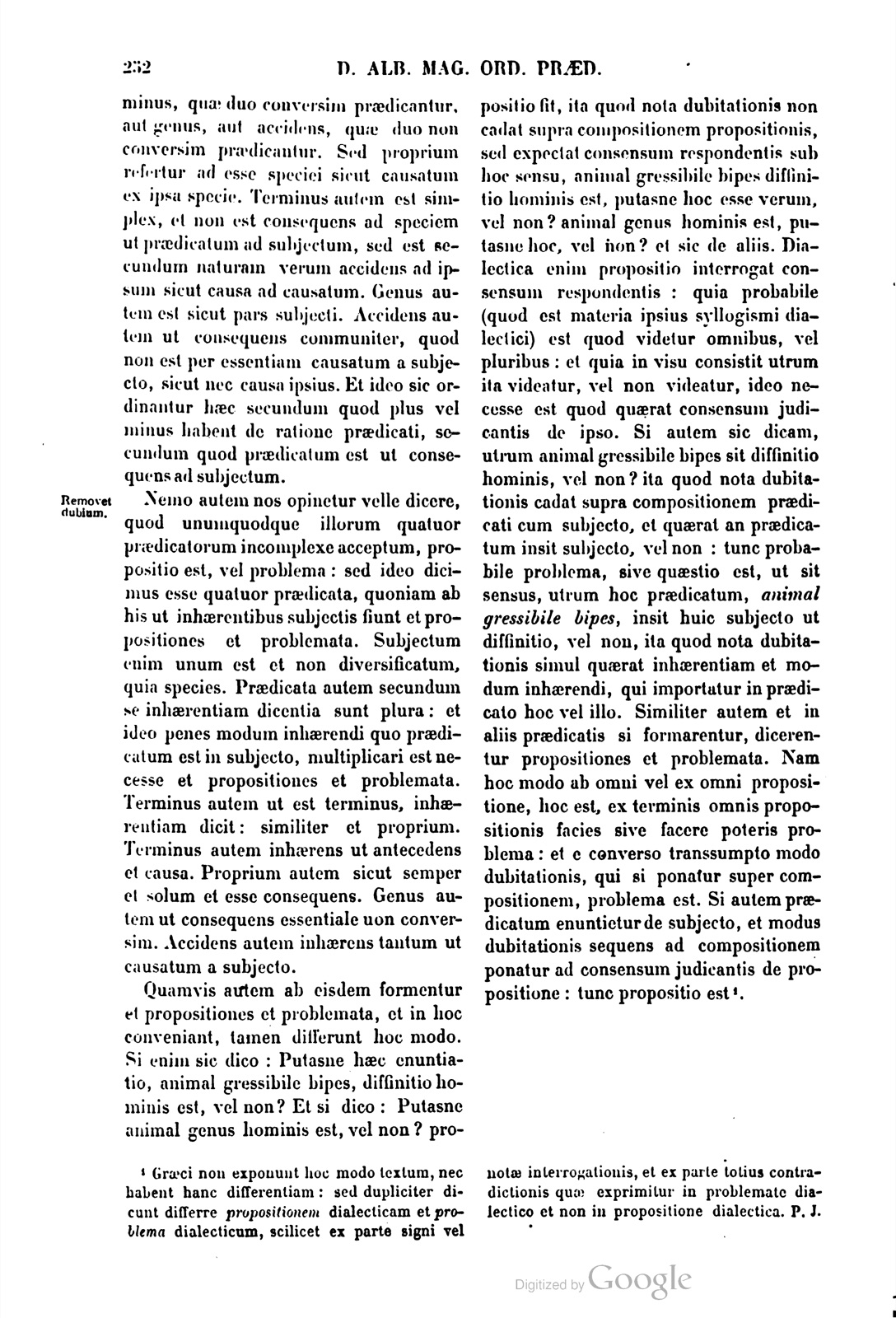
Nemo autem nos opinetur velle dicere, quod unumquodque illorum quatuor praedicatorum incomplexe acceptum, propositio est, vel problema: sed ideo dicimus esse quatuor praedicata, quoniam ab his ut inhaerentibus subjectis fiunt et propositiones et problemata. Subjectum enim unum est et non diversificatum, quia species. Praedicata autem secundum se inhaerentiam dicentia sunt plura: et ideo penes modum inhaerendi quo praedicatum est in subjecto, multiplicari est necesse et propositiones et problemata. Terminus autem ut est terminus, inhaerentiam dicit: similiter et proprium. Terminus autem inhaerens ut antecedens et causa. Proprium autem sicut semper et solum et esse consequens. Genus autem ut consequens essentiale non conversim. Accidens autem inhaerens tantum ut causatum a subjecto.
Quamvis autem ab eisdem formentur et propositiones et problemata, et in hoc conveniant, tamen differunt hoc modo. Si enim sic dico: Putasne haec enuntiatio, animal gressibile bipes, diffinitio hominis est, vel non? Et si dico: Putasne animal genus hominis est, vel non? propositio fit, ita quod nota dubitationis non cadat supra compositionem propositionis, sed exspectat consensum respondentis sub hoc sensu, animal gressibile bipes diffinitio hominis est, putasne hoc esse verum, vel non? animal genus hominis est, putasne hoc, vel non? et sic de aliis. Dialectica enim propositio interrogat consensum respondentis: quia probabile, quod est materia ipsius syllogismi dialectici, est quod videtur omnibus, vel pluribus: et quia in visu consistit utrum ita videatur, vel non videatur, ideo necesse est quod quaerat consensum iudicantis de ipso. Si autem sic dicam, utrum animal gressibile bipes sit diffinitio hominis, vel non? ita quod nota dubitationis cadat supra compositionem praedicati cum subjecto, et quaerat an praedicatum insit subjecto, vel non: tunc probabile problema, sive quaestio est, ut sit sensus, utrum hoc praedicatum, animal gressibile bipes, insit huic subjecto ut diffinitio, vel non, ita quod nota dubitationis simul quaerat inhaerentiam et modum inhaerendi, qui importatur in praedicato hoc vel illo. Similiter autem et in aliis praedicatis si formarentur, dicerentur propositiones et problemata. Nam hoc modo ab omni vel ex omni propositione, hoc est, ex terminis omnis propositionis facies sive facere poteris problema: et e converso transsumpto modo dubitationis, qui si ponatur super compositionem, problema est. Si autem praedicatum enuntietur de subjecto, et modus dubitationis sequens ad compositionem ponatur ad consensum iudicantis de propositione: tunc propositio est 2.
[Marginal label, printed page 252: He removes a doubt.]
But let no one think that we wish to say that each of those four predicates, accepted incomplexly, is a proposition or a problem; rather we say that there are four predicates because from these, as inhering in subjects, propositions and problems are made. For the subject is one and not diversified, because it is species. But predicates, saying inherence according to themselves, are many: and therefore according to the mode of inhering by which the predicate is in the subject, propositions and problems necessarily are multiplied. Now term, insofar as it is term, says inherence; and similarly proper. But term inheres as antecedent and cause. Proper, however, inheres as always and alone and as consequent being. But genus inheres as an essential consequent, not conversely. Accident, however, inheres only as caused by the subject.
Although propositions and problems are formed from the same things, and agree in this, nevertheless they differ in this way. For if I say thus: Do you think this enunciation, animal capable of walking, two-footed, is the definition of human being, or not? And if I say: Do you think animal is the genus of human being, or not? a proposition is made, in such a way that the note of doubt does not fall upon the composition of the proposition, but awaits the consent of the respondent under this sense: animal capable of walking, two-footed, is the definition of human being; do you think this is true, or not? animal is the genus of human being; do you think this, or not? and so concerning the others. For a dialectical proposition interrogates the consent of the respondent, because the probable, which is the matter of that dialectical syllogism, is what seems so to all or to many; and because it consists in sight whether it seems so or does not seem so, therefore it is necessary that it seek the consent of the one judging about it. But if I say thus, whether animal capable of walking, two-footed, is the definition of human being, or not, in such a way that the note of doubt falls upon the composition of the predicate with the subject, and seeks whether the predicate is in the subject or not: then it is a probable problem, or question, so that the sense is whether this predicate, animal capable of walking, two-footed, is in this subject as definition, or not, so that the note of doubt simultaneously seeks inherence and the mode of inhering that is imported in this or that predicate. Similarly, if they were formed in the other predicates, they would be called propositions and problems. For in this way from every or out of every proposition, that is, from the terms of every proposition, you will make or will be able to make a problem; and conversely, when the mode of doubting is transferred, if it is placed over composition, it is a problem. But if the predicate is enunciated of the subject, and the mode of doubting following upon the composition is placed toward the consent of the one judging about the proposition, then it is a proposition 2.
Notes
- Averroes, Metaphysics I, commentary 17. (Averroes, I Metaphys. com. 17.) ↩
- The Greeks do not expound the text in this way, nor do they have this difference; but they say that dialectical proposition and dialectical problem differ in two ways, namely on the part of the sign or note of interrogation, and on the part of the whole contradiction that is expressed in the dialectical problem and not in the dialectical proposition. P. J. (Graeci non exponunt hoc modo textum, nec habent hanc differentiam: sed dupliciter dicunt differre propositionem dialecticam et problema dialecticum, scilicet ex parte signi vel notae interrogationis, et ex parte totius contradictionis quae exprimitur in problemate dialectico et non in propositione dialectica. P. J.) ↩
If a page does not appear, its photograph has not been uploaded yet.