Volume 2 · pp. 245–249
Continuation of Chapter IV and Chapter V. For How Many and What Things This Work Is Useful.
A marker with ≈ is an approximate page boundary, placed by measure of the text; the page photographs remain the authority. In the paired views, clicking a page marker brings that page into view.
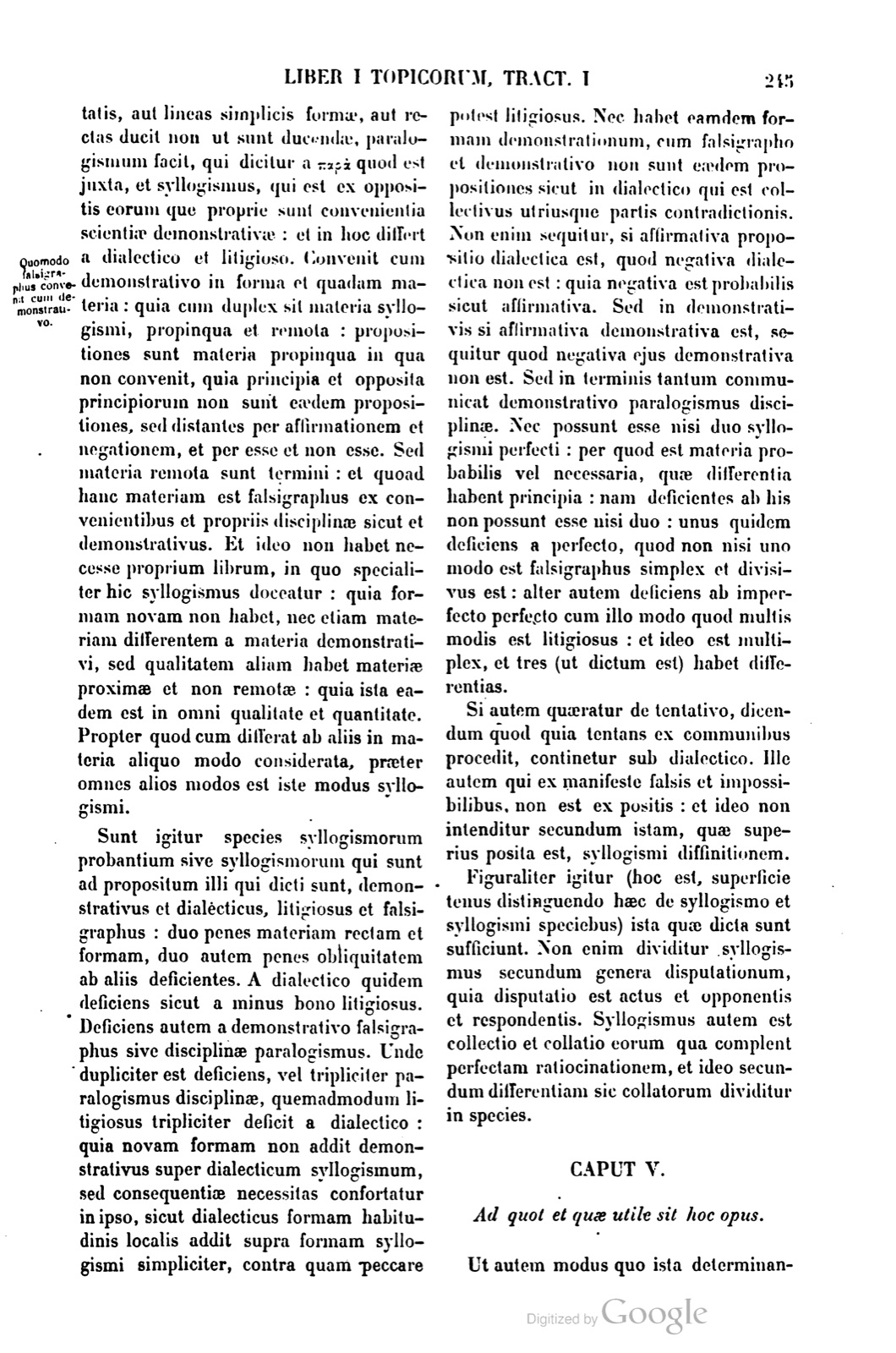
aut lineas simplicis formae, aut rectas ducit non ut sunt ducendae, paralogismum facit, qui dicitur a παρά quod est iuxta, et syllogismus, qui est ex oppositis eorum quae proprie sunt convenientia scientiae demonstrativae: et in hoc differt a dialectico et litigioso.
[Marginal label, printed page 245: Quomodo falsigraphus convenit cum demonstrativo.]
Convenit cum demonstrativo in forma et quadam materia: quia cum duplex sit materia syllogismi, propinqua et remota: propositiones sunt materia propinqua in qua non convenit, quia principia et opposita principiorum non sunt eaedem propositiones, sed distantes per affirmationem et negationem, et per esse et non esse. Sed materia remota sunt termini: et quoad hanc materiam est falsigraphus ex convenientibus et propriis disciplinae sicut et demonstrativus. Et ideo non habet necesse proprium librum, in quo specialiter hic syllogismus doceatur: quia formam novam non habet, nec etiam materiam differentem a materia demonstrativi, sed qualitatem aliam habet materiae proximae et non remotae: quia ista eadem est in omni qualitate et quantitate. Propter quod cum differat ab aliis in materia aliquo modo considerata, praeter omnes alios modos est iste modus syllogismi.
Sunt igitur species syllogismorum probantium sive syllogismorum qui sunt ad propositum illi qui dicti sunt, demonstrativus et dialecticus, litigiosus et falsigraphus: duo penes materiam rectam et formam, duo autem penes obliquitatem ab aliis deficientes. A dialectico quidem deficiens sicut a minus bono litigiosus. Deficiens autem a demonstrativo falsigraphus sive disciplinae paralogismus. Unde dupliciter est deficiens, vel tripliciter paralogismus disciplinae, quemadmodum litigiosus tripliciter deficit a dialectico: quia novam formam non addit demonstrativus super dialecticum syllogismum, sed consequentiae necessitas confortatur in ipso, sicut dialecticus formam habitudinis localis addit supra formam syllogismi simpliciter, contra quam peccare potest litigiosus. Nec habet eamdem formam demonstrationum, cum falsigrapho et demonstrativo non sunt eaedem propositiones sicut in dialectico qui est collectivus utriusque partis contradictionis. Non enim sequitur, si affirmativa propositio dialectica est, quod negativa dialectica non est: quia negativa est probabilis sicut affirmativa. Sed in demonstrativis si affirmativa demonstrativa est, sequitur quod negativa eius demonstrativa non est. Sed in terminis tantum communicat demonstrativo paralogismus disciplinae. Nec possunt esse nisi duo syllogismi perfecti: per quod est materia probabilis vel necessaria, quae differentia habent principia: nam deficientes ab his non possunt esse nisi duo: unus quidem deficiens a perfecto, quod non nisi uno modo est falsigraphus simplex et divisivus est; alter autem deficiens ab imperfecto perfecto cum illo modo quod multis modis est litigiosus: et ideo est multiplex, et tres, ut dictum est, habet differentias.
Si autem quaeratur de tentativo, dicendum quod quia tentans ex communibus procedit, continetur sub dialectico. Ille autem qui ex manifeste falsis et impossibilibus, non est ex positis: et ideo non intenditur secundum istam, quae superius posita est, syllogismi diffinitionem. Figuraliter igitur, hoc est, superficie tenus distinguendo haec de syllogismo et syllogismi speciebus, ista quae dicta sunt sufficiunt. Non enim dividitur syllogismus secundum genera disputationum, quia disputatio est actus et opponentis et respondentis. Syllogismus autem est collectio et collatio eorum quae complent perfectam ratiocinationem, et ideo secundum differentiam sic collatorum dividitur in species.
or draws lines of simple form, or straight lines, not as they ought to be drawn, he makes a paralogism, which is so called from παρά, which is beside, and syllogism, because it is from things opposite to those that are properly suitable to demonstrative science; and in this it differs from the dialectical and the contentious.
[Marginal label, printed page 245: How the falsigraphic syllogism agrees with the demonstrative.]
It agrees with the demonstrative in form and in a certain matter: because, since the matter of syllogism is twofold, proximate and remote, propositions are the proximate matter, in which it does not agree, because principles and things opposite to principles are not the same propositions, but things distant through affirmation and negation and through being and not-being. But terms are the remote matter: and with respect to this matter the falsigraphic syllogism is from things suitable and proper to the discipline, just as the demonstrative syllogism is. And therefore it does not need its own book in which this syllogism is taught specially, because it does not have a new form, nor even matter different from the matter of the demonstrative, but it has another quality of proximate and not remote matter: because that matter is the same in every quality and quantity. On account of this, since it differs from the others in matter considered in some way, this mode of syllogism exists besides all the other modes.
Therefore the species of probative syllogisms, or of syllogisms that are to the proposed object, are those that have been mentioned: demonstrative and dialectical, contentious and falsigraphic. Two are according to right matter and form, but two according to obliquity, deficient from the others. The contentious is deficient from the dialectical as from what is less good. The falsigraphic, or the paralogism of a discipline, is deficient from the demonstrative. Whence the paralogism of a discipline is deficient in two ways, or in three ways, just as the contentious is deficient from the dialectical in three ways: because the demonstrative does not add a new form over and above the dialectical syllogism, but the necessity of consequence is strengthened in it, just as the dialectical adds the form of local relation over and above the form of syllogism simply, against which the contentious can sin. Nor does it have the same form of demonstrations, since with the falsigraphic and the demonstrative the propositions are not the same as in the dialectical, which is collective of each part of a contradiction. For it does not follow, if the affirmative proposition is dialectical, that the negative dialectical proposition is not dialectical: because the negative is probable just as the affirmative is. But in demonstrative matters, if the affirmative is demonstrative, it follows that its negative is not demonstrative. But the paralogism of a discipline communicates with the demonstrative only in terms. Nor can there be except two perfect syllogisms, through which there is probable or necessary matter, which have different principles: for those deficient from these can be only two: one deficient from the perfect, which only in one way is the simple and divisive falsigraphic; but the other deficient from the perfect imperfect with that mode which in many modes is contentious; and therefore it is multiple and has three differences, as was said.
But if inquiry is made concerning the tentative syllogism, it must be said that because one who tests proceeds from common things, it is contained under the dialectical. But the one that proceeds from things manifestly false and impossible is not from things posited: and therefore it is not intended according to that definition of syllogism which was placed above. Therefore figurally, that is, by distinguishing on the surface these things concerning syllogism and the species of syllogism, the things that have been said suffice. For syllogism is not divided according to the genera of disputations, because disputation is the act both of the opponent and of the respondent. But syllogism is a collecting and bringing together of those things that complete perfect reasoning, and therefore it is divided into species according to the difference of things thus brought together.
CAPUT V.
Ad quot et quae utile sit hoc opus.
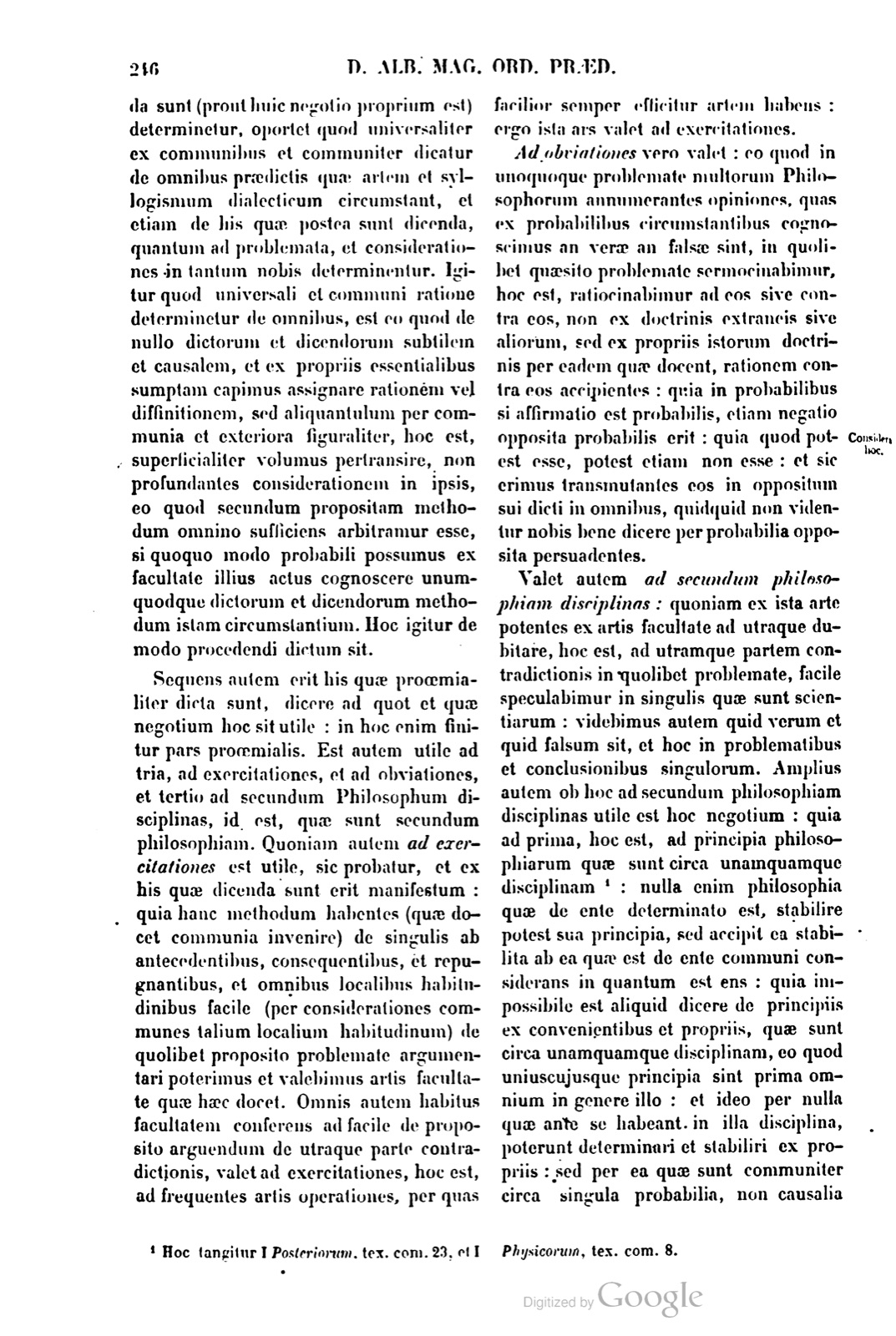
Ut autem modus quo ista determinanda sunt, prout huic negotio proprium est, determinetur, oportet quod universaliter ex communibus et communiter dicatur de omnibus praedictis quae artem et syllogismum dialecticum circumstant, et etiam de his quae postea sunt dicenda, quantum ad problemata, et considerationes in tantum nobis determinentur. Igitur quod universali et communi ratione determinetur de omnibus, est eo quod de nullo dictorum et dicendorum subtilem et causalem, et ex propriis essentialibus sumptam capimus assignare rationem vel diffinitionem, sed aliquantulum per communia et exteriora figuraliter, hoc est, superficialiter volumus pertransire, non profundantes considerationem in ipsis, eo quod secundum propositam methodum omnino sufficiens arbitramur esse, si quoquo modo probabili possumus ex facultate illius actus cognoscere unumquodque dictorum et dicendorum methodum istam circumstantium. Hoc igitur de modo procedendi dictum sit.
Sequens autem erit his quae prooemialiter dicta sunt, dicere ad quot et quae negotium hoc sit utile: in hoc enim finitur pars proaemialis. Est autem utile ad tria, ad exercitationes, et ad obviationes, et tertio ad secundum Philosophum disciplinas, id est, quae sunt secundum philosophiam. Quoniam autem ad exercitationes est utile, sic probatur, et ex his quae dicenda sunt erit manifestum: quia hanc methodum habentes, quae docet communia invenire, de singulis ab antecedentibus, consequentibus, et repugnantibus, et omnibus localibus habitudinibus facile, per considerationes communes talium localium habitudinum, de quolibet proposito problemate argumentari poterimus et valebimus artis facultate quae haec docet. Omnis autem habitus facultatem conferens ad facile de proposito arguendum de utraque parte contradictionis, valet ad exercitationes, hoc est, ad frequentes artis operationes, per quas facilior semper efficitur artem habens: ergo ista ars valet ad exercitationes.
Ad obviationes vero valet: eo quod in unoquoque problemate multorum Philosophorum annumerantes opiniones, quas ex probabilibus circumstantibus cognoscimus an verae an falsae sint, in quolibet quaesito problemate sermocinabimur, hoc est, ratiocinabimur ad eos sive contra eos, non ex doctrinis extraneis sive aliorum, sed ex propriis istorum doctrinis per eadem quae docent, rationem contra eos accipientes: quia in probabilibus si affirmatio est probabilis, etiam negatio opposita probabilis erit: quia quod potest esse, potest etiam non esse: et sic erimus transmutantes eos in oppositum sui dicti in omnibus, quidquid non videntur nobis bene dicere per probabilia opposita persuadentes.
[Marginal label, printed page 246: Considera hoc.]
Valet autem ad secundum philosophiam disciplinas: quoniam ex ista arte potentes ex artis facultate ad utraque dubitare, hoc est, ad utramque partem contradictionis in quolibet problemate, facile speculabimur in singulis quae sunt scientiarum: videbimus autem quid verum et quid falsum sit, et hoc in problematibus et conclusionibus singulorum. Amplius autem ob hoc ad secundum philosophiam disciplinas utile est hoc negotium: quia ad prima, hoc est, ad principia philosophiarum quae sunt circa unamquamque disciplinam 1: nulla enim philosophia quae de ente determinato est, stabilire potest sua principia, sed accipit ea stabilita ab ea quae est de ente communi considerans in quantum est ens: quia impossibile est aliquid dicere de principiis ex convenientibus et propriis, quae sunt circa unamquamque disciplinam, eo quod uniuscuiusque principia sint prima omnium in genere illo: et ideo per nulla quae ante se habeant in illa disciplina, poterunt determinari et stabiliri ex propriis: sed per ea quae sunt communiter circa singula probabilia, non causalia autem, necesse est de his principiis singularum philosophiarum pertransire non profundato sermone.
CHAPTER V.
For how many and what things this work is useful.
But so that the mode in which these things must be determined, as is proper to this business, may be determined, it is necessary that universally from common things and commonly something be said concerning all the things already mentioned that surround the art and dialectical syllogism, and also concerning those things that are afterward to be said, insofar as problems and considerations are determined for us to that extent. Therefore the fact that determination about all of them is made by a universal and common account is because concerning none of the things said and to be said do we undertake to assign a subtle and causal account or definition taken from proper essential things; rather we wish to pass through them somewhat through common and exterior things figurally, that is, superficially, not deepening consideration in them, because according to the proposed method we judge it altogether sufficient if, in whatever probable way, we can from the faculty of its act know each of the things said and to be said that surround this method. Therefore let this have been said concerning the mode of proceeding.
But what follows upon the things said proemially will be to say for how many and what things this business is useful; for in this the proemial part is finished. It is useful for three things: for exercises, for obviations, and third, according to the Philosopher, for disciplines, that is, those that are according to philosophy. That it is useful for exercises is proved thus, and from the things to be said it will be manifest: because, having this method, which teaches how to discover common things, we shall be able and shall have power, by the faculty of the art that teaches these things, to argue easily concerning each proposed problem from antecedents, consequents, repugnants, and all local relations, through common considerations of such local relations. But every habit conferring a faculty for arguing easily from the proposed thing on either part of a contradiction is useful for exercises, that is, for frequent operations of the art, through which the one having the art is always made easier: therefore this art is useful for exercises.
But it is useful for obviations because, in each problem, counting up the opinions of many Philosophers, which from surrounding probable things we know to be true or false, we shall discourse, that is, reason, in any problem sought, toward them or against them, not from foreign doctrines or the doctrines of others, but from their own doctrines, taking an argument against them through the same things that they teach: because in probable matters, if an affirmation is probable, the opposite negation also will be probable; because what can be, can also not be; and thus we shall be changing them into the opposite of their own statement in all matters, by persuading them through opposite probable things whenever they do not seem to us to speak well.
[Marginal label, printed page 246: Consider this.]
But it is useful for disciplines according to philosophy: because from this art, being able by the faculty of the art to doubt toward both things, that is, toward either part of a contradiction in any problem, we shall easily speculate in the individual things that belong to the sciences; and we shall see what is true and what is false, and this in the problems and conclusions of individual sciences. Furthermore, for this reason this business is useful for disciplines according to philosophy: because it is useful for first things, that is, for the principles of philosophies that are about each discipline 1. For no philosophy that is about a determinate being can establish its own principles, but it receives them established by that philosophy which is about common being, considering it insofar as it is being; because it is impossible to say anything about principles from the suitable and proper things that are about each discipline, since the principles of each discipline are first of all things in that genus; and therefore through nothing that they have before themselves in that discipline will they be able to be determined and established from proper things; but through those things that are commonly about individual probable things, not causal things, it is necessary to pass through these principles of the individual philosophies with speech not deepened.
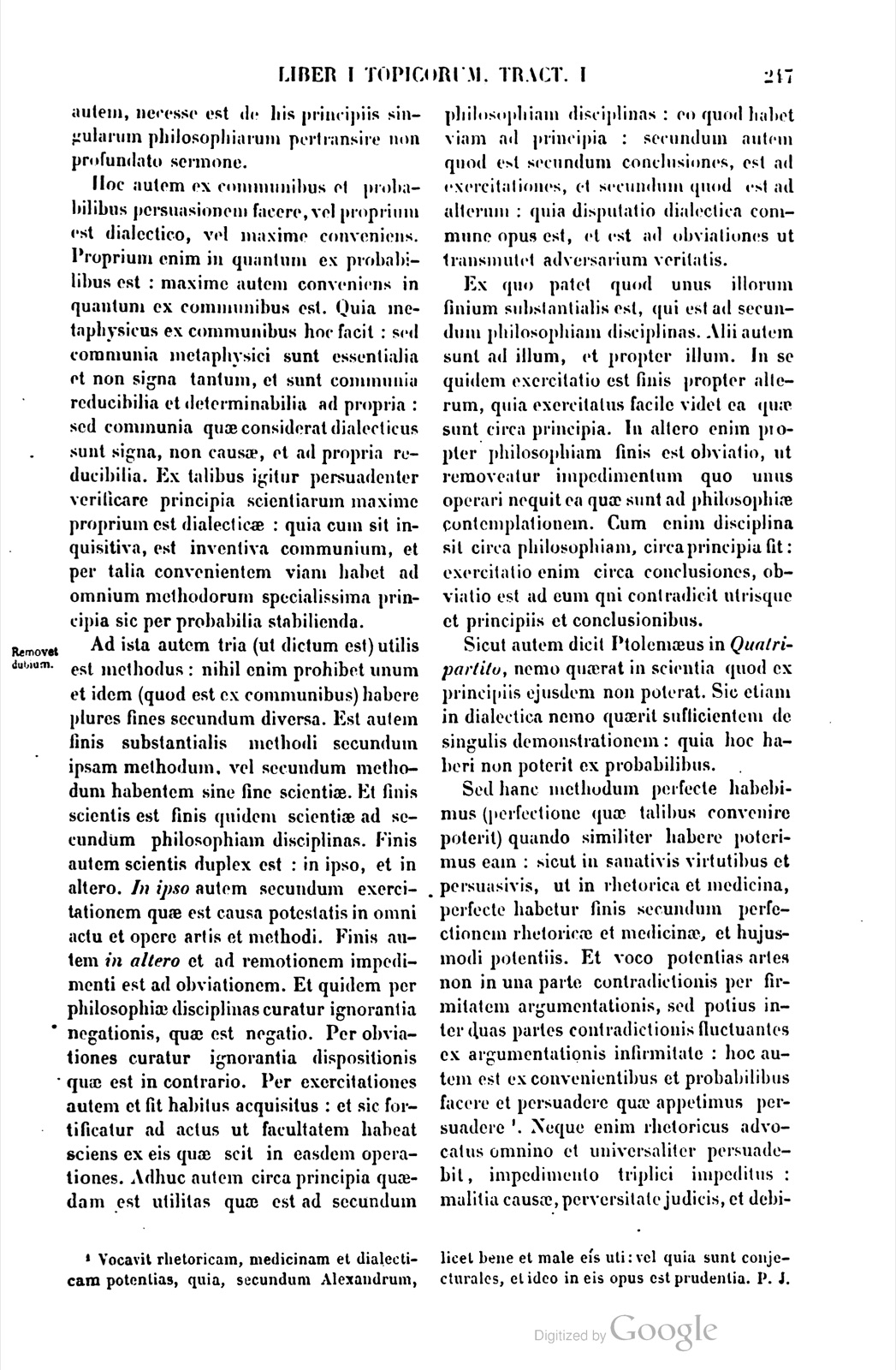
Hoc autem ex communibus et probabilibus persuasionem facere, vel proprium est dialectico, vel maxime conveniens. Proprium enim in quantum ex probabilibus est: maxime autem conveniens in quantum ex communibus est. Quia metaphysicus ex communibus hoc facit: sed communia metaphysici sunt essentialia et non signa tantum, et sunt communia reducibilia et determinabilia ad propria: sed communia quae considerat dialecticus sunt signa, non causae, et ad propria reducibilia. Ex talibus igitur persuadenter verificare principia scientiarum maxime proprium est dialecticae: quia cum sit inquisitiva, est inventiva communium, et per talia convenientem viam habet ad omnium methodorum specialissima principia sic per probabilia stabilienda.
[Marginal label, printed page 247: Removet dubium.]
Ad ista autem tria, ut dictum est, utilis est methodus: nihil enim prohibet unum et idem, quod est ex communibus, habere plures fines secundum diversa. Est autem finis substantialis methodi secundum ipsam methodum, vel secundum methodum habentem sine fine scientiae. Et finis scientis est finis quidem scientiae ad secundum philosophiam disciplinas. Finis autem scientis duplex est: in ipso, et in altero. In ipso autem secundum exercitationem quae est causa potestatis in omni actu et opere artis et methodi. Finis autem in altero et ad remotionem impedimenti est ad obviationem. Et quidem per philosophiae disciplinas curatur ignorantia negationis, quae est negatio. Per obviationes curatur ignorantia dispositionis quae est in contrario. Per exercitationes autem et fit habitus acquisitus: et sic fortificatur ad actus ut facultatem habeat sciens ex eis quae scit in easdem operationes. Adhuc autem circa principia quaedam est utilitas quae est ad secundum philosophiam disciplinas: eo quod habet viam ad principia: secundum autem quod est secundum conclusiones, est ad exercitationes, et secundum quod est ad alterum: quia disputatio dialectica commune opus est, et est ad obviationes ut transmutet adversarium veritatis.
Ex quo patet quod unus illorum finium substantialis est, qui est ad secundum philosophiam disciplinas. Alii autem sunt ad illum, et propter illum. In se quidem exercitatio est finis propter alterum, quia exercitatus facile videt ea quae sunt circa principia. In altero enim propter philosophiam finis est obviatio, ut removeatur impedimentum quo unus operari nequit ea quae sunt ad philosophiae contemplationem. Cum enim disciplina sit circa philosophiam, circa principia fit: exercitatio enim circa conclusiones, obviatio est ad eum qui contradicit utrisque et principiis et conclusionibus.
But to make persuasion about this from common and probable things is either proper to the dialectician, or most suitable. It is proper insofar as it is from probable things; but most suitable insofar as it is from common things. For the metaphysician does this from common things, but the common things of the metaphysician are essential and not only signs, and they are common things reducible and determinable to proper things. But the common things that the dialectician considers are signs, not causes, and reducible to proper things. Therefore from such things to verify persuasively the principles of the sciences is especially proper to dialectic: because, since it is inquisitive, it is inventive of common things, and through such things it has a suitable way for establishing in this way, through probable things, the most special principles of all methods.
[Marginal label, printed page 247: He removes a doubt.]
But for these three things, as has been said, the method is useful: for nothing prevents one and the same thing, which is from common things, from having several ends according to diverse respects. Now the substantial end of the method is according to the method itself, or according to the one having the method without the end of science. And the end of the knower is indeed the end of science with respect to disciplines according to philosophy. But the end of the knower is twofold: in himself and in another. In himself, according to exercise, which is the cause of power in every act and work of art and method. But the end in another and for the removal of an impediment is for obviation. And by the disciplines of philosophy there is indeed cured the ignorance of negation, which is negation. By obviations there is cured the ignorance of disposition that is in the contrary. By exercises also an acquired habit is made; and thus the knower is strengthened for acts, so that from the things he knows he may have faculty for the same operations. Furthermore, concerning principles there is a certain usefulness that is for disciplines according to philosophy, because it has a way to principles; but according as it is with respect to conclusions, it is for exercises; and according as it is toward another, because dialectical disputation is a common work, it is for obviations, so that it may change the adversary of truth.
From this it is clear that one of those ends is substantial, namely the one that is for disciplines according to philosophy. But the others are for that one and on account of that one. In itself, exercise indeed is an end on account of another, because one who has been exercised easily sees the things that are about principles. But in another, on account of philosophy, the end is obviation, so that the impediment may be removed by which someone cannot work those things that belong to the contemplation of philosophy. For since discipline is about philosophy, it is done about principles; for exercise is about conclusions, but obviation is directed to the one who contradicts both principles and conclusions.
Sicut autem dicit Ptolemaeus in Quadripartito, nemo quaerat in scientia quod ex principiis eiusdem non poterat. Sic etiam in dialectica nemo quaerit sufficientem de singulis demonstrationem: quia hoc haberi non poterit ex probabilibus.
Sed hanc methodum perfecte habebimus, perfectione quae talibus convenire poterit, quando similiter habere poterimus eam: sicut in sanativis virtutibus et persuasivis, ut in rhetorica et medicina, perfecte habetur finis secundum perfectionem rhetoricae et medicinae, et huiusmodi potentiis. Et voco potentias artes non in una parte contradictionis per firmitatem argumentationis, sed potius inter duas partes contradictionis fluctuantes ex argumentationis infirmitate: hoc autem est ex convenientibus et probabilibus facere et persuadere quae appetimus persuadere 2. Neque enim rhetoricus advocatus omnino et universaliter persuadebit, impedimento triplici impeditus: malitia causae, perversitate iudicis, et debilitate allegationis suae. Nec medicus similiter omnino sanabit propter triplex impedimentum, scilicet fallacia experimenti, malitia infirmitatis, et inobedientia aegroti: et ideo non semper consequuntur finem in alio. Et similiter impeditur dialecticus ex debilitate probabilis quod adducit, et ex protervitate respondentis, et difficultate problematis circa quod disputat, ita quod non semper consequitur finem in alio. Sed si unusquisque horum trium ex contingentibus secundum suae artis facultatem nihil omiserit, dicemus disciplinam et disciplinabilem finem habere sufficienter secundum artis contingentiam, quamvis non semper habeat finem sufficienter in alio secundum effectum persuasionis vel sanitatis vel dialecticae probationis et contemplationis 3.
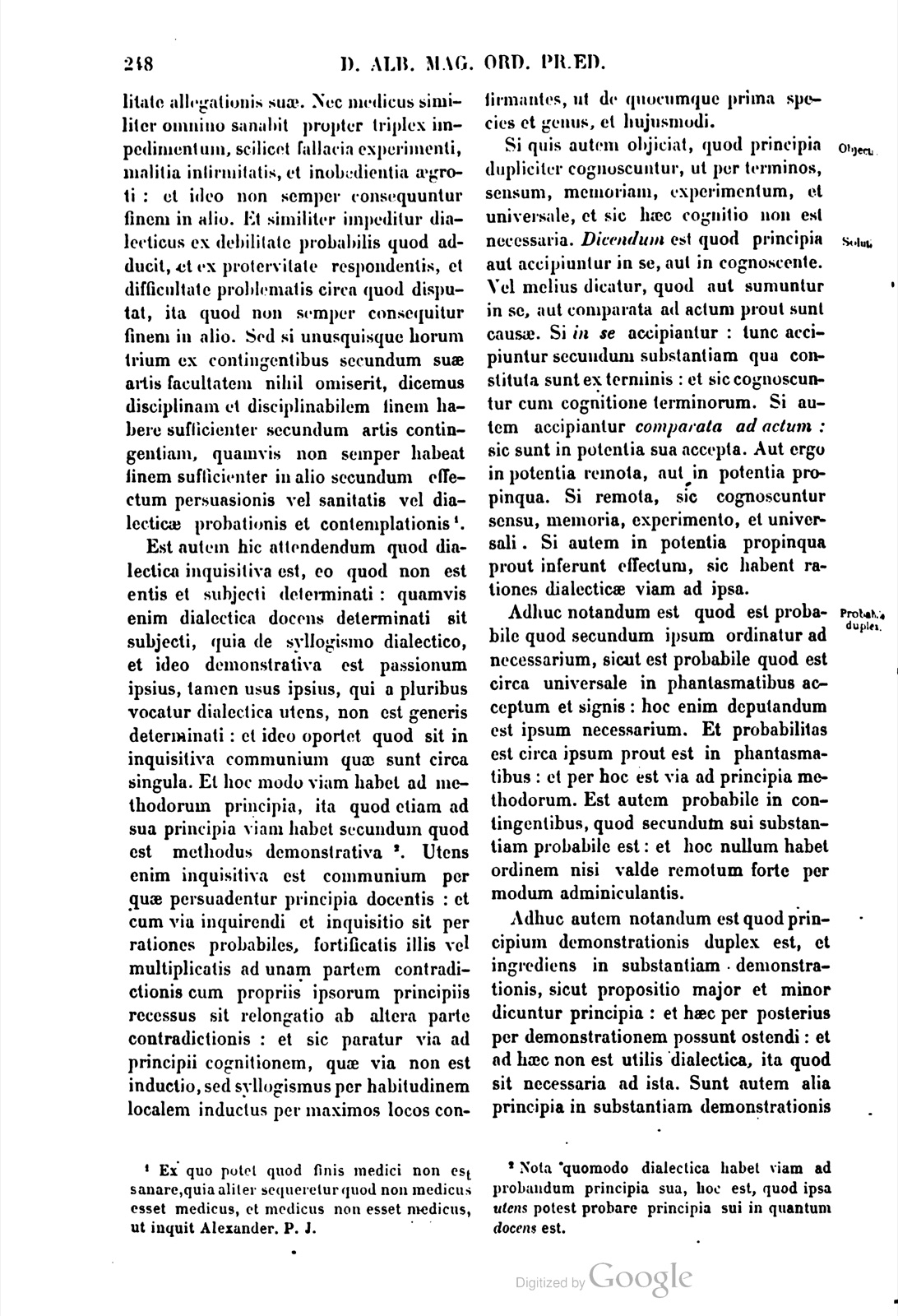
Est autem hic attendendum quod dialectica inquisitiva est, eo quod non est entis et subjecti determinati: quamvis enim dialectica docens determinati sit subjecti, quia de syllogismo dialectico, et ideo demonstrativa est passionum ipsius, tamen usus ipsius, qui a pluribus vocatur dialectica utens, non est generis determinati: et ideo oportet quod sit inquisitiva communium quae sunt circa singula. Et hoc modo viam habet ad methodorum principia, ita quod etiam ad sua principia viam habet secundum quod est methodus demonstrativa 4. Utens enim inquisitiva est communium per quae persuadentur principia docentis: et cum via inquirendi et inquisitio sit per rationes probabiles, fortificatis illis vel multiplicatis ad unam partem contradictionis cum propriis ipsorum principiis recessus sit elongatio ab altera parte contradictionis: et sic paratur via ad principii cognitionem, quae via non est inductio, sed syllogismus per habitudinem localem inductus per maximos locos confirmantes, ut de quocumque prima species et genus, et huiusmodi.
But as Ptolemy says in the Quadripartite, let no one seek in a science what he could not seek from the principles of that same science. So also in dialectic no one seeks a sufficient demonstration about individual things, because this cannot be had from probable things.
But we shall have this method perfectly, with the perfection that can belong to such things, when we shall be able to have it in like manner: as in healing and persuasive powers, as in rhetoric and medicine, the end is had perfectly according to the perfection of rhetoric and medicine and powers of this kind. And I call arts powers, not because of firmness of argumentation in one part of a contradiction, but rather because of their wavering between two parts of a contradiction from the weakness of argumentation; and this is to make and to persuade from suitable and probable things the things that we desire to persuade 2. For neither will a rhetorical advocate persuade altogether and universally, being hindered by a threefold impediment: the badness of the case, the perversity of the judge, and the weakness of his allegation. Nor similarly will a physician heal altogether, because of a threefold impediment, namely fallacy of experiment, badness of the illness, and disobedience of the sick person; and therefore they do not always attain the end in another. And similarly the dialectician is hindered by the weakness of the probable thing that he adduces, and by the obstinacy of the respondent, and by the difficulty of the problem about which he disputes, so that he does not always attain the end in another. But if each of these three has omitted nothing from contingent things according to the faculty of his art, we shall say that he has sufficiently the discipline and the end capable of discipline according to the contingency of the art, although he does not always have the end sufficiently in another according to the effect of persuasion or health or dialectical proof and contemplation 3.
But here one must attend that dialectic is inquisitive, because it is not about a determinate being and subject: for although dialectic as teaching is of a determinate subject, because it is concerning dialectical syllogism, and therefore it is demonstrative of its properties, nevertheless its use, which by many is called dialectic as using, is not of a determinate genus; and therefore it must be inquisitive of common things that are about individual things. And in this way it has a way to the principles of methods, so that it also has a way to its own principles according as it is a demonstrative method 4. For as using it is inquisitive of common things through which the principles of the teaching science are persuaded; and since the way of inquiring and inquiry is through probable reasons, when those are strengthened or multiplied toward one part of a contradiction along with their own principles, withdrawal is a distancing from the other part of the contradiction; and thus a way is prepared to cognition of the principle, which way is not induction, but a syllogism induced through local relation by the greatest places confirming, as concerning anything whatever, first species and genus and things of this kind.
[Marginal label, printed page 248: Objectio.]
Si quis autem obiciat, quod principia dupliciter cognoscuntur, ut per terminos, sensum, memoriam, experimentum, et universale, et sic haec cognitio non est necessaria.
[Marginal label, printed page 248: Solutio.]
Dicendum est quod principia aut accipiuntur in se, aut in cognoscente. Vel melius dicatur, quod aut sumuntur in se, aut comparata ad actum prout sunt causae. Si in se accipiantur: tunc accipiuntur secundum substantiam qua constituta sunt ex terminis: et sic cognoscuntur cum cognitione terminorum. Si autem accipiantur comparata ad actum: sic sunt in potentia sua accepta. Aut ergo in potentia remota, aut in potentia propinqua. Si remota, sic cognoscuntur sensu, memoria, experimento, et universali. Si autem in potentia propinqua prout inferunt effectum, sic habent rationes dialecticae viam ad ipsa.
[Marginal label, printed page 248: Probabile duplex.]
Adhuc notandum est quod est probabile quod secundum ipsum ordinatur ad necessarium, sicut est probabile quod est circa universale in phantasmatibus acceptum et signis: hoc enim deputandum est ipsum necessarium. Et probabilitas est circa ipsum prout est in phantasmatibus: et per hoc est via ad principia methodorum. Est autem probabile in contingentibus, quod secundum sui substantiam probabile est: et hoc nullum habet ordinem nisi valde remotum forte per modum adminiculantis.
Adhuc autem notandum est quod principium demonstrationis duplex est, et ingrediens in substantiam demonstrationis, sicut propositio maior et minor dicuntur principia: et haec per posterius per demonstrationem possunt ostendi: et ad haec non est utilis dialectica, ita quod sit necessaria ad ista. Sunt autem alia principia in substantiam demonstrationis non ingredientia, ut dignitates, suppositiones, petitiones, diffinitiones, quae per posterius non possunt ostendi, sed per inquisitionem et inventionem communium localium via habetur ad ipsa. Adhuc autem dupliciter accipitur principium: aut id quod est principium, et sic habetur via ad ipsum: vel secundum quod est primum, et sic est immediatum, et non habetur via ad ipsum.
[Marginal label, printed page 249: Quare syllogismus dialecticus dicitur figuralis.]
Et quia ex communibus est omnis syllogismus dialecticus, figuralis est: quia figura extrinsece est ultimum ad quod terminatur essentia figurati, et sic omnibus aliis magis est extrinsecum: propter quod non facit cognitionem principii secundum quod est scitum, sed facit viam ad ipsum prout est opinatum et per rationem iuvantem elongatur ab altera parte contradictionis, et sic accedit ad veritatem alterius: et hoc est dare viam per cognitionem, et adminiculum, et non per proprias causas, ex quibus sit scientia veritatis rerum. Haec igitur proaemialiter dicta sunt.
[Marginal label, printed page 249: Removet dubium.]
Adhuc notandum est quod quamvis dialectica sit circa singula, tamen est ex communibus singulorum, et non ex propriis: et ideo certam non potest de singulis facere cognitionem: propter quod non superfluunt, sed necessariae sunt species scientiae quae de singulis in speciali perfectam ex propriis faciunt cognitionem.
[Marginal label, printed page 248: Objection.]
But if someone objects that principles are known in two ways, namely through terms, sense, memory, experiment, and the universal, and thus this cognition is not necessary.
[Marginal label, printed page 248: Solution.]
It must be said that principles are either accepted in themselves or in the knower. Or it may be better said that they are taken either in themselves or compared to act insofar as they are causes. If they are accepted in themselves, then they are accepted according to the substance by which they are constituted from terms, and thus they are known with cognition of the terms. But if they are accepted as compared to act, then they are accepted in their power. Therefore either in remote power or in proximate power. If in remote power, then they are known by sense, memory, experiment, and the universal. But if in proximate power, insofar as they infer an effect, then dialectical reasons have a way to them.
[Marginal label, printed page 248: The probable is twofold.]
Furthermore it must be noted that there is a probable thing which according to itself is ordered to the necessary, as the probable that is accepted around the universal in phantasms and signs: for this must be reckoned the necessary itself. And probability is about it as it is in phantasms; and through this there is a way to the principles of methods. But there is a probable thing in contingent matters which according to its own substance is probable; and this has no order except a very remote one, perhaps by way of what gives support.
Furthermore it must be noted that the principle of demonstration is twofold: one entering into the substance of demonstration, as the major and minor proposition are called principles; and these can be shown afterward by demonstration, and dialectic is not useful for these in such a way that it is necessary for them. But there are other principles not entering into the substance of demonstration, such as dignities, suppositions, petitions, definitions, which cannot be shown afterward, but by inquiry and discovery of common local things a way is had to them. Furthermore, principle is taken in two ways: either as that which is a principle, and thus a way is had to it; or according as it is first, and thus it is immediate, and no way is had to it.
[Marginal label, printed page 249: Why dialectical syllogism is called figural.]
And because every dialectical syllogism is from common things, it is figural: because figure outwardly is the ultimate thing at which the essence of the figured thing is terminated, and thus more than all other things it is extrinsic. On account of this it does not make cognition of a principle according as it is known scientifically, but it makes a way to it insofar as it is opined, and by a reason giving help one is distanced from the other part of the contradiction, and thus it approaches the truth of the other part: and this is to give a way through cognition and assistance, and not through proper causes from which there would be science of the truth of things. Therefore these things have been said proemially.
[Marginal label, printed page 249: He removes a doubt.]
Furthermore it must be noted that although dialectic is about individual things, nevertheless it is from the common things of individual things and not from proper things: and therefore it cannot make certain cognition concerning individual things; on account of which the species of science that make perfect cognition from proper things concerning individual things in a special way are not superfluous, but necessary.
Notes
- This is touched on in Posterior Analytics I, textual commentary 23, and Physics I, textual commentary 8. (Hoc tangitur I Posteriorum, tex. com. 23, et I Physicorum, tex. com. 8.) ↩
- He called rhetoric, medicine, and dialectic powers because, according to Alexander, it is permitted to use them well and badly; or because they are conjectural, and therefore in them there is need of prudence. P. J. (Vocavit rhetoricam, medicinam et dialecticam potentias, quia, secundum Alexandrum, licet bene et male eis uti: vel quia sunt conjecturales, et ideo in eis opus est prudentia. P. J.) ↩
- From this it is clear that the end of the physician is not to heal, because otherwise it would follow that a non-physician would be a physician, and a physician would not be a physician, as Alexander says. P. J. (Ex quo patet quod finis medici non est sanare, quia aliter sequeretur quod non medicus esset medicus, et medicus non esset medicus, ut inquit Alexander. P. J.) ↩
- Note how dialectic has a way for proving its own principles, that is, that dialectic itself as using can prove the principles of itself insofar as it is teaching. (Nota quomodo dialectica habet viam ad probandum principia sua, hoc est, quod ipsa utens potest probare principia sui in quantum docens est.) ↩
If a page does not appear, its photograph has not been uploaded yet.