Volume 2 · p. 244
Chapter IV. On Paralogisms.
CAPUT IV.
De paralogismis.
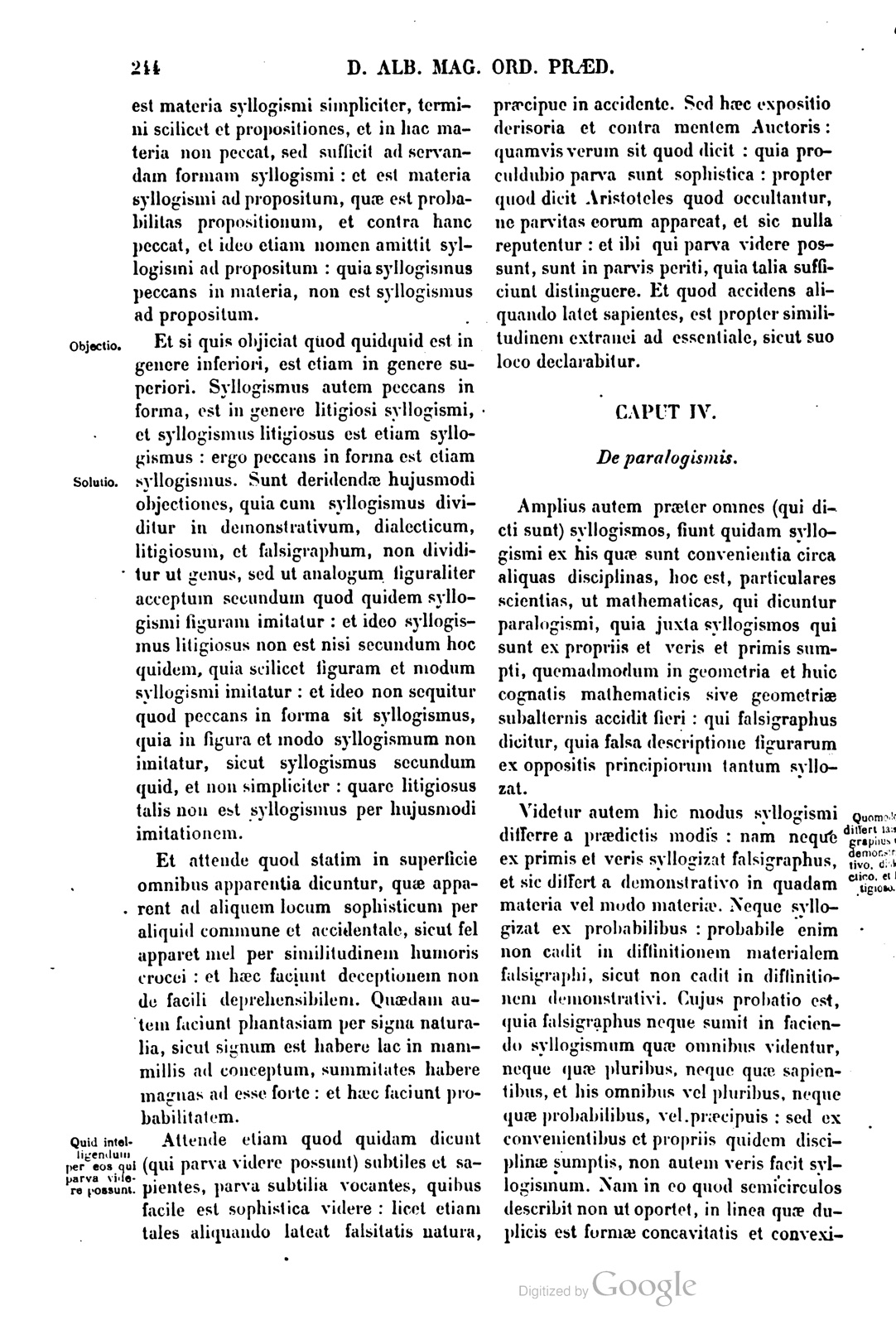
Amplius autem praeter omnes, qui dicti sunt, syllogismos, fiunt quidam syllogismi ex his quae sunt convenientia circa aliquas disciplinas, hoc est, particulares scientias, ut mathematicas, qui dicuntur paralogismi, quia iuxta syllogismos qui sunt ex propriis et veris et primis sumpti, quemadmodum in geometria et huic cognatis mathematicis sive geometriae subalternis accidit fieri: qui falsigraphus dicitur, quia falsa descriptione figurarum ex oppositis principiorum tantum syllozat.
[Marginal label, printed page 244: Quomodo falsigraphus differt a demonstrativo, dialectico, et litigioso.]
Videtur autem hic modus syllogismi differre a praedictis modis: nam neque ex primis et veris syllogizat falsigraphus, et sic differt a demonstrativo in quadam materia vel modo materiae. Neque syllogizat ex probabilibus: probabile enim non cadit in diffinitionem materialem falsigraphi, sicut non cadit in diffinitionem demonstrativi. Cuius probatio est, quia falsigraphus neque sumit in faciendo syllogismum quae omnibus videntur, neque quae pluribus, neque quae sapientibus, et his omnibus vel pluribus, neque quae probabilibus vel praecipuis: sed ex convenientibus et propriis quidem disciplinae sumptis, non autem veris facit syllogismum. Nam in eo quod semicirculos describit non ut oportet, in linea quae duplicis est formae concavitatis et convexitatis,
CHAPTER IV.
On paralogisms.
Moreover, besides all the syllogisms that have been mentioned, certain syllogisms are made from those things that are suitable around certain disciplines, that is, particular sciences, such as the mathematical sciences. These are called paralogisms, because they are beside syllogisms that are taken from proper, true, and first things, as happens to be done in geometry and in mathematical sciences akin to this or subalternate to geometry. This one is called falsigraphic, because by a false description of figures it syllogizes only from things opposite to the principles.
[Marginal label, printed page 244: How the falsigraphic syllogism differs from the demonstrative, dialectical, and contentious.]
But this mode of syllogism seems to differ from the modes previously mentioned: for the falsigraphic syllogism does not syllogize from first and true things, and thus it differs from the demonstrative in a certain matter or mode of matter. Nor does it syllogize from probable things: for the probable does not fall into the material definition of the falsigraphic, just as it does not fall into the definition of the demonstrative. The proof of this is that the falsigraphic syllogism, in making a syllogism, takes neither the things that seem so to all, nor those that seem so to many, nor those that seem so to the wise, and to these, either all or many, nor those that seem so to the probable or principal persons; but from things suitable and proper indeed to the discipline, yet not true, it makes a syllogism. For in that it describes semicircles not as it ought, in a line that is of a twofold form of concavity and convexity,
If a page does not appear, its photograph has not been uploaded yet.