Volume 2 · pp. 242–244
Chapter III. On Contentious Syllogism.
A marker with ≈ is an approximate page boundary, placed by measure of the text; the page photographs remain the authority. In the paired views, clicking a page marker brings that page into view.
CAPUT III.
De litigioso syllogismo.
[Marginal label, printed page 242: Litigiosus quare sic dicitur.]
Litigiosus autem syllogismus a lite, quae inter opponentem et respondentem oriri potest, nomen accipit. Potest autem esse lis de syllogismi materia, et potest esse lis de syllogismi forma, et potest esse lis de utroque illorum: et ideo sic describitur vel notificatur syllogismus litigiosus. Litigiosus est qui est ex his quae videntur probabilia, non sunt autem probabilia, sed probabilitas est in eis quaedam phantasia sive apparentia, ita quod ex talibus est syllogizatus formam perfectam habens syllogismi in figura et modo, et inferentia: et hic est primus modus litigiosi peccans in materia. Et ille est etiam litigiosus secundo modo, qui ex probabilibus vere est, et non ex apparentibus probabilibus tantum: sed non est syllogizatus secundum formam figurae et modi. Aut etiam ille litigiosus est tertio loco, qui apparens sive apparenter et non existenter syllogizatus ex his quae non sunt, sed videntur probabilia: et iste peccat tam in materia quam in forma.
Hoc autem dupliciter exponitur, scilicet de materia et forma syllogismi simpliciter, et de materia et forma syllogismi ad propositum. Priori quidem modo de forma et materia simpliciter exponendo detur tale exemplum. Omnis statua est naturalis: Herculis statua est statua: ergo est naturalis. Patet quod prima est falsa, et non probabilis: videtur tamen esse secundum phantasiam probabilitatis, per locum sophisticum procedentem sic: omne aes est naturale: statua est aes: ergo statua est naturale. Ordo autem terminorum et combinatio propositionum in qualitate et quantitate formam tenent syllogisticam: propter quod ille syllogismus peccat in materia tantum, et non in forma. Si autem sic arguitur: omnis homo est animal: omnis asinus est animal: ergo omnis asinus est homo. Iste syllogismus procedit ex vere probabilibus: tamen non est syllogizatus, quoniam formam in figura et modo non habet, cum sit in secunda figura ex affirmativis, nec tenet figuram et modum nisi inutilis coniugationis. Si autem sic arguitur: omnis homo est animal: nullum risibile est homo: ergo nullum risibile est animal. Erit falsa minor et improbabilis: quae tamen videtur probabilis apparenter per locum sophisticum: quia omne risibile est proprium: nullum proprium est animal: sic, nullum proprium est animal: omne risibile est proprium: ergo nullum risibile animal. Et sic peccat in materia in minori propositione: et peccat in forma, quia minor est negativa contra formam in modo primae figurae: peccat igitur tam in materia quam in forma.
De syllogismo autem ad propositum planum est hic exponere: quia si sic arguitur: omnis canis est latrabile: omne marinum est canis: ergo omne marinum est latrabile. Constat quod iste syllogismus est litigiosus, et non peccat contra syllogismum simpliciter, sed contra formam syllogismi ad propositum: si enim termini positi in tali syllogismo recte se haberent in habitudine medii ad maius extremum, et in habitudine medii ad minus extremum, esset syllogismus probans et ad propositum: sed quia non habent terminorum debitam habitudinem, quae est causa concludendi in syllogismo ad propositum in forma ipsius, ideo peccat contra formam syllogismi probantis: et secundum hanc formam non est syllogizatus, quamvis habeat formam simpliciter.
CHAPTER III.
On contentious syllogism.
[Marginal label, printed page 242: Why it is called contentious.]
But contentious syllogism takes its name from contention, which can arise between opponent and respondent. Now there can be contention concerning the matter of syllogism, and there can be contention concerning the form of syllogism, and there can be contention concerning both of those: and therefore contentious syllogism is described or made known in this way. The contentious is that which is from things that seem probable but are not probable; rather there is in them a certain imagining or appearance of probability, so that from such things it has been syllogized while having the perfect form of syllogism in figure and mode and inference: and this is the first mode of the contentious, sinning in matter. And that also is contentious in a second mode which is truly from probable things, and not merely from things apparently probable, but has not been syllogized according to the form of figure and mode. Or again that is contentious in a third place which, appearing, or apparently and not existentially syllogized from things that are not but seem probable, sins both in matter and in form.
But this is expounded in two ways, namely concerning the matter and form of syllogism simply, and concerning the matter and form of syllogism to the proposed object. In the prior way, expounding concerning form and matter simply, let such an example be given. Every statue is natural; the statue of Hercules is a statue; therefore it is natural. It is clear that the first proposition is false and not probable: nevertheless it seems to be so according to an imagining of probability, through a sophistical place proceeding thus: every bronze is natural; a statue is bronze; therefore a statue is natural. But the order of terms and the combination of propositions in quality and quantity hold syllogistic form; on account of which that syllogism sins only in matter and not in form. But if one argues thus: every human being is an animal; every donkey is an animal; therefore every donkey is a human being. This syllogism proceeds from things truly probable; nevertheless it has not been syllogized, since it does not have form in figure and mode, since it is in the second figure from affirmatives, nor does it hold figure and mode except of a useless conjugation. But if one argues thus: every human being is an animal; no risible thing is a human being; therefore no risible thing is an animal. The minor will be false and improbable; nevertheless it seems probable apparently through a sophistical place: because every risible thing is a proper; no proper is an animal; thus, no proper is an animal; every risible thing is a proper; therefore no risible thing is an animal. And thus it sins in matter in the minor proposition; and it sins in form, because the minor is negative contrary to the form in a mode of the first figure: therefore it sins both in matter and in form.
But concerning syllogism to the proposed object, it is plain to expound here: because if one argues thus: every dog is barkable; every sea-thing is a dog; therefore every sea-thing is barkable. It is established that this syllogism is contentious, and does not sin against syllogism simply, but against the form of syllogism to the proposed object: for if the terms posited in such a syllogism had themselves rightly in the relation of the middle to the greater extreme and in the relation of the middle to the lesser extreme, it would be a syllogism proving and to the proposed object; but because they do not have the due relation of terms, which is the cause of concluding in a syllogism to the proposed object in its form, therefore it sins against the form of proving syllogism; and according to this form it has not been syllogized, although it has form simply.
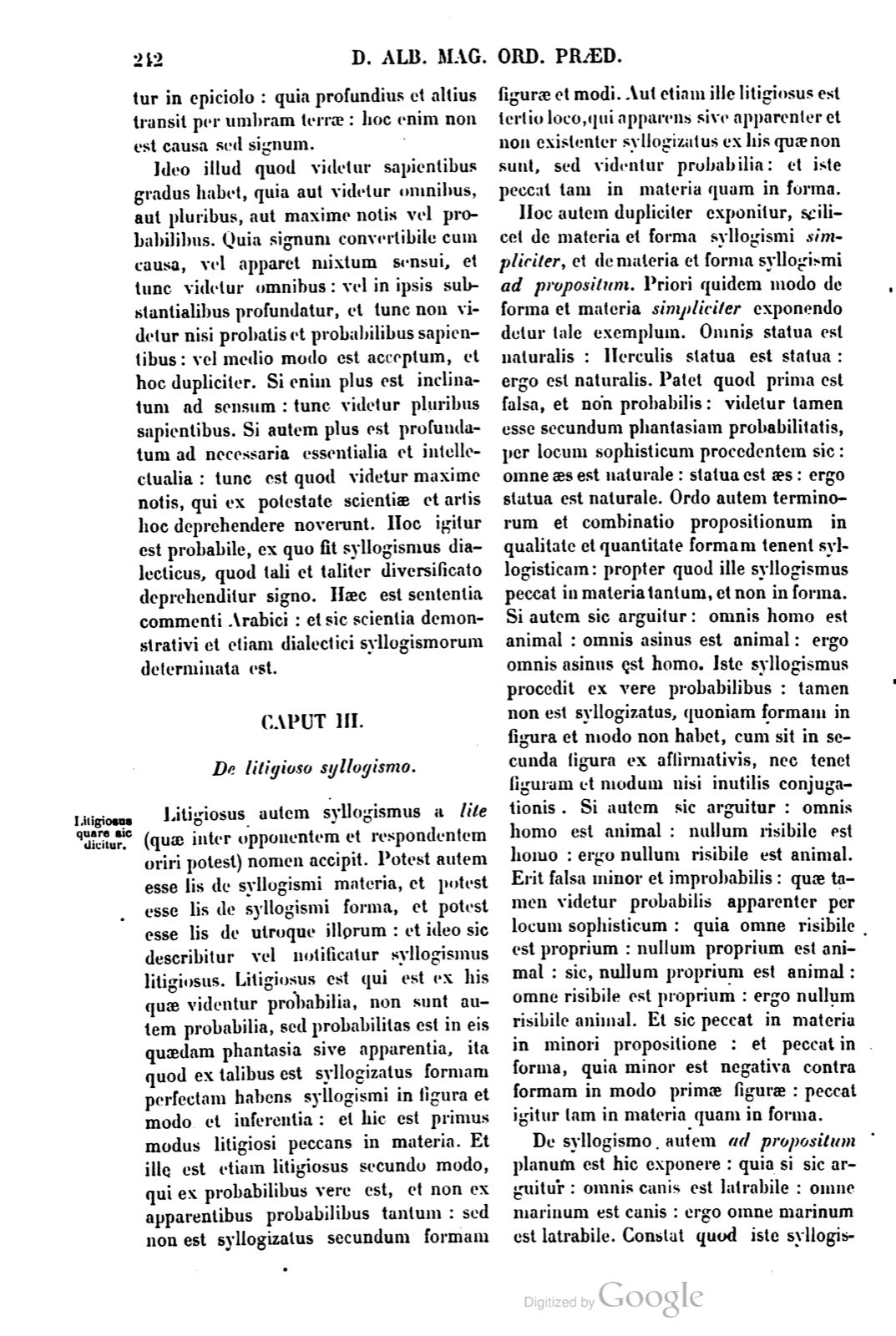
Et secundum hoc trium syllogismorum litigiosorum ista sunt exempla. Omne nomen unum significat unum: canis est nomen unum: ergo significat unum. Vel sic secundum Epicurum: omnis voluptas est bona: coitus est voluptas: ergo coitus est bonus. Hic enim peccatur in prima propositione contra probabilitatem quae est materia syllogismi dialectici: et non peccant termini in habitudine positi in figura et modo. Si autem sic arguitur: omnis iustitia est bona: omnis honestas est bona: ergo omnis honestas est iustitia. Habitudo terminorum probantium non valet: quia non sequitur si idem consequens sequitur ad duo antecedentia, quod unum istorum sequatur ad aliud: et ideo peccat contra formam syllogismi ad propositum, quamvis in materia non peccat in aliquo. Si autem sic arguatur: omnis canis est latrabile: marinum est canis: ergo marinum latrabile. Hic prima falsa est peccans in materia probabilitatis: et habitudo medii ad utrumque extremum indebita: et sic peccat contra terminorum habitudinem ad probandum, et sic peccat contra formam syllogismi ad propositum. Distinximus autem inter syllogismum ex probabilibus, et syllogismum ex apparenter probabilibus: ideo quia non omne quod videtur probabile per locum aliquem, est etiam probabile secundum rei veritatem: nihil enim horum quae videntur probabilia tantum in superficie ex signo aliquo fallaci, omnino sive omnimodam et profundatam habet phantasiam, hoc est, apparentiam, quae usque ad existentiam pertingat, velut se habere accidit apparentiam quae est circa principia quae sunt loci sophistici litigiosarum disputationum: litigiosa enim disputatio locis sophisticis innititur sicut principiis: statim enim in primo intuitu, etiam eis qui parva per rationem videre possunt, manifesta est in eis, quia talia sunt, falsitatis natura sive causa: et ideo sunt probabilia, et aut quae videntur probabilia.
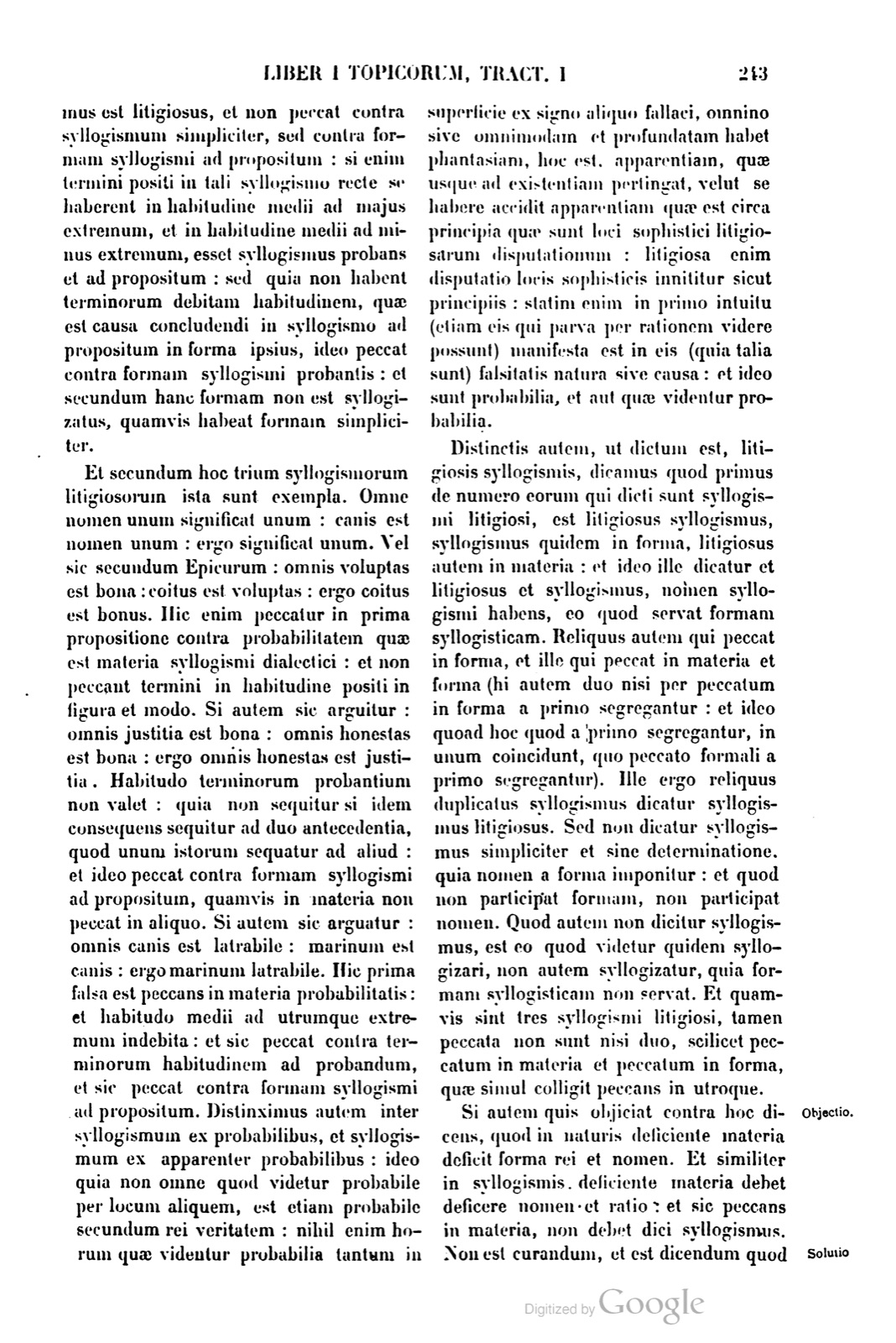
Distinctis autem, ut dictum est, litigiosis syllogismis, dicamus quod primus de numero eorum qui dicti sunt syllogismi litigiosi, est litigiosus syllogismus, syllogismus quidem in forma, litigiosus autem in materia: et ideo ille dicatur et litigiosus et syllogismus, nomen syllogismi habens, eo quod servat formam syllogisticam. Reliquus autem qui peccat in forma, et ille qui peccat in materia et forma, hi autem duo nisi per peccatum in forma a primo segregantur: et ideo quoad hoc quod a primo segregantur, in unum coincidunt, quo peccato formali a primo segregantur. Ille ergo reliquus duplicatus syllogismus dicatur syllogismus litigiosus. Sed non dicatur syllogismus simpliciter et sine determinatione, quia nomen a forma imponitur: et quod non participat formam, non participat nomen. Quod autem non dicitur syllogismus, est eo quod videtur quidem syllogizari, non autem syllogizatur, quia formam syllogisticam non servat. Et quamvis sint tres syllogismi litigiosi, tamen peccata non sunt nisi duo, scilicet peccatum in materia et peccatum in forma, quae simul colligit peccans in utroque.
And according to this, these are the examples of the three contentious syllogisms. Every one name signifies one thing; dog is one name; therefore it signifies one thing. Or thus according to Epicurus: every pleasure is good; intercourse is pleasure; therefore intercourse is good. For here sin occurs in the first proposition against probability, which is the matter of dialectical syllogism; and the terms posited in relation in figure and mode do not sin. But if one argues thus: every justice is good; every honorableness is good; therefore every honorableness is justice. The relation of the proving terms is not valid: because, if the same consequent follows upon two antecedents, it does not follow that one of those follows upon the other; and therefore it sins against the form of syllogism to the proposed object, although it does not sin in matter in anything. But if one argues thus: every dog is barkable; a sea-thing is a dog; therefore a sea-thing is barkable. Here the first proposition is false, sinning in the matter of probability; and the relation of the middle to each extreme is undue: and thus it sins against the relation of terms for proving, and thus it sins against the form of syllogism to the proposed object. But we have distinguished between syllogism from probable things and syllogism from apparently probable things for this reason: because not everything that seems probable through some place is also probable according to the truth of the thing. For none of those things that seem merely probable on the surface from some fallacious sign has altogether or in every way a deepened imagining, that is, an appearance, which reaches all the way to existence, as the appearance that is about the principles that are places of sophistical contentious disputations happens to have itself; for contentious disputation relies on sophistical places as on principles. For immediately in the first sight, even to those who can see small things by reason, the nature or cause of falsity is manifest in them, because they are such; and therefore they are probable, or things that seem probable.
But having distinguished contentious syllogisms as was said, let us say that the first among the number of those that have been called contentious syllogisms is a contentious syllogism: indeed a syllogism in form, but contentious in matter. And therefore that one may be called both contentious and syllogism, having the name of syllogism because it preserves syllogistic form. But the remaining one that sins in form, and the one that sins in matter and form, for these two are separated from the first only through sin in form; and therefore, with respect to the fact that they are separated from the first, they coincide into one, by which formal sin they are separated from the first. Therefore that remaining duplicated syllogism may be called a contentious syllogism. But let it not be called syllogism simply and without determination, because a name is imposed from form; and what does not participate in form does not participate in the name. But the reason it is not called syllogism is that it indeed seems to be syllogized, yet it is not syllogized, because it does not preserve syllogistic form. And although there are three contentious syllogisms, nevertheless the sins are only two, namely sin in matter and sin in form, which the one sinning in both gathers together at once.
[Marginal label, printed page 243: Objectio.]
Si autem quis obiciat contra hoc dicens, quod in naturis deficiente materia deficit forma rei et nomen. Et similiter in syllogismis, deficiente materia debet deficere nomen et ratio: et sic peccans in materia, non debet dici syllogismus.
[Marginal label, printed page 243: Solutio.]
Non est curandum, et est dicendum quod est materia syllogismi simpliciter, termini scilicet et propositiones, et in hac materia non peccat, sed sufficit ad servandam formam syllogismi: et est materia syllogismi ad propositum, quae est probabilitas propositionum, et contra hanc peccat, et ideo etiam nomen amittit syllogismi ad propositum: quia syllogismus peccans in materia, non est syllogismus ad propositum.
[Marginal label, printed page 244: Objectio.]
Et si quis obiciat quod quidquid est in genere inferiori, est etiam in genere superiori. Syllogismus autem peccans in forma, est in genere litigiosi syllogismi, et syllogismus litigiosus est etiam syllogismus: ergo peccans in forma est etiam syllogismus.
[Marginal label, printed page 244: Solutio.]
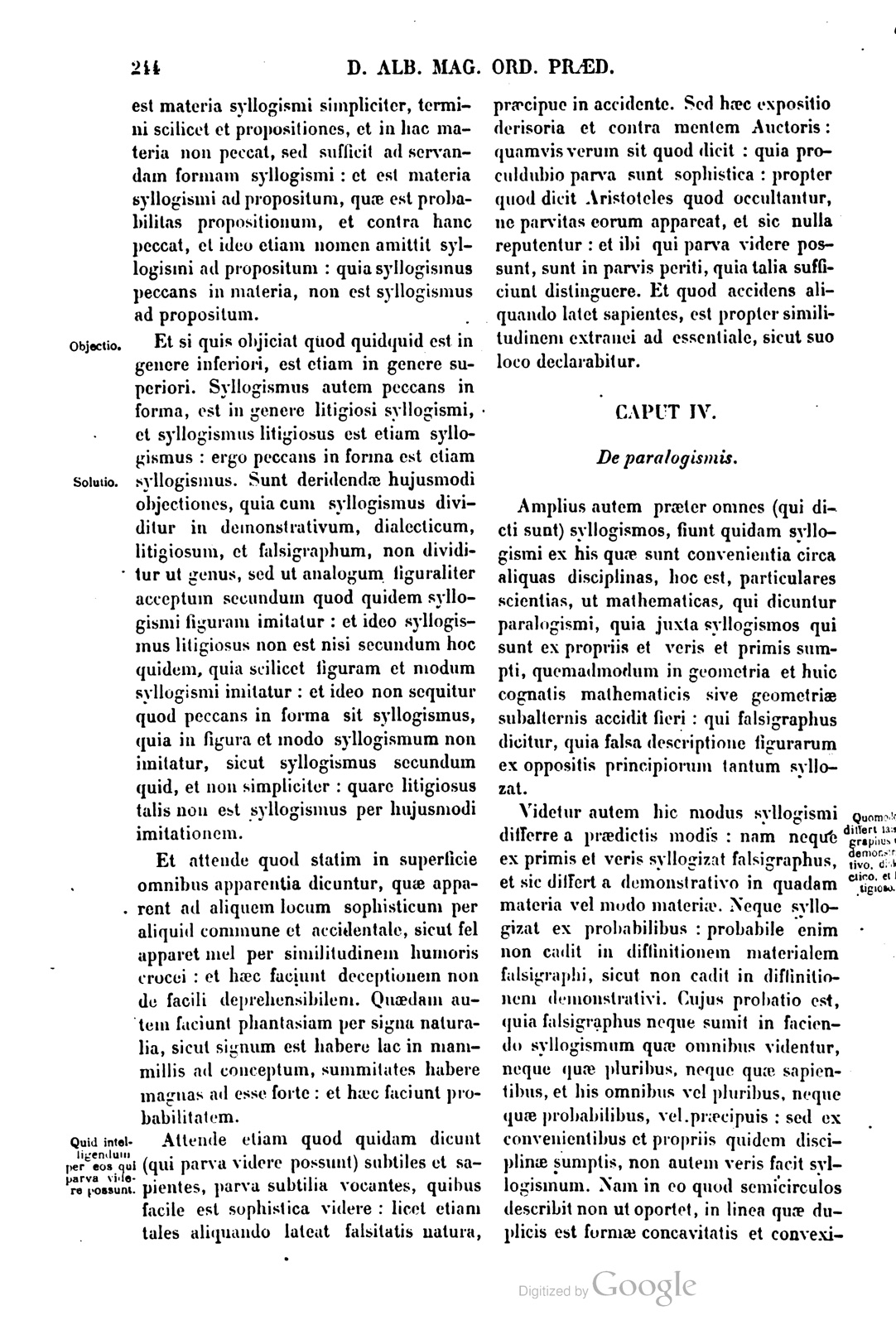
Sunt deridendae huiusmodi obiectiones, quia cum syllogismus dividitur in demonstrativum, dialecticum, litigiosum, et falsigraphum, non dividitur ut genus, sed ut analogum figuraliter acceptum secundum quod quidem syllogismi figuram imitatur: et ideo syllogismus litigiosus non est nisi secundum hoc quidem, quia scilicet figuram et modum syllogismi imitatur: et ideo non sequitur quod peccans in forma sit syllogismus, quia in figura et modo syllogismum non imitatur, sicut syllogismus secundum quid, et non simpliciter: quare litigiosus talis non est syllogismus per huiusmodi imitationem.
Et attende quod statim in superficie omnibus apparentia dicuntur, quae apparent ad aliquem locum sophisticum per aliquid commune et accidentale, sicut fel apparet mel per similitudinem humoris crocei: et haec faciunt deceptionem non de facili deprehensibilem. Quaedam autem faciunt phantasiam per signa naturalia, sicut signum est habere lac in mammillis ad conceptum, summitates habere magnas ad esse forte: et haec faciunt probabilitatem.
[Marginal label, printed page 244: Quid intelligendum per eos qui parva videre possunt.]
Attende etiam quod quidam dicunt, qui parva videre possunt, subtiles et sapientes, parva subtilia vocantes, quibus facile est sophistica videre: licet etiam tales aliquando lateat falsitatis natura, praecipue in accidente. Sed haec expositio derisoria et contra mentem Auctoris: quamvis verum sit quod dicit: quia proculdubio parva sunt sophistica: propter quod dicit Aristoteles quod occultantur, ne parvitas eorum appareat, et sic nulla reputentur: et ibi qui parva videre possunt, sunt in parvis periti, quia talia sufficiunt distinguere. Et quod accidens aliquando latet sapientes, est propter similitudinem extranei ad essentiale, sicut suo loco declarabitur.
[Marginal label, printed page 243: Objection.]
But if someone objects against this, saying that in natural things, when matter is lacking, the form of the thing and the name are lacking. And similarly in syllogisms, when matter is lacking, the name and account ought to be lacking: and thus what sins in matter ought not to be called a syllogism.
[Marginal label, printed page 243: Solution.]
It is not to be cared about, and it must be said that there is matter of syllogism simply, namely terms and propositions, and in this matter it does not sin, but this suffices for preserving the form of syllogism; and there is matter of syllogism to the proposed object, which is the probability of propositions, and against this it sins, and therefore it also loses the name of syllogism to the proposed object: because a syllogism sinning in matter is not a syllogism to the proposed object.
[Marginal label, printed page 244: Objection.]
And if someone objects that whatever is in an inferior genus is also in a superior genus. But a syllogism sinning in form is in the genus of contentious syllogism, and contentious syllogism is also syllogism: therefore what sins in form is also syllogism.
[Marginal label, printed page 244: Solution.]
Objections of this kind should be laughed at, because when syllogism is divided into demonstrative, dialectical, contentious, and falsigraphic, it is not divided as a genus, but as an analog accepted figurally according as indeed it imitates the figure of syllogism; and therefore contentious syllogism exists only according to this, namely because it imitates the figure and mode of syllogism: and therefore it does not follow that what sins in form is syllogism, because in figure and mode it does not imitate syllogism, except as a syllogism in a certain respect and not simply; for which reason such a contentious thing is not a syllogism through imitation of this kind.
And attend that things appearing immediately on the surface to all are called appearances, which appear toward some sophistical place through something common and accidental, just as gall appears to be honey through the likeness of yellow liquid: and these make a deception not easily detectable. But certain things make an imagining through natural signs, as it is a sign to have milk in the breasts toward conception, to have great summits toward being strong: and these make probability.
[Marginal label, printed page 244: What is to be understood by those who can see small things.]
Attend also that certain people say that those who can see small things are subtle and wise, calling small subtle things those by which it is easy to see sophistical matters, although sometimes the nature of falsity lies hidden even from such people, especially in accident. But this exposition is laughable and contrary to the mind of the Author; although what he says is true: because without doubt sophistical things are small; on account of which Aristotle says that they are hidden, lest their smallness appear and thus they be reckoned as nothing; and there those who can see small things are skilled in small things, because such things suffice to distinguish them. And that accident sometimes lies hidden from the wise is on account of the likeness of what is foreign to what is essential, as will be declared in its own place.
If a page does not appear, its photograph has not been uploaded yet.