Volume 2 · pp. 240–242
Chapter II. On Dialectical Syllogism.
A marker with ≈ is an approximate page boundary, placed by measure of the text; the page photographs remain the authority. In the paired views, clicking a page marker brings that page into view.
CAPUT II.
De syllogismo dialectico.
Dialecticus autem syllogismus post demonstrationem rationem syllogismi participat, quia minus addit super syllogismi consequentiam et necessitatem consequentiae quam demonstratio: sicut verius causa est, quod assequitur causam per necessitatem, quam quod assequitur causam per probabilitatem. Est syllogismus dialecticus, qui ex probabilibus est quantum ad materiam, et est syllogizatus quantum ad formam quae est ex terminorum numero et ordine in figura, et ex modo qui est combinatio propositionum secundum formam debitam in qualitate et quantitate et ordine qualitatis et quantitatis. Et quia licet ex affirmativa et negativa possit fieri syllogismus, tamen minor propositio in prima et tertia non potest esse negativa: et si fiat, non est syllogizatus talis syllogismus, quia formam combinationis utilis non habet. Quae autem sint probabilia inferius dicetur, et gratia illius praemittemus eorum, quae prius in diffinitione demonstrationis dicta sunt, declarationem, dicentes quod vera quidem et prima sunt, quae non per alia sicut media vel principia, sed per seipsa secundum sui naturam habent fidem: et istae sunt dignitates quas quisque probat auditas. Sicut enim in visu quaedam luce manifestantur aliena, sicut colorata; quaedam autem luce propria, ut lucida: sic est in intellectualibus, quod prima non habentia medium suae constitutionis inter lucem intelligentiae et ipsa, sed ipso lumine intellectuali constituta sua propria luce manifestantur intellectui. Alia autem quae mediantibus formis aliorum procedunt, ab intelligentia constituuntur, ab intellectu non accipiuntur, nisi lumine primorum illustrata: et quae sic accipiuntur, sunt secunda et non prima, quia non sunt intelligentiae lumini immediate coniuncta.
Nullum intelligibile ab hominis accipitur intelligentia, nisi in quantum lumen est intelligentiae agentis ipsum, quod si sola agit, per se intelligitur: si autem agit ipsum per medium, oportet quod illustretur lumine ipsius, antequam ab intellectu accipiatur: quae autem est causa propter quam quaedam per se intelliguntur, iam dictum est.
CHAPTER II.
On dialectical syllogism.
But dialectical syllogism, after demonstration, participates in the account of syllogism, because it adds less over and above the consequence of syllogism and the necessity of the consequence than demonstration does: just as that which attains the cause through necessity is more truly a cause than that which attains the cause through probability. A dialectical syllogism is that which is from probable things as to matter, and is syllogized as to form, which comes from the number and order of terms in figure, and from mode, which is the combination of propositions according to the due form in quality and quantity and in the order of quality and quantity. And although a syllogism can be made from an affirmative and a negative, nevertheless the minor proposition in the first and third figure cannot be negative: and if it is made so, such a syllogism has not been syllogized, because it does not have the form of a useful combination. But what probable things are will be said below, and for its sake we shall first set down the declaration of those things that were said before in the definition of demonstration, saying that true and first things are those that have credibility not through other things as through middles or principles, but through themselves according to their own nature; and these are dignities that anyone approves when heard. For just as in sight certain alien things are manifested by light, such as colored things, while certain things are manifested by their own light, as luminous things are: so it is in intellectual matters, that first things, not having a middle of their constitution between the light of intelligence and themselves, but constituted by the intellectual light itself, are manifested to intellect by their own light. But other things that proceed through mediating forms of other things are constituted by intelligence and are not received by intellect unless they are illuminated by the light of the first things: and those that are received in this way are second and not first, because they are not immediately joined to the light of intelligence.
No intelligible is received by the intelligence of a human being except insofar as it is the light of the intelligence acting upon it; and if that intelligence acts alone, it is understood through itself; but if it acts upon it through a middle, it must be illuminated by the light of that intelligence before it is received by the intellect. But what is the cause on account of which certain things are understood through themselves has now been said.
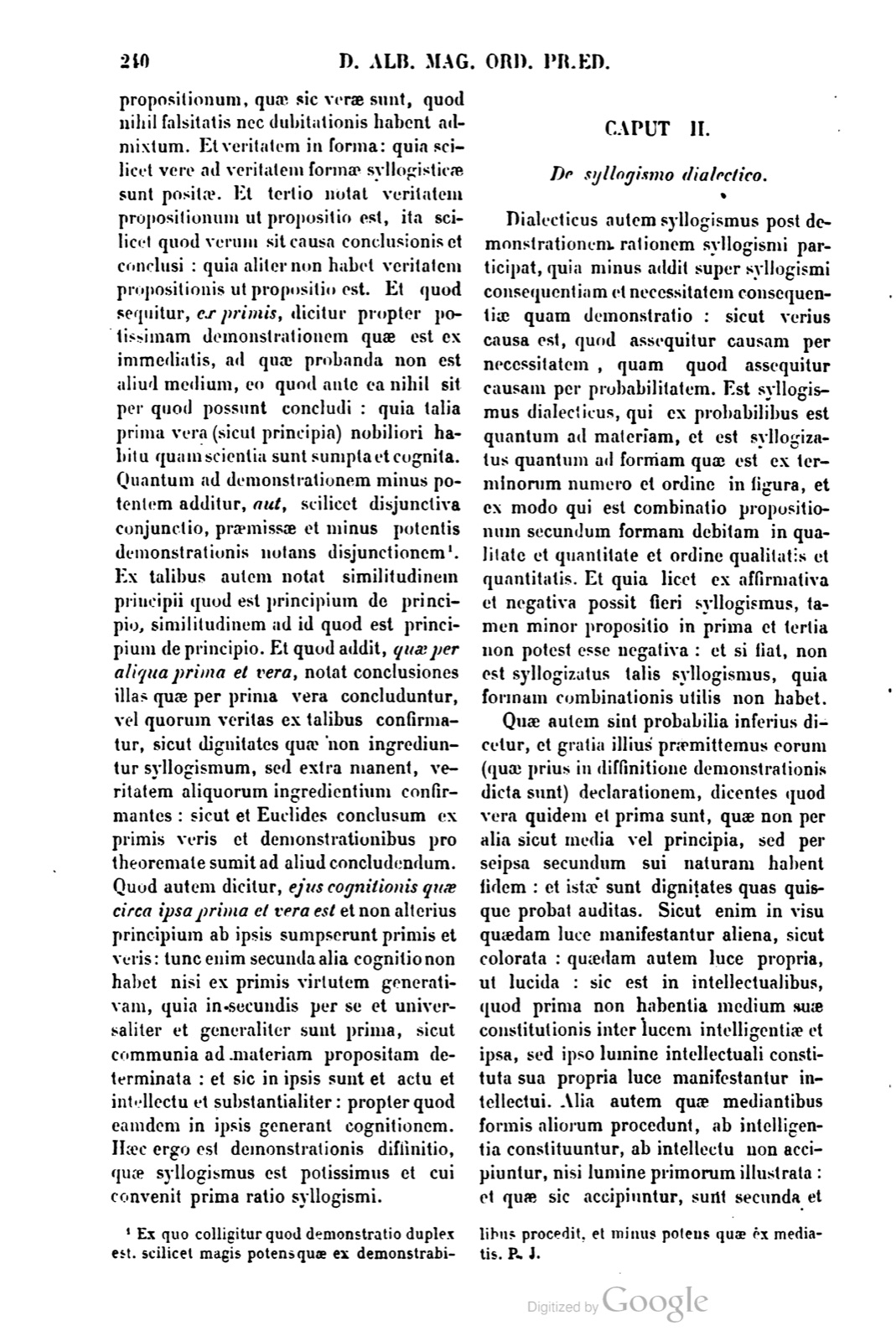
Et ex hoc causatur ulterius, quod non oportet quaerere, hoc est, oportet non quaerere in scientiis disciplinalibus sive doctrinalibus quaerendo propter quid: in scientiis enim disciplinalibus sive doctrinalibus ex primis et veris proceditur et immediatis, hoc est, ad quae syllogizanda nullum est medium: et ideo oportet in ipsis non quaerere propter quid: quia terminus dicens propter quid est medium, ut dicit Aristoteles, et cum talia medium non habeant, non quaeritur propter quid: quia si haberent terminum propter quid, haberent medium, et sic non essent immediata: sed oportet unumquodque quod est principiorum primorum et ipsum esse sibi fidem, hoc est, fidei causam. Fides enim est assensus in ipsum respondentis, sicut dictum est, propter quod talia principia prima communes animi conceptiones vocantur, ut dicit Avicenna, quod statim assentit eis animus audientis: propter quod etiam indemonstrabilia talia dicuntur. Haec igitur sunt principia demonstrationis, ex quibus demonstrativus fit syllogismus.
Probabilia autem, ex quibus fit syllogismus dialecticus, sunt verisimilia. Dupliciter autem verisimilia: aut enim in se sunt verisimilia, eo quod ipsa habitudo praedicati ad subjectum verisimilis est, eo quod nec praedicatum est in subjecto per se, nec subjectum in praedicato per se, nec utrumque in utroque, nec praedicatum necessariam et essentialem inhaerentiam habet cum subjecto, sed verisimile est in signis non in causis necessariis acceptum. Aut quia necessariam habet inhaerentiam, sed non accipitur nisi per signum: et hoc est probabile secundum modum acceptionis, quamvis in se sit necessarium: sicut solem esse maiorem terra, eo quod ubique unius quantitatis apparet, probabiliter acceptum est 1. Solem autem esse maiorem terra per quantitatem diametri acceptum est necessarium et non probabile, secundum quod probabile et necessarium opponuntur. Probabile autem sic dictum verisimile est, quod per suiipsius veritatis figuram videtur omnibus aut pluribus aut sapientibus, et his sapientibus videtur omnibus aut pluribus aut maxime notis et probabilibus: ita quod sapientibus et his vel omnibus sapientibus vel pluribus vel maxime notis vel probabilibus, totum pro uno membro ponatur.
And from this it is further caused that one must not seek, that is, one must not seek in disciplinary or doctrinal sciences by seeking why: for in disciplinary or doctrinal sciences one proceeds from first, true, and immediate things, that is, things for syllogizing which there is no middle; and therefore in them one must not seek why, because the term saying why is the middle, as Aristotle says; and since such things do not have a middle, why is not sought; because if they had a term why, they would have a middle, and so they would not be immediate. But each thing that belongs to the first principles must itself be credibility to itself, that is, a cause of belief. For belief is the assent of the respondent into it, as has been said; on account of which such first principles are called common conceptions of the soul, as Avicenna says, because the soul of the hearer immediately assents to them; on account of which such things are also called indemonstrable. Therefore these are the principles of demonstration, from which demonstrative syllogism is made.
But probable things, from which dialectical syllogism is made, are truth-like things. Now truth-like things are twofold: for either they are truth-like in themselves, because the very relation of predicate to subject is truth-like, since neither is the predicate in the subject per se, nor the subject in the predicate per se, nor each in the other, nor does the predicate have a necessary and essential inherence with the subject, but the truth-like is accepted in signs, not in necessary causes. Or they are so because it has necessary inherence, but is accepted only through a sign: and this is probable according to the mode of acceptance, although in itself it is necessary; as that the sun is larger than the earth, because everywhere it appears of one quantity, is accepted probably 1. But that the sun is larger than the earth, accepted through the quantity of diameter, is necessary and not probable, according as the probable and the necessary are opposed. But the probable, so called truth-like, is what, through the figure of its own truth, seems so to all or to many or to the wise; and to these wise persons it seems so to all or to many or to the most noted and probable: so that for wise persons and these, whether all wise persons or many or the most noted or probable, the whole is placed for one member.
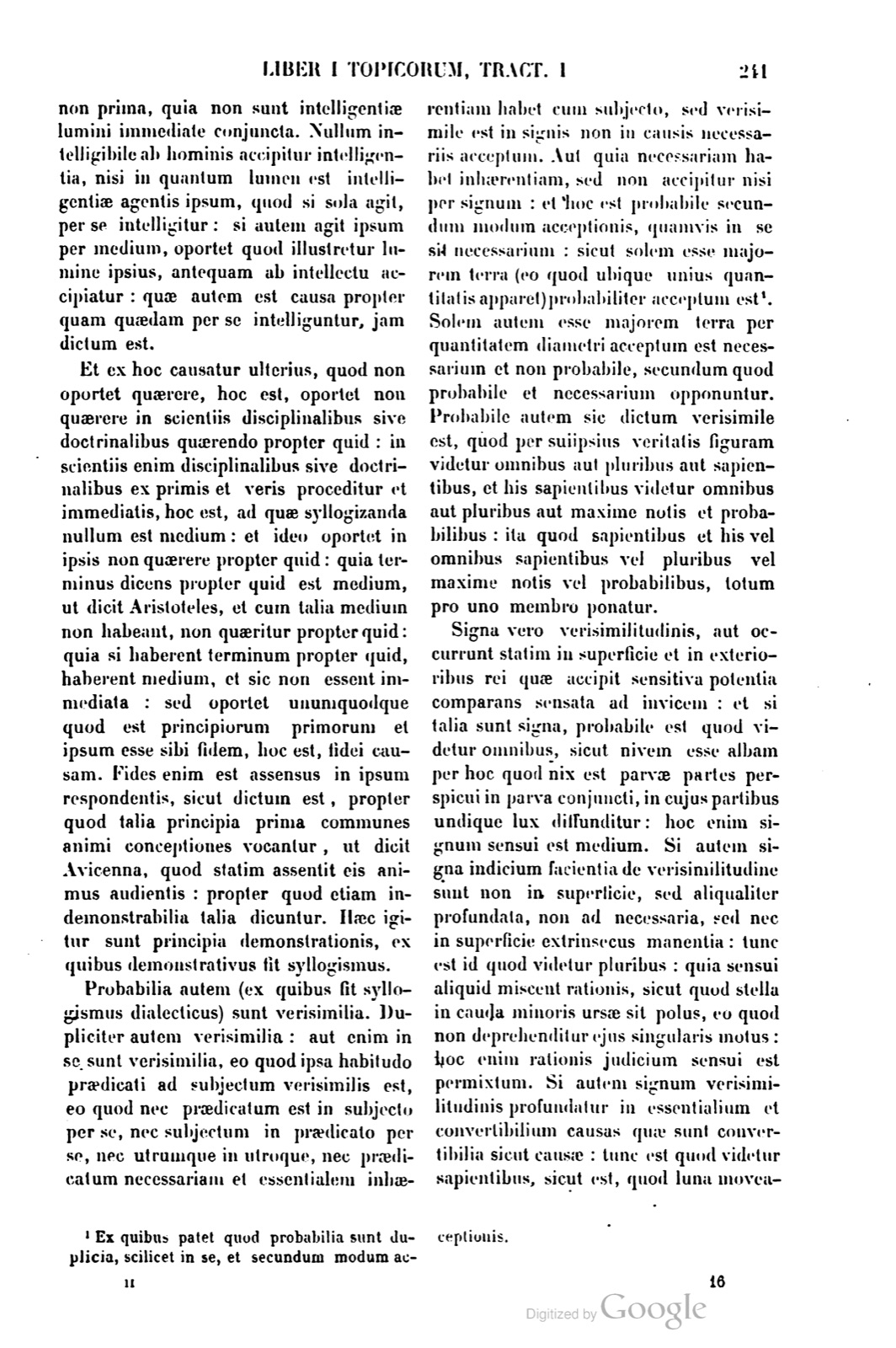
Signa vero verisimilitudinis, aut occurrunt statim in superficie et in exterioribus rei quae accipit sensitiva potentia comparans sensata ad invicem: et si talia sunt signa, probabile est quod videtur omnibus, sicut nivem esse albam per hoc quod nix est parvae partes perspicui in parva coniuncti, in cuius partibus undique lux diffunditur: hoc enim signum sensui est medium. Si autem signa indicium facientia de verisimilitudine sunt non in superficie, sed aliqualiter profundata, non ad necessaria, sed nec in superficie extrinsecus manentia: tunc est id quod videtur pluribus: quia sensui aliquid miscent rationis, sicut quod stella in cauda minoris ursae sit polus, eo quod non deprehenditur eius singularis motus: hoc enim rationis iudicium sensui est permixtum. Si autem signum verisimilitudinis profundatur in essentialium et convertibilium causas quae sunt convertibilia sicut causae: tunc est quod videtur sapientibus, sicut est, quod luna moveatur in epicyclo: quia profundius et altius transit per umbram terrae: hoc enim non est causa sed signum.
Ideo illud quod videtur sapientibus gradus habet, quia aut videtur omnibus, aut pluribus, aut maxime notis vel probabilibus. Quia signum convertibile cum causa, vel apparet mixtum sensui, et tunc videtur omnibus: vel in ipsis substantialibus profundatur, et tunc non videtur nisi probatis et probabilibus sapientibus: vel medio modo est acceptum, et hoc dupliciter. Si enim plus est inclinatum ad sensum: tunc videtur pluribus sapientibus. Si autem plus est profundatum ad necessaria essentialia et intellectualia: tunc est quod videtur maxime notis, qui ex potestate scientiae et artis hoc deprehendere noverunt. Hoc igitur est probabile, ex quo fit syllogismus dialecticus, quod tali et taliter diversificato deprehenditur signo. Haec est sententia commenti Arabici: et sic scientia demonstrativi et etiam dialectici syllogismorum determinata est.
But signs of truth-likeness either occur immediately on the surface and in the exteriors of the thing, which the sensitive power receives by comparing sensed things to one another; and if the signs are such, the probable is what seems so to all, as that snow is white because snow is small parts of something transparent joined in smallness, in whose parts light is poured out from every side: for this sign is the middle for sense. But if signs making an indication about truth-likeness are not on the surface, but are in some way deepened, not to necessary things, yet not remaining outwardly on the surface, then there is what seems so to many: because they mix something of reason with sense, as that the star in the tail of the Little Bear is the pole, because its singular motion is not detected; for this judgment of reason is mixed with sense. But if the sign of truth-likeness is deepened into the causes of essential and convertible things that are convertible as causes, then there is what seems so to the wise, as that the moon is moved in an epicycle, because it passes more deeply and higher through the shadow of the earth: for this is not a cause but a sign.
Therefore that which seems so to the wise has degrees, because either it seems so to all, or to many, or to the most noted or probable. Because a sign convertible with a cause either appears mixed with sense, and then it seems so to all; or it is deepened in the very substantial things, and then it does not seem so except to approved and probable wise persons; or it is accepted in a middle way, and this in two ways. For if it is more inclined toward sense, then it seems so to many wise persons. But if it is more deepened toward necessary essential and intellectual things, then it is what seems so to the most noted, who have known how to detect this from the power of science and art. Therefore this is the probable, from which dialectical syllogism is made, namely what is detected by a sign such and diversified in such a way. This is the meaning of the Arabic commentary: and thus the science of demonstrative syllogisms and also of dialectical syllogisms has been determined.
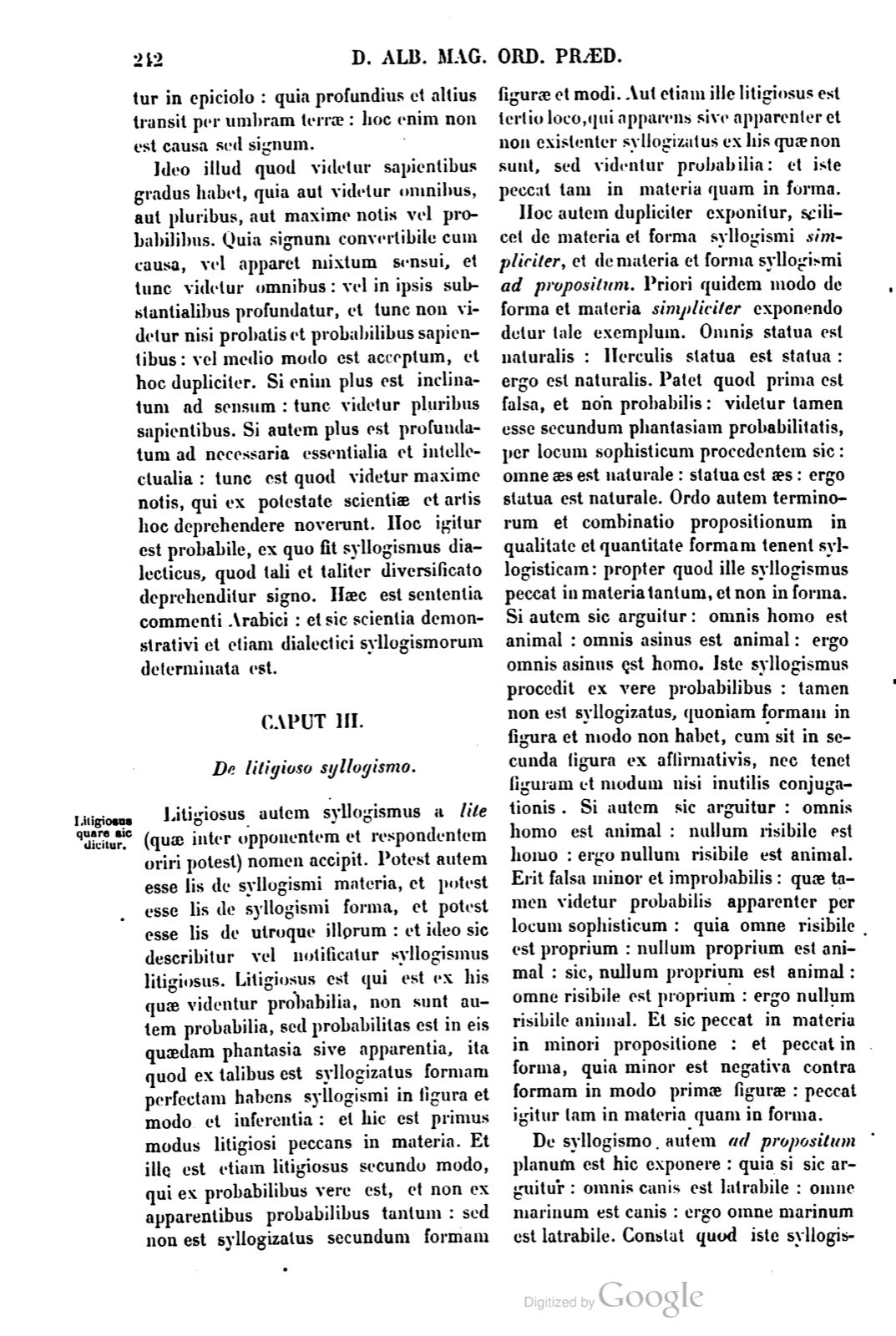
Notes
- From these things it is clear that probable things are twofold, namely in themselves, and according to the mode of acceptance. (Ex quibus patet quod probabilia sunt duplicia, scilicet in se, et secundum modum acceptionis.) ↩
If a page does not appear, its photograph has not been uploaded yet.