Volume 2 · pp. 238–240
Treatise I. On Syllogisms and Paralogisms. Chapter I. On Syllogism in Common.
A marker with ≈ is an approximate page boundary, placed by measure of the text; the page photographs remain the authority. In the paired views, clicking a page marker brings that page into view.
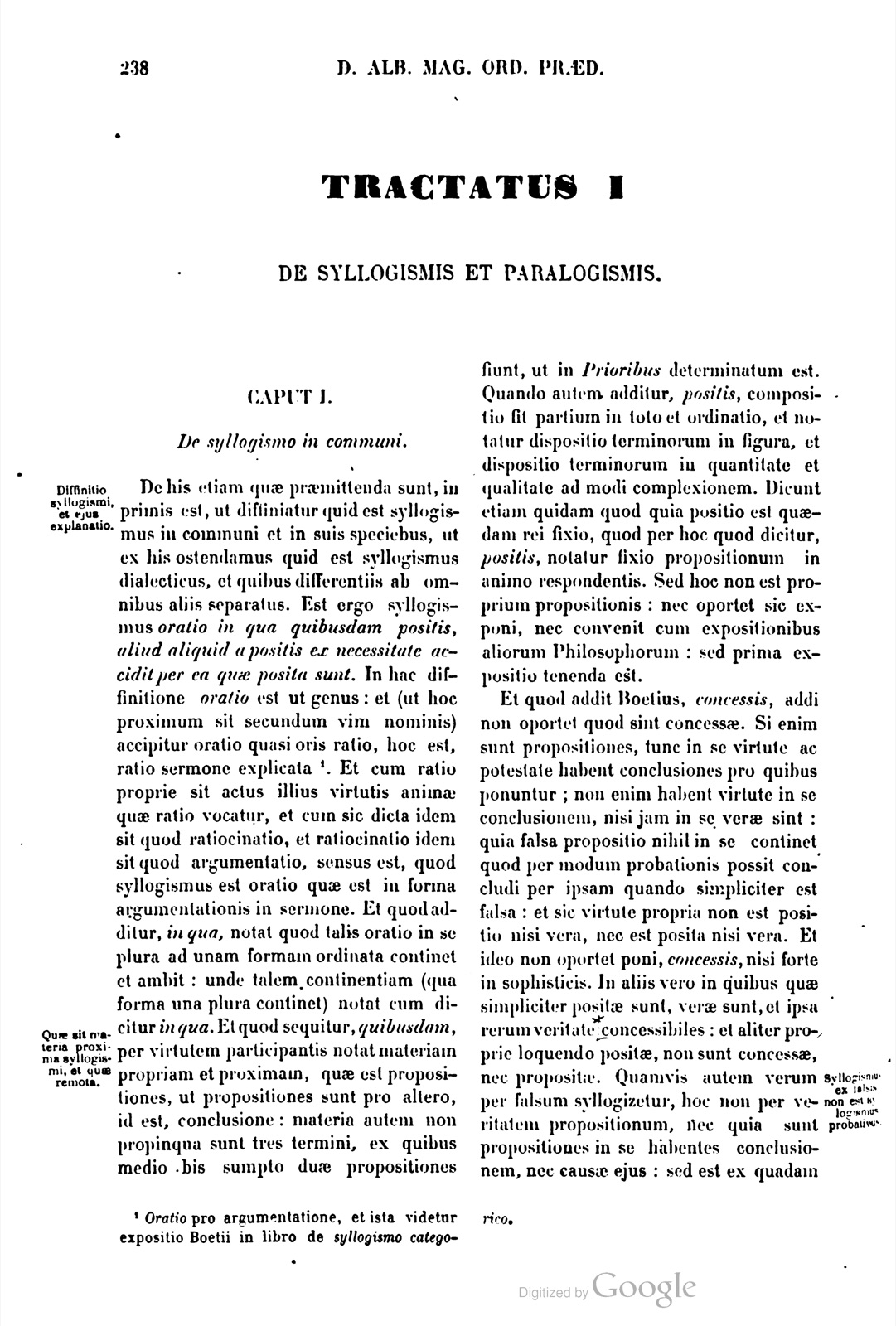
TRACTATUS I.
DE SYLLOGISMIS ET PARALOGISMIS.
CAPUT I.
De syllogismo in communi.
[Marginal label, printed page 238: Diffinitio syllogismi, et eius explanatio.]
De his etiam quae praemittenda sunt, in primis est, ut diffiniatur quid est syllogismus in communi et in suis speciebus, ut ex his ostendamus quid est syllogismus dialecticus, et quibus differentiis ab omnibus aliis separatus. Est ergo syllogismus oratio in qua quibusdam positis, aliud aliquid a positis ex necessitate accidit per ea quae posita sunt. In hac diffinitione oratio est ut genus: et, ut hoc proximum sit secundum vim nominis, accipitur oratio quasi oris ratio, hoc est, ratio sermone explicata 1. Et cum ratio proprie sit actus illius virtutis animae quae ratio vocatur, et cum sic dicta idem sit quod ratiocinatio, et ratiocinatio idem sit quod argumentatio, sensus est, quod syllogismus est oratio quae est in forma argumentationis in sermone. Et quod additur, in qua, notat quod talis oratio in se plura ad unam formam ordinata continet et ambit: unde talem continentiam qua forma una plura continet, notat cum dicitur in qua.
[Marginal label, printed page 238: Quae sit materia propria syllogismi, et quae proxima.]
Et quod sequitur, quibusdam, per virtutem participiantis notat materiam propriam et proximam, quae est propositiones, ut propositiones sunt pro altero, id est, conclusione: materia autem non propinqua sunt tres termini, ex quibus medio bis sumpto duae propositiones fiunt, ut in Prioribus determinatum est. Quando autem additur, positis, compositio fit partium in toto et ordinatio, et notatur dispositio terminorum in figura, et dispositio terminorum in quantitate et qualitate ad modi complexionem. Dicunt etiam quidam quod quia positio est quaedam rei fixio, quod per hoc quod dicitur, positis, notatur fixio propositionum in animo respondentis. Sed hoc non est proprium propositionis: nec oportet sic exponi, nec convenit cum expositionibus aliorum Philosophorum: sed prima expositio tenenda est.
Et quod addit Boetius, concessis, addi non oportet quod sint concessae. Si enim sunt propositiones, tunc in se virtute ac potestate habent conclusiones pro quibus ponuntur; non enim habent virtute in se conclusionem, nisi iam in se verae sint: quia falsa propositio nihil in se continet quod per modum probationis possit concludi per ipsam quando simpliciter est falsa: et sic virtute propria non est positio nisi vera, nec est posita nisi vera. Et ideo non oportet poni, concessis, nisi forte in sophisticis. In aliis vero in quibus quae simpliciter positae sunt, verae sunt, et ipsa rerum veritate concessibiles: et aliter proprie loquendo positae, non sunt concessae, nec propositae. Quamvis autem verum per falsum syllogizetur, hoc non per veritatem propositionum, nec quia sunt propositiones in se habentes conclusionem, nec causae eius: sed est ex quadam forma et complexione valde generali propositionum: quae non probant, nec causam in se habent probationis alicuius: et talis syllogismus non est syllogismus ad propositum aliquod probandum.
TREATISE I.
ON SYLLOGISMS AND PARALOGISMS.
CHAPTER I.
On syllogism in common.
[Marginal label, printed page 238: Definition of syllogism, and its explanation.]
Concerning these things also that must be set before, first of all there is this: that it be defined what syllogism is in common and in its species, so that from these things we may show what dialectical syllogism is, and by what differences it is separated from all the others. Therefore syllogism is speech in which, certain things having been posited, something other than the things posited happens from necessity through the things that have been posited. In this definition speech is as the genus: and, so that this may be proximate according to the force of the name, speech is taken as it were as the account of the mouth, that is, reason unfolded in discourse 1. And since reason properly is the act of that power of the soul that is called reason, and since reason so spoken of is the same as ratiocination, and ratiocination is the same as argumentation, the sense is that syllogism is speech that is in the form of argumentation in discourse. And what is added, in which, notes that such speech contains and embraces in itself many things ordered to one form: whence, when in which is said, it notes such containment by which one form contains many things.
[Marginal label, printed page 238: What is the proper matter of syllogism, and what is the proximate matter.]
And what follows, certain things, through the force of the participle notes the proper and proximate matter, which is propositions, insofar as propositions exist for something else, that is, for a conclusion. But the non-proximate matter is three terms, from which, when the middle is taken twice, two propositions are made, as was determined in the Prior Analytics. But when posited is added, a composition of parts in a whole and an ordering is made, and the disposition of terms in figure is noted, and the disposition of terms in quantity and quality for the complexing of a mode. Some also say that, because position is a certain fixing of a thing, by what is said, posited, the fixing of propositions in the mind of the respondent is noted. But this is not proper to proposition: nor is it necessary to expound it so, nor does it agree with the expositions of the other Philosophers: rather the first exposition must be held.
And as for what Boethius adds, granted, it need not be added that they are granted. For if they are propositions, then in themselves in virtue and power they have the conclusions for which they are posited; for they do not have a conclusion in themselves in virtue unless they are now true in themselves: because a false proposition contains nothing in itself that can be concluded through it by way of proof when it is false simply; and thus by proper virtue there is no position unless it is true, nor is it posited unless it is true. And therefore it is not necessary to posit granted, except perhaps in sophistical matters. But in other matters, in which the things posited simply are true and grantable by the very truth of the things, otherwise, properly speaking, posited things are neither granted nor proposed. But although a true thing is syllogized through a false thing, this is not through the truth of the propositions, nor because they are propositions having a conclusion in themselves, nor causes of it: but it is from a certain very general form and complexing of propositions, which do not prove, nor have in themselves the cause of any proof; and such a syllogism is not a syllogism for proving any proposed object.
[Marginal label, printed page 238: Syllogismus ex falsis non est syllogismus probativus.]
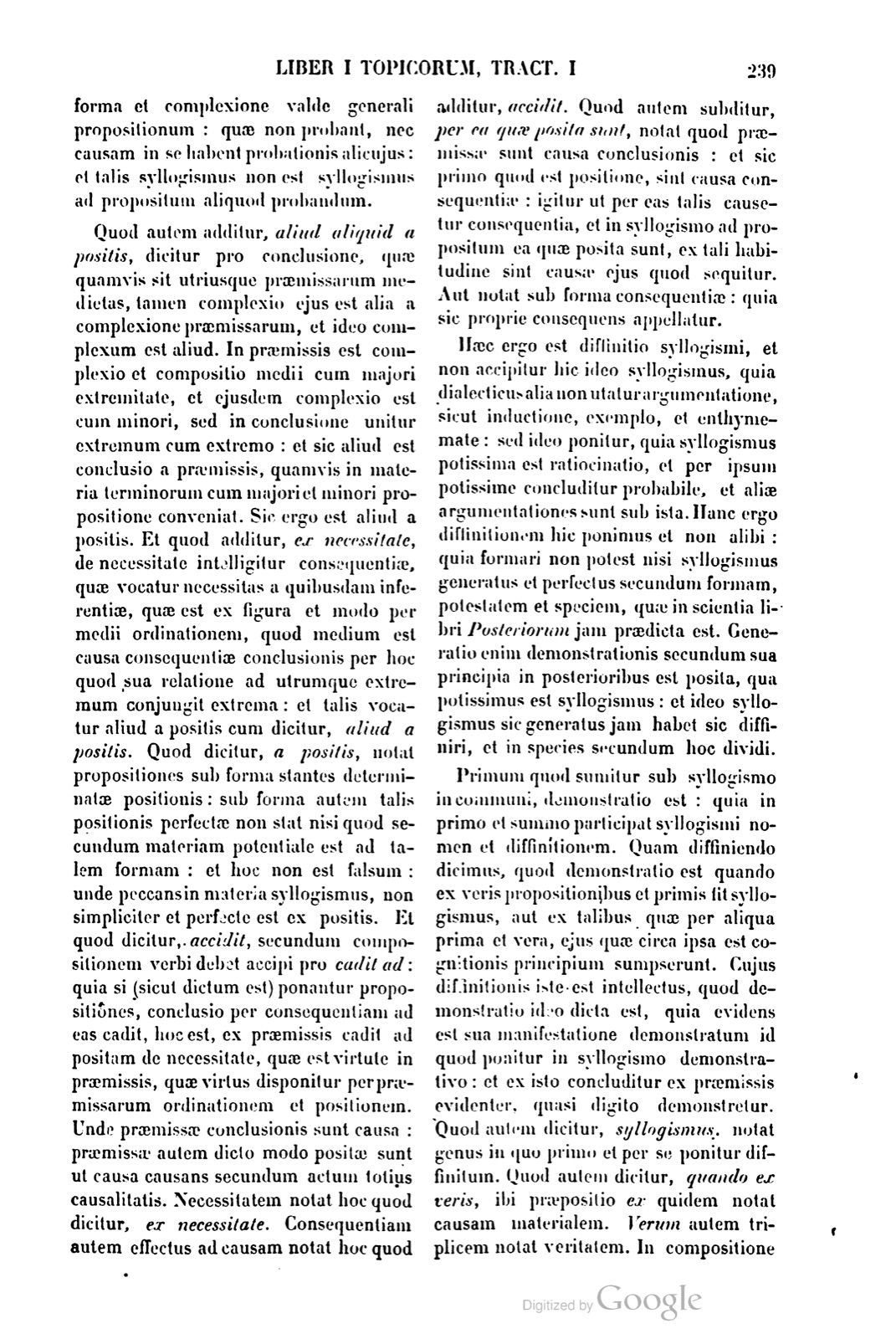
Quod autem additur, aliud aliquid a positis, dicitur pro conclusione, quae quamvis sit utriusque praemissarum medietas, tamen complexio eius est alia a complexione praemissarum, et ideo complexum est aliud. In praemissis est complexio et compositio medii cum maiori extremitate, et eiusdem complexio est cum minori, sed in conclusione unitur extremum cum extremo: et sic aliud est conclusio a praemissis, quamvis in materia terminorum cum maiori et minori propositione conveniat. Sic ergo est aliud a positis. Et quod additur, ex necessitate, de necessitate intelligitur consequentiae, quae vocatur necessitas a quibusdam inferentiae, quae est ex figura et modo per medii ordinationem, quod medium est causa consequentiae conclusionis per hoc quod sua relatione ad utrumque extremum coniungit extrema: et talis vocatur aliud a positis cum dicitur, aliud a positis. Quod dicitur, a positis, notat propositiones sub forma stantes determinatae positionis: sub forma autem talis positionis perfectae non stat nisi quod secundum materiam potentiale est ad talem formam: et hoc non est falsum: unde peccans in materia syllogismus, non simpliciter et perfecte est ex positis. Et quod dicitur, accidit, secundum compositionem verbi debet accipi pro cadit ad: quia si, sicut dictum est, ponantur propositiones, conclusio per consequentiam ad eas cadit, hoc est, ex praemissis cadit ad positam de necessitate, quae est virtute in praemissis, quae virtus disponitur per praemissarum ordinationem et positionem. Unde praemissae conclusionis sunt causa: praemissae autem dicto modo positae sunt ut causa causans secundum actum totius causalitatis. Necessitatem notat hoc quod dicitur, ex necessitate. Consequentiam autem effectus ad causam notat hoc quod additur, accidit. Quod autem subditur, per ea quae posita sunt, notat quod praemissae sunt causa conclusionis: et sic primo quod est positione, sint causa consequentiae: igitur ut per eas talis causetur consequentia, et in syllogismo ad propositum ea quae posita sunt, ex tali habitudine sint causae eius quod sequitur. Aut notat sub forma consequentiae: quia sic proprie consequens appellatur.
Haec ergo est diffinitio syllogismi, et non accipitur hic ideo syllogismus, quia dialecticus alia non utatur argumentatione, sicut inductione, exemplo, et enthymemate: sed ideo ponitur, quia syllogismus potissima est ratiocinatio, et per ipsum potissime concluditur probabile, et aliae argumentationes sunt sub ista. Hanc ergo diffinitionem hic ponimus et non alibi: quia formari non potest nisi syllogismus generatus et perfectus secundum formam, potestatem et speciem, quae in scientia libri Posteriorum iam praedicta est. Generatio enim demonstrationis secundum sua principia in posterioribus est posita, qua potissimus est syllogismus: et ideo syllogismus sic generatus iam habet sic diffiniri, et in species secundum hoc dividi.
[Marginal label, printed page 238: A syllogism from false things is not a probative syllogism.]
But what is added, something other than the things posited, is said for the conclusion, which, although it is the midpoint of each of the premises, nevertheless its complexing is other than the complexing of the premises, and therefore the thing complexed is other. In the premises there is the complexing and composition of the middle with the greater extreme, and the complexing of the same middle with the lesser; but in the conclusion extreme is united with extreme: and thus the conclusion is other than the premises, although in the matter of the terms it agrees with the greater and lesser proposition. Therefore in this way it is other than the things posited. And what is added, from necessity, is understood of the necessity of the consequence, which by some is called the necessity of inference, which is from figure and mode through the ordering of the middle, because the middle is the cause of the consequence of the conclusion through the fact that by its relation to each extreme it joins the extremes: and such a thing is called other than the things posited when other than the things posited is said. What is said, from the things posited, notes propositions standing under the form of determinate position: but under the form of such perfect position there stands only what according to matter is potential to such a form; and this is not false: whence a syllogism sinning in matter is not simply and perfectly from things posited. And what is said, happens, according to the composition of the verb must be taken for falls to: because if, as has been said, propositions are posited, the conclusion through consequence falls to them, that is, from the premises it falls to what has been posited from necessity, which exists in virtue in the premises, and this virtue is disposed through the ordering and position of the premises. Whence the premises are the cause of the conclusion: but premises posited in the said way are as a cause causing according to the act of the whole causality. What is said, from necessity, notes necessity. But what is added, happens, notes the consequence of the effect to the cause. But what is subjoined, through the things that have been posited, notes that the premises are the cause of the conclusion: and thus first what is by position, they are the cause of consequence; therefore, so that through them such a consequence may be caused, also in a syllogism to the proposed object the things that are posited are, from such a relation, causes of that which follows. Or it notes under the form of consequence: because in this way it is properly called consequent.
Therefore this is the definition of syllogism, and syllogism is not taken here for this reason, that the dialectician does not use other argumentation, such as induction, example, and enthymeme; but it is posited for this reason, that syllogism is the most powerful reasoning, and through it the probable is concluded most powerfully, and other argumentations are under this one. Therefore we place this definition here and not elsewhere: because syllogism cannot be formed unless it has been generated and perfected according to form, power, and species, which has already been said beforehand in the science of the book of the Posterior Analytics. For the generation of demonstration according to its principles has been placed in the Posterior Analytics, by which demonstration syllogism is most powerful; and therefore syllogism thus generated now has to be defined in this way, and divided into species according to this.
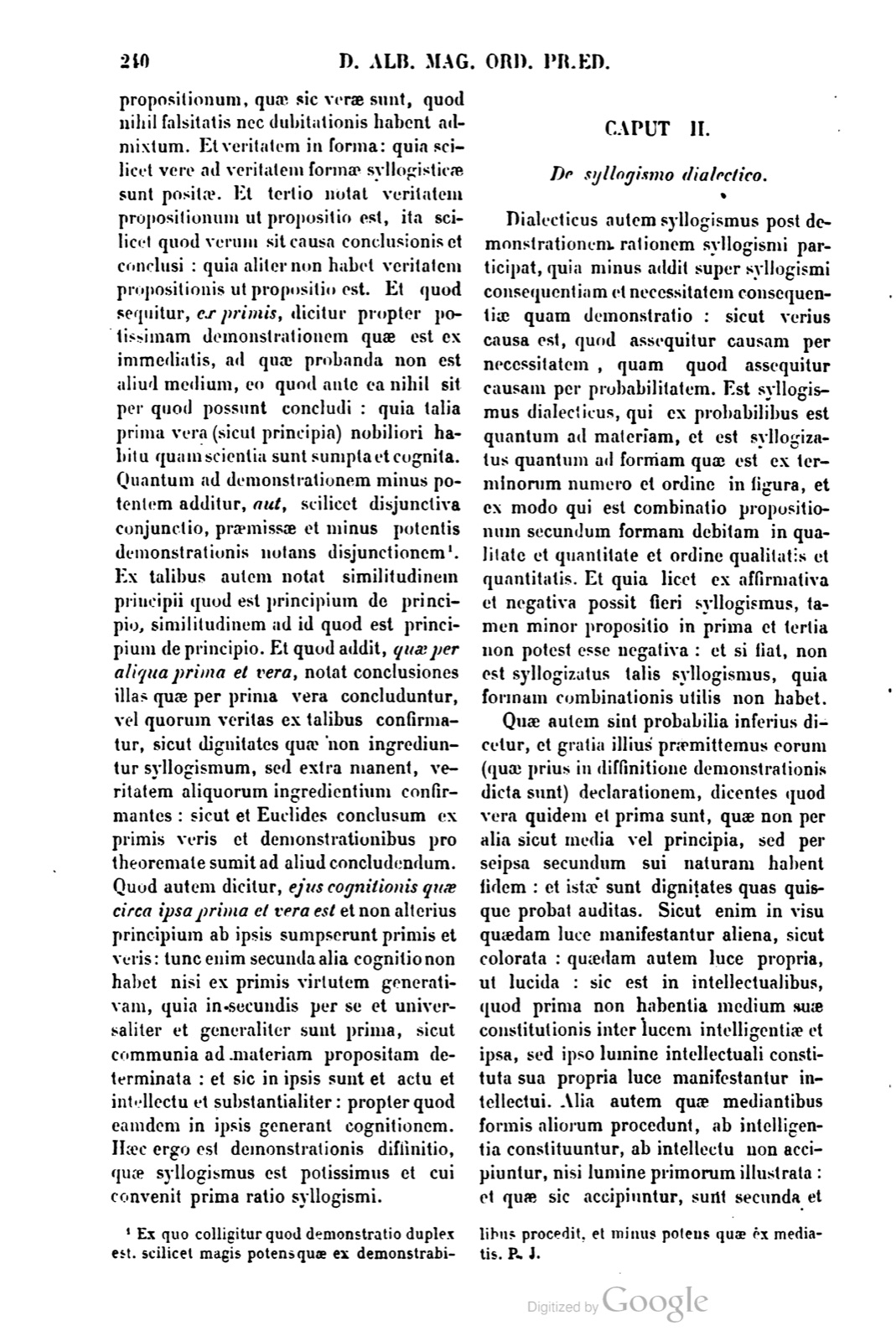
Primum quod sumitur sub syllogismo in communi, demonstratio est: quia in primo et summo participat syllogismi nomen et diffinitionem. Quam diffiniendo dicimus, quod demonstratio est quando ex veris propositionibus et primis fit syllogismus, aut ex talibus quae per aliqua prima et vera, eius quae circa ipsa est cognitionis principium sumpserunt. Cuius diffinitionis iste est intellectus, quod demonstratio ideo dicta est, quia evidens est sua manifestatione demonstratum id quod ponitur in syllogismo demonstrativo: et ex isto concluditur ex praemissis evidenter, quasi digito demonstretur. Quod autem dicitur, syllogismus, notat genus in quo primo et per se ponitur diffinitum. Quod autem dicitur, quando ex veris, ibi praepositio ex quidem notat causam materialem. Verum autem triplicem notat veritatem. In compositione propositionum, quae sic verae sunt, quod nihil falsitatis nec dubitationis habent admixtum. Et veritatem in forma: quia scilicet vere ad veritatem formae syllogisticae sunt positae. Et tertio notat veritatem propositionum ut propositio est, ita scilicet quod verum sit causa conclusionis et conclusi: quia aliter non habet veritatem propositionis ut propositio est. Et quod sequitur, ex primis, dicitur propter potissimam demonstrationem quae est ex immediatis, ad quae probanda non est aliud medium, eo quod ante ea nihil sit per quod possunt concludi: quia talia prima vera sicut principia nobiliori habitu quam scientia sunt sumpta et cognita.
Quantum ad demonstrationem minus potentem additur, aut, scilicet disiunctiva coniunctio, praemissae et minus potentis demonstrationis notans disiunctionem 2. Ex talibus autem notat similitudinem principii quod est principium de principio, similitudinem ad id quod est principium de principio. Et quod addit, quae per aliqua prima et vera, notat conclusiones illas quae per prima vera concluduntur, vel quorum veritas ex talibus confirmatur, sicut dignitates quae non ingrediuntur syllogismum, sed extra manent, veritatem aliquorum ingredientium confirmantes: sicut et Euclides conclusum ex primis veris et demonstrationibus pro theoremate sumit ad aliud concludendum. Quod autem dicitur, eius cognitionis quae circa ipsa prima et vera est et non alterius principium ab ipsis sumpserunt primis et veris: tunc enim secunda alia cognitio non habet nisi ex primis virtutem generativam, quia in secundis per se et universaliter et generaliter sunt prima, sicut communia ad materiam propositam determinata: et sic in ipsis sunt et actu et intellectu et substantialiter: propter quod eamdem in ipsis generant cognitionem. Haec ergo est demonstrationis diffinitio, quae syllogismus est potissimus et cui convenit prima ratio syllogismi.
The first thing taken under syllogism in common is demonstration: because in the first and highest way it participates in the name and definition of syllogism. Defining it, we say that demonstration is when a syllogism is made from true propositions and first propositions, or from such things as have taken the principle of the cognition that is about them through certain first and true things. The understanding of this definition is this: that demonstration is so called because what is placed in demonstrative syllogism is demonstrated as evident by its manifestation; and from this it is concluded evidently from the premises, as though it were shown with a finger. But what is said, syllogism, notes the genus in which the thing defined is first and per se placed. But what is said, when from true things, there the preposition from indeed notes the material cause. But true notes a threefold truth. It notes truth in the composition of propositions, which are true in such a way that they have no falsity or doubt mixed in. And it notes truth in form: because namely they are truly posited toward the truth of syllogistic form. And third it notes the truth of propositions insofar as a proposition is a proposition, namely in such a way that the true is the cause of the conclusion and of the thing concluded; because otherwise it does not have the truth of proposition insofar as it is proposition. And what follows, from first things, is said on account of the most powerful demonstration, which is from immediate things, for proving which there is no other middle, because before them there is nothing through which they can be concluded: because such first truths, as principles, are taken and known by a habit nobler than science.
With respect to the less powerful demonstration, or is added, namely a disjunctive conjunction, noting the disjunction of the premise and of the less powerful demonstration 2. But from such things notes the likeness of the principle that is the principle from a principle, a likeness to that which is the principle from a principle. And what it adds, which through certain first and true things, notes those conclusions that are concluded through first truths, or those whose truth is confirmed from such things, as dignities that do not enter into the syllogism but remain outside, confirming the truth of some things entering in: just as Euclid also takes what is concluded from first truths and demonstrations as a theorem for concluding something else. But what is said, have taken the principle of the cognition that is about those first and true things and not of another from those first and true things, means this: for then a second and other cognition has generative power only from the first things, because in the second things the first things are per se and universally and generally present, as common things determined to the proposed matter; and thus in them they are present actually, intellectually, and substantially; on account of which they generate the same cognition in them. Therefore this is the definition of demonstration, which is the most powerful syllogism and to which the first account of syllogism belongs.
Notes
- Speech for argumentation, and this appears to be the exposition of Boethius in the book On the Categorical Syllogism. (Oratio pro argumentatione, et ista videtur expositio Boetii in libro de syllogismo categorico.) ↩
- From this it is gathered that demonstration is twofold, namely the more powerful, which proceeds from demonstrable things, and the less powerful, which proceeds from mediate things. P. J. (Ex quo colligitur quod demonstratio duplex est, scilicet magis potens quae ex demonstrabilibus procedit, et minus potens quae ex mediatis. P. J.) ↩
If a page does not appear, its photograph has not been uploaded yet.