Volume 2 · pp. 233–237
Book I of the Topics. Chapter I. Proemium of D. Albert.
A marker with ≈ is an approximate page boundary, placed by measure of the text; the page photographs remain the authority. In the paired views, clicking a page marker brings that page into view.
LIBER I TOPICORUM.
CAPUT I.
Proaemium D. Alberti.
[Marginal label, printed page 233: Nota continuationem huius libri ad praecedentes.]
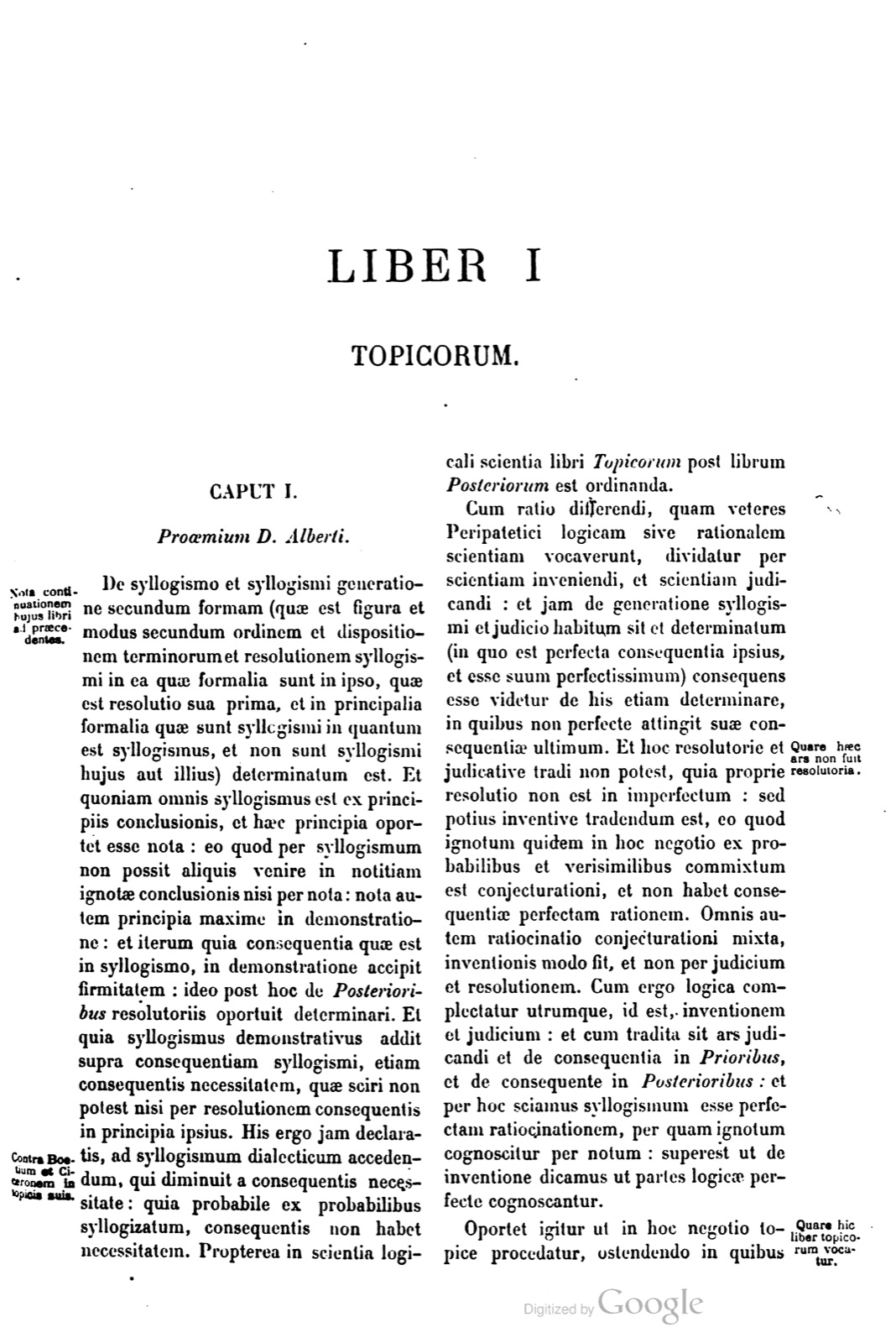
De syllogismo et syllogismi generatione secundum formam, quae est figura et modus secundum ordinem et dispositionem terminorum et resolutionem syllogismi in ea quae formalia sunt in ipso, quae est resolutio sua prima, et in principalia formalia quae sunt syllogismi in quantum est syllogismus, et non sunt syllogismi huius aut illius, determinatum est. Et quoniam omnis syllogismus est ex principiis conclusionis, et haec principia oportet esse nota, eo quod per syllogismum non possit aliquis venire in notitiam ignotae conclusionis nisi per nota; nota autem principia maxime in demonstratione; et iterum quia consequentia quae est in syllogismo, in demonstratione accipit firmitatem: ideo post hoc de Posterioribus resolutoriis oportuit determinari. Et quia syllogismus demonstrativus addit supra consequentiam syllogismi, etiam consequentis necessitatem, quae sciri non potest nisi per resolutionem consequentis in principia ipsius. His ergo iam declaratis, ad syllogismum dialecticum accedendum, qui diminuit a consequentis necessitate: quia probabile ex probabilibus syllogizatum, consequentis non habet necessitatem. Propterea in scientia logicali scientia libri Topicorum post librum Posteriorum est ordinanda.
[Marginal label, printed page 233: Contra Boetium et Ciceronem in topicis suis.]
Cum ratio differendi, quam veteres Peripatetici logicam sive rationalem scientiam vocaverunt, dividatur per scientiam inveniendi, et scientiam iudicandi; et iam de generatione syllogismi et iudicio habitum sit et determinatum, in quo est perfecta consequentia ipsius, et esse suum perfectissimum, consequens esse videtur de his etiam determinare, in quibus non perfecte attingit suae consequentiae ultimum. Et hoc resolutorie et iudicative tradi non potest, quia proprie resolutio non est in imperfectum: sed potius inventive tradendum est, eo quod ignotum quidem in hoc negotio ex probabilibus et verisimilibus commixtum est coniecturationi, et non habet consequentiae perfectam rationem. Omnis autem ratiocinatio coniecturationi mixta, inventionis modo fit, et non per iudicium et resolutionem. Cum ergo logica complectatur utrumque, id est, inventionem et iudicium; et cum tradita sit ars iudicandi et de consequentia in Prioribus, et de consequente in Posterioribus: et per hoc sciamus syllogismum esse perfectam ratiocinationem, per quam ignotum cognoscitur per notum: superest ut de inventione dicamus ut partes logicae perfecte cognoscantur.
[Marginal label, printed page 233: Quare haec ars non fuit resolutoria.]
Oportet igitur ut in hoc negotio topice procedatur, ostendendo in quibus rerum habitudinibus, ut in quibusdam locis claudatur ignoti notitia, quod scire desideramus: propter quod etiam haec scientia liber Topicorum vocatur. Cujus quidem materia et subjectum est syllogismus topicus sive dialecticus: qui ideo Topicus dicitur, quia a locali habitudine rerum ad invicem trahit suae consequentiae necessitatem. Et ideo dicitur dialecticus, quia procedit ex probabilibus, quae in consequentia syllogistica, in qua principia ad conclusionem referuntur, mixtam sibi habent coniecturationem ex probabilibus et habitudine rerum ad invicem. Hic tamen syllogismus postquam visus et inventus est, totum usum habet circa probabile, hoc est, quaestionem ex communibus terminandam. Ex communibus autem dico, quae vel in pluribus vel in omnibus inveniuntur, non profundata in ipsis, sicut profundantur propria et essentialia, sed quae apparent in superficie statim, quamvis ex ipsis propria possint coniecturari, propter id quod vere probabilia aliqualiter pertingunt in profundum ad propria sicut signa propriorum.
BOOK I OF THE TOPICS.
CHAPTER I.
Proemium of D. Albert.
[Marginal label, printed page 233: Note the continuation of this book with the preceding things.]
Concerning syllogism and the generation of syllogism according to form, which is figure and mode according to the order and disposition of terms, and concerning the resolution of syllogism into those things that are formal in it, which is its first resolution, and into the principal formal things that belong to syllogism insofar as it is syllogism, and do not belong to the syllogism of this or of that, a determination has been made. And because every syllogism is from the principles of the conclusion, and these principles must be known, since through syllogism someone cannot come into knowledge of an unknown conclusion except through things known; and principles are especially known in demonstration; and again because the consequence that is in syllogism receives firmness in demonstration: therefore after this it was necessary to determine concerning the Posterior Analytics. And because demonstrative syllogism adds, over and above the consequence of syllogism, also the necessity of the consequent, which cannot be known except through the resolution of the consequent into its own principles. Therefore, once these things have now been declared, one must approach dialectical syllogism, which diminishes from the necessity of the consequent: because the probable, syllogized from probable things, does not have the necessity of the consequent. Therefore in logical science the science of the book of the Topics must be arranged after the book of the Posterior Analytics.
[Marginal label, printed page 233: Against Boethius and Cicero in their Topics.]
Since the account of discussing, which the old Peripatetics called logic or rational science, is divided through the science of discovering and the science of judging; and since there has now been treatment and determination concerning the generation of syllogism and judgment, in which there is its perfect consequence and its most perfect being, it seems consequent also to determine concerning those things in which it does not perfectly reach the ultimate point of its consequence. And this cannot be handed down resolutorily and judicially, because properly resolution is not into the imperfect: but rather it must be handed down inventively, because in this business the unknown, from probable and truth-like things, is mixed with conjecture, and does not have the perfect account of consequence. But every reasoning mixed with conjecture occurs in the mode of discovery, and not through judgment and resolution. Therefore, since logic embraces both, that is, discovery and judgment; and since the art of judging has been handed down both concerning consequence in the Prior Analytics and concerning the consequent in the Posterior Analytics; and through this we know that syllogism is a perfect reasoning through which the unknown is known through the known: it remains that we speak concerning discovery, so that the parts of logic may be known perfectly.
[Marginal label, printed page 233: Why this art was not resolutory.]
Therefore it is necessary that in this business one proceed topically, by showing in what relations of things, as in certain places, the knowledge of the unknown, which we desire to know, is enclosed: on account of which this science is also called the book of the Topics. Its matter and subject indeed is topical or dialectical syllogism: it is therefore called topical, because from the local relation of things to one another it draws the necessity of its consequence. And therefore it is called dialectical, because it proceeds from probable things, which in syllogistic consequence, in which principles are referred to a conclusion, have conjecture mixed with themselves from probable things and from the relation of things to one another. Yet after this syllogism has been seen and discovered, it has its whole use concerning the probable, that is, concerning a question to be terminated from common things. But by common things I mean those that are found either in many things or in all things, not deepened in them as proper and essential things are deepened, but those things that appear at once on the surface, although from them proper things can be conjectured, because things truly probable in some way reach deeply to proper things as signs of proper things.
[Marginal label, printed page 233: Quare hic liber Topicorum vocatur.]
[Marginal label, printed page 234: Subjectum libri huius.]
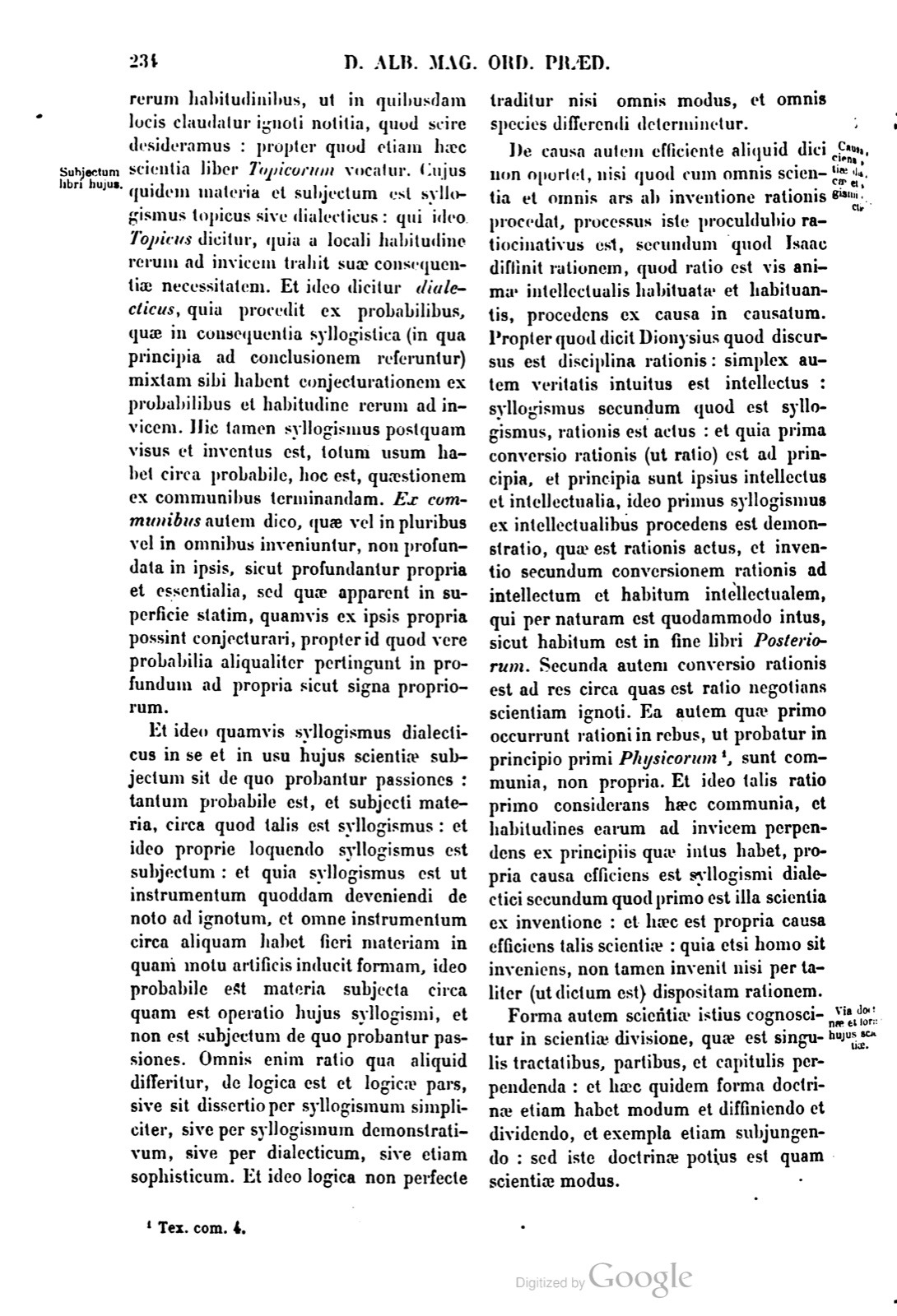
Et ideo quamvis syllogismus dialecticus in se et in usu huius scientiae subjectum sit de quo probantur passiones: tantum probabile est, et subjecti materia, circa quod talis est syllogismus: et ideo proprie loquendo syllogismus est subjectum: et quia syllogismus est ut instrumentum quoddam deveniendi de noto ad ignotum, et omne instrumentum circa aliquam habet fieri materiam in quam motu artificis inducit formam, ideo probabile est materia subjecta circa quam est operatio huius syllogismi, et non est subjectum de quo probantur passiones. Omnis enim ratio qua aliquid differtur, de logica est et logicae pars, sive sit dissertio per syllogismum simpliciter, sive per syllogismum demonstrativum, sive per dialecticum, sive etiam sophisticum. Et ideo logica non perfecte traditur nisi omnis modus, et omnis species differendi determinetur.
[Marginal label, printed page 234: Causa efficiens huius scientiae de syllogismo.]
De causa autem efficiente aliquid dici non oportet, nisi quod cum omnis scientia et omnis ars ab inventione rationis procedat, processus iste proculdubio ratiocinativus est, secundum quod Isaac diffinit rationem, quod ratio est vis animae intellectualis habituatae et habituantis, procedens ex causa in causatum. Propter quod dicit Dionysius quod discursus est disciplina rationis: simplex autem veritatis intuitus est intellectus: syllogismus secundum quod est syllogismus, rationis est actus: et quia prima conversio rationis ut ratio est ad principia, et principia sunt ipsius intellectus et intellectualia, ideo primus syllogismus ex intellectualibus procedens est demonstratio, quae est rationis actus, et inventio secundum conversionem rationis ad intellectum et habitum intellectualem, qui per naturam est quodammodo intus, sicut habitum est in fine libri Posteriorum. Secunda autem conversio rationis est ad res circa quas est ratio negotians scientiam ignoti. Ea autem quae primo occurrunt rationi in rebus, ut probatur in principio primi Physicorum 1, sunt communia, non propria. Et ideo talis ratio primo considerans haec communia, et habitudines earum ad invicem perpendens ex principiis quae intus habet, propria causa efficiens est syllogismi dialectici secundum quod primo est illa scientia ex inventione: et haec est propria causa efficiens talis scientiae: quia etsi homo sit inveniens, non tamen invenit nisi per taliter, ut dictum est, dispositam rationem.
[Marginal label, printed page 234: Via et ordo doctrinae huius scientiae.]
Forma autem scientiae istius cognoscitur in scientiae divisione, quae est singulis tractatibus, partibus, et capitulis perpendenda: et haec quidem forma doctrinae etiam habet modum et diffiniendo et dividendo, et exempla etiam subiungendo: sed iste doctrinae potius est quam scientiae modus.
[Marginal label, printed page 233: Why this book is called the book of the Topics.]
[Marginal label, printed page 234: The subject of this book.]
And therefore although dialectical syllogism in itself and in the use of this science is the subject about which properties are proved, nevertheless the probable is both the matter of the subject and that concerning which such a syllogism exists: and therefore, properly speaking, syllogism is the subject. And because syllogism is as a certain instrument for coming from the known to the unknown, and every instrument has to be made about some matter into which, by the motion of the artisan, it induces form, therefore the probable is the subject matter about which the operation of this syllogism exists, and is not the subject about which properties are proved. For every reason by which something is discussed belongs to logic and is a part of logic, whether it is discussion through syllogism simply, or through demonstrative syllogism, or through dialectical syllogism, or even through sophistical syllogism. And therefore logic is not perfectly handed down unless every mode and every species of discussing is determined.
[Marginal label, printed page 234: The efficient cause of this science concerning syllogism.]
But concerning the efficient cause something need not be said, except that, since every science and every art proceeds from the discovery of reason, this process is without doubt ratiocinative, according as Isaac defines reason, namely that reason is a force of the intellectual soul, habituated and habituating, proceeding from cause into caused. On account of this Dionysius says that discourse is the discipline of reason: but the simple intuition of truth is intellect. Syllogism, insofar as it is syllogism, is an act of reason: and because the first conversion of reason as reason is toward principles, and principles belong to intellect itself and are intellectual, therefore the first syllogism, proceeding from intellectual things, is demonstration, which is an act of reason, and discovery according to the conversion of reason toward intellect and toward the intellectual habit, which by nature is in some way within, as was had at the end of the book of the Posterior Analytics. But the second conversion of reason is toward the things about which reason negotiates the science of the unknown. Now the things that first occur to reason in things, as is proved at the beginning of the first book of the Physics 1, are common, not proper. And therefore such reason, first considering these common things, and weighing their relations to one another from the principles that it has within, is the proper efficient cause of dialectical syllogism according as that science first exists from discovery: and this is the proper efficient cause of such science; because, even if a human being is the one discovering, nevertheless he does not discover except through reason disposed in such a way, as was said.
[Marginal label, printed page 234: The way and order of the doctrine of this science.]
But the form of this science is known in the division of the science, which must be weighed in the several treatises, parts, and chapters: and indeed this form of doctrine also has a mode both by defining and by dividing, and also by adding examples; but this is a mode of doctrine rather than of science.
[Marginal label, printed page 235: Finis scientiae huius.]
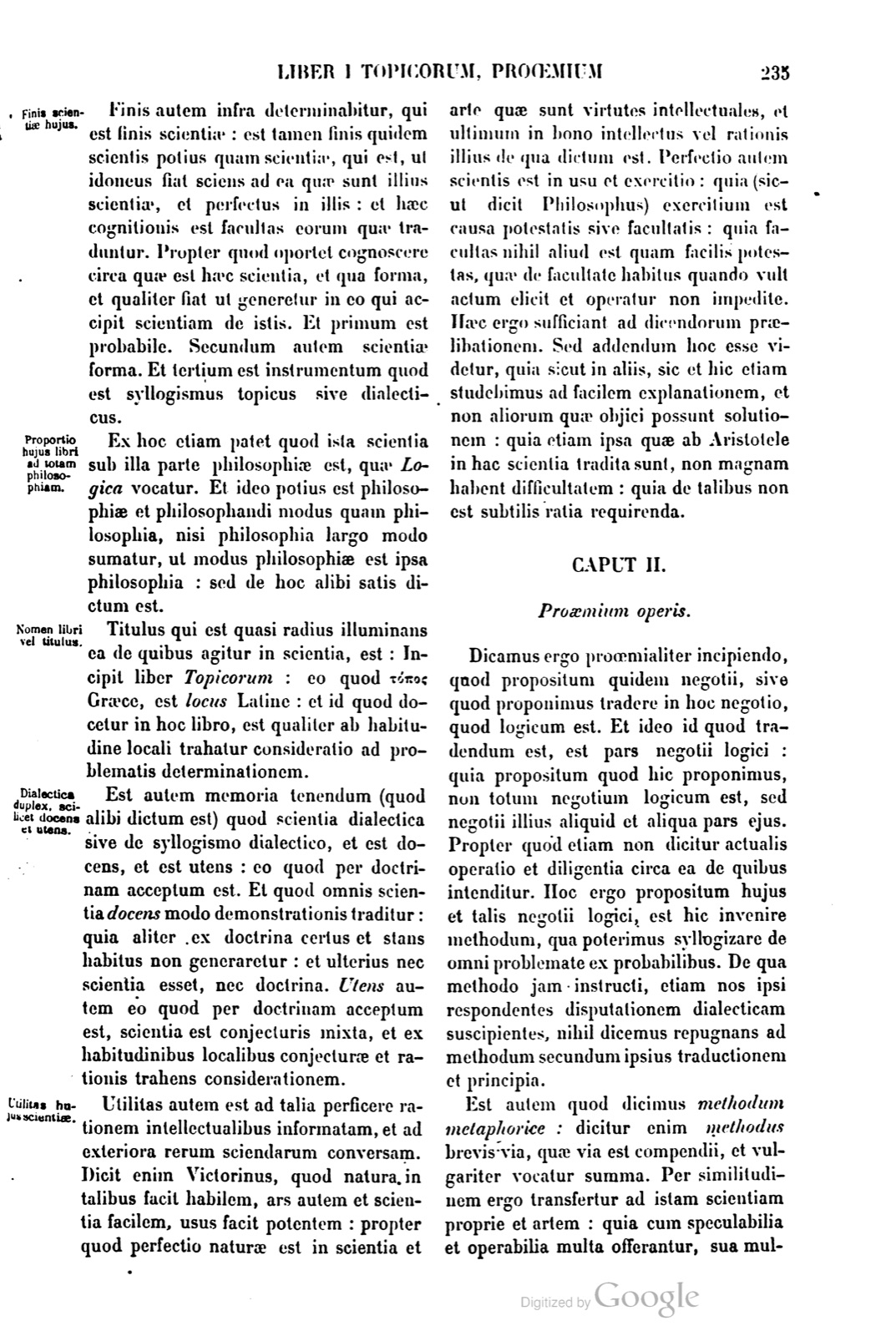
Finis autem infra determinabitur, qui est finis scientiae: est tamen finis quidem scientis potius quam scientiae, qui est, ut idoneus fiat sciens ad ea quae sunt illius scientiae, et perfectus in illis: et haec cognitionis est facultas eorum quae traduntur. Propter quod oportet cognoscere circa quae est haec scientia, et qua forma, et qualiter fiat ut generetur in eo qui accipit scientiam de istis. Et primum est probabile. Secundum autem scientiae forma. Et tertium est instrumentum quod est syllogismus topicus sive dialecticus.
[Marginal label, printed page 235: Proportio huius libri ad totam philosophiam.]
Ex hoc etiam patet quod ista scientia sub illa parte philosophiae est, quae Logica vocatur. Et ideo potius est philosophiae et philosophandi modus quam philosophia, nisi philosophia largo modo sumatur, ut modus philosophiae est ipsa philosophia: sed de hoc alibi satis dictum est.
[Marginal label, printed page 235: Nomen libri vel titulus.]
Titulus qui est quasi radius illuminans ea de quibus agitur in scientia, est: Incipit liber Topicorum: eo quod τόπος Graece, est locus Latine: et id quod docetur in hoc libro, est qualiter ab habitudine locali trahatur consideratio ad problematis determinationem.
[Marginal label, printed page 235: Dialectica duplex, scilicet docens et utens.]
Est autem memoria tenendum, quod alibi dictum est, quod scientia dialectica sive de syllogismo dialectico, et est docens, et est utens: eo quod per doctrinam acceptum est. Et quod omnis scientia docens modo demonstrationis traditur: quia aliter ex doctrina certus et stans habitus non generaretur: et ulterius nec scientia esset, nec doctrina. Utens autem eo quod per doctrinam acceptum est, scientia est coniecturis mixta, et ex habitudinibus localibus coniecturae et rationis trahens considerationem.
[Marginal label, printed page 235: Utilitas huius scientiae.]
Utilitas autem est ad talia perficere rationem intellectualibus informatam, et ad exteriora rerum sciendarum conversam. Dicit enim Victorinus, quod natura, in talibus facit habilem, ars autem et scientia facilem, usus facit potentem: propter quod perfectio naturae est in scientia et arte quae sunt virtutes intellectuales, et ultimum in bono intellectus vel rationis illius de qua dictum est. Perfectio autem scientis est in usu et exercitio: quia sicut dicit Philosophus, exercitium est causa potestatis sive facultatis: quia facultas nihil aliud est quam facilis potestas, quae de facultate habitus quando vult actum elicit et operatur non impedite. Haec ergo sufficiant ad dicendorum praelibationem. Sed addendum hoc esse videtur, quia sicut in aliis, sic et hic etiam studebimus ad facilem explanationem, et non aliorum quae obici possunt solutionem: quia etiam ipsa quae ab Aristotele in hac scientia tradita sunt, non magnam habent difficultatem: quia de talibus non est subtilis ratio requirenda.
CAPUT II.
Proaemium operis.
Dicamus ergo prooemialiter incipiendo, quod propositum quidem negotii, sive quod proponimus tradere in hoc negotio, quod logicum est. Et ideo id quod tradendum est, est pars negotii logici: quia propositum quod hic proponimus, non totum negotium logicum est, sed negotii illius aliquid et aliqua pars eius. Propter quod etiam non dicitur actualis operatio et diligentia circa ea de quibus intenditur. Hoc ergo propositum huius et talis negotii logici, est hic invenire methodum, qua poterimus syllogizare de omni problemate ex probabilibus. De qua methodo iam instructi, etiam nos ipsi respondentes disputationem dialecticam suscipientes, nihil dicemus repugnans ad methodum secundum ipsius traductionem et principia.
[Marginal label, printed page 235: The end of this science.]
But the end will be determined below, which is the end of the science: yet there is an end belonging rather to the knower than to the science, which is that the knower should become fit for those things that belong to that science, and perfect in them; and this is the faculty of cognition of those things that are handed down. On account of this it is necessary to know what this science is about, and by what form, and in what manner it comes to be generated in the one who receives science concerning these things. And the first is the probable. The second is the form of the science. And the third is the instrument, which is topical or dialectical syllogism.
[Marginal label, printed page 235: The proportion of this book to the whole of philosophy.]
From this it is also clear that this science is under that part of philosophy that is called Logic. And therefore it is rather the mode of philosophy and of philosophizing than philosophy, unless philosophy is taken in a broad way, so that the mode of philosophy is itself philosophy: but enough has been said elsewhere about this.
[Marginal label, printed page 235: The name of the book or the title.]
The title, which is like a ray illuminating those matters that are treated in the science, is: The book of the Topics begins; because τόπος in Greek is place in Latin: and what is taught in this book is how, from a local relation, consideration is drawn toward the determination of a problem.
[Marginal label, printed page 235: Dialectic is twofold, namely teaching and using.]
But it must be held in memory, as has been said elsewhere, that dialectical science, or the science concerning dialectical syllogism, both teaches and uses: in that it has been received through teaching. And every teaching science is handed down in the mode of demonstration: because otherwise from teaching a certain and standing habit would not be generated; and further there would be neither science nor teaching. But as using what has been received through teaching, the science is mixed with conjectures, and from local relations it draws consideration of conjecture and reason.
[Marginal label, printed page 235: The usefulness of this science.]
But the usefulness is to perfect reason for such things, reason informed by intellectual things and turned toward the exterior things to be known. For Victorinus says that nature, in such matters, makes one apt, but art and science make one ready, use makes one powerful: on account of which the perfection of nature is in science and art, which are intellectual virtues, and the ultimate in the good of the intellect or reason of which we have spoken. But the perfection of the knower is in use and exercise: because, as the Philosopher says, exercise is the cause of power or faculty; because faculty is nothing other than easy power, which, from the faculty of the habit, elicits and performs an act when it wishes, without hindrance. Therefore let these things suffice for a foretaste of what is to be said. But this seems to need to be added, that as in other matters, so also here we shall strive for easy explanation, and not for the solution of other things that can be objected: because even the things that have been handed down by Aristotle in this science do not have great difficulty; because concerning such things a subtle account is not to be required.
CHAPTER II.
Proemium of the work.
Therefore let us speak, beginning proemially, because the proposed object indeed of the business, or what we propose to hand down in this business, is logical. And therefore what must be handed down is a part of the logical business: because the proposed object that we propose here is not the whole logical business, but something of that business and some part of it. On account of this there is also not said to be an actual operation and diligence about those things concerning which the intention is directed. Therefore the proposed object of this and of such a logical business is here to discover a method by which we shall be able to syllogize concerning every problem from probable things. Once instructed in this method, we ourselves also, receiving dialectical disputation as respondents, will say nothing repugnant to the method according to its handing-down and principles.
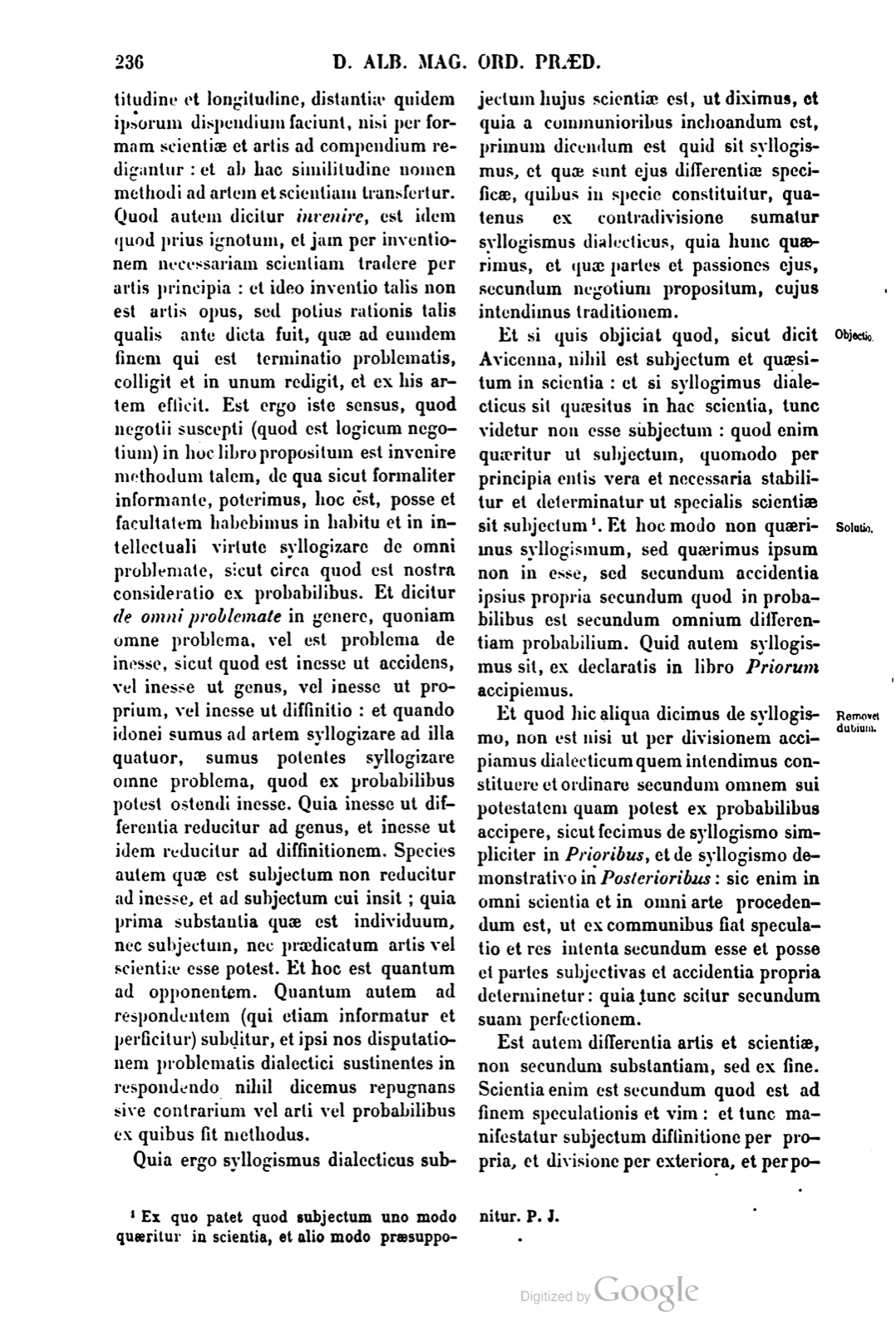
Est autem quod dicimus methodum metaphorice: dicitur enim methodus brevis via, quae via est compendii, et vulgariter vocatur summa. Per similitudinem ergo transfertur ad istam scientiam proprie et artem: quia cum speculabilia et operabilia multa offerantur, sua multitudine et longitudine, distantiae quidem ipsorum dispendium faciunt, nisi per formam scientiae et artis ad compendium redigantur: et ab hac similitudine nomen methodi ad artem et scientiam transfertur. Quod autem dicitur invenire, est idem quod prius ignotum, et iam per inventionem necessariam scientiam tradere per artis principia: et ideo inventio talis non est artis opus, sed potius rationis talis qualis ante dicta fuit, quae ad eumdem finem qui est terminatio problematis, colligit et in unum redigit, et ex his artem efficit. Est ergo iste sensus, quod negotii suscepti, quod est logicum negotium, in hoc libro propositum est invenire methodum talem, de qua sicut formaliter informante, poterimus, hoc est, posse et facultatem habebimus in habitu et in intellectuali virtute syllogizare de omni problemate, sicut circa quod est nostra consideratio ex probabilibus. Et dicitur de omni problemate in genere, quoniam omne problema, vel est problema de inesse, sicut quod est inesse ut accidens, vel inesse ut genus, vel inesse ut proprium, vel inesse ut diffinitio: et quando idonei sumus ad artem syllogizare ad illa quatuor, sumus potentes syllogizare omne problema, quod ex probabilibus potest ostendi inesse. Quia inesse ut differentia reducitur ad genus, et inesse ut idem reducitur ad diffinitionem. Species autem quae est subjectum non reducitur ad inesse, et ad subjectum cui insit; quia prima substantia quae est individuum, nec subjectum, nec praedicatum artis vel scientiae esse potest. Et hoc est quantum ad opponentem. Quantum autem ad respondentem, qui etiam informatur et perficitur, subditur, et ipsi nos disputationem problematis dialectici sustinentes in respondendo nihil dicemus repugnans sive contrarium vel arti vel probabilibus ex quibus fit methodus.
Quia ergo syllogismus dialecticus subjectum huius scientiae est, ut diximus, et quia a communioribus inchoandum est, primum dicendum est quid sit syllogismus, et quae sunt eius differentiae specificae, quibus in specie constituitur, quatenus ex contradivisione sumatur syllogismus dialecticus, quia hunc quaerimus, et quae partes et passiones eius, secundum negotium propositum, cuius intendimus traditionem.
[Marginal label, printed page 236: Objectio.]
Et si quis obiciat quod, sicut dicit Avicenna, nihil est subjectum et quaesitum in scientia: et si syllogimus dialecticus sit quaesitus in hac scientia, tunc videtur non esse subjectum: quod enim quaeritur ut subjectum, quomodo per principia entis vera et necessaria stabilitur et determinatur ut specialis scientiae sit subjectum 2.
But what we call method is said metaphorically: for method is called a short way, which way is one of compendium, and is commonly called a summary. Therefore by similitude it is transferred to this science properly and to the art: because, when many speculative and operative things are offered, by their multitude and length they indeed cause loss of distance, unless they are reduced to compendium through the form of science and art; and from this similitude the name of method is transferred to art and science. But what is called to discover is the same as to hand down a previously unknown thing, and now through discovery, as necessary science, through the principles of art: and therefore such discovery is not the work of art, but rather of such reason as was mentioned before, which gathers and reduces into one toward the same end, which is the termination of the problem, and from these things makes an art. Therefore this is the sense: that in this book the proposed object of the business undertaken, which is the logical business, is to discover such a method by which, as by something formally informing, we shall be able, that is, shall have ability and faculty in habit and in intellectual virtue, to syllogize concerning every problem, as concerning that about which our consideration proceeds from probable things. And it is said concerning every problem in genus, since every problem either is a problem concerning being-in, as what is being-in as accident, or being-in as genus, or being-in as proper, or being-in as definition: and when we are fit for the art of syllogizing toward those four, we are able to syllogize every problem that can be shown from probable things to belong. For being-in as difference is reduced to genus, and being-in as same is reduced to definition. But the species that is the subject is not reduced to being-in and to the subject in which it belongs; because first substance, which is the individual, can be neither the subject nor the predicate of art or science. And this is with respect to the opponent. But with respect to the respondent, who is also informed and perfected, there is added that we ourselves, sustaining disputation of the dialectical problem in responding, will say nothing repugnant or contrary either to the art or to the probable things from which the method is made.
Therefore because dialectical syllogism is the subject of this science, as we have said, and because one must begin from the more common things, first it must be said what syllogism is, and what are its specific differences by which it is constituted in species, so that from contradivision dialectical syllogism may be taken, because this is what we seek, and what are its parts and properties, according to the proposed business whose handing-down we intend.
[Marginal label, printed page 236: Objection.]
And if someone objects that, as Avicenna says, nothing is both subject and thing sought in a science; and if dialectical syllogism is the thing sought in this science, then it seems not to be the subject: for what is sought as subject, in what manner is it established and determined through true and necessary principles of being so that it may be the subject of a special science 2?
[Marginal label, printed page 236: Solutio.]
Et hoc modo non quaerimus syllogismum, sed quaerimus ipsum non in esse, sed secundum accidentia ipsius propria secundum quod in probabilibus est secundum omnium differentiam probabilium. Quid autem syllogismus sit, ex declaratis in libro Priorum accipiemus.
[Marginal label, printed page 236: Removet dubium.]
Et quod hic aliqua dicimus de syllogismo, non est nisi ut per divisionem accipiamus dialecticum quem intendimus constituere et ordinare secundum omnem sui potestatem quam potest ex probabilibus accipere, sicut fecimus de syllogismo simpliciter in Prioribus, et de syllogismo demonstrativo in Posterioribus: sic enim in omni scientia et in omni arte procedendum est, ut ex communibus fiat speculatio et res intenta secundum esse et posse et partes subjectivas et accidentia propria determinetur: quia tunc scitur secundum suam perfectionem.
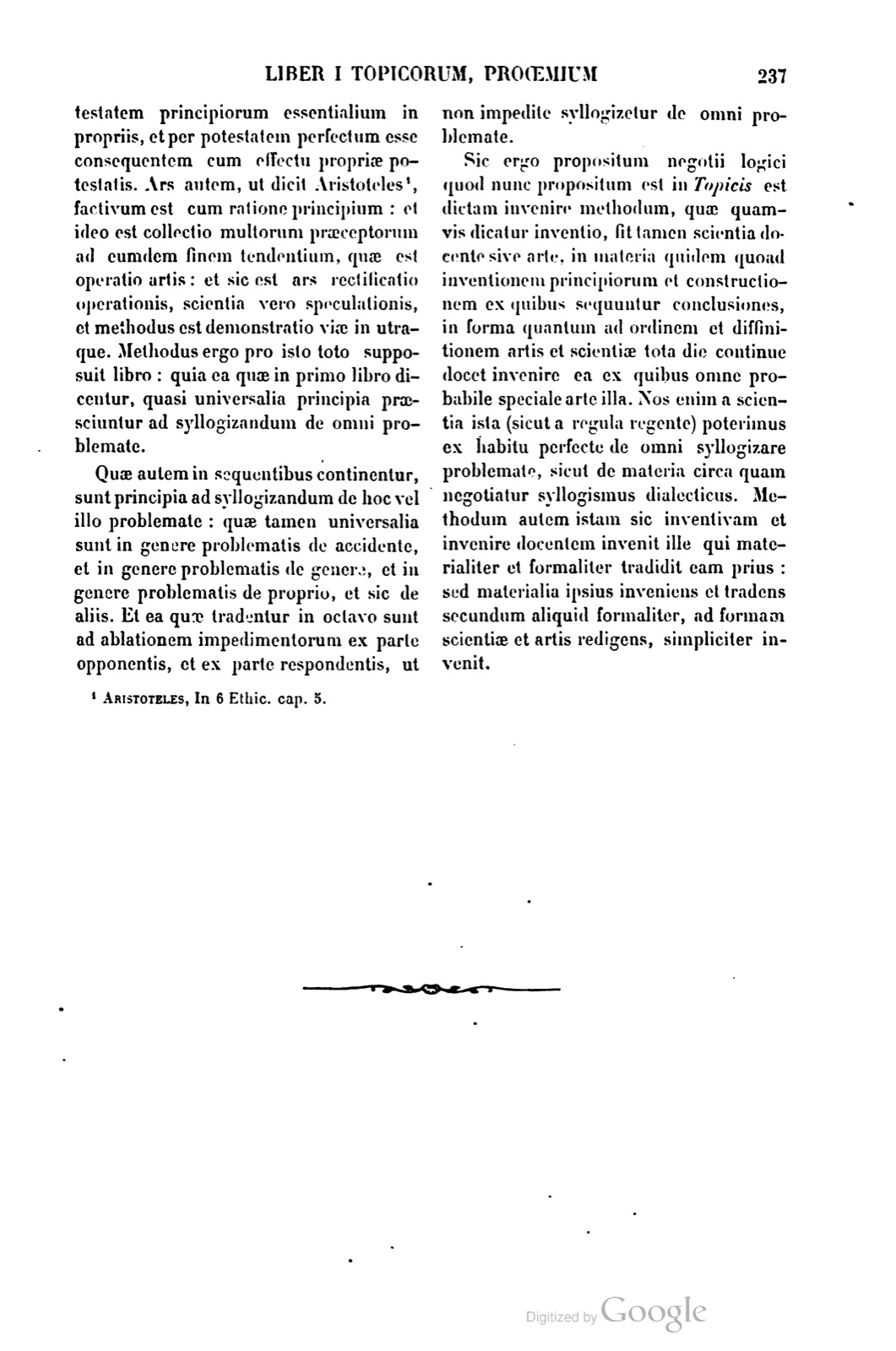
Est autem differentia artis et scientiae, non secundum substantiam, sed ex fine. Scientia enim est secundum quod est ad finem speculationis et vim: et tunc manifestatur subjectum diffinitione per propria, et divisione per exteriora, et per potestatem principiorum essentialium in propriis, et per potestatem perfectum esse consequentem cum effectu propriae potestatis. Ars autem, ut dicit Aristoteles 3, factivum est cum ratione principium: et ideo est collectio multorum praeceptorum ad eumdem finem tendentium, quae est operatio artis: et sic est ars rectificatio operationis, scientia vero speculationis, et methodus est demonstratio viae in utraque. Methodus ergo pro isto toto supposuit libro: quia ea quae in primo libro dicentur, quasi universalia principia praesciuntur ad syllogizandum de omni problemate.
Quae autem in sequentibus continentur, sunt principia ad syllogizandum de hoc vel illo problemate: quae tamen universalia sunt in genere problematis de accidente, et in genere problematis de genere, et in genere problematis de proprio, et sic de aliis. Et ea quae tradentur in octavo sunt ad ablationem impedimentorum ex parte opponentis, et ex parte respondentis, ut non impedite syllogizetur de omni problemate.
Sic ergo propositum negotii logici quod nunc propositum est in Topicis est dictam invenire methodum, quae quamvis dicatur inventio, fit tamen scientia docente sive arte, in materia quidem quoad inventionem principiorum et constructionem ex quibus sequuntur conclusiones, in forma quantum ad ordinem et diffinitionem artis et scientiae tota die continue docet invenire ea ex quibus omne probabile speciale arte illa. Nos enim a scientia ista, sicut a regula regente, poterimus ex habitu perfecte de omni syllogizare problemate, sicut de materia circa quam negotiatur syllogismus dialecticus. Methodum autem istam sic inventivam et invenire docentem invenit ille qui materialiter et formaliter tradidit eam prius: sed materialia ipsius inveniens et tradens secundum aliquid formaliter, ad formam scientiae et artis redigens, simpliciter invenit.
[Marginal label, printed page 236: Solution.]
And in this way we do not seek syllogism, but we seek it not in its being, but according to its own accidents insofar as it is in probable things according to every difference of probable things. But what syllogism is we shall receive from the things declared in the book of the Prior Analytics.
[Marginal label, printed page 236: He removes a doubt.]
And the fact that here we say some things about syllogism is only so that through division we may receive the dialectical syllogism that we intend to constitute and order according to every power of itself that it can receive from probable things, as we did concerning syllogism simply in the Prior Analytics, and concerning demonstrative syllogism in the Posterior Analytics: for thus in every science and in every art one must proceed, so that from common things there may be speculation, and the thing intended may be determined according to being and possibility and subjective parts and proper accidents; because then it is known according to its perfection.
But the difference of art and science is not according to substance, but from the end. For science is according as it is for the end of speculation and force: and then the subject is manifested by definition through proper things, and by division through exterior things, and through the power of essential principles in proper things, and through power, perfect being consequent with the effect of its proper power. But art, as Aristotle says 3, is a principle productive with reason: and therefore it is a collection of many precepts tending to the same end, which is the operation of art. And thus art is the rectification of operation, but science is the rectification of speculation, and method is the showing of the way in both. Therefore method has been placed before this whole book: because those things that will be said in the first book are foreknown as universal principles for syllogizing concerning every problem.
But the things that are contained in what follows are principles for syllogizing concerning this or that problem: nevertheless these are universal in the genus of the problem concerning accident, and in the genus of the problem concerning genus, and in the genus of the problem concerning proper, and so concerning the others. And the things that will be handed down in the eighth book are for removing impediments on the part of the opponent and on the part of the respondent, so that one may syllogize concerning every problem without hindrance.
Therefore in this way the proposed object of the logical business, which is now proposed in the Topics, is to discover the stated method. Although it is called discovery, nevertheless it is made by a teaching science or art: in matter indeed as to the discovery of principles and the construction from which conclusions follow; in form as to the order and definition of art and science, it teaches continuously day by day to discover those things from which every special probable matter is handled by that art. For from this science, as from a ruling rule, we shall be able from habit perfectly to syllogize concerning every problem, as concerning the matter about which dialectical syllogism negotiates. But he discovered this method, thus inventive and teaching how to discover, who first handed it down materially and formally; but by discovering and handing down its materials formally in some respect, reducing them to the form of science and art, he discovered it simply.
Notes
- Textual commentary 4. (Tex. com. 4.) ↩
- From this it is clear that the subject is sought in a science in one way, and is presupposed in another way. P. J. (Ex quo patet quod subjectum uno modo quaeritur in scientia, et alio modo praesupponitur. P. J.) ↩
- Aristotle, in Ethics VI, chapter 5. (Aristoteles, In 6 Ethic. cap. 5.) ↩
If a page does not appear, its photograph has not been uploaded yet.