Works › Posterior Analytics, Books I–II
Volume 2 · pp. 231–232
Chapter 2. What habit is cognoscitive of principles.
A marker with ≈ is an approximate page boundary, placed by measure of the text; the page photographs remain the authority. In the paired views, clicking a page marker brings that page into view.
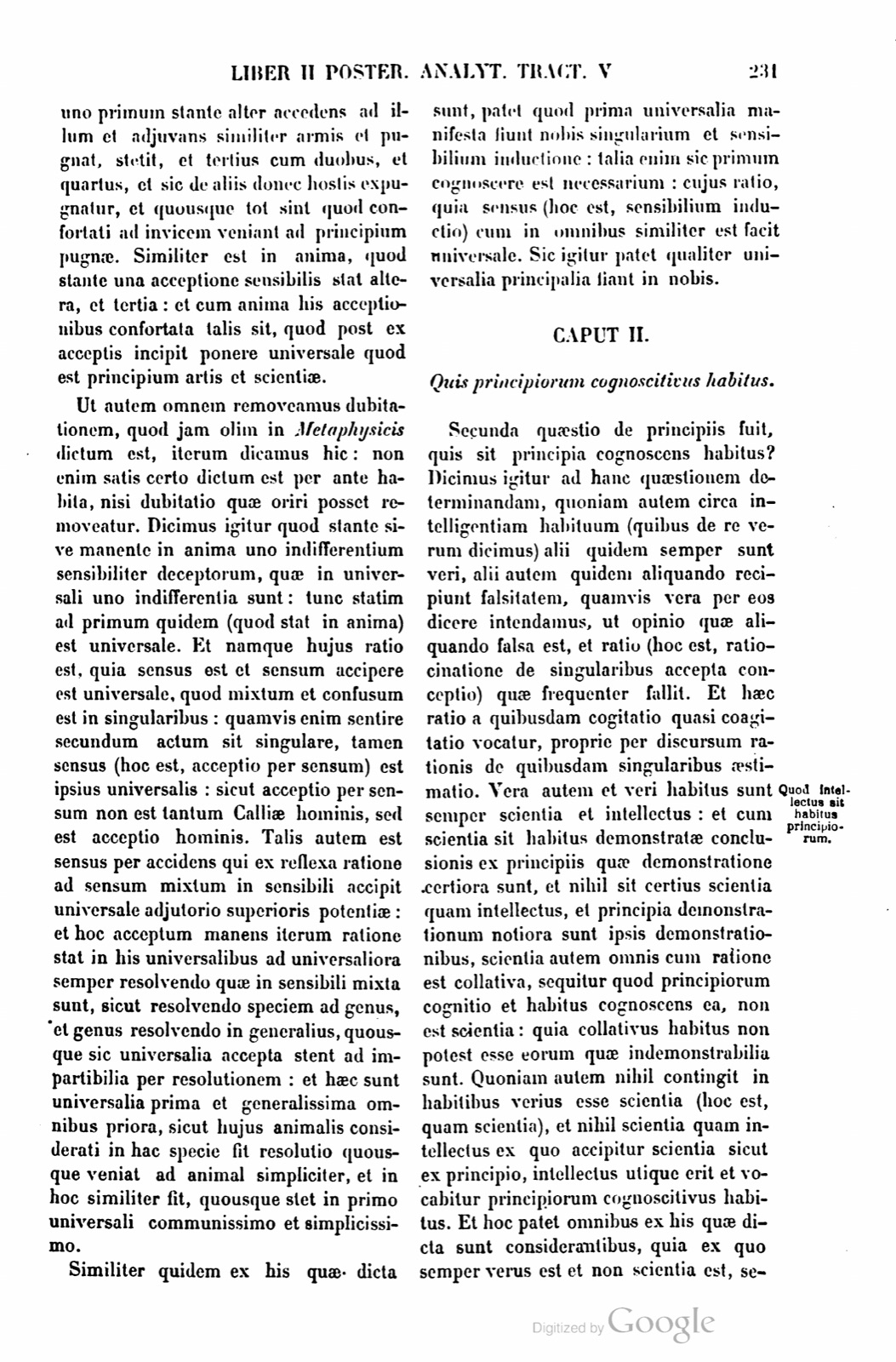
CAPUT II. Quis principiorum cognoscitivus habitus.
Secunda quaestio de principiis fuit, quis sit principia cognoscens habitus? Dicimus igitur ad hanc quaestionem determinandam, quoniam autem circa intelligentiam habituum quibus de re verum dicimus, alii quidem semper sunt veri, alii autem quidem aliquando recipiunt falsitatem, quamvis vera per eos dicere intendamus, ut opinio quae aliquando falsa est, et ratio, hoc est, ratiocinatione de singularibus accepta conceptio, quae frequenter fallit. Et haec ratio a quibusdam cogitatio quasi coagitatio vocatur, proprie per discursum rationis de quibusdam singularibus aestimatio.
<marginal-label>Quod Intellectus sit habitus principiorum.</marginal-label>
Vera autem et veri habitus sunt semper scientia et intellectus. Et cum scientia sit habitus demonstratae conclusionis ex principiis quae demonstratione certiora sunt, et nihil sit certius scientia quam intellectus, et principia demonstrationum notiora sunt ipsis demonstrationibus, scientia autem omnis cum ratione est collativa, sequitur quod principiorum cognitio et habitus cognoscens ea, non est scientia, quia collativus habitus non potest esse eorum quae indemonstrabilia sunt. Quoniam autem nihil contingit in habitibus verius esse scientia, hoc est, quam scientia, et nihil scientia quam intellectus ex quo accipitur scientia sicut ex principio, intellectus utique erit et vocabitur principiorum cognoscitivus habitus. Et hoc patet omnibus ex his quae dicta sunt considerantibus, quia ex quo semper verus est et non scientia est, sequitur quod sit intellectus; cum sapientia non sit in talibus secundum proprietatem accepta, quae non est nisi in summis et difficillimis homini cognoscere, tunc sequitur necessario, quod intellectus habitus principiorum cognoscens est.
Patet etiam sic considerantibus, quod quidem intellectus principium demonstrationis sit et non demonstratio, quia neque scientiae principium est scientia. Si igitur nihil aliud vel nullum aliud genus habitus habemus, quod sit secundum scientiam ad ipsam relatum sicut principium ad principiatum, quod sit semper dicens verum, nisi intellectum, sequitur quod intellectus utique erit habitus qui est scientiae principium. Hoc autem omne, quod de intellectu et demonstratione dictum est, similiter se habet in communi ad omne genus rerum, hoc est, ad omnem rem scitam in omni scientia. In omnibus enim scientia conclusionum causatur a cognitione intellectuali principiorum; et in hoc una scientia non differt ab alia.
CHAPTER 2. What habit is cognoscitive of principles.
The second question concerning principles was: what is the habit knowing principles? Therefore, to determine this question, we say that, concerning the understanding of habits by which we say what is true about a thing, some indeed are always true, while some sometimes receive falsity, although we intend to say true things through them, as opinion, which is sometimes false, and reason, that is, a conception accepted from reasoning about singulars, which frequently fails. And this reason is called by some cogitation, as though coagitation, properly an estimation concerning certain singulars through a discourse of reason.
<marginal-label>That intellect is the habit of principles.</marginal-label>
But true things and habits of the true are always science and intellect. And since science is the habit of a demonstrated conclusion from principles that are more certain than the demonstration, and nothing is more certain than science except intellect, and the principles of demonstrations are better known than the demonstrations themselves, while every science with reason is comparative, it follows that the cognition of principles, and the habit knowing them, is not science, because a comparative habit cannot be of those things that are indemonstrable. But because it does not happen that anything in habits is truer than science, that is, than science, and nothing is truer than science except intellect from which science is received as from a principle, intellect will certainly be and will be called the habit cognoscitive of principles. And this is clear to all who consider from the things that have been said, because since it is always true and is not science, it follows that it is intellect; since wisdom is not accepted properly in such matters, for it is only in the highest and most difficult things for a human being to know, then it follows necessarily that intellect is the habit knowing principles.
It is also clear to those considering in this way that intellect indeed is the principle of demonstration and is not demonstration, because neither is the principle of science science. Therefore, if we have no other thing or no other genus of habit which is related according to science to science itself as principle to principled, and which is always saying the true, except intellect, it follows that intellect will certainly be the habit which is the principle of science. But all this, which has been said about intellect and demonstration, is related similarly in common to every genus of things, that is, to every thing known in every science. For in all things the science of conclusions is caused by intellectual cognition of principles; and in this one science does not differ from another.
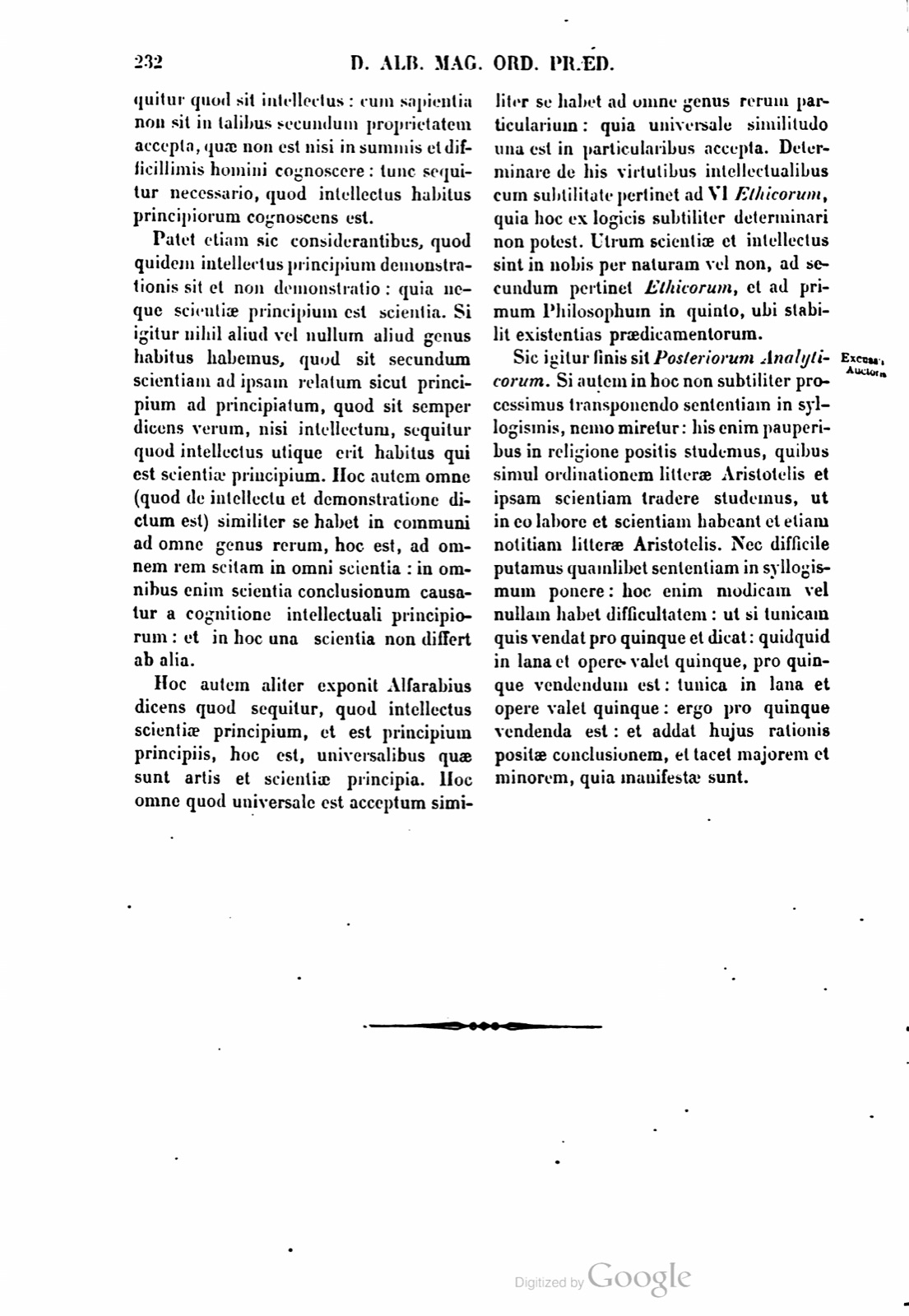
Hoc autem aliter exponit Alfarabius dicens quod sequitur, quod intellectus scientiae principium, et est principium principiis, hoc est, universalibus quae sunt artis et scientiae principia. Hoc omne quod universale est acceptum similiter se habet ad omne genus rerum particularium, quia universale similitudo una est in particularibus accepta. Determinare de his virtutibus intellectualibus cum subtilitate pertinet ad VI Ethicorum, quia hoc ex logicis subtiliter determinari non potest. Utrum scientiae et intellectus sint in nobis per naturam vel non, ad secundum pertinet Ethicorum, et ad primum Philosophum in quinto, ubi stabilit existentias praedicamentorum.
<marginal-label>Excusa Auctoris.</marginal-label>
Sic igitur finis sit Posteriorum Analyticorum. Si autem in hoc non subtiliter processimus transponendo sententiam in syllogismis, nemo miretur: his enim pauperibus in religione positis studemus, quibus simul ordinationem litterae Aristotelis et ipsam scientiam tradere studemus, ut in eo labore et scientiam habeant et etiam notitiam litterae Aristotelis. Nec difficile putamus quamlibet sententiam in syllogismum ponere: hoc enim modicam vel nullam habet difficultatem. Ut si tunicam quis vendat pro quinque et dicat: quidquid in lana et opere valet quinque, pro quinque vendendum est; tunica in lana et opere valet quinque; ergo pro quinque vendenda est; et addat hujus rationis positae conclusionem, et tacet majorem et minorem, quia manifestae sunt.
But Alfarabius expounds this otherwise, saying that it follows that intellect is the principle of science, and is the principle for principles, that is, for universals which are the principles of art and science. All this, namely what is accepted as universal, is related similarly to every genus of particular things, because the universal is one likeness accepted in particulars. To determine subtly concerning these intellectual virtues belongs to the sixth book of the Ethics, because this cannot be determined subtly from logical works. Whether sciences and intellect are in us through nature or not belongs to the second book of the Ethics, and to the First Philosopher in the fifth book, where he establishes the existences of the predicaments.
<marginal-label>Excuse of the Author.</marginal-label>
Thus, therefore, let this be the end of the Posterior Analytics. But if in this we have not proceeded subtly by transposing the meaning into syllogisms, let no one wonder: for we study for these poor men placed in religion, to whom at the same time we strive to hand down the ordering of Aristotle's text and the science itself, so that in that labor they may have both the science and also knowledge of Aristotle's text. Nor do we think it difficult to put any meaning whatever into a syllogism; for this has little or no difficulty. For example, if someone sells a tunic for five and says: whatever in wool and work is worth five must be sold for five; the tunic in wool and work is worth five; therefore it must be sold for five; and he adds the conclusion of this posited reasoning, and is silent about the major and minor premise, because they are manifest.
If a page does not appear, its photograph has not been uploaded yet.