Works › Posterior Analytics, Books I–II
Volume 2 · pp. 206–207
Chapter VII. On the demonstration of those things which are frequent and have circular generation.
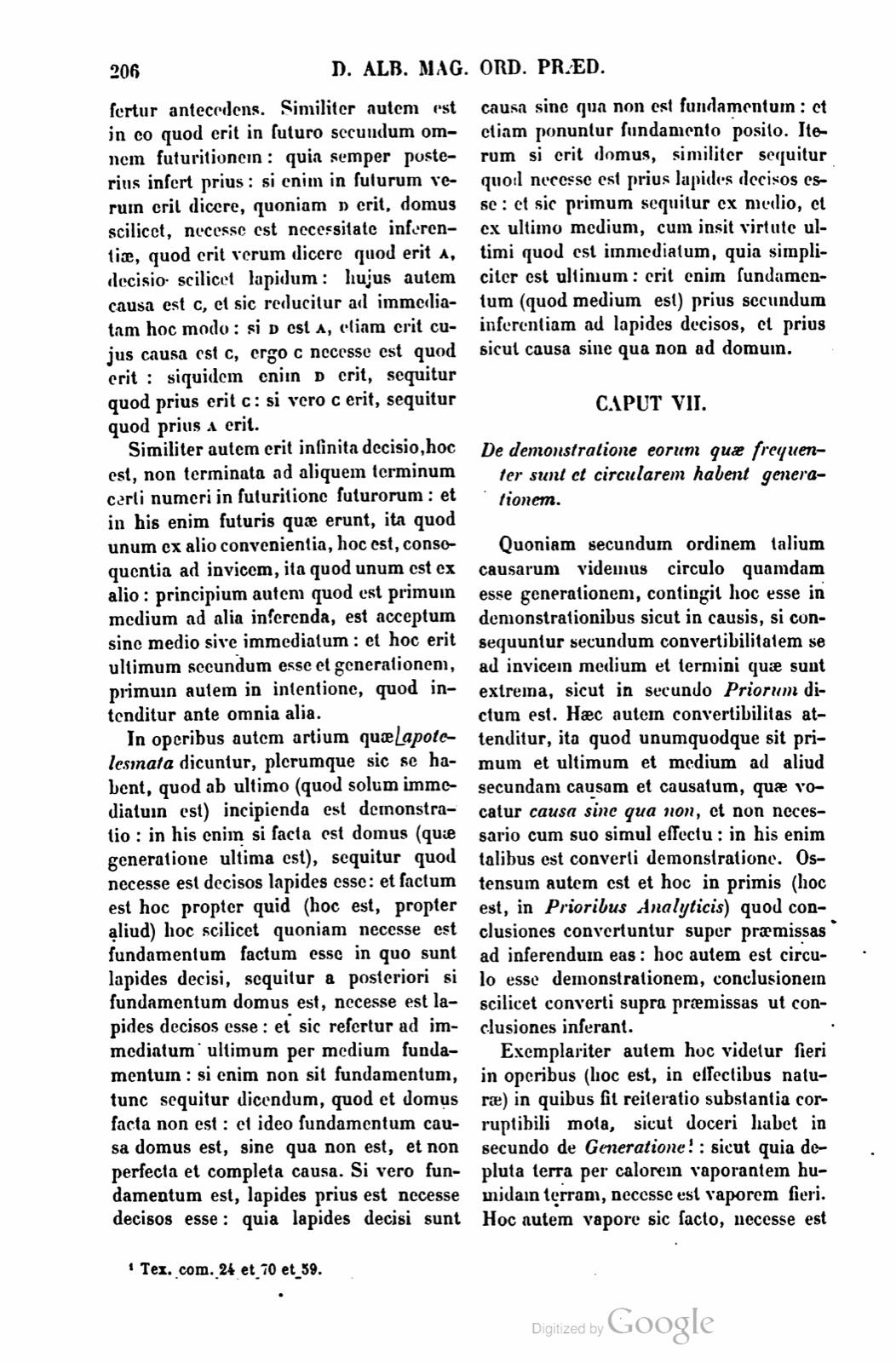
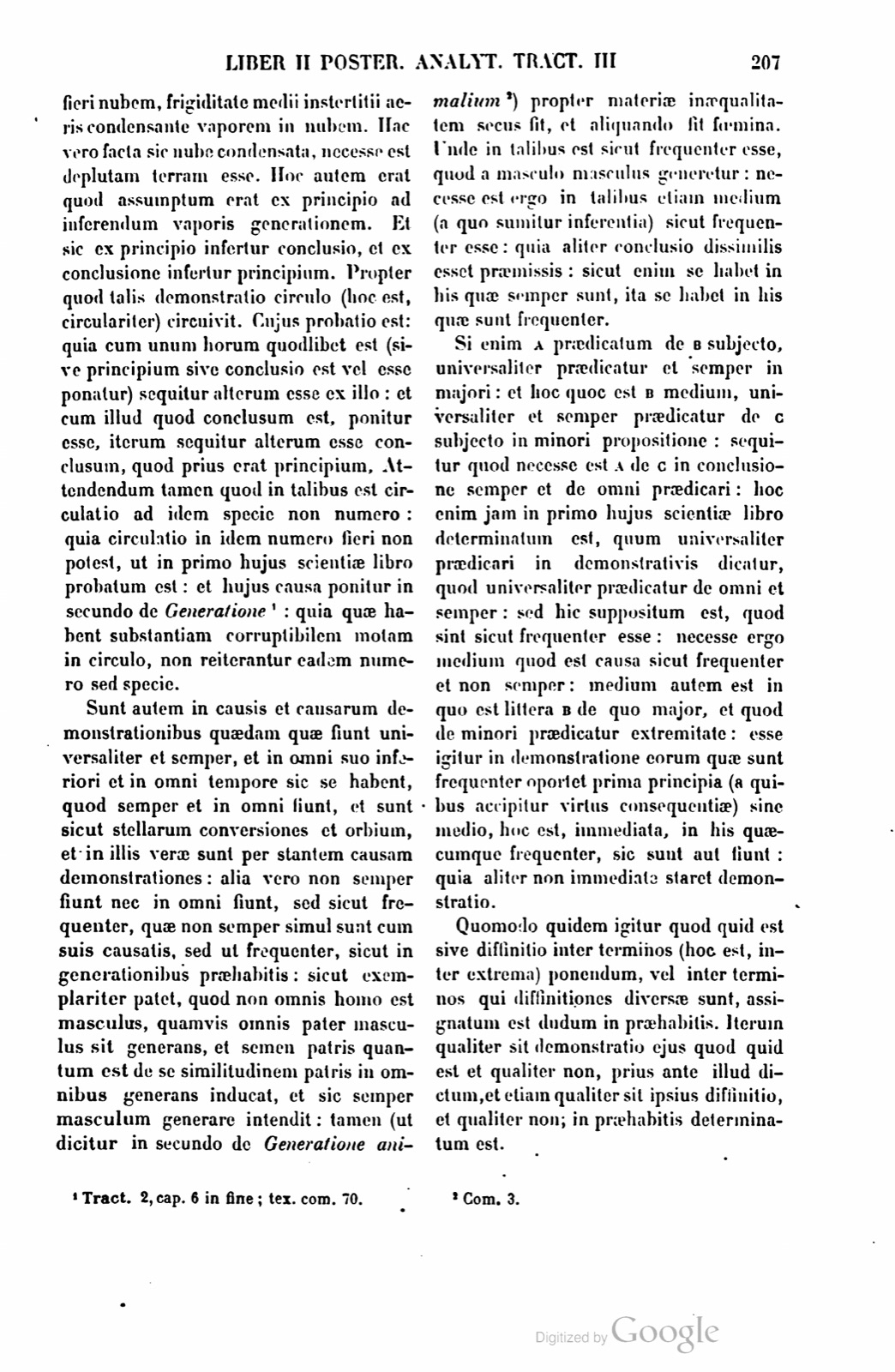
CAPUT VII. De demonstratione eorum quae frequenter sunt et circularem habent generationem. Quoniam secundum ordinem talium causarum videmus circulo quamdam esse generationem, contingit hoc esse in demonstrationibus sicut in causis, si consequuntur secundum convertibilitatem se ad invicem medium et termini quae sunt extrema, sicut in secundo Priorum dictum est. Haec autem convertibilitas attenditur, ita quod unumquodque sit primum et ultimum et medium ad aliud secundum causam et causatum, quae vocatur causa sine qua non, et non necessario cum suo simul effectu: in his enim talibus est converti demonstratione. Ostensum autem est et hoc in primis (hoc est, in Prioribus Analyticis) quod conclusiones convertuntur super praemissas ad inferendum eas: hoc autem est circulo esse demonstrationem, conclusionem scilicet converti supra praemissas ut conclusiones inferant. Exemplariter autem hoc videtur fieri in operibus (hoc est, in effectibus naturae) in quibus fit reiteratio substantia corruptibili mota, sicut doceri habet in secundo de Generatione 1: sicut quia depluta terra per calorem vaporantem humidam terram, necesse est vaporem fieri. Hoc autem vapore sic facto, necesse est fieri nubem, frigiditate medii interstitii aeris condensante vaporem in nubem. Hac vero facta sic nube condensata, necesse est deplutam terram esse. Hoc autem erat quod assumptum erat ex principio ad inferendum vaporis generationem. Et sic ex principio infertur conclusio, et ex conclusione infertur principium. Propter quod talis demonstratio circulo (hoc est, circulariter) circuivit. Cujus probatio est: quia cum unum horum quodlibet est (sive principium sive conclusio est vel esse ponatur) sequitur alterum esse ex illo: et cum illud quod conclusum est, ponitur esse, iterum sequitur alterum esse conclusum, quod prius erat principium. Attendendum tamen quod in talibus est circulatio ad idem specie non numero: quia circulatio in idem numero fieri non potest, ut in primo hujus scientiae libro probatum est: et hujus causa ponitur in secundo de Generatione 2: quia quae habent substantiam corruptibilem motam in circulo, non reiterantur eadem numero sed specie. Sunt autem in causis et causarum demonstrationibus quaedam quae fiunt universaliter et semper, et in omni suo inferiori et in omni tempore sic se habent, quod semper et in omni fiunt, et sunt sicut stellarum conversiones et orbium, et in illis verae sunt per stantem causam demonstrationes: alia vero non semper fiunt nec in omni fiunt, sed sicut frequenter, quae non semper simul sunt cum suis causatis, sed ut frequenter, sicut in generationibus praehabitis: sicut exemplariter patet, quod non omnis homo est masculus, quamvis omnis pater masculus sit generans, et semen patris quantum est de se similitudinem patris in omnibus generans inducat, et sic semper masculum generare intendit: tamen (ut dicitur in secundo de Generatione animalium 3) propter materiae inaequalitatem secus fit, et aliquando fit foemina. Unde in talibus est sicut frequenter esse, quod a masculo masculus generetur: necesse est ergo in talibus etiam medium (a quo sumitur inferentia) sicut frequenter esse: quia aliter conclusio dissimilis esset praemissis: sicut enim se habet in his quae semper sunt, ita se habet in his quae sunt frequenter. Si enim A praedicatum de C subjecto, universaliter praedicatur et semper in majori: et hoc quod est B medium, universaliter et semper praedicatur de C subjecto in minori propositione: sequitur quod necesse est A de C in conclusione semper et de omni praedicari: hoc enim jam in primo hujus scientiae libro determinatum est, quum universaliter praedicari in demonstrativis dicatur, quod universaliter praedicatur de omni et semper: sed hic suppositum est, quod sint sicut frequenter esse: necesse ergo medium quod est causa sicut frequenter et non semper: medium autem est in quo est littera B de quo major, et quod de minori praedicatur extremitate: esse igitur in demonstratione eorum quae sunt frequenter oportet prima principia (a quibus accipitur virtus consequentiae) sine medio, hoc est, immediata, in his quaecumque frequenter, sic sunt aut fiunt: quia aliter non immediate staret demonstratio. Quomodo quidem igitur quod quid est sive diffinitio inter terminos (hoc est, inter extrema) ponendum, vel inter terminos qui diffinitiones diversae sunt, assignatum est dudum in praehabitis. Iterum qualiter sit demonstratio ejus quod quid est et qualiter non, prius ante illud dictum, et etiam qualiter sit ipsius diffinitio, et qualiter non; in praehabitis determinatum est.
CHAPTER VII. On the demonstration of those things which are frequent and have circular generation. Since according to the order of such causes we see that there is a certain generation in a circle, this happens to be in demonstrations just as in causes, if the middle and the terms which are extremes follow one another according to convertibility, as was said in the second book of the Prior Analytics. But this convertibility is attended to in such a way that each thing is first and last and middle with respect to another according to cause and caused thing, which is called the cause without which not, and not necessarily together with its effect. For in such things there is conversion in demonstration. And this also has been shown in the first matters, that is, in the Prior Analytics, namely that conclusions are converted upon the premises for inferring them; but this is for demonstration to be in a circle, namely for the conclusion to be converted upon the premises so that they may infer conclusions. But by way of example this seems to happen in works, that is, in effects of nature, in which reiteration takes place when a corruptible substance is moved, as it must be taught in the second book On Generation 1. Thus, because the earth has been rained upon, through heat making the moist earth vaporous, it is necessary that vapor come to be. But when this vapor has thus been made, it is necessary that a cloud come to be, the coldness of the intervening middle air condensing the vapor into a cloud. But when this cloud has thus been made and condensed, it is necessary that the earth have been rained upon. But this was what had been assumed from the beginning for inferring the generation of vapor. And thus from the principle the conclusion is inferred, and from the conclusion the principle is inferred. For this reason such a demonstration has gone around in a circle, that is, circularly. The proof of this is that when any one of these is, whether it is the principle or conclusion or is posited to be, the other follows to be from it; and when that which has been concluded is posited to be, again the other follows to be concluded, which earlier was the principle. Nevertheless one must attend that in such things there is circulation to the same in species, not in number, because circulation to the same in number cannot occur, as was proved in the first book of this science; and the cause of this is posited in the second book On Generation 2, because things which have corruptible substance moved in a circle are not reiterated as the same in number but as the same in species. But in causes and demonstrations of causes there are certain things which come to be universally and always, and in every inferior of theirs and at every time have themselves thus, that they come to be always and in every case, and they are like the turnings of the stars and spheres, and in them demonstrations are true through a standing cause. But others do not come to be always nor in every case, but as frequently, and they are not always together with their caused things, but as frequently, as in the generations already had. Thus it is clear by example that not every human being is male, although every father is a male generating, and the seed of the father, as much as is of itself, introduces the likeness of the father in all things by generating, and thus always intends to generate a male; nevertheless, as is said in the second book On the Generation of Animals 3, because of the inequality of matter it happens otherwise, and sometimes a female comes to be. Hence in such things there is being as frequently, that from a male a male is generated; therefore in such things the middle, from which the inference is taken, must also be as frequently, because otherwise the conclusion would be unlike the premises. For as it has itself in those things which always are, so it has itself in those things which are frequently. For if A, the predicate, is predicated of C the subject universally and always in the major, and this which is B, the middle, is predicated universally and always of C the subject in the minor proposition, it follows that A must be predicated of C in the conclusion always and of every case; for this has already been determined in the first book of this science, when being predicated universally in demonstrative matters is said to be that which is predicated universally of every case and always. But here it has been supposed that they are as frequently; therefore the middle which is the cause must be as frequently and not always. But the middle is that in which the letter B is, concerning which there is the major, and that which is predicated of the lesser extremity. Therefore in demonstration of those things which are frequent, the first principles from which the force of the consequence is received must be without a middle, that is, immediate, in whatever things frequently are or come to be in this way, because otherwise demonstration would not stand immediately. Therefore in what way what it is or definition must be posited between the terms, that is, between the extremes, or between terms which are diverse definitions, was assigned some time ago in what was already had. Again, in what way there is demonstration of what it is and in what way not was said before that, and also in what way there is definition of it and in what way not; this has been determined in what was had before.
If a page does not appear, its photograph has not been uploaded yet.