Works › Posterior Analytics, Books I–II
Volume 2 · pp. 203–206
Chapter VI. On demonstration in causes and caused things which are not simultaneous.
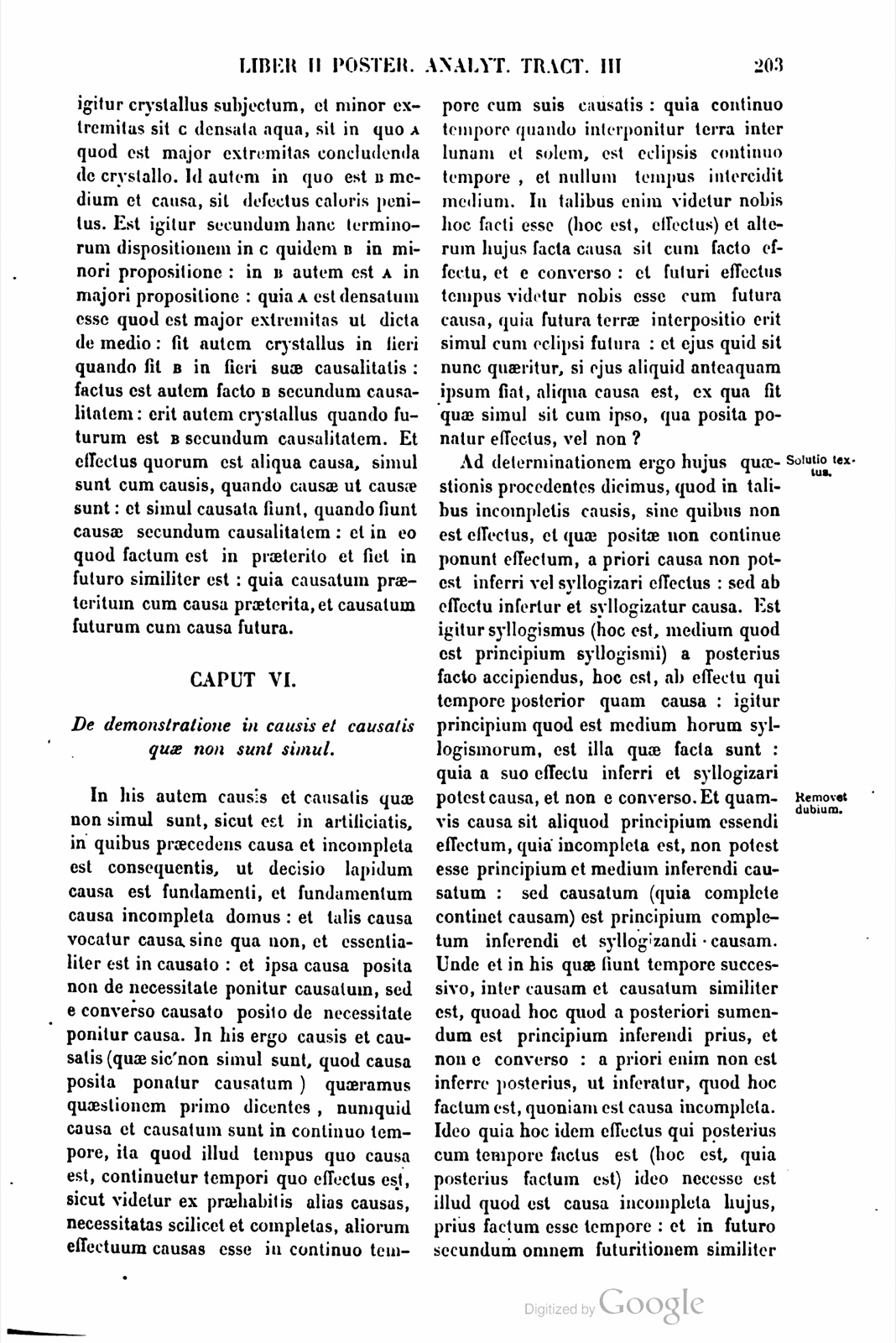
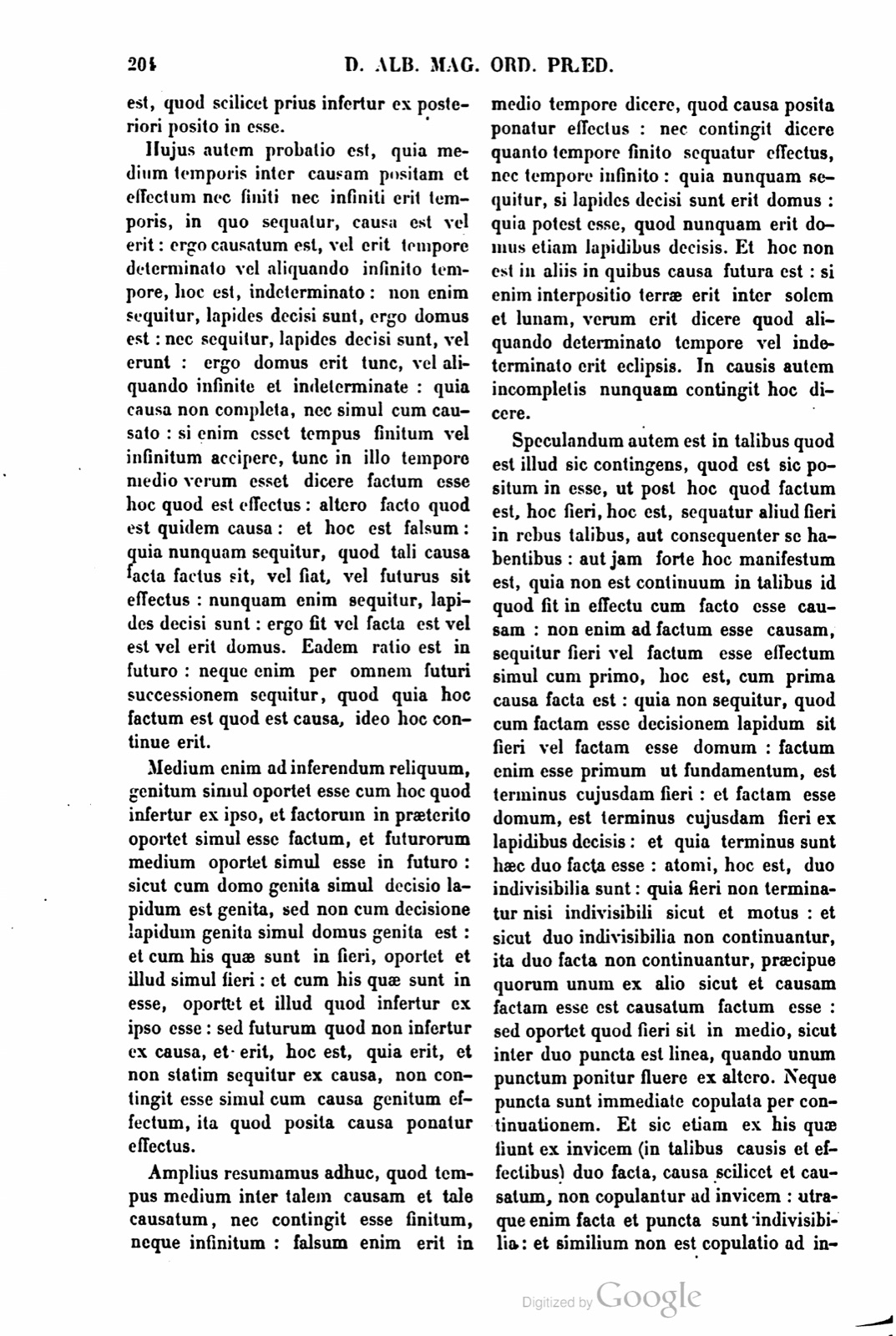
CAPUT VI. De demonstratione in causis et causatis quae non sunt simul. In his autem causis et causatis quae non simul sunt, sicut est in artificiatis, in quibus praecedens causa et incompleta est consequentis, ut decisio lapidum causa est fundamenti, et fundamentum causa incompleta domus: et talis causa vocatur causa sine qua non, et essentialiter est in causato: et ipsa causa posita non de necessitate ponitur causatum, sed e converso causato posito de necessitate ponitur causa. In his ergo causis et causatis (quae sic non simul sunt, quod causa posita ponatur causatum) quaeramus quaestionem primo dicentes, numquid causa et causatum sunt in continuo tempore, ita quod illud tempus quo causa est, continuetur tempori quo effectus est, sicut videtur ex praehabitis alias causas, necessitatas scilicet et completas, aliorum effectuum causas esse in continuo tempore cum suis causatis: quia continuo tempore quando interponitur terra inter lunam et solem, est eclipsis continuo tempore, et nullum tempus intercidit medium. In talibus enim videtur nobis hoc facti esse (hoc est, effectus) et alterum hujus facta causa sit cum facto effectu, et e converso: et futuri effectus tempus videtur nobis esse cum futura causa, quia futura terrae interpositio erit simul cum eclipsi futura: et ejus quid sit nunc quaeritur, si ejus aliquid antea quam ipsum fiat, aliqua causa est, ex qua fit quae simul sit cum ipso, qua posita ponatur effectus, vel non? <marginal-label>Solutio textus.</marginal-label> Ad determinationem ergo hujus quaestionis procedentes dicimus, quod in talibus incompletis causis, sine quibus non est effectus, et quae positae non continue ponunt effectum, a priori causa non potest inferri vel syllogizari effectus: sed ab effectu infertur et syllogizatur causa. Est igitur syllogismus (hoc est, medium quod est principium syllogismi) a posterius facto accipiendus, hoc est, ab effectu qui tempore posterior quam causa: igitur principium quod est medium horum syllogismorum, est illa quae facta sunt: quia a suo effectu inferri et syllogizari potest causa, et non e converso. <marginal-label>Removet dubium.</marginal-label> Et quamvis causa sit aliquod principium essendi effectum, quia incompleta est, non potest esse principium et medium inferendi causatum: sed causatum (quia complete continet causam) est principium completum inferendi et syllogizandi causam. Unde et in his quae fiunt tempore successivo, inter causam et causatum similiter est, quoad hoc quod a posteriori sumendum est principium inferendi prius, et non e converso: a priori enim non est inferre posterius, ut inferatur, quod hoc factum est, quoniam est causa incompleta. Ideo quia hoc idem effectus qui posterius cum tempore factus est (hoc est, quia posterius factum est) ideo necesse est illud quod est causa incompleta hujus, prius factum esse tempore: et in futuro secundum omnem futuritionem similiter est, quod scilicet prius infertur ex posteriori posito in esse. Hujus autem probatio est, quia medium temporis inter causam positam et effectum nec finiti nec infiniti erit temporis, in quo sequatur, causa est vel erit: ergo causatum est, vel erit tempore determinato vel aliquando infinito tempore, hoc est, indeterminato: non enim sequitur, lapides decisi sunt, ergo domus est: nec sequitur, lapides decisi sunt, vel erunt: ergo domus erit tunc, vel aliquando infinite et indeterminate: quia causa non completa, nec simul cum causato: si enim esset tempus finitum vel infinitum accipere, tunc in illo tempore medio verum esset dicere factum esse hoc quod est effectus: altero facto quod est quidem causa: et hoc est falsum: quia nunquam sequitur, quod tali causa facta factus sit, vel fiat, vel futurus sit effectus: nunquam enim sequitur, lapides decisi sunt: ergo fit vel facta est vel est vel erit domus. Eadem ratio est in futuro: neque enim per omnem futuri successionem sequitur, quod quia hoc factum est quod est causa, ideo hoc continue erit. Medium enim ad inferendum reliquum, genitum simul oportet esse cum hoc quod infertur ex ipso, et factorum in praeterito oportet simul esse factum, et futurorum medium oportet simul esse in futuro: sicut cum domo genita simul decisio lapidum est genita, sed non cum decisione lapidum genita simul domus genita est: et cum his quae sunt in fieri, oportet et illud simul fieri: et cum his quae sunt in esse, oportet et illud quod infertur ex ipso esse: sed futurum quod non infertur ex causa, et erit, hoc est, quia erit, et non statim sequitur ex causa, non contingit esse simul cum causa genitum effectum, ita quod posita causa ponatur effectus. Amplius resumamus adhuc, quod tempus medium inter talem causam et tale causatum, nec contingit esse finitum, neque infinitum: falsum enim erit in medio tempore dicere, quod causa posita ponatur effectus: nec contingit dicere quanto tempore finito sequatur effectus, nec tempore infinito: quia nunquam sequitur, si lapides decisi sunt erit domus: quia potest esse, quod nunquam erit domus etiam lapidibus decisis. Et hoc non est in aliis in quibus causa futura est: si enim interpositio terrae erit inter solem et lunam, verum erit dicere quod aliquando determinato tempore vel indeterminato erit eclipsis. In causis autem incompletis nunquam contingit hoc dicere. Speculandum autem est in talibus quod est illud sic contingens, quod est sic positum in esse, ut post hoc quod factum est, hoc fieri, hoc est, sequatur aliud fieri in rebus talibus, aut consequenter se habentibus: aut jam forte hoc manifestum est, quia non est continuum in talibus id quod fit in effectu cum facto esse causam: non enim ad factum esse causam, sequitur fieri vel factum esse effectum simul cum primo, hoc est, cum prima causa facta est: quia non sequitur, quod cum factam esse decisionem lapidum sit fieri vel factam esse domum: factum enim esse primum ut fundamentum, est terminus cujusdam fieri: et factam esse domum, est terminus cujusdam fieri ex lapidibus decisis: et quia terminus sunt haec duo facta esse: atomi, hoc est, duo indivisibilia sunt: quia fieri non terminatur nisi indivisibili sicut et motus: et sicut duo indivisibilia non continuantur, ita duo facta non continuantur, praecipue quorum unum ex alio sicut et causam factam esse est causatum factum esse: sed oportet quod fieri sit in medio, sicut inter duo puncta est linea, quando unum punctum ponitur fluere ex altero. Neque puncta sunt immediate copulata per continuationem. Et sic etiam ex his quae fiunt ex invicem (in talibus causis et effectibus) duo facta, causa scilicet et causatum, non copulantur ad invicem: utraque enim facta et puncta sunt indivisibilia: et similium non est copulatio ad invicem.
CHAPTER VI. On demonstration in causes and caused things which are not simultaneous. But in these causes and caused things which are not simultaneous, as happens in things made by art, in which a preceding and incomplete cause belongs to what follows, as the cutting of stones is the cause of the foundation and the foundation is the incomplete cause of the house, and such a cause is called a cause without which not, and is essentially in the caused thing, and when the cause itself has been posited the caused thing is not posited from necessity, but conversely, when the caused thing has been posited, the cause is posited from necessity. Therefore in these causes and caused things, which are not simultaneous in such a way that, when the cause is posited, the caused thing is posited, let us first ask the question by saying whether the cause and caused thing are in continuous time, so that that time in which the cause is is continuous with the time in which the effect is, just as from what has been had before other causes, namely necessitated and complete causes, seem to be causes of other effects in continuous time with their caused things; because in continuous time, when the earth is interposed between the moon and the sun, the eclipse exists in continuous time and no middle time intervenes. For in such things this seems to us to have been made, that is, the effect, and the other, the made cause of this, seems to be with the made effect, and conversely; and the time of the future effect seems to us to be with the future cause, because the future interposition of the earth will be together with the future eclipse. And what it is is now sought concerning this: whether there is some cause of it before it itself comes to be, from which it comes to be, which is together with it, such that when it is posited the effect is posited, or not. <marginal-label>Solution of the text.</marginal-label> Therefore proceeding to the determination of this question, we say that in such incomplete causes, without which there is not an effect and which when posited do not continuously posit the effect, the effect cannot be inferred or syllogized from the prior cause; but from the effect the cause is inferred and syllogized. Therefore the syllogism, that is, the middle which is the principle of the syllogism, must be taken from the thing made afterward, that is, from the effect which is later in time than the cause. Therefore the principle which is the middle of these syllogisms is those things which have been made, because the cause can be inferred and syllogized from its effect, and not conversely. <marginal-label>He removes a doubt.</marginal-label> And although the cause is some principle of the effect's being, because it is incomplete, it cannot be the principle and middle for inferring the caused thing; but the caused thing, because it completely contains the cause, is the complete principle for inferring and syllogizing the cause. Hence also in those things which come to be in successive time, between cause and caused thing it is similar with respect to this, that the principle of inferring the prior must be taken from the posterior and not conversely; for from the prior there is no inferring the posterior so that it may be inferred that this has been made because it is an incomplete cause. Therefore because this same effect, which later was made together with time, that is, because it was made later, therefore it is necessary that that which is the incomplete cause of this was made earlier in time; and in the future according to every futurition it is similar, namely that the prior is inferred from the posterior posited in being. But the proof of this is that the middle of time between a posited cause and the effect will be of neither finite nor infinite time, in which it follows that the cause is or will be; therefore the caused thing is or will be at a determinate time or sometime in infinite time, that is, indeterminate time. For it does not follow, the stones have been cut, therefore the house exists; nor does it follow, the stones have been cut, or will have been cut, therefore the house will then be, or sometime infinitely and indeterminately, because the cause is not complete nor together with the caused thing. For if it were possible to receive a finite or infinite time, then in that middle time it would be true to say that this which is the effect has been made, when the other which is indeed the cause has been made; and this is false, because it never follows that, when such a cause has been made, the effect has been made, or comes to be, or will be. For it never follows: the stones have been cut; therefore the house comes to be or has been made or exists or will be. The same account holds in the future; for not through every succession of the future does it follow that, because this which is the cause has been made, therefore this will continuously be. For the middle for inferring the remaining thing, when generated, must be together with that which is inferred from it; and of things made in the past it must have been made together; and of future things the middle must be together in the future. For example, with a generated house the cutting of stones was generated together, but with the generated cutting of stones the generated house was not together. And with those things which are in coming-to-be, that too must come to be together; and with those things which are in being, that which is inferred from it also must be. But the future thing which is not inferred from the cause, and will be, that is, because it will be and does not immediately follow from the cause, cannot be an effect generated together with the cause in such a way that when the cause is posited the effect is posited. Moreover let us take up again that the middle time between such a cause and such a caused thing cannot be finite, nor infinite; for it will be false to say in the middle time that, when the cause has been posited, the effect is posited. Nor can one say by how much finite time the effect follows, nor by infinite time, because it never follows: if the stones have been cut, the house will be; because it can be that there will never be a house even with the stones having been cut. And this is not so in other things in which the cause is future; for if the interposition of the earth will be between the sun and the moon, it will be true to say that sometime at a determinate or indeterminate time there will be an eclipse. But in incomplete causes it never happens to say this. But in such matters one must consider what that thing thus contingent is, which is so posited in being that after this has been made, this comes to be, that is, another coming-to-be follows in such things, or in things having themselves consequently. Or perhaps this is now manifest, that in such things what comes to be in the effect is not continuous with the having-been-made of the cause. For upon the cause's having-been-made there does not follow the coming-to-be or having-been-made of the effect simultaneously with the first, that is, when the first cause has been made, because it does not follow that, when the cutting of stones has been made, there is the coming-to-be or the having-been-made of the house. For the first having-been-made, as the foundation, is the term of a certain coming-to-be; and the having-been-made of the house is the term of a certain coming-to-be from cut stones. And because these two having-been-made things are termini, they are atoms, that is, two indivisibles, because coming-to-be is terminated only by an indivisible, as also motion is. And just as two indivisibles are not continued, so two made things are not continued, especially when one of them is from the other, just as the having-been-made of the cause is the having-been-made of the caused thing. But it is necessary that coming-to-be be in the middle, just as between two points there is a line when one point is posited to flow from the other. Nor are points immediately joined by continuation. And thus also from these things which come to be from one another, in such causes and effects, the two made things, namely cause and caused thing, are not joined to one another; for both made things and points are indivisible, and there is no joining of things alike to one another.
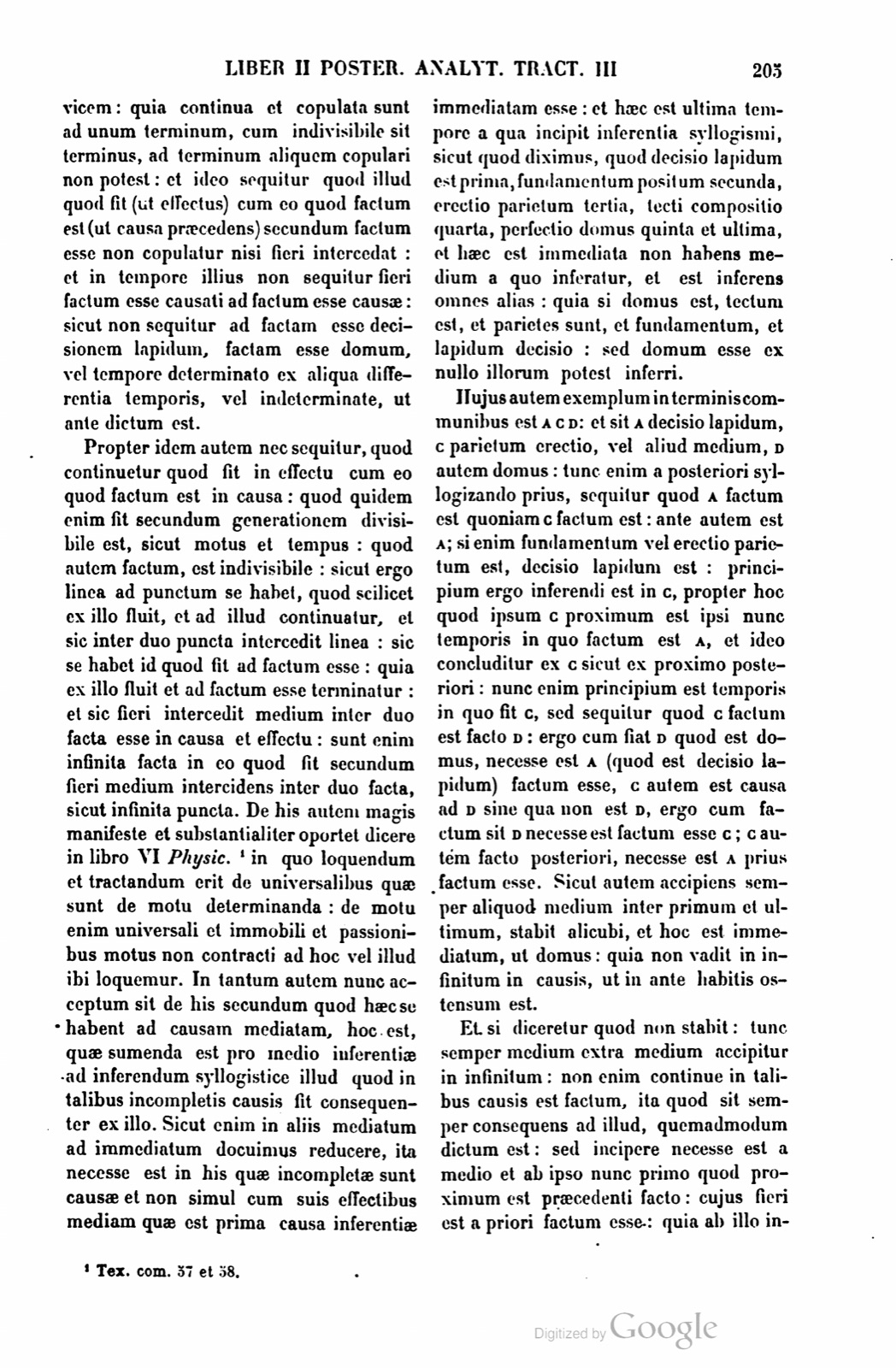
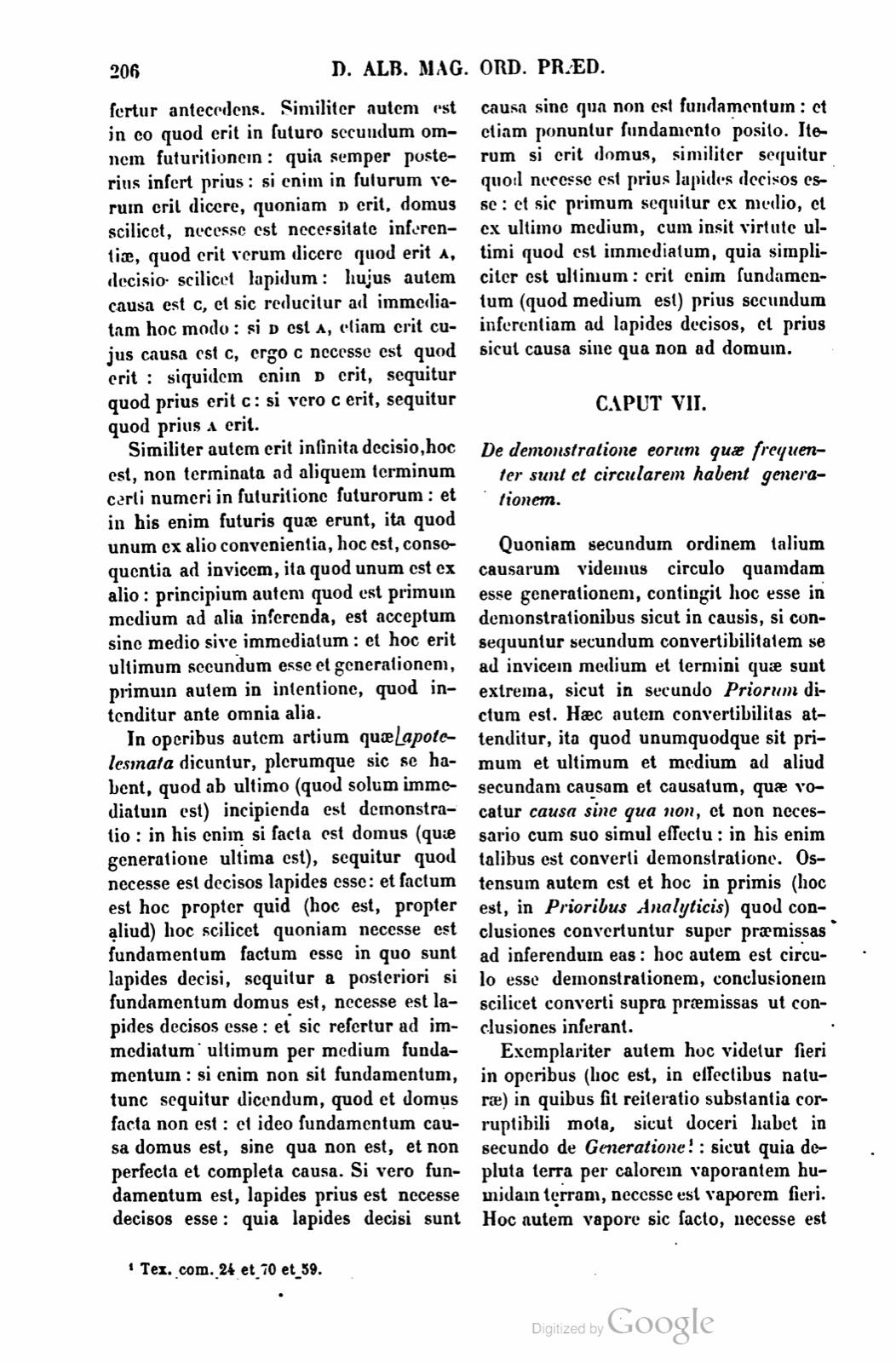
quia continua et copulata sunt ad unum terminum, cum indivisibile sit terminus, ad terminum aliquem copulari non potest: et ideo sequitur quod illud quod fit (ut effectus) cum eo quod factum est (ut causa praecedens) secundum factum esse non copulatur nisi fieri intercedat: et in tempore illius non sequitur fieri factum esse causati ad factum esse causae: sicut non sequitur ad factam esse decisionem lapidum, factam esse domum, vel tempore determinato ex aliqua differentia temporis, vel indeterminate, ut ante dictum est. Propter idem autem nec sequitur, quod continuetur quod fit in effectu cum eo quod factum est in causa: quod quidem enim fit secundum generationem divisibile est, sicut motus et tempus: quod autem factum, est indivisibile: sicut ergo linea ad punctum se habet, quod scilicet ex illo fluit, et ad illud continuatur, et sic inter duo puncta intercedit linea: sic se habet id quod fit ad factum esse: quia ex illo fluit et ad factum esse terminatur: et sic fieri intercedit medium inter duo facta esse in causa et effectu: sunt enim infinita facta in eo quod fit secundum fieri medium intercidens inter duo facta, sicut infinita puncta. De his autem magis manifeste et substantialiter oportet dicere in libro VI Physic. 1 in quo loquendum et tractandum erit de universalibus quae sunt de motu determinanda: de motu enim universali et immobili et passionibus motus non contracti ad hoc vel illud ibi loquemur. In tantum autem nunc acceptum sit de his secundum quod haec se habent ad causam mediatam, hoc est, quae sumenda est pro medio inferentiae ad inferendum syllogistice illud quod in talibus incompletis causis fit consequenter ex illo. Sicut enim in aliis mediatum ad immediatum docuimus reducere, ita necesse est in his quae incompletae sunt causae et non simul cum suis effectibus mediam quae est prima causa inferentiae immediatam esse: et haec est ultima tempore a qua incipit inferentia syllogismi, sicut quod diximus, quod decisio lapidum est prima, fundamentum positum secunda, erectio parietum tertia, tecti compositio quarta, perfectio domus quinta et ultima, et haec est immediata non habens medium a quo inferatur, et est inferens omnes alias: quia si domus est, tectum est, et parietes sunt, et fundamentum, et lapidum decisio: sed domum esse ex nullo illorum potest inferri. Hujus autem exemplum in terminis communibus est A C D: et sit A decisio lapidum, C parietum erectio, vel aliud medium, D autem domus: tunc enim a posteriori syllogizando prius, sequitur quod A factum est quoniam C factum est: ante autem est A; si enim fundamentum vel erectio parietum est, decisio lapidum est: principium ergo inferendi est in C, propter hoc quod ipsum C proximum est ipsi nunc temporis in quo factum est A, et ideo concluditur ex C sicut ex proximo posteriori: nunc enim principium est temporis in quo fit C, sed sequitur quod C factum est facto D: ergo cum fiat D quod est domus, necesse est A (quod est decisio lapidum) factum esse, C autem est causa ad D sine qua non est D, ergo cum factum sit D necesse est factum esse C; causa autem facto posteriori, necesse est A prius factum esse. Sicut autem accipiens semper aliquod medium inter primum et ultimum, stabit alicubi, et hoc est immediatum, ut domus: quia non vadit in infinitum in causis, ut in ante habitis ostensum est. Et si diceretur quod non stabit: tunc semper medium extra medium accipitur in infinitum: non enim continue in talibus causis est factum, ita quod sit semper consequens ad illud, quemadmodum dictum est: sed incipere necesse est a medio et ab ipso nunc primo quod proximum est praecedenti facto: cujus fieri est a priori factum esse: quia ab illo infertur antecedens. Similiter autem est in eo quod erit in futuro secundum omnem futuritionem: quia semper posterius infert prius: si enim in futurum verum erit dicere, quoniam D erit, domus scilicet, necesse est necessitate inferentiae, quod erit verum dicere quod erit A, decisio scilicet lapidum: hujus autem causa est C, et sic reducitur ad immediatam hoc modo: si D est A, etiam erit cujus causa est C, ergo C necesse est quod erit: siquidem enim D erit, sequitur quod prius erit C: si vero C erit, sequitur quod prius A erit. Similiter autem erit infinita decisio, hoc est, non terminata ad aliquem terminum certi numeri in futuritione futurorum: et in his enim futuris quae erunt, ita quod unum ex alio convenientia, hoc est, consequentia ad invicem, ita quod unum est ex alio: principium autem quod est primum medium ad alia inferenda, est acceptum sine medio sive immediatum: et hoc erit ultimum secundum esse et generationem, primum autem in intentione, quod intenditur ante omnia alia. In operibus autem artium quae apotelesmata dicuntur, plerumque sic se habent, quod ab ultimo (quod solum immediatum est) incipienda est demonstratio: in his enim si facta est domus (quae generatione ultima est), sequitur quod necesse est decisos lapides esse: et factum est hoc propter quid (hoc est, propter aliud) hoc scilicet quoniam necesse est fundamentum factum esse in quo sunt lapides decisi, sequitur a posteriori si fundamentum domus est, necesse est lapides decisos esse: et sic refertur ad immediatum ultimum per medium fundamentum: si enim non sit fundamentum, tunc sequitur dicendum, quod et domus facta non est: et ideo fundamentum causa domus est, sine qua non est, et non perfecta et completa causa. Si vero fundamentum est, lapides prius est necesse decisos esse: quia lapides decisi sunt causa sine qua non est fundamentum: et etiam ponuntur fundamento posito. Iterum si erit domus, similiter sequitur quod necesse est prius lapides decisos esse: et sic primum sequitur ex medio, et ex ultimo medium, cum insit virtute ultimi quod est immediatum, quia simpliciter est ultimum: erit enim fundamentum (quod medium est) prius secundum inferentiam ad lapides decisos, et prius sicut causa sine qua non ad domum.
because continuous and joined things are continuous and joined to one term, since an indivisible is a term, it cannot be joined to some term; and therefore it follows that that which comes to be, as an effect, with that which has been made, as the preceding cause, is not joined according to having-been-made unless coming-to-be intervenes. And in the time of that coming-to-be there does not follow the having-been-made of the caused thing upon the having-been-made of the cause, just as upon the cutting of stones having been made there does not follow the having-been-made of a house, either in a determinate time from some difference of time or indeterminately, as was said before. For the same reason it also does not follow that what comes to be in the effect is continued with what has been made in the cause. For that which comes to be according to generation is divisible, as motion and time are, but that which has been made is indivisible. Therefore just as a line has itself to a point, namely that it flows from that and is continued to that, and so a line intervenes between two points, so that which comes to be has itself to having-been-made, because it flows from that and is terminated at having-been-made. And thus coming-to-be intervenes as a middle between two things having been made in cause and effect; for there are infinite made things in that which comes to be according to coming-to-be, the middle falling between two made things, as infinite points. But concerning these things one must speak more manifestly and substantially in book VI of the Physics 1, in which one will have to speak and treat of the universals which must be determined concerning motion; for there we shall speak concerning universal and immobile motion and concerning the passions of motion not contracted to this or that. But for now let so much have been accepted concerning these things according as they are related to a mediate cause, that is, one which must be taken as the middle of inference for syllogistically inferring that which in such incomplete causes comes to be consequently from it. For just as in other things we have taught that the mediate is to be reduced to the immediate, so in these things which are incomplete causes and are not simultaneous with their effects, it is necessary that the mediate cause which is the first cause of inference be immediate; and this is last in time, from which the inference of the syllogism begins, as what we said: that the cutting of stones is first, the foundation posited second, the erection of walls third, the composition of the roof fourth, the perfection of the house fifth and last, and this is immediate, having no middle from which it may be inferred, and it infers all the others, because if the house exists, the roof exists, and the walls exist, and the foundation, and the cutting of stones; but the being of the house cannot be inferred from any of those. But the example of this in common terms is A C D; and let A be the cutting of stones, C the erection of walls or another middle, and D the house. For then by syllogizing the prior from the posterior, it follows that A has been made because C has been made; but A is before. For if the foundation or erection of walls exists, the cutting of stones exists. Therefore the principle of inferring is in C, on account of this, that C itself is nearest to the now of time in which A has been made, and therefore it is concluded from C as from the nearest posterior. For now is the principle of the time in which C comes to be, but it follows that C has been made when D has been made. Therefore, when D comes to be, which is the house, it is necessary that A, which is the cutting of stones, has been made; but C is a cause to D without which D is not. Therefore when D has been made, it is necessary that C has been made; and when the posterior has been made as caused, it is necessary that A was made earlier. But just as one always taking some middle between the first and the last will stand somewhere, and this is immediate, as a house, because one does not go to infinity in causes, as has been shown in what was had before. And if it were said that it will not stand, then a middle beyond a middle is always taken to infinity; for the made thing is not continuous in such causes, so that it should always be consequent upon that, in the way that has been said. But it is necessary to begin from the middle and from the first now itself which is nearest to the preceding made thing, whose coming-to-be is a having-been-made from the prior, because from that the antecedent is inferred. But it is similar in that which will be in the future according to every futurition, because the posterior always infers the prior. For if in the future it will be true to say that D will be, namely the house, it is necessary by the necessity of inference that it will be true to say that A will be, namely the cutting of stones. But the cause of this is C, and thus it is reduced to the immediate in this way: if D is A, that also will be whose cause is C; therefore it is necessary that C will be. For if D will be, it follows that C will be prior; but if C will be, it follows that A will be prior. But similarly there will be an infinite cutting, that is, one not terminated to some term of a certain number in the futurition of future things. For also in these future things which will be, in such a way that one thing is from another, things agreeing, that is, consequent upon one another, so that one is from another, the principle which is the first middle for inferring the others is accepted without a middle or immediate; and this will be last according to being and generation, but first in intention, because it is intended before all other things. But in works of arts which are called apotelesmata, they usually have themselves thus, that demonstration must begin from the last, which alone is immediate. For in these things, if the house has been made, which is last in generation, it follows that it is necessary for the stones to have been cut; and this has been made on account of which, that is, on account of another thing, namely because it is necessary that the foundation in which the cut stones are has been made. It follows from the posterior, if the foundation of the house exists, that it is necessary that the stones have been cut; and thus it is referred to the immediate last through the middle, the foundation. For if the foundation is not, then it follows that one must say that the house too has not been made; and therefore the foundation is a cause of the house, without which it is not, and not a perfect and complete cause. But if the foundation exists, it is necessary that the stones have been cut before, because the cut stones are the cause without which the foundation is not; and they are also posited when the foundation has been posited. Again, if the house will be, similarly it follows that it is necessary for the stones to have been cut before; and thus the first follows from the middle, and from the last the middle, since it is in the power of the last, which is immediate, because it is simply last. For the foundation, which is the middle, will be prior according to inference to the cut stones, and prior as a cause without which not to the house.
Notes
- Commentary texts 37 and 58. (Tex. com. 37 et 58.) ↩
If a page does not appear, its photograph has not been uploaded yet.