Works › Posterior Analytics, Books I–II
Volume 2 · pp. 159–161
Chapter II. On the exclusion of doubtful things concerning the principles.
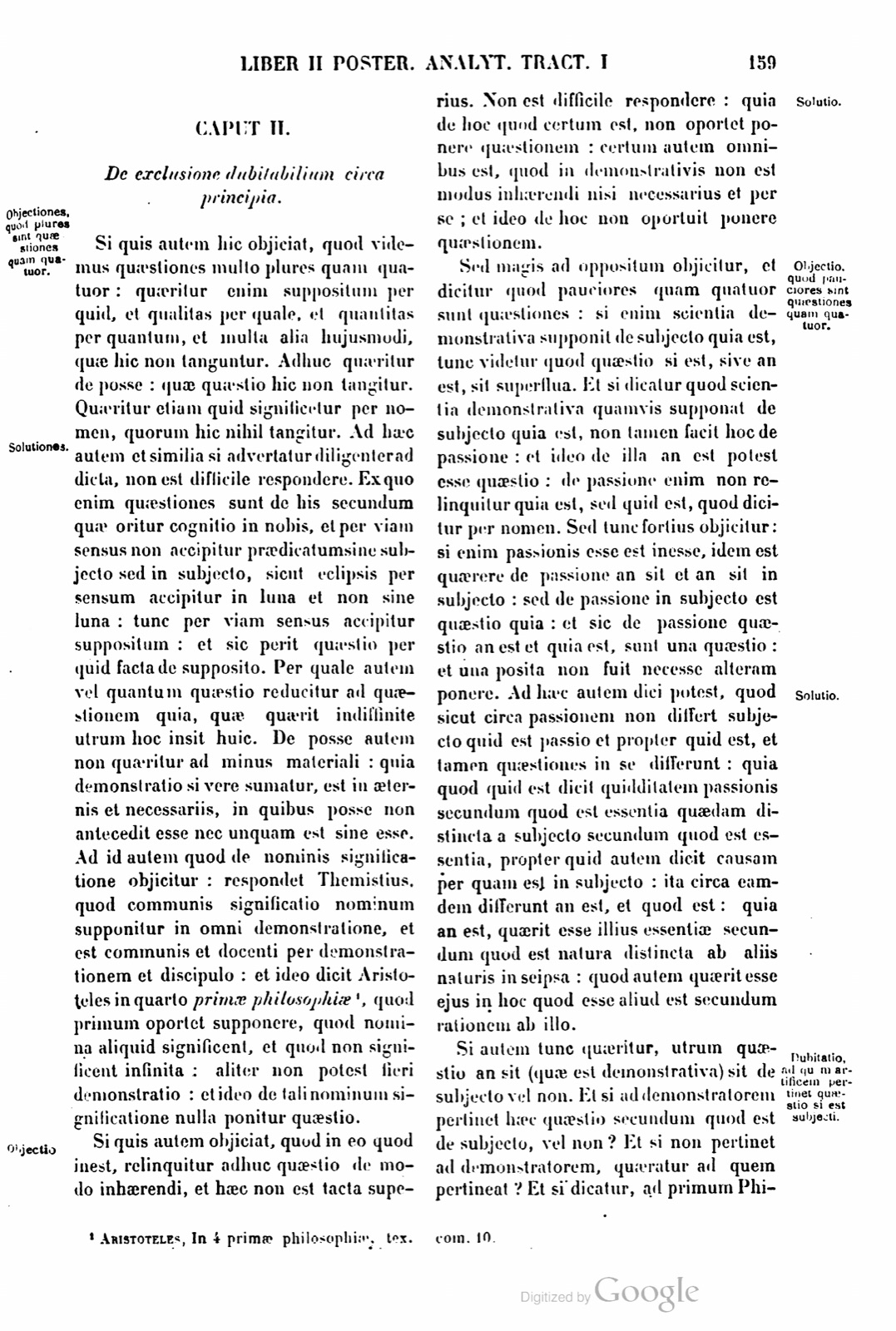
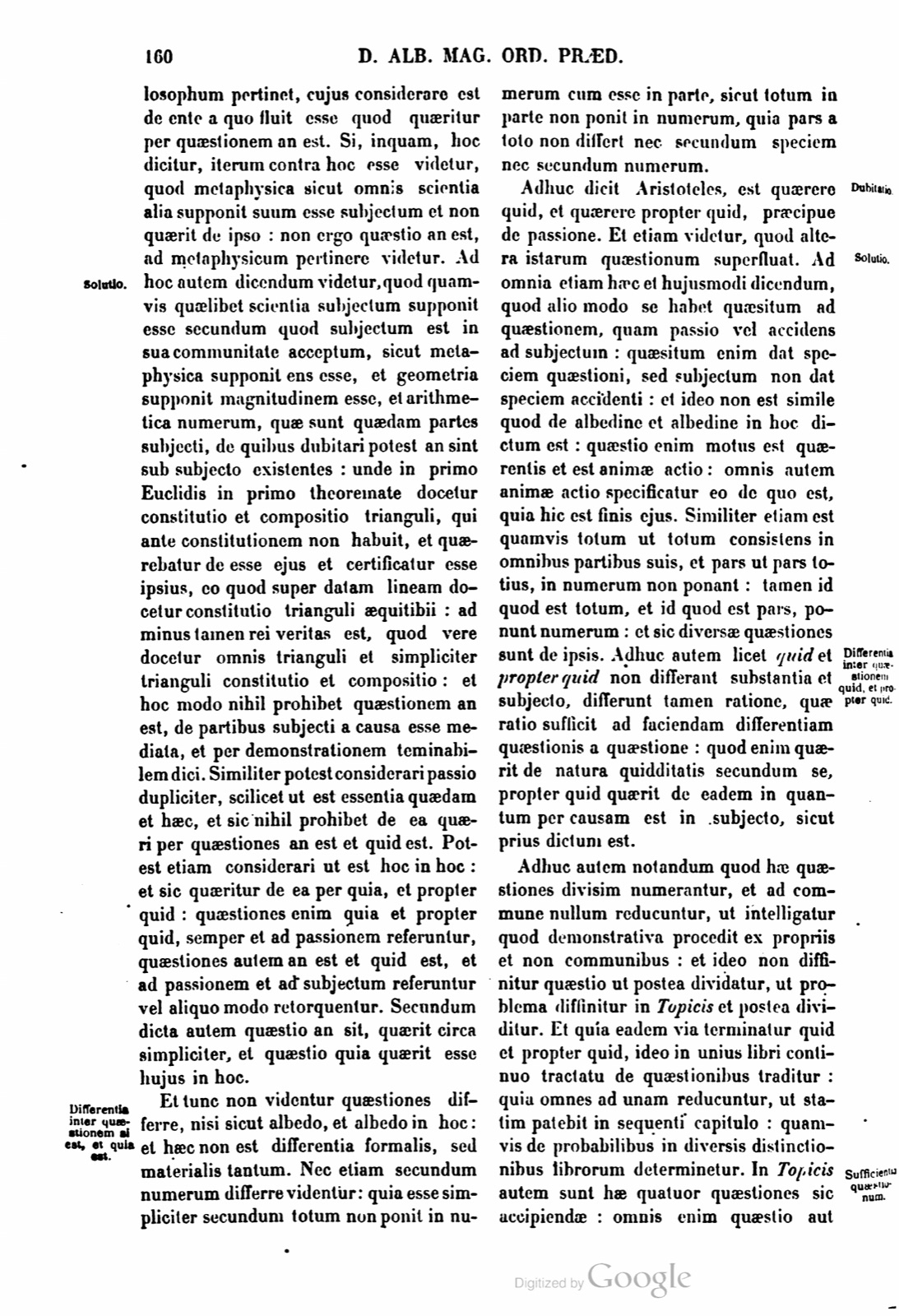
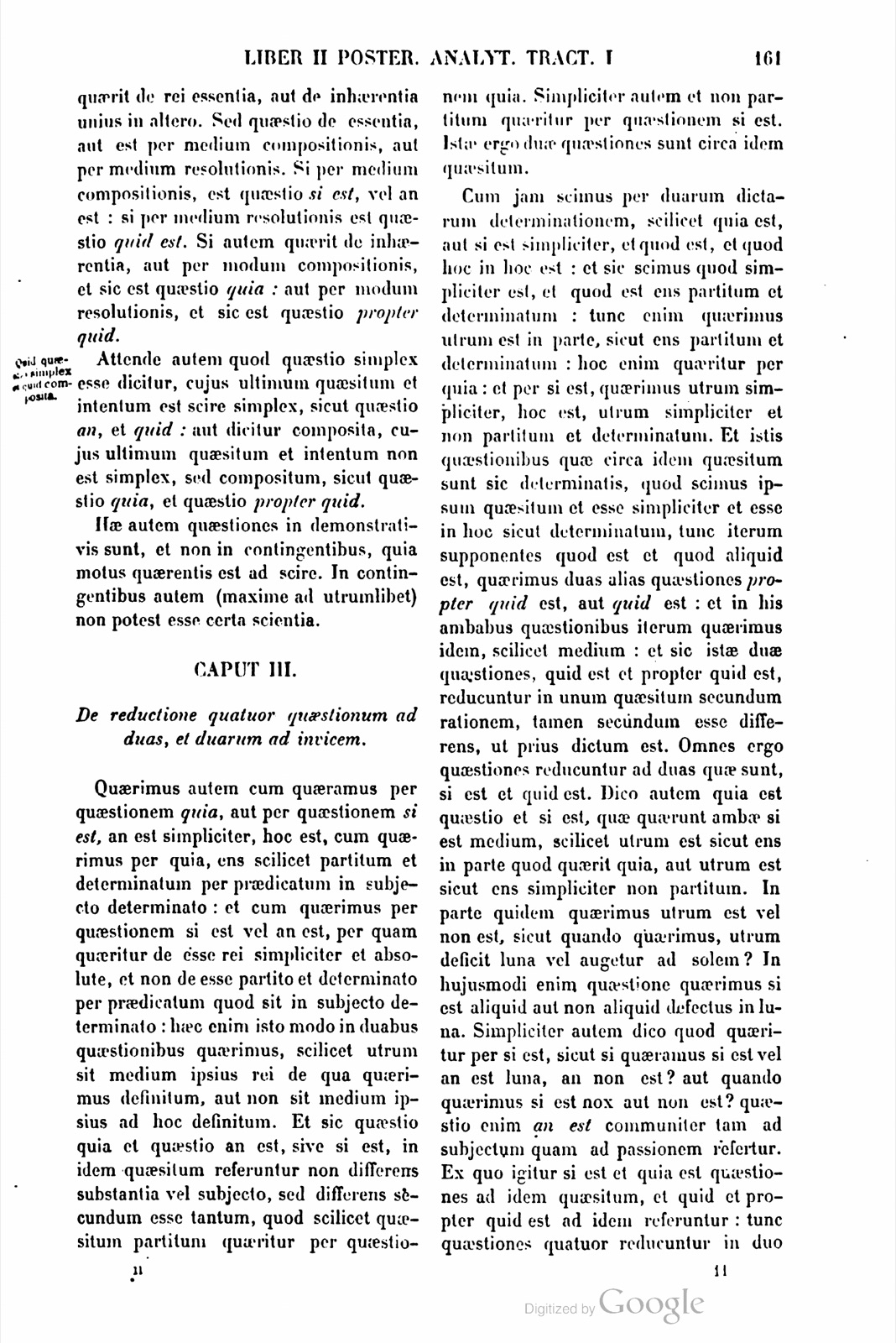
CAPUT II. De exclusione dubitabilium circa principia. <marginal-label>Objectiones, quod plures sint quaestiones quam quatuor.</marginal-label> Si quis autem hic objiciat, quod videmus quaestiones multo plures quam quatuor: quaeritur enim suppositum per quid, et qualitas per quale, et quantitas per quantum, et multa alia hujusmodi, quae hic non tanguntur. Adhuc quaeritur de posse: quae quaestio hic non tangitur. Quaeritur etiam quid significetur per nomen, quorum hic nihil tangitur. <marginal-label>Solutiones.</marginal-label> Ad haec autem et similia si advertatur diligenter ad dicta, non est difficile respondere. Ex quo enim quaestiones sunt de his secundum quae oritur cognitio in nobis, et per viam sensus non accipitur praedicatum sine subjecto sed in subjecto, sicut eclipsis per sensum accipitur in luna et non sine luna: tunc per viam sensus accipitur suppositum: et sic perit quaestio per quid facta de supposito. Per quale autem vel quantum quaestio reducitur ad quaestionem quia, quae quaerit indiffinite utrum hoc insit huic. De posse autem non quaeritur ad minus materiali: quia demonstratio si vere sumatur, est in aeternis et necessariis, in quibus posse non antecedit esse nec unquam est sine esse. Ad id autem quod de nominis significatione objicitur: respondet Themistius, quod communis significatio nominum supponitur in omni demonstratione, et est communis et docenti per demonstrationem et discipulo: et ideo dicit Aristoteles in quarto primae philosophiae 1, quod primum oportet supponere, quod nomina aliquid significent, et quod non significent infinita: aliter non potest fieri demonstratio: et ideo de tali nominum significatione nulla ponitur quaestio. <marginal-label>Objectio.</marginal-label> Si quis autem objiciat, quod in eo quod inest, relinquitur adhuc quaestio de modo inhaerendi, et haec non est tacta superius. <marginal-label>Solutio.</marginal-label> Non est difficile respondere: quia de hoc quod certum est, non oportet ponere quaestionem: certum autem omnibus est, quod in demonstrativis non est modus inhaerendi nisi necessarius et per se; et ideo de hoc non oportuit ponere quaestionem. <marginal-label>Objectio, quod pauciores sint quaestiones quam quatuor.</marginal-label> Sed magis ad oppositum objicitur, et quod dicitur quod pauciores quam quatuor sunt quaestiones: si enim scientia demonstrativa supponit de subjecto quia est, tunc videtur quod quaestio si est, sive an est, sit superflua. Et si dicatur quod scientia demonstrativa quamvis supponat de subjecto quia est, non tamen facit hoc de passione: et ideo de illa an est potest esse quaestio: de passione enim non relinquitur quia est, sed quid est, quod dicitur per nomen. Sed tunc fortius objicitur: si enim passionis esse est inesse, idem est quaerere de passione an sit et an sit in subjecto: sed de passione in subjecto est quaestio quia: et sic de passione quaestio an est et quia est, sunt una quaestio: et una posita non fuit necesse alteram ponere. <marginal-label>Solutio.</marginal-label> Ad haec autem dici potest, quod sicut circa passionem non differt subjecto quid est passio et propter quid est, et tamen quaestiones in se differunt: quia quod quid est dicit quidditatem passionis secundum quod est essentia quaedam distincta a subjecto secundum quod est essentia, propter quid autem dicit causam per quam est in subjecto: ita circa eamdem differunt an est, et quod est: quia an est, quaerit esse illius essentiae secundum quod est natura distincta ab aliis naturis in seipsa: quod autem quaerit esse ejus in hoc quod esse aliud est secundum rationem ab illo. <marginal-label>Dubitatio, ad quem artificem pertinet quaestio si est subjecti.</marginal-label> Si autem tunc quaeritur, utrum quaestio an sit (quae est demonstrativa) sit de subjecto vel non. Et si ad demonstratorem pertinet haec quaestio secundum quod est de subjecto, vel non? Et si non pertinet ad demonstratorem, quaeratur ad quem pertineat? Et si dicatur, ad primum Philosophum pertinet, cujus considerare est de ente a quo fluit esse quod quaeritur per quaestionem an est. Si, inquam, hoc dicitur, iterum contra hoc esse videtur, quod metaphysica sicut omnis scientia alia supponit suum esse subjectum et non quaerit de ipso: non ergo quaestio an est, ad metaphysicum pertinere videtur. <marginal-label>Solutio.</marginal-label> Ad hoc autem dicendum videtur, quod quamvis quaelibet scientia subjectum supponit esse secundum quod subjectum est in sua communitate acceptum, sicut metaphysica supponit ens esse, et geometria supponit magnitudinem esse, et arithmetica numerum, quae sunt quaedam partes subjecti, de quibus dubitari potest an sint sub subjecto existentes: unde in primo Euclidis in primo theoremate docetur constitutio et compositio trianguli, qui ante constitutionem non habuit, et quaerebatur de esse ejus et certificatur esse ipsius, eo quod super datam lineam docetur constitutio trianguli aequilateri: ad minus tamen rei veritas est, quod vere docetur omnis trianguli et simpliciter trianguli constitutio et compositio: et hoc modo nihil prohibet quaestionem an est, de partibus subjecti a causa esse mediata, et per demonstrationem terminabilem dici. Similiter potest considerari passio dupliciter, scilicet ut est essentia quaedam et haec, et sic nihil prohibet de ea quaeri per quaestiones an est et quid est. Potest etiam considerari ut est hoc in hoc: et sic quaeritur de ea per quia, et propter quid: quaestiones enim quia et propter quid, semper et ad passionem referuntur, quaestiones autem an est et quid est, et ad passionem et ad subjectum referuntur vel aliquo modo retorquentur. Secundum dicta autem quaestio an sit, quaerit circa simpliciter, et quaestio quia quaerit esse hujus in hoc. <marginal-label>Differentia inter quaestionem si est, et quia est.</marginal-label> Et tunc non videntur quaestiones differre, nisi sicut albedo, et albedo in hoc: et haec non est differentia formalis, sed materialis tantum. Nec etiam secundum numerum differre videntur: quia esse simpliciter secundum totum non ponit in numerum cum esse in parte, sicut totum in parte non ponit in numerum, quia pars a toto non differt nec secundum speciem nec secundum numerum. <marginal-label>Dubitatio.</marginal-label> Adhuc dicit Aristoteles, est quaerere quid, et quaerere propter quid, praecipue de passione. Et etiam videtur, quod altera istarum quaestionum superfluat. <marginal-label>Solutio.</marginal-label> Ad omnia etiam haec et hujusmodi dicendum, quod alio modo se habet quaesitum ad quaestionem, quam passio vel accidens ad subjectum: quaesitum enim dat speciem quaestioni, sed subjectum non dat speciem accidenti: et ideo non est simile quod de albedine et albedine in hoc dictum est: quaestio enim motus est quaerentis et est animae actio: omnis autem animae actio specificatur eo de quo est, quia hic est finis ejus. Similiter etiam est quamvis totum ut totum consistens in omnibus partibus suis, et pars ut pars totius, in numerum non ponant: tamen id quod est totum, et id quod est pars, ponunt numerum: et sic diversae quaestiones sunt de ipsis. <marginal-label>Differentia inter quaestionem quid, et propter quid.</marginal-label> Adhuc autem licet quid et propter quid non differant substantia et subjecto, differunt tamen ratione, quae ratio sufficit ad faciendam differentiam quaestionis a quaestione: quod enim quaerit de natura quidditatis secundum se, propter quid quaerit de eadem in quantum per causam est in subjecto, sicut prius dictum est. Adhuc autem notandum quod hae quaestiones divisim numerantur, et ad commune nullum reducuntur, ut intelligatur quod demonstrativa procedit ex propriis et non communibus: et ideo non diffinitur quaestio ut postea dividatur, ut problema diffinitur in Topicis et postea dividitur. Et quia eadem via terminatur quid et propter quid, ideo in unius libri continuo tractatu de quaestionibus traditur: quia omnes ad unam reducuntur, ut statim patebit in sequenti capitulo: quamvis de probabilibus in diversis distinctionibus librorum determinetur. <marginal-label>Sufficientia quaestionum.</marginal-label> In Topicis autem sunt hae quatuor quaestiones sic accipiendae: omnis enim quaestio aut quaerit de rei essentia, aut de inhaerentia unius in altero. Sed quaestio de essentia, aut est per medium compositionis, aut per medium resolutionis. Si per medium compositionis, est quaestio si est, vel an est: si per medium resolutionis est quaestio quid est. Si autem quaerit de inhaerentia, aut per modum compositionis, et sic est quaestio quia: aut per modum resolutionis, et sic est quaestio propter quid. <marginal-label>Quid quaestio simplex, quid composita.</marginal-label> Attende autem quod quaestio simplex esse dicitur, cujus ultimum quaesitum et intentum est scire simplex, sicut quaestio an, et quid: aut dicitur composita, cujus ultimum quaesitum et intentum non est simplex, sed compositum, sicut quaestio quia, et quaestio propter quid. Hae autem quaestiones in demonstrativis sunt, et non in contingentibus, quia motus quaerentis est ad scire. In contingentibus autem (maxime ad utrumlibet) non potest esse certa scientia.
CHAPTER II. On the exclusion of doubtful things concerning the principles. <marginal-label>Objections, that there are more questions than four.</marginal-label> But if someone here objects that we see questions to be many more than four, for the supposit is asked through what, and quality through what kind, and quantity through how much, and many other things of this sort which are not touched here. Moreover, inquiry is made about possibility, which question is not touched here. Inquiry is also made about what is signified through the name, of which nothing is touched here. <marginal-label>Solutions.</marginal-label> But to these and similar things, if one attends diligently to the things said, it is not difficult to respond. For from the fact that questions are about those things according to which cognition arises in us, and through the way of sense a predicate is not received without a subject but in a subject, just as eclipse is received through sense in the moon and not without the moon, then through the way of sense the supposit is received; and thus the question made through what about the supposit perishes. But through what kind or how much the question is reduced to the question that, which asks indefinitely whether this belongs to this. But about possibility there is no question, at least materially, because demonstration, if it is taken truly, is in eternal and necessary things, in which possibility does not precede being nor is it ever without being. But to that which is objected concerning the signification of the name, Themistius responds that the common signification of names is supposed in every demonstration and is common both to the one teaching through demonstration and to the disciple; and therefore Aristotle says in the fourth book of First Philosophy 1 that first one must suppose that names signify something, and that they do not signify infinite things. Otherwise demonstration cannot be made; and therefore no question is posited about such signification of names. <marginal-label>Objection.</marginal-label> But if someone objects that, in the fact that it inheres, there is still left the question about the mode of inhering, and this was not touched above. <marginal-label>Solution.</marginal-label> It is not difficult to respond, because concerning that which is certain, one need not posit a question. But it is certain to all that in demonstrative matters there is no mode of inhering except necessary and per se; and therefore one did not need to posit a question about this. <marginal-label>Objection, that the questions are fewer than four.</marginal-label> But more on the opposite side it is objected, and it is said that questions are fewer than four. For if demonstrative science supposes concerning the subject that it is, then it seems that the question if it is, or whether it is, is superfluous. And if it is said that demonstrative science, although it supposes concerning the subject that it is, nevertheless does not do this concerning the property, and therefore there can be a question whether it is about that; for concerning a property there is not left that it is, but what it is, which is said through the name. But then it is objected more strongly: for if the being of a property is to inhere, it is the same to ask about a property whether it is and whether it is in the subject; but concerning a property in a subject there is the question that; and thus concerning a property the question whether it is and that it is are one question, and when one has been posited it was not necessary to posit the other. <marginal-label>Solution.</marginal-label> But to these things it can be said that, just as concerning a property what the property is and on account of what it is do not differ in subject, and nevertheless the questions differ in themselves, because what it is states the quiddity of the property according as it is a certain essence distinct from the subject according as it is an essence, but on account of what states the cause through which it is in the subject; so concerning the same thing whether it is and what it is differ, because whether it is asks the being of that essence according as it is a nature distinct from other natures in itself, but the other asks its being in this, because being is another thing according to account from that. <marginal-label>Doubt, to which art the question if the subject is belongs.</marginal-label> But if then it is asked whether the question whether it is, which is demonstrative, is about the subject or not. And if this question pertains to the demonstrator according as it is about the subject, or not? And if it does not pertain to the demonstrator, let it be asked to whom it pertains? And if it is said that it pertains to the first Philosopher, whose task it is to consider being, from which flows the being that is asked through the question whether it is. If, I say, this is said, again it seems that there is something against this, because metaphysics, like every other science, supposes the being of its subject and does not ask about it; therefore the question whether it is does not seem to pertain to the metaphysician. <marginal-label>Solution.</marginal-label> But to this it seems one must say that, although any science supposes its subject to be according as the subject is received in its commonness, as metaphysics supposes being to be, and geometry supposes magnitude to be, and arithmetic supposes number, which are certain parts of the subject about which one can doubt whether they exist under the subject; hence in the first theorem of the first book of Euclid the constitution and composition of a triangle is taught, which it did not have before constitution, and inquiry was made about its being and its being is made certain, because the constitution of an equilateral triangle is taught on a given line; nevertheless, at least the truth of the matter is that the constitution and composition of every triangle and of triangle simply is truly taught. And in this way nothing prevents the question whether it is, concerning the parts of the subject, from being said to be mediated from the cause of being and terminable through demonstration. Similarly a property can be considered in two ways, namely as it is a certain essence and this essence, and thus nothing prevents inquiry about it through the questions whether it is and what it is. It can also be considered as it is this in this, and thus inquiry is made about it through that and on account of what. For the questions that and on account of what are always referred also to a property, but the questions whether it is and what it is are referred both to a property and to a subject, or are in some way turned back to them. But according to the things said, the question whether it is asks about the simply, and the question that asks the being of this in this. <marginal-label>The difference between the question if it is and that it is.</marginal-label> And then the questions do not seem to differ except as whiteness and whiteness in this differ; and this is not a formal difference, but only a material one. Nor do they seem to differ according to number, because being simply according to the whole does not place in number with being in a part, just as a whole in a part does not place in number, because the part does not differ from the whole either according to species or according to number. <marginal-label>Doubt.</marginal-label> Moreover Aristotle says that there is asking what, and asking on account of what, especially concerning a property. And it also seems that one of these questions is superfluous. <marginal-label>Solution.</marginal-label> To all these things and things of this sort one must also say that the thing asked is related to the question in one way, but a property or accident to the subject in another way. For the thing asked gives species to the question, but the subject does not give species to an accident; and therefore what has been said about whiteness and whiteness in this is not similar. For a question is the motion of the one asking and is an action of the soul; but every action of the soul is specified by that about which it is, because this is its end. Similarly also, although the whole as a whole consisting in all its parts, and the part as a part of the whole, do not place in number, nevertheless that which is a whole and that which is a part place number; and thus there are diverse questions about them. <marginal-label>The difference between the question what and on account of what.</marginal-label> Moreover, although what and on account of what do not differ in substance and subject, nevertheless they differ in account, which account suffices for making the difference of question from question. For what asks about the nature of the quiddity according to itself; on account of what asks about the same nature insofar as it is in the subject through a cause, as was said before. Moreover it must be noted that these questions are numbered separately and are reduced to no common thing, so that it may be understood that demonstrative science proceeds from proper things and not from common things. And therefore question is not defined so that afterward it may be divided, as problem is defined in the Topics and afterward divided. And because what and on account of what are terminated by the same way, therefore in the continuous treatise of one book the account concerning questions is handed down, because all are reduced to one, as will at once be clear in the following chapter, although concerning probable things the determination is made in diverse distinctions of books. <marginal-label>The sufficiency of questions.</marginal-label> But in the Topics these four questions are to be received thus: for every question either asks about the essence of the thing, or about the inherence of one thing in another. But a question about essence is either through a middle of composition or through a middle of resolution. If through a middle of composition, it is the question if it is or whether it is; if through a middle of resolution, it is the question what it is. But if it asks about inherence, it is either through the mode of composition, and thus it is the question that, or through the mode of resolution, and thus it is the question on account of what. <marginal-label>What a simple question is, what a composite one is.</marginal-label> But attend that a question is called simple whose ultimate thing asked and intended is to know a simple thing, as the question whether and what; or it is called composite whose ultimate thing asked and intended is not simple but composite, as the question that and the question on account of what. But these questions are in demonstrative matters and not in contingent matters, because the motion of the one asking is toward knowing. But in contingent things, especially those open to either side, there cannot be certain science.
Notes
- Aristotle, in book 4 of First Philosophy, text commentary 10. (Aristoteles, in 4 primae philosophiae, tex. com. 10.) ↩
If a page does not appear, its photograph has not been uploaded yet.