Works › Posterior Analytics, Books I–II
Volume 2 · pp. 153–154
Chapter X. On solertia.
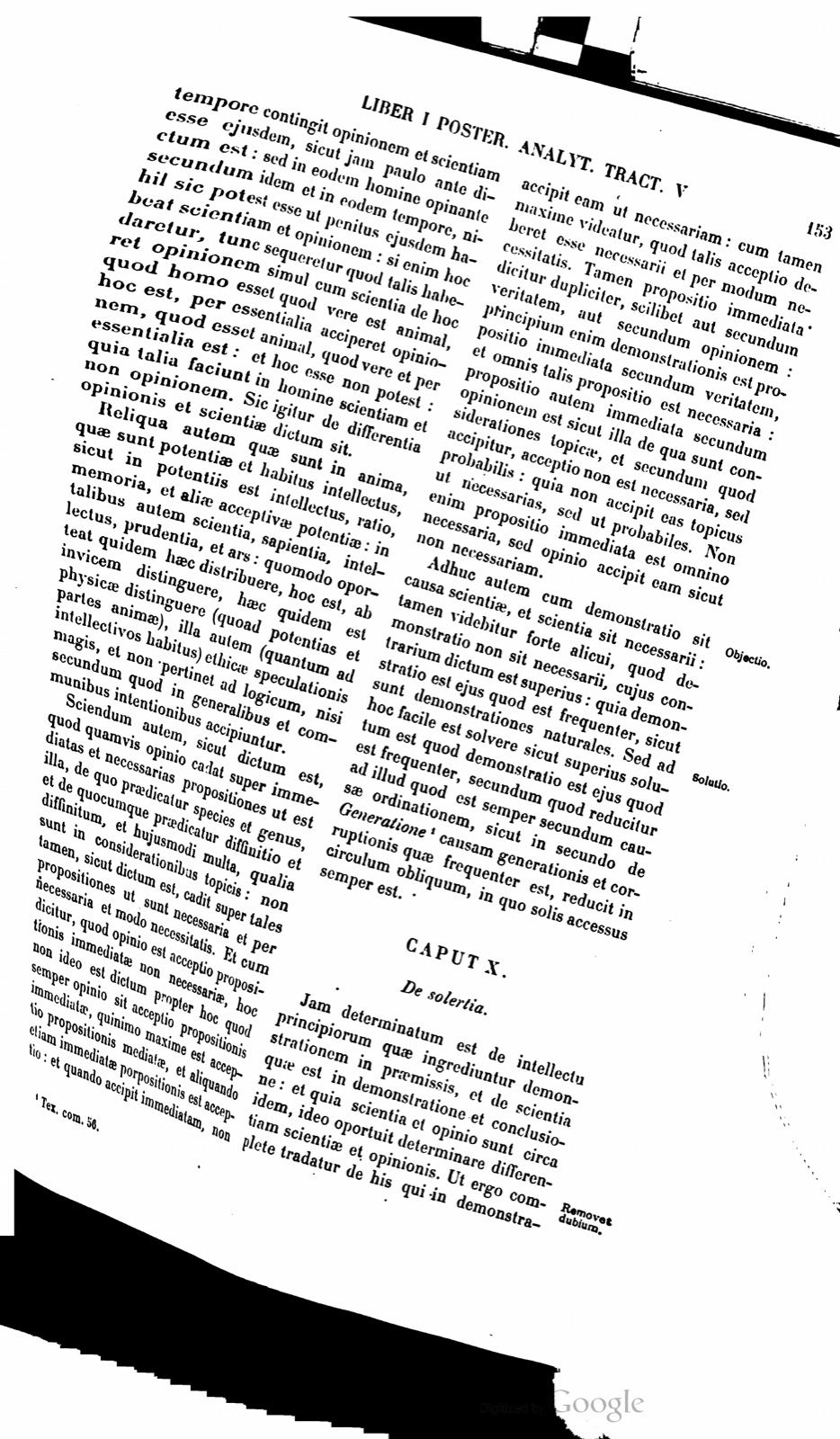
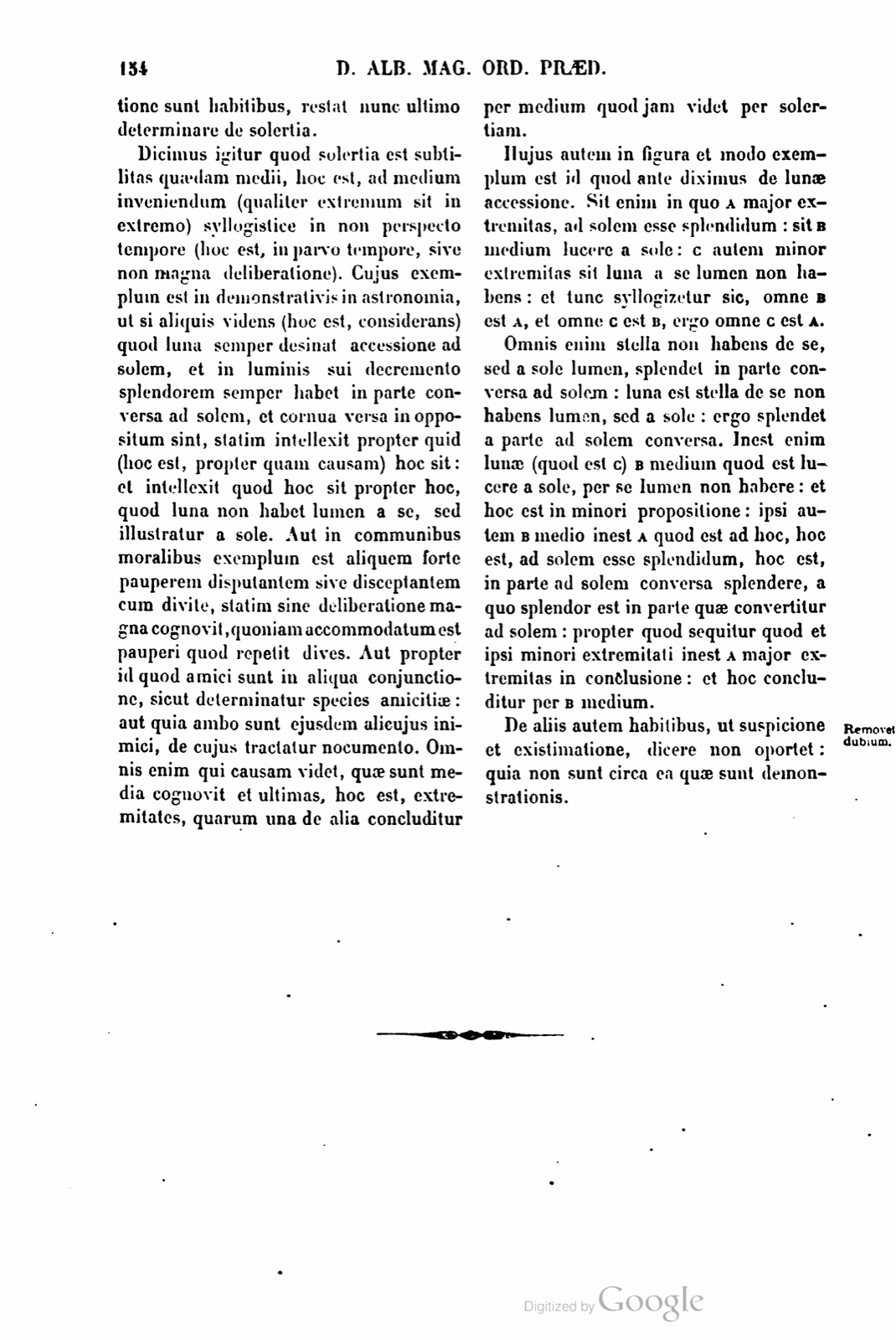
CAPUT X. De solertia. Jam determinatum est de intellectu principiorum quae ingrediuntur demonstrationem in praemissis, et de scientia quae est in demonstratione et conclusione: et quia scientia et opinio sunt circa idem, ideo oportuit determinare differentiam scientiae et opinionis. Ut ergo complete tradatur de his qui in demonstratione sunt habitibus, restat nunc ultimo determinare de solertia. <marginal-label>Removet dubium.</marginal-label> Dicimus igitur quod solertia est subtilitas quaedam medii, hoc est, ad medium inveniendum (qualiter extremum sit in extremo) syllogistice in non perspecto tempore (hoc est, in parvo tempore, sive non magna deliberatione). Cujus exemplum est in demonstrativis in astronomia, ut si aliquis videns (hoc est, considerans) quod luna semper desinat accessione ad solem, et in luminis sui decremento splendorem semper habet in parte conversa ad solem, et cornua versa in oppositum sint, statim intellexit propter quid (hoc est, propter quam causam) hoc sit: et intellexit quod hoc sit propter hoc, quod luna non habet lumen a se, sed illustratur a sole. Aut in communibus moralibus exemplum est aliquem forte pauperem disputantem sive disceptantem cum divite, statim sine deliberatione magna cognovit, quoniam accommodatum est pauperi quod repetit dives. Aut propter id quod amici sunt in aliqua conjunctione, sicut determinatur species amicitiae: aut quia ambo sunt ejusdem alicujus inimici, de cujus tractatur nocumento. Omnis enim qui causam videt, quae sunt media cognovit et ultimas, hoc est, extremitates, quarum una de alia concluditur per medium quod jam videt per solertiam. Hujus autem in figura et modo exemplum est id quod ante diximus de lunae accessione. Sit enim in quo A major extremitas, ad solem esse splendidum: sit B medium lucere a sole: C autem minor extremitas sit luna a se lumen non habens: et tunc syllogizetur sic, omne B est A, et omne C est B, ergo omne C est A. Omnis enim stella non habens de se, sed a sole lumen, splendet in parte conversa ad solem: luna est stella de se non habens lumen, sed a sole: ergo splendet a parte ad solem conversa. Inest enim lunae (quod est C) B medium quod est lucere a sole, per se lumen non habere: et hoc est in minori propositione: ipsi autem B medio inest A quod est ad hoc, hoc est, ad solem esse splendidum, hoc est, in parte ad solem conversa splendere, a quo splendor est in parte quae convertitur ad solem: propter quod sequitur quod et ipsi minori extremitati inest A major extremitas in conclusione: et hoc concluditur per B medium. <marginal-label>Removet dubium.</marginal-label> De aliis autem habitibus, ut suspicione et existimatione, dicere non oportet: quia non sunt circa ea quae sunt demonstrationis.
CHAPTER X. On solertia. It has now been determined concerning the understanding of the principles which enter demonstration in the premises, and concerning the science which is in demonstration and in the conclusion; and because science and opinion are about the same thing, it was therefore necessary to determine the difference of science and opinion. Therefore, so that the treatment may be handed down completely concerning the habits which are in demonstration, it now remains lastly to determine concerning solertia. <marginal-label>He removes a doubt.</marginal-label> Therefore we say that solertia is a certain subtlety of the middle, that is, a subtlety for finding the middle, namely how the extreme is in the extreme, syllogistically in an unexamined time, that is, in a short time or without great deliberation. The example of this in demonstrative matters is in astronomy: as if someone seeing, that is, considering, that the moon always ceases by approach to the sun, and that in the decrease of its light it always has brightness on the part turned toward the sun, and that its horns are turned to the opposite, at once understands on account of what, that is, on account of what cause, this is; and he understands that this is on account of this, that the moon does not have light from itself, but is illuminated by the sun. Or in common moral matters the example is that someone perhaps seeing a poor man disputing or arguing with a rich man, at once without great deliberation knows that what the rich man seeks back was lent to the poor man. Or it is on account of the fact that they are friends in some conjunction, just as the species of friendship is determined; or because both are enemies of some same person, concerning whose harm there is a discussion. For everyone who sees the cause has known the things which are middles and the last things, that is, the extremes, of which one is concluded of the other through the middle that he now sees through solertia. But the example of this in figure and mode is that which we said before concerning the moon's approach. Let A, the major extreme, be that in which it is bright toward the sun; let B, the middle, be to shine from the sun; but let C, the minor extreme, be the moon not having light from itself. And then let it be syllogized thus: every B is A, and every C is B, therefore every C is A. For every star not having light from itself but from the sun shines on the part turned toward the sun; the moon is a star not having light from itself but from the sun; therefore it shines on the part turned toward the sun. For B, the middle, which is to shine from the sun and not to have light through itself, belongs to the moon, which is C; and this is in the minor proposition. But A belongs to the middle itself, which is B, namely this, that it is bright toward the sun, that is, to shine on the part turned toward the sun, from which there is brightness in the part that is turned toward the sun. On account of this it follows that A, the major extreme, also belongs to the minor extreme itself in the conclusion, and this is concluded through middle B. <marginal-label>He removes a doubt.</marginal-label> But concerning the other habits, such as suspicion and estimation, one need not speak, because they are not about those things which belong to demonstration.
If a page does not appear, its photograph has not been uploaded yet.