Works › Posterior Analytics, Books I–II
Volume 2 · pp. 149–153
Chapter IX. On the diversity of science, understanding, and opinion.
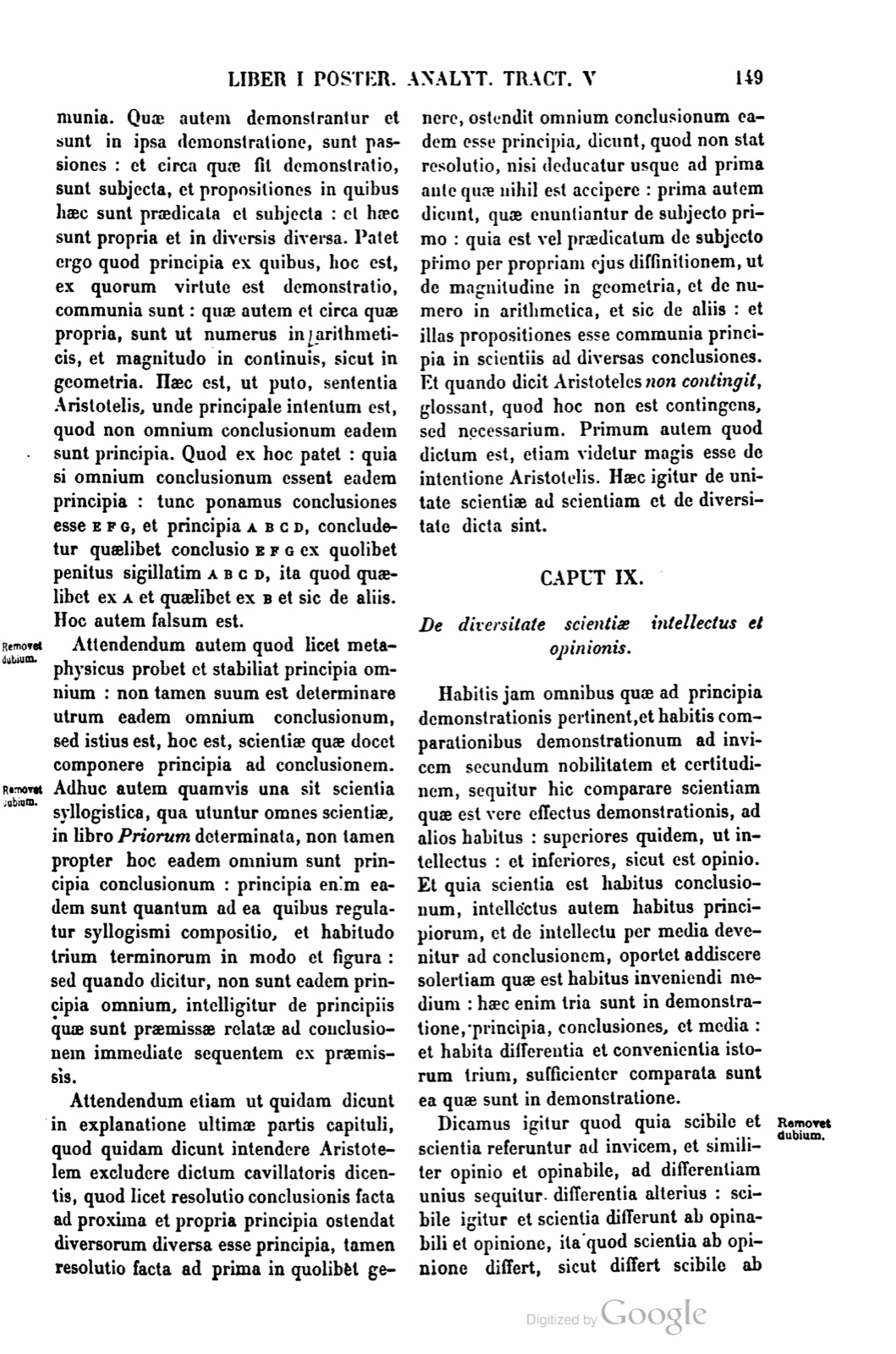
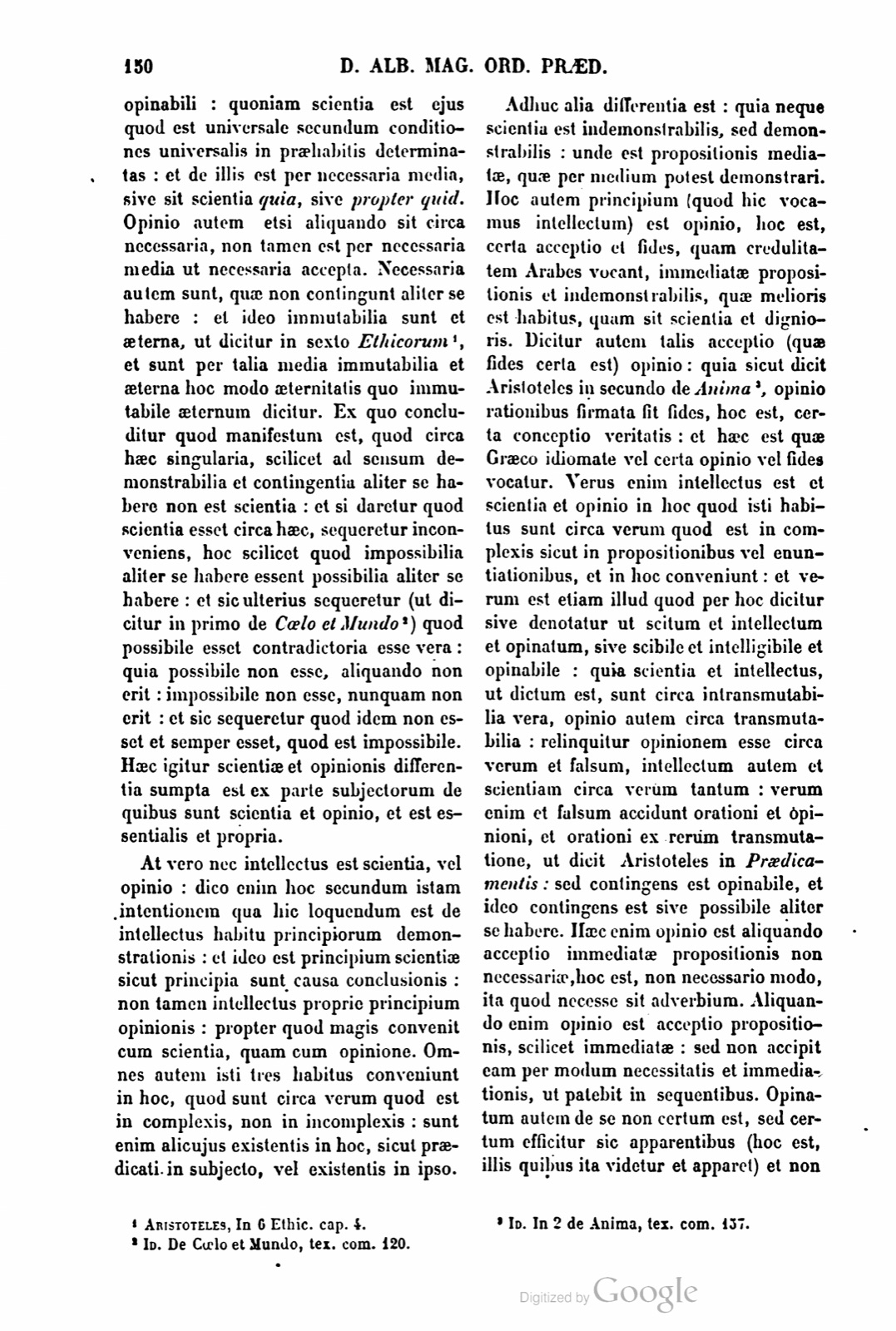
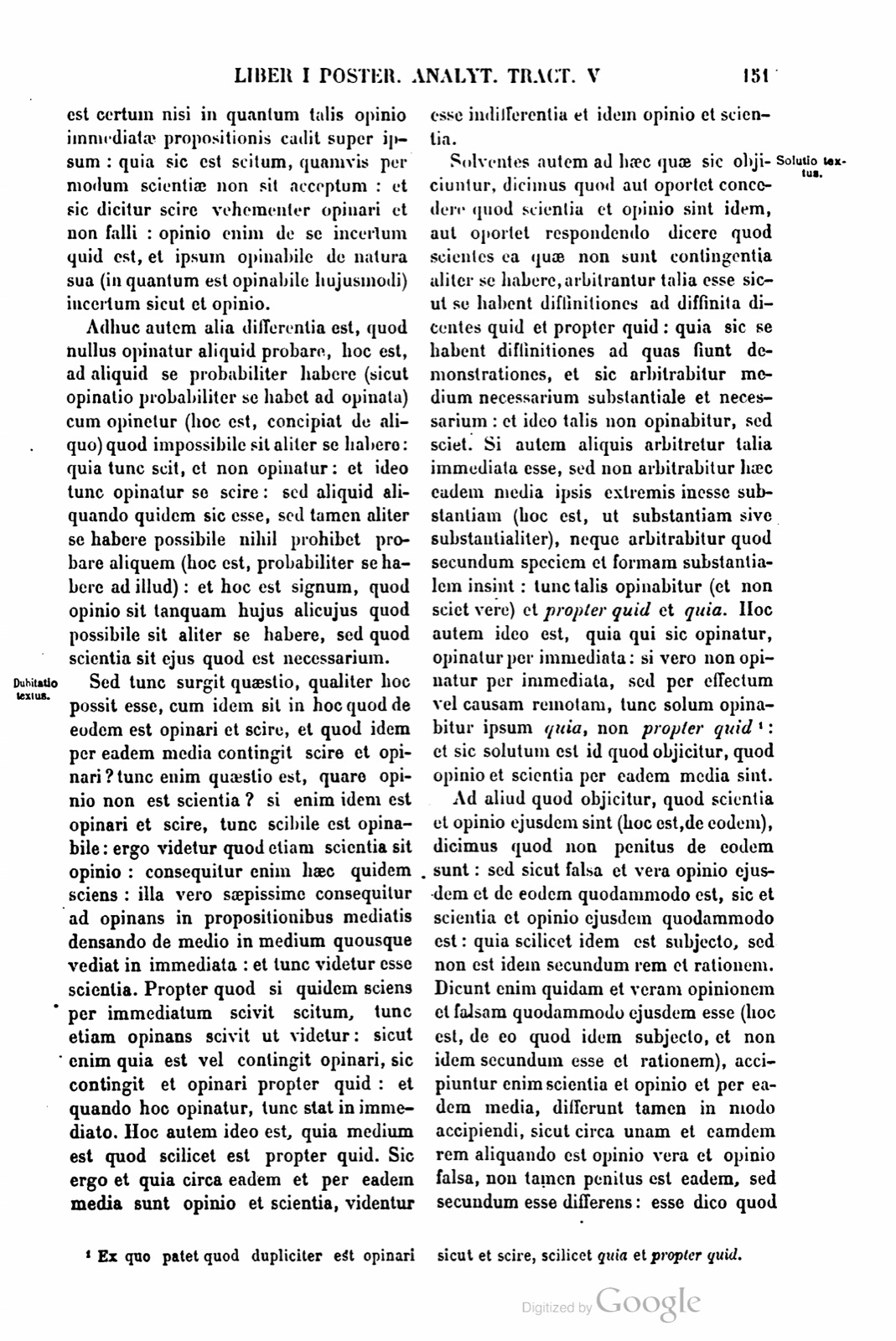
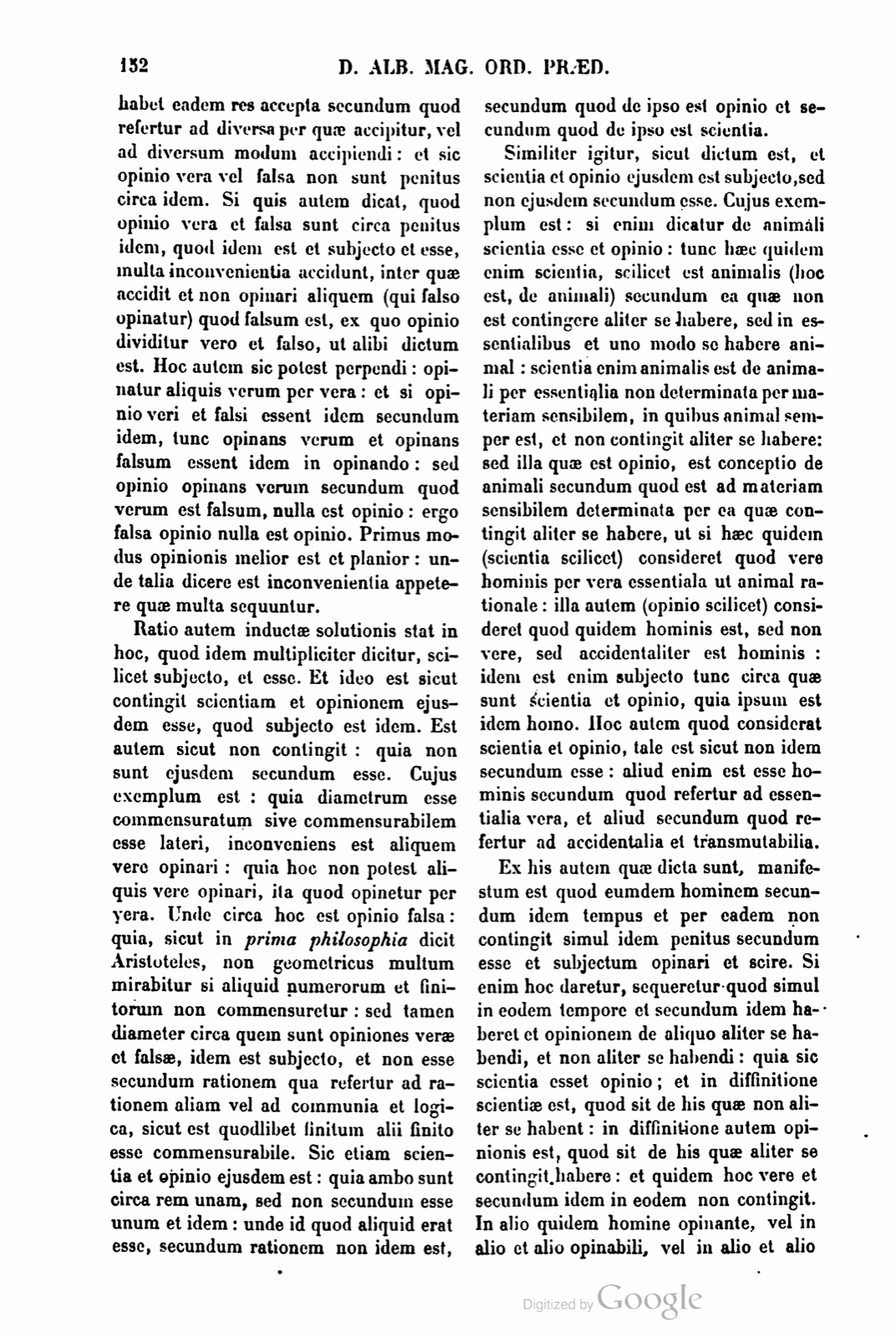
CAPUT IX. De diversitate scientiae intellectus et opinionis. Habitis jam omnibus quae ad principia demonstrationis pertinent, et habitis comparationibus demonstrationum ad invicem secundum nobilitatem et certitudinem, sequitur hic comparare scientiam quae est vere effectus demonstrationis, ad alios habitus: superiores quidem, ut intellectus: et inferiores, sicut est opinio. Et quia scientia est habitus conclusionum, intellectus autem habitus principiorum, et de intellectu per media devenitur ad conclusionem, oportet addiscere solertiam quae est habitus inveniendi medium: haec enim tria sunt in demonstratione, principia, conclusiones, et media: et habita differentia et convenientia istorum trium, sufficienter comparata sunt ea quae sunt in demonstratione. <marginal-label>Removet dubium.</marginal-label> Dicamus igitur quod quia scibile et scientia referuntur ad invicem, et similiter opinio et opinabile, ad differentiam unius sequitur differentia alterius: scibile igitur et scientia differunt ab opinabili et opinione, ita quod scientia ab opinione differt, sicut differt scibile ab opinabili: quoniam scientia est ejus quod est universale secundum conditiones universalis in praehabitis determinatas: et de illis est per necessaria media, sive sit scientia quia, sive propter quid. Opinio autem etsi aliquando sit circa necessaria, non tamen est per necessaria media ut necessaria accepta. Necessaria autem sunt, quae non contingunt aliter se habere: et ideo immutabilia sunt et aeterna, ut dicitur in sexto Ethicorum 1, et sunt per talia media immutabilia et aeterna hoc modo aeternitatis quo immutabile aeternum dicitur. Ex quo concluditur quod manifestum est, quod circa haec singularia, scilicet ad sensum demonstrabilia et contingentia aliter se habere non est scientia: et si daretur quod scientia esset circa haec, sequeretur inconveniens, hoc scilicet quod impossibilia aliter se habere essent possibilia aliter se habere: et sic ulterius sequeretur (ut dicitur in primo de Caelo et Mundo 2) quod possibile esset contradictoria esse vera: quia possibile non esse, aliquando non erit: impossibile non esse, nunquam non erit: et sic sequeretur quod idem non esset et semper esset, quod est impossibile. Haec igitur scientiae et opinionis differentia sumpta est ex parte subjectorum de quibus sunt scientia et opinio, et est essentialis et propria. At vero nec intellectus est scientia, vel opinio: dico enim hoc secundum istam intentionem qua hic loquendum est de intellectus habitu principiorum demonstrationis: et ideo est principium scientiae sicut principia sunt causa conclusionis: non tamen intellectus proprie principium opinionis: propter quod magis convenit cum scientia, quam cum opinione. Omnes autem isti tres habitus conveniunt in hoc, quod sunt circa verum quod est in complexis, non in incomplexis: sunt enim alicujus existentis in hoc, sicut praedicati in subjecto, vel existentis in ipso. Adhuc alia differentia est: quia neque scientia est indemonstrabilis, sed demonstrabilis: unde est propositionis mediatae, quae per medium potest demonstrari. Hoc autem principium (quod hic vocamus intellectum) est opinio, hoc est, certa acceptio et fides, quam credulitatem Arabes vocant, immediatae propositionis et indemonstrabilis, quae melioris est habitus, quam sit scientia et dignioris. Dicitur autem talis acceptio (quae fides certa est) opinio: quia sicut dicit Aristoteles in secundo de Anima 3, opinio rationibus firmata fit fides, hoc est, certa conceptio veritatis: et haec est quae Graeco idiomate vel certa opinio vel fides vocatur. Verus enim intellectus est et scientia et opinio in hoc quod isti habitus sunt circa verum quod est in complexis sicut in propositionibus vel enuntiationibus, et in hoc conveniunt: et verum est etiam illud quod per hoc dicitur sive denotatur ut scitum et intellectum et opinatum, sive scibile et intelligibile et opinabile: quia scientia et intellectus, ut dictum est, sunt circa intransmutabilia vera, opinio autem circa transmutabilia: relinquitur opinionem esse circa verum et falsum, intellectum autem et scientiam circa verum tantum: verum enim et falsum accidunt orationi et opinioni, et orationi ex rerum transmutatione, ut dicit Aristoteles in Praedicamentis: sed contingens est opinabile, et ideo contingens est sive possibile aliter se habere. Haec enim opinio est aliquando acceptio immediatae propositionis non necessariae, hoc est, non necessario modo, ita quod necesse sit adverbium. Aliquando enim opinio est acceptio propositionis, scilicet immediatae: sed non accipit eam per modum necessitatis et immediationis, ut patebit in sequentibus. Opinatum autem de se non certum est, sed certum efficitur sic apparentibus (hoc est, illis quibus ita videtur et apparet) et non est certum nisi in quantum talis opinio immediatae propositionis cadit super ipsum: quia sic est scitum, quamvis per modum scientiae non sit acceptum: et sic dicitur scire vehementer opinari et non falli: opinio enim de se incertum quid est, et ipsum opinabile de natura sua (in quantum est opinabile hujusmodi) incertum sicut et opinio. Adhuc autem alia differentia est, quod nullus opinatur aliquid probare, hoc est, ad aliquid se probabiliter habere (sicut opinatio probabiliter se habet ad opinata) cum opinetur (hoc est, concipiat de aliquo) quod impossibile sit aliter se habere: quia tunc scit, et non opinatur: et ideo tunc opinatur se scire: sed aliquid aliquando quidem sic esse, sed tamen aliter se habere possibile nihil prohibet probare aliquem (hoc est, probabiliter se habere ad illud): et hoc est signum, quod opinio sit tanquam hujus alicujus quod possibile sit aliter se habere, sed quod scientia sit ejus quod est necessarium. <marginal-label>Dubitatio textus.</marginal-label> Sed tunc surgit quaestio, qualiter hoc possit esse, cum idem sit in hoc quod de eodem est opinari et scire, et quod idem per eadem media contingit scire et opinari? tunc enim quaestio est, quare opinio non est scientia? si enim idem est opinari et scire, tunc scibile est opinabile: ergo videtur quod etiam scientia sit opinio: consequitur enim haec quidem sciens: illa vero saepissime consequitur ad opinans in propositionibus mediatis densando de medio in medium quousque veniat in immediata: et tunc videtur esse scientia. Propter quod si quidem sciens per immediatum scivit scitum, tunc etiam opinans scivit ut videtur: sicut enim quia est vel contingit opinari, sic contingit et opinari propter quid: et quando hoc opinatur, tunc stat in immediato. Hoc autem ideo est, quia medium est quod scilicet est propter quid. Sic ergo et quia circa eadem et per eadem media sunt opinio et scientia, videntur esse indifferentia et idem opinio et scientia. <marginal-label>Solutio textus.</marginal-label> Solventes autem ad haec quae sic objiciuntur, dicimus quod aut oportet concedere quod scientia et opinio sint idem, aut oportet respondendo dicere quod scientes ea quae non sunt contingentia aliter se habere, arbitrantur talia esse sicut se habent diffinitiones ad diffinita dicentes quid et propter quid: quia sic se habent diffinitiones ad quas fiunt demonstrationes, et sic arbitrabitur medium necessarium substantiale et necessarium: et ideo talis non opinabitur, sed sciet. Si autem aliquis arbitretur talia immediata esse, sed non arbitrabitur haec eadem media ipsis extremis inesse substantiam (hoc est, ut substantiam sive substantialiter), neque arbitrabitur quod secundum speciem et formam substantialem insint: tunc talis opinabitur (et non sciet vere) et propter quid et quia. Hoc autem ideo est, quia qui sic opinatur, opinatur per immediata: si vero non opinatur per immediata, sed per effectum vel causam remotam, tunc solum opinabitur ipsum quia, non propter quid 4: et sic solutum est id quod objicitur, quod opinio et scientia per eadem media sint. Ad aliud quod objicitur, quod scientia et opinio ejusdem sint (hoc est, de eodem), dicimus quod non penitus de eodem sunt: sed sicut falsa et vera opinio ejusdem et de eodem quodammodo est, sic et scientia et opinio ejusdem quodammodo est: quia scilicet idem est subjecto, sed non est idem secundum rem et rationem. Dicunt enim quidam et veram opinionem et falsam quodammodo ejusdem esse (hoc est, de eo quod idem subjecto, et non idem secundum esse et rationem), accipiuntur enim scientia et opinio et per eadem media, differunt tamen in modo accipiendi, sicut circa unam et eamdem rem aliquando est opinio vera et opinio falsa, non tamen penitus est eadem, sed secundum esse differens: esse dico quod habet eadem res accepta secundum quod refertur ad diversa per quae accipitur, vel ad diversum modum accipiendi: et sic opinio vera vel falsa non sunt penitus circa idem. Si quis autem dicat, quod opinio vera et falsa sunt circa penitus idem, quod idem est et subjecto et esse, multa inconvenientia accidunt, inter quae accidit et non opinari aliquem (qui falso opinatur) quod falsum est, ex quo opinio dividitur vero et falso, ut alibi dictum est. Hoc autem sic potest perpendi: opinatur aliquis verum per vera: et si opinio veri et falsi essent idem secundum idem, tunc opinans verum et opinans falsum essent idem in opinando: sed opinio opinans verum secundum quod verum est falsum, nulla est opinio: ergo falsa opinio nulla est opinio. Primus modus opinionis melior est et planior: unde talia dicere est inconvenientia appetere quae multa sequuntur. Ratio autem inductae solutionis stat in hoc, quod idem multipliciter dicitur, scilicet subjecto, et esse. Et ideo est sicut contingit scientiam et opinionem ejusdem esse, quod subjecto est idem. Est autem sicut non contingit: quia non sunt ejusdem secundum esse. Cujus exemplum est: quia diametrum esse commensuratum sive commensurabilem esse lateri, inconveniens est aliquem vere opinari: quia hoc non potest aliquis vere opinari, ita quod opinetur per vera. Unde circa hoc est opinio falsa: quia, sicut in prima philosophia dicit Aristoteles, non geometricus multum mirabitur si aliquid numerorum et finitorum non commensuretur: sed tamen diameter circa quem sunt opiniones verae et falsae, idem est subjecto, et non esse secundum rationem qua refertur ad rationem aliam vel ad communia et logica, sicut est quodlibet finitum alii finito esse commensurabile. Sic etiam scientia et opinio ejusdem est: quia ambo sunt circa rem unam, sed non secundum esse unum et idem: unde id quod aliquid erat esse, secundum rationem non idem est, secundum quod de ipso est opinio et secundum quod de ipso est scientia. Similiter igitur, sicut dictum est, et scientia et opinio ejusdem est subjecto, sed non ejusdem secundum esse. Cujus exemplum est: si enim dicatur de animali scientia esse et opinio: tunc haec quidem enim scientia, scilicet est animalis (hoc est, de animali) secundum ea quae non est contingere aliter se habere, sed in essentialibus et uno modo se habere animal: scientia enim animalis est de animali per essentialia non determinata per materiam sensibilem, in quibus animal semper est, et non contingit aliter se habere: sed illa quae est opinio, est conceptio de animali secundum quod est ad materiam sensibilem determinata per ea quae contingit aliter se habere, ut si haec quidem (scientia scilicet) consideret quod vere hominis per vera essentialia ut animal rationale: illa autem (opinio scilicet) consideret quod quidem hominis est, sed non vere, sed accidentaliter est hominis: idem est enim subjecto tunc circa quae sunt scientia et opinio, quia ipsum est idem homo. Hoc autem quod considerat scientia et opinio, tale est sicut non idem secundum esse: aliud enim est esse hominis secundum quod refertur ad essentialia vera, et aliud secundum quod refertur ad accidentalia et transmutabilia. Ex his autem quae dicta sunt, manifestum est quod eumdem hominem secundum idem tempus et per eadem non contingit simul idem penitus secundum esse et subjectum opinari et scire. Si enim hoc daretur, sequeretur quod simul in eodem tempore et secundum idem haberet et opinionem de aliquo aliter se habendi, et non aliter se habendi: quia sic scientia esset opinio; et in diffinitione scientiae est, quod sit de his quae non aliter se habent: in diffinitione autem opinionis est, quod sit de his quae aliter se contingit habere: et quidem hoc vere et secundum idem in eodem non contingit. In alio quidem homine opinante, vel in alio et alio opinabili, vel in alio et alio tempore contingit opinionem et scientiam esse ejusdem, sicut jam paulo ante dictum est: sed in eodem homine opinante secundum idem et in eodem tempore, nihil sic potest esse ut penitus ejusdem habeat scientiam et opinionem: si enim hoc daretur, tunc sequeretur quod talis haberet opinionem simul cum scientia de hoc quod homo esset quod vere est animal, hoc est, per essentialia acciperet opinionem, quod esset animal, quod vere et per essentialia est: et hoc esse non potest: quia talia faciunt in homine scientiam et non opinionem. Sic igitur de differentia opinionis et scientiae dictum sit. Reliqua autem quae sunt in anima, quae sunt potentiae et habitus intellectus, sicut in potentiis est intellectus, ratio, memoria, et aliae acceptivae potentiae: in talibus autem scientia, sapientia, intellectus, prudentia, et ars: quomodo oporteat quidem haec distribuere, hoc est, ab invicem distinguere, haec quidem est physicae distinguere (quoad potentias et partes animae), illa autem (quantum ad intellectivos habitus) ethicae speculationis magis, et non pertinet ad logicum, nisi secundum quod in generalibus et communibus intentionibus accipiuntur. <marginal-label>Removet dubium.</marginal-label> Sciendum autem, sicut dictum est, quod quamvis opinio cadat super immediatas et necessarias propositiones ut est illa, de quo praedicatur species et genus, et de quocumque praedicatur diffinitio et diffinitum, et hujusmodi multa, qualia sunt in considerationibus topicis: non tamen, sicut dictum est, cadit super tales propositiones ut sunt necessariae et per necessariae modo necessitatis. Et cum dicitur, quod opinio est acceptio propositionis immediatae non necessariae, hoc non ideo est dictum propter hoc quod semper opinio sit acceptio propositionis immediatae, quinimo maxime est acceptio propositionis mediatae, et aliquando etiam immediatae propositionis est acceptio: et quando accipit immediatam, non accipit eam ut necessariam: cum tamen maxime videatur, quod talis acceptio deberet esse necessarii et per modum necessitatis. Tamen propositio immediata dicitur dupliciter, scilicet aut secundum veritatem, aut secundum opinionem: principium enim demonstrationis est propositio immediata secundum veritatem, et omnis talis propositio est necessaria: propositio autem immediata secundum opinionem est sicut illa de qua sunt considerationes topicae, et secundum quod accipitur, acceptio non est necessaria, sed probabilis: quia non accipit eas topicus ut necessarias, sed ut probabiles. Non enim propositio immediata est omnino necessaria, sed opinio accipit eam sicut non necessariam. <marginal-label>Objectio.</marginal-label> Adhuc autem cum demonstratio sit causa scientiae, et scientia sit necessarii: tamen videbitur forte alicui, quod demonstratio non sit necessarii, cujus contrarium dictum est superius: quia demonstratio est ejus quod est frequenter, sicut sunt demonstrationes naturales. <marginal-label>Solutio.</marginal-label> Sed ad hoc facile est solvere sicut superius solutum est quod demonstratio est ejus quod est frequenter, secundum quod reducitur ad illud quod est semper secundum causae ordinationem, sicut in secundo de Generatione 5 causam generationis et corruptionis quae frequenter est, reducit in circulum obliquum, in quo solis accessus semper est.
CHAPTER IX. On the diversity of science, understanding, and opinion. Now that all things which pertain to the principles of demonstration have been had, and the comparisons of demonstrations to one another according to nobility and certainty have been had, it follows here to compare science, which is truly the effect of demonstration, to other habits: to higher ones indeed, such as understanding, and to lower ones, as opinion is. And because science is the habit of conclusions, but understanding is the habit of principles, and from understanding through middles one comes to the conclusion, one must learn solertia, which is the habit of finding a middle. For these three are in demonstration, principles, conclusions, and middles; and when the difference and agreement of these three have been had, the things that are in demonstration have been sufficiently compared. <marginal-label>He removes a doubt.</marginal-label> Therefore let us say that, because the knowable and science are referred to one another, and similarly opinion and the opinable, the difference of the other follows upon the difference of one. Therefore the knowable and science differ from the opinable and opinion, so that science differs from opinion as the knowable differs from the opinable, since science is of that which is universal according to the conditions of the universal determined in what has been had before, and it is about those through necessary middles, whether it is science that or science on-account-of-what. But opinion, even if sometimes it is about necessary things, nevertheless is not through necessary middles taken as necessary. But necessary things are those which cannot be otherwise; and therefore they are immutable and eternal, as is said in the sixth book of the Ethics 1, and they are through such immutable and eternal middles according to that mode of eternity by which the immutable is called eternal. From this it is concluded that it is manifest that there is no science concerning these singulars, namely those demonstrable to sense and contingent to be otherwise. And if it were granted that science were concerned with these, an unsuitable consequence would follow, namely this, that things impossible to be otherwise would be possible to be otherwise; and thus further it would follow, as is said in the first book On the Heavens and the World 2, that it would be possible for contradictories to be true, because the possible not to be, at some time, will not be; the impossible not to be will never not be; and thus it would follow that the same thing would not be and would always be, which is impossible. Therefore this difference of science and opinion is taken from the part of the subjects concerning which science and opinion are, and it is essential and proper. But indeed understanding is not science or opinion. For I say this according to that intention according to which one must speak here about the habit of understanding of the principles of demonstration; and therefore it is the principle of science as principles are the cause of the conclusion, but understanding is not properly the principle of opinion. For this reason it agrees more with science than with opinion. But all these three habits agree in this, that they are about the true which is in complexes, not in incompletes; for they are of something existing in this, as of a predicate in a subject, or existing in it. Moreover, another difference is that science is not indemonstrable but demonstrable; hence it belongs to a mediate proposition, which can be demonstrated through a middle. But this principle, which here we call understanding, is opinion, that is, a certain reception and faith, which the Arabs call credulity, of an immediate and indemonstrable proposition, and this belongs to a better and worthier habit than science. But such a reception, which is certain faith, is called opinion because, as Aristotle says in the second book On the Soul 3, opinion strengthened by reasons becomes faith, that is, a certain conception of truth; and this is what in the Greek idiom is called either certain opinion or faith. For true understanding, science, and opinion are in this, that these habits are about the true which is in complexes, as in propositions or enunciations, and in this they agree. And true also is that which is said or denoted through this as known, understood, and opined, or as knowable, intelligible, and opinable, because science and understanding, as has been said, are about unchangeable true things, but opinion is about changeable things. It remains that opinion is about true and false, but understanding and science about true only. For true and false happen to speech and opinion, and to speech from the change of things, as Aristotle says in the Predicaments; but the contingent is opinable, and therefore the contingent is, or is possible, to be otherwise. For this opinion is sometimes the reception of a non-necessary immediate proposition, that is, in a non-necessary mode, so that necessarily is an adverb. For sometimes opinion is the reception of a proposition, namely an immediate one; but it does not receive it through the mode of necessity and immediation, as will be clear in the following. But the opined thing is not certain of itself, but it is made certain for those to whom it thus appears, that is, for those to whom it is thus seen and appears, and it is not certain except insofar as such an opinion of an immediate proposition falls upon it, because in this way it is known, although it is not received through the mode of science; and thus to know is said to be to opine vehemently and not to be deceived. For opinion of itself is something uncertain, and the opinable itself by its nature, insofar as it is opinable of this kind, is uncertain just as opinion is. Moreover, there is another difference, that no one thinks that he proves something, that is, that he is disposed probably toward something, as opining is disposed probably toward opined things, when he thinks, that is, conceives concerning something, that it is impossible for it to be otherwise, because then he knows and does not opine; and therefore then he thinks that he knows. But nothing prevents someone from proving, that is, from being disposed probably toward it, that something indeed is sometimes thus and yet is possible to be otherwise; and this is the sign that opinion is, as it were, of this something which can be otherwise, but science is of that which is necessary. <marginal-label>Doubt of the text.</marginal-label> But then the question arises how this can be, since the same thing is in this, that there is opining and knowing about the same thing, and that it is possible to know and opine the same thing through the same middles. For then the question is, why is opinion not science? For if to opine and to know are the same, then the knowable is opinable; therefore it seems that science also is opinion. For this indeed follows upon the knower; but that very often follows upon the one opining in mediate propositions by condensing from middle to middle until it comes to immediate propositions, and then it seems to be science. For this reason, if indeed the knower knew the known thing through an immediate thing, then the one opining also knew, as it seems; for just as it is possible to opine that it is, so it is also possible to opine on account of what. And when he opines this, then he stands in the immediate. But this is so because the middle is that which is, namely, the on-account-of-what. Thus, therefore, both because opinion and science are about the same things and through the same middles, opinion and science seem to be undifferentiated and the same. <marginal-label>Solution of the text.</marginal-label> But solving the things that are objected in this way, we say that either one must concede that science and opinion are the same, or one must say in response that those knowing things which are not contingent to be otherwise judge such things to be as definitions are related to the defined, saying what and on account of what, because definitions to which demonstrations are made are related in this way; and thus he will judge the middle to be necessary, substantial, and necessary, and therefore such a person will not opine but will know. But if someone judges that such things are immediate, but will not judge that these same middles belong to the extremes themselves as substance, that is, as substance or substantially, nor will he judge that they belong according to species and substantial form, then such a person will opine, and will not truly know, both the on-account-of-what and the that. This is so because the one who thus opines opines through immediate things. But if he does not opine through immediate things, but through an effect or a remote cause, then he will opine only the very that, not the on-account-of-what 4. And thus what is objected, that opinion and science are through the same middles, has been solved. To the other thing that is objected, that science and opinion are of the same thing, that is, about the same thing, we say that they are not entirely about the same thing; but as false and true opinion are of the same and about the same in a certain way, so also science and opinion are of the same in a certain way, because namely the same is the same in subject, but it is not the same according to thing and account. For some say that both true opinion and false opinion are in a certain way of the same thing, that is, about that which is the same in subject and not the same according to being and account. For science and opinion are taken even through the same middles, nevertheless they differ in the mode of accepting, just as about one and the same thing there is sometimes true opinion and false opinion; nevertheless it is not entirely the same, but differing according to being. I call being that which the same thing has when it is accepted according as it is referred to diverse things through which it is accepted, or to a diverse mode of accepting; and thus true or false opinion are not entirely about the same thing. But if someone says that true and false opinion are about exactly the same thing, which is the same both in subject and in being, many unsuitable consequences occur, among which it also happens that someone who falsely opines does not opine what is false, from which opinion is divided into true and false, as has been said elsewhere. But this can be weighed in this way: someone opines the true through true things; and if opinion of the true and of the false were the same according to the same thing, then the one opining the true and the one opining the false would be the same in opining. But an opinion opining the true according as the true is false is no opinion; therefore false opinion is no opinion. The first mode of opinion is better and plainer; hence to say such things is to seek unsuitable consequences, many of which follow. But the reason of the solution brought in stands in this, that the same is said in many ways, namely in subject and in being. And therefore there is a way in which it happens that science and opinion are of the same thing, because it is the same in subject. But there is a way in which it does not happen, because they are not of the same according to being. The example of this is that it is unsuitable for someone truly to opine that the diameter is commensurated or commensurable with the side, because someone cannot truly opine this so that he opines through true things. Hence about this there is false opinion, because, as Aristotle says in first philosophy, the non-geometer will wonder greatly if something among numbers and finite things is not commensurated. Nevertheless the diameter, about which true and false opinions are, is the same in subject, and not the same in being according to the account by which it is referred to another account or to common and logical things, such as that anything finite is commensurable with another finite thing. Thus also science and opinion are of the same thing, because both are about one thing, but not according to one and the same being. Hence what it was for something to be is not the same according to account, according as there is opinion about it and according as there is science about it. Similarly, therefore, as has been said, science and opinion also are of the same thing in subject, but not of the same according to being. The example of this is: if it is said that there is science and opinion concerning animal, then this indeed, namely science, is of animal, that is, about animal, according to those things which cannot be otherwise, but in essential things and in animal having itself in one way. For science of animal is about animal through essential things not determined by sensible matter, in which animal always is and cannot be otherwise. But that which is opinion is a conception about animal according as it is determined to sensible matter through those things which can be otherwise, as if this, namely science, considers what is truly of a human being through true essentials, as rational animal; but that, namely opinion, considers what indeed is of a human being, but not truly, rather what is accidentally of a human being. For then that about which science and opinion are is the same in subject, because it is the same human being. But what science and opinion consider is such as not the same according to being, for the being of human being is one thing according as it is referred to true essentials, and another according as it is referred to accidental and changeable things. But from the things that have been said, it is manifest that the same human being, according to the same time and through the same things, cannot at once opine and know the same thing entirely according to being and subject. For if this were granted, it would follow that at once, in the same time and according to the same thing, he would have both opinion about something's being otherwise and about its not being otherwise, because in this way science would be opinion. And in the definition of science it is that it be about those things that are not otherwise; but in the definition of opinion it is that it be about those things that can happen to be otherwise; and indeed this, truly and according to the same thing in the same thing, does not happen. In another human being opining, or in another and another opinable thing, or in another and another time, it happens that opinion and science are of the same thing, as was said a little before; but in the same human being opining according to the same thing and at the same time, nothing can be in such a way that he has science and opinion of entirely the same thing. For if this were granted, then it would follow that such a person would have opinion at once with science concerning this, that human being was what animal truly is, that is, he would receive through essentials an opinion that it was animal, which truly and through essentials it is; and this cannot be, because such things make science in a human being and not opinion. Thus, therefore, let the difference of opinion and science have been stated. But the remaining things that are in the soul, which are powers and habits of understanding, just as among the powers there are understanding, reason, memory, and other receptive powers, but among such things there are science, wisdom, understanding, prudence, and art: in what way these should indeed be distributed, that is, distinguished from one another, belongs to physics to distinguish, as regards the powers and parts of the soul, but the other distinction, as regards intellectual habits, belongs more to ethical speculation, and does not pertain to logic except according as they are received in general and common intentions. <marginal-label>He removes a doubt.</marginal-label> But it must be known, as has been said, that although opinion falls upon immediate and necessary propositions, such as that proposition of which species and genus are predicated, and of whatever definition and the defined are predicated, and many things of this kind, such as are in topical considerations, nevertheless, as has been said, it does not fall upon such propositions as they are necessary and through necessary things in the mode of necessity. And when it is said that opinion is the reception of a non-necessary immediate proposition, this was not said because of this, that opinion is always the reception of an immediate proposition; rather, it is especially the reception of a mediate proposition, and sometimes it is also the reception of an immediate proposition. And when it receives an immediate one, it does not receive it as necessary, although it seems especially that such a reception ought to be of a necessary thing and through the mode of necessity. Nevertheless an immediate proposition is said in two ways, namely either according to truth or according to opinion. For the principle of demonstration is an immediate proposition according to truth, and every such proposition is necessary; but an immediate proposition according to opinion is like that about which there are topical considerations, and according as it is received, the reception is not necessary but probable, because the topicus does not receive them as necessary, but as probable. For an immediate proposition is not altogether necessary, but opinion receives it as non-necessary. <marginal-label>Objection.</marginal-label> Moreover, since demonstration is the cause of science, and science is of the necessary, nevertheless perhaps it will seem to someone that demonstration is not of the necessary, the contrary of which was said above, because demonstration is of what is frequent, as natural demonstrations are. <marginal-label>Solution.</marginal-label> But to this it is easy to reply, as it was solved above, that demonstration is of what is frequent according as it is reduced to that which is always according to the ordering of the cause, just as in the second book On Generation 5 he reduces the cause of generation and corruption, which is frequent, to the oblique circle, in which the sun's approach is always.
Notes
- Aristotle, in book 6 of the Ethics, chapter 4. (Aristoteles, in 6 Ethic. cap. 4.) ↩
- The same, On the Heavens and the World, text commentary 120. (Id., de Caelo et Mundo, tex. com. 120.) ↩
- The same, in book 2 of On the Soul, text commentary 137. (Id., in 2 de Anima, tex. com. 137.) ↩
- From this it is clear that there is opining in two ways, just as there is knowing, namely that and on account of what. (Ex quo patet quod dupliciter est opinari sicut et scire, scilicet quia et propter quid.) ↩
- Text commentary 56. (Tex. com. 56.) ↩
If a page does not appear, its photograph has not been uploaded yet.